Learning to See Again

“The real voyage of discovery consists not in seeking new landscapes, but in having new eyes.”

Marcel Proust (1871–1922). French novelist, essayist, and critic, best known for In Search of Lost Time, his monumental meditation on memory, perception, and the passage of time.

In my mind’s eye—somewhere on the outer edge of memory—I can still see the garden in all its pristine beauty, bright but fading at the edges, a photograph rather than the living scene.

What I’m seeing had to be a few years after I bought my cozy weekend cabin—in a clearing in the midst of a forest. The lower yard was little more than red Virginia clay speckled with red ant hills–a blank canvas waiting to come into focus. And I was determined to have some plants that would add a touch or two of civilization.

My neighbor, though, was amused by my vision:

“Only a city-slicker,” he quipped, “would move to the mountain and then decide to tame the wilderness.”

His ridicule didn’t bother me one whit. I kept my sights on turning the lower yard into a garden–something bold enough to make even the wilderness take notice.

I started with Paeonia lactiflora–the common garden peony, ironically crowned the King of the Flowers in eighth century China. It seemed perfect and impervious to ants. I triple dug curved beds in the midst of clay, lightened by little more than hope.

But what I’m seeing in my memory’s eye must be after those peonies that became the garden’s backbone were in place. Maybe, even, after I had incorporated into the landscape a triumphantly angled row of three Norwegian Spruce, their weeping branches cascading to the ground. It seemed to me that my mountain needed evergreens every bit as much as it needed civilization.

While that’s close, what I’m seeing must have been a few years later, still. The weeds and briars are gone, and in the very middle of the garden where an oak once stood is a totally civilized black pine, pruned into a cloud-like form, in Japanese niwaki-style, with a stone wall surrounding its stateliness.

And the entire garden is mulched o’er with crisp and clean pathways connecting mulched beds, edged with stones, suggesting order and intention. Even the trees are well-mannered—young and small and respectful—never daring to cast shade on the glamorous peony blooms below.

That vision was when it was new, and so was I, in more ways than the calendar would show. Helping me fulfill the grand design sketched in my head was Allen—my partner at the time and also an avid gardener. We worked together to turn that wild slope into something neighbors would praise as a “mountain oasis.” We hauled soil, set stones, and dug hole after hopeful hole, seeing nothing but promise in every shovel of dirt and imagining a garden that would last forever. It did. For a while. Allen had an artist’s patience, and, together, we believed we could hold beauty in place—keep it from slipping away.

I guess I believed that if I worked hard enough, beauty would freeze in place. I believed I had carved something permanent out of the slope. Something ideal. Something that would stay.

But here’s the truth. Time has a wicked sense of humor, and nature doesn’t do nostalgia. Its light keeps changing; the old scene grows dim, and new growth blocks the view you thought you’d always see.

As the years slipped by—teaching, conferences, a pandemic, Zoom, and Allen’s unexpected death—I realized that just as the seasons kept on turning, the garden kept going, too. The dogwoods shot skyward, spreading like ballroom skirts. The Weeping Spruce filled out and took up more space: “We live here now,” they said with every widening limb. And the weeds? They formed a governing council. They didn’t just visit. They settled in until the once-clear paths vanished from sight.

Every spring, Ruby and I would gaze down from the deck into the garden, and I’d make the very same promise, always aloud:

This year. This is the year I’ll restore it to my original vision.

Restore—it’s such a loaded word. It assumes the past was correct and the future is suspect.

Each year I’d march into the mess with gloves, tools, and determination, trying to resurrect a moment that existed only in my mind’s eye on the outer edge of yesteryear. But no matter how many briars I hacked back or weeds I shamed into submission, I could not get back there. Because there no longer existed.

Somewhere between one spring and the next, I realized the harder I tried to resurrect the past, the less alive it all seemed. And get this. The garden wasn’t asking to be restored. It had never asked to be restored. Instead, it was begging to be reimagined.

Reimagined. Imagine that.

I thought that insight would vanish by morning, but it didn’t. It lingered, like a seed waiting for rain. And sure enough, a few years later, when time seemed to have stopped, I found myself on the deck no longer alone with just Ruby, but now with Gary. We stood there, staring down at what had once been a garden and now looked suspiciously like wilderness—three slightly bewildered land barons trying to determine where the paths used to be.

I announced, with calm and certain confidence, that maybe the best plan was to clear almost everything except the evergreens that had stood their ground—cut it all back, seed grass, and mow it like a civilized lawn. Ruby, ever hopeful, wagged her approval. Gary nodded, already thinking his way silently through the logistics. We were so certain that grass was our destiny that we went ahead and bought a lawn mower—because when you’re unsure what to do, the obvious step is to buy machinery. And we already had a head start: the area below the old peony bed was grass-ish, though it had only ever known the loving snarl of a weedwhacker. We had already agreed that patch would become a smooth little lawn—with a small croquet court, because if we’re going to reinvent life when we’re 78, we might as well do it with wickets.

The next thing we knew, we were down and dirty, creating a free-form stone island in the middle of it all, moving the peonies there where the sun could find them again. So we grabbed gloves and energy—fall being the perfect time to transplant—and began laying stones without anything resembling a plan. What we did have was a revelation. The garden could never be what it once was. And even if it could, it needed a new vision.

When I stopped staring at the old picture in my mind, the living landscape came back into view. What needed restoring wasn’t the garden—it was my way of seeing.

The more I looked and the more Gary and I talked, the more I realized that my original vision wasn’t wrong. It was perfect for then. Yet what once made the garden beautiful cannot make it beautiful now. The land, like life, grows up and changes.

As soon as I accepted that reality, I began seeing the truth elsewhere in my life.

Take my body, for example—it’s demanding a new vision, too. My Fitbit still dutifully tracks every bell and whistle, but these days I’m more interested in a restorative night’s sleep and a decent HRV score. I once carried a vision of myself as a younger man, more muscle, thinner waist. Now I’m content to watch the numbers on the scale edge downward even a little and not have to suck it in quite so much when I button my pants. I used to set goals to prove something; now I set them simply to be a healthier me. Even the mirror reminds me that the younger man I still hope to see there has already faded from the frame.

And my love life? It needed the power of a new vision, too. For years I thought restoration was the aim—to recreate what once was. Now, I know otherwise. In this new season, Gary is beside me — patient, steady, and speaking with a modest, humble confidence that somehow makes even weed-pulling feel like hope. Together we’re designing a new garden and a new future without trying to photocopy our past lives.

Then there’s faith—perhaps the deepest shift of all. The God of my childhood was one cool dude who loved and accepted everybody, including gay guys, even if others didn’t always see His capacity for love. I’m amazed, though, at how He’s grown up, down through the years. These days, He gardens. He celebrates the wild mountain yeasts that make a potent sourdough starter—proof that transformation still rises from what’s alive. He lets life spill over boundaries. He shows me that when I put doctrines, certainties, and old visions aside, mysteries will magically razzle-dazzle me with their brilliance.

Maybe that’s the real work of life: learning to see with new vision, not old memory. When the past dims, the present comes into focus—and as the old hums behind us, it rides in the backseat—useful for perspective, not direction. What matters is the focus of the lens we hold today. To honor what has endured while daring to imagine what might be next. To let our roots deepen while our dreams stretch further.

This isn’t just about one garden, one man, or one patch of earth. The truth keeps repeating itself—in every life, in every heart still clinging to an old picture. And maybe—quietly, gently—we begin to ask ourselves:

Where in life are we still trying to restore something that has already grown up?

Where do we need to let go of how it was so we can finally see what it could become?

I’m still sitting with those questions, letting them settle like morning light—revealing what I need to see, one truth at a time.

The garden that once blossomed when I was younger has had its day, and what a day it was. But now, it hums with a new rhythm, a new vision—one taking shape right here, right now. It’s rooted in what has endured, but it’s alive with what’s possible: the life Gary, Ruby, and I are growing into, one season, one heartbeat, one sunrise at a time.

The view keeps changing. So do we. And thank heaven for that.

Saved by a Weedwhacker

“Grace finds us in the most unlikely of places.”

—Frederick Buechner (1926–2022). American novelist, essayist, and theologian celebrated for finding the sacred in ordinary life and revealing grace in the everyday.

The weedwhacker seemed to swerve to the right automatically, all on its own, drawing my attention to the seedling it had spared.

It was no taller than a thumb sticking out from the ground, standing amidst weeds with shy determination. Its two bright green leaves caught the light like miniature solar panels of hope. Its stem, soft and pale and furry, leaned slightly as if listening for encouragement. Even then, that little plant held a quiet confidence—as if it kmew. It had been planted by chance but saved by grace.

I recognized at once what it was. A cherry tomato plant. What I didn’t know at the start was how it ended up on the ravine side of the house. But looking up, I saw the deck and remembered that I had a pot of cherry tomatoes immediately overhead the summer before. No doubt one had fallen, survived winter’s biting cold and deep snows, and decided to spring up anew.

And there I stood, weedwhacker in hand, faced with a near-end-of-summer decision. I turned off the engine, knelt down, and started clearing out a circle around this bold and unexpected “volunteer”—the name given to plants that come up on their own against all odds.

“Why not,” I thought. “With a little care, it might yield a few homegrown cherry tomatoes I never expected to enjoy this summer.”

And sure enough. I kept its care. It kept its harvest.

Now–just a few nights before an early October freeze–it stands there, as triumphant as any tomato ever stood that weathered an entire growing season.

Now, it rises shoulder-high, a tower of green threaded with promise. Its vines twist around the dark metal frame like gratitude made visible. Tiny green globes cluster along the stems, and lower down, a few ripe ones gleam in red defiance, as if to say, “I told you so.” The leaves still shimmer with a stubborn kind of life, even as the maples beyond it begin to blush.

There’s nothing cultivated about it—no pruning, no fertilizer, no plan. Just persistence and grace, sunlight and chance. And yet here it stands, holding its own in the cooling air, reminding me that survival itself can be a form of beauty.

I’ve been thinking a lot about my “volunteer.” It’s bringing me far more than a modest crop of unexpected cherry tomatoes.

It’s made me realize that volunteers don’t wait for ideal conditions—they take root where chance (or a passing bird) drops them. They don’t ask for permission or perfect soil. They just begin.

It’s the same old truth we’ve all heard before: Bloom where you’re planted. But maybe it’s deeper than that. Maybe it’s: Grow where you’re dropped—in the shadow of a deck, on the far side of life, wherever circumstance has flung you.

I’ve seen it in my own life. Years ago, I applied for one of the most prestigious internship programs in the world—only twelve applicants accepted each year at the Library of Congress. I wasn’t one of them. I remember feeling the sting of that closed door, certain the opportunity had passed me by.

But life has a way of circling back with a wink. A few years later, I found myself not as an applicant, but as the Director of that very program.

Turns out, I didn’t need to be planted there. I just had to be dropped nearby—and let grace do the rest.

My uninvited tomato plant taught me something else as well. Trust the hidden season. Volunteer seeds sleep all winter, cradled in darkness, before quietly awakening at the right time. Growth doesn’t happen on command. It happens in its own good time.

I’m acquainted with that hidden season, too. When I stepped away from teaching a few years ago, I knew that my growing wasn’t over, but I didn’t know what would grow next. I told everyone that I was reinventing myself. Beneath the quiet, growth was germinating—new books, new research, and even new love. What looked like waiting turned out to be preparation. What seemed still was simply the ground beneath me and the spirit within me doing unseen work.

And when the time was right, I did what the volunteer does—I showed up. No fanfare, no grand design, just the simple decision to do it. For me, that meant saying yes to each of those beneath-the-soil quiet callings—to write the books that had been whispering for years, to follow the research wherever it led, and to open my heart to the unexpected tenderness of late love.

That’s the thing about volunteers—they don’t wait for invitation or applause. No one planted them, but they bloom anyway. They don’t ask whether the garden has room or whether their color belongs—they just begin.

And maybe that’s the lesson I needed most. I didn’t have to worry about where my voice fit, or whether the world needed another essay, another story, or even another reiteration of me. I didn’t ask for permission to grow again. I realized it was enough to rise simply because it was my season to do so, trusting there’s sunlight enough for us all.

And here’s another thing about volunteers. They don’t replicate the parent plant exactly. They grow into something recognizably related but distinctly their own.

I’ve come to see that being true to myself doesn’t always mean staying the same. I’m not who I was as the classroom professor, but my impulse to share and to spark curiosity still grows from the same root. The fruit’s changed, that’s all. The lessons I once delivered from a lectern now bloom in essays, in talks, and in conversations that reach farther than any classroom wall. What I’ve learned is that my reinvention isn’t a transplant. It’s a graft. We keep growing from the old stock, but the new branch has its own flavor and its own light.

And, finally, my volunteer has reminded me to continue giving back what I’ve been given. Each seed that grows here will fall and feed the soil for something new. Maybe that’s the best any of us can hope for—to leave behind the nourishment we once received.

In my own small way, that’s what I’m trying to do. The knowledge, encouragement, and faith that once took root in me now find new life in the books I write, the talks I give, and the scholarships I’ve planted for students I may never meet. It’s a kind of composting of the spirit—the slow transformation of gratitude into something that can feed others.

I don’t expect to see everything that grows from it. Few gardeners do. But the joy is in knowing that something will. The volunteer’s real legacy isn’t its own fruit—it’s the next generation of seeds that quietly scatter, waiting for their moment to rise.

Looking back, it still amazes me that it all began with a weedwhacker that swerved on its own. A fraction of an inch the other way, and none of this would have happened—no green tower, no handfuls of sweet tomatoes, no lessons rooted deep enough to feed a soul.

I used to think grace arrived like a grand gesture, something shining and unmistakable. Now I know better. Sometimes grace hums in the hands of someone trimming weeds, sparing one small life without even knowing it.

And so I celebrate them all—the unplanned blessings, the second chances, the overlooked beauties that spring up where no one thought they could. The friendships. The ideas. The late loves. The little resurrections that ask nothing but a bit of light and a chance to grow.

Because in the end, life itself may be one long volunteer—unplanted, unscripted, but somehow still determined to bear fruit.

Lifted Higher and Higher

“Stories are the communal currency of humanity.”

—Terry Tempest Williams (b. 1955. American writer and environmental activist whose lyrical essays explore the intersections of personal narrative, place, and ecological stewardship.)

Something snuck up on me yesterday.

I was talking on the phone with my 90-year-old sister when I glanced down at my smartphone, saw my WordPress dashboard—and nearly did a spit take.

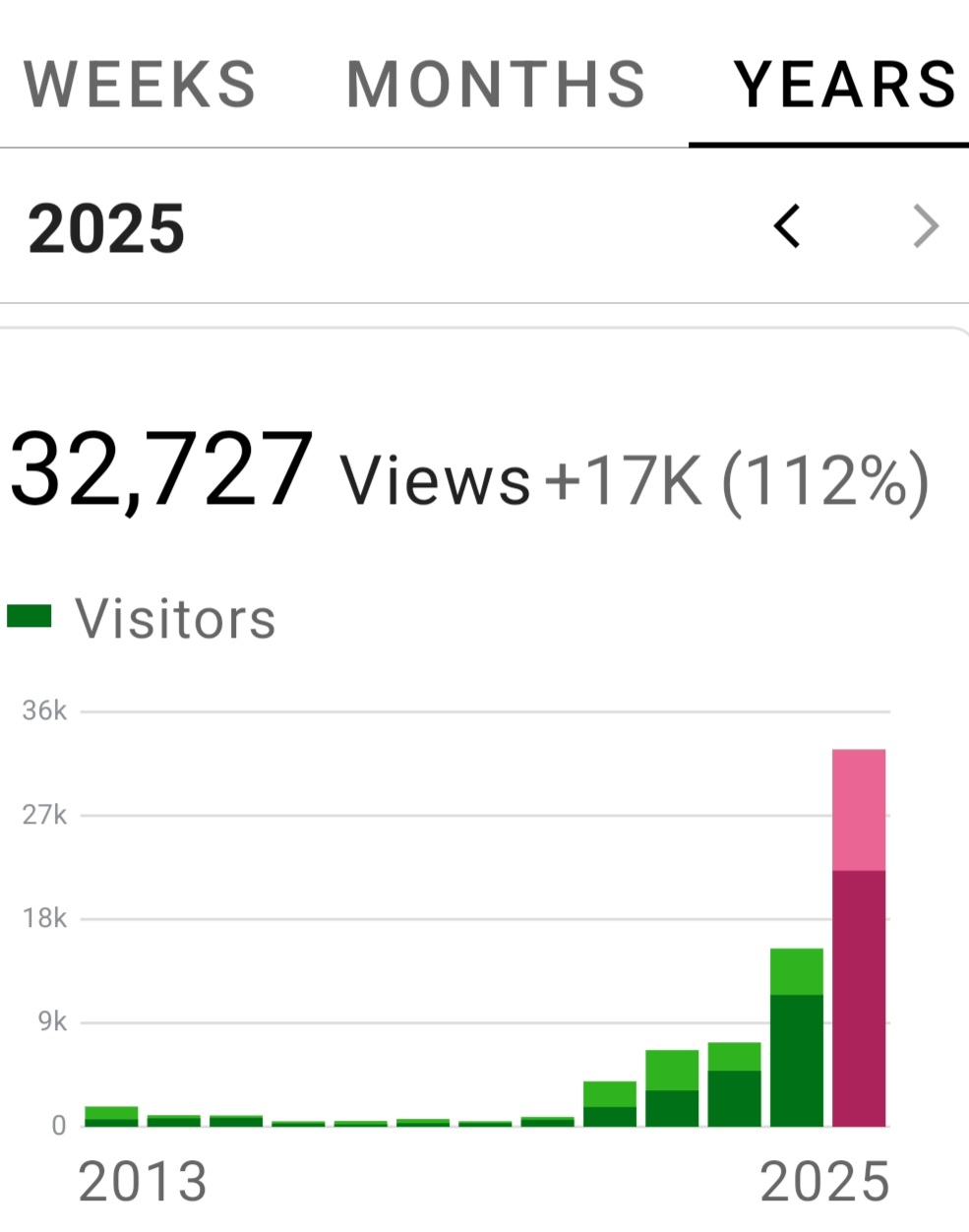
Over 15,188 views this year already!

That’s already more than all of 2024, and we still have October, November, and December to go. Apparently, my little mountain corner has gone global again—and I couldn’t be more grateful.

To every one of you, My Dear Readers, who reads, comments, shares, or quietly lingers over a sentence or two: thank you. You’ve turned this space into a community of curiosity, compassion, and laughter. Every click, every view, every thoughtful message reminds me that words still matter—and that connection runs deeper than algorithms.

Your Top 10 Favorites of 2025 (So Far)

Every year tells its own story through what readers choose. This year’s list made me smile. It’s a mix of reflection, resilience, and rediscovery—with a dash of irreverence (because, well, it’s me or Poor Brentford Lee or maybe both).

“I Am Afraid” — A wake-up call for our country—and a reminder of who we still can be.

“The Place: Charleston” — The launch of my Unmasking The Humourist: Alexander Gordon’s Lost Essays of Colonial Charleston, South Carolina.

“Redbuds of Remembrance” — Even loss can bloom in the right season.

“FramilySaid™: For When Family Isn’t Enough” — A reminder that your worth doesn’t need a witness. Show up for yourself.

“Rise Up with Words. A Declaration for Our Troubled Times” — In these politically charged times — when so many people feel hopeless, unheard, and unseen — words matter more than ever.

“My Altar Ego” — “‘I be fabulous. You be fabulous, too.”

“The Rust Whisperer” — Aging is a journey filled with yearnings. To arrive. To become.

“What Could $40 Million Do—Besides Fund a Parade? A Love Letter to Priorities (with a Side-Eye to A Spectacle)” — History is watching. Are you?

“A Week Back to the Future” — How my sister’s Remington Rand typewriter changed my life.

“Finding Love Later in Life—Baggage and All” — Proof that love comes to those who believe.

Looking Ahead

There’s still more to come before year’s end—new essays, reflections, maybe even a few surprises that have been sitting in my drafts waiting for the right moment. Perhaps even one or two guest posts by our famed and acclaimed Poor Brentford Lee.

I can’t promise I’ll always be profound, but I can promise I’ll keep showing up with authenticity, honesty, humor, and heart.

Thank you, My Dear Readers, for being here, for reading, and for reminding me—every day—that a single voice can still find an echo.

I Am Afraid

We can be fearless in proclaiming that we are afraidafraid of what is happening, afraid of what might come, afraid of becoming numb to it all.

It could be any morning up here on the mountain. Any season. The light spills over the valley like it’s been rehearsing for centuries, finding its way to the deck that I sanded and painted myself. Ruby’s already made her first round of the yard, nose to the wind, tail announcing that all is well in our little dominion—hers and mine and Gary’s.

From the outside, it might look like the middle of nowhere. But to us, it’s home. It’s our mountaintop oasis. It speaks peace. It speaks love. It knows both.

And yet—I am afraid.

I’m not afraid of dying.

I’m not afraid of the questions at my annual doctor’s visit—how’s the sleep, how’s the balance, any falls lately? I know the drill, know the tone. It’s the small talk we make with time itself.

I am afraid of more than that. Much more.

I am afraid of living.

I am afraid when I watch our nation take one step, then another, back and back and back toward what too many call the “Good Ole Days.” Days that weren’t always that good in reality—at least not for everyone. I’ve seen real progress during my seventy-seven years, hard-won and deeply felt. But now I know what it feels like to watch it slip away.

I am afraid when I see the National Guard deployed to American cities—unbidden, uninvited—storming in under the cloak of “security,” while local leaders protest and courts rule against the deployment as unconstitutional.

I am afraid when I see streams of homeless men, women, and children forcibly cleared from our Nation’s capital—not relocated, but shamed off the sidewalks, invisible again to the people who run the city.

I am afraid when masked men wearing ICE uniforms sweep through neighborhoods in unmarked vans—when people are grabbed at early hours, dragged from their routines, as children watch from windows.

I am afraid when I see our public health agencies bend—when the CDC overturns or ignores scientific consensus, issuing guidelines that feel political more than medical, eroding trust in what should be shields, not targets.

I am afraid when I see older Americans treated as burdens instead of blessings—when Social Security and food programs are cut under the banner of “efficiency,” when Medicare oversight is weakened and the sickest lose coverage, when senior housing programs vanish from federal budgets as if aging were a mistake. When growing old becomes a liability instead of an honor, a nation has lost its sense of inheritance.

I am afraid when I see poor and working families once again blamed for their poverty—when SNAP and WIC are gutted, when rent assistance dries up, when wages shrink while profits soar. Poverty is being rebranded as personal failure again, as though the system itself weren’t tilting the table.

I am afraid when I see classrooms and libraries turned into battlegrounds—when teachers are monitored, words are banned, and curiosity is treated as defiance. When education becomes indoctrination, the light that should guide us turns inward and burns.

I am afraid when I see our museums stripped of independence—when curators are told which histories to showcase and which to hide, when funding depends on keeping donors and politicians comfortable instead of keeping the record honest. When museums are told what stories to tell, history itself becomes propaganda.

I am afraid when I see the earth itself crying out—when wildfires, floods, and droughts speak the truth our leaders refuse to hear. When those in power in Washington call climate change a hoax, mock science, and dismantle what fragile protections remain—treating the planet not as inheritance but as inventory. The soil, the rivers, the air—they are not ours to own. They are the breath of every living thing that will come after us.

I am afraid when I see our history books rewritten—when the ugliness of our past is softened or omitted altogether, as if truth were a stain to be scrubbed away. I am afraid when textbooks trade context for comfort, when children are taught pride without responsibility. That’s not education. That’s amnesia dressed as virtue.

I am afraid when I see books banned from shelves—works of art, witness, and imagination stripped from students’ hands because someone decided fear should be the curriculum. A nation that fears its own words is a nation already forgetting how to think.

I am afraid when I see faith itself being rewritten—when those who hold the Bible high forget the heart of its message: love thy neighbor as thyself. When “the least of these” are ignored or condemned, when compassion is replaced with control, when the name of Christ is used not to comfort but to conquer.

I am afraid when I see the Department of Defense renamed the War Department—as if we’ve abandoned even the language of restraint, as if the goal were not defense but dominance. Words matter. Change the name, and you change the story. Change the story, and you change what we become.

I’ve lived long enough to see this nation inch closer to its promise, step by hard-won step. I watched the Civil Rights Movement force open doors that had been locked for centuries. I watched women claim the rights and respect they were long denied. I watched same-sex marriage move from silence to law, from whispers to weddings. I watched a Black man take the oath of office as President of the United States and felt, for the first time in my life, that maybe—just maybe—we were learning what equality really means.

And yet, I’m watching so much of that progress being undone in plain sight—rolled back by men who smile as they sign the papers. That’s what eats at me. We came so far. We proved we could change. And now I fear we’re proving how quickly we can forget.

I have one more fear—one that hits closer to home for me than any of the others, and yet it reaches out and encompasses them all.

I am afraid when I see LGBTQ freedoms stripped away in bill after state bill—protections withdrawn, rights revoked, marriages questioned, school policies reversed—while the rhetoric whispers “return to order,” but the victims are many.

It hits me hard, like a gut punch, because I know what it feels like to live quietly on the margins of acceptance. I had a place at the table—as long as I behaved. As long as I laughed at the right jokes. As long as I didn’t speak the truth of who I was. I was welcome, yes—but only in disguise. That was the unspoken bargain: conformity in exchange for belonging. A seat, but not a voice. Presence without personhood.

It took me years to understand that silence isn’t peace—it’s erasure wrapped in politeness. And acceptance that depends on pretending is not acceptance at all. So when I see hard-won freedoms for LGBTQ people being stripped away, I don’t see politics. I see people—people like me—being pushed back into the shadows we worked so long to escape.

I am afraid, too, of the silence that wears love’s disguise. Of families who say they accept us—so long as it’s private. Who love their gay brother or their trans child quietly, behind closed doors, but never speak that love out loud. Because public love takes courage, and private love costs nothing.

I am afraid that if the reckoning comes—and it may—some of us will look around and find that the people who said they loved us privately will deny us publicly.

And I am afraid that the ground is shifting for all of us—that what’s being erased is not just rights, but recognition of value.

I am afraid that we are being bombarded deliberately with so much chaos and confusion that we are forgetting what lies at the core of who we are—as Americans, yes, but more deeply, as human beings: the value of the individual.

The gay and the straight.
The trans and the cis.
The believer and the atheist.
The refugee and the citizen.
The imprisoned and the free.
The Black and the white.
The immigrant and the native-born.
The woman and the man.
The poor and the privileged.
The child and the elder.
The body that moves easily, and the one that cannot.
The mind that remembers, and the mind that forgets.
The one who speaks, and the one who has no voice.
The one who is seen, and the one who is invisible.

Each carries the same sacred value.
Each bears the image of us all.
Leave one behind, and the whole is diminished.
Forget one, and the soul of the people forgets itself.

I am afraid that this forgetting has already begun. It’s not just in Washington, though Washington leads the charge. It seeps into pulpits, classrooms, living rooms—into the quiet corners of our own decency. It’s in the news we scroll past, the cruelty we explain away, the silence we call “staying out of it.”

I am afraid because I see what happens when the faceless stay faceless—when the homeless become numbers, when the refugee becomes a threat, when the trans child becomes a talking point. I am afraid because I know what happens when we stop seeing each other as sacred.

And I am afraid because I’m not sure what I can do.

But I know I have to do something. We all do.

We can vote. We can write. We can reach out to those in power and to those who believe they hold it. But maybe more than any of those things, we can be fearless in proclaiming that we are afraid—afraid of what is happening, afraid of what might come, afraid of becoming numb to it all.

We can name it.
We can put a face to it.
We can be the moral engine of one—
each of us reaching further than comfort,
further than tribe or label—
to hold on to what makes us human,
to reclaim it before it slips away.

One human being girding up another.
One hand extended.
One voice saying, I see you.
That’s where resistance begins.

We can show, by the way we live, that each person matters—every single one. The forgotten, the dismissed, the weary, the silenced. Because the measure of a democracy—like the measure of a soul—is not how it treats the powerful, but how it protects the powerless.

So yes, I am afraid.
But fear, spoken aloud, can become light.
And light, once shared, can become strength.

Maybe that’s where our healing begins:
in the courage to care out loud,
to stand with the one beside us and say,
You are not forgotten.

Because the next person erased could be someone we love.
Or it could be us. You. Me.
But if we stand together—if we keep standing—
it will not be all of us.

⸻ ✦ ⸻ ⸻ ✦ ⸻ ⸻ ✦ ⸻

If this essay speaks to your heart, please like it. Please share it.
Let it travel further than fear—and bring us closer to hope.

FramilySaid™: For When “Bless Your Heart” Isn’t Enough

Benjamin Franklin had Poor Richard.
TheWiredResearcher now welcomes a guest contributor:
Poor Brentford Lee,
who has agreed to sanctify our troubled times
with a bold mix of satire and sass.

Approved by ole Ben Franklin.
Improved by Poor Brentford Lee

“Forgiveness is divine—but FramilySaid™ is faster and comes in gummable gummies.”

-— Poor Brentford Lee (b. 1947). Unlicensed. Unfiltered. Unapologetically adopted.
Known for saying the quiet part loud, he’s back by popular demand (and at least one cease-and-desist letter). Seasoned expert in nothing but experience. Sourdough connoisseur. Self-declared inventor of emotional supplements. Hangs out somewhere between a heavenly blessing and A HOMEMADE biscuit (preferably sourdough).

Years and years ago, in one of my brilliant moments—you know, the kind that arrive somewhere between misplacing your glasses and finding your purpose—I concocted a miracle elixir. An emotional balm. A psychological salve. A chewable sacrament.

And I’m convinced—when it’s finally patented, mass-produced, and widely distributed—it will relieve the world of all its wounds and arrows of outrageous fortune.

Or, at the very least, it will help you forget them for a little while. And really, isn’t that what the world needs most right now? Not advice. Not enlightenment. Not deep therapy.

All you need is Forgetfulness.

Chances are good that if you’re reading this—and have not forgotten—you’re an Oldie-Goldie who still remembers when love was all you needed, and your hips didn’t pop when you bent over.

But friend, times have changed. Now what the world needs isn’t just love—it’s a little bit of blessed, blissful forgetfulness.

So in the spirit of rock legends and gospel truths, I offer you an updated version of the Beatles’ classic. Hum along. Or gum along. Or just pretend you know the tune and clap on the offbeat:

All You Need Is Forgetfulness (Redux)
(with apologies to Lennon & McCartney—and gratitude, too)

There’s nothing they can say that can’t be un-heard
No shame so deep it can’t be deterred
No burn so old it can’t be un-spurred
You can let it go

All you need is forgetfulness
(Da-da-da-da-da)
All you need is forgetfulness
(Sing it like you mean it)
All you need is forgetfulness, forgetfulness
Forgetfulness is all you need

(Slide whistle optional. Biscuit in hand, sourdough preferred.)

Yep. That’s it. All you need is forgetfulness. Not the kind that sneaks up on you in your golden years, when you can’t remember who you bit when you meant to kiss or where you were going with your pants unzipped or where you’ve been with a bowl of popcorn when you went to get strawberries. No—I’m talking about on-demand forgetfulness. Reliable, immediate, with controlled-release options for holidays, family reunions, and any Sunday when your phone rings before you’ve had time to check your Fitbit to make sure you made it through the night.

That, My Dear Readers, is where FramilySaid™ comes in.

They mean well. They always do—those “bless your heart” people. But sometimes, what your framily says can lodge itself right in the soft tissue of your soul, like a splinter from the communion table.

That’s why I made FramilySaid™—not FDA-approved (yet), but clinically proven (by yours truly) to dull the sting of being emotionally ignored by people who should know better. In gummable form, naturally.

A Quick Word about the Name.

FramilySaid™ is exactly what it sounds like. It’s a mountain prof’s fusion of friends, family, and the things they’ve said—bless ’em.

Because sometimes, it’s the people closest to you (by blood—or, in my case, by adoption—history, or shared casserole) whose words linger just a little too long. Who don’t mean to hurt you but somehow do. Who support you privately … but not publicly. Who say “I love you” but never with the clincher: “just the way you are.”

When they speak and zing you with their petty little barbs? FramilySaid™ can help you. Un-hear it. Un-feel it. Un-bother yourself entirely.

A New Kind of Relief.

I developed this product in a dimly lit, emotionally unstable lab located precisely between my kitchen and a moment of near-epiphany. FramilySaid™ is the first over-the-counter solution specifically designed to help you temporarily forget your people. Not all of them, bless ’em. Just the ones whose “support” lost all its elasticity because you’re doing all the emotional heavy lifting.

Get this. FramilySaid™ is so hip that it comes in gummy form. Flavors include Denial-Drop Cherry and Emotional Support Butterscotch. Easy to chew. Easy to swallow. No dentures? No problem. Just gum it and go.

I just heard a panicked soul (bless their heart) blurt out:

“How can I get me some?”

Well, bless your little heart. It’s so simple. Go online–or use your phone app–and in just a few clicks you’ll be consulting with a doctor named “Jeff” who is definitely certified but not necessarily licensed. Within days or maybe even as soon as yesterday—Poof! A discreet brown package arrives at your door—just like your sex toys arrive, but with more dignity—and fewer batteries.

Anyway, from that point forward, you’ve got protection from friends and family. Take FramilySaid™ when the text message lands wrong. Take it when the smile feels fake. Take it when someone who “loves you no matter what” leaves your partner off the guest list.

Take it. Just take it. Now, that wasn’t so bad, was it.

Now go ahead. Swallow your truth with a buttery sourdough biscuit, included free, one for every FramilySaid™ gummy included in your order. Remember: Cheaper by the Baker’s Dozen.

Now breathe. Breathe again. You’ve got this.

Situations When You Might Need a Gummy.

Situation #1. You call with good news—any kind of news, really—and they respond with:

“Oh, that’s… nice.”

You smile politely. Take a FramilySaid™ gummy. Let the world blur at the edges.

And what would Poor Brentford Lee do? Why, he’d just sigh and say:

“Law me, child…”

And then he’d smile sweetly, fold his napkin with precision, and add demurely:

“Well, bless your little pea-pickin’ heart. Would you pass the sourdough biscuits?”

Situation #2. You share something meaningful—a photo, a milestone, a moment—and get nothing but a thumbs-up emoji.

You chew slowly. Cinnamon apathy floods your tongue.

And what would Poor Brentford Lee do? He’d lean back, fan himself once, and say:

“Why, don’t you worry that pretty little head of yours nary one bit.”

Then, with that same cool smile, he’d add:

“Well, bless your little heart. Would you pass the sourdough biscuits? I need me ‘nuther one”

Situation #3. You confide in someone you thought might be a safe space. Instead, they tilt their head like a golden retriever hearing static and say:

“Well, as long as you’re happy.”

You double your dosage and erase five awkward conversations from memory.

And what would Poor Brentford Lee do? Why, he’d just sigh and say:

“Law me, child… we are officially rationing warmth now.”

And then he’d smile sweetly, fold his napkin precisely, and add demurely:

“Well, bless your little heart. Them sourdough biscuits sure are good. Can I have just one more? Not the whole basket. Thank you kindly.”

Situation #4. Someone finally asks:

“How did you two old geysers meet anyway?”

But get this. Their tone sounds more like a customs agent than a curious soul.

You suddenly feel like a suspect in your own joy. FramilySaid™ softens the interrogation.

And what would Poor Brentford Lee do? He’d lift one eyebrow, cross his silverware, and murmur:

“Law me, child. Love ain’t no interview.”

Then he’d smile–all teeth, all grace–and whisper at his loudest:

“Well, bless your little heart. I think I’ll have another sourdough biscuit—maybe two if you’re feeling generous.”

Situation #5. On one of your hardest days ever in your entire ancient life, you look up at the sky—not metaphorically, but really look—and ask:

“God? Really? After all I’ve done to live with grace, to love deeply, to forgive… and this is still where I land?”

That’s when you reach for the God-level dose. FramilySaid™ won’t answer the prayer. But it will quiet the ache long enough for you to refill your hope.

And what would Poor Brentford Lee do? He’d blink once, breathe deep, and say,

“Law me, child. Even Heaven can ghost you sometimes.”

Then with a reverent nod upward:

“Well, bless your eternal heart. Hand me a biscuit. The everlastin’ kind.”

™ … ™ … ™

Final Notes from the Founder.

Every time you take FramilySaid™, you’ll forget for a spell. You’ll feel better for a spell.
Might smile, hum a tune, maybe even whistle while folding your fitted sheets.

But eventually—inevitably—you’ll sit real still. And your heart will tap you on the shoulder and say:

“This ache? It don’t need numbing. It needs naming.”

And you’ll remember:

“It wasn’t the forgetting that healed you. It was remembering the friendship and kinship you truly deserve.

So go ahead. Declare what you need. Claim your joy. Refill your prescriptions for love, laughter, and a little holy audacity.

And if someone still doesn’t get it?

“Well, bless their little hearts. Just hand ’em one of those perpetual sourdough biscuits and smile like you mean it.”

Coming Soon from the Maker of FramilySaid™.

Because sometimes one generic gummy just isn’t enough, the Maker offers you some specific options:

SisterStrength™ – For passive-aggression that’s been simmering since the day before forever.

CousinClear™ – When you can’t remember which cousin sells snake-oils and which one married his ex’s sister brother’s husband.

UncleMute™ – One dose silences three stories about the Civil Wah he and his kin are still fightin’.

MatriarchMax™ – For that layered guilt, always served hot, always with a side of pie—and a smile.

HolidayProlonged Release™ – Kicks in during grace and peaks after the second round of green bean casserole.

A Final, Final Word from the Maker—Yours and Mine—The Big One Who Always Gets the Last Word.

Forgetting isn’t what you need, child.
Remembering what you’re worth?
Dagnabbit. That’s exactly what you need.
That’s the real prescription.
(Signed, sealed, and delivered by Poor Brentford Lee, totally unlicensed but highly seasoned.)

While you’re remembering, just reach up and hand me a sourdough biscuit, swallow your pride, go ahead and make up with your low-down, no-good Framily. And then? Move it. Move it. Move it—as fast as a tumbleweed in a windstorm.

And don’t forget Poor Brentford Lee, sitting here, there, and everywhere–all smiles–saying to himself for no one else to hear:

“Law me. Won’t you lay one on me? No, no. Not a biscuit—though they are mighty fine. Just a blessing, child. That’s all I ever needed.”

Poor Brentford Says

“Your worth doesn’t need a witness.
Show up for yourself.
That’s the real feast.”

Show Me What You Wrote

“The act of writing is the act of discovering what you believe.”

— David Hare (b. 1947.) British playwright and screenwriter, whose works probe truth, belief, and the human condition.

Sometimes in the hush of evening, when the lamp spills its amber light and the world grows gentle, I watch. His head tilts slightly, caught by the glow, and suddenly, the years loosen their grip. The lines that life has written across his face soften; the jaw loosens, light as breath; the mouth, so often set in quiet thought, curves with the ease of youth. His eyes, clear and steady, seem to brighten from within, carrying a spark that belonged first to a boy and then to a young man. Slowly, the present thins. I see him slipping into his past. Fifty. Thirty. Twenty. And then, for the briefest moment, the man beside me becomes the eighteen-year-old he once was—time erasing each layer, revealing what was always there: the young man, quietly returning.

As I glance elsewhere in the room, I see an artifact from his past—one that has crossed time and threshold to find its place in ours: the grand piano. Massive and unyielding, it took four men to wrestle it off the truck and ease it through the doorway. Yet here it rests, polished wood catching the lamplight, waiting.

At this moment, I still hear the sound as his hands moved across the piano earlier in the day—measured, assured, easy. And I heard “For All We Know” rise into the room, each note carrying a hush that reached backward in time. The melody was not just music; it was memory, and it wrapped itself around him, around me, around the room itself. Ruby retreated to the bed, but not fully at rest. She leaned forward, her body stretched long, her head angled as far as she dared—as though even she knew the swell of sound carried us into places layered and deep. She held herself at the edge, cautious not to tumble into the wandering past, into the chasms of memory, beckoning us toward knowing and truth.

Elsewhere in the room, near the piano, another layer from the past peels back. Hanging on the wall is a sepia-toned etching—Salena Gazebo, number 8 of only 200, signed by the artist Carl Johnson. The lines are delicate, deliberate: the curving path, the quiet trees, the pavilion standing open like an invitation. It feels less like a structure than a memory, as if the paper itself breathed it into being. When I look at it, I sense not just the gazebo, but the moments once lived beneath it—the warmth of gatherings, the hush of twilight, the whispered vows of past lovers who lingered there. Dream and truth blur, as though the etching had captured not a place at all but a pulse of longing and a flicker of knowledge, carrying us softly toward knowing and truth.

In another room, on top of the chest of drawers, rest family photographs. Portraits, a chorus of faces gathered through years, smiling, standing, caught in stillness. They look out across the room with a quiet weight, less about who they are than the collective feel they give: belonging, continuity, the insistence that life moves forward even as it circles back. They do not need names to speak; their presence alone is enough.

Nearby, on a table, sits something smaller, more ordinary yet no less enduring: an iron toast holder. His grandmother’s. On his mother’s side? Or, maybe, his father’s? The lineage matters less than the fact that he kept it, carried it through moves and years, never discarding, never forgetting. The metal holds more than memories of bread he may never have seen toasted. It holds a thread of persistence, a reason to keep even the smallest objects close.

In the dining room, on a side table, another artifact gleams in silver relief: The Last Supper, framed, gifted to his maternal grandparents on their fiftieth wedding anniversary. Sacred and commemorative at once, it shimmers with devotion, not only to faith but also to family. The silver has traveled down through generations, carried into his keeping, held as though letting go would diminish more than memory. It is a marker of continuity, of reverence, of love that lasted long enough to be honored.

And then there is the little boy riding a dog—a keepsake that belonged first to his father when his father was a child, before his life was cut tragically short. A small porcelain figure, a child astride a loyal companion, frozen in time. Yet in that figure is more than innocence; it is a bridge across absence, a way of knowing a father he never met. It survived when the man did not, passed on to him as both wound and inheritance, loss and gift. That little boy on the dog rides still through the years, carrying ache and legacy.

Through these artifacts, I glimpse the man I already know and love, his story unfolding in fragments that matter. In the little boy riding the dog, I see both wound and inheritance, a bridge across absence. In the Last Supper, I see reverence, devotion, love honored and passed along. In the iron toast holder, I see endurance, the instinct to keep and carry even what is small. In the family photographs, I see continuity, lives pressed together across generations. In the drawing of the gazebo, I see invitation and hush—the twilight blur where dreams fade into memory and truth. And in the grand piano, I hear the melody that threads them all together—still rising, still echoing, ever playing in the quiet of his soul.

These artifacts matter to him and, now, to me. I could point to others. But I won’t. Yet one more remains, quiet and insistent, the truest of them all—not carved in silver or pressed into porcelain, but carried in ink and idea. His 1965 high-school graduation essay. He was co-valedictorian. He was eighteen.

It rests inside his high-school yearbook, the Bluejay, its cover deep blue and gilt, its pages a mosaic of faces, cheers, and world events already turning into history. And there, slipped carefully between those pages, lies his speech—typed, carried through six decades of moves and seasons. The paper holds its shape, and the words stand sure, preserved as though waiting for their moment to be read again. In its keeping, I see more than memory; I see devotion—the instinct to preserve not only what he did but who he was becoming. It is an artifact, yes, but it is also a testament, held safe in the place that marked his youth and carried forward into the man he is now.

I smiled and whispered:

“Show me what you wrote.”

He lifted the page, holding it in his hands, just as he held it onstage sixty years ago. Soft at first, his voice grew firmer as he returned to the beliefs that had steadied him even then: that learning gives life its shape, that responsibility gives it weight, that hope gives it breath, and that perseverance gives it endurance. Sixty years have passed, yet as he read, I heard not only the boy addressing his classmates but the man beside me—the same convictions intact, the same spirit enduring.

In those moments, as his voice stretched back and returned to me across the decades, I realized that of all his artifacts, this was the richest. My partner, Gary T. Knutson, wrote those words in youth. They carried him into a future he could not yet imagine. And they anchor him still—steadying him in the present, guiding him toward tomorrow. The piano may sing, the photographs may remember, the silver may gleam, the porcelain boy may still ride—but they can only point, only hint. His own words, fragile on paper yet alive in spirit, opened the door wider. They revealed not just what he kept but who he was becoming, and who he still is.

That is the power of words—not just Gary’s words, but all our words. They outlast objects, outshine heirlooms, outlive even memory. In them can be found who we are when all else has been stripped away—values, beliefs, longings, the essence of self, laid bare. And more than that, words do not simply keep; they move. They persuade and console, ignite and endure. They reveal who we were, and they shape who we might yet become. That is their gift, and their power—becoming, in a way, stronger than stone.

Show me what you wrote, and I’ll see who you are—then, now, and still becoming. For words outlast memory and outshine the heirlooms we keep. They carry the essence. They carry the longing. And they proclaim the truths we’ve always held.

The Place: Charleston, SC. The Venue: Charleston Library Society. The Moment: October 1.

This week’s post is arriving early, because in just a few days I will step into a room filled with history and voices that refuse to fade. On October 1, the Charleston Library Society—the oldest cultural institution in the South and the second-oldest circulating library in the nation—will host the launch of my Unmasking The Humourist: Alexander Gordon’s Lost Essays of Colonial Charleston, South Carolina.

Why Charleston? Because the city itself is part of the story. It was here, in November 1753, that Alexander Gordon began publishing his Humourist essays in The South-Carolina Gazette. Through wit and irony, Gordon held up a mirror to colonial society, skewering hypocrisy, praising learning, and questioning authority. His essays pulsed with the contradictions of a city that was both refined and raw, elegant and quarrelsome. Charleston was his stage, and for nearly three centuries his voice remained hidden in the fragile pages of a newspaper few had cause to revisit.

That is, until now.

The Charleston Library Society is not just the venue for this launch—it is the very repository that safeguarded the Gazette itself, preserving the faint ink on brittle pages that carried Gordon’s words into the future. Founded in 1748, just five years before The Humourist first appeared, the Library has weathered fires, wars, earthquakes, and centuries of change. Its shelves and archives testify to the endurance of ideas—and to the truth that words matter. To stand in this place and reintroduce Gordon’s voice is both an author’s honor and a literary historian’s homecoming.

This launch also falls on a milestone: 272 years since the first Humourist essay appeared in Charleston. That span of time is almost unimaginable. Empires have risen and fallen, nations have been born, wars have been fought, and yet these essays—sharp, funny, insightful—still breathe. They remind us that human folly, ambition, vanity, and hope are constants. Gordon was not writing only for 1753. He was writing for us.

For me, this book represents years of research and a kind of detective work: following a trail of clues, comparing voices, weighing evidence, and finally piecing together the case for Gordon’s authorship. It is scholarship, yes—but it is also a story of recovery. Of bringing back a writer who deserved to be remembered, who deserves a place in our understanding of American letters.

And so, on October 1, Unmasking The Humourist will take its first public bow in the very city that first gave it life.

If you are in or near Charleston, I would be delighted to see you at the Charleston Library Society. If you are far away, I hope you will celebrate with me from wherever you are.

Because this launch is not just mine—it belongs to every reader who believes in the power of words to survive, to provoke, to amuse, and to endure.

About the Book

This edition definitively establishes Alexander Gordon (c. 1692–1754)—antiquarian, Egyptologist, scholar, singer, and later Clerk of His Majesty’s Council of South Carolina—as the author of The Humourist essays, restoring his rightful place in literary history.

The Introduction confirms Gordon’s authorship and provides the necessary historical context surrounding the essays and their publication in The South-Carolina Gazette.

The Humourist Essays section presents the complete authoritative text. Each essay is introduced with a detailed headnote offering historical context, exploring key themes, and situating the essay within broader literary and cultural traditions. These headnotes also clarify references, highlight rhetorical and satirical techniques, and connect The Humourist to its periodical essay tradition. Following each essay, explanatory notes supply annotations that illuminate historical allusions, linguistic nuances, and biographical details, making the essays more accessible to modern readers while preserving their original wit and bite.

The Afterword suggests areas for future scholarship—richer literary analysis of Gordon’s techniques, his engagement with Charleston’s intellectual and political life, his later years in South Carolina, and his place in transatlantic literary traditions. This volume thus serves both as a definitive authorship study and as a definitive text, laying a foundation for future research.

Finally, the Appendix corrects a 277-year-old historical error that mistakenly attributed to Gordon a natural history of South Carolina. This archival correction not only restores the record but also underscores the importance of rigorous scholarship—whether in reclaiming a forgotten author’s voice or in ensuring that legacy is preserved with accuracy.

Unmasking The Humourist: Alexander Gordon’s Lost Essays of Colonial Charleston, South Carolina is available now:

Amazon and Barnes & Noble

All proceeds from the sale of this book will be donated to The Virginia Foundation for Community College Education

Climbing Higher and Higher: 12,000 Views (and Counting!)

“The reader is the final arbiter of a text. Without the reader, the words are silent.”

Margaret Atwood (b. 1939). Canadian poet, novelist, essayist, and critic, one of the most influential literary voices of our time.

My Dear Readers, I blinked yesterday, and suddenly my little corner of the internet tallied 12,000 views for 2025—with three months still to go!

That’s not just a number. It’s 12,000 moments of connection. 12,000 times someone out there paused long enough to read my words, nod, chuckle, roll an eye, or maybe even find a flicker of themselves in my essays.

And here’s the part that stuns me: with this pace, we’re on track to sail past last year’s phenomenal 15,000 peak—a record I once thought unrepeatable. But here we are, repeating (and then some).

The 10 You Loved the Loudest

Every essay I publish is a seed tossed into the world. Some sprout quietly. Some bloom bold and bright. Here are the ten that you watered most generously this year:

Redbuds of Remembrance

A Forgotten Voice, A Solved Mystery—And Soon, A Book

Rise Up with Words. A Declaration for Our Troubled Times

My Altar Ego

The Rust Whisperer

A Week Back to the Future

What Could $40 Million Do—Besides Fund a Parade? A Love Letter to Priorities (with a Side-Eye to A Spectacle)

Learning to Love in New Ways

Finding Love Later in Life—Baggage and All

A Culinary Heist in Broad Daylight

My Thanks

Whether you’ve been here since my first blog post nearly 13 years ago or you just stumbled across my latest musings, you’ve made this milestone possible. I don’t take your presence lightly.

So, here’s to you—my companions in this ongoing experiment of storytelling, memory-making, and meaning-finding. Let’s see how far we can climb before 2025 closes the books.

After all, the numbers matter—but the connections matter more.

Self-Serve

“Talk to yourself like you would to someone you love.”

Brené Brown (b. 1965), American research professor, author, and speaker on vulnerability, courage, and self-worth.

Go ahead! Run reference if you must. You’ll probably confirm what you already suspect. More than once, I’ve asked you to lean in real close and listen as I shout out for all the world to hear something that I think no one in the world should hear. Private should stay private, right? Not always. Here I am about to pull you in and do it all over again.

But this time it’s different. It’s one of those insights I’ve had before—the kind that first comes as a shadow of knowledge, and then, with a turn, reveals itself fully, clad in nothing more than the simplicity that truth always wears.

That’s exactly what happened to me. I was all by myself. My partner Gary—Remember? My Tennessee Gary?—had gone off to Minnesota for his 60th high school reunion and for a family reunion to boot. So it came to be that I dined alone.

I plated my entree with all the attention that might bespeak the 5-star restaurant that I know my kitchen will never be. Yet, I keep right on striving.

The golden-crusted whiting stretched across the plate like a painter’s confident stroke, its edges crisp, its center promising tender flake with the first touch of a fork. Beside it, a tangle of violet cabbage shimmered as though the skillet had coaxed from it not just flavor but light itself—earthy, sweet, and just slightly wild. A sprig of thyme leaned in, whispering green against the purple, while a single blossom, fuchsia and unapologetic, dared to remind me that even supper alone can flirt with beauty.

Then, an hour or so later, I was ready for dessert. Don’t you dare tell anyone—especially Gary—but since I was alone, I decided that a store-bought dessert would do.

It was tiramisu with all the makings of a showstopper—moist sponge, creamy layers, a hint of coffee and chocolate—but there it sat, in its plastic box, reminding me that sometimes dessert doesn’t need fanfare to be enjoyed.

“Fine. I’ll enjoy it straight from the plastic box.”

Just when I was about to grab a fork (but not a plastic one, mind you), I decided that it needed proper plating, too.

It only took a second for me to turn store-bought into five-star. The tiramisu rose in creamy, coffee-kissed layers, draped with curls of chocolate that caught the light just so. Against the deep black plate, a scarlet bloom blazed like a velvet exclamation point, transforming a humble slice into a scene-stealer. Every bite promised richness, every glance was pure seduction on porcelain.

In no time at all, I had done for myself what I do for us all the time. In no time at all, I had done for myself what I would have done for me and Gary if we had been sharing the table that night. I had lifted something ordinary into something memorable. I had taken the plastic box off the table and replaced it with care, intention, beauty. In that small act—so quick, so simple—I realized that I had given myself the very same attention I so easily give to the life we are building together. And I had done it when it mattered just as much—I was alone.

We forget, don’t we? Especially when we are alone. We fall into the trap of thinking that we have to wait for company, for celebration, for some special someone before we let ourselves live five-star. But that’s not so. We don’t have to wait, nor should we. We should use the special napkins every day, especially when we’re alone. We should have flowers on the table every day, especially when we’re alone. We should bring forth all of life’s little graces, especially when we’re alone.

We should always see ourselves as the guest of honor—especially when we are alone, even when the chair across from us is empty.

We should remind ourselves that this kind of self serve isn’t selfish and it’s not uppity. It’s simply a way that we can say “Yes” to ourselves. It’s pulling the good wine from the rack, even on a Tuesday night. It’s plating coleslaw in a little bowl instead of scooping it from the mixing dish. It’s lighting the fireplace in October simply because the first chill makes you want to. It’s cueing up Black Gospel or Acoustic Chill while kneading bread, letting the room swell with music as much as with sourdough. It’s slipping into my favorite blue linen shirt, even if no one but Ruby will see me in it. These are the gestures that matter most—especially when we are alone.

These “alone” moments count. Every single one of them counts. And if we don’t serve ourselves with dignity, who else will?

So, My Dear Readers, let me raise a glass to the hydrangeas cut and arranged, to the figs sliced and drizzled, to the silver chest opened on an ordinary weeknight. Here’s to the quiet supper for one that still deserves a sprig of thyme, and to the tiramisu that—freed from its plastic coffin—reminds me that even the humblest store-bought sweet can rise to the level of celebration.

Because self serve is never second best.
It is the altar we lay with linen and light.
It is the chalice filled, the bread broken, the sweetness offered.
It is the music of a knife against porcelain,
the fragrance of thyme rising like incense,
the candle flame trembling like a prayer.

Let the plate gleam.
Let the glass catch the last gold of evening.
Let the blossom burn bright against the dark.
Let the feast of one be as radiant as the feast of many.

Be the guest of honor. Your own.
Be the blessing at the table. Your own.
Be the flame, the flower, the feast. Your own trinity.

Even when we are alone.
Especially when we are alone.

Let’s never–for even a moment–forget:
We are enough.

A Reckoning

“Some of us think holding on makes us strong, but sometimes it is letting go.”

Hermann Hesse (1877–1962), German-Swiss novelist and Nobel Prize laureate, best known for Siddhartha, Steppenwolf, and The Glass Bead Game.

Believe it or not, a week or so ago, the past rose up and slapped me across the face. No, it didn’t leave a bruise, but it left behind something I’m still thinking about.

The slap started when I walked into my office. At first glance, it looks impressive. The lamp casts a golden pool across my glass-top computer desk, giving the whole space a glow that almost convinces me I’ve got things under control. The Oriental rug circles wide and bold underfoot, all rich blues and reds that make the room feel grounded, important, and maybe even a little too proud of itself. Books and papers rise in uneven towers, but in that first glance, they seem less like clutter and more like credentials—proof that I’ve been busy living, working, collecting. Even the cows in the painting on the wall keep a calm eye on the scene, as if to say,

“Carry on, Mtn Prof. You’ve got this.”

But as I walk through the door, the illusion collapses. What looked like a tidy study becomes a landscape of leaning towers and stubborn archives. Books crowd tables in uneven stacks, some open, some shut tight, all demanding to be dealt with. Boxes huddle together on the floor, their labels promising order—but their bulging edges betray the lie. Folders spill their contents, paper curling like leaves that refuse to fall from the tree. A shirt slouches over the back of a chair, a plaid witness to resolve slipping into resignation.

Everywhere I turn, something insists on being noticed. Woven baskets perch on top of files, as if even the containers need containers. The desk is less a surface than a staging ground for half-made decisions. Another painting on the back wall gazes out of its pasture, unblinking, as though it’s been watching me circle this mess for years. It has. It’s not chaos exactly—it’s accumulation. Layer upon layer, a sediment of living, each piece waiting for me to finally decide whether it still belongs.

It isn’t permanent chaos. The boxes say as much, their sharp edges and taped seams hinting at better days ahead—days when decisions will be made, order restored, and space reclaimed. For now, it’s not just an office; it’s a staging area where the past collides with the present, where choices will shape the future. Every pile, every stack, every half-forgotten guidebook, and every dog-eared folder is here because I pulled it out of hiding and chose to face it. In that sense, the clutter is not failure but progress. It’s the visible proof that I’m reckoning with the past, one piece at a time.

I’ll continue to reckon, and I’ll keep on making progress. I know I will. But I know, too, that I can’t rid myself of a lifetime of artifacts in one day. Take the CDs, for instance. Three rows deep. Wedged into the lowest shelf of the floor-to-ceiling bookcase at the far end of the office. They’ve been squirreled away there for years. Waiting. Ralph Stanley leans against Sting, Nina Simone keeps company with Mahalia Jackson, and Susan Boyle dreams her dream right next to the Chuck Wagon Gang. It’s less a collection than a timeline—decades of moods, memories, and seasons pressed into plastic cases. But here’s the thing. I don’t have the heart to get rid of them in one fell swoop. And besides, maybe I don’t want to get rid of them all. Maybe I don’t need to get rid of them all. But I can’t hang on just to hang on. Each one becomes a decision. Which will serenade me today? Into the future? Which has already sung its last song?

Other choices are easier. Travel guides, for instance. Like Fodor’s Greece and Frommer’s Greece on $35 a Day. Both hopelessly outdated, their covers promising adventures I never took. They carry missed possibilities but not regret. Into the discard pile they go. Or the box of Library of Congress business cards, embossed with the proud gold seal of my past career. They once carried weight, proof of my role in the world’s premier library. Now? Nothing more than relics of a past identity. They go into the discard pile, too. The work, the years, the meaning, and the memories? They stay.

Other choices are so easy they’re no brainers. My Frost shelf, for instance: concordances, centennial essays, letters, the familiar black-and-green spines that have followed me across decades. They stay. The same goes for my Mary E. Wilkins Freeman books, lined up in their muted blues and browns. They’re not just books; they’re part of my scholarly DNA. No question, no hesitation. They stay.

Then there are some things whose fate I know as soon as my touch awakens forgottenness. My college copy of Hemingway’s The Old Man and the Sea, margins crammed with the notes of an eighteen-year-old who thought he already knew something about struggle. It stays. My copy of Gibran’s The Prophet, inscribed by a fraternity brother—a book I’ve carried long past the days of Greek letters and youthful certainties. It stays.

A three-by-five oil painting of the covered bridge in Philippi, West Virginia? It’s no masterpiece, but it hardly needs to be. I crossed those boards more times than I remember during my years at Alderson-Broaddus College, each passage a kind of bridge between my coal camp past and the life I was building in the present. The brushstrokes may be clumsy, the colors a bit too bright, but none of that matters. It stays.

A small stack of cassettes holds my mother’s voice on magnetic ribbon. One, dated 11/12/81, is labeled I Take a Stroll and Cause Worry among the Worry Warts. The cassettes may be obsolete, but her voice? Never. Alongside them rests the Bible she gave me when I left for college, her handwriting in the front marking it as mine, though I’ve always known it was hers first.

And the kettle bottom resting heavy on my desk—a flat, round stone that once fell from mine roofs where my father worked fifty years. In those seams, a kettle bottom was a miner’s dread, dropping without warning, too often killing the man beneath it. This one didn’t. My father walked away again and again, spared by chance or grace. These pieces stay—not for their weight, but for his, for hers, and for mine.

Tucked nearly into oblivion is a small 4-H patch from fourth grade, meant to be sewn onto a jacket I didn’t have. But I never needed the jacket to know the four H’s—head, heart, hands, health embroidered in me long before I understood mottos or mission statements. They shaped how I worked, how I cared, and how I learned to give myself to something larger. That patch will never leave me. Some things you don’t outgrow; they simply grow with you.

The things in my office are only the visible part of the past. The rest doesn’t sit on shelves—it lives in memory, in relationships, in faith, in regret, in longing. Those pieces weigh just as much, sometimes more. They, too, must be faced, not in sweeping generalizations, but one by one, moment by moment, decision by decision.

Because that’s how the past works. Even though we can’t erase it, we can’t carry all of it forward either. We have to make hard choices, keeping only what steadies us and letting go of the rest. That’s the only way we’ll have room for life to keep unfolding. Room for the present to breathe. Room for the future to arrive. Room to move forward without being smothered by what came before.

I’m glad the past slapped me across the face. It taught me what we all eventually learn: the only way to live fully in the present, and prepare for the future, is to reckon with the past—seen and unseen, tangible and intangible—piece by piece, choice by choice. The past, the present, and the future are never separate. They are one continuum of time. One long sorting. One steady choosing. One true becoming.