“Seeing into the future? Maybe. But the real vision is daring to look closer—at now.”
—Extra E(Ad)dition for a NY Times Essay that didn’t exist on this day in 1947.
The world at large knows fully well that I’m always walking around with something rumbling around in my head. Half a paragraph. A misplaced metaphor. An idea that swears it’s a New Yorker masterpiece if I’d only give it five quiet minutes.
Today, though, it’s something else. It’s a song. If you’ve been around as long as I have—seventy-eight years today, thank you very much—you probably know it, especially if you like high notes of hope and courage.
It’s “I Can See Clearly Now,” released by Johnny Nash in 1972. It hit the Billboard Hot 100, Billboard Adult Contemporary charts, and Cash Box. I’m not surprised. From the moment those opening bars roll in, with that bright, easy rhythm that feels like sunlight tapping at your window, you’re already halfway to feeling better about the world. And then the lyrics land with their uncomplicated hopefulness:
“I can see clearly now, the rain is gone… It’s gonna be a bright, bright sun-shiny day.”
It’s a song that doesn’t pretend to be profound. It is profound because it’s simple, clean, declarative, and certain. The rhythm carries you forward. The lyrics lift you up. It’s optimism set to a beat you can sway to. It’s a three-minute promise that whatever clouds you’re carrying won’t last forever. The doubts that pile up like storm fronts won’t last. The troubles that cling like a stubborn fog won’t last. The little fears that hover just above eye level won’t last. Even the big ones that black out the sky won’t last.
Nash calls them “obstacles in our way,” but we all know what he means. Heartbreaks. Hesitations. Heavy thoughts. Anything that dims the day before it even begins. His song doesn’t erase them. It dissolves them, one bright measure at a time.
So for three minutes, the rain really does feel gone. And even if the sun isn’t shining yet, you believe with full, uncomplicated certainty that it’s on its way.
So there you have it. My. First. Clue!
And somewhere I hear a chorus of readers asking:
Clue to what, exactly?
All right, if you insist, I’ll go ahead and tell you what I was going to tell you anyway.
Like I said, it’s my birthday. You’ve probably already marked your calendars, because I do tend to make a fuss every year.
And yes, I’m talking about my birthday presents. Or rather, my presence.
Every year, I receive lovely gifts, but the silliest, most ridiculous one always comes from me. I buy myself something special—something utterly frivolous—and I wrap it in the most over-the-top paper I can find. Then I write myself a card declaring, in no uncertain terms, how truly spectacular I am.
Because guess what? I am spectacular.
Guess what else? You are, too.
This year’s gift? Well, it’s so far out there I’m not sure I dare tell you what I’ve done.
But I will give you another clue or three, like the one I just gave you.
Vision. It has to do with my eyes.
“Good God, no! I’m not having cataract surgery!”
Why, you’ve got some nerve even thinking such a thing—let alone blurting it out for the world to hear. Maybe in a few years I’ll blurt it out myself, but not this year.
Any guesses? None? Oh, come on. You can do better than this.
All right then—one more hint.
Glasses!
And to that clue I’ll add a question: Do you remember those 3-D glasses we used to wear at the movies? The cardboard ones with one red lens and one blue? The kind that made the screen come alive and sent spaceships flying toward your popcorn, dinosaurs roaring in your lap, and your best friend ducking beside you like it might all be real?
Those gloriously goofy things that made the world look both ridiculous and absolutely amazing at the same time?
Try to remember. You can, I’m sure.
I sure did when I opened the mail not too long ago and saw what I saw. I saw the future coming right at me. Really. Right at me.
I knew immediately: this was it. My birthday splurge.
Might I have a drumroll, please, before my big reveal?
And now, My Dear Readers, I am pleased to announce that I treated myself to …
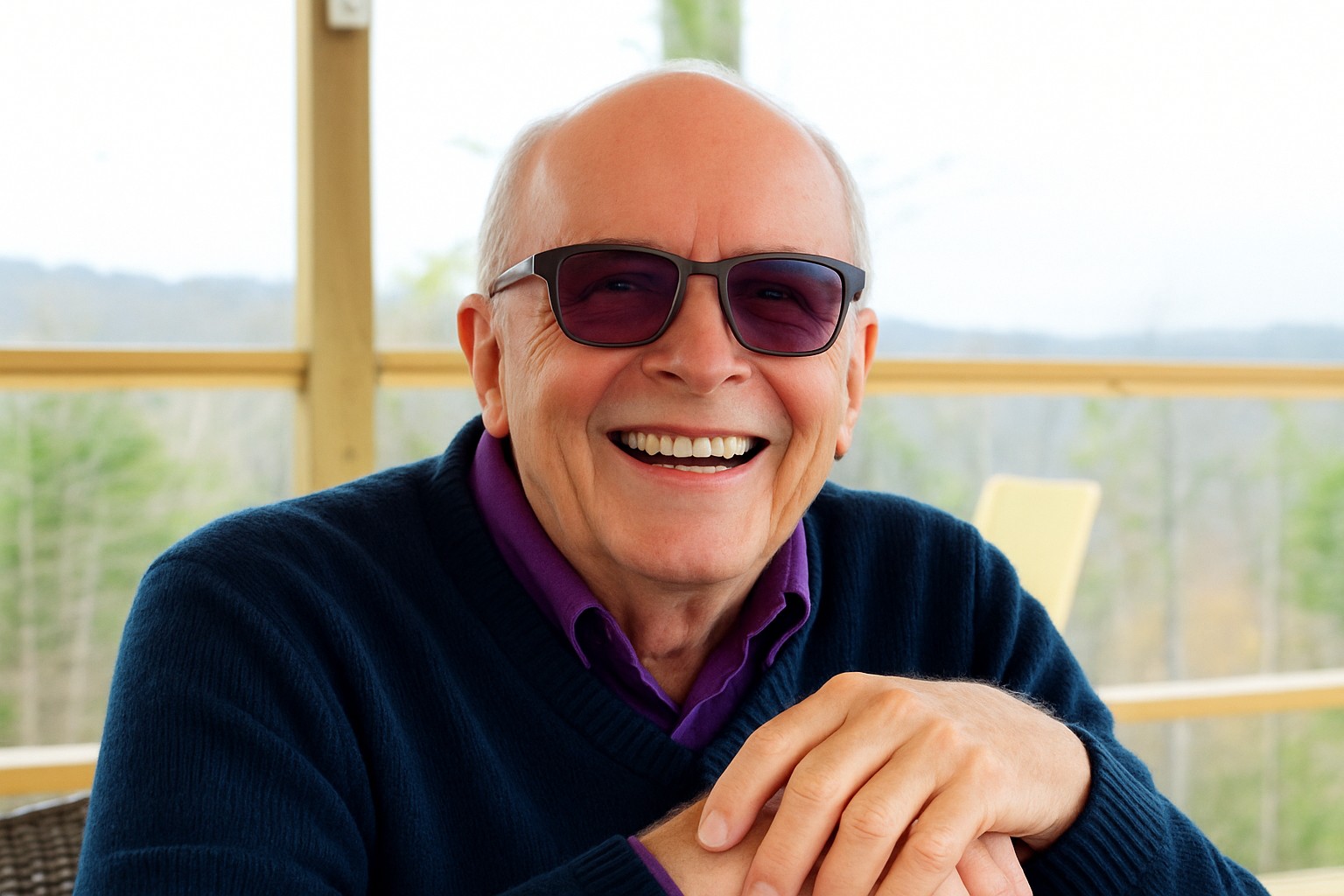
… a pair of sleek, impossibly cool Ray-Ban Meta AI glasses with dark gray frames and purple transition lenses. They’re futuristic enough to make James Bond fumble for the manual. They gleamed like they already knew my secrets. The ad promised, “Experience Meta AI like never before,” and I swear it winked at me.
And yes, I bought them.
I didn’t need them. I just got new glasses in June. But I wanted them because something in me knew this was more than eyewear. This was foresight.
So brace yourself (and maybe pour yourself a dram of Bunnahabhain): I have officially joined the ranks of the cyborg chic.
I’d love to tell you I can see clearly now, to croon along with Johnny Nash, but the truth is—literally speaking—I can’t see much better.
Figuratively? Metaphorically? You bet! I can see better and farther than ever.
I’ve been writing about artificial intelligence since the early chatbots of 2021. I’ve talked about robots, about ChatGPT, about how this strange partnership between humans and machines is unfolding faster than anyone expected—certainly faster than most people are ready for.
And I, for one, don’t want to be left behind blinking in the dust.
I want to experience it. I want to learn from it. I want to understand where it’s leading us—not from the sidelines, but right in the thick of it.
So these glasses aren’t just a frivolous birthday splurge. They’re my passport to the next chapter. They’re literally my lens on the merging of human curiosity and machine intelligence.
That merger is coming, you know, when man and machines become one. It’s called the Singularity. A year or so ago, it was projected for 2037. Now I think futurists will be lucky if it waits five. And if that’s true, then I plan to be ready. I don’t want to be afraid. I don’t want to be resistant. I want to be curious. I want to be awake. I want to be willing to see.
I’ve spent seventy-eight years watching the world evolve in ways my childhood self could never have imagined. And yet, here I am, ready to keep moving forward.
My Ray-Ban Meta glasses are just a step in that direction: a gift to my future self, a wink to the present, and a promise that I’ll keep exploring what’s possible. Because for me, this isn’t just about sight. It’s about vision.
There you have it. Now you know. This seventy-eighth birthday gift might be my best ever from-me-to-me gift. These new AI glasses don’t just sit on my face—they announce something. They say I’m still moving forward, still curious, still willing to step into whatever’s next and report back with a grin.
I didn’t just give myself a gift. I threw down a gauntlet. Johnny Nash didn’t promise perfect vision; he promised guts. These AI glasses may not sharpen every detail, but they supercharge my curiosity. Maybe that’s the real clarity: strapping on the future, stepping into the frame, and letting life rocket toward me in full, outrageous 3-D.
If the future wants to come screaming at my face, fine by me. I’ll meet it head-on, glasses gleaming, ready for the light—and absolutely ready for my close-up, grinning from ear to ear.
The knock at the door was as gentle as any I had ever heard before, yet it frightened me with its persistence. After all, it was the middle of the night, and I rarely have visitors here on my mountain, and when I do, I anticipate their arrival and meet them in the walkway.
After a while, my curiosity overcame my fear. I went to the kitchen door and opened it. There, not on all fours, but standing as upright and erect as any human I had ever seen was my dog Hazel.
Lit by the spill of the floodlights—like some mythic creature caught mid-transformation—Hazel looked less like a pet and more like a story I hadn’t yet written: fifty-nine pounds of sinewy poise, all confidence and oversized paws planted with purpose. Her coat shimmered with its reddish golden shades of ember and mischief—Husky in spirit, Shepherd in legacy, and wholly herself.
Her tail curled tight; her head slightly tilted—alert, noble, a whisper of the wild. Her ears twitched once as if tuning in to something I would never hear. And her eyes? They saw, as if piercing through the darkness that found me standing there.
She wasn’t waiting. She was watching. And in that moment, so was I—awed by her stillness, her strength, and a quiet reminder of something I had yet to remember.
And, as naturally as anything you would never expect a dog to say, she looked at me:
“I’m just a monkey. I’m a howler.”
Then I awakened. Amused. Grinning. Lying there in bed. Musing. Hazel. Fifteen years of fierce love, muddy pawprints, and conversations that needed no translation, except in dreams.
As I lay there, I realized the dream’s significance. In a way, it was the oldest kind of magic: a name spoken often comes true.
For years and years and years, Hazel’s bark reminded me of a monkey. Not just any monkey—a howler. One of those wild-voiced beings that belt their souls into the sky from treetop pulpits at dawn. Her bark had that same deep, echoing wildness—less a request than a proclamation.
Some dogs bark. Hazel declared.
And so it came to be. I would say to her over and over again:
“You’re just a monkey! You’re a howler.”
She didn’t seem offended. If anything, I think she took it as a compliment. Obviously, Hazel was not a monkey, nor could she become one. Except in my dream.
But here’s the thing:
She became what I had named her.
And that truth deserves repeating:
She became what I had named her.
That dream set me to thinking long and hard about what it means to name.
To Name.
I started wondering when the phrase was first used and in what context. And if you know me as I know you do, you know that I headed off to the Oxford English Dictionary (OED) where I discovered that it was first used in Old English:
“[Hælend] gefregn hine huætd ðe tonoma is? & cuæð to him here tonoma me is, forðon monig we sindon” (Lindisfarne Gospels Mark v. 9).
Right! That doesn’t look like English to you either, does it? Let’s look at the translation.
“[The Savior] asked him, ‘What is your name?’ And he said to him, ‘My name is Legion, for we are many.'”
It’s a well-known moment in the Gospels—Jesus (the Hælend) encountering a man possessed by demons. The phrase “My name is Legion, for we are many” comes from Mark 5:9 (and Luke 8:30), rendered above in Old English.
This is an incredible example of what happens when we name something. The name Legion does far more than identify. It reveals nature, condition, and moral alignment. When Jesus asks for a name, he isn’t just asking for a label—he’s uncloaking the essence of what possesses the man.
Did you catch that? A name reveals essence.
And I ask you–right here, right now, as I am about to do–to start thinking about names swirling around in your head. Maybe the names associated with you: the names that others call you.
As you reflect, let me share with you the significance of the names swirling around in my head.
The Names that Others Called Me.
The first that I remember was not my given name—Brentford Lee. Rather, it was LittleMisterSunshine. My mother gave me that name because—as she loved to tell others, including me–I was born smiling and radiating happiness. Now, 77 years later? Others say that I’m still smiling. Still radiating happiness.
Clearly, my mother saw the essence of who I am and named it.
Or how’s this? My siblings, for as far back as I can remember, had another way of naming me. They always called me different.
“You don’t look like us.
“You don’t talk like us.
“You don’t walk like us.
“You’re different.“
Truth be told, I was different, and I knew it. Ironically and for my own well-being, when they called me different, I leaned into it as compliment rather than condemnation.
It didn’t take me long, however, until I came to feel and understand the word they weren’t naming, the word that others, later, named. Queer. Either way–and even though I continued to see myself as special, a way of looking at myself that would stay with me for a lifetime, even now–it was a label of notquite, a soft-spokenexile and an unspokenache.
Clearly, my siblings and others saw my essence—and named it.
And I ask you—right here, right now, as I am about to do—to think about the names you’ve claimed for yourself. Not the ones others gave you. The ones you whispered into being. The ones that changed how you stood in the world.
As you reflect, let me share with you the significance of the names swirling around in my head.
The Names that I Called Myself.
The first that I remember was when I was in the third grade. Professor. Can you imagine anything more outlandish than that coming from a coal-camp kid in a town with not one professor? I have no idea where I had heard the word or came to know it. But I knew that in order to be a professor–in order to teach in a college or university—I would have to earn the highest degree conferred in my field. I picked English because I believed—no, I knew—that words mattered. Yes, words could wound. I had learned firsthand how they could cut to the soul. But I also knew something else. Words could heal. Words could save. Words could give wings.
I earned my Ph.D. in literature. I became a college professor—”full” no less. And when students called me Dr. Kendrick at the institutions where I taught–the University of South Carolina, the Library of Congress, and Laurel Ridge Community College–in deference to my degree, I always suggested Professor in deference to the earliest name I called myself–the name that captured my essence.
More recently, I call myself Reinventor. I came up with that name at the start of 2023–after my 23-year career at Laurel Ridge. Most folks retire. Not me. I’ve never liked the word—because right there in the middle of retired is tired. Trust me. I ain’t no ways tired. I have more books to write–far more than the five I’ve already published since 2023. I have more life to live than the one I’ve lived. I have more love to give than the love I’ve given. My colleagues and friends may call themselves retired—and that’s fine. But me? I’ll keep saying I’m a reinventor. It’s not just who I am now. It’s who I’m still becoming.
These days, I call myself Writer. I’ve always been one—researching, digging, unraveling stories. But since reinventing myself, being a writer has taken on a new, truer shape. I write in bed every night, publish my blog posts every Monday morning, and every year, I bring forth a new book of creative nonfiction essays, stories that bear my name and my soul.
I’ve branched out, too—seeing through to publication my Unmasking The Humourist: Alexander Gordon’s Lost Essays of Colonial Charleston, South Carolina and immersing myself a two-volume biography of Mary E. Wilkins Freeman, a labor of love and legacy.
Yes, right now, the name I call myself is Writer. It captures the essence of who I am— what I do, what I am becoming, and who I cannot stop being.
As we continue reflecting on the power of names, I ask you—right here, right now, as I am about to do—to think about names that wound others, perhaps forever or perhaps giving them a transformative moment to heal.
The Names that Wound or Heal.
The first that comes to mind is a word in Countee Cullen’s “Incident.” It’s painful—inflicted on an innocent child, standing at the edge of razzle-dazzle wonder.
Once riding in old Baltimore, Heart-filled, head-filled with glee, I saw a Baltimorean Keep looking straight at me.
Now I was eight and very small, And he was no whit bigger, And so I smiled, but he poked out His tongue and called me, “Nigger.”
I saw the whole of Baltimore From May until December: Of all the things that happened there That’s all that I remember.
What the speaker in the poem remembers being called Nigger. One word. It shattered an eight-year-old’s heart—and likely left a lifetime crack.
It’s haunting—how a single word, spoken with cruelty, can eclipse everything else.
I’ve known that kind of eclipse, too. Different.Queer.Faggot.Fag. Words I never asked for—words that crawled in and clung, no matter how often I repeated what my mother had taught me:
“Sticks and stones may break my bones, but words can never hurt me.”
Of course, they hurt, but I rose above the pain, smoothing over my soul like a balm the names that lifted me—Little Mister Sunshine, and the one I whispered in those early, tender years—Professor. But here’s the strange and saving truth: I didn’t start to heal until I explicitly named the sexual dimension of myself. Ironically, I had to declare it publicly before I could begin to claim the healing I didn’t yet realize I needed. I had to say gay—not in a whisper, not in code, but openly. Aloud. Loud. In front of the world.
Gay.
Only then could I begin to gather all the pieces I’d hidden away. The softness. The brilliance. The full shape of who I was—who I had always been. One word. My word. Spoken not with shame, but with quiet certainty. And for the first time, I didn’t flinch. I stood. Proud. With that naming, I finally gave myself permission to shine—fully and fiercely, without apology.
I have one more request–one more “ask” of you–as we grapple with what might just be the most powerful part of naming. I ask you—right here, right now, as I am about to do—what are the names we whisper when we reach for meaning? The names we murmur in awe, in need, in love? The names we give the force that calls us?
The Names We Call the Force that Calls.
Whenever I think that thought–and the older I get, the more often I think it–I recall Bill Gaither’s interview with acclaimed Gospel singer Jessy Dixon–one of my favorites. Gaither was bold and direct as the interview neared its end:
“When your time comes—as it will surely come for each of us—what do you want people to remember about you?”
After a soft pause, the answer came with quiet certainty:
“Tell them I am redeemed.”
In those five words, Jessy Dixon named–and claimed–the essence of his destiny.
Redeemed.
I can’t help but wonder: what name rises up in you when you reach for meaning? God? Creator? Oversoul? Spirit? Light? Love? Source? Mystery?
And in my wonder, I’m mindful that names like those are what we call the ungraspable—the presence that nudges us forward, the light that finds us when we didn’t even know we were lost. We reach for names when we reach for meaning. And whatever we call it—it calls us, too.
Whatever name you use, My Dear Reader— whoever you are, wherever you are:
Say it loud and clear.
Speak it like it matters— because it does.
Speak it like it carries the full weight of your becoming— because it does.
Let the world see the essence of who you are.
Name it— knowing that names have power.
Remember: you are enough— not despite all the names you carry, but because of them.
You are every name you’ve claimed and every name you have yet to whisper into being.
And when the time comes— I hope you’ll speak your name as boldly as I speak mine.
Let others know: their names can never hurt you.
But your name? It roots you deep in everything that matters— your truth, your becoming, your essence.
“Nature does not hurry, yet everything is accomplished.”
—Lao Tzu (6th century BCE. Founder of Taoism. His teachings focus on harmony with nature, patience in becoming, and the quiet power of letting life unfold in its own time.)
Every time I walked to my Jeep and looked toward the forest’s edge, I chuckled. Smack dab in front of me was a contraption the likes of which I had never seen in my life. Actually, I made it and even gave it a name. The Rust Spa.
“Say whaaaaat?” someone just rasped.
Yes. The Rust Spa. It didn’t take me long to come up with the idea. It works so well that I may apply for a patent and sell it to US Steel, the company that owns the trademark for Corten. You may know it as COR-TEN.
Either way–and rather ironically as you will discover–the COR stands for COrrosion Resistance and the TEN stands for TENsile strength. Corten is well-known for aging gracefully and creating a deep, natural tone as “the thickened oxide forms.” For me, that translates to aging gracefully as plain ole rust appears, and I actually love the deep rich natural brownish-red tone that metal takes on over time.
That’s exactly why I bought myself a Corten planter–for its trademark rusty patina. Of course, I realized when I bought it, that rusting would take time.
I knew it would take a long, long time when the planter arrived, and I opened the box. Behold! Sleek. Clean. Almost smug in its shine. Smooth bare metal, cool to the touch, untouched by time. No rust, no streaks, no signs of surrender. Just raw, industrial silver. It was so pristine it practically glinted in the morning sun, as if daring me to try to change it.
Change it, however, I would, and I knew my resolve from the start. In a bottle, I mixed equal parts of white vinegar and hydrogen peroxide with one tablespoon of salt per cup of liquid. Then I positioned the Corten planter on a stump near the forest’s edge, and every three hours or so, I sprayed it evenly like a soft mist of time.
After just a few applications, the raw steel started to shift—deep ochre streaks rippled down the surface, gathering in drips and blooms that caught the light like burnished velvet. The edges darkened, the face mottled, and the rust arrived quietly.
But I was eager for a little more fanfare. In that moment–and let history take note–I came up with the idea that will ensure my infamy: The Rust Spa. I wanted to speed up the alchemy. Easy peasy. I misted the planter with my magic spray of time. I put it inside a black yard bag to trap heat and moisture, both ideal for rust formation. Then, to keep it all in place, I inverted the delivery box and placed it on top. Voila! The Rust Spa.
The Rust Spa worked its quiet magic. When I disrobed the planter, it sat proudly on its stump throne, no longer silver and self-conscious, but cloaked in a deep, burnished rust. Its warm, mottled patina caught the light in uneven streaks, each drip and blush a quiet testament to time, to weather, to letting go. It no longer shouted; it hummed. And in that stillness, it held a beauty—neither flashy nor fresh but seasoned and settled. With a coat of boiled linseed oil, I sealed the patina in place, locking in that rich, rusty finish like a photograph of time itself.
Now, locked in time, it graces my deck in the middle of a rustic, wrought-iron table with stone top.
It’s there in all my comings and goings, and every time I cast admiring glances in its direction, I cast backward glances to my own life, to all the times when I wished to be older so that I could experience sooner all the things that I would experience later on at the appointed time.
When I was eleven and twelve, I was eager to be a teenager, so I could do the “cool stuff.” Looking back, I’m not certain what the “cool stuff” was. We didn’t have a car. We didn’t have a telephone. We had a TV, but why would I stay up late? For what? As for choices, I was known for making my own and for making them my way. Still, I wanted to fast forward my life. I wanted my own Rust Spa.
After I reached my teenage years, I was eager to be sixteen. Even though we didn’t have a family car, my sister and her husband lived next door. Judy taught me how to drive, and I thought that I had arrived when I got my driver’s license. I’m not sure why. I suppose I dreamt of driving off into the sunset with the gay date that I didn’t have in the Chevy that I didn’t own. Still, I wanted to fast forward my life. I wanted my own Rust Spa.
Then, of course, I was so eager to be eighteen, so I could get away from all the limitations of my home, my town, and my place. I did. I went to college in fast pursuit of me, myself, more authentic than the one I wasn’t really able to be in my home, my town, and my place. How ironic that I always went back on holidays and breaks. Still, I wanted to fast forward my life. I wanted my own Rust Spa.
With my degree in hand, I was eager to start climbing the rungs of my career ladder. That’s just what I did, and it ended up being a twofer. I landed a position at The Library of Congress, at home in the place with all of the books. And I found myself living on Capitol Hill, at home with me as a gay guy, realizing that I wasn’t alone. Still, I wanted to fast forward my life to a place where I could learn more. I wanted my own Rust Spa.
The place turned out to be the University of South Carolina in Columbia, where I earned my doctor’s degree in philosophy and became an expert in American Literature, British Literature, Handpress Bibliography, and, more important, where I learned that an education softens character and keeps it from being cruel. Still, I wanted to fast forward my life to a place where I had been before: home. I wanted my own Rust Spa.
I circled back home to DC and the Library of Congress. A place of emotional grounding where I felt whole, safe, and—authentic. A place where I sensed spiritual and intellectual belonging. A place where I could elevate self-acceptance from fleeting to permanent. A place where I could wrap my arms around all with all that my mother taught me as a child about diversity, equity, and inclusion and, at the same time, widen my embrace to include gender identity and sexual orientation. A place where, through the power of my pen, I soared to heights higher than I ever dreamt that words could fly. Still, I was eager to be what I had dreamt of being since the third grade: a college English professor. I wanted my own Rust Spa.
Laurel Ridge Community College opened the door, and the dream was fulfilled. Imagine! Me–a professor. A desire to stretch my students helped me stand on tiptoe looking at the bright futures of more than 7,000 students for twenty-three years. And beyond fulfilling the professional dream was realizing another one. Falling in love and exchanging wedding rings. Two men living their lives openly. Proud. Explanations? None. The happiness of our twenty-year love outlives Allen’s unexpected death. Still, I was eager to write my final chapters. I wanted my own Rust Spa.
I’m writing them now as one more part of Reinvention. Ask all who know me. I did not reTIRE because I ain’t no ways tired. In fact, I’ve been reinventing myself forever, with every twist and turn of my journey. This most recent started in 2023, and it’s turning out to be one of the most creative and productive times of my life. Five published books with others in progress. Speaking engagements several times a year, including a few that showcase not only my hopes for AI to save us from ourselves but also my hopes for online dating to spirit another Mr. Right my way so that we can co-author the closing chapters together–his, mine, ours.
And here’s where I start to chuckle again. My Corten planter had absolutely nothing to do with achieving its exquisite and inexplicable patina. I did it by speeding up the process in my Rust Spa. I kept applying my mist of time until it achieved the look that I wanted. Then, I sealed it for all eternity.
And so it is with me. Despite all the times down through the years when I wished to be older so that I could experience sooner all the things that I would experience later on at the appointed time, I could do little more than wish and dream.
In reality, I had no more control over achieving my aged patina than my planter had. It’s been a journey filled with yearnings. To arrive. To become.
In reality, every time I was eager to be “somewhere next,” I had to wait on time to take me there.
In reality, I can no more see my finish than my planter can see its.
Yet I know that it’s seasoned.
Yet I know that it’s settled.
Yet I know that it’s not finished.
Still, of this much I am certain. When the appointed time comes, soft and magical mists will seal in place patinaed perfection.
“I learned that courage was not the absence of fear, but the triumph over it. The brave man is not he who does not feel afraid, but he who conquers that fear.”
–Nelson Mandela (1918-2013; a towering figure in the fight against apartheid in South Africa and a symbol of resilience, reconciliation, and forgiveness worldwide.)
Have you ever found yourself sitting in front of your computer, fingerspoisedoverthekeyboard, eyeslockedontheblank screen? The cursor blinks, mocking your indecision. The room holds its breath, waiting for your next move.
Of course you have. We all have. I have, too.
Actually, I had that happen not long ago. I was sitting in front of my computer, enveloped in a curious trance as I looked at my PowerPoint options. Each was a digital beacon of possibilities, beckoning me into a realm where creativity and innovation might dance hand in hand.
My seasoned fingers, once adept at coaxing brilliance from the keys, hovered hesitantly over the mouse, betraying the uncertainty that clouded my thoughts. The screen gazed back at me with patient anticipation, as if urging me to breathe life into the blankness into which I stared.
But as I peered into the depths of the display, my mind became a whirlwind of memories. How many lectures had I crafted with this very tool? How many minds had I ignited with the flicker of a well-placed slide or the resonance of a perfectly timed transition?
And yet, despite my seasoned expertise, I found myself transfixed, caught in the labyrinth of my own imagination. The cursor blinked mockingly, a silent reminder of the silence that echoed through my mind.
I sat there, staring, waiting, realizing that in the digital world of ones and zeros, the true magic lies not in the tools we wield, but in the stories we choose to tell.
Indeed, I had a story to tell. Gina Byrd, Executive Director of the Friends of Handley Library System, had invited me for an “Author Talk” at Bowman Library (Stephens City, VA). My topic? “Reinventing Yourself: Writing Your Next Chapter.”
Several weeks before my talk, Gina and I met at the library so that we could go over logistics.
“Will you be using PowerPoint?”
“No, I don’t think so. I like to walk around the room while I talk.”
It was settled. No PowerPoint.
But when I got back home, the notion swept over me that perhaps I should use PowerPoint. I hesitated for a moment before deciding to reach out to Gina. After all, I had initially dismissed the idea, preferring the freedom of movement without slides. But as I mulled it over, I realized that visual aids could enhance the audience’s understanding of my topic. With a sense of uncertainty If I can keep from it, I fired off an email to Gina:
It occurs to me that I might want to use PowerPoint after all, especially if you all have a remote clicker that I could use as I walk around.
Gina’s prompt reply reassured me:
That’s fine! We have the Clear Touch Panel (it’s basically a huge iPad) and a clicker you can use. If you can bring your presentation on a thumb drive, that would be easiest.
The next day, I talked myself into tackling the PowerPoint presentation.
“Piece of cake. You’re an expert on reinvention. After all, you’ve been reinventing yourself for a lifetime. You’ve got this.”
Sure. Right. Self-talk works most of the time. However, this seemed to be one of those times when it wasn’t working. There I sat, once again, staring at my blank computer screen while PowerPoint stared back at me. Even though I had more than a week to complete the PowerPoint, my mantra was immediate:
“Go on. Just do it. Get it out of the way.”
The glow of the PowerPoint screen beckoned, but I found myself lured instead into chasing the indoor tasks awaiting my attention. The dust bunnies, like mischievous gremlins, taunted me from their hiding places, my laundry begged to be folded and sorted, and my houseplants drooped in silent protest against neglect. As I tackled each chore, a siren call steered me further away from the digital abyss.
The next day, I faced the blank screen once more. It was then that my fear looked back at me. I realized that I had not developed a PowerPoint presentation in more than two years. I realized that I was fearful simply because I was no longer familiar with a task that, in reality, was simple and straightforward.
That settled it. I sat down in front of my computer, determined to develop the presentation, slide by slide. I had no expectation that I would finish it that day, but I resolved to complete a draft. I knew that I had to get past my fear.
The next thing I knew, I found myself ensnared by the choices at my fingertips. Each transition, a delicate balance between subtlety and spectacle, whispered promises of visual delight. Each animation added movement and meaning to static slides. Each carefully selected photograph added depth and resonance to my narrative. The bullets, like soldiers marching in formation, stood ready to deliver their payload of information with precision and clarity. Every click held power, and I was in charge.
I finished my PowerPoint presentation the next day, and I was delighted with it. Actually, I was ecstatic because I had as much fun developing it as I had ever enjoyed in the past.
When I gave my talk at Bowman Library, I realized that my decision to use PowerPoint was a wise one. It helped me navigate my talk smoothly, and, more importantly, it kept everyone engaged. Afterward, several people commented on its effectiveness, with special praise for the transitions, which they felt reinforced the content.
As I drove back home, I started thinking about the PowerPoint battle that I had fought and nearly lost. It would have been so easy for me to have aborted my plan. After all, I hadn’t planned to use PowerPoint initially. But I had changed my mind. What a pity it would have been for me to have lost the battle to the dis-ease that I was experiencing simply because I had not used PowerPoint in more than two years.
Don’t get me wrong. If I were rating the level of my fear, I’d probably give it a 4 on a scale of 10, with 10 being the greatest fear. Actually, that’s not that bad at all, yet it was bad enough to lure me away from the task, not once, not twice, but multiple times.
Without a doubt, I’ve experienced far greater fears in my life. How well I recall getting back on a bicycle after several decades of not riding a bike. There I stood, at the trailhead to the Virginia Creeper Trail, nostalgia tugging at my muscles. The trail stretched downhill before me. I glanced at the path, comforted that Allen–my late partner, who also hadn’t ridden a bike in several decades–was facing the challenge with me. But as I considered the downhill descent, I could neither hide nor disguise my fear. With trembling legs, I pushed off, the wind carrying whispers of both fear and exhilaration. The trail unfolded. I pedaled. I kept on pedaling until I made it to Damascus, 34 miles later, safely past my fear.
More recently, I had a more frightening encounter with a chainsaw. I was finishing a day’s work of taking down some small trees behind my home. I decided to end the job by cutting a sapling. There I stood—a weekend warrior in faded jeans and work boots. The sapling seemed to know exactly how to make the saw bounce back, cut through denim, and rip through flesh, all the way down to but not through my patella—the hinge of leg movement, the guardian of joints. It took twelve stitches and nearly as many weeks to heal my knee.
It took me far longer to bounce back from the deep-seated fear that the chainsaw had instilled. Months passed. Every trip to my basement found me staring at the saw, wondering whether I would ever have the courage to use it again. Determined to conquer the fear, I ordered protective chainsaw chaps. When they arrived, I put them on hesitantly, started the Stihl, and cautiously but triumphantly took down a small tree. I tossed the wood and my fear into the stack for winter fires.
Experiencing fear, especially in certain situations or after a prolonged period of inactivity or after an accident, is a common and normal human response. Fear is a natural part of the human experience.
As a seasoned educator and as a man in his seventies, I’ve seen fear kick ass over and over again as people faced:
● Technology ● Change ● Failure ● Medical Procedures ● Public Speaking ● Rejection ● Regret ● Success ● Letting Go ● Driving ● Aging
The list is endless. But here’s the caution that we all need to hear regardless of who we are or where we are in life. As we navigate life, fear can often stand as a formidable barrier between us and our aspirations. Yet, as I’ve learned through my own experiences, it’s in confronting these fears head-on that we find the true essence of courage and resilience.
I urge you to take a moment to reflect on the fears that may be holding you back—whether it’s the fear of trying something new, the fear of failure, or the fear of the unknown. Embrace these fears not as obstacles but as opportunities for growth and self-discovery.
Just as I conquered my hesitation with PowerPoint, rode a bike after decades, and faced down a chainsaw, you too can overcome the fears that threaten to immobilize you. Step by step, challenge by challenge, you have the power to rewrite your story and embark on a journey of transformation.
I encourage you to take that first step today. Identify one fear that’s lingering in the shadows of your mind and make a commitment to confront it. Whether it’s signing up for that class you’ve been eyeing, reaching out to mend a broken relationship, or simply daring to dream a little bigger—embrace the discomfort, for it’s in pushing past our boundaries that we discover our true potential.
Remember: you are capable of far more than you know. Let’s rise above our fears, embrace the adventure of life, and write the next chapter of our story with courage, resilience, and unwavering determination. The blank page of possibility awaits. Let’s fill it with the triumphs of our bravery.
“Laughter connects you with people. It’s almost impossible to maintain any kind of distance or any sense of social hierarchy when you’re just howling with laughter. Laughter is a force for democracy.”
–John Cleese (well-known English actor, comedian, and writer; a member of the comedy group Monty Python; played Basil Fawlty in the classic British sitcom “Fawlty Towers.”)
THE BACKSTORY.
My life has been punctuated by several major turning points. Two of them are inextricably linked. In the fall of 1998, I took an early retirement from the Library of Congress, sold my home on Capitol Hill, bought myself a Jeep Wrangler, and relocated to my weekend cabin in the Shenandoah Valley of Virginia. I was fifty and determined to fulfill my childhood dream of becoming a college professor. I believed fully that by fall 1999, I would be teaching in the hallowed halls of academe.
The key phrase, of course, is: “I believed.” Belief was all that I had. Hope was all that I could hang on to. When I left DC, I had no teaching offers lined up. I simply believed and hoped that a door would open.
I did my part, too, to open the door. I explored teaching opportunities at Shenanadoah University, James Madison University, and Bridgewater College. While I explored, I served as a consultant to the Librarian of Congress, driving back and forth from Edinburg to DC several days a week. One July day, as I returned home via I-66, I noticed a sign for Lord Fairfax Community College.
“Why not explore community college opportunities, too?”
In an instant, I agreed with myself:
“Great idea. I’ll do just that.”
I took the exit, found the small campus–less than a mile away–and within a magical nanosecond I was chatting about my career and my resume with Dr. Sissy Crowther who, at the time, was the dean of the Humanities Division.
“Teach two Technical Writing classes as an adjunct?”
Luckily, I think fast and negotiate even faster:
“Sure. I’d love to teach Technical Writing, but I’d love it even more if I could also teach American Literature.”
“You live in Edinburg?”
“Yes.”
“How about an American Lit from 7-10pm at our offsite Luray High School facility? That’s just over the mountain from you. And maybe you’d like a Saturday morning American Lit that we’re offering also offsite at Warren County High School in Front Royal?”
“Absolutely!”
To be sure, Dr. Crowther had just filled in some gaps in her Fall 1999 class schedule. What she did not know, however, was this. When she asked me to teach those classes at Lord Fairfax Community College, she opened the door that my third-grade dream walked through. Now was the time of fulfillment. I had arrived. I was home.
In the next nanosecond I was in my cabin, on my mountaintop in the Shenandoah Valley of Virginia, United States of America, Planet Happiness and Dreams Come True. To this day, I do not believe–nor shall I ever believe–that my Jeep Wrangler took me there.
I did not know then that in the class schedule, under the instructor column, I would be listed as STAFF.
I did not know then that adjunct pay was low, pitifully low.
I did not know then that the American Lit classes I had agreed to teach so readily were the ones that full-time faculty had no desire to teach–at night, on Saturday, and in high-school buildings that didn’t feel like college.
Even if I had known, it would not have mattered.
All that mattered was that my childhood dream had come true.
All that mattered was that I felt at home.
All that mattered was that I was part of an academic family.
Now fast forward with me, past more than 7,000 students and more than 250 classes that anchored me morning and night during a 23-year teaching career that happened magically at a community college, right in my own back yard.
Now fast forward to January 1, 2023, when another turning point punctuated my life.
I decided to bring my teaching career to a close and to reinvent myself. Notice that I did NOT say that I retired. Retire and reinvent are two entirely different words and two entirely different worlds. Trust me: I mince no words about the difference. Trust me again: I respect both worlds. It’s simply that I am not ready to do that R-t-r- thing. All those who know me know that I keep it simple and call it the “R” thing.
Since then, I have been dynamically engaged in teaching a stellar class of one admiring student: me. Subjects? Research. Writing. Publishing. With two books to my credit in 2023 and with two more on the horizon for 2024, what can I say other than my Reinvention is all that I hoped it would be.
As you might imagine, I love talking with others about my journey, and I can be as serious or as silly as they would have me be.
Obviously, when Andy Gyurisin, Development Officer, Office of the Foundation, Laurel Ridge Community College (formerly Lord Fairfax Community College) invited me to speak at the November 1, 2023, Retirees Brunch and Learn, I accepted immediately, especially after he told me that he wanted a light-hearted, humorous presentation.
I jokingly warned Andy from the start that I would be poking fun at me, at him, at the college, at my adjunct teaching days and more.
“Go for it. It will be fun.”
The beauty, of course, about poking fun at colleagues whom you love is knowing that the tight family bonds will make the humor all the brighter.
MY MOMENT AS AN UNPAID COMEDIAN.
Andy, thank you so much!
My goodness! What can I say! Isn’t it amazing how home always feel like home?
How many of you feel as if you’re home? That’s great!
As for me, all I can say is this. Based on how I look these days—especially when I get up in the morning and look in the mirror and all the hair that I don’t have is standing up all over my head, I say to myself:
“Good God. HOME. You belong in … a home.“
Actually, I started feeling at home as soon as Andy invited me to talk. I agreed immediately, without even asking about the speaker’s fee, that I was sure I wouldn’t be getting anyway.
But you know what they say:
“You get what you pay for.”
So, folks, you ain’t gettin’ much from me, not even good grammar. You can thank Andy!
§ § §
Damn! That felt good. Saying damn felt good, too.
What else might have felt good if I had had the nerve to say it on the first day of class—you know—back in the day when I was teaching, especially in my adjunct days?
How many of you started as an adjunct?
Remember the pay back then? Maybe you’ve been able to put it out of your mind. I haven’t. It was nightmarish.
So, let’s see. If I had had the nerve back then, maybe something like this would have flown out of my mouth when I walked into class that first day:
“Good morning, young scholars! You know the old saying, ‘You get what you pay for?'”
They’d just sit there and stare and not reply, not even nod. Then I’d shock them with:
“Well, I’m an adjunct. I’m not being paid much, so you’re not going to get much!”
(President Blosser, you might want to put your fingers in your ears. It gets worse. Like I said: I ain’t bein’ paid much!)
Or how about wanting to say this to your students. You know the situation. You walk into class, all hyped up to talk about Dynamical Systems & Differential Equations or The Single Theory of Gravity or The Rise and Fall of the Roman Empire or, God forbid, something literary like the really good stuff that students love, like Whitman’s Leaves of Grass. And there you stand.
“Good morning, young scholars. Does anyone have any questions?”
“Professor, I have a question, but it’s probably a dumb one.”
You know what comes next. The fixed smile. The formulaic response.
“Thanks, Casey. There’s no such thing as a dumb question except the one that doesn’t get asked.”
Deep down inside, you’re dying to scream:
“Guess what? There are dumb questions. Why don’t you just keep your dumb question to yourself.”
Can you relate?
§ § §
But it’s not always about the money. We all know that! After all, we taught at a community college.
Sometimes it’s enough just to see your name in the lights or on an invitation.
I confess. I was hoping to see my name on the invitation to today’s brunch and learn—whatever the hell that is; you won’t be learning a thing from me—but I hoped to see my name on it anyway, just so I could add the event to the resume that I no longer need.
Sure, enough. I got my invitation. I opened it up with great anticipation. Yep. I was right. No speaker’s fee and no mention of my name.
Yep. Made me feel right at home.
§ § §
Actually, it took me back to 1999 when I started teaching here as an adjunct. I was so excited. It was the fulfillment of a childhood dream.
I could hardly wait for the class schedule to come out.
It did. I was thrilled.
I found all of my classes listed. You know, the ones at times of day that full-time faculty never want and never fight to get: 7-10 at night. And in places where full-time faculty are never thrilled to go in the dark. Luray High School. Warren County High School.
But it’s all good. I had landed myself a job teaching, and I was so eager to send that schedule to my folks back home in West Virginia so they could see that I had arrived.
And sure enough—just like the invitation—my name did NOT appear on the schedule. What do you think appeared in the Instructor Column for my classes? What do you think appeared?
Yep. You got it. STAFF.
Anyone else remember those days?
§ § §
But you know what I did when I saw STAFF on that schedule? You know what I did?
I did it just for the sake of consistency, nothing more. I certainly not do it to get even or anything like that.
If I’m STAFF on the schedule, well, hell! I’ll be Professor Staff on my syllabi, too.
It took my dean three years to notice what I was doing. What else is new?
(Morgan, don’t look so alarmed. You weren’t my dean then. Anyway, it took you five or six years to figure out my shenanigans.)
§ § §
OK. This is really funny! But it’s true. The other day when I was at Sheetz pumping gas—a whole dollar’s worth; got it? A dollar’s worth—that’s all that I can afford these days. Anyway, there I stood, head down, facing the pump, so no one would see me.
Lo and behold from three islands away, someone yelled:
“Hey, Professor Staff!“
§ § §
But here’s what I want to know? Have any of you—since you did that R thing—had to pump gas only to discover that you were down to your last dollar?
Come on: let me see hands. You’re pumping gas and only have a dollar to your name?
Just what I figured. I guess that I should have retired, too. But I decided to be different.
OK. What else is new? I’m always different.
So to be different this time, I decided to reinvent myself.
Obviously, you’re getting a better paycheck than I’m getting.
§ § §
But that’s okay. Reinvention has had some good sides to it.
For starters, I took $400 cash, instead of the rocking chair. I wonder. How many of you opted for the rocking chair?
That’s great! You all rock!
(President Blosser, I hope you noticed. Did you see all those hands that didn’t go up? It might be time to reconsider the rocking chair.)
As for me, I didn’t need to consider or reconsider.
I took my money and bought myself a gorgeous coral bracelet. Yep. That’s what I did. See. Take a gander. I think it rocks, too.
When I finish, you all can come up close to get a better look while you drool.
For those of you who took the rocking chair, I’ve got a sweet deal for you. Let me see your hands again.
Great. I’ll visit you at your home so that you can see my bracelet while you rock … and drool.
§ § §
I don’t know about what you’ve experienced since you retired, but since I started reinventing myself—got it? Reinventing. There’s a difference!–I’ve heard some really silly if not downright dumb retirement jokes.
I sure hope that you haven’t heard them. You’re going to hear them again.
Question: When is a retiree’s bedtime? Answer: Three hours after he falls asleep on the couch.
Question: How many retirees does it take to change a light bulb? Answer: Only one, but it might take all day.
Question: Why does a retiree often say he doesn’t miss work but misses the people he used to work with? Answer: He’s too polite to tell the whole truth.
§ § §
I also get asked some really dumb questions, far dumber than the ones my students never asked. I mean, really dumb.
Just the other day, my phone rang. It was a friend. Like you, they retired. They know, though, that I did NOT do that R thing. They know fully well fully well that I’m reinventing myself.
Dingaling. Dingaling. Dingaling.
Joy of all bored joys. Someone’s calling!
“Hey. How’s it going.”
“Good. Real good. I don’t imagine that I interrupted anything important did I?”
“Nope. I’m just lying on the couch, counting the ceiling tiles that I don’t have, just to pass the time.”
Idiot! They know fully well that I have a schedule just as rigid as the one that I didn’t have when I was teaching. These days I’m just doing a little research here and there and a little writing here and there. But you know, when you do those little things, your entire life is so loosey-goosey.
§ § §
Yep. Loosey-goosey. That’s how I managed to get two books published this year.
I need to see some hands. How many of you would have the nerve to write about foolin’ around in bed with whoever it is that you’re foolin’ around with?
Just what I thought. You did that R thing. You’re probably not foolin’ around with anybody. You should have reinvented yourself, like I did. Then you could have invited anybody and everybody to hop in bed with you, the way more than 7,000 people have hopped in bed with me since I got smart and reinvented myself.
I mean just look here. It’s a gorgeous book. Hard is really gorgeous. Feels good. Soft is gorgeous, too. It feels good, too, but hard feels lots better. If you want to feel it, buy your own dang copy!
§ § §
Then while I’m counting ceiling tiles that I don’t have—you know, just to pass away my idle days—I cranked out another book: Green Mountain Stories.
It’s a gorgeous book, too. It’s available in hard copy only. It feels so good. But again, if you want to feel it, buy it!
And I am not going to tell you what it’s about. If you want to know, buy it. And shame on you if you don’t. You need to get some learning and find out all about Mary E. Wilkins Freeman, especially you women who have probably never heard of her. Shame on you. Shame I say. Shame. Buy your own copy and get some smarts.
And while you’re buying those books, remember the gifting season is fast upon us. These books will be the perfect gift—an absolutely pluperfect gift—that you can give yourself, your family, your friends—and, perhaps, even your enemies, especially the ones who think folks like me have no busy sharing with the world the shenanigans that I’ve been carrying on in bed.
§ § §
Come on now. You can be as green about my two books as you want to be—and some of you are showing color already—but don’t be jealous. Please don’t. Let me tell you why.
When I taught Creative Writing, I always told my students—even the really superior ones that I never had:
“Don’t give up your day job. Got it? Don’t give up your day job.”
And what do you think I did? What do you think I did? Come on: give it up. What do you think I did?
I went and gave up my day job. Well, it wasn’t much of one anyway, and the pay was pitifully low. But the royalty payments I’m getting from these two books are lower. Actually, the payments are pathetic. Plumb pathetic. They weren’t too bad the first month or two. $370. $276. $180. $85. Then those payments went from little to less to almost nothing. I got a check yesterday—yes, a check, a paper check; I didn’t know they even existed anymore—a whopping $1.85.
Yep. I should have listened to the advice that I gave: Don’t give up your day job!
§ § §
All right. I’m about to wrap things up. I realize that I’ll be ending far short of the three hours that Andy said I couldn’t have, but remember: you get what you pay for and …
I wish that I had time to talk about some of the really fun essays in my book In Bed. Truthfully, they’re all funny. They are! Want proof? Fine. I’ll give you some.
One reviewer said: “The essays are most philosophical, but what I’m drawn to most often is the humor.”
Here’s another: “Engaging, poignant, humorous, heart-felt. A must read.” Did you get that? “A must read.” (Thank you, Dr. Cheryl.)
Here’s another: “Universal appeal and connectivity. Souls gathered around a complex and intriguing thought or proposition. Whimsical observations turned into moments of community meaning.” (Thank you, Morgan.)
How’s this for a final review comment. There are lots more, of course, but I’m running out of time: But how’s this: “Reminds me of Dave Berry and his dry sarcasm and satire.” OMG. I think I died and went to Heaven.
§ § §
Sadly, I won’t get to amuse you with any of the things that I hadn’t planned to amuse you with. Like …
1. How I’m keeping my house clean…by having imaginary guests.
2. How I’m staying fit as a fiddle…the inefficient way
3. How I’m enjoying living with a writer … me.
I wish that I could talk about those and more, but I can’t. Andy was as cheap with my time as he was with my speaker’s fee.
Anyway, you’ll find all those topics and more In Bed. So, go buy your own dang copy! And when you do, I hope that you’ll read all 55 essays in bed, which is exactly where I wrote them, night after night.
§ § §
Andy, thank you so much for inviting me to speak.
Colleagues, thank you all so much for coming out.
It really is great to be home despite all of my banter. Laurel Ridge will always hold a special place in my heart. It opened its doors to me way back in 1999 in ye olden Lord Fairfax Community College days. When those doors opened, my childhood dream of becoming a college professor came true.
Whatever you’re doing since you did that R thing, I hope that you are having as much fun as I’m having with my own reinvention!
A word is dead When it is said, Some say. I say it just Begins to live That day.
–Emily Dickinson (1830-1886; one of the most important poets in American literature.)
Who doesn’t love a good story? We all do. And why wouldn’t we? We’ve spent our entire lives–including our fetal days–listening to others’ stories. Equally important, we’ve spent most of our entire lives telling stories. Humans are born storytellers.
We spend a large part of every day sharing with others the stories of our lives and taking the time to let others share with us the stories of their lives. I’m not talking about stories with profound, monumental meaning. I’m talking about the simple joy of sharing the narrative of what’s going on in our lives. I’m talking about the simple joy of hearing the narrative about what’s going on in other people’s lives.
With friends and colleagues, we’re sure to get a story going as soon as we start talking about trips, cooking, movies, music, what’s happening at work, pets, health, or social media.
With family, we’re sure to get a story going as soon as we start talking about childhood memories, family traditions, milestones, lessons learned from parents, family challenges, or heirlooms.
Obviously, story topics often overlap with family and friends, and, obviously, the topics are far more extensive than the few examples that I just gave.
Our stories–our personal narratives–are invaluable. They help us:
● connect, laugh, cry, and bond.
● gain a deeper understanding of others’ experiences and lives.
● discover who the other people in our lives are.
● discover who we are.
● define and shape our lives.
Luckily, most of us know how to tell our stories.
● Start with just enough information to establish a timeframe and to identify where things are taking place.
● Tell what happened to put things into motion.
● Explain subsequent events, making each one more intense than the one before, and hopefully moving them along at a clipped pace.
● Make the climax the most intense moment in the story.
● Wrap things up and share some insights into the “meaning” of the story that we just told.
We know a lot when it comes to telling our stories.
At the same time, we fall short in one way that has far-reaching ramifications. More often than not, we don’t spend enough time thinking about what to put in and what to leave out.
Think about it for a minute:What should we put in our stories, our personal narratives?
Think about it for a minute: What should we leave out of our stories, our personal narratives?
What we leave out matters, but ironically, it’s what we put in that matters far more.
What we put in creates the image of who we are. It creates the dominant impression that our listeners–friends, family, colleagues, and casual acquaintances–have about us.
The stories that we tell reflect who we are, shape who we are, and determine who we are yet to become.
What got me to thinking about the significance of our personal narratives was a casual statement that someone made to me a few weeks ago when we were talking about one of my culinary triumphs:
“Everything that you make in the kitchen is extraordinary,” she said.
“Hardly,” I replied. I have lots of failures.”
“Really?”
“Of course, I do. I just don’t talk about them. Remember: it’s my story, and I’ll tell it my way.“
It’s my story, and I’ll tell it my way. I always have. I always will.
My way of telling my story–going as far back as I can remember–is to make it glisten with smiling happiness, hard work, steadfast belief, stubborn success, and undying optimism.
That’s not to say that I haven’t known the opposites of those glistenings. Of course, I have. Often, I have known them in overflowing measure, unknown to others.
At the same time, I have never allowed negatives to be the measure of who I am. When I share my story–my personal narrative–I give the downsides of my life exactly what I think they deserve: either no mention at all or brief mention at best.
For years, I’ve shared in my story that as early as the third grade, I knew that I wanted to be an English professor.
I have no idea where I got that notion. We certainly didn’t have any professors in my coal camp, although we had exceptional educators who, in my mind, walked on water. Who knows. Maybe one of them challenged me to go further than they had gone? Maybe it was my mother, who also walked on water. Maybe she challenged me to go further than she had seen others go.
I don’t remember. But I do recall that from the third grade forward, becoming an English professor became the thrust of my story–my personal narrative–that I told myself and that I shared with others.
The story came true. I became an English professor.
These days, my story is taking a new twist. I’m reinventing myself. When I tell people what I’m doing, I often get raised eyebrows.
“You mean you’ve retired?”
“No. I mean that I’m reinventing myself.”
For me, as someone who treasures words and stories, there’s a world of difference between retiring and reinventing.
It’s my story, and I’ll tell it my way. If the word professor carried my personal narrative forward from the third grade up until now–and it did, with success beyond measure, I might add–then I believe with all my heart that the word reinventing will carry my personal narrative forward for the rest of my life.
And you? What about you?
It’s your story to tell. How will you tell it? What will you put in? What will you leave out? As you make your choices, remember: the way that you tell your story will shape your life now and forever.

 The Wired Researcher