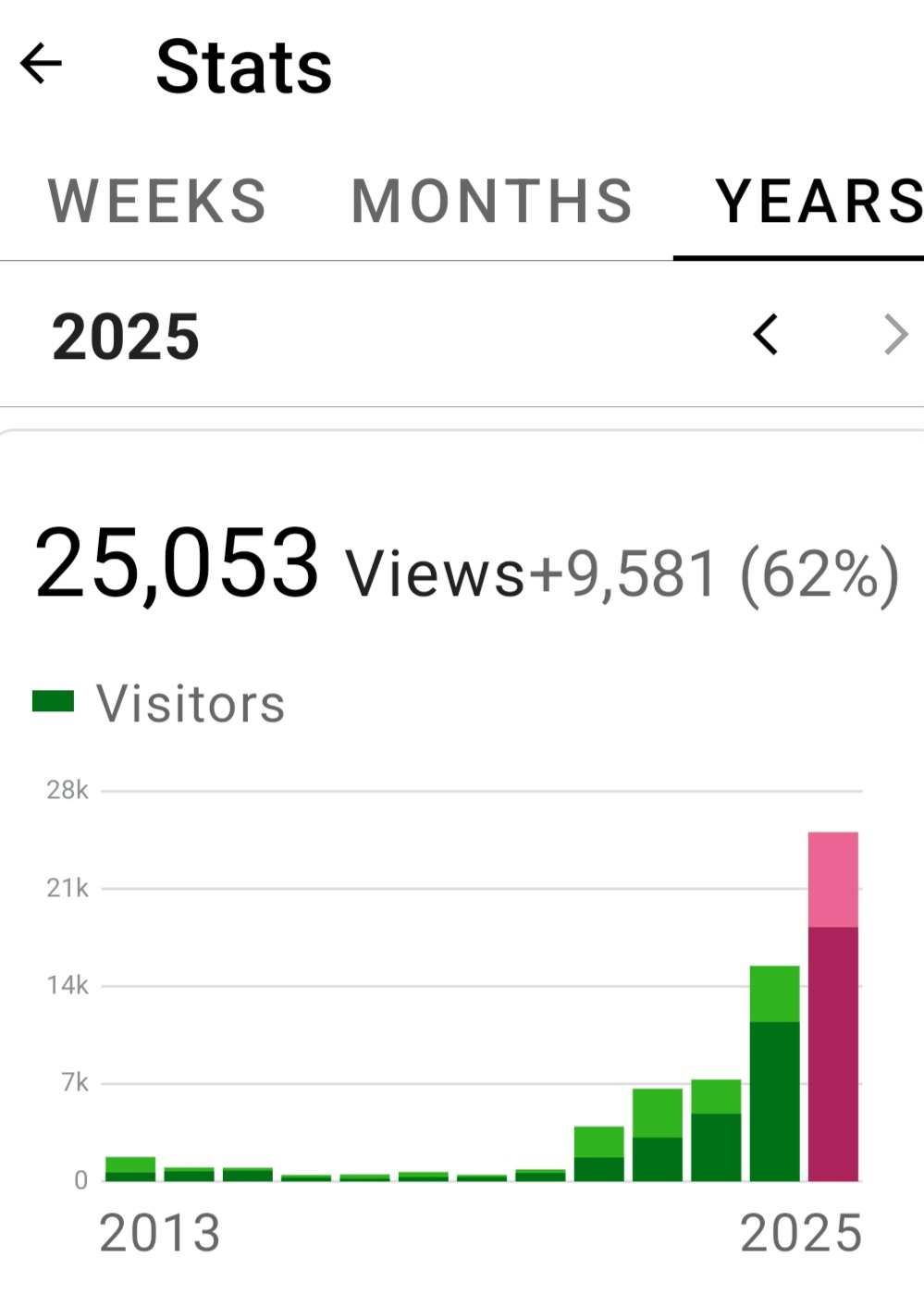
You took me by surprise again this morning. As always, when I awakened, I checked my Fitbit to see how my heart did overnight. Then I checked WordPress to see how my readers were doing.
And there you were. Another thousand views. A quiet jolt to the chart. Numbers climbing when I wasn’t looking.
You’ve been dancing higher and higher since October, when I passed 15,000 and figured I’d reached my high-water mark. I even wrote a piece of thanks back then, thinking I’d said all there was to say. But now here we are—December 11th—and this little corner of the internet has gathered 25,053 views.
I’ve done nothing different. I have no flashy headlines. I have no trending hashtags. I just keep following the same rhythm: writing essays born from memory in a home filled with love. I just keep foolin’ around with words and ideas.
So why now, after all these years?
That question hangs gently in the room with me. It’s not demanding an answer. It’s simply inviting a reflection. Maybe something shifted in the writing. Maybe it’s more expansive. Maybe it’s more lived-in. Maybe it’s a voice carrying a steadier warmth now. Maybe it’s grief that’s softened into grace. Maybe it’s love that arrived not with fanfare, but with a quiet hand stretched out in invitation. Maybe it’s all of those things. Maybe. And add to all those maybes one more. Maybe it’s readers sharing with readers.
Gary, of course, doesn’t ask to be written about. But his presence is here, between the lines, in the patience of a paragraph, the steadiness of tone, the way I’ve learned to let silence do some of the talking.
Ruby, on the other hand, insists on being written about, whether she’s nosing me away from my smartphone or curling up in solidarity as I revise for the twenty-fifth time. She is, as always, the keeper of the tempo, the mistress of the move.
So this isn’t an open letter to public stats. It’s a letter to something deeper. It’s a letter to what it means to keep writing when no one’s watching, and then to wake up and find that someone was.
My essays aren’t meant to dazzle. And I know: they don’t. They’re just small acts of holding up the light, one weekly reflection at a time. The fact that they’re being read, now more than ever, tells me something I didn’t expect: quiet honesty still finds its way.
Thank you, Sudden Surge, for reminding me that patience has its own reward, that consistency is a kind of faith, and that somewhere out there, readers are still pausing to linger with a slow essay from the mountain.
I don’t know what this upturn means, or where it leads. But I do know I’ll keep showing up with my smartphone in hand and love at my side.
won’t you celebrate with me what i have shaped into a kind of life? i had no model. born in babylon both nonwhite and woman what did i see to be except myself? i made it up here on this bridge between starshine and clay, my one hand holding tight my other hand; come celebrate with me that everyday something has tried to kill me and has failed.
—Lucille Clifton (1936–2010), award-winning American poet and former Poet Laureate of Maryland, celebrated for her spare, powerful verse that gave voice to Black womanhood, resilience, and self-invention.
It hangs there—dripping in crystal like it’s late for a curtain call at the Kennedy Center. A blazing burst of light and glamour. A chandelier so decadently faceted it might’ve been smuggled out of a Versailles estate sale or rescued from a Broadway set mid-strike. And yet, here it is: mounted proudly on a ceiling so low you could toast it with your coffee mug.
Where?
Why, right here on my mountaintop, in my rustic foyer wrapped in pine-paneled nostalgia, with a Shenandoah Valley pie safe, stoically anchoring one side and a polished silver chest on the other. An antique Asian vase—graceful and aloof—presides atop the chest like it’s seen empires rise and fall. Beneath it all, an Oriental runner unspools like a red carpet nobody asked for, but everybody deserves.
And then—just beyond the shimmer—a French door opens into another room, as if the whole scene is a prelude to a slow reveal.
It shouldn’t work. I know that fully well. A chandelier like this belongs somewhere fancy and regal. But guess what? Somehow, its sparkle doesn’t clash with the country charm, at least in my mind. In fact, it crowns it. And you can rest assured. It isn’t a mistake. It’s my way of declaring that my home isn’t just a home. It’s a story–actually, it’s lots of stories–told in light and shadow. And at the center of it all? My refusal to decorate according to rules. I couldn’t even if I wanted to because I have no idea what the rules are.
But a week or so ago, my Tennessee Gary stood smackdab beneath the chandelier—looking right at me, poised (I was certain) on the cusp of praise or profundity. But the next thing I knew, he spoke six words, which made me a tad uncertain about my certainty.
“I’m not sure it belongs there.”
“What?”
“The chandelier.”
“Well, I think it’s perfect. I wasn’t about to leave it in my Capitol Hill home when I moved here. It cost me a small fortune, and besides—I like it.”
That ended it. For then.
But a few days later, Gary brought it up again.
“Actually,” he said, studying the ceiling with a fresh softness, “the chandelier grows on you. It looks quite good there.”
If that’s not a kiss-and-make-amends moment, then lay one on me.
I grinned and agreed.
And let me tell you—that right there? That’s the moment that stuck. Not the first comment, but the second. The way Gary circled back. The way he didn’t double down, but opened up. That takes grace. That takes someone who sees with more than just their eyes.
He didn’t just help me see the chandelier differently. He helped me see the whole house—and maybe even myself—with a little more curiosity. A little more clarity. And that’s when I started walking through the rooms again—not to judge or justify, but to really look. Through his eyes. Through my eyes. Through the eyes of everyone who’s ever stepped inside and wondered how on earth all of this could possibly make sense.
And yet—to me—all of this makes perfectly good sense. Placed with memory, not trend. Positioned not for symmetry but sentiment. A lifetime’s worth of objects tucked wherever I could fit them, arranged with a kind of chaotic confidence that, somehow, glows.
But, still, I heard echoes rumbling around in my memory’s storehouse:
“It’s so homey.”
“I feel so comfortable here.”
“Wow! It’s like walking through a museum.”
In the midst of those echoes, I figured out how to find comfort: find someone else who decorates the way I do! It didn’t take me long at all before I remembered someone who had lived—and decorated—with the same truth: Mary E. Wilkins Freeman.
As soon as I had that recall moment, I scooched up beside her so close that I could peek over her shoulder as she penned a letter to Kate Upson Clark. And Lord have Mercy Jesus! You can’t imagine my joy when I realized that folks said the same sort of things about her home decor as they say about my mine:
“I light this room with candles in old brass candlesticks. I have dull blue-and-gilt paper on the walls, and a striped Madagascar rug over a door, and a fur rug before the hearth. It is one of the queerest looking places you ever saw, I expect. You ought to see the Randolph folks when they come in. They look doubtful in the front room, but they say it is ‘pretty.’ When they get out into the back room, they say it ‘looks just like me’. I don’t know when I shall ever find out if that is a compliment.” (Letter 46, August 12, 1889. The Infant Sphinx: Collected Letters of Mary E. Wilkins Freeman. Edited with Biographical/Critical Introductions and Annotations by Brent L. Kendrick. Scarecrow, 1985)
I was thrilled to know that I was “keeping house,” if you will, in style with Freeman herself, especially since she and Mark Twain were America’s most beloved late-nineteenth-century writers. It didn’t really matter that I’m as much in the dark as she was when it comes to figuring out whether folks’ comments about my home-decorating talents are compliments or not.
And believe me. My home is filled with things far-more out of place than anything in Freeman’s or even the chandelier in my foyer.
If you need more proof, just walk around the corner and take a gander at my kitchen.
Who, in their wildest imagination, would expect to see an antique, cast-iron corn sheller anchoring a kitchen wall painted a rather dull gold. There it stands—bold, barn-red wood frame worn just enough to whisper stories, and a great black flywheel so theatrical it looks like it could power Mark Twain’s steamboat. Its jagged steel teeth peer out from one side like a warning or a dare. And yes, that’s a Buddha head poised gracefully on top. And a crystal vase of dried hydrangeas beside that. And behind it all, a painting of apples that, frankly, looks like it might have been pilfered from a still-life museum.
The whole wall, absurd as it may sound, radiates a kind of balance. It shouldn’t work. But neither should a chandelier in a pine-paneled foyer—yet here we are.
Even Ruby’s dog bowls sit below it like they were placed by a set designer with a sense of humor or a flair for the unexpected. And maybe they were. After all, this isn’t just décor. It’s a declaration. I live here. I made this up.
I did. I made it all up. And if these examples of how I decorate aren’t duncified enough, walk with me to the master bedroom where you’ll witness equally outlandish shenanigans.
I mean when you walk through the door you see a full wall of glass rising two stories high, flanked in clean wood trim like a frame around nature’s own oil painting, dappled with sunlight or clouds or rain or snow depending on the season. It’s modern, no question—open, architectural, and bright. The trees outside don’t just peek in—they wave, as I peek out and wave back.
Yet, in the midst of that modernity, you see a primitive wardrobe planted firmly against the Narragansett Green wall like it wandered in from a barn and decided to stay. It doesn’t whisper for attention—it claims it, with its wide plank doors, turned feet, and a latch that looks like it could keep out winter or wolves or well-meaning minimalists. It stands there like a wooden exclamation mark at the end of a free verse stanza.
And on top? Oh, mercy. You won’t believe it.
A faux flow-blue cachepot stuffed full of peacock feathers–a riot of iridescence exploding upward. Liberace himself would approve. And to its right is a clay figure with a gaze both weary and wise, like she’s been through it all and chose to dress up anyway.
This is not a design decision. This is pageantry. This is poetry. This is proof. If you’re bold enough to mix the primitive with the peacock, you might just get something startlingly close to the divine.
I could take you through the whole house—room by room—and you’d see the same thing.
A treasure here. A treasure there. (Yes. Sometimes another person’s trash became my treasure.) And for each, I can tell you when and where I bought it, along with what I paid. But here’s the thing. I never made one single solitary purchase with an eye toward resale. I never made one single solitary purchase with an eye toward decorating. I bought each and every treasure simply because I liked it. And when I brought it home, I put it wherever I had a spot on the floor or a space on the wall.
Now, don’t go jumping to the wrong conclusion. My decorating is not as haphazard as it might sound. I do have a few notions about “where things belong” and “what goes with what.” And when I visit other folks’ homes, I never hesitate to step back and declare:
“Oh. My. God. Look at that painting. I love the way it pops on that wall.”
Well, hello. Of course, it pops. With all that negative space around it, it would have to.
Let me add this, too. I love it when I see that kind of plain, simple, and powerful artistry at play–in other people’s homes.
And who knows. Perhaps, moving forward, there might even be a snowball’s chance in hell that, with some subtle, indirect and loving guidance, I could learn to value and appreciate negative space here on the mountain, too.
But for now, my goodness! I don’t have any negative space. Everywhere you look, you see a glorious mishmash. Sentiment over symmetry. Memory over minimalism.
I know. I know. It’s homey. It’s so comfortable. It’s a museum. Also, I know it’s not for everyone. But as I look around, I realize something majorly important.
I’ve decorated my house the way I’ve lived my life.
I had no blueprint. I had no Pinterest board. I didn’t consult trends. I didn’t ask for permission. I placed things where they felt right. I trusted instinct, not instruction. I listened to heart, not head.
And I’ve done the same with the living of my days.
I didn’t wait for others to validate the things that mattered to me—my work, my relationships, my choices, or my way of making a way in a world that hadn’t made a way for gay guys like me. I’ve been both the curator and the interpreter of it all. I’ve decided what stays, what goes, what gets the spotlight, and what quietly holds meaning just for me.
And maybe—just maybe—there’s something to be said for that kind of decorating. For that kind of living. One made up along the way. One that, in the end, fits and feels just right.
Who knows what kind of unruly hodgepodge I’ll have gathered by the time I reach the end. Or what I’ll do with it when I arrive—wherever it is that I’m headed—that place none of us is exactly rushing to, despite tantalizing rumors of eternal rest and better acoustics.
But this much I do know.
If I take a notion, I might just take the chandelier with me. Not for the lighting. Not for the resale value. But as glowing, glittering, slightly-too-low-hanging proof that I never followed the map—I just kept decorating the journey. With memory. With mischief. With mismatched joy. And with the quiet grace of learning to see things through someone else’s eyes—sometimes anew.
And when I show up at whatever comes next—the pearly gates, some velvet ropes, or a reincarnation waiting room—I want folks to look at that chandelier, then look at me, and say with raised eyebrows and holy disbelief:
“I’m not sure it belongs here.”
To which I’ll smile as wide as I’m smiling right now and reply,
“Well, I wasn’t about to leave it behind. Besides, I have it on good authority—it’ll grow on you.”
And that’s the truth. It’ll grow on you. I should know because I made it all up, all along my way.

 The Wired Researcher