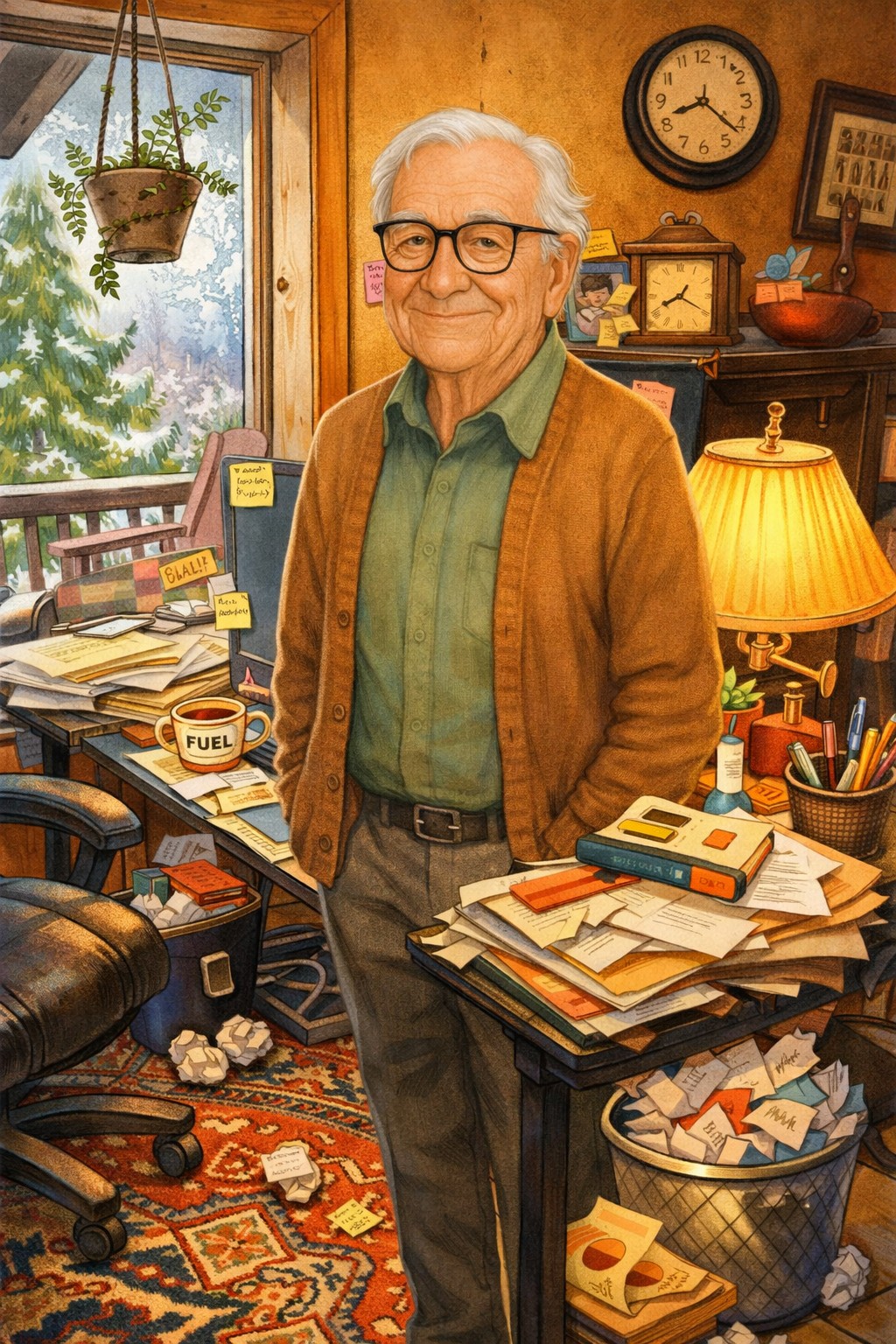
Poor Brentford Gives a Knuckle Rap. A Guest Column.


“Never mistake the undone for the unworthy.
The desk may be cluttered.
The life is not.”

Poor Brentford Lee (b. 1947. Altar ego—with an alter ego, too, of course. He ministers and he meddles. Life coach without credentials. Available for lectures, upbraidings, and unsolicited reminders of everything you’ve already accomplished.)


Sometimes we’re our own worst enemies. Maybe, all times. I know I am.

It doesn’t matter how much I get done, it’s always the undone that grabs hold of me in my waking hours and throws me into a tiff.

Just the other day—just as dawn was breaking—I sprang up in bed, asking myself:

“Where did it go? Where did it all go?”

Not my life, mind you. That’s still very much in progress.

I meant January and February—two months that often keep me snowed in on my mountaintop here in the Shenandoah Valley. And this year—once and for all—they were supposed to be the two perfect months to bring order to chaos. To organize my office.

Boxes. Amazon boxes, to be precise—a small mountain of them, stacked near the woodstove like a cardboard monument to every good intention I’ve ever had. Some are open. Some are not. All of them smile at me. That relentless Amazon smile, curved and cheerful and absolutely unbothered by my shame. I have begun to suspect they are multiplying when I’m not looking.

Desk and worktable. Buried. Buried under manila envelopes, unopened mail, a box of highlighters, a coffee mug that may or may not still contain coffee, and enough paper to reforest a modest hillside. The lamp burns bravely through the chaos like a lighthouse in a nor’easter.

Even the plants have opinions. Two magnificent specimens—sprawling dramatically across their ornate iron stands—have taken matters into their own fronds. One has sent a long, accusatory leaf directly toward my leather chair. As if pointing.

Pointing. Yes, pointing. The same way the ghost of my gray-haired grade school history teacher would point and declare with the wrath of an angry God:

“A cluttered desk is the devil’s workshop.”

And between Mrs. Snyder’s admonitions and my lament—”Where did it go? Where did it all go?”—Poor Brentford appeared as if in a vision rising up from nowhere in particular and everywhere at once.

“Where did it all go, you ask? Where did it all go? I’ll tell you exactly where it went. Pull up a chair if you can find one in that brain of yours, all cluttered now with nonsense.”

I thought I knew for sure where his harangue was headed. But for once he surprised. He did not stoop so low as to rap knuckles with any of the cliches from his repertoire of wisdom.

Not once did I hear,

“Time and tide wait for no one.”

Not once did I hear,

“Make hay while the sun shines.”

I didn’t even hear the one I was certain he would speak with calm certainty,

“Lost time is never found again.”

He didn’t recite any of those things.

Instead, he cleared his throat with great ceremony and delivered his first knuckle rap with the precision of a surgeon and the satisfaction of a man who has been waiting a very long time.

“Only handle it once.”

He let it hang there. Just those four words. Floating in the air above the Amazon boxes and the buried desk and the manila envelopes and the coffee mug of uncertain vintage.

“Your words. Well, Grace Reed’s words, if we’re being precise. Your Copyright Office colleague. The woman whose office was lean, mean, and sparse. The woman whose wisdom you borrowed, researched, published, celebrated, and then—apparently—left to ride around in the Jeep with the junk mail.”

He fixed me with a look that left no room for argument.

“Don’t bemoan where it all went. You know fully well. And you know exactly what to do.”

Then Poor Brentford’s voice softened. Just slightly. Just enough.

“Do you remember what you wrote on January 15th, 2024? You raised your Bunnahabhain to all the tarriers, the delayers, and the occasional shelver. You said, and I quote, ‘Here’s to the to-morrowers, the champions of It can wait until tomorrow, because sometimes tomorrow is just a delay away from today.'”

He smiled. For the first time.

“And do you remember Scarlett?

“She understood something you sometimes forget. Tomorrow is not surrender. Tomorrow is strategy.”

Poor Brentford gestured grandly at the Amazon boxes.

“Your Tara is a little more cardboard than hers. But the principle holds.”

He straightened his jacket.

“The office will get cleaned. One day. Tomorrow, perhaps. Or the day after. Or sometime before the Amazon boxes learn to walk.”

“Scarlett managed. So will you.”

But Poor Brentford wasn’t finished. He stood there, poised to deliver his final and most devastating knuckle rap. Quietly. Almost tenderly.

“Forget the cluttered office for now. I want you to remember something you wrote, something about a young professor who stopped you in a hallway and handed you an offprint with four words inscribed on the front.”

He paused.

“This is life everlasting.”

Another pause. Longer this time.

“You asked whether he was suggesting that we live on forever through what we share with others: ideas immortalized in print. You answered your own question. Here you are, nearly fifty years later, speaking his name. Professor Myerson continues to live.”

He leaned in close.

“And so will you. Through every word you have ever written. Eight books. More than a million words. Scholarship and essays that will outlast every Amazon box in that corner.”

“THAT is your life everlastin’. Now act like it.”

Just when my chair started getting uncomfortable, Poor Brentford had the nerve to tell me to shout out:

“Get behind me, Satan.”

I sprang up at once because in that command I recognized my own mother’s voice. Over and over again I had heard her rebuke the Devil whenever she faced her own pole of proverbial chaos.

Only then did I realize what Poor Brentford had done.

He had serenaded me with snippets of my own advice—counsel I had been publishing right here in this column for years.

I could hardly be offended.

I looked again at the Amazon boxes. The buried desk. The pointing plant.

They were all still there.

But the panic was gone.

The office could wait.

After all, tomorrow is strategy.

What We Know. What We Believe.


“Death is not extinguishing the light;
it is putting out the lamp because the dawn has come.”

—Rabindranath Tagore (1861–1941). Bengali poet, philosopher, and Nobel laureate.


“Dead? She died?”

“Yesterday.”

“Well, she suffered a lot. Now maybe she’s with her mother and father and relatives.”

“Is that what you believe?”

“I don’t really know. I don’t think we’ll recognize people the way we do here, now. But I don’t know.”

“I believe she understands the mysteries … of life and death. She knows all.”

The conversation was getting too heavy, so we drifted to other topics.

Somehow, though, it struck a nerve. How can you not know what you believe about death, especially as you get closer and closer to that unknown journey.

Afterward, I started thinking about how we come to know what we know. What we believe.

After all, we know some things with certainty. Right?

Some because the results never vary. Two plus two always equals four. The distance between two fixed points remains the same no matter when we measure it. Water boils at a predictable temperature. Gravity pulls downward. Cause produces effect with reassuring regularity.

These certainties are grounded in repeatable outcomes. Test them once or a thousand times—the answer holds. They do not depend on belief, mood, or memory. The world behaves, and we trust it to keep behaving.

Then there are the certainties born of lived experience. Morning follows night. Habits steady us. The familiar route gets us home. What worked yesterday will probably work again today. These truths may not be written as formulas, but repetition grants them authority. Experience becomes evidence. Pattern becomes trust.

Together, these forms of knowing shape our confidence in the world. Whether derived from calculation or habit, they rest on the same foundation: consistency. When outcomes repeat, doubt quiets. We stop testing. We accept and move on.

Other things we know but with less certainty.

The weather forecast offers likelihoods, not guarantees. A medication helps one person and fails another. A conversation unfolds as expected or veers off course for reasons we cannot quite name. We plant the same seeds in the same soil, and one season flourishes while the next disappoints.

Here, knowledge comes through probability rather than proof. We notice tendencies, not laws. We have seen enough to believe, but not enough to relax. Patterns appear, then break. This kind of knowing asks something different of us. Not trust, but attentiveness. Not certainty, but judgment. We proceed carefully, aware that what often happens is not the same as what must happen.

Now comes the third kind of knowing: knowing what we believe.

This one does not submit to proof or probability. It rises instead from lived moments that resist explanation. Experiences that arrive uninvited and linger long after analysis ends. The sense that someone who has died is still, somehow, present. The calm that sometimes settles in a room at the moment of death, unmistakable and unearned. The feeling that something matters even when nothing practical is at stake.

These are not conclusions we reach. They are recognitions we undergo.

Here, certainty takes a different form. Not the certainty of answers, but the certainty of encounter. We may disagree about what these moments mean, but we rarely deny that they occur. They are woven into our lives—in hospitals and bedrooms, at gravesides and kitchen tables, in silences that feel fuller than speech.

This is where death stands apart.

Death is neither a hypothesis nor a forecast or a probability curve. It is the one certainty that admits no exception, the one experience every one of us, without fail, will face. Whatever else we debate, revise, or relinquish, this much is fixed.

What matters is that we cannot face death—our own or another’s—without believing something. Belief, in this sense, is not doctrine. It is orientation. It is how we stand in the presence of loss, how we love without guarantees, how we make sense of endings that refuse to be tidy.

I have always lived in awe of what has come my way. I have bowed, again and again, to the belief that life is good and meaningful and mysterious. I see no reason to abandon that posture now. I am confident that death will be a continuation of that vision—for me.

Shaped by faith traditions throughout the world, by experience, and by nearly eighty years of living, I can say what I believe.

I may be wrong. Others will stand elsewhere, with different convictions or none at all. But belief, for me, is not certainty. It is the posture I choose in the presence of mystery.


I believe that death is not an ending but an unveiling, a beginning—a stepping into shared sacredness.

I believe that I will understand fully, see clearly, and grasp truth without distortion.

I believe that I will know others as completely as I have been known.

I believe that all confusion will clear and all mysteries resolve.

I believe that the questions of life and death, justice and suffering, will be answered.

I believe that I will be gathered into a collective consciousness—united with all who have gone before and present with all who have yet to go.

I believe that every life is known clearly, held equally, and belongs fully.

I believe that love stands unveiled—clear, complete, and free from all that once obscured it.

I believe that fear has no place in death, because the journey continues as it always has—guided by goodness, shaped by beauty, and sustained by love.

I believe that I will go on.

Oh, No! No Sourdough!


“Convince me that you have a seed there, and I am prepared to expect wonders.”

—Henry David Thoreau (1817–1862). American essayist, naturalist, and author of Walden, whose writings celebrated attentive living and the quiet wisdom of nature.


Superstitions surrounding Friday the 13th do not concern me. If my middle name weren’t Lee, it would be Lucky. I walk under ladders, ignore black cats, shop, travel and do all the things others won’t do. I will keep right on doing what I’ve always done. But this year, my luck may have run out. Or not.

The day started out on as good a note as possible. I fed my sourdough starter in my usual fashion even though the kitchen was a tad cooler than usual. A slow rise never kept me from planning ahead for scrumptious sourdough pancakes.

After our usual morning routines, Gary and I went out for lunch and returned home. In the afternoon, I preheated the oven to 350° so that it would be ready for whatever it was that I planned to cook for dinner.

Then I went about my affairs as usual. That is until I smelled a wonderful aroma wafting out from the kitchen. Bread? Cake? I was fascinated because I hadn’t started dinner. What could it possibly be?

Just as I walked into the kitchen to see what had lured me there, I exclaimed,

“Oh. No. My sourdough!”

When I turned the oven to preheat after lunch, I forgot that hours earlier I had put my sourdough starter in there on “proof” to get a faster rise.

What I saw when I opened the oven door was not fermentation. It was transformation.

The jar no longer held a living starter. It held evidence of my carelessness. The sides were lacquered in amber and gold, as if the sourdough had tried to climb out and been stopped mid-escape. A caramelized tide line marked how high it had risen before heat overtook it. What had once been soft and elastic was now fixed in place, streaked and hardened like candle wax after a long vigil.

Inside, the starter had transformed into something strangely geological. A pale, spongy dome baked solid at the edges, its surface torn open in small craters where trapped gases had burst and frozen in time. The smell was unmistakable: toasted flour, faint sweetness, a whisper of bread that almost existed.

I stood there looking at a crime scene, fully aware that the culprit and the witness were one and the same.

I had been the one who coaxed these mountain spores into life years ago, watching their first tentative bubbles gather and rise as if they had somewhere important to be. I had fed them, talked about them, and trusted them to do their quiet work while I went about mine.

They had made their way into breads and cakes and cookies and scones and cinnamon rolls, earning praise far beyond my mountaintop kitchen. And yet, on this particular Friday the 13th, I had forgotten them entirely, leaving a small natural wonder behind, unnoticed, to the fate of an oven I had set to preheat.

For a time, I did nothing but stand there, laughing at my stupidity while absorbing the lesson. There seemed little left to do but clean the jar and move on.

But just when I was feeling the depth of loss, I remembered. Flakes. Sourdough flakes.

A year or so ago I had dried some starter and set it aside, more as an experiment than anything else. I never imagined needing them. They sat unnoticed in a small jar, ordinary and still, offering no hint that they might hold anything alive.

I weighed a small portion and put it in a bowl with an equal amount of warm water. I watched as they softened and disappeared into a cloudy mixture. Then I added an equal amount of flour, creating a pasty potential. It felt more like a laboratory ritual than a kitchen rescue. Truthfully, I wasn’t certain anything would happen. But I held on to hope, realizing that those flakes were the only thing left for me to try.

At first, nothing happened.

The mixture sat on the counter looking exactly as one might expect flour and water to look when stirred together: pale, still, and entirely unremarkable. I told myself not to expect too much. After all, these were only dried remnants, fragments of something that had once been alive. Whatever vitality they possessed had long since faded.

But some time later–hours, perhaps less–I noticed a change so small it might easily have been missed. A tiny bubble appeared along the edge of the bowl. Then another. The surface loosened almost imperceptibly, as if taking a slow breath after a long sleep.

By the next morning, there was no denying it. The mixture had awakened. Fine bubbles traced delicate pathways through the paste, and a faint, familiar aroma rose to meet me—not flour, not water, but something living. Something remembering what it had been.

What astonished me most was not simply that the sourdough culture had returned, but how quickly it did so. Years ago, when I first coaxed those mountain spores into existence, I waited days for signs of life, peering into the jar with the anxious patience of a novice. This time, revival came with confidence, as though the culture already knew what it was meant to do.

Up from the flakes it arose.

What had seemed lifeless only hours earlier now stretched upward, gathering strength from invisible work. I found myself watching it the way one watches a garden after rain—not interfering, not hurrying, simply witnessing growth. A living culture once again, carrying within it all the strength and possibility of its ancestral spores.

And standing there, I realized that nothing about it felt accidental. Life, given the smallest chance, had simply resumed its work.

Watching it rise again, I began to understand that what I had witnessed was more than a small kitchen recovery. I had baked the starter, yes. But I had not baked the possibility.

Something essential had been preserved long before the mistake was made. Tucked away almost absentmindedly, those flakes had carried forward what mattered most. Given warmth, patience, and a little attention, the sourdough culture simply resumed its work, as though interruption were only a pause and not an ending.

It struck me then how stubbornly life finds its way back, even after neglect, even after carelessness. What appears lost may only be waiting for the right conditions to begin again.

Perhaps that is the real lesson Friday the 13th had to offer me this year. Not bad luck. Not superstition confirmed. Just a moment of carelessness and a jar of forgotten flakes, both filled with truth. We measure our mistakes with finality, and we assume that one moment of inattention defines the whole story.

Nature does not agree.

Two Porches. One Voice.


“The first porch is where you find your voice. The second porch is where your voice finds others.” —Poor Brentford Lee (b. 1947. Keeper of two porches, one mountain, one dog, and an inexhaustible supply of things worth saying—none of which he has to say alone anymore, thanks to his partner, Gary.)


Dear Faithful Readers,

You’ve been here with me on the porch since—well, some of you since the very beginning, back when I built it as nothing more than a place where you could pull up a chair and talk with me about the joys, challenges, and discoveries of research. We kept right on doing that from 2012 to 2021 when I decided to make the porch a little more fun by bringing you weekly creative nonfiction essays.

I’m still at it. Nearly 750,000 words later. Yes, you read it right. Foolin’ around in bed every night with ideas and words adds up. I’m spurred on by you, my Dear Readers, whose numbers keep increasing annually! Last year, we shared more than 35,000 views right here on the porch.

But I’ve built a brand-new porch, and I want you to be the first to know about it.

Don’t worry, though. I’m not leaving The Wired Researcher porch. It will remain open virtually forever. Same Monday mornings. Same voice–mine, with Poor Brentford’s voice chiming in from time to time. We’ll both be there, waiting for you.

I just heard someone shout out:

“So, why are you building a new porch? What’s that all about?”

Well, for starters, it has better lighting, and it might just bring in more neighbors for all of us to visit and exchange ideas.

I’m counting on you to check it out. I’ve named the second porch The Kendrick Chronicles.

“Where on earth is this new porch of yours?”

Gracious me! You know that I like to take my time–slow and easy like. In a sec, I’ll give you the link so that you can check it out for yourself. And when you do, go ahead and Subscribe! From that point forward, my essays–ever goldern new one that hits the world, every Monday morning like a neighbor who always brings something worth reading and never overstays his welcome–will find their way directly to your Inbox.

You can find this new porch of mine in Substack. Here’s the link:

brentlkendrick.substack.com

“What will I find when I get to this new porch of yours?”

Why, gracious me! You’ll find a comfy chair with your name on it and a handful of your favorite essays with my name on ’em:

● Redbuds of Remembrance

● Learning to Love in New Ways

● I Am Afraid

● Poor Brentford Cleans the Wax Out of His Ears

● Two, Together

● Glimpses of My Mother’s Hands

● The Ghost of Palmyra Church Road

● Truths Half-Told. Letters Half-Burned. A Legacy Waiting to Be Fully Heard.

● Carrying the Bags of Colonial America’s Humourist

And get this. If you subscribe, next week you’ll get an essay about a kitchen disaster beyond belief: “Oh, No! No Sourdough!” And the week after that, “What We Know. What We Believe.” It may be the most complete thing I’ve ever written about who I am and what I believe about what comes next.

So go on now. Pull up a chair. Same voice. Wider porch.

Come find me there:

The Kendrick Chroniclesbrentlkendrick.substack.com

But always remember to come back here, as I remain–

Epigraphically yours forever,

Brent L. Kendrick
(—and Poor Brentford Lee, who deserves full credit for my nonsense)

Little by Little


“The greatest thing in the world is to know how to belong to oneself.”
—Michel de Montaigne (1533-1592). French pioneer of the personal essay.


I tried to blame it on the boots.

I tried to blame it on the coat.

I tried to blame it on the sweater.

I tried to blame it on the scales.

I even tried to blame it on Thanksgiving and Christmas.

But I knew deep down inside that on those occasions I made conscious choices to eat the rich foods that I served up for Gary and me, and sometimes for our guests. Turkey first, of course—sliced generously, then followed by ham, salty and sweet, and later a rack of lamb brought out because it felt like the season called for something a little special. Deep-dish pecan pie, glossy and heavy with syrup. Deep-dish apple pie, still warm, the kind that sinks slightly when the knife goes in. Golden fruitcake—dense, fragrant, unapologetic—cut thin and then, somehow, not so thin. Banana nut bread—the healthy version, of course—on the counter, always ready for just one more slice. Candy dishes everywhere, each one holding something different: chocolates, caramels, peppermints, specialty candies meant for guests but sampled daily. Taffy apple salad. Orange fluff salad. Cranberry sauce—homemade, of course—because it wouldn’t be the holidays without it. Gravy poured generously, more than once. Sourdough dinner rolls torn open while still warm, butter melting into the crumb. And wine—one bottle opened, then another, because it paired well, because it was already there, and because winter evenings stretch long. And it was good. All of it was good.

One or two overindulgences wouldn’t have been so bad. But what started with Thanksgiving rolled into Christmas, kept going through New Year’s, and here I am after a prolonged pig-out snow-in, blaming my weight on scales, sweaters, coats, and boots.

I know better. This is a repeat of last year and the year before, stretching back to the start of memory. All along my satiated journey, I knew what was happening. I sensed it in my body. I felt it in my clothes. I saw it in the mirror. Eventually, my day of reckoning came when I stepped on the scales, gasped, and sighed,

“Enough, Brent. Enough.”

I could veer off into a litany about all the reasons I overindulged. I have no doubt that you’ve heard them all already. Heard them all.

But I’ll plate up a few reasons anyway. Food is how we mark time. Holidays, snow days, long evenings, the stretch between Thanksgiving and New Year’s—meals become punctuation marks. We don’t just eat; we commemorate. One dinner leads to another, then another, until the season itself seems to demand a full plate.

Then there’s winter. The quiet. The staying in. Food keeps us company. It warms the house, fills the hours, shapes the day. A loaf on the counter, something sweet after supper, a little more than usual because there’s nowhere else to go and nothing much else to do.

None of this is shocking. None of this is new. But here’s the thing. Knowing why doesn’t change the outcome. It only explains how easily awareness can lag behind—until one morning, one glance, one number brings it all into focus.

I could dwell on all of that. But chances are you can already relate—whether in your own “appetite” life or in some other corner. You can relate to areas where you’ve lost an awareness—areas that need attention.  Maybe it’s your perennial garden beds overtaken by weeds. Maybe it’s your inbox overtaken by junk mail. Maybe it’s your personal and spiritual relationships overtaken by inattention. The list of “maybes” goes on and on.

But here’s the good news. We don’t need to rant and rave. We don’t need to blame our metaphorical sweaters, coats, and scales. And we don’t need to blame ourselves.

We only need to notice—and then course-correct.

Little by little.