“Hope is being able to see that there is light despite all of the darkness.”
—Desmond Tutu (1931–2021; a South African Anglican bishop, social rights activist, leading figure in the struggle against apartheid, and an enduring global symbol of hope and resilience.)
Sometimes, a recollection gets trapped in my mind and won’t exit, even when I open a door. One memory paid me a visit weeks ago, and it’s still lingering. I’ve decided that the best way to get rid of it is to write about it, send it out into the world, and let it take up residence in other people’s minds. So, here: it’s yours now.
The memory is from 1968. Student attitudes on college campuses–even at a conservative school like Alderson-Broaddus, where I was a junior–were marked by activism and rejection of traditional norms and authority. Fueled by the counterculture movement, we protested for civil rights, opposed the Vietnam War, and championed various social justice causes, shaping a decade defined by idealism and dissent.
Some of that spirit spilled over into the classroom and sometimes made some of us bolder than we might otherwise have been.
It certainly made me bolder that spring when I was taking a three-credit World Literature course. We focused heavily on Dante Alighieri’s epic poem The Divine Comedy, widely considered to be the pre-eminent work in Italian literature and one of the greatest works of Western literature. Divided into three parts–Inferno, Purgatorio, and Paradiso–the poem explores the state of the soul after death and its journey toward God.
My classmates and I felt challenged by Dr. Callison’s rigor and her insistence that we gain an in-depth understanding of this acclaimed literary work. We did, as I recall, and we even grew to like the poem, playfully sprinkling our daily conversations with some of its famous lines.
Nonetheless, we all felt anxious as exam day approached. I decided to be bold and comedic by making a banner to put above our classroom door so that my classmates would see it as they walked in to take the exam. I created the banner alone, told no one about it, went to our classroom in Old Main, and hung the banner well in advance. There–in a position of prominence for my classmates and Dr. Callison to see as they entered–was a line from the Inferno section of TheDivine Comedy as Dante passes through the gate of Hell:
“Abandon hope all ye who enter here.”
I wanted the banner to be a grim but humorous reminder that as we faced the Hellish torments of Dr. Callison’s exam, we could neither be redeemed nor rescued.
Everyone stared at the banner as they entered the classroom and proceeded to their seats. Some laughed. Some gasped. All questioned: “Who would dare be so bold, especially in Dr. Callison’s class?” Some even speculated that she was the prankster. I sat there quietly, hoping to look as innocent as one of the souls headed toward Paradise.
My countenance worked. No one suspected me, not even Dr. Callison when she walked through the door. To our surprise, she burst into laughter and continued laughing as she handed out bluebooks and wished us well on the exam.
I’ve thought about that day often down through the years, not because of my bold banter–revealed here for the first time ever–but rather because of my take on the famous line, “Abandon hope all ye who enter here.” I understood the literal interpretation of the line precisely. It’s a warning to all who enter Hell that they are leaving behind all hope of salvation or escape. It sets the tone for the suffering and despair that pervades Hell, emphasizing the eternal nature of the punishment awaiting the damned souls within.
However, as a student then–and as a lifelong learner now–I find that literature takes on richer dimensions when looked at metaphorically.
I saw Dante’s poetic line then–and I see it now–as a caution against entering into a state of despair or hopelessness. It suggests that giving in to despair is like crossing a threshold into a mental or emotional Hell, where recovery becomes incredibly difficult if not impossible. It’s a warning to maintain hope and resilience even in challenging circumstances. Otherwise, we will create our own Hell and live in it right here on earth.
Don’t get me wrong. I know despair. Who doesn’t experience despair during moments of profound loss, such as the death of a loved one, the end of a significant relationship, or the loss of a job? We all do. Who doesn’t experience despair when grappling with chronic illness or debilitating injury, especially if it hinders our ability to pursue our passions or maintain our independence? We all do. Who doesn’t experience despair when feeling overwhelmed by financial struggles, loneliness, or a sense of purposelessness? We all do.
Although I understand the nature of despair, it seems to me that embracing a positive and optimistic mindset can be a powerful antidote to despair.
Years ago, I made a conscious decision that my glass would always be “half full” and that I would actively cultivate a positive outlook on life, even in the face of challenges. That approach has served me well.
Let me share with you some of the strategies that I use to foster positivity and optimism.
I strive to find joy in everyday moments. I cultivate mindfulness by being fully present and appreciating the simple pleasures of life, whether it’s a beautiful sunset on my mountaintop, a delicious meal in my kitchen, or a heartfelt conversation with a stranger.
I work hard at practicing positive thinking. When negative thoughts come my way–and they do–I reframe them in a more positive light. When I have problems–and I do–I shift my focus and dwell in the realm of solutions.
I make a point every day of counting my blessings. Sometimes, I carve out time to reflect on the things that I’m grateful for. However, more often than not, I take time to be grateful each time I’m aware of a blessing. I find that approach to gratitude lets me be in constant celebration of what I have.
I do my best to surround myself with positivity. I listen to uplifting music, and I spend time with optimistic and supportive people who uplift and encourage. Positivity is contagious.
I make living a healthy lifestyle a priority. I know that my physical well-being directly influences my mental and emotional health. Indoor biking is a priority for me, along with nutritious eating, adequate sleep, and meditation. All of those things work together to keep me upbeat and resilient.
I do my best to practice self-compassion. I try to be kind to myself when the going is rough, and I try to treat myself with the same compassion and understanding that I offer others who would be facing similar challenges.
I believe in laughter. I don’t have to work too hard to find humor in life through books, jokes, spending time with friends who make me laugh, or, best of all, laughing at being me. Humor provides relief and perspective in tough times.
I’ve saved my best strategy for last because it’s the one that I know I can rely on the most. I cultivate a sense of faith or belief in the overall goodness of life and humanity. I trust and believe that, despite challenges, humanity’s inherent thrust toward greatness and goodness will prevail.
I must add that because I work to stay positive doesn’t mean that I ignore or deny negative emotions. I don’t. I acknowledge them while consciously choosing to focus on the positive aspects of life and maintaining hope for the future.
As I look back on that bold act of hanging the banner, I realize how much it symbolizes a pivotal lesson from my college years—maintaining hope and resilience in the face of adversity. That memorable day in Dr. Callison’s class reaffirmed for me that humor and a positive outlook can transform even the most daunting challenges into manageable experiences.
Now, decades later, I believe that lesson remains relevant. We all encounter moments of despair, but we don’t have to surrender to them. By fostering positivity and optimism, we can navigate life’s hardships more effectively. The strategies I’ve outlined—practicing gratitude, surrounding ourselves with positive influences, and embracing humor—serve as a powerful toolkit against despair.
Ultimately, the famous line from Dante’s Inferno serves as a cautionary reminder not just of the perils of Hell, but of the importance of hope in our daily lives. By choosing to see our glass as half full, we can maintain a sense of purpose and joy, even amid difficulties. Let’s embrace the enduring message that hope and resilience can guide us through even the darkest times.
“The privilege of a lifetime is to become who you truly are.”
—Carl Jung (1875-1961; a Swiss psychiatrist and psychoanalyst who founded analytical psychology; explored the human psyche, emphasizing the importance of integrating the conscious and unconscious aspects of the self.)
The air is sweet with success all around the world as another academic year draws to a close. A rightful sense of accomplishment and pride abounds as graduates, their families and friends, educators who guided them, and communities that supported them come together to celebrate this momentous occasion. It’s a milestone that marks the culmination of years of hard work, dedication, and perseverance, as graduates have demonstrated their commitment to excellence in various forms.
As I reflect on my own academic celebrations down through the years as an educator and as a student, one stands taller than the rest: Alderson-Broaddus University’s Honors Convocation on April 5, 1997. Held in Wilcox Chapel, it was the university’s forty-fourth annual convocation, and I was the speaker. I can’t begin to express how honored I was to be returning to my alma mater to speak on such an important occasion. What made it even more special was the fact that the invitation came from a former classmate, Dr. Kenneth Yount. Ken and I were both 1969 A-B grads, and as seniors, he was President of Student Government, and I was Vice-President. Ken went on to become A-B’s Provost/Vice-President for Academic Affairs, and, when he invited me to come back home to our mountaintop campus, I was serving as the Training Coordinator, United States Copyright Office, the Library of Congress.
In delivering my remarks, I had one goal: ignite a spark of introspection and perseverance among those being honored and those in attendance. I believe that my remarks achieved that goal, and I believe that what I had to say then is equally relevant to graduates today whenever they might be on their journey to tomorrow.
I am honored to share my remarks today with readers all around the world.
“Winning from Within”
Dr. Yount, President Markwood, Faculty, Honored Students, Parents, Guests: thank you for such a warm welcome.
When Dr. Yount invited me here today, he asked that I do three things. First, he asked me to sprinkle my remarks with humor. Second, he asked that I speak from the heart about what Alderson-Broaddus has meant to me. Third, he asked that I talk about academic excellence. As an aside, he noted that I had to do all this–make you laugh, make you cry, and make you think–in no more than 15 minutes. What a challenge. In fact, I confess that it makes me feel rather like a mosquito in a nudist colony. I know exactly what I’m supposed to do. I just don’t know quite where to begin.
Thank you for your laughter. You prove that I can be humorous. Believing brevity to be the soul of wit, now let me speak from the heart, from the heart about my experience here at A-B, from the heart about excellence, and from the heart about winning from within.
I do so willingly. I spent four wonderful years on this mountaintop. They were so good, in fact, that I would live them again, and never once say, “If I knew then what I know now.” That’s no small concession, considering that I will turn fifty later this year. But I would live those four years again, because I am able to say–and do say, day after day–that A-B touched my life in ways that made lasting differences.
Let me explain. I grew up in a small town, the sixth child of a West Virginia coal miner. My mom and dad always provided well for us, but in reality, they lived rather anxiously from coal-strike to coal-strike, from pay-check to pay-check. But they rose above those financial challenges and instilled in my brothers and sisters and me a work ethic, the likes of which I have never seen. They made us know that there is nobility in work, that there is honor in work, that there is dignity in work, and that there is love in work. My dad labored for fifty years in the coal mines, but neither he nor my mother ever said to me, “You can’t grow up to be a coal miner.” Instead, they taught me this, and it stands as my earliest lesson, my greatest tribute to them:
If a job is once begun, Never leave until it’s done. Be its labor great or small, Do it well, or not at all.
That quote has governed my life–shaped my life–in ways that probably only a psychiatrist could unravel. But at least one part of it is woven in a continuous thread that requires no untwisting. As early as the fourth grade, I fell in love with words and how words relate to one another and how they serve as building blocks for ideas. I fell in love with the eight parts of speech. I fell in love with diagraming sentences. I took my parents’ guidance at face value and applied it to my love of English.
My classmates, of course, had no idea of how possessed I was by my love of the language. They had an even more feeble understanding of how driven I was by the work ethic that my parents had instilled in me. But I was possessed by my love of words. And I was driven by my work of putting words together. And if my classmates did not quite understand it then, they soon came to realize that they had better step out of my way whenever it came to moving to the front of the class in spelling bees, in parsing, in diagraming sentences, in writing assignments, and in essay competitions. Those honors and all those related to English were mine exclusively. I had claimed them. I knew the subject. I loved the subject. And I had no fear of hard work.
I can reflect smugly on my childhood accomplishments now. They were not easy accomplishments then. Every trip to the front of the class was characterized by no small degree of fear and trepidation. After all, I was only nine years old. But I believed my parents and never once questioned their guidance. I studied hard, worked hard, and played hard at what I loved to do. I knew from the start that my life’s labor would center around English, teaching English, whatever that might have meant to a fourth grader. I thought then that it meant, somehow, making the world a better place by helping others understand the parts of speech and helping them diagram sentences so that they could express their ideas clearly and, obviously, in a grammatically correct manner. Much later in school, I learned what the study of the English language really entailed, but in my nine-year-old world, it was quite sufficient for me to believe that studying English was a great labor, to know that my accomplishments in the field outdistanced my classmates. and to know that I would not leave my pursuit until it was done.
Looking back, I am not too surprised by this turn of events in my life. Remember. I grew up in a small coal mining town. We had no library. Now let me tell you this. We had only two books in our house: the King James version of the Bible and Webster’s dictionary. My mother dog-eared the pages of the Bible and preached and prayed it to the rest of us. Though always mindful of–and let me add influenced by–her spiritual travels, I dog-eared Webster and pursued my own adventures with the English language.
Imagine my parents’ surprise when I declared, again, as a fourth grader, that I was not only going to college but also that I was going to complete a doctoral degree in English. I had not the foggiest idea of how I, in a coal-strike to coal- strike, pay-check to pay-check household, would ever get there. But I believed fully that if I followed by parents’ guidance, stuck with what I loved, worked hard at it, somehow, the door would be opened. I went forward with blind faith, declaring finally in my senior year that I was going to West Virginia University or to the University of Richmond. I applied to both. Then I met Tom Bee, the Admissions Counselor here at A-B, when he visited my high school. I had no idea that his visit would redefine my life. But it did. He encouraged me to apply to A-B. I did and was accepted here as well as at my other two choices.
Thank God, Alderson-Broaddus saw my needs. It saw my needs financially. Remember my dad, the coal miner. It saw my needs spiritually. Remember my mother, the prayer warrior. It saw my needs intellectually. Remember my dream of becoming an English teacher.
How well I remember the summer of 1965 when I visited this campus for the first time. I had no decision to make. I knew from the start, in the inner recesses of my soul, that I was home, not in the Robert Frost sense that “Home is the place that when you have to go there, they have to take you in” but rather in his sense of the word that “Home is something you somehow haven’t to deserve.” I am not certain I deserved the home that Alderson-Broaddus made for me when it took me in, in 1965. And I am even less certain that I deserve to be invited back on an occasion of this importance. But it’s good to be home again, and I thank you heartily.
I use as the springboard for my remarks today an oft-told story about an event that took place in Thailand. The year, 1957. The city, Bangkok. The players, a group of monks and a group of construction workers. The situation, a new highway that was to run smack dab in the middle of the temple. The monks had to move a 10 ½ foot tall clay Buddha from their temple to make room for progress. When the crane began to lift the giant idol, the weight of it was so tremendous that it began to crack. The head monk–the abbot–aside from being concerned about the immediate damage, became even more alarmed as rain began to fall. He ordered that the statue be lowered to the ground and that it be covered with a large canvas tarp to protect it from the rain.
Later that night, the abbot went to check on the Buddha. He shined his flashlight under the tarp to see if it was staying dry. As the light reached the crack, he noticed a gleam shining back. He looked closer at the gleam of light, believing that there was something underneath the clay. He fetched a hammer and chisel and began to chip away at the clay. As he knocked off shards of clay, the gleam grew brighter and brighter, and by morning, the abbot stood face to face with an extraordinary solid gold Buddha, weighing more than 5 tons.
Historians believe that several hundred years earlier, monks had covered the Buddha with an outer covering of clay to keep their treasure from being looted by an invading Burmese army. Unfortunately, they slaughtered all the monks, and their golden Buddha remained a secret until that fateful date in 1957 when the abbot recognized the gleam beneath the surface and dared to chip away at the clay, to find the real gold within.
What a splendid discovery. Finding real gold, solid gold, within. In many ways, we are all like that Buddha, pure gold inside but covered with a hard outer shell that hides our “golden essence,” “our inner self,” “our real self.” Much like the abbot with the hammer and chisel, our challenge is to break through the surface to find our true essence, to find our pure gold, to win from within.
Today’s Honors Convocation confirms that you have been hard at work with your own hammers and chisels. You have chipped away across academic classes and across academic disciplines. I am more than gratified to see that excellence in writing is being recognized in several fields. I am heartened to see an emphasis on Greek academic excellence. I am encouraged and touched and saddened–all at the same time–by the growing number of memorial awards. At the risk of singling out any, lest they be given a prominence equally deserved by all the others, I cannot help but note the awards being given in memory of Dr. Ruth Shearer and Dr. Louise Callison, two of my own English professors.
I salute you. You have broken through your own hard outer shell. Your own true excellence shows. Your own true gold shines. I salute Alderson- Broaddus as well, for its role in guiding you throughout this time of personal discovery and growth. Today is a shared celebration. As an institution and as individuals, you should feel rightfully proud of your accomplishments.
As I stand here, though, I cannot help but ask myself, “Why aren’t all your classmates being honored?” Wouldn’t that be wonderful? To have so many students recognized today that Wilcox Chapel would be filled in a celebration of collective institutional excellence.
In case I have not made my point clearly enough already, let me hammer it home one more time: we are all solid gold. We are all capable of achieving excellence. Just as I have never met an ugly person–and I have not–so have I never had a student who is not gold, not capable of excellence. Never forget that point for one moment. If you do forget it, now or later on in your life, your competition will do you in. Ounce for ounce, your classmates in the world are just as much solid gold as you and just as capable of distinguishing themselves as you. They, too, can achieve excellence. And to varying degrees, they are. Like you, they have begun chipping away at their outer clay. But unlike you, they haven’t broken fully through the surface, yet, to see what’s inside. That’s what an undergraduate education is all about: taking the time to look within, to do self-exploration, to bring out self-awareness, and to find out who you are. At no time in your life, even when you pursue graduate studies–and I hope that many of you will–at no time in your life will you ever again have the luxury of focusing, twenty four hours a day, on winning from within–on finding yourself–and of being sheltered all the while from the cares of a 9 to 5 work-a-day world by an institution like Alderson-Broaddus, of being nurtured by such caring and dedicated and learned faculty as are assembled with us today. But I believe that you, unlike your classmates, have chipped away more broadly and more deeply. You have taken your pursuit of excellence to a deeper level. You have engaged yourselves in a more spiritual kind of search, a more personal search that has helped you become knowledge navigators in the academic fields you love best.
But, looking ahead, what do you do? It’s simple.
● It has but three words. Stick with it.
● It has but two words. Chip away.
● It has but one word. Persevere.
If you don’t stick with it, chip away, and persevere, your honor today will be short-lived. Here’s why. If you don’t continue to remain engaged in a spiritual search to find more and more of your real gold, more and more of your inner essence, if you don’t continue to develop your talents to the fullest, you will soon get side-tracked. You will soon start looking for self-love in all the wrong places, and you will ignore your own deep-rooted needs. You will get caught up in the busy-ness of life, of trying to demonstrate your self-worth through external sources, through achieving a material worth that will be obvious to others–that they will notice, that they will validate, and that they will appreciate. That approach may well bring you pleasure, accomplishments, a coveted job, big bucks, status, and even success. Just keep in mind, though, that the world is filled with people who have spent their entire lives validating themselves through external sources. All too often, their stories end on the sad note of personal regret and profound unhappiness.
Don’t wait for others to approve you. Respect who you are. Accept yourself. Approve yourself. Continue to tend to your soul, to develop the real you that lies beneath the surface, and to go for your own gold. Doing what you love should govern not just how you spend your time now, not just how you pursue college, but how you pursue your life.
Find what you love. Then do it with dedication, with determination, with daring, with ceaseless work, and with dogged perseverance. If you do, just as you have distinguished yourselves today, so too will you lead lives of distinction that will bring honor to you, to your families, and to Alderson-Broaddus.
Again, I salute all of you on your accomplishments, and, again, I thank you for including me in your celebration.
“Life can only be understood backward, but it must be lived forwards.”
–Søren Kierkegaard (1813-1855; Danish Philosopher, Theologian, and father of Existentialism.)
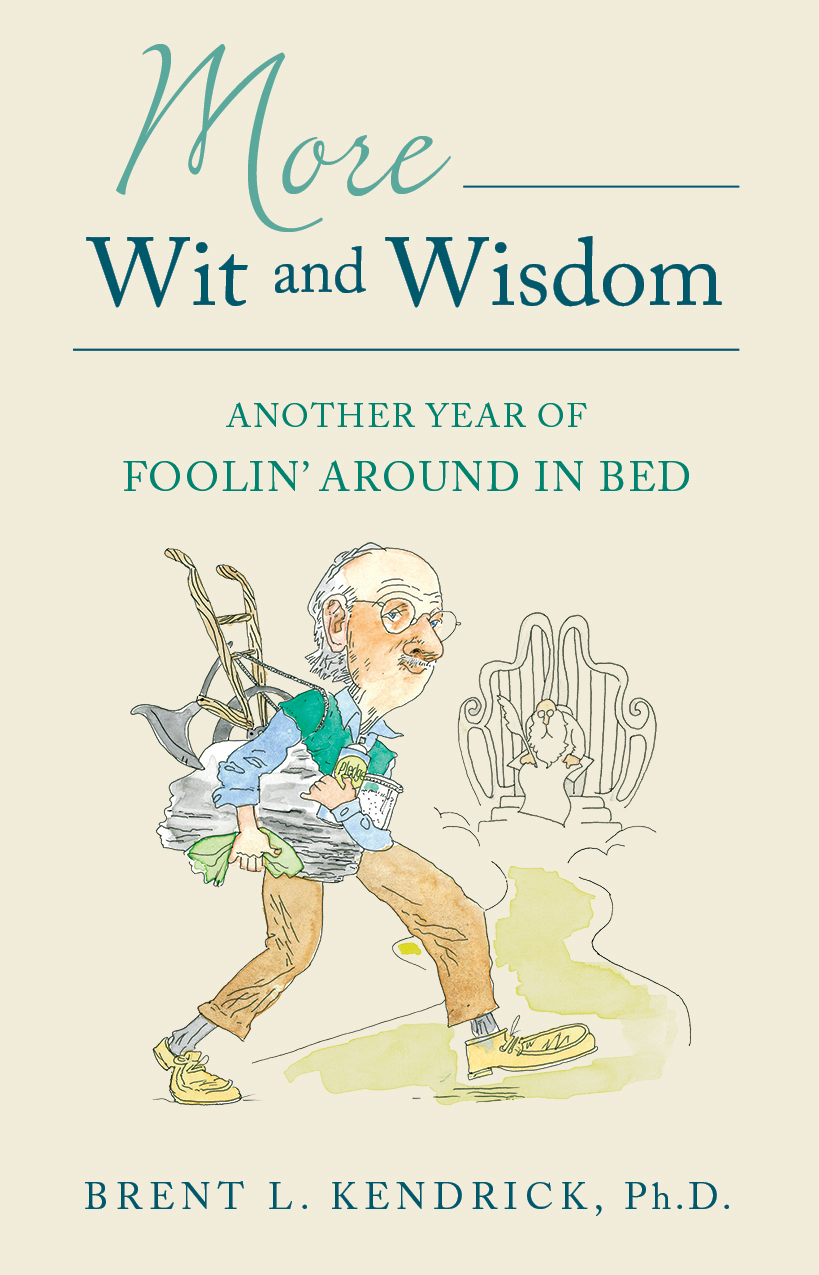
As promised, today is the day for the third reveal from my forthcoming collection of essays, More Wit and Wisdom: Another Year of Foolin’ Around in Bed.
Yesterday, I disclosed that I’ll be donating all proceeds from the sale of More Wit and Wisdom to the Student Success Fund at Laurel Ridge Community College.
The day before I shared with you that the book is dedicated to educators worldwide, in recognition of their transformative impact on our lives through education.
Today’s reveal is an excerpt from the book’s preface, “Embrace the Journey.” It has not appeared as a blog post. It’s a special essay just for the book.
By sharing an excerpt with you, I hope it will encourage you to do as I am striving to do. Reflect on your own journey. Embrace your journey. Trust your journey.
So, without further ado, let me share the final paragraphs from preface—a space where words dance, ideas collide, and the magic of Creative Nonfiction begins.
As you read these essays, I hope that you will see what I have come to see. What started for me as a cathartic ritual morphed into a nightly routine that anchors me and in a mysterious way strengthens me to embrace my journey more and more every day. It’s allowing me to grow personally. It’s allowing me to leave behind some kind of written legacy, even if it’s nothing more than my thoughts about my own experiences on this wonderful planet Earth. It’s allowing me to expand my creative landscape. It’s allowing me to foster connections through creating a sense of unity and shared understanding. It’s giving me the chance to address societal issues, with the potential to drive positive change on a broader scale. It’s giving me the chance to connect with readers from all around the world. Who would have imagined that this coal-camp kid from West Virginia would have the chance to share his ideas and emotions with 7,320 people from 88 countries around the world? Yet, that’s how many readers I had last year. I am humbled and grateful, realizing that the power of connection transcends backgrounds and boundaries, turning a coal-camp kid’s dreams into a heartfelt symphony that resonates with thousands, reverberating the sound of our shared humanity.
Embracing my journey in writing is an exhilarating testament to the richness of my life. Each word written is a celebration of the journey I’ve traveled, and every essay penned is a reflection of the life I’ve lived. As I continue to navigate my journey, I do so with a heart full of gratitude for the many chapters that have unfolded. Life, in all its complexities, is beautiful, and I am blessed because I see the beauty more clearly as I continue on my way. It’s an affirmation that, indeed, life is good. I hope that my melody resonates through the words on the page and the years in my life that have brought me to this moment. With each passing day, I embrace the journey, with open arms and a spirit eager to discover the wonders that lie ahead. Life is not just a journey; it’s a magnificent composition, and I am still living it and writing it.
I hope that you, too, will embrace your journey, whatever it may be, and I hope that this collection of essays will encourage you. Life’s journey is an opportunity for growth. Each moment is a chance to celebrate meaningful and fulfilling endeavors. In the midst of solitude and the questioning of life’s purpose, remember that your journey matters. Let me say it again. Your journey matters. Embrace it with open arms, finding motivation, validation, and personal connection all along the way. May these essays inspire you to navigate your path with resilience, discover the beauty in your unique perspectives, and confidently affirm that your journey, too, is significant and purposeful.
Next week, More Wit and Wisdom will be available in all formats: hardback, paperback, and Kindle. Stay tuned for details!
Remember my January 22 post Exciting News: More Wit and Wisdom Headed Your Way? I had just put the final touches on a 390-page manuscript for my new book More Wit and Wisdom: Another Year of Foolin’ Around in Bed, and I had submitted it to my publisher, Luminare Press. It brought together a whopping 93,897 words that I poured my heart and soul into during 2023. Yes, you read that right—93,897 words of pure wit, wisdom, and a dash of my trademark humor and modesty!
In my post, I also teased you by announcing that the book has three surprises.
● First, the dedication.
● Second, a preface that is one of the best essays that I’ve written, ever!
● Thethird is that all proceeds from the sale of the book (and the eventual movie rights) will benefit a special cause.
Up until now, I have kept all three surprises close to my chest, known but to me, to God, and to Luminare.
But now that the book is getting closer and closer to publication, I’m taking three days–May 7, May 8, and May 9–to reveal the three surprises to you.
Today, May 7, it gives me great pleasure to reveal the DEDICATION:
Educators have had my back for my entire life. Growing up in the coal fields of Southern West Virginia, I was blessed to have some of the best educators in the world. They knew the subjects that they taught, and they taught those subjects with passion. Perhaps more important, they loved their students and took personal interest in us. They were living witnesses: we could transform our lives through education just as education had transformed their lives.
My third-grade teacher at Shady Spring Elementary School introduced me to Robert Frost’s poetry. I fell in love–and remain in love–with poetry, and Frost remains my favorite poet. Other teachers pulled me toward Scripps National Spelling Bee Competitions and Voice of Democracy Competitions. And I will always remember the teacher who got me hooked on the parts of speech and sentence diagramming. She knew that she had unleashed a wild child in love with the power of language.
My teachers at Shady Spring High School remain in my memory, too. One showed me that powerful writing and hefty revision go hand in hand. Another helped me realize that typing and bookkeeping were solid backup skills that could open other career paths if my dream of going to college had to be deferred. And what a critical contribution my high school biology teacher provided by welcoming me and several other students to crash his desk every day at lunch, day after day, week after week, semester after semester, from our sophomore year all the way through graduation. Those lunch-time conversations were far more important than any lunch before or since. He gave us his time. He gave us himself.
My professors at Alderson-Broaddus University added wonderfully rich dimensions to my life. Most of them lived on campus–on faculty row–and our classes were so small that we were often their dinner guests. They helped me see the human side of the academic ivory tower that later I would strive to model. My advisor, in her fifties, finished her doctoral degree while I studied under her and served as her Work Study. She gave me an appreciation of lifelong learning.
As a graduate student at the University of South Carolina, phenomenal educators continued to enrich my life. I’m thinking of my advisor who turned me on to textual bibliography. Another professor introduced me to Mary E. Wilkins Freeman–the ongoing focal point of my scholarly research from then until now. I’m recalling, too, the professor who lectured, literary work in hand and not a lecture note in sight, with fiery passion and exultant joy. He allowed himself to be slain in the intellectual moment just as my mother always allowed herself to be slain in the spiritual moment. Through his teaching, I saw the best of both worlds–his and my mother’s. I had a vision of the educator that I would strive to be.
I am honored and humbled to dedicate More Wit and Wisdom: Another Year of Foolin’ Around in Bed to educators around the world because they know that education holds the power to transform lives.
Stay tuned! Tomorrow, I will unveil surprise #2 fromMore Wit and Wisdom!
“A letter is a soul, so faithful an echo of the speaking voice that to the sensitive it is among the richest treasures of love.”
—Honoré de Balzac (1799-1850; French novelist and playwright whose works are considered foundational to the realism movement in literature; the quote is from his novel Père Goriot.)
Last week, I unveiled the captivating and downright riveting backstory of my The Infant Sphinx: Collected Letters of Mary E. Wilkins Freeman, highlighting the book’s serendipitous journey from manuscript to publication. I recounted my bold encounter with the president of Scarecrow Press at an American Library Association conference, leading to the acceptance of my manuscript. I shared with you the details of preparing my own camera-ready copy to ensure that the letters I had spent ten years locating, transcribing, and annotating were faithful to their originals when they were published and sent out into the world for all the world to read.
I ended the post with a teaser, hoping to lure you back this week!
In my Scarecrow Press folder that I had forgotten about, I found a forgotten copy of a review that I wrote of my own book. How preposterous is that? Well, it sounds exactly like something that I would do. I’m always telling friends and colleagues that I know no shame. I guess I didn’t back then either. However, I can not for the life of me remember whether I sent my self-review out for publication. I must have because what I discovered in my dusty folder is a photocopy, and it’s so faded that I struggled to read it.
But read it, I did. Dare I say that I enjoyed doing so? I did. Even this many years later, my review strikes me as fresh and refreshing. I’m surprised that I seemed to have found my writer’s voice relatively early in my career, and it has not changed that much at all. Dare I say that I have worked hard down through the years to keep my writer’s voice–even in academic publications–from sounding snotty? I have. Simplicity is always a suit that fits me perfectly in all ways.
By and large, I stand by everything in my review, except for two points. When I wrote the review, I really liked the book’s title, TheInfantSphinx. However, since then, I’ve come to like the title less, and I have come to know Freeman more. Let me explain. In the review, I commented that “I confess to a deep-down-inside wish that a cache of letters secreted away somewhere would be made public and smash to smithereens my claim of having yielded up all there is.”
A cache of letters has not appeared, but enough individual letters have surfaced here and there that I’m working on an updated two-volume work that will use a name more to my liking and more to the liking of Freeman’s closest friends–and presumably more to Freeman’s liking as well– since it’s the name they called her: Dolly. The book title will be Dolly: Life and Letters of Mary E. Wilkins Freeman. Vol. I: The New England Years (1852-1901). Vol. II: The New Jersey Years (1902-1930).
Now, DearReaders, I know no shame as I share with you my review of my own scholarly book, written 39 years ago and published for the first time right here, right now..
Enjoy!
Confessions of an Editor: The Infant Sphinx Reviewed
The Infant Sphinx: Collected Letters of Mary E. Wilkins Freeman. Edited with Biographical/Critical Introductions and Annotations by Brent L. Kendrick. (Metuchen, N.J. and London: Scarecrow Press, Inc., 1985) 634 pages Illus. ISBN 0-8108-1775-06 $35.00
Mary E. Wilkins Freeman, American short-story writer and novelist with more than forty fictional volumes to her credit, has been so long and so unjustly neglected by twentieth century readers that I don’t even blush as I write my own review of her collected letters. A contemporary of Mark Twain, she shared with him the honor of being one of America’s most beloved writers. She was the first recipient of the William Dean Howells Gold Medal for Distinguished Work in Fiction. She was among the first women elected to membership in the National Institute of Arts and Letters. She was the one posthumously honored when the American Academy of Arts and Letters installed its bronze doors in 1938: “Dedicated to the Memory of Mary E. Wilkins Freeman and the Women Writers of America.”
Obviously, Freeman deserves attention. Twenty-two of her books are in print today. It is fitting that her collected letters should join those volumes rightfully hers and that they should join the slight biography of her that is in print and the equally small critical study.
Freeman was herself described by her townspeople in Randolph, Massachusetts, where she was born in 1852, as “a tiny person, all in brown, like a little mouse.” This volume of her letters is similarly attired: brown buckram covers with gold stamping. But its 634 pages make it somewhat more than tiny. I confess a fear, though, that despite its size and its wealth of information, it might go unnoticed in as unjust a fashion as Freeman herself has gone. I hope not. Once letters appear in print, people are compelled to consult them.
Forgetting this feat, however, it seems to me that a review by a book’s editor (or, for that matter, by a book’s author) is rather innovative and not such a bad idea after all. Who better knows what went into its making? Who better knows why it appears as it does? The answer, of course, is the editor.
TheInfantSphinx was conceived in September 1972. I had just read my first Mary E. Wilkins Freeman short story, “On the Walpole Road.” Before then I had never heard the author’s name. That story so impressed me with its technique, its humor, its characters’ steadfastness in the face of obstacles that I recognized an unusual combination of realism with an inherent belief in man’s thrust toward greatness. Here was a peculiarly American story that was truthful yet positive.
I liked that story so much that I wanted to read more. I moved on to Freeman’s A Humble Romance (1887). The selection was accidental. Little did I know at the time that it was her first collection of adult short stories. Little did I know that it made her a near-overnight success. I learned both facts later. What I knew after finishing that volume was that I liked this author more and more. Then, I read her second collection, A New England Nun (1891). My initial opinion was confirmed: here were powerful stories and powerful characters. Here was a thematic thrust toward greatness. Or, as Freeman said herself in “The Revolt of Mother,” “nobility of character manifests itself in small loop holes when it is not provided large doors.”
I was so intrigued that I wanted to know more about the author. Her biography had been written. But it reduced her entire life to only 194 pages. In fact, it skimmed over her last 30 years in a mere 36 pages. And possibly, worst of all, it had not one photograph of the writer who had so won my attention.
Solace came in the belief that biographies are not always that insightful anyway. So, I resolved to read her letters. I immediately went to a local university library. When I found no catalog entry for Freeman’s correspondence, I attributed it to underdeveloped collections. I checked BooksinPrint. No luck. I perused guides to our nation’s libraries. Again, no luck. Ultimately, I faced up to the bittersweet fact: Freeman’s letters had never been published.
I resolved at once to undertake the task. I did not dream that it would require nearly ten years. But little did I dream that the letters were deposited in more than fifty library collections (public and personal). They are. Or, perhaps more accurately, were. They are physically still with their owners, of course. But the beauty of an edition of letters is the bringing together of so many separate parts into their rightful whole. That which was scattered becomes united.
A total of 517 items of correspondence were brought together in The Infant Sphinx. Although the last numbered letter in the volume is 510, seven others are “hidden” in between: 110a, 194a, 260a, 281a, 282a, 293a, and 439a. I confess some embarrassment. But what else could I do? All along I had prided myself in including all Freeman letters, even some so scant and some so poor they hardly deserved inclusion. But I wanted the title collected to be accurate. I wanted my claim of having include all letters to be true. So, when these seven wayward epistles were sent to me late in the editing stage, I felt compelled to place them in their proper chronological places.
I confess that I wish there were more. How can it be that a woman who lived so much of her life before the existence of the telephone began to deprive us all of letters wrote so few of the same? Or how can it be that those who received letters from one so popular and so famous kept so few? How can such a woman be survived by a mere 517 letters? I suggest in the edition that Freeman was so busy with her fiction that she did not have much time for letter writing. I point out too that many of her letters were deliberately or accidentally destroyed. I account for the dearth in other ways as well. But I confess to a deep-down-inside wish that a cache of letters secreted away somewhere would be made public and smash to smithereens my claim of having yielded up all there is.
Obviously, it did not take me ten years to collect and edit so few letters. I spent more than half that time gathering biographical material to include in the introduction. The Infant Sphinx has six. The “General Introduction” provides a broad overview. Then there are five others, one for each division. I did not plan it that way initially. But in the end the book took its own shape despite my predetermined wishes. I found myself following the natural biographical divisions of Freeman’s life. Part One, for example, focuses largely on Brattleboro, Vermont, where she launched her literary career, and it traces her shift from a children’s writer (poetry was the genre; children, the audience) to a short story writer for adults. That part, like each of the remaining four, has its own title: “Raising Wonders in a New Literary Field.”
I can take no real credit for those titles. As any perceptive reader will discover, each comes from the letters themselves. I simply selected the quote most appropriate to the section. I remain pleased with the choices. During the years covered by Part One, Freeman did raise wonders on both sides of the Atlantic, and it was in a new literary field. She shifted from poetry to short stories. Her audience changed from children to adults.
“Deviations from My Usual Line of Work” was her title for Part Two. It seemed fit. It was a period of artistic experimentation as she tried her hand at both dramas and novels. I’ve never really cared for her efforts in either direction. I would except from that blanket statement her first two novels, Jane Field (1893) and Pembroke (1894). As for her other thirteen novels, I have not bothered going back to see whether they are any better the second time around. High praises are sounded for her The Shoulders of Atlas (1908). Its probing into homosexuality was a pioneering effort for the time.
Part Three is called “A Hopeless Sort of Chase of Myself.” It was precisely that. Freeman was terribly overworked. She was overworked all her life. How else could she have written over forty volumes in a fifty-year career? But that was not the real reason she was engaged in a hopeless sort of chase. Somehow, she came up with the idea that she should marry even though she was nearly fifty. She decided to leave her native New England where her daily life (and her neighbors’, too) had become almost inseparable from her fiction. Marry. Move. She did both. But she did neither before going off to Paris, presumably to think things over. The trip only made her seasick. It did not change her mind.
She married Charles Manning Freeman, a non-practicing physician, who owned and operated a lucrative coal and lumber business. She moved to her husband’s hometown of Metuchen, New Jersey. Both took place on New Year’s Day, 1902.
That new beginning occupies Part Four, “Tiptoeing Along the Summit.” The quote has nothing to do with the early years of their marriage which were quite happy enough. Neither does it relate to the building of their colonial mansion, “Freewarren,” built with money earned from The Shoulders of Atlas. Nor does it have any relevance to the many volumes of fiction written during that time. Rather, it was prompted by Freeman’s belief that her novel Jerome (1897) was to be made into a movie. On that particular point, Freeman probably tottered from the summit. I was never able to locate a movie version of that novel. Perhaps it appeared under some other title. If so, the underlying work was not credited. Two other movies, however, were made from her books. One was An Alabaster Box (1917) based on the novel of the same name written collaboratively with Florence Morse Kingsley. The other was False Evidence (1919) based on Madelon. That Jerome was not preserved on celluloid hardly matters. Two other novels were. She could rightfully tiptoe.
Earlier in this review I claimed satisfaction with the letter quotes as subtitles. That is, I confess, only four-fifths true. I waivered with Part Five. I changed its title just a few weeks before the volume went to press. Originally, it had been called “Exigencies of Existence.” I had reservations from the start. In the first place, I like words that are easily pronounced and easily understood. Exigencies is neither. But I kept it because it pointed in the direction of truth. Freeman’s final years were difficult. She wrote less and less. Or, more accurately, she wrote quite a lot, but her work was rejected more and more. She had never enjoyed good health, and with age she did so even less.
But most difficult of all was the tragic ending of her marriage. Dr. Freeman had always been fond of his scotch. By 1917 he was so addicted to alcohol and drugs that he was committed to the New Jersey Asylum for the Insane at Trenton. He was released ultimately. Fearing for herself and her servants (of which she usually had several maids and a chauffeur), Freeman obtained a legal separation. Imagine her shock when the doctor died suddenly of heart failure on March 7, 1923, in the home of his chauffeur. Imagine again how she and her four sisters-in-law felt when the chauffeur brought forth a will, naming him as sole executor and heir and leaving Freeman with only $1.00. They fought and broke that will. It required many years and thousands of dollars in lawyers’ fees. All the details are in The Infant Sphinx. Little wonder that Freeman spoke of the exigencies of existence.
But that title bothered me beyond my dislike of the word exigencies. The title conveyed only partial truth. Tragedy loomed large in Freeman’s final years. But so did glory. In 1919, Harper & Brothers, her principal publisher all along, brought out a Modern Classics edition of her New England Nun. In 1926, she was the first recipient of the prestigious William Dean Howells Gold Medal for Distinguished Work in Fiction. Also, in 1926, she was among the first women admitted to membership in the National Institute of Arts and Letters. In 1928, Henry Lanier brought out The Best Short Stories of Mary E. Wilkins. Honor came from her Metuchen neighbors as well. They made her an honorary member of the Borough Improvement League. The mayor even proclaimed a “Mary E. Wilkins Day.” “Exigencies of Existence” simply would not do. I fretted. I looked. I looked and I fretted. Finally, I saw a phrase appropriate to the English language and in keeping with a conscience bent on telling the truth. At the last moment, it was selected for Part Five: “Obstacles in the Path of Pleasure and Duty.”
I can’t claim the book’s title either. Neither can Freeman. Henry Mills Alden takes full credit. One of her closest friends and also editor of Harper’s Weekly, he felt that she was so old and wise in some ways and so young and infantile in others that he called her “The Infant Sphinx.” She had visited in his Metuchen home for nearly a decade before moving there herself. The town immediately dubbed itself “The Brainy Borough.” Afterwards the Freemans and the Aldens dined together often. They played bridge together with even greater frequency. And the Aldens regularly critiqued her work. That is, until she became so sensitive that they dared voice only approval. Henry Alden was certainly qualified to give the transplanted spinster an epithet. His certainly outdistanced “Pussy Willow,” the nickname given her by Mary Louise Booth, another close friend and editor of Harper’s Bazar. Equally inferior were three other endearments: “Mamie,” “Dolly,” and “Cherie.” Alden certainly knew best.
The range of possibilities underlying his epithet comes across strongest in the analysis of Freeman as a businesswoman. I confess that there were times when the dollar sign loomed so large and so often in the letters that Freeman’s artistic integrity was called into question. Such bargaining. Such quibbling. Such subtle strategies to get higher and higher prices. Such skill in financially pitting editor against editor. But I confess at the same time that I enjoyed a restoration of faith when I read in the letters that such actions panged her own New England conscience and that they were prompted by harsh necessity.
Here was no Harriet Beecher Stowe with a family and husband to back her. Here was no Sarah Orne Jewett with a doctor for a father. Here was Mary Wilkins. To be sure, she came from good New England stock on both sides. But there was no money. Her father had been a housewright in Randolph, Massachusetts. Later he was a dry goods merchant in Brattleboro, Vermont. But, when he died in 1883, Mary was left alone. Her inheritance was $969 in cash and one-half interest in the Steen/Wilkins block in Brattleboro, Vermont. She was forced to earn her own living. Writing was her second occupational choice. Years later, she recalled, “I did not want to write at all. I wanted to be an artist. But for lack of paint, etc., and sufficiency of pens, ink, and paper, I wrote” (Letter 478). She did a splendid job. One novel alone brought her outright $20,000. With that money she built a grand colonial house. With royalties earned from other fiction, she bought expensive automobiles and antique oriental rugs. She purchased emerald and diamond rings, just to cheer herself out of moods of depression. But she also invested wisely in stocks ranging from American Telephone and Telegraph to Bohemia Gold mining Company. After her death on March 13, 1930, the auctioned value of her estate came to $118,099. Obviously, this was one American writer with a clear business head. What I can’t quite understand is how such a good businesswoman could die and not leave a last will and testament. Freeman did just that.
I confess that I take great pride in the volume’s 16-page special photographic insert section. Here can be found photographs of Freeman, the men, the houses, and the honors in her life. Elsewhere in the volume can be found facsimiles of Freeman’s letters and an architectural drawing by her father.
And now I have my final confession. Writing a review such as this has been tremendously rewarding. I dare hazard it is just as objective, just as honest, and hopefully just as helpful as one by an outsider would be. I’ve never paid much attention to reviews. I’ve always wanted to make up my own mind. I’ve even known of reviews written by reviewers who had not even read the books. That certainly is not the case here.
A review is intended to whet the appetite, to encourage readers to read, to encourage books to sell. I hope this one scores a big success on all three counts. This much I know. Anyone interested in Mary E. Wilkins Freeman is compelled to read this edition, or risk being criticized for not exploring all the primary and secondary sources. Anyone interested in women’s studies would do well to take notice. Before Freeman’s time, she had no equal among American women writers. She very well may not have had since then. Anyone interested in nineteenth century American literature can find enough here of significance to merit consulting the volume’s thirty-page index at least. More than a hundred letters are to the House of Harper. There is also extensive correspondence to early American newspaper syndicates. Those individuals whose interests aren’t covered by these categories should read The Infant Sphinx just for the sake of their own enlightenment.
“The intersection of art and artificial intelligence is where imagination meets innovation, sparking a revolution in human potential.”
–Attributed to Ray Kurzweil (b. 1948; prominent American inventor, futurist, and author known for his groundbreaking work in artificial intelligence and technological forecasting.)
When I opened my kitchen door one morning last week, I knew that my lilacs had bloomed overnight. Their fragrance washed over my mountaintop world, signaling their presence long before I laid eyes on them. Amidst the whispers of spring’s arrival, my garden became a canvas painted in hues of lilac. Delicate clusters of lilac-colored blooms burst forth from slender branches, their petals unfurling like tiny, fragrant clouds against the blue sky. Each blossom carried a mesmerizing hue, ranging from soft lavender to rich violet, casting a gentle spell over the landscape. As the sunlight danced upon their petals, they seemed to shimmer with an otherworldly radiance, infusing my yard with tranquility and beauty. In their ephemeral splendor, my lilacs evoked a sense of wonder and awe, reminding me of the fleeting yet profound magic of nature’s creations.
At the same time, my lilacs transported me instantly to “When Lilacs Last in the Dooryard Bloom’d,” Walt Whitman’s poignant elegiac response to the 1865 assassination of President Abraham Lincoln.
It’s a long poem–16 free-verse stanzas, totaling 206 lines–that I remember from high school. I never made any attempt to memorize the entire poem, but I vowed to carry the first stanza around with me in my head forever so that I could forever celebrate Lincoln and Whitman whenever life gave me lilacs:
When lilacs last in the dooryard bloom’d, And the great star early droop’d in the western sky in the night, I mourn’d, and yet shall mourn with ever-returning spring. Ever-returning spring, trinity sure to me you bring, Lilac blooming perennial and drooping star in the west, And thought of him I love.
I have been faithful to my vow down through the years. These days, here on my mountaintop, whenever my lilacs bloom, I linger–sometimes standing, sometimes pacing, sometimes kneeling–and I recite Whitman’s lines, inhaling deeply as I anchor myself to the deep roots of then, of now, and of eternity.
This past week, when the heady fragrance heralded my lilacs blooming, I felt an urgency to share what I experienced on Facebook. I posted several photos of my lilacs along with a brief sentence or two leading to the full text of “When Lilacs Last in the Dooryard Bloom’d.” Even as I uploaded the poem, I thought to myself:
“Way too long. Not many followers will read the poem.”
As soon as I hit POST, my doubt weighed even heavier. By now, I know. FB folks like photos. FB folks like short. FB folks like clever. Of course, we do. I can relate. We need to move on so that we can LIKE whatever it is that we choose to like (or not) next.
I sat there nearly wishing that I had simply provided a summary of the poem for those who didn’t have time to read it all. I could have done so with ready ease, especially since I often taught the poem in my college-level American Literature courses. Even though it’s a long poem, it’s not hard to grasp. Through vivid imagery and lyrical language, Whitman mourns Lincoln’s death and explores themes of grief, nature, and the passage of time. The lilacs in the poem symbolize mourning and renewal, while the thrush’s song serves as a solemn requiem. Whitman’s elegy reflects on the impact of Lincoln’s death on the nation and contemplates the enduring cycle of life and death. The poem is considered one of Whitman’s greatest works and a masterpiece of American literature, capturing the profound emotions surrounding a pivotal moment in our nation’s history.
Of course, I had the option to edit my FB post and include a summary comparable to the preceding paragraph as a way perhaps of teasing my FB followers to read the entire poem. As I considered that option, an unthinkable thought strolled across my mindscape.
“See what kind of summary ChatGPT can write. Better still, ask ChatGPT to write a sonnet that captures the essence of Whitman’s poem.”
I know. I know. How dare I write about a famous elegy and pull AI into the same discussion? I confess that even for an ardent AI lover like me, bringing the two together felt almost like a sacrilege. Yet, there I was, grappling with the intersection of technology and poetry. I felt uneasy, yet the idea was already planted in my brain. I had to do something with it, and ignoring the idea was not an option.
It seemed to me in that moment–and it seems to me now–that I could let AI fool around with “When Lilac’s Last in the Dooryard Bloom’d” without in any way diminishing my reverence for the original poem, for Whitman, or for his morning of Lincoln’s death. It seemed to me that I had an obligation to explore the idea that had grabbed hold of me just as intensely as the heady fragrance of my lilacs had commanded my respectful attention.
It was from that perspective that I set out not only to see what AI might do but also to see what I might learn. I knew, at that point, that I didn’t want a summary of the poem. I wanted to see whether AI could write a sonnet that would capture the essence of the original poem.
I started with ChatGPT, asking them to rewrite Whitman’s poem as a sonnet, keeping its message and Whitman’s poetic style. Below is ChatGPT’s untitled sonnet:
When lilacs bloomed in dooryard’s sacred space, And starry heavens wept with evening’s dew, I mourned, embracing nature’s tender grace, For Lincoln, lost, in death’s embrace so true.
The thrush’s song, a solemn requiem, Through leafy boughs, did echo sorrow’s call. As cedars wept, o’er fields and stream, with them, I wandered, grief’s heavy cloak did befall.
Yet midst the mourning, there bloomed a light, A radiant orb, in darkness’ deep domain. A symbol of hope, amid the endless night, In death’s embrace, new life shall yet attain.
Though Lilacs fade, and time’s cruel hand may sever, In nature’s cycle, life renews forever.
As I reached the end of the sonnet, I wondered what ChatGPT would have to say about their own poetic flight:
“Does your sonnet capture the essence of Whitman’s original poem?”
While I aimed to capture the essence of Whitman’s original poem, it’s important to note that translating a work as rich and complex as “When Lilacs Last in the Dooryard Bloom’d” into a different poetic form inevitably entails some loss of nuance and depth. My sonnet attempts to convey Whitman’s themes of mourning, nature’s solace, and the cycle of life and death within the constraints of the sonnet form, but it necessarily condenses and simplifies the original work. Whitman’s poem is expansive and deeply personal, and my sonnet can only offer a glimpse of its profound beauty and significance.
So, there you have it. Well, actually, you don’t have it all, not yet. There’s another chatbot that Microsoft launched on February 7, 2023. Copilot is billed as “your everyday AI companion” that searches for specific information, generates text such as emails and summaries, and creates images based on text prompts.
If I had committed a sacrilege by asking ChatGPT to turn Whitman’s famous poem into a sonnet, then I had just as well enjoy my transgression more fully by putting Copilot through the same hoops. I had to do so. I had no other choice. Read Copilot’s sonnet below:
When Lilacs Bloomed
When lilacs graced the dooryard, skies aglow, And stars, like tears, descended in the west, I mourned, and shall, as seasons come and go, With spring’s return, my heart forever pressed.
Perennial lilacs, fragrant and profound, Their purple blooms a balm for grief and pain, While stars, once bright, now hidden in night’s shroud, Evoke memories of love that still remain.
O fallen star, your absence veils the land, Yet lilacs whisper solace to my soul, In heart-shaped leaves, a tender touch, a strand, A sprig of hope, where grief and memories toll.
So let this sonnet bloom, a lilac’s grace, A tribute to the lost, in time and space.
You may have guessed what’s coming next. Yep. I asked Copilot the same question that I asked ChatGPT: “Does your sonnet capture the essence of Whitman’s original poem?” Copilot responded as follows:
Indeed, my sonnet endeavors to echo the essence of Walt Whitman’s original poem, “When Lilacs Last in the Dooryard Bloom’d.” Like Whitman, I pay homage to loss, memory, and the natural world. The lilacs, stars, and grief remain central, albeit in a condensed form. While my sonnet may not encompass every nuance, it seeks to honor the spirit of Whitman’s elegy.
Done? Not quite! We’ve got a new kid on the block, and they deserve a chance, too: Meta AI. They’ve been rolled out across various social media platforms: WhatsApp, Instagram, Facebook, and Messenger. They can answer questions, create animations, and generate “high quality” images, according to Meta’s CEO, Mark Zuckerberg. Also, they’re built on the company’s latest large language model called Meta Llama 3.
Sounds impressive, no? Obviously, I had to see what kind of Whitmanesque sonnet they could create, using the same guidelines that I had been using. Here’s Meta AI’s poetic flight:
When lilacs last in the dooryard bloom’d and fell, A solemn requiem for the fallen chief, The nation’s sorrow echoed, a mournful knell, As death’s dark veil shrouded the presidential seat.
The fragrant blooms, like memories, did cling To Lincoln’s legacy, a bittersweet refrain, The thrush’s song, a dirge, did sorrowfully ring, As nature mourned with us, in sympathetic pain.
Yet, in the midst of grief, a glimmer shone, A hope that death may not forever reign, For just as lilacs bloom again, so may be known A resurrection, a new birth from pain.
And so we’ll hold the memory of him dear, And cherish every bloom that dooryards bring near.
Obviously, too, I asked Meta AI the same question that I had asked their counterparts: “Does your sonnet capture the essence of Whitman’s original poem?” Meta AI responded:
My sonnet attempts to distill the essence of Whitman’s original poem, but it’s a challenging task to condense the complexity and nuance of Whitman’s poetry into a shorter form like a sonnet. Whitman’s poem is known for its free verse style, which allows for a more fluid and expansive exploration of themes and emotions.
My sonnet aims to capture the core themes of mourning, memory, and the cyclical nature of life and death, but it necessarily leaves out some of the richness and detail of the original poem. Whitman’s poem is also deeply rooted in the context of Lincoln’s assassination and the American Civil War, which adds a layer of historical and cultural significance that my sonnet can only allude to.
That being said, I tried to stay true to the spirit of Whitman’s poem by using language and imagery that evokes a sense of reverence, sorrow, and hope. I hope that my sonnet can serve as a tribute to Whitman’s original work and inspire readers to explore the beauty and power of his poetry.
So, there you have it. For now. Yes? Actually, no. We never really have it. Not ever. We’re constantly growing and learning and changing. Isn’t that what makes life worth living?
But, for now, let’s pretend that you really do have it all, everything that you need to transport yourself magically to somewhere that only you can decide and that only you will know whether and when you reach your destination.
● You’ve got Whitman’s original masterpiece, “When Lilacs Last in the Dooryard Bloom’d.”I wonder: will you read it, the entire original version? I wonder: will you let one line linger longerwith you than all of the others? I wonder: what line?why?
● You’ve got three AI-generated sonnets, each one a 14-line version of Whitman’s original 206-line elegy. I wonder: will you revisit them and decide which one is best?
● You’ve got their own assessment of their sonnets. I wonder: which one do you think is most insightful?
● You’ve seen three AI generators in action, tackling the same task. I wonder: which one would you want as your “everyday AI companion”? ChatGPT? Copilot? MetaAI?
As for me, I’ve gone and fooled around for another week, and now, I’m leaning back on my pillow with a wider than wide smile on my face. This has been as much fun as being in class, giving my students exactly what I have given you, asking them to think about our conversation until we meet again.
Right now, though, I’m thinking about one thing, and I’m chuckling. When my lilacs bloomed last week, I never dreamt that their fragrance and their sight would take me on a journey into the intersection of Walt Whitman’s poetry and artificial intelligence. Yet it did, and I’m glad that the magic happened. It gave me a platform to champion once more the ever-growing role of AI in shaping our understanding of the world around us. AI is not a novelty or a passing trend. It is a powerful tool that is here to stay. We must embrace its capabilities, harness its potential, and use it to deepen our appreciation and gain new insights into even the most sacrosanct aspects of human experience, including poetry. By engaging with AI-generated content, we open ourselves to new perspectives and new opportunities for learning, challenging us to reevaluate our assumptions and to expand our horizons.
However, as we navigate this complex landscape, let’s remember that AI is not a replacement for human creativity. It is a complement to it, a tool that amplifies our capabilities and extends the boundaries of our imagination. By embracing AI as a partner in our inquiries, we can unlock new avenues of expression and deepen our appreciation for the beauty and complexity of the human experience. As we move forward, let us continue to embrace the possibilities of AI, recognizing its capacity to enrich our lives and enhance our understanding of the world we inhabit.
One more thing, Dear Reader. If you haven’t read Whitman’s “When Lilacs Last in the Dooryard Bloom’d,” please read it in its entirety. If you have read it before, please read it once again. In either case, I hope that you read the poem, appropriately, amidst lilacs, and, as you read, I hope their heady fragrance washes over your world and refreshes your soul.
I have some exciting news to share! After a fruitful conversation with my publisher, I’m thrilled to announce the birth of The Wired Researcher Series!
Starting with last year’s beloved In Bed: My Year of Foolin’ Around, this series promises to deliver a delightful blend of wit and wisdom through creative nonfiction essays. And in just a few weeks, get ready for my new collection of essays, More Wit and Wisdom: Another Year of Foolin’ Around in Bed. I’ll let you know when it’s available so that you can order your copy.
But this series is more than just a collection of books. It’s a community—a space where readers can find familiarity, camaraderie, and a sense of continuity. Join me on this journey of joy and enlightenment as we explore the intricacies of life, love, and laughter.
Spread the word! Let’s continue our journey together with The Wired Researcher Series!
“The past is a source of knowledge, and the future is a source of hope. Love of the past implies faith in the future.”
–Stephen Ambrose (1936-2002; American historian and biographer. The quote is from his Undaunted Courage: Meriwether Lewis, Thomas Jefferson, and the Opening of the American West, 1996).
No doubt you’ve heard me own up to the sad reality that I am a packrat. I keep everything. Letters and all other forms of personal correspondenceincludingholidaycards. (Scattered here and there; some loose, some bundled). Canceled checks. Remember ye olden days? (Scattered here and there; some loose, some bundled–the canceled checks, silly, not ye olden days, though they’re certainly scattered and shattered to smithereens, sometimes for the better.) Emails going back to forever. (Scattered on flash drives by and large; some printed; both courtesy of my good friend of longest standing with whom I have exchanged more than 23,000 emails since we first met. She’s hoping that if our virtual world disappears after our real world does, someone might be guilted into keeping the printed emails as proof that once upon a time we were.) Taxreturns. (Organized by year, as I recall, in two filing cabinets–one in my office; the other, in a teeny-tiny space, with slanting ceiling parallel to the slant of the descending stairs above.)
I have held on to all of these treasures in the full belief that by now I’d be unrich and unfamous and that the tax returns, emails, canceled checks, and letters/correspondence/cards would be helpful to the unbiographer who isn’t with me working on the unbiography that they’re not writing.
Now, however, I confess that more than once, I’ve been tempted to toss it all into the fire as of no worth, but I dare not do so until I review it all carefully. Since I keep everything, who knows what other valuables I might have tossed into a folder knowing that the best way to hide anything is in plain sight, but over time, I forgot what I put where.
However, with Federal Tax Day upon us, what better time than now to scrutinize all of my tax returns going all the way back to 1969. My God! I must be deranged to have kept all those tax records, especially since the IRS has no such requirement. I don’t think it does, at any rate. Let me check. BRB. Okay. Here’s what the IRS says:
“1. Keep records for 3 years if situations (4), (5), and (6) below do not apply to you. “2. Keep records for 3 years from the date you filed your original return or 2 years from the date you paid the tax, whichever is later, if you file a claim for credit or refund after you file your return. “3. Keep records for 7 years if you file a claim for a loss from worthless securities or bad debt deduction. “4. Keep records for 6 years if you do not report income that you should report, and it is more than 25% of the gross income shown on your return. “5. Keep records indefinitely if you do not file a return. “6. Keep records indefinitely if you file a fraudulent return.” [Emphasis supplied. Leave it to the IRS to take us from the ridiculous to the sublime. Let me make it perfectly clear right here, right now: I kept all of my returns and not one–no, not one–is fraudulent. Wouldn’t that be stupid. I mean to file a fraudulent return and keep a copy of it on file. “Excuse me, your honor. Right here in Exhibit A is proof that my tax return for 19– is fraudulent. I’m so glad that I kept a copy so that I could have my day in court and prove my point, your Honor. A fine plus five years? But, your Honor, I kept all of my records. Don’t they count for anything?] “7. Keep employment tax records for at least 4 years after the date that the tax becomes due or is paid, whichever is later.”
OMG! I have no idea what any of the preceding means. Maybe I never did. Maybe that’s why I kept all these damned documents all these years.All I know is this. Right now, I’m so dizzy that I’m about to faint. Excuse me for a sec while I chant. You’re dizzy, too? I understand. Let’s do it together:
● Let’s close our eyes. ● Now, let’s take a handful of deep, calming breaths. ● Let each exhalation be a “letting go” of any tension or worry. ● Let’s take a slow, deep breath. ● On the out-breath, let’s chant the single word: “Ohhhhhhhmmmmmmm.” ● Let’s repeat again and again and again until we can no longer say IRS.
Ahhhh. I’m feeling much better now, and I’m enjoying my desired Ohhhhhhhhhhmmmmm outcome. In fact, my tongue is tingling so much that I couldn’t say IRS if all of my unfraudulent tax returns depended on it.
Thank you so much for chanting with me. To reward you, I’m going to give you a rare treat, probably never heard of before in all the annals of blogging. I’m going to review all of my tax records and treat this post exactly as a producer would treat a reality TV show. You know, where ordinary people do extraordinary things, like argue over who forgot to buy the milk or dramatically flip a pancake for the camera. My words will be my mic and my camera, and what you read will be me, live, unscripted, minute by minute, as I open tax folders that have not been opened in decades, and it all unfolds right here on my Mountain top in Virginia’s Shenandoah Valley: ordinary me going through my ordinary, real-life tax files, hoping for your sake and mine that I find something extraordinarily extraordinary, but whatever I find you’re going to get it: the good, the bad, and the whatever. (But not all. Some things must be left to the imagination. Just sayin’.)
Hotdayumm! Is this exciting or what? Shall we start? Are you ready? Yes? Me, too! Let us go then. You and I. A lifetime of tax returns awaits us.
OMG! I can’t believe it! I opened the file cabinet drawer in the closet beneath the stairs, and the folders are arranged in perfect alphabetical order, just as I knew they would be. I see a folder with a typed label: INCOMETAXES. I am surprised, doubly. First, this folder is thick, about an inch or so. Second, unlike the other tax folders, the label on this one does not specify a year. I am intrigued. I have no idea–absolutely no idea–what’s inside this generic, non-date-specific folder.
Good God! I know that I’m a packrat, but I didn’t know that I’m apparently a moron, too. It’s no wonder this folder is so thick. I kept not only my tax returns but also the instruction booklets. But hold on here just a minute. Maybe I’m not a moron after all. I wonder, DearReader, whether you have an original IRS instructional booklet from the 1960s? Do you? Be honest! I bet you don’t. I’ll bet the IRS doesn’t. I’ll bet that even the Library of Congress doesn’t. I just did a quick review of all of my tax folders. It appears that I have the original instruction booklet for each year since I first filed taxes. I have an entire “run.” I’m betting that these booklets are worth a fortune. I see a golden future ahead of me. Soon and very soon, I’ll be featured on Antiques Road Show.
Now, I’m really wired, but I can’t continue. For now, I must cease and desist. I have some shopping to do. It’s clear to me that these moronic tax folders of mine deserve the White Glove treatment.
I’m back from shopping. But here’s the thing. In reality, sometimes we don’t get what we think we deserve, and sometimes, historically significant tax folders don’t get what I’d like to think that they deserve, either. I couldn’t find any white cotton gloves that would fit me, and I’m not about to slip on latex.
So here I am, perusing these tax folders with my bare hands. Actually, I love being able to feel the texture of the paper. Papers do differ, you know. The instructional booklet paper is thin, lightweight, and porous. The tax return paper, on the other hand, is a little thicker, heavier, and smoother, intended to be kept, perhaps indefinitely for anyone who might have filed a fraudulent tax return.
At this point, I’m so glad that you’re readingme rather than watchingme on reality TV. I don’t think crimson is quite my color, and yet my blush right now is even deeper. This is so embarrassing, but since I promised to reveal all, I shall. Bear with me.
Down through the years, and even at the start of this post, I’ve told anyone and everyone–even rank strangers–that I had kept all of my tax returns going back to 1969. Looking back, I wonder why I thought those files started then. Undoubtedly, it’s because 1969 was when I began my 25-year career at the Library of Congress. But what I discovered in the one-inch folder that I’m exploring now is that I actually filed my first return in 1967, two years earlier than I remembered.
Guess what else I discovered? Apparently, I didn’t keep a copy of my 1967 tax return. I have to confess the same for my 1968, 1969, and 1970 returns. Goodness. This is far more embarrassing than I ever dreamt that it would be!
Oh. Don’t worry. I have copies of those returns that I had forgotten about! Here’s why and how I got them. For tax year 1971, I used the Five-Year Income Average method. However, since I hadn’t kept the prior four years, I had to write the IRS and request copies! I have a copy of my original request. It’s a handwritten, carbon copy on onion skin paper. A few months later, I sent the IRS a follow-up request. It’s a typed carbon copy, again on onion skin. I guess I thought that a typed letter might result in the requested action that my handwritten request had not achieved. It did. My copies arrived, I filed my return, and here I am, looking at them nearly six decades later.
No doubt, you’re wondering about my taxable income for those years. I promised bare reality, so here goes:
I have to say that as I looked at my tax records, I wasn’t focusing at all on income. Instead, I was focusing on the memories that washed over me as I looked.
Take, for example, my 1967 return. By today’s standard, $1,604 isn’t much, but it was a small fortune for me as a sophomore at Alderson-Broaddus University. The income, though, is totally eclipsed by the work experience that gave me my earning opportunity. As an undergraduate, I was required to have two off-campus experiences. I could have opted for the university’s educational programs in Switzerland or Mexico. Instead, for my first one, I decided to orchestrate my own internship experience that would let me live for a few months in our Nation’s Capital. Looking back, I’m not certain how that notion found its way into my head. Further, I’m not certain how I ever came up with the idea of an internship with Senator Robert Byrd (D-WV).
But I did both, and of this, I am certain. With unwavering determination, once I had lined up my internship with Senator Byrd, I knew that I’d be moving to DC and that I had to have somewhere to live. Looking back, I am surprised by my ingenuity and my boldness. Equipped only with DC Yellow Pages and a rotary telephone and undaunted by the challenge, I found myself an apartment at McClean Gardens in northwest DC, right off of Wisconsin Avenue and just a few blocks from the Washington Cathedral, St. Albans School for Boys, Sidwell Friends School, and the Washington Ballet. In my mind, an apartment near those landmarks meant one thing: I’d be discovering city life while living in a safe neighborhood. Then, armed with courage, I further surprised myself when I packed up my bags, got a one-way Greyhound ticket from Philippi (WV) to DC. When I arrived late at night, I took a metro bus from downtown out to my McClean Gardens apartment. For three glorious spring months, amidst the bloom of new beginnings, I enjoyed living in the shadow of the Washington Cathedral and working in the hallowed halls of Senate Office Buildings, House Office Buildings, and the U.S. Capitol.
Or what about my 1969 return. Again, the taxable income of $2,932 is anything but impressive. But I will always remember that summer, that fall, and the opportunities that allowed me to earn that income.
The summer months found me immersed in my second internship in DC, at the former Department of Health, Education, and Welfare, Division of the Two-Year College. It was an extraordinary transformative opportunity that shaped my perspective on education and the world, but amidst the whirlwind of learning, one moment stands out above all others: the historic July 20 Moon Landing. I vividly recall the anticipation and excitement as my fraternity brother and I, sharing a modest apartment in Capitol Heights, MD–just across the DC line–resolved to witness this monumental event. Strapped for cash and lacking a television, Tim and I scrounged together enough change to afford a single beer each at a local bar on nearby Marlboro Pike, nursing it patiently through the evening until American astronauts Neil Armstrong and Edwin “Buzz” Aldrin made history by setting foot on the lunar surface. Armstrong’s immortal words, “That’s one small step for man, one giant leap for mankind,” reverberated through the air, etching themselves into the annals of human achievement and forever echoing in my mind.
The fall months, starting in September, found me beaming with pride when I was my appointed to a position at the Library of Congress as a MARC Editor. (Yes. I was appointed, not hired. Yes. It was a position, not a job.) I gave up my apartment in Capitol Heights, I sold my Chevrolet Bel Air, and I moved into an apartment at 200 C Street, SE–now Capitol Hill Hotel–a block away from the Library of Congress. Days found me as an Editor in the John Adams Building, at that time known as the Library Annex. Evenings found me as a Reader/Researcher in the Library’s Main Reading Room of the Thomas Jefferson Building, where the grandeur of its architecture served as a backdrop to my dreams. As I immersed myself in the serene ambiance of the Main Reading Room, I couldn’t help but be captivated by the intricate architectural details. The soaring ceiling, adorned with elaborate frescoes and intricate carvings, seemed to reach towards the heavens, instilling within me a sense of awe and wonder. As I wandered through the upper-level alcoves, tracing my fingers along the spines of ancient tomes, I found solace in timeless beauty.
I could continue looking at my 1971 Five-Year Income Average tax return, and I could share with you other memories from those early years. Then, I could keep right on going with all of the subsequent tax returns that I have held on to down through the years, along with their counterparts: the emails, the canceled checks, and the various forms of personal correspondence.
However, just by examining one small section of one thick tax folder, I’ve unearthed a treasure trove of significance. These tax files, meticulously kept over my lifetime, hold a value far beyond what I initially anticipated. They serve as far more than just financial records; they are windows into the chapters of my life. Each line item, each deduction, anchors me to specific moments and places, serving as poignant reminders of my journey—where I’ve been, who I’ve become, and the person I continue to evolve into.
As I reflect on the journey through my tax records, I realize that these seemingly mundane documents hold far more than financial data. Through the haze of numbers and figures, I glimpse moments of triumph, of uncertainty, and of growth. In these records, I unearth not just financial transactions but the very essence of my existence, woven into the fabric of time itself.
In preserving these records, I’ve safeguarded not just financial history, but personal narratives. They serve as markers of my evolution, from the eager college student navigating the halls of power in Washington, D.C., to the budding professional finding my footing in the corridors of the Library of Congress.
Each tax year returns a story, not just of income earned or taxes paid, but of experiences, challenges, and aspirations that shaped me. They are reminders of the resilience and resourcefulness that carried me through moments of courage, doubt, and uncertainty.
Taxing though we may be, let’s give a shoutout to the packrats, the keepers of memories, the custodians of personal history. May we never underestimate the value of our archives, for within them lies the essence of who we are, where we’ve been, and the dreams that propel us forward.
As I close these tax folders–Just for now, mind you; I will open them again moving forward–I do so with a newfound appreciation for the richness they contain. In the end, it’s not just about the numbers, but the stories they tell, and the legacy they leave behind. I’ve discovered treasures far beyond what I ever imagined. I am grateful for the journey they’ve allowed me to relive and the memories they’ve helped me preserve and hold tight.
DearReader–whoever you are and wherever you are–may your own archives be a source of inspiration and reflection to you, too, reminding you of the moments that define you and the dreams that fuel your journey. May your own journey through personal records echo the profound discovery and appreciation that mine has evoked, reminding you of the richness of your own narrative.
“The glory of gardening: hands in the dirt, head in the sun, heart with nature. To nurture a garden is to feed not just the body, but the soul.”
—Alfred Austin (1835–1913; English poet who served as Poet Laureate of the United Kingdom from 1896 until his death.)
The love of gardening runs deep in my veins, pulsing and pumping from my father and my mother.
As far back as I can remember, we always had a garden, even in the coal camp of Cherokee (WV) where I was born. Most folks wouldn’t have been impressed by those gardens. They weren’t much to look at, and they were scattered all over the place. A patch of lettuce here. A patch of scallions there. Potatoes over yonder. Tomatoes somewhere further beyond. Yet, in the midst of the coal dust, the slate dump behind our house, and the rugged landscape, those humble patches of green were our oasis, our source of sustenance, and a testament to the resilience of our family.
We moved away from McDowell County when I was seven, marking a shift in our endeavors. Our gardens transitioned from scattered patches to full-sized plots, big enough to be tractor tilled in early Spring, big enough to lay out rows with a push plow, and big enough to raise high hopes for a bountiful harvest.
While gardening was always a family affair, my father and mother took the lead in deciding what to plant, where. But we all shared in the labor. My dad always headed out to the field after dinner, even though he had worked in the mines all day. He was there on weekends, too. But my mom and all of us kids who were home worked the garden as well. I believe my love for gardening surpassed my siblings. If anyone happened to be looking for me, they knew they could always find me in the garden. Putting in the seeds. Pulling the weeds. Hoeing rows of corn and green beans. Hilling potatoes. Strawing watermelons and cantaloupe. Sitting in the cucumbers, saltshaker in hand, having an any-time snack or watching the night sky fill up with stars.
I cherished everything that we grew in our garden: fiery banana peppers, ribbed bell peppers, towering broccoli, robust cabbage, beige-netted cantaloupes, lacy-topped carrots, creamy cauliflower, towering cornstalks, prickly cucumbers, English peas, slender green beans, curly kale, leaf lettuce, peppery mustard greens, thick pole beans, Irish potatoes, globed radishes, sprightly scallions, juicy tomatoes, and striped watermelons.
Although every garden that we ever had was my most favorite, ever, the one that we had the summer before I turned ten was my favorite of them all. It’s the one that I remember most. To my childhood eyes, that garden was huge, and even now, it looms large. I would say that it was a whole two acres of rich loamy soil, open field, without too many rocks, large or small, woods remaining on one side, reminder of things past.
Besides its size, I recall the mathematical precision in how my father laid it out. After it had been tilled, the garden magically turned itself into a checkerboard of stakes and strings that my dad and I, working together, spaced equally apart, declaring what vegetables belonged where. Then, day by day, sections of stakes and strings came down except for the perimeters defining places that specific vegetables could call home. Each vegetable had its own plot, with the largest reserved for potatoes. Next came sweet yellow corn, all twined and tangled with Kentucky Wonder pole beans reaching for the tasseled tops. And so, it was. Every vegetable had its own place, based not only on our family needs but also on its soil and light requirements.
Adding to the garden’s charm were the meticulously planned paths, a good three feet wide, separating the interior vegetable plots and hugging the garden’s outer edge. My mother and I bordered all the paths with flowers. Most were annuals–zinnias, four clocks, nasturtium, cosmos, and marigolds. Two were perennials–dahlias and gladiolus–boastfully standing sentinel in square clumps on the four corners.
Occasionally, I’d steal away to the garden, finding solace amidst the rows of corn. Lying between them, I’d watch birds circling overhead, imagining how our garden appeared from their lofty perspective. To them, it must have resembled a patchwork quilt with neatly arranged squares against the backdrop of greenery. Paths crisscrossed the landscape, separating plots, while vibrant flowers added bursts of color along the way. The orderly rows of crops, interspersed with flowering plants, spoke of meticulous planning and dedication. In my youthful innocence, I believed the birds were admiring our garden—a harmonious blend of practicality and beauty, a testament to our family’s care and effort.
By mid-summer, when the crops were beginning to peak and the flowers were showing off their heads of brilliant colors, word spread, and people came from miles around to take in its beauty. That summer, our potato harvest was the best ever–thirty bushels or so–most shared with neighbors or admiring passersby. That summer, one potato weighed in at five pounds, caught the attention of a local reporter, and a photograph of my father, proudly holding the potato, found its way into our local Raleigh Register newspaper. That summer, my father put up shelves in our basement so that my mother could proudly display the 3,000 or so quarts of garden harvest she canned not only to meet our needs but also to share with others in need.
Apart from the care we lavished on our gardens, I’m uncertain why they yielded such abundant harvests. However, I thought then–and I think now–that it might have been because my parents always planted according to zodiac signs, moon phases, and long-standing traditions. Regardless of the signs, my father always planted potatoes on Good Friday, believing that it would ensure a bountiful harvest, and it did. But with other crops, I have fond recollections of him and my mother discussing at considerable length the best signs for planting. Cabbage, in the head. Corn, in the arms or thighs. Cucumbers, in the fingers and toes. On and on it went, always piquing my curiosity and making me wonder: Could there be something to this age-old practice that they followed almost religiously?
All of my family’s gardens linger in my mind as fertile fields, ever growing, ever growing. And the spirit of those gardens has followed me wherever I have lived. I have always had my own garden patch. It might have been as simple as a potted plant in my college dorm rooms. It might have been a larger patio patch in the city apartments and homes. Now, it’s my mountaintop, patchworked with specimen evergreens and iris and peonies and hardy banana trees and bamboo. Regardless of the garden’s size and location, the soil has always reached out to my soul just as lovingly as my ungloved hands have reached down into the soil.
Aside from my own love of gardening, I have harvested so much more from those fertile fields that sustained us so joyfully from one summer season to the next when I was growing up. Lessons learned in the fields have sustained and nourished me for my entire life.
I learned all about patience and perseverance as I waited for seeds to sprout, nurtured plants as they grew, and dealt with setbacks such as pests or weather. What an impact that lesson had on other areas of life, including my education and my career.
I learned all about responsibility and commitment. Watering, weeding, and caring for garden plants taught me the value of follow-through, dedication, and fulfilling obligations and commitments.
I learned about teamwork and collaboration as I worked with my family, planning, planting, and maintaining our gardens. Those communication skills and cooperation skills remain among my strongest assets.
Perhaps more important than those invaluable practical lessons, I learned about hope and optimism. Witnessing the cycle of growth and renewal in our gardens taught me that even in difficult times, there is potential for growth and transformation. It fostered my hopeful outlook on life and my perpetual belief in possibilities for positive change.
Above all, this. Gardening as a child and now as a man on the other side of childhood taught me to honor the Divine presence that’s all around us. Gardening connects me to the creative forces of the universe and gives me a sense of reverence for the sacredness of all life. Gardening is a form of prayer that deepens and enriches my spiritual connections and anchors me to a certainty of purpose.
For me, my childhood gardening transcended the mere act of planting seeds and tending crops. It served as a powerful crucible for forging my character and cultivating values that have endured well beyond the gardens that I once knew and still know. Embracing the earth beneath my feet, I learned patience, responsibility, and resilience, laying the groundwork for purpose and meaning. The tender shoots of my childhood gave me a profound appreciation for the interconnectedness of all life, a steadfast belief in the power of hope and renewal, and a deep-seated reverence for the sacredness of the natural world. The seeds sown in my childhood have illuminated my path all along the way, and I am confident they will continue to brighten the paths I have yet to trod.
“The joy of publishing is in sharing your stories with the world and knowing that they’ll live on long after you’re gone.”
–Maya Angelou (1928-2014; a renowned American author, poet, and Civil Rights activist whose works explore themes of identity, race, and resilience.)
DearReaders, gather ’round!
The moment we’re all eagerly waiting for is just around the corner. That’s right—my new book, More Wit and Wisdom: Another Year of Foolin’ Around in Bed–is getting closer and closer to its grand debut in late April, and boy, oh boy, do I have some juicy updates to share with you!
I’m thrilled to announce that I’ve personally PDFed every single one of the 380 interior pages, ensuring that each word, each sentence, shines as bright as a star in my mountaintop night sky. Proofing? Poof! Completed!
Whoever you are and wherever you are, your unwavering support means the world to me. MoreWitandWisdom: AnotherYearofFoolin’ AroundinBed isn’t just ink on paper. It’s a journey shared across 88 countries with 7,320 readers from the Shenandoah Valley to Okinawa.
But wait, wait! Don’t go! There’s one more thing. Feast your eyes upon the cover art for this new upcoming literary escapade. Just imagine it gracing your bookshelf, waiting to be cracked open and devoured, page by page. It will be available in hardback and paperback from Amazon, Barnes and Noble, and, hopefully, your own hometown bookstore. (Drumming up anticipation yet?)
Grand Publication Debut of a Soon-to-Be American Classic Expected by the End of April 2024. (Coverartbyacclaimedillustrator, Mike Caplanis.)