Home Alone, Together


“We’re all just walking each other home.”
Ram Dass (1931–2019). American spiritual teacher and author of Be Here Now. His work emphasizes compassion, presence, and our shared human journey.
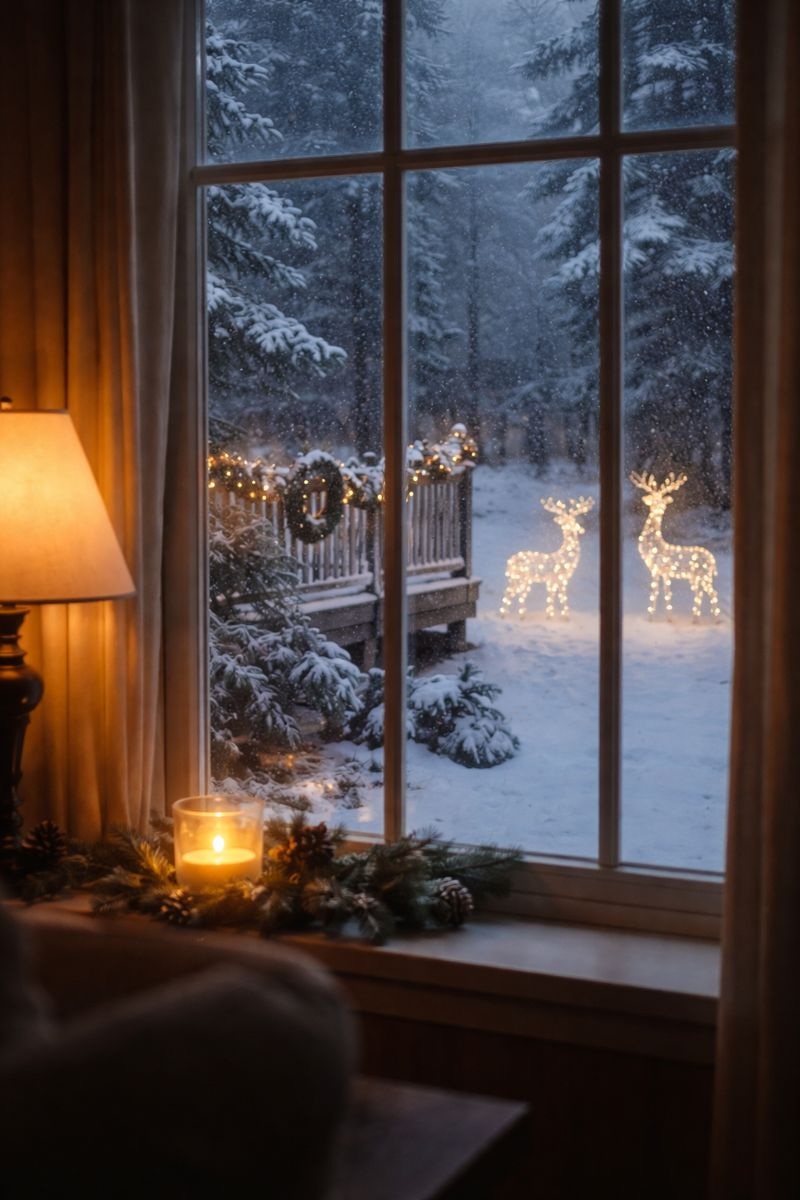

Early morning. Early breakfast. Just the two of us—three, counting Ruby, who has claimed her customary spot under the kitchen table, waiting for the last crumbs of food or wisdom, whichever falls first. Gary and I are sitting across from one another, easing into our day as we always do.

He’s looking out through the French doors toward the deck, where the lighted reindeer we put up together stand frozen in their stately poses of the first snow. I’m facing the working end of the kitchen: stainless steel appliances catching the last of yesterday’s shine, boxwood wreaths hanging in the window, the whole room trimmed and tucked as though company is coming.

Between us is the long view into the living room—garlands draped over the loft railing, trees (plural—cheerfully, unapologetically plural) gleaming in their corners, lamps warming the walls, decorations perched on every surface that would hold still long enough. It looks, frankly, as though Christmas got carried away and stayed for dessert.

Out of nowhere, I say, “She’ll be alone this weekend.”

Gary turns. “Who?”

“My sister. Arlene.” I take a sip of coffee. “I’ve gotten this ridiculous notion in my head that she’s going to round up all the nearby senior citizens and stage their own version of Home Alone.

We both chuckle, but the idea has already taken hold of me, and the cameras start rolling.

I can see it clearly. The walkers revved up like getaway cars, hearing aids squealing like high-tech booby traps, and the whole troop plotting slapstick with the seriousness of jewel thieves. It’s claptrap nonsense, of course. They’d never really do it. Would they? I doubt it. But how would I know? I don’t know any of them except my sister.

But in my mind, the first scene is already framed and from there the full movie unfolds.

The massive wooden door closes with that soft, familiar thump, and for a moment I can hear the whole house settling around it, almost the way a person exhales after company leaves. Snow blankets the yard like a quilt pulled up by a generous hand. In reality, there is no snow there in North Carolina, except in the photograph from last winter that I’m looking at, the one insisting that I let the house and yard wear a snowfall, too.

It’s a small town, one state away. But it could just as easily be your town or mine or anyone’s. Places like this multiply across the country, each one familiar enough that you can walk through the front door in your imagination without fumbling for the light switch.

Inside stands my sister. She’s eighty-five and determined, leaning into the walker that has become her steady companion. Mind you, she wasn’t left home alone accidentally to fend for herself like Kevin McCallister in Home Alone. She’s simply stepping into a quiet weekend while her daughter and son-in-law are away. She has love, support, and everything she needs.

It’s a beautiful house to behold and to be alone inside. Christmas trees are scattered through the rooms like warm invitations. The largest stands in the front room, glowing with the kind of soft light that makes winter feel kinder. Miss Kitty, the household’s silent monarch, purrs beneath it as if she has been appointed guardian of the glittering tree skirt. If mischief were to break out, she would be responsible, not my sister. My sister is more likely navigating the kitchen with caution, pouring coffee, warming dinner, and keeping an eye on keeping steady.

Still, my mind keeps drifting toward the movie. The parallels surface whether invited or not. A child unexpectedly alone. A golden-ager temporarily on her own. Two people at opposite ends of life who have to face the same truth: they’re the only human heartbeat in the house. His version of that truth was noisy and slapstick. Hers, quiet and measured. Yet both had to answer the same unnerving question:

What now?

And that’s where I started to realize that the nonsense of the movie points toward an important truth, one buried deep down inside each of us. The boy did not simply defend his house. He defended himself against the old, universal fear of being alone. He did it in the only way an eight-year-old could: with a heap of claptrap and a wild imagination. He tied paint cans to bannisters. He smeared tar on the steps. He turned cardboard cutouts into party guests. He rigged a toy train so it looked like Michael Jordan was circling the living room. The entire operation was absurd, but it worked. It gave him something to do with his fear, and in doing so, it transformed the fear itself.

I think we all do something similar, no matter our age. We gather what we have at hand and fashion a small defense against the fear of being alone. Children build their courage with noise and make-believe. Adults use busyness, familiar routines, and the jokes that soften the dark edges of a room. Elders rely on rituals, morning light through the same window, and the quiet companionship of animals who seem to understand more than they let on. Whatever the tools, the intention is the same. We are all trying to steady ourselves against the quiet and find a little joy in the process.

This wasn’t theoretical for my sister. She is capable, yet I imagine she felt afraid. She’d never say so, of course. She’s too strong. But, really, who wouldn’t be? When the door closed, when the house settled, when she realized she was the only heartbeat inside, fear must have visited her the way it visits all of us. Human. Ancient. Asking its familiar question:

Can I do this? Alone?

Yet even in her fear, I can imagine her shaping the hours with the practical, stubborn spark that has carried her through a lifetime. If she had been the star of her own senior-citizen remake of Home Alone, she wouldn’t have rigged paint cans or tarred the steps, but I can picture her angling her walker like a modest barricade, checking the locks with practiced determination, setting her ears and senses to “alert mode,” and deputizing Miss Kitty as Head of Household Security. She would have done nothing reckless. She would have done nothing theatrical. She would have done the small, knowing gestures that help an old fear settle down and behave.

It’s right here at this quiet, ordinary threshold that I started to be stirred by an even deeper truth. What my sister faced in that moment isn’t unique to someone alone for a weekend. It is the condition every human being inherits the moment we arrive in this world. Being “home alone” is human. I don’t mean in the cute, holiday-movie sense, but in the older, deeper, existential one. From the beginning, every one of us has lived within the small boundaries of our own minds, our private fears, private hopes, and our private rooms. Aloneness is the quiet fact beneath every era, every culture, every age. An eight-year-old with a slingshot in a Chicago suburb. An eighty-five-year-old with a walker in North Carolina. A shepherd in ancient Israel. A monk in a Himalayan monastery. A woman weaving baskets in West Africa. A man tapping away on his smartphone in the Shenandoah Valley. Put them on the same long timeline and the same truth surfaces: each one faces the same inner room, the same echoing questions, and the same silence that asks to be met.

This is meaning-making, and it begins the moment we face our aloneness, not when we avoid it, not when we panic in it. It begins when we turn toward it and say:

“Well, here I am. Now what? What can I shape from this?”

Philosophers have been wrestling with that same question since the dawn of thought. From the Buddha to Kierkegaard, from Lao Tzu to Camus, from the psalmists to the Stoics, every tradition has circled the same enduring question:

● How does a human being rise inside the solitude of their own existence?

● How do we take the raw material of being alone and coax something illuminated out of it?

World religions, in all their variety and beauty, have offered the same response in their own accents. They do not deny the dark. They answer it with light. Literally, symbolically, ritually. Light as remembrance. Light as resistance. Light as meaning. Light as shared humanity. Advent candles. Hanukkah flames. Diwali lamps. Temple lanterns. The kinara burning through the seven days of Kwanzaa. All of them whisper the same ancient encouragement: keep something bright near you. Keep something burning for the ones who come after. If you must face the dark—and everyone must—then face it with a flame.

As I kept circling back to look at the whole scene, I realized that, at some point, each one of us is “home alone.” But it isn’t a tragedy. And it isn’t a failure. It is simply the place where the human spirit begins to show its strength. When we face the aloneness—not outrun it, not dramatize it, but turn toward it—we start gathering whatever light we can find. A lamp switched on at dusk. A familiar chair pulled close to the tree. A loving voice warming the room. A cat curling into our lap with quiet reassurance. These gestures are anything but small. They are how we turn fear into presence, and presence into possibility.

What astonishes me is not that we are afraid, but that we keep meeting our fear with resourcefulness, humor, memory, and hope. We keep rising. We keep lighting dark corners. We keep finding ways to move through our aloneness with a surprising and stubborn grace.

We don’t pretend aloneness away—we meet it together. That is the miracle.

Day by day, weekend by weekend, life by life, we find enough light to find one another and to walk one another home—alone, together.

I Am Afraid

We can be fearless in proclaiming that we are afraidafraid of what is happening, afraid of what might come, afraid of becoming numb to it all.

It could be any morning up here on the mountain. Any season. The light spills over the valley like it’s been rehearsing for centuries, finding its way to the deck that I sanded and painted myself. Ruby’s already made her first round of the yard, nose to the wind, tail announcing that all is well in our little dominion—hers and mine and Gary’s.

From the outside, it might look like the middle of nowhere. But to us, it’s home. It’s our mountaintop oasis. It speaks peace. It speaks love. It knows both.

And yet—I am afraid.

I’m not afraid of dying.

I’m not afraid of the questions at my annual doctor’s visit—how’s the sleep, how’s the balance, any falls lately? I know the drill, know the tone. It’s the small talk we make with time itself.

I am afraid of more than that. Much more.

I am afraid of living.

I am afraid when I watch our nation take one step, then another, back and back and back toward what too many call the “Good Ole Days.” Days that weren’t always that good in reality—at least not for everyone. I’ve seen real progress during my seventy-seven years, hard-won and deeply felt. But now I know what it feels like to watch it slip away.

I am afraid when I see the National Guard deployed to American cities—unbidden, uninvited—storming in under the cloak of “security,” while local leaders protest and courts rule against the deployment as unconstitutional.

I am afraid when I see streams of homeless men, women, and children forcibly cleared from our Nation’s capital—not relocated, but shamed off the sidewalks, invisible again to the people who run the city.

I am afraid when masked men wearing ICE uniforms sweep through neighborhoods in unmarked vans—when people are grabbed at early hours, dragged from their routines, as children watch from windows.

I am afraid when I see our public health agencies bend—when the CDC overturns or ignores scientific consensus, issuing guidelines that feel political more than medical, eroding trust in what should be shields, not targets.

I am afraid when I see older Americans treated as burdens instead of blessings—when Social Security and food programs are cut under the banner of “efficiency,” when Medicare oversight is weakened and the sickest lose coverage, when senior housing programs vanish from federal budgets as if aging were a mistake. When growing old becomes a liability instead of an honor, a nation has lost its sense of inheritance.

I am afraid when I see poor and working families once again blamed for their poverty—when SNAP and WIC are gutted, when rent assistance dries up, when wages shrink while profits soar. Poverty is being rebranded as personal failure again, as though the system itself weren’t tilting the table.

I am afraid when I see classrooms and libraries turned into battlegrounds—when teachers are monitored, words are banned, and curiosity is treated as defiance. When education becomes indoctrination, the light that should guide us turns inward and burns.

I am afraid when I see our museums stripped of independence—when curators are told which histories to showcase and which to hide, when funding depends on keeping donors and politicians comfortable instead of keeping the record honest. When museums are told what stories to tell, history itself becomes propaganda.

I am afraid when I see the earth itself crying out—when wildfires, floods, and droughts speak the truth our leaders refuse to hear. When those in power in Washington call climate change a hoax, mock science, and dismantle what fragile protections remain—treating the planet not as inheritance but as inventory. The soil, the rivers, the air—they are not ours to own. They are the breath of every living thing that will come after us.

I am afraid when I see our history books rewritten—when the ugliness of our past is softened or omitted altogether, as if truth were a stain to be scrubbed away. I am afraid when textbooks trade context for comfort, when children are taught pride without responsibility. That’s not education. That’s amnesia dressed as virtue.

I am afraid when I see books banned from shelves—works of art, witness, and imagination stripped from students’ hands because someone decided fear should be the curriculum. A nation that fears its own words is a nation already forgetting how to think.

I am afraid when I see faith itself being rewritten—when those who hold the Bible high forget the heart of its message: love thy neighbor as thyself. When “the least of these” are ignored or condemned, when compassion is replaced with control, when the name of Christ is used not to comfort but to conquer.

I am afraid when I see the Department of Defense renamed the War Department—as if we’ve abandoned even the language of restraint, as if the goal were not defense but dominance. Words matter. Change the name, and you change the story. Change the story, and you change what we become.

I’ve lived long enough to see this nation inch closer to its promise, step by hard-won step. I watched the Civil Rights Movement force open doors that had been locked for centuries. I watched women claim the rights and respect they were long denied. I watched same-sex marriage move from silence to law, from whispers to weddings. I watched a Black man take the oath of office as President of the United States and felt, for the first time in my life, that maybe—just maybe—we were learning what equality really means.

And yet, I’m watching so much of that progress being undone in plain sight—rolled back by men who smile as they sign the papers. That’s what eats at me. We came so far. We proved we could change. And now I fear we’re proving how quickly we can forget.

I have one more fear—one that hits closer to home for me than any of the others, and yet it reaches out and encompasses them all.

I am afraid when I see LGBTQ freedoms stripped away in bill after state bill—protections withdrawn, rights revoked, marriages questioned, school policies reversed—while the rhetoric whispers “return to order,” but the victims are many.

It hits me hard, like a gut punch, because I know what it feels like to live quietly on the margins of acceptance. I had a place at the table—as long as I behaved. As long as I laughed at the right jokes. As long as I didn’t speak the truth of who I was. I was welcome, yes—but only in disguise. That was the unspoken bargain: conformity in exchange for belonging. A seat, but not a voice. Presence without personhood.

It took me years to understand that silence isn’t peace—it’s erasure wrapped in politeness. And acceptance that depends on pretending is not acceptance at all. So when I see hard-won freedoms for LGBTQ people being stripped away, I don’t see politics. I see people—people like me—being pushed back into the shadows we worked so long to escape.

I am afraid, too, of the silence that wears love’s disguise. Of families who say they accept us—so long as it’s private. Who love their gay brother or their trans child quietly, behind closed doors, but never speak that love out loud. Because public love takes courage, and private love costs nothing.

I am afraid that if the reckoning comes—and it may—some of us will look around and find that the people who said they loved us privately will deny us publicly.

And I am afraid that the ground is shifting for all of us—that what’s being erased is not just rights, but recognition of value.

I am afraid that we are being bombarded deliberately with so much chaos and confusion that we are forgetting what lies at the core of who we are—as Americans, yes, but more deeply, as human beings: the value of the individual.

The gay and the straight.
The trans and the cis.
The believer and the atheist.
The refugee and the citizen.
The imprisoned and the free.
The Black and the white.
The immigrant and the native-born.
The woman and the man.
The poor and the privileged.
The child and the elder.
The body that moves easily, and the one that cannot.
The mind that remembers, and the mind that forgets.
The one who speaks, and the one who has no voice.
The one who is seen, and the one who is invisible.

Each carries the same sacred value.
Each bears the image of us all.
Leave one behind, and the whole is diminished.
Forget one, and the soul of the people forgets itself.

I am afraid that this forgetting has already begun. It’s not just in Washington, though Washington leads the charge. It seeps into pulpits, classrooms, living rooms—into the quiet corners of our own decency. It’s in the news we scroll past, the cruelty we explain away, the silence we call “staying out of it.”

I am afraid because I see what happens when the faceless stay faceless—when the homeless become numbers, when the refugee becomes a threat, when the trans child becomes a talking point. I am afraid because I know what happens when we stop seeing each other as sacred.

And I am afraid because I’m not sure what I can do.

But I know I have to do something. We all do.

We can vote. We can write. We can reach out to those in power and to those who believe they hold it. But maybe more than any of those things, we can be fearless in proclaiming that we are afraid—afraid of what is happening, afraid of what might come, afraid of becoming numb to it all.

We can name it.
We can put a face to it.
We can be the moral engine of one—
each of us reaching further than comfort,
further than tribe or label—
to hold on to what makes us human,
to reclaim it before it slips away.

One human being girding up another.
One hand extended.
One voice saying, I see you.
That’s where resistance begins.

We can show, by the way we live, that each person matters—every single one. The forgotten, the dismissed, the weary, the silenced. Because the measure of a democracy—like the measure of a soul—is not how it treats the powerful, but how it protects the powerless.

So yes, I am afraid.
But fear, spoken aloud, can become light.
And light, once shared, can become strength.

Maybe that’s where our healing begins:
in the courage to care out loud,
to stand with the one beside us and say,
You are not forgotten.

Because the next person erased could be someone we love.
Or it could be us. You. Me.
But if we stand together—if we keep standing—
it will not be all of us.

⸻ ✦ ⸻ ⸻ ✦ ⸻ ⸻ ✦ ⸻

If this essay speaks to your heart, please like it. Please share it.
Let it travel further than fear—and bring us closer to hope.

Show Me What You Wrote

“The act of writing is the act of discovering what you believe.”

— David Hare (b. 1947.) British playwright and screenwriter, whose works probe truth, belief, and the human condition.

Sometimes in the hush of evening, when the lamp spills its amber light and the world grows gentle, I watch. His head tilts slightly, caught by the glow, and suddenly, the years loosen their grip. The lines that life has written across his face soften; the jaw loosens, light as breath; the mouth, so often set in quiet thought, curves with the ease of youth. His eyes, clear and steady, seem to brighten from within, carrying a spark that belonged first to a boy and then to a young man. Slowly, the present thins. I see him slipping into his past. Fifty. Thirty. Twenty. And then, for the briefest moment, the man beside me becomes the eighteen-year-old he once was—time erasing each layer, revealing what was always there: the young man, quietly returning.

As I glance elsewhere in the room, I see an artifact from his past—one that has crossed time and threshold to find its place in ours: the grand piano. Massive and unyielding, it took four men to wrestle it off the truck and ease it through the doorway. Yet here it rests, polished wood catching the lamplight, waiting.

At this moment, I still hear the sound as his hands moved across the piano earlier in the day—measured, assured, easy. And I heard “For All We Know” rise into the room, each note carrying a hush that reached backward in time. The melody was not just music; it was memory, and it wrapped itself around him, around me, around the room itself. Ruby retreated to the bed, but not fully at rest. She leaned forward, her body stretched long, her head angled as far as she dared—as though even she knew the swell of sound carried us into places layered and deep. She held herself at the edge, cautious not to tumble into the wandering past, into the chasms of memory, beckoning us toward knowing and truth.

Elsewhere in the room, near the piano, another layer from the past peels back. Hanging on the wall is a sepia-toned etching—Salena Gazebo, number 8 of only 200, signed by the artist Carl Johnson. The lines are delicate, deliberate: the curving path, the quiet trees, the pavilion standing open like an invitation. It feels less like a structure than a memory, as if the paper itself breathed it into being. When I look at it, I sense not just the gazebo, but the moments once lived beneath it—the warmth of gatherings, the hush of twilight, the whispered vows of past lovers who lingered there. Dream and truth blur, as though the etching had captured not a place at all but a pulse of longing and a flicker of knowledge, carrying us softly toward knowing and truth.

In another room, on top of the chest of drawers, rest family photographs. Portraits, a chorus of faces gathered through years, smiling, standing, caught in stillness. They look out across the room with a quiet weight, less about who they are than the collective feel they give: belonging, continuity, the insistence that life moves forward even as it circles back. They do not need names to speak; their presence alone is enough.

Nearby, on a table, sits something smaller, more ordinary yet no less enduring: an iron toast holder. His grandmother’s. On his mother’s side? Or, maybe, his father’s? The lineage matters less than the fact that he kept it, carried it through moves and years, never discarding, never forgetting. The metal holds more than memories of bread he may never have seen toasted. It holds a thread of persistence, a reason to keep even the smallest objects close.

In the dining room, on a side table, another artifact gleams in silver relief: The Last Supper, framed, gifted to his maternal grandparents on their fiftieth wedding anniversary. Sacred and commemorative at once, it shimmers with devotion, not only to faith but also to family. The silver has traveled down through generations, carried into his keeping, held as though letting go would diminish more than memory. It is a marker of continuity, of reverence, of love that lasted long enough to be honored.

And then there is the little boy riding a dog—a keepsake that belonged first to his father when his father was a child, before his life was cut tragically short. A small porcelain figure, a child astride a loyal companion, frozen in time. Yet in that figure is more than innocence; it is a bridge across absence, a way of knowing a father he never met. It survived when the man did not, passed on to him as both wound and inheritance, loss and gift. That little boy on the dog rides still through the years, carrying ache and legacy.

Through these artifacts, I glimpse the man I already know and love, his story unfolding in fragments that matter. In the little boy riding the dog, I see both wound and inheritance, a bridge across absence. In the Last Supper, I see reverence, devotion, love honored and passed along. In the iron toast holder, I see endurance, the instinct to keep and carry even what is small. In the family photographs, I see continuity, lives pressed together across generations. In the drawing of the gazebo, I see invitation and hush—the twilight blur where dreams fade into memory and truth. And in the grand piano, I hear the melody that threads them all together—still rising, still echoing, ever playing in the quiet of his soul.

These artifacts matter to him and, now, to me. I could point to others. But I won’t. Yet one more remains, quiet and insistent, the truest of them all—not carved in silver or pressed into porcelain, but carried in ink and idea. His 1965 high-school graduation essay. He was co-valedictorian. He was eighteen.

It rests inside his high-school yearbook, the Bluejay, its cover deep blue and gilt, its pages a mosaic of faces, cheers, and world events already turning into history. And there, slipped carefully between those pages, lies his speech—typed, carried through six decades of moves and seasons. The paper holds its shape, and the words stand sure, preserved as though waiting for their moment to be read again. In its keeping, I see more than memory; I see devotion—the instinct to preserve not only what he did but who he was becoming. It is an artifact, yes, but it is also a testament, held safe in the place that marked his youth and carried forward into the man he is now.

I smiled and whispered:

“Show me what you wrote.”

He lifted the page, holding it in his hands, just as he held it onstage sixty years ago. Soft at first, his voice grew firmer as he returned to the beliefs that had steadied him even then: that learning gives life its shape, that responsibility gives it weight, that hope gives it breath, and that perseverance gives it endurance. Sixty years have passed, yet as he read, I heard not only the boy addressing his classmates but the man beside me—the same convictions intact, the same spirit enduring.

In those moments, as his voice stretched back and returned to me across the decades, I realized that of all his artifacts, this was the richest. My partner, Gary T. Knutson, wrote those words in youth. They carried him into a future he could not yet imagine. And they anchor him still—steadying him in the present, guiding him toward tomorrow. The piano may sing, the photographs may remember, the silver may gleam, the porcelain boy may still ride—but they can only point, only hint. His own words, fragile on paper yet alive in spirit, opened the door wider. They revealed not just what he kept but who he was becoming, and who he still is.

That is the power of words—not just Gary’s words, but all our words. They outlast objects, outshine heirlooms, outlive even memory. In them can be found who we are when all else has been stripped away—values, beliefs, longings, the essence of self, laid bare. And more than that, words do not simply keep; they move. They persuade and console, ignite and endure. They reveal who we were, and they shape who we might yet become. That is their gift, and their power—becoming, in a way, stronger than stone.

Show me what you wrote, and I’ll see who you are—then, now, and still becoming. For words outlast memory and outshine the heirlooms we keep. They carry the essence. They carry the longing. And they proclaim the truths we’ve always held.

Abandon Hope? Not a Chance!

“Hope is being able to see that there is light despite all of the darkness.”

Desmond Tutu (1931–2021; a South African Anglican bishop, social rights activist, leading figure in the struggle against apartheid, and an enduring global symbol of hope and resilience.)

Sometimes, a recollection gets trapped in my mind and won’t exit, even when I open a door. One memory paid me a visit weeks ago, and it’s still lingering. I’ve decided that the best way to get rid of it is to write about it, send it out into the world, and let it take up residence in other people’s minds. So, here: it’s yours now.

The memory is from 1968. Student attitudes on college campuses–even at a conservative school like Alderson-Broaddus, where I was a junior–were marked by activism and rejection of traditional norms and authority. Fueled by the counterculture movement, we protested for civil rights, opposed the Vietnam War, and championed various social justice causes, shaping a decade defined by idealism and dissent.

Some of that spirit spilled over into the classroom and sometimes made some of us bolder than we might otherwise have been.

It certainly made me bolder that spring when I was taking a three-credit World Literature course. We focused heavily on Dante Alighieri’s epic poem The Divine Comedy, widely considered to be the pre-eminent work in Italian literature and one of the greatest works of Western literature. Divided into three parts–Inferno, Purgatorio, and Paradiso–the poem explores the state of the soul after death and its journey toward God.

My classmates and I felt challenged by Dr. Callison’s rigor and her insistence that we gain an in-depth understanding of this acclaimed literary work. We did, as I recall, and we even grew to like the poem, playfully sprinkling our daily conversations with some of its famous lines.

Nonetheless, we all felt anxious as exam day approached. I decided to be bold and comedic by making a banner to put above our classroom door so that my classmates would see it as they walked in to take the exam. I created the banner alone, told no one about it, went to our classroom in Old Main, and hung the banner well in advance. There–in a position of prominence for my classmates and Dr. Callison to see as they entered–was a line from the Inferno section of The Divine Comedy as Dante passes through the gate of Hell:

“Abandon hope all ye who enter here.”

I wanted the banner to be a grim but humorous reminder that as we faced the Hellish torments of Dr. Callison’s exam, we could neither be redeemed nor rescued.

Everyone stared at the banner as they entered the classroom and proceeded to their seats. Some laughed. Some gasped. All questioned: “Who would dare be so bold, especially in Dr. Callison’s class?” Some even speculated that she was the prankster. I sat there quietly, hoping to look as innocent as one of the souls headed toward Paradise.

My countenance worked. No one suspected me, not even Dr. Callison when she walked through the door. To our surprise, she burst into laughter and continued laughing as she handed out bluebooks and wished us well on the exam.

I’ve thought about that day often down through the years, not because of my bold banter–revealed here for the first time ever–but rather because of my take on the famous line, “Abandon hope all ye who enter here.” I understood the literal interpretation of the line precisely. It’s a warning to all who enter Hell that they are leaving behind all hope of salvation or escape. It sets the tone for the suffering and despair that pervades Hell, emphasizing the eternal nature of the punishment awaiting the damned souls within.

However, as a student then–and as a lifelong learner now–I find that literature takes on richer dimensions when looked at metaphorically.

I saw Dante’s poetic line then–and I see it now–as a caution against entering into a state of despair or hopelessness. It suggests that giving in to despair is like crossing a threshold into a mental or emotional Hell, where recovery becomes incredibly difficult if not impossible. It’s a warning to maintain hope and resilience even in challenging circumstances. Otherwise, we will create our own Hell and live in it right here on earth.

Don’t get me wrong. I know despair. Who doesn’t experience despair during moments of profound loss, such as the death of a loved one, the end of a significant relationship, or the loss of a job? We all do. Who doesn’t experience despair when grappling with chronic illness or debilitating injury, especially if it hinders our ability to pursue our passions or maintain our independence? We all do. Who doesn’t experience despair when feeling overwhelmed by financial struggles, loneliness, or a sense of purposelessness? We all do.

Although I understand the nature of despair, it seems to me that embracing a positive and optimistic mindset can be a powerful antidote to despair.

Years ago, I made a conscious decision that my glass would always be “half full” and that I would actively cultivate a positive outlook on life, even in the face of challenges. That approach has served me well.

Let me share with you some of the strategies that I use to foster positivity and optimism.

I strive to find joy in everyday moments. I cultivate mindfulness by being fully present and appreciating the simple pleasures of life, whether it’s a beautiful sunset on my mountaintop, a delicious meal in my kitchen, or a heartfelt conversation with a stranger.

I work hard at practicing positive thinking. When negative thoughts come my way–and they do–I reframe them in a more positive light. When I have problems–and I do–I shift my focus and dwell in the realm of solutions.

I make a point every day of counting my blessings. Sometimes, I carve out time to reflect on the things that I’m grateful for. However, more often than not, I take time to be grateful each time I’m aware of a blessing. I find that approach to gratitude lets me be in constant celebration of what I have.

I do my best to surround myself with positivity. I listen to uplifting music, and I spend time with optimistic and supportive people who uplift and encourage. Positivity is contagious.

I make living a healthy lifestyle a priority. I know that my physical well-being directly influences my mental and emotional health. Indoor biking is a priority for me, along with nutritious eating, adequate sleep, and meditation. All of those things work together to keep me upbeat and resilient.

I do my best to practice self-compassion. I try to be kind to myself when the going is rough, and I try to treat myself with the same compassion and understanding that I offer others who would be facing similar challenges.

I believe in laughter. I don’t have to work too hard to find humor in life through books, jokes, spending time with friends who make me laugh, or, best of all, laughing at being me. Humor provides relief and perspective in tough times.

I’ve saved my best strategy for last because it’s the one that I know I can rely on the most. I cultivate a sense of faith or belief in the overall goodness of life and humanity. I trust and believe that, despite challenges, humanity’s inherent thrust toward greatness and goodness will prevail.

I must add that because I work to stay positive doesn’t mean that I ignore or deny negative emotions. I don’t. I acknowledge them while consciously choosing to focus on the positive aspects of life and maintaining hope for the future.

As I look back on that bold act of hanging the banner, I realize how much it symbolizes a pivotal lesson from my college years—maintaining hope and resilience in the face of adversity. That memorable day in Dr. Callison’s class reaffirmed for me that humor and a positive outlook can transform even the most daunting challenges into manageable experiences.

Now, decades later, I believe that lesson remains relevant. We all encounter moments of despair, but we don’t have to surrender to them. By fostering positivity and optimism, we can navigate life’s hardships more effectively. The strategies I’ve outlined—practicing gratitude, surrounding ourselves with positive influences, and embracing humor—serve as a powerful toolkit against despair.

Ultimately, the famous line from Dante’s Inferno serves as a cautionary reminder not just of the perils of Hell, but of the importance of hope in our daily lives. By choosing to see our glass as half full, we can maintain a sense of purpose and joy, even amid difficulties. Let’s embrace the enduring message that hope and resilience can guide us through even the darkest times.

My Kentucky Wonder

“To cherish what remains of the Earth and to foster its renewal is our only legitimate hope of survival.”

–Wendell Berry (b. 1934; American novelist, poet, environmental activist, cultural critic, and farmer.)

My oldest sister, Audrey, keeps everything, and, like her memories, everything is tucked away here and there and everywhere, ready to be brought out and shared with others in a heartbeat.

Not too long ago–Yesterday? The day before? Forever ago?–she sent me a package, securely wrapped and taped, as befits irreplaceable heirlooms sent out into the world, leaving nothing behind to hold on to save precious memories.

When the package arrived, I wondered what was inside. With great care, I managed to unloose family treasures that had been alive decades ago, now destined for a new life decades later.

One by one, I gave Audrey’s relics the loving release that she desired. As I held each, I witnessed the release of my own memories locked away since–Yesterday? The day before? Forever ago? I recognized and remembered everything immediately.

The stainless steel EKCO can opener from my teenage 1960s, perfect for opening cans and bottles with ease, even today. It must have been quite high tech in its day, based on the full directions stamped into the handle:

MIRACLE CAN OPENER. HOLD IN LEFT HAND – HOOK GEAR UNDER RIM OF CAN – SQUEEZE HANDLES – TURN KEY TO RIGHT.

I grin as I hold that vintage kitchen marvel. Squeezing the handles, I wonder why my sister held on to it.

The Belgian tapestry, measuring 18″ high x 56″ long, that once hung above the fireplace mantel in my parents’ bedroom. I recall its presence vividly when I was a toddler. It offers a captivating glimpse into a Venetian court ball beneath a moonlit sky, where graceful dancers swirl elegantly across an outdoor terrace, their movements bathed in the soft glow of the moon. Despite some fraying along the edges, the tapestry remains beautifully preserved, capturing the timeless allure of a bygone era. I wonder when my mother gave the tapestry to my sister.

The Ever-Ready #79 Sterilized Shaving Brush, with its bakelite handle adorned in a nostalgic red and cream hue, its bristles worn ragged by decades of use. As a child, I watched my father dance the brush upon the surface of the soap, coaxing forth creamy lather like an artist delicately crafting a masterpiece. As a teenager, I danced that brush on the surface of my own shaving soap as I journeyed into manhood. Now, as I hold the brush in my hand in a moment of memory and reflection, time stands still, and I wonder when my father held the brush in his hand for the last time.

The Red Velvet Pipe and Cigarette Tobacco tin, with a hinged lid, made by Pinkerton Tobacco Company, Owensboro, Kentucky. It’s still filled to the top. My father smoked cigarettes until he was seventy and had a heart attack. I wonder whether this was his last tin of tobacco when he came to the realization that he had to quit.

The robust pipe, the next item that I gave release. When my father stopped smoking cigarettes, he took up pipe smoking. I hoped that the pipe in my hand was the incredibly expensive Meerschaum that I gifted him. It wasn’t. Instead, what I held in my hand was a Whitehall Jumbos large rustic straight pot pipe. It shows slight signs of age, but the walls of its bowl remain thick with a large flat surface on the rim. The pipe has a robust feel in my hand. I wonder when my dad held it in his weathered hands for the last time, wisps of smoke dancing ’round his head, carrying the rich fragrance of aged tobacco that I so much enjoyed. I wonder what happened to the Meerschaum that I hoped to hold.

Or the infamous knife, the one that nearly cut off my right hand. When but a child—no more than four or five, so small that I had to stand on a kitchen chair to watch as my father butchered a fresh chicken—I reached out to ask, “What’s that?” just as his knife—raised high in air—came thrusting down to sever the chicken breast. The knife could not stop. With equal speed, my father’s hand grasped my nearly severed right hand and held it in place until the doctor arrived. Today, the scar that spans my hand authenticates the strength of his: holding on, not letting go. My mother threw the kitchen knife into the coal bucket, resolving to never use it again. My oldest brother, John, took the knife and hid it away in a brown paper bag. Now, as I hold the knife in my scarred right hand and the crumpled bag in my left, I wonder why he retrieved it. I wonder why he kept it. I wonder when he passed it on to Audrey.

Or what about the Prince Albert Tobacco can, the last heirloom in the box that arrived–Yesterday? The day before? Forever ago? It’s the one that fascinates me the most. It’s 3 inches wide, 4 inches tall, and 3/4 inch thick. It’s vivid red, adorned with elegant gold lettering. On the front is an oval portrait of Edward VII before he was king, when he was known as “Prince Albert.” Since the image appears on the front only, the tin would have been manufactured before 1960. After that year, it was printed on the front and the back. 

As I run my fingers over its surface, I feel the nostalgic echo of my father’s smoking tradition. This pocket tin holds more than just the 1 5/8 ounces of tobacco that it once held. It holds treasured memories of a time that is no more.

Audrey taped a small handwritten note on the front:

Look in can under paper. Try to see if they will grow.

I wonder what’s inside. I take my thumbs and push up on the lid. I remove the paper. Beneath, bean seeds. Dark brown bean seeds.

“Kentucky Wonder!” I exclaim to myself. “Those are Kentucky Wonder seeds, my father’s favorite pole beans.”

I called Audrey to thank her for passing these keepsakes on to me. We shared memories, hers far richer than mine because she lived those treasures through the eyes of an older sibling.

She’s certain that the Prince Albert Tobacco tin is from the 1930s or 1940s, when my family lived in Cherokee (WV). She’s certain that my father collected those seeds from one of his gardens during those years.

Now, I’m not sure when that box of treasures arrived–Yesterday? The day before? Forever ago? But now that spring is here, I vow to do what Audrey bid me do:

“Try to see if they will grow.”

My mind is racing fast and faster with questions. I could ask Audrey who, no doubt, would know the answers.

But my mind is slant toward wonderment.

● I wonder whether those seeds really are from the 1930s and 1940s.

● I wonder when Audrey closeted away that tobacco tin filled with such potential.

● I wonder why she didn’t plant the seeds herself.

● I wonder why she sent the seeds to me, now, as she approaches 90 and as 80 chases me.

● I wonder whether those seeds will germinate and grow after all these years.

● I wonder whether those seeds really are Kentucky Wonder beans.

● I wonder what bean they might be if those seeds are not Kentucky Wonder.

I don’t wonder, however, about what I need to do. I will do exactly as my father and I did when I was but a child, and we started gardening together. As soon as the danger of frost is past and my fingers feel warm when I push them deep into the soil, I’ll put the seeds in a glass of water, and I’ll wait patiently for them to sprout.

Then, I’ll plant them, in threes, next to something tall that they can cling to and hold on to as they climb higher and higher. Then I’ll wait and watch with hope as summer unfolds and fulfills itself, wondering whether my father’s Kentucky Wonder beans, after seven decades or more of hiding away, have run back home to me.

§ § §

John Saunders Kendrick (April 8, 1902–September 21, 1983)

Let Your Light Shine Bright

won’t you celebrate with me
what i have shaped into
a kind of life? i had no model.
born in babylon
both nonwhite and woman
what did i see to be except myself?
i made it up
here on this bridge between
starshine and clay,
my one hand holding tight
my other hand; come celebrate
with me that everyday
something has tried to kill me
and has failed.

–Lucille Clifton (1936-2010; “won’t you celebrate with me”; acclaimed poet and writer who overcame significant obstacles related to race, gender, and economic adversity; a Chancellor of the Academy of American Poets; Poet Laureate for the State of Maryland; and Distinguished Professor of Humanities at St. Mary’s College of Maryland)

Sometimes late at night when my words grow tired of dancing and I grow tired of waiting for the dance to begin anew, I let music waltz me off to sleep. Recently, I drowsed off to Susan Boyle singing “I Dreamed a Dream” from Les Miserable. Instantly, I remembered her appearance on Britain’s Got Talent (2009, Episode 1, April 11). I was mesmerized across time’s timeless expanse. I knew then, and I know now, exactly why. In part, it’s because of the poignant lyrics that evoke raw and vulnerable emotions:

I dreamed a dream in time gone by
When hope was high and life worth living
I dreamed that love would never die
I dreamed that God would be forgiving

In part, it’s because of Boyle’s powerful, soulful, resonant, evocative, and captivating voice.

However, more than the voice and more than the lyrics is this. Susan Boyle overcame great odds and landed a triumphant second-place finish. Her performance left everyone reeling, including the judges:

Piers Morgan: Without a doubt, that was the biggest surprise that I have had in three years on this show. When you stood there with that cheeky grin and said, ‘I want to be like Elaine Paige,’ everyone was laughing at you. No one is laughing now. That was a stunning, an incredible performance. Amazing. I’m reeling from shock. I don’t know about you two.

Amanda Holden: I am so thrilled because I honestly think that everybody was against you. I honestly think that we were all being very cynical, and I think that’s the biggest wake-up call ever, and I just want to say that it was a complete privilege listening to that.

Simon Cowell: Susan, I knew the minute that you walked out onto that stage that we were going to hear something extraordinary, and I was right. […] Susan, you’re a little tiger, aren’t you?

Then, the moment of truth: the voting and the final word:

Cowell: Susan Boyle, you can go back to the village with your head held high. It’s three yesses.

Cowell’s comment–“Go back to the village with your head held high”--resonates with all of us. Something in us makes us root for the underdog–“everybody was laughing at you”–because we’re hoping that someone out there is rooting for us when others are laughing.

Susan Boyle’s performance that night catapulted her into fame and stardom and set me to thinking about other underdogs whom I admire because they overcame seemingly herculean obstacles to achieve success, sometimes breaking barriers, always reminding us that the human spirit can prevail against all odds.

Immediately, I started thinking about underdogs from my home state of West Virginia. In an instant, Pearl S. Buck, author of The Good Earth and the first American woman to win the Nobel Prize in Literature, came to mind. With equal speed, I was ready to exclude her because I wasn’t certain that she had really faced obstacles on her path to fame. Then I remembered. Born in Hillsboro, the daughter of missionaries, she spent much of her early life in China. Without a doubt, she faced monumental challenges growing up as a minority in a different culture, and her early years were marked by poverty and social isolation.

Closer to where I grew up is Bill Withers, known for his acclaimed hits like “Lean on Me” and “Ain’t No Sunshine” and heralded as the Bruce Springsteen of the African-American community. Born in Slab Fork, a coal mining town, Withers grew up in a poor, working-class family and rose above those obstacles. His soulful and heartfelt songs have left a lasting impact on the music industry.

Still within spitting distance of where I grew up is Katherine Johnson from White Sulphur Springs. She was a pioneering mathematician and physicist known for her contributions to NASA’s early space programs. Her story gained widespread recognition with the release of the movie Hidden Figures, which highlighted the overlooked contributions of African-American women mathematicians to the space race.

And what about Homer Hickman, who grew up in the coal mining community of Coalwood? Inspired by the launch of the Soviet satellite Sputnik in 1957, he pursued a career in rocketry. Hickman’s story is depicted in the memoir Rocket Boys, later adapted into the film October Sky. He overcame the challenges of his mining town upbringing and became a NASA engineer.

Obviously, I can’t leave out Jeannette Walls who spent part of her life in Welch–just a stone’s throw from Coalwood–and went on to write The Glass Castle. Her memoir details her unconventional and challenging childhood, growing up in poverty with her eccentric and nomadic family. It has received widespread acclaim for its honest portrayal of resilience and determination in the face of adversity.

I thought, too, of Don Knotts, actor and comedian best known for his role as Barney Fife on The Andy Griffith Show. Born in Morgantown, he grew up in a family that struggled financially during the Great Depression. As a child, he was known for his lanky frame and high-strung personality, but he used humor as a way to cope with social awkwardness and to connect with others.

All of those West Virginians–and I could talk about others who resonate with me, including Chuck Yeager, Mary Lou Retton, Brad D. Smith, and John Nash–showcase the resilience and determination to be found time and time again as underdogs overcome obstacles–whatever they may be–and achieve success that inspires each of us and helps us believe:

“If they can do it, I can, too.”

By and large, my West Virginia anchors of hope overcame economic and cultural barriers. But here’s the beauty of it all. Anchors of hope can be found everywhere in the world, in every field of endeavor that we attempt, and in every obstacle that we face.

Among writers, I would note James Baldwin, an African American and openly gay writer, who faced the dual challenges of racial and sexual discrimination during a time of significant social upheaval. His eloquent and unapologetic writing style made him a prominent figure in the Civil Rights Movement and an influential voice for the LGBTQ+ community.

Another writer who transformed obstacles into insightful and controversial Broadway plays is Edward Albee, whose life was far from easy. Adopted into a wealthy family when he was just 18 days old, he never felt a sense of connection with his parents and instead felt alienated from them because of their high morality. Growing up gay in the 1930s and 1940s posed immense challenges for Albee–at home and beyond–yet he stood strong, celebrated his sexual orientation, celebrated the larger LBGT+ community of Greenwich Village and the world. At the time of his death in 2016, he was hailed as America’s greatest playwright.

I’m thinking about others who defied gender norms and achieved success, people like Christina Tosi founder and co-owner of Milk Bar, serving as its chef and chief executive officer. Food & Wine magazine included her in their 2014 list of “Most Innovative Women in Food and Drink.”

I’m thinking as well of Dr. Carla Hayden who made history by becoming the first woman and the first African American to serve as the Librarian of Congress. She overcame gender and racial barriers to become a trailblazer in the field of librarianship. Her leadership exemplifies resilience and the ability to break down barriers in traditionally male-dominated professions.

In the political realm, what about Shirley Chisholm (first African-American woman in Congress) or the late Sandra Day O’Connor (first female justice of the United States Supreme Court) or Barack Obama (first African American to be elected President of the United States)?

What about overcoming mental health challenges and financial hardship as Vincent Van Gogh did? He produced some of the most iconic and influential works in the history of art, demonstrating the transformative potential of creativity in the face of personal adversity.

Or can you imagine being born with no limbs? I’m thinking now of Nick Vujicic who overcame that immense physical challenge to become one of the most important motivational speakers today, delivering a message of resilience, gratitude, and the limitless potential of the human spirit.

These are just a few of my anchors of hope. I could go on and on with others, each representing a unique testament to the human spirit. Chuck Close (who triumphed over physical disabilities in art), and Misty Copeland (who shattered barriers in ballet) embody the resilience and determination that inspire me. Denzel Washington (rising from a challenging childhood to acclaim in acting) and Beverly Cleary (whose pioneering work defied gender norms in children’s literature) exemplify the power of perseverance. Dr. Ben Carson’s journey from poverty and academic struggles to a renowned neurosurgeon and Jay-Z’s success in overcoming the challenging environment of Brooklyn’s Marcy Projects showcase the transformative potential within adversity. Mark Zuckerberg (who faced skepticism and legal challenges in Facebook’s origins) and Elon Musk (who overcame personal and financial struggles in Tesla and SpaceX’s early days) reflect the tenacity of visionary entrepreneurs. Morgan Freeman (defying age norms with a career renaissance in his fifties) and Laura Ingalls Wilder (achieving fame at 65 with her Little House series) symbolize that hope and success know no age limits. Each is an additional anchor, proving that obstacles can be stepping stone’s to greatness.

I celebrate my anchors of hope all year long, but I do so even more during December. It’s a month chockfull of celebrations, starting with Hanukkah, moving on to St. Nicholas Day, Bodhi Day, Las Posadas, The Feast of Our Lady of Guadalupe, Yule, Christmas, and ending with Kwanzaa. Each carries a unique message of hope, transcends boundaries, and unifies us in the spirit of optimism and shared celebration. What better time than now to celebrate the triumph of the human spirit against all odds and to gift ourselves with an extra measure of hope.

And you? Who are your anchors of hope? Reflect on them. Celebrate them. Hold them close to your heart. As you do, don’t forget the unsung heroes who can also be anchors of hope. A mother’s resilience, a father’s unwavering support, a brother’s camaraderie, a sister’s understanding, a teacher’s guidance, and a neighbor’s kindness—anchors, each and every one. With their unspoken sacrifices and steadfast presence, they embody extraordinary strength within ordinary moments, reminding us that greatness resides not only in fame but also in the uncharted territories of love, connection, and the indomitable spirit of the human heart.

As you reflect, remember this as well. Someone, somewhere, might be looking to you as their everyday hero who has achieved success against all odds. Someone, somewhere, might be looking to you as their anchor of hope.

Be the light that someone else needs to see. Shine bright. Shine bright.

The Story of Angel Falls

“Hope” is the thing with feathers –

That perches in the soul –

And sings the tune without the words –

And never stops – at all –

from “Hope is the thing with feathers” by Emily Dickinson (1830-1886)

This is a story about a weeping pine.

But it’s not just any story. It can’t be just any story, because this isn’t just any weeping pine.

This weeping pine is a special weeping pine. It’s one of a kind. It’s unique.

I bought it about four months ago. Actually, I bought it on March 17. In case you’re wondering why I remember the exact date, here’s why. It was my late partner’s birthday.

I had not planned to buy anything that day. I was just browsing the local nursery’s new arrival of plants, mainly West Coast conifers.

As I walked past one conifer, it looked like a stunning, younger version of a stately, older weeping pine right outside my kitchen door. “Gorgeous!” I thought. “But no need for another one.”

At about the same time, the manager walked past and saw me looking. Lingering. Pondering. Wondering.

“You don’t want to miss out on this one, Dr. Kendrick. It’s super special. We only have two, and they’ll go fast.”

I’ve known John since he was a youngster, when his dad owned the nursery, and I trust him just as implicitly as I trust his dad.

“Oh, yeah?” I teased. “What makes it so special?”

John started telling me all the details, reassuring me that it’s mature size would be perfect for the small area where he knew that I wanted a unique conifer.

I leaned in close to take a closer look at the tag, and as soon as I saw the name–Angel Falls–I knew that this tree was going home with me. It had to go home with me. Aside from being Allen’s birthday, I had written a blog post about him two months earlier, “Honoring an Angel.” But this story is not about Allen. This story is about a special weeping pine.

I had an immediate plan. This tree would become one more focal point in the garden that I had designed for Allen. But, again, this story is not about him. This story is about a special weeping pine.

I had just one concern. Even though the tree was small–no more than three feet tall–it was in a large tub, the size, perhaps, of a bushel basket. I knew that John would help load the tree into my Jeep, but could I manage to unload it alone?

I decided to figure out the logistics after I got the weeping pine home.

And figure it out I did. I stacked bags of mulch below my Jeep’s lowered tailgate. I slid the tubbed weeping pine onto the top bag, and, then I continued stepping it down onto the ground.

From that point forward, I knew that dragging it downhill to its intended destination would be as easy as stepping into the future.

And, for a second, I stepped off the sharp edge of now into the softened expanse of tomorrow. I stood there–looking beyond the spot where I would plant the weeping pine–gazing ahead into years, each stretching beyond the next, further and further and further into the memory of forever.

And there it stood, as majestic and as grand and as unique as I ever dreamt or hoped that it would become: days, months, seasons and years melting into fluid time.

Then, suddenly, a March wind blew me back to my present reality, and I pushed the tub right beside the spot where, tomorrow, I would dig the hole that would become forever to my Angel Falls weeping pine.

The next day, I did the early, chilly morning needful. I dug the hole. I measured it precisely, making certain that it was the perfect width and depth. I added loam to loosen and enrich the soil. And I had my water hose at the ready to give a good soaking once the weeping pine was in place. I wanted to make certain that I did everything within my power to get the weeping pine off to the right start.

Then I locked the unsheathed blade of my utility knife and cut the sides of the tub so that I could free the weeping pine and anchor it to its new earth home.

The heave-ho that I gave was far more than needed. I found myself standing there with the weeping pine mid-air, with little more than a 5-pound ball of clay securing the roots of its foundation, the roots of its future, the roots of my hopes.

Where was the balled and burlapped bundle that I had always seen before whenever I gave a heave-ho to lift a tree from its tub? Where were the tender, wondrous roots pushing through the burlap? Where were the reassuring signs of life?

As I stood there, decades of gardening whispered to me, telling me to take this one of a kind, unique weeping pine back to the nursery and get a refund. The root ball was wrong. All wrong.

But I had dug the hole. I had freed the weeping pine from its tub. And I really wanted that tree in that spot. Now. Forever.

I sighed a sigh of hope, and I planted it. Now it was mine. All the worry about its well-being. All the responsibility of taking care of it. Today. Tomorrow. Beyond. Mine. All mine.

Nonetheless, I was so convinced that my weeping pine was a loser that I stopped by the nursery the next day and told John all about my experience and my misgivings. He was more optimistic than I, but he agreed to put my name on the second weeping pine as a replacement, just in case.

When I drove back home, I stopped beside my weeping pine. It looked stunning with its twisting, green-needled, falling branches contrasted against the fresh mulch.

As I looked, I wondered whether my morning assessment had been too harsh. I wondered whether my morning  conversation with John had been too direct. I wondered whether I had been too stern.

Confident that my assessment was correct and my conversation on target, I drove a little further up the hill and turned left into the driveway.

March melted slowly into April. Every day I visited my weeping pine. I was so proud. I wondered whether my neighbors admired it, too, as they drove past daily.

No one had said a word. Not one neighbor. Not one word. Finally, I asked one neighbor what he thought.

“You just planted it? You’re joking. I thought that it had been there all along.”

I thanked him for what I took to be a compliment. It was a compliment in my mind, because I like my garden plants to look as if they are growing in forever.

It was too early in the season for me to see new growth. But even so it was now my responsibility to water my weeping pine weekly during times with no rain or no snow.  And that’s just what I did.

By mid-May, my world was a mountaintop of spring growth and spring blossoms. Bleeding hearts. Clematis. Daffodils. Dogwood. Peonies.

More important, all of my specimen evergreens were putting out new-growth candles, especially my white pine outside my kitchen door: candles six inches long, if not longer.

Sadly, my Angel Falls looked exactly as it looked the day that I planted it.

“Well,” I thought, “at least its needles are still green.”

I checked, every day, attentively. It became my routine.

By the start of June, something started happening: yellowing, browning needles appeared on the lowest branches of my weeping pine.

Armed with a cell-phone photo, I stopped at the nursery the next day to show John the death that I was living.

He grimaced. “Not good.”

“Yeah. I know. Maybe I should go ahead and replace it with the one you’re holding?”

“Hmmm. Not yet. Try cutting off the dead branches and wait two weeks.”

My weeping pine looked better with the dead branches removed. Actually, it looked rather healthy once again. I was cautiously hopeful.

One of my neighbors agreed, reminding me that my weeping pine was probably in shock just from being transplanted from the West Coast to here.

“But you know,” he said, “It’s gonna do what it’s gonna do. It will all work out the way it’s supposed to work out. That’s how life is.”

Two weeks later, more branches had died.

Armed with more photos, I went back to the nursery.

“Should I give it some fertilizer?”

“That would just stress it more. It’s probably a goner, but let’s wait a couple more weeks, just to see.”

I had never lost a tree before in all my years of gardening. I kept replaying everything that I had done since planting my weeping pine. I couldn’t help but wonder whether what was happening was my fault. What had I done wrong? What could I have done better?

When I weeded the garden where I had given my weeping pine a home, I talked to it, encouragingly and out loud, especially as I sadly cut off more and more branches.

When neighbors walked past, I lowered my voice, hoping that they would lower theirs. I didn’t want my weeping pine to hear them as they bluntly asked whether I had noticed that it was dead. Dead. That’s exactly what they said. I was shocked.

“I’m not so sure. It’s still trying. It’s a fighter. You’ll see.” I know how to put up a front when I need one.

My weeping pine kept fighting, all the while that its branches kept dying.

“How long do I hold on?” I pondered.

Two more weeks passed. My weeping pine was an embarrassment, to me and to neighbors who, by then, didn’t know what to say. Sometimes, saying nothing is the best thing to say.

I resolved to take one final photo, show it to John, and drive back home with the replacement weeping pine.

The next morning, when I got up close to my weeping pine, I witnessed a few short candles, no longer than an inch. Not many, but enough to make me believe that my weeping pine was alive, that it really was fighting. I zoomed in really close on those candles, determined to capture their bright green.

“Dr. Kendrick, you’re holding on to false hope. Let’s get that replacement loaded into your …”

“But look!” I took my fingers and stretched the image as far as John was certain that I had stretched my hopes. “Look at how green those candles are. See? Look. Right here.”

“All right. If you insist. Maybe give it another couple of weeks.”

Every day, I visited my weeping pine, witnessing more and more green candles of life in the midst of more and more brown needles of death.

A little more than a week after that, I was ecstatic when I made my daily visit and discovered that all the green candles all over my weeping pine had unfurled into short, stubby, vibrantly green needles. At this point, my weeping pine was certainly not much of a specimen. In fact, it was just a shadow of what it had been. But it was a livng witness to life’s fierce determination to keep on holding on, against all odds.

By then it was near the end of July. One morning, I stopped by the nursery just to check out their inventory.

John approached and inquired about my weeping pine.

I beamed as I shared the recent turn of events. Beam begets beam.

“Here’s the deal, John. Go ahead and sell the replacement pine that you’ve been holding for me.”

“You’re sure?”

“I’m absolutely certain.”

“Okay. I will. One thing’s for sure. If your weeping pine doesn’t make it after all this, at least you have a story.”

“You bet,” I thought, as I walked away. “It’s a story of survival.”