To Mend or Not to Mend, that Is the Question | Poor Brentford Has His Notions


“Some things serve us best by finishing well.”
— Poor Brentford Lee (b. 1947. Advisor on matters requiring both thread and judgment. Maintains that things well used are best released with gratitude.)


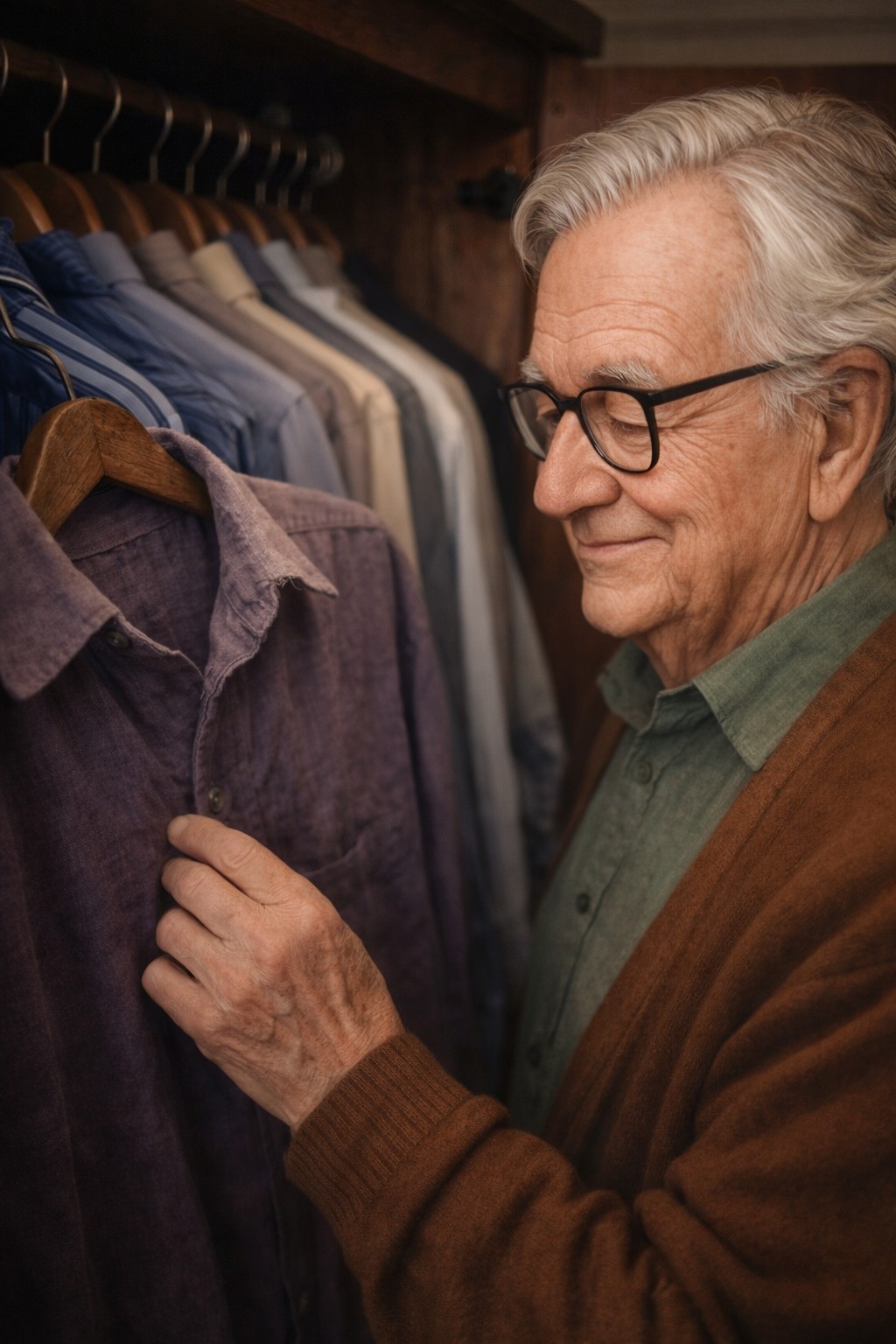
Poor thing. It was just hanging there in the closet.

My favorite purple linen shirt. It was freshly ironed, as it always is, because Gary cares and continues faithfully to press it into presentability even though we both know the collar has grown thin, the threads worn nearly bare, the fabric softened beyond persuasion by years of loyal service at the neckline.

It hangs. Right beside the better ones, right beside the best ones. It still looks handsome at a distance. The color holds its dignity. The linen remembers its authority.

But up close, the collar tells the truth.

There I stood, looking at it, wondering whether I might wear it out in public one more time.

“Dare I?”

I suspected not.

Still, the idea would not entirely leave me. Gary has shown more than once that he knows his way around a needle. I have seen evidence of his skill. A careful stitch here, a thoughtful repair there. Nothing dramatic. Simply competent and reliable.

I couldn’t help but wonder:

“Could Gary save my collar? Could he perform one more act of restoration that would allow me to parade around in public in my old faithful shirt?”

I stood there longer than any sensible person should reasonably devote to a worn piece of linen, quietly debating whether dignity required retirement or reinforcement.

And that was when Poor Brentford arrived.

He did not offer advice immediately. Poor Brentford rarely rushes. He prefers to ask me questions that seem innocent until I attempt to answer them.

“Are you quite certain,” he asked mildly, “that this is a path you wish to explore?”

I did not answer because I knew what direction he was about to take.

Poor Brentford’s memory is longer than I care to admit, even when it comes to fabric.

“Don’t you recall other occasions,” he continued, “when well-intended mending produced unintended outcomes?”

He did not need to specify.

I knew. But I chose to give him that blank stare that always works for me when I feign innocence.

“Remember your sister’s dress?”

Of course, I did. Judy needed something special for an important high school occasion. She had a lovely white dress–a hand-me-down from an older sister. Elegant, well made, perfectly respectable. But what teenage lady wants to wear a dress that has made its public debut already?

“Surely you remember the persuasive talk your resourceful mother gave her?”

“‘Judy,’ she whimpered with soft confidence, “I can transform that dress into something so stunning it will look brand new. A packet of Rit dye is all I need. Pink will be breathtaking on you.'”

Poor Brentford need not have refreshed my memory further. I remembered all.

My mother prepared the dye, immersed the dress, and waited the appointed time.

Judy and I walked out into the back yard with my mother as she hung the dress on the clothesline.

“Oh, Judy. It’s stunning!”

Judy looked, not terribly convinced, even less so when she walked around to inspect the back of the dress.

“Mama! Look! The back doesn’t match. It’s a much deeper pink.”

She was right. The front embraced a gentle pink, while the back pursued a darker vision of the same dream.

Judy was crying. I was laughing. And Poor Brentford? He had the nerve to offer encouragement.

“Listen here, girl. Two shades of pink simply mean twice the fashion. People admire originality.”

They did not. But Poor Brentford was not to be undone. To this day I can still hear him applauding my mother’s sincerity all the while admitting that a new dress was what the day—and Judy’s event—needed.

“Stop pining away over your purple shirt,” he ordered as I continued to stand and stare. “Sometimes, some things are best left alone. Have you forgotten Audrey’s sewing machine?”

How could I not remember. My sister had talked about it often.

As a newlywed, she was proud of her sewing skills but lacked the mechanical companion she believed her talents deserved. Rather than come right out and ask for a sewing machine, she mentioned casually that if she had one, she could mend his tattered garments while frugally extending their wearability.

Poor Brentford understood her plight and reminded her:

“A sewing machine is never an extravagance. It is an investment in continuity.”

And so it was. Repairs followed. Patches appeared. Shirts and trousers acquired energetic embellishments that coworkers described—not entirely unfairly—as reminiscent of a coat of many colors.

But the decisive test came when a funeral required that Audrey shorten Bobby’s dress pants. She took careful measurements and made her sewing machine sing. She was certain that she had completed the alteration with seamstress precision. When her husband tried on the trousers, one side was several inches shorter than the other.

Poor Brentford, never inclined toward alarm, regarded the matter calmly.

“Length,” he observed, “is sometimes a matter of perspective.”

Audrey made every effort to restore balance. She even added fabric at the bottom, but she could not hide the seam that was required to extend the length. Her husband never made it to the funeral, but he never forgot the trousers that he never wore.

By resurrecting these two historical family moments, I knew what Poor Brentford was doing. He was reminding me of the disappointment I would face if I insisted on saving what time had already altered.

“Well-intended mending,” he whispered gently, “does not always restore what we hope it will restore.”

We stood there together, looking at the collar Gary had pressed with such quiet care.

“Surely you’re not thinking that the collar could be reversed?”

It was as if he had read my mind.

“Don’t even go there,” he continued. “Allow the shirt to go down dignified.”

Poor Brentford has always understood something I am still learning. Mending is not always accomplished with needle and thread. The dress was altered beyond harmony. The trousers were improved beyond wearability. The collar had been laundered into truth, its edge now softened to the point of surrender.

“Some things serve us best by finishing well.”

Poor Brentford said nothing more. He did not need to. He has always known that mending takes many forms.

We mend by stitching.
We mend by adapting.
We mend by honoring.
We mend by remembering.

But, sometimes, we mend best by releasing.

Show Me What You Wrote

“The act of writing is the act of discovering what you believe.”

— David Hare (b. 1947.) British playwright and screenwriter, whose works probe truth, belief, and the human condition.

Sometimes in the hush of evening, when the lamp spills its amber light and the world grows gentle, I watch. His head tilts slightly, caught by the glow, and suddenly, the years loosen their grip. The lines that life has written across his face soften; the jaw loosens, light as breath; the mouth, so often set in quiet thought, curves with the ease of youth. His eyes, clear and steady, seem to brighten from within, carrying a spark that belonged first to a boy and then to a young man. Slowly, the present thins. I see him slipping into his past. Fifty. Thirty. Twenty. And then, for the briefest moment, the man beside me becomes the eighteen-year-old he once was—time erasing each layer, revealing what was always there: the young man, quietly returning.

As I glance elsewhere in the room, I see an artifact from his past—one that has crossed time and threshold to find its place in ours: the grand piano. Massive and unyielding, it took four men to wrestle it off the truck and ease it through the doorway. Yet here it rests, polished wood catching the lamplight, waiting.

At this moment, I still hear the sound as his hands moved across the piano earlier in the day—measured, assured, easy. And I heard “For All We Know” rise into the room, each note carrying a hush that reached backward in time. The melody was not just music; it was memory, and it wrapped itself around him, around me, around the room itself. Ruby retreated to the bed, but not fully at rest. She leaned forward, her body stretched long, her head angled as far as she dared—as though even she knew the swell of sound carried us into places layered and deep. She held herself at the edge, cautious not to tumble into the wandering past, into the chasms of memory, beckoning us toward knowing and truth.

Elsewhere in the room, near the piano, another layer from the past peels back. Hanging on the wall is a sepia-toned etching—Salena Gazebo, number 8 of only 200, signed by the artist Carl Johnson. The lines are delicate, deliberate: the curving path, the quiet trees, the pavilion standing open like an invitation. It feels less like a structure than a memory, as if the paper itself breathed it into being. When I look at it, I sense not just the gazebo, but the moments once lived beneath it—the warmth of gatherings, the hush of twilight, the whispered vows of past lovers who lingered there. Dream and truth blur, as though the etching had captured not a place at all but a pulse of longing and a flicker of knowledge, carrying us softly toward knowing and truth.

In another room, on top of the chest of drawers, rest family photographs. Portraits, a chorus of faces gathered through years, smiling, standing, caught in stillness. They look out across the room with a quiet weight, less about who they are than the collective feel they give: belonging, continuity, the insistence that life moves forward even as it circles back. They do not need names to speak; their presence alone is enough.

Nearby, on a table, sits something smaller, more ordinary yet no less enduring: an iron toast holder. His grandmother’s. On his mother’s side? Or, maybe, his father’s? The lineage matters less than the fact that he kept it, carried it through moves and years, never discarding, never forgetting. The metal holds more than memories of bread he may never have seen toasted. It holds a thread of persistence, a reason to keep even the smallest objects close.

In the dining room, on a side table, another artifact gleams in silver relief: The Last Supper, framed, gifted to his maternal grandparents on their fiftieth wedding anniversary. Sacred and commemorative at once, it shimmers with devotion, not only to faith but also to family. The silver has traveled down through generations, carried into his keeping, held as though letting go would diminish more than memory. It is a marker of continuity, of reverence, of love that lasted long enough to be honored.

And then there is the little boy riding a dog—a keepsake that belonged first to his father when his father was a child, before his life was cut tragically short. A small porcelain figure, a child astride a loyal companion, frozen in time. Yet in that figure is more than innocence; it is a bridge across absence, a way of knowing a father he never met. It survived when the man did not, passed on to him as both wound and inheritance, loss and gift. That little boy on the dog rides still through the years, carrying ache and legacy.

Through these artifacts, I glimpse the man I already know and love, his story unfolding in fragments that matter. In the little boy riding the dog, I see both wound and inheritance, a bridge across absence. In the Last Supper, I see reverence, devotion, love honored and passed along. In the iron toast holder, I see endurance, the instinct to keep and carry even what is small. In the family photographs, I see continuity, lives pressed together across generations. In the drawing of the gazebo, I see invitation and hush—the twilight blur where dreams fade into memory and truth. And in the grand piano, I hear the melody that threads them all together—still rising, still echoing, ever playing in the quiet of his soul.

These artifacts matter to him and, now, to me. I could point to others. But I won’t. Yet one more remains, quiet and insistent, the truest of them all—not carved in silver or pressed into porcelain, but carried in ink and idea. His 1965 high-school graduation essay. He was co-valedictorian. He was eighteen.

It rests inside his high-school yearbook, the Bluejay, its cover deep blue and gilt, its pages a mosaic of faces, cheers, and world events already turning into history. And there, slipped carefully between those pages, lies his speech—typed, carried through six decades of moves and seasons. The paper holds its shape, and the words stand sure, preserved as though waiting for their moment to be read again. In its keeping, I see more than memory; I see devotion—the instinct to preserve not only what he did but who he was becoming. It is an artifact, yes, but it is also a testament, held safe in the place that marked his youth and carried forward into the man he is now.

I smiled and whispered:

“Show me what you wrote.”

He lifted the page, holding it in his hands, just as he held it onstage sixty years ago. Soft at first, his voice grew firmer as he returned to the beliefs that had steadied him even then: that learning gives life its shape, that responsibility gives it weight, that hope gives it breath, and that perseverance gives it endurance. Sixty years have passed, yet as he read, I heard not only the boy addressing his classmates but the man beside me—the same convictions intact, the same spirit enduring.

In those moments, as his voice stretched back and returned to me across the decades, I realized that of all his artifacts, this was the richest. My partner, Gary T. Knutson, wrote those words in youth. They carried him into a future he could not yet imagine. And they anchor him still—steadying him in the present, guiding him toward tomorrow. The piano may sing, the photographs may remember, the silver may gleam, the porcelain boy may still ride—but they can only point, only hint. His own words, fragile on paper yet alive in spirit, opened the door wider. They revealed not just what he kept but who he was becoming, and who he still is.

That is the power of words—not just Gary’s words, but all our words. They outlast objects, outshine heirlooms, outlive even memory. In them can be found who we are when all else has been stripped away—values, beliefs, longings, the essence of self, laid bare. And more than that, words do not simply keep; they move. They persuade and console, ignite and endure. They reveal who we were, and they shape who we might yet become. That is their gift, and their power—becoming, in a way, stronger than stone.

Show me what you wrote, and I’ll see who you are—then, now, and still becoming. For words outlast memory and outshine the heirlooms we keep. They carry the essence. They carry the longing. And they proclaim the truths we’ve always held.