A Week Back to the Future

“Sometimes the smallest things take up the most room in your heart.”

A. A. Milne (1882–1956), English author best known for creating Winnie-the-Pooh and stories that continue to shape how we remember childhood, love, and the quiet power of small things.

It was a portable Remington Rand typewriter in a gray box lined with green felt. In 1956, my parents went to Lilly Office Supply and bought it for my sister Arlene, who was taking high school typing. After graduation, she “went away”—not far, but far enough to feel exotic to my boyhood mind—to become a medical technologist in a residential hospital program.

She returned home often, always bringing—unbeknownst to her and to me—pieces of my future.

One of the first that impressed my ten-year-old spirit was her interest in tropical fish, no fancier than fan-tail guppies but fancy enough to ignite in me a lifelong love. My one-hundred-gallon tropical aquarium speaks to a piece of my future that settled in and endured.

I’m not sure, but next up might have been some of the exotic recipes she cooked when she came back on visits. I remember one dish in particular. Arlene called it pepper steak, but it wasn’t French au poivre or Chinese stir-fry. This was hers—flank steak pounded thin, rolled up tight, and packed with cracked black pepper. Lots and lots of pepper. She baked it low and slow until the whole kitchen smelled like heat and adventure.

I was hell-bent on loving it. It was different, and Arlene made it. That alone made it holy. My mother, no stranger to bold flavors from coal camp kitchens, loved it too. She said Arlene had a touch. That dish lit a fuse. It was the first truly “foreign” flavor I fell for—and from that bite forward, I was hungry for worldwide cuisine. It was a piece of my future that still lingers on my adventuresome culinary palate.

What else? Once, Arlene brought home one of her Mahalia Jackson albums—a 12-inch LP—titled In the Upper Room. I remember the cover, but even more, I remember the sound: Mahalia’s voice rising from the vinyl like a sermon on wings, wide-mouthed and full-throated, her vowels rich and trembling with conviction. That mouth—large, commanding, joyful—seemed to carry an entire congregation inside it. You didn’t just hear her sing. You stood up straighter, somewhere deep in your bones. Her singing resonated naturally with me. I had fallen in love with Black Gospel in my early coal camp years, and even though we had moved away, now I could enjoy Black Gospel on my own record player. Notes and chords from that piece of my future still rattle my rafters every morning as my soul feeds on Black Gospel fire while I bike indoors or garden in the sun.

Arlene brought many other pieces of my future back home when she visited, all held tightly together by my realization that she was living the good life, maybe because she had “gone away” but definitely because her education had opened doors. As a medical technologist, she could go anywhere in the world. Bluefield (WV) was nearby yet far away. Richlands (VA)–just across a mountain or two–was ever further away. Richmond, which in my young mind was further than the stretch of my imagination, was clean across Virginia.

When she came back home, she arrived in style.

How well I remember her 1959 BMW 507 Roadster, white as a wedding glove, low-slung and impossibly sleek. The chrome trim shimmered like polished silverware, and the twin kidney grilles gave it a kind of sly, knowing smile. With its long, sculpted hood and tucked-in waistline, it didn’t sit on the dirt road in front of our home—it posed. And yet—for all its glamour—it was so feather-light, I once watched my brother Stanley and my brother-in-law Lemuel lift it off the road and set it gently in the yard, as if it were a city toy that had wandered into a grown-up mountain world by mistake.

Sometimes, instead of driving home, Arlene would fly. I can still see her coming down the steps of the plane, with a look on her face fiercely defying the engine’s turbulence to disturb her sculpted bouffant—a chin-length hairstyle with smooth volume at the crown, gently curled ends, and a sleek, side-swept part. It was polished but not overdone, and it framed her face with effortless elegance, just as it did her heroine Jackie Kennedy, who made the hairstyle fashionable.

Arlene had exquisite taste in clothing, too—expensive, yes, but timeless. She didn’t follow fashion; she curated it. Her closet was a study in fine fabrics: tailored wool skirts, cashmere sweaters so soft they seemed to hold their own breath, and coats that whispered elegance with every movement. She favored deep, dramatic colors—navy, charcoal, forest green, black—tones my mother thought too somber for a woman her young age.

But Arlene wore them with such composure that you’d never question it. Even in our modest home, she had the poise of someone just back from Paris or somewhere so far away it sounded like it should be whispered.

In my young mind, she had arrived, not only with all the quiet showings of her success but also with the equally quiet sharing of her largesse. She was religious in sending money to my parents—especially as my dad began his retirement from the coal mines—and later to me when I started college.

In all of those ways, I saw in her life pieces of my own future.

But when Arlene “went away,” she left behind one piece that might have had an impact on me—equal to if not greater than—the other pieces of my future that she brought back home with every visit.

Her Remington Rand typewriter in a gray box lined with green felt.

My sister Judy used it when she took typing. And if you guessed that it was passed on to me, you guessed right. Starting with my typing classes and stretching far into the future, Arlene’s Remington Rand began a remarkable journey—one that may be unmatched in the annals of typewriter chronicles.

When I went to Alderson-Broaddus University in 1965, it went with me. I typed all of my papers, including my Honors Thesis, on that Remington.

When I graduated in 1969, it went with me to Washington, DC, where I started my career at the Library of Congress. I typed a proposal for a concordance to Robert Frost’s poetry on that Remington.

Three years later, when I started my doctoral program at the University of South Carolina (USC), it went with me to Columbia, where I wrote all of my graduate papers on that Remington.

One was more important than any of the others. In preparing it, I found myself in Richmond for a week, staying with Arlene and her husband Clyde, a police officer. She was surprised that I still had her Remington and that I was using it even in graduate school.

I put it to phenomenal use that week. Looking back, I wonder what trajectory my life might’ve taken had it not been for that turning-point.

Lean in a little closer and let me explain.

It was my first semester at USC, and I was taking a survey course in 19th-century American Literature. One of the stories that we read was Mary E. Wilkins Freeman’s “A Humble Romance.” I had never heard of the writer before, but I was so smitten by her story that I read another one and then another one and many, many more. Aside from thinking that they were extraordinary stories, I was captivated by a pattern of strong-willed women who inevitably never married. I was equally captivated when I discovered that Freeman herself did not marry until she was nearly fifty.

It was a minor aha moment. I had a perfect research paper topic: “Single Women and Gender Identity in Selected Stories by Mary E. Wilkins Freeman.” My professor approved, suggesting that I explore Freeman’s letters for supporting biographical evidence.

To my initial horror, I discovered that Freeman’s letters had never been published. But to my immediate delight, I discovered that Clifton Waller Barrett Library at the University of Virginia had a small collection of her letters. In a flash, I had an action plan. I would stay with Arlene and Clyde in Richmond, make the daily one-hour drive to Charlottesville, spend the day in Barrett Library, and return at the end of each day.

The typewriter went with me on those daily research trips, and during that week, I prepared a transcript of the Freeman letters at the Barrett Library, systematically and methodically using that Remington.

I returned to Columbia the next week and continued working on my Freeman paper and on papers in my other courses, all typed on that Remington.

By semester’s end, I had an epiphany. For my doctoral dissertation, I could locate and edit Freeman’s letters. My advisor loved the idea, as did my committee, but knowing more fully than I the rigor involved in such a project, they urged me to limit my scope to selected letters. I prevailed with my initial proposal. Ten years of research later–with trips to more than fifty libraries across the country, always armed with Arlene’s Remington Rand–I finished my dissertation and was awarded my Ph.D. In 1985, the fruit of my scholarly labors was published: The Infant Sphinx: Collected Letters of Mary E. Wilkins Freeman. It remains, as The Journal of Modern Literature noted in its review, “the most complete record to date of Freeman’s life as writer and woman.”

But wait, wait. Don’t go. I need to share a few more details so that you’ll understand even more fully how Arlene’s Remington Rand typewriter and her quiet support during that week in her home all came together, and a life of research dedicated to Freeman found its rhythm—click by click, page by page.

The five decades since have witnessed me not only digging up the past in all the towns where Freeman lived, wrote, and made the rest of the world sit up and take notice but also returning there as frequent keynote speaker, sharing with the towns’ citizens all of my findings, never before shared. Those same towns helped launch the publication of my landmark The Infant Sphinx as well as my watershed edition of Freeman’s Green Mountain Stories (2023), the intended title of her first collection of adult stories, A Humble Romance and Other Stories (1887).

These days, I’m working on Dolly: Life and Letters of Mary E. Wilkins Freeman. Vol I: The New England Years (1852-1901). Vol. II: The New Jersey Years (1902-1930). I have no doubt that three towns will welcome me back when Dolly is published. Randolph (MA), where she was born. Brattleboro (VT), where she launched her literary career. Metuchen (NJ), where she died.

But let’s move past all that Freeman stuff.

For now, let’s keep the spotlight on the woman who went away when I was a boy, returning home with a passion for tropical fish and gospel records, pepper steak and black wool coats, fast cars and high-flying planes, and all the other things that the good life had to offer–giving me something far more. The dreams. The belief. The typewriter.

For now, let’s keep the spotlight on my sister Arlene, who always brought home—unbeknownst to her and to me—pieces of my enduring future.

A Reader’s Compendium to Intimacy

“Maybe the next new old way to intimacy is right here. Voice. Breath. Story.”

—-TheWiredResearcher, b. 1947. Author of A Reader’s Compendium to Intimacy, guaranteed to make you explore all the rooms in your home.

Whiplash!

If I were a betting man, I’d wager the title gave you a little jolt. You paused on Compendium—“Wait, does that mean what I think it means?”—and then BAM! You hit Intimacy, and it was like you got rear-ended at a stoplight. Neck snap. Mind swirl. Whiplash.

Let me double down. The moment you saw Intimacy, your head unzipped at least one of these:

● “Sex.”
● “Emotional stuff… here we go.”
● “Being seen. Fully. Yikes.”
● “Something I want—and fear.”
● “Crying in front of someone.”
● “Letting someone in—too far in.”
● “When it’s good, it’s everything.”
● “That’s what I’m missing.”
● “It never lasts.”
● “Real connection. No filter.”
● “The kind of thing that leaves you wordless—and maybe a little wrecked.”

Aha! Caught you! If you hadn’t blushed, I wouldn’t have known. But don’t worry. You’re okay. I’m okay. And talking about intimacy? Trust me. It’s more than okay. Try it. You’ll be surprised by your discoveries.

Let me also assure you of something else. If sex is what you thought of first, you’re still fine. I’ll prove it to you. I wanted to sprinkle some hard data into this essay, like the suggestive power of scattering rose petals on bedroom sheets, so I googled:

“How many times a day do people think about intimacy?”

What popped up first? Guess. Every hit focused on some aspect of sex, and since I’ve already gone down that rabbit hole, let me share what I found. Men think about sex 19 times a day; women, 10.

But sex is just one slice of intimacy. So if something else popped up as your first thought, you’re in good company. As a matter of fact, many studies don’t even include physical closeness in defining intimacy.

Instead, they zero in on what intimacy requires before it even begins: establishing trust, cultivating closeness, and voicing truth aloud.

Some experts get really specific and focus on what they call the 5 As of intimacy:

Attention to the present moment–observing, listening, and noticing all the feelings at play in the relationships.
Acceptance of ourselves and others just as we are.
Appreciation of all our gifts, our limits, and our longings as human beings.
Affection shown through holding and touching.
Allowing life and love to be just as they are, with all their ecstasy and ache, without trying to take control.

Other experts focus on the 5 Cs of intimacy:

Communication–talking openly, honestly, and respectfully.
Compatibility–sharing core values and goals.
Commitment–showing up and working through challenges together.
Care–expressing love through empathy, support, and small gestures.
Compromise–meeting in the middle to make sure both people feel heard, valued, and respected.

Also, the experts have recommendations for keeping intimacy alive and well in the bedroom. Well. Good grief. Somebody needs to tell the experts that houses have more rooms than the bedroom. Joking aside, most of the tips circle back to sex. So let me share one that doesn’t. I stumbled on it the other day. It’s the 2-2-2 rule that goes like this. Committed couples should go on a date once every two weeks, spend a weekend away every two months, and take a week-long vacation every two years.

I’m fascinated by that rule, but just to be transparent: I’d need more dates, more getaways, and more week-long vacays. Preferably soon. Preferably with someone special who knows how to linger over dessert and pillow talk and other sweet nuthins that mean everything.

Lately, though, something softer has been curling around the edges of my mind. It’s something that doesn’t require a plane ticket or a fancy reservation. All it needs is a dedicated space, a good voice, and the willingness to listen.

Are you ready? It’s so incredibly simple.

Reading aloud to someone.

Can you imagine?

Actually, I can. I don’t know about you, but I love reading aloud. I always have. As an educator, reading literary selections aloud to my students is one of my greatest joys. Time after time after time, they respond:

“Professor Kendrick, when I read this story, I didn’t get it. But hearing you read helped me understand. Now, I get it.”

I think I know why. Reading aloud requires understanding not just the meaning strung out in words but also the heart and soul that live in the spaces surrounding those words, sometimes haunting those spaces, and sometimes hoping and longing for release that comes only when the words hear themselves spoken, knowing that they’ve been set free through sharing. Author. Reader. Listener. Intertwined. Joined. One. It’s one of the most intimate moments ever, even if fleeting.

Occasionally, that moment becomes even more intimate when words catch the reader off guard and nuanced meanings surface as the words roll off the tongue, releasing a sudden floodgate of tears, falling unexpectedly but without need of apology or explanation.

It’s happened to me more than once, but I most remember what happened when I taught Thomas Wolfe’s “The Lost Boy” for the first time. I loved the story from the start, and I was confident of my ability to lead a general class discussion built around the question:

“Who is the lost boy in the novella?

“Eugene? Grover? How do you know. Where’s the textual evidence to support your claim?”

Just as we were ending our lively and spirited class conversation, I decided to read the last paragraph.

“And out of the enchanted wood, that thicket of man’s memory, Eugene knew that the dark eye and the quiet face of his friend and brother—poor child, life’s stranger, and life’s exile, lost like all of us, a cipher in blind mazes, long ago—the lost boy was gone forever, and would not return.”

With quivering voice and with tears moistening my cheeks, I made it through the final words, realizing as I had never realized before, the existential pain that comes with knowing how lost we all are on life’s journey.

There I stood in all my vulnerability. There my students sat, seeing me in that moment. And then, we all understood simply because I had read aloud.

The intensity of that intimate moment remains unforgettable.

I’ve never tried reading aloud in a relationship, but I’d love to try it. I’m thinking that it would be slow burn. I’m thinking that it would be like foreplay for the soul.

I’ll take credit for the sultriness that I just brought to the notion of reading aloud to someone. But when it comes to the idea itself, I’ll have to give credit to a neighbor. We were enjoying a cocktail, and somewhere between Gin-and-Tonic sips, Gary started telling me about the reading ritual he and his late wife practiced daily:

● Same time.
● Same place.
● Different books, usually.
● Breaking the silence, whenever desired, to share a passage aloud.

As he kept talking, I watched and listened, spellbound. He was transported if only for a few fleeting moments to a lifetime of fleeting moments when he and Jody read together in a ritual so profound that it transcended the physical and found home in heart and soul.

Actually, neither Gary nor Jody can claim the ritual as theirs. Couples have been doing it forever.

Step back in American history to Thomas and Martha Jefferson. They were known to spend evenings at Monticello reading novels and poetry to each other, their voices soft against the candlelight of a Virginia evening. It was one of the few quiet pleasures in a life that was otherwise noisy with politics.

Several presidencies later, John and Abigail Adams read political theory, plays, and moral philosophy aloud to each other—sometimes in the same room, sometimes through the pages of their legendary letters. Shared reading was one way they kept their minds, and their marriage, sharp.

Hop to the other side of the Pond and fast forward to the next century and we’ll find Queen Victoria and Prince Albert often reading poetry aloud in the evenings—sometimes in English, sometimes in German. Victoria later wrote in her journals that Albert’s voice brought her calm. Their reading wasn’t just education. It was connection.

Reading aloud to each other isn’t just a thing of the past either.

Fast forward to the present. Everyone knows that Jimmy and Rosalynn Carter—married for 77 years—read the Bible aloud to one another every single night, even when they were apart. When travel or illness intervened, they kept the tradition alive by phone. It wasn’t about religion so much as rhythm. A ritual. A bond.

Another presidential couple, Barack and Michelle Obama, often speak about sharing books with each other—discussing what they’re reading, trading pages, sometimes reading passages aloud. For them, books are not only a window into each other’s minds but also a way to stay close while being in the public eye.

Even acting duos like Michael McKean and Annette O’Toole read books aloud to each other. They’ve done so for decades, weaving stories into the fabric of their relationship like a shared language.

Now that I’ve got my rhythm going, let me share with you something that I’ve known all along. Literature is filled with couples who share books, poems, and whispered lines by firelight.

I’m thinking about Hazel & Augustus in John Green’s The Fault in Our Stars. They read An Imperial Affliction aloud to each other, sharing lines that feel like lifelines. It’s tender, flirty, and heartbreaking.

Or what about Anne Shirley and Gilbert Blythe in L. M. Montgomery’s Anne’s House of Dreams? As their relationship deepens, they read poetry and essays together, sometimes aloud. It’s subtle, romantic, and tied to their shared love of words and growth.

I guess I should mention The Guernsey Literary and Potato Peel Pie Society, a novel by Mary Ann Shaffer and Annie Barrows. Several characters read aloud to each other throughout wartime, showing that community forms through books and shared voices and that reading as intimacy outlasts chaos.

But I’m not going to talk about any of those literary works. They’re all lovely, earnest, and romantic. But I want something different. I want something quieter. I want to talk about Charlotte Brontë’s Jane Eyre. After fire and blindness and the long stretch of absence, it’s Jane who reads aloud to Mr. Rochester. She does it not to dazzle, not to perform, but simply to be there. Her voice becomes his window to the world—and maybe even back to himself. It’s not just love—it’s restoration, offered one word at a time.

And that’s the kind of reading aloud that I’m moving toward at this point in my life. I want it to be not just a ritual of sharing aloud but also a ritual of staying in place.

It’s a ritual that I’ve never practiced in a relationship. But I’m ready to give it a try, just to see. Maybe start with poetry or essays.

I’m ready to say, “Pick something you love–or wrote. Maybe a poem. I’ll pick something I love–or wrote. Maybe an essay. Let’s read when we feel like it. Share when we want to. Listen, when we can.”

I’m ready for a voice I know to wrap itself around ideas I don’t.

I’m ready for the quiet thrill of saying, “Listen to this,” and meaning everything.

Who knows. Maybe that’s the next new old way to explore intimacy—not with technique or timing or strategy, but with voice, breath, and story.

There. Now you have it. A Reader’s Compendium to Intimacy. Now you know.

Go. Do it. No rose petals. No script.

Just this. Read. Together. Aloud, sometimes. And when your love reads back to you?

Remember: That’s not just a voice.

Remember: That’s a heart unfolding, anew.

For Mothers Everywhere: Glimpses of My Mother’s Hands

Originally published last year, this remains my most-read—and most-shared—essay. I’m honored to bring it back this Mother’s Day weekend, just as I first wrote it—a quiet tribute to the hands that shaped us all, guiding, giving, and leaving their imprint long after they’re gone.

“Mothers hold their children’s hands for a short while, but their hearts forever.”

–Unknown

On top of my bedroom chest of drawers is a pair of studio portraits of my father and my mother. They’re hand-colored originals, each measuring 3 inches by 4 inches, taken a year or so after my parents’ 1932 marriage. The portraits are in hinged gold frames. My father is on the left. My mother is on the right. A lamp behind illuminates both.

Right now, as I lie in bed, I’m focusing on my mother. Even though her portrait is five feet or so away, she is as clear to my sight as if she were right beside my bed. I’m glimpsing into a distant past, where memories of her linger like whispers.

She’s seated on a bench, wooden, perhaps. The artistic backdrop transports me outdoors. Trees frame the scene, a tall one behind her, their branches reaching skyward, and shorter ones in the background, on the bank of a calm body of water, perhaps a serene river.

She’s wearing a dark dress with short sleeves and a deep-cut neckline, accentuated by a glistening leaf-shaped brooch.

Her finger-waved hair, parted in the middle, falls softly just below her ears. Her eyes are dark and intense, with a gaze that seems to pierce through the image. They are surrounded by her soft, light skin tone, which provides a striking contrast. Their depth and intensity draw me in and make me wonder. What secrets lie hidden behind them? What stories and dreams do they hold? Are they looking into the depths of the world, seeking answers and understanding? Are they inviting me to join in their quest for knowledge?

Her features captivate and mesmerize me, regardless of how often I look at her portrait. Somehow, though, I seem to see my mother’s hands the most. Their contours are soft and graceful, and the fingers curve delicately, one hand gently clasping the other hand.

I see my mother’s hands the most because I know her hands the best.

My mother’s hands are engaging hands. Her hands held mine when I was but a child, and we scurried down the path behind our home where two boulders stood sentinel on either side as colored snow fell down in green and pink and blue flakes, making me believe in magic. Her hands held mine when I was a few years older, and she led me outdoors when our world was covered in snow and showed me how to lie down in stillness, moving arms and legs left and right to create angel wings, making me believe in flight. Her hands held mine a few years later when our world was green with summer and led me to lie down in warm grass, eyes skyward, discovering cloud figures, pointing out the details to one another so vividly that each could see brand new worlds of our own imaginings, making me believe in sharing visions so that others might see.

My mother’s hands are cooking hands. Her hands could transform pinto beans, onions, cornbread, buttermilk, and sweet potato cobbler into a feast, making me want it weekly. Her hands could turn a 25-pound turkey into a bronzed Thanksgiving dinner that rivaled Norman Rockwell’s iconic oil painting Freedom from Want, making art come alive in our own coal camp kitchen. Her hands could measure out with perfection all the ingredients for any dish from any cuisine that she had tasted with no need for recipe and with no need for measurements, teaching me to trust my senses.

My mother’s hands are versatile hands. Her hands could make our clothing without pattern, simply by taking our measure with her hands, making me aware that some things are more felt than seen. Her hands could cut my hair using scissors, comb, and the soft stretch of her fingers, reinforcing in my mind the marriage of expertise and craftsmanship. Her hands could take a pastry brush and turn a greased baking sheet or cake pan into a perfect likeness of Christ, making me see Holiness in the everyday.

My mother’s hands are industrious hands. Her hands could transform a grassy field into a kaleidoscope of gladiolas or dahlias, bursting with vibrant hues, teaching me to see potential in the ordinary. Her hands could hold her side of a wooden pole stretched through handles of a galvanized tub, carrying water to the garden, making me realize that many hands can carry heavy loads. Her hands could hang wallpaper with finesse, demonstrating how effort can elevate even the smallest task to art.

My mother’s hands are inclusive hands. Her hands always opened wide the door, welcoming everyone as guests into our home, making me value open-heartedness and acceptance of others, regardless of differences. Her hands always set a place for them at our modest table, making me understand that meager becomes abundance when shared with others. Her hands always held theirs in loving celebration and thanksgiving, making me a witness to the genuine communion of mankind.

My mother’s hands are nurturing hands. Her hands cared for her father and her mother in times when they could not take care of themselves, impressing on me the importance of helping others. Her hands cared for my dad and me and all my siblings, even when our hands might well have lessened the weight that she carried in hers, showing me that strength comes with sacrifice. Her hands took pine rosin to hold tight and heal the gash in my foot, the scar on my sole still a reminder of what she had learned from her mother’s hands, helping me appreciate generational know-how and wisdom.

My mother’s hands are writing hands. Her hands penned sermons when she pastored a church, making me realize that the intellect can lead the heart to be slain by the Holy Spirit. Her hands sent letters out into the world to those she knew well and to those she hardly knew at all, making me see that the power of words reaches beyond the pulpit. Her hands discovered typewriter keys late in life, determined that hand tremors would not tame her self-expression, making me realize the strength of determination.

My mother’s hands are spiritual hands. Her hands joined the hands of other warriors, praying over me as a child with polio, making me–one of the lucky, uncrippled survivors–a believer in the power of prayer. Her hands walked their way through her Bible and her commentary books–from cover to cover–more than thirty times in her lifetime, making me know the richness to be gained through close readings and research. Her hands clapped, sending thunderous applause into the Heavens to show her thankfulness and gratitude, making me know the joy of praise.

My mother’s hands are clasped hands. As she lay in her casket after her funeral, I removed her rings, took her hands and clasped one gently on top of the other, leaned in for a farewell kiss, and, then, closed the lid.

After her burial, my hands–strong from the strength of hers–released from their cage three white doves, flying upward toward the celestial realm, perhaps at that same mysterious moment when my mother found her way back home and celebrated her arrival with outstretched hands.

From Francesco’s Stew to the Sound of My Pounding Heart

“When you realize there is nothing lacking, the whole world belongs to you.”

Lao Tzu (6th century BCE; ancient Chinese philosopher and founder of Taoism. His teachings emphasize harmony with the natural flow of life.)

Ta-TUM. Ta-TUM. Ta-TUM.

With rhythmic precision, it keeps pounding just like my heart.

But it’s not my heart.

It’s my mind, beating to the same rhythm, chanting.

I want. I want. I want.

In my most recent chant, I wanted Francesco Mattano’s famed Peposo, a traditional Tuscan Red Wine Beef Stew. It’s so simple with just a few ingredients: garlic, beef, salt, coarsely ground black pepper, a bouquet garni, and red wine. Simmered for several hours and served up in a well of buttered polenta, it’s the recipe’s clean simplicity that makes it so sinfully delicious.

Altroché! That’s just what I wanted–an entree promising good-to-the-last-bite deliciousness. At the same time, I was well aware that I had leftover pork tenderloin as well as chicken salad.

Once upon a time, I would have rushed off to the grocery store, bought the provisions for Peposo, and celebrated another culinary triumph.

These days, however, even though my wants are as rhythmic as my heart, I am pulling back as I try to reconcile what I want with what I have.

With food, for example, I wanted Francesco’s stew, but I had pork tenderloin and chicken salad already prepared. The craving was there, but so was a perfectly good meal.

Take books, for example. I’ve dedicated decades of my life to Mary E. Wilkins Freeman, and I’ve amassed a significant collection. But I want to chase after one more obscure letter or document that will make my already rich archive even richer.

What about dating? I want romance—not out of need, but out of hope. My life is full and meaningful, yet I’d love to share it with someone who brings his own fullness—a shared life made richer by both of us.

Even in garden centers, new specimen evergreens whisper, “Take me. Plant me.” But I already have a beautiful Zen-like landscape.

I’m also trying to reconcile what I want with what I need.

I might want dessert, but what I need is a meal that aligns with my health goals. I’m cutting out sweets but keeping nightly Bunnahabhain—for balance!

When it comes to fitness, I might want quick results, but I need consistency not as much in biking as in weight training.  At my age–no, at any age–real strength comes from steady, intentional effort.

What about my writing?  I want more time to write, but I need to manage my other commitments more wisely so that I have the time I need.

Even in relationships, I want certainty, but I need to let connections unfold naturally—his rhythm, my rhythm, coming into step together.

The more I realize that I don’t need everything I want and that, in reality, I already have what I need, the more I’m discovering new dimensions of freedom.

What had been a constant search for more, whether material things, achievements, or validation, has given way to peace.

What had been a scarcity mindset has become a focus on embracing abundance—not in excess, but in sufficiency.

What had been a notion that having more means being more has yielded to the realization that I’m already enough.

What had been impulse is now intentional as I make choices that nourish me rather than just satisfy my fleeting cravings.

I’m shifting from grasping to gratitude,
from craving to contentment.

I’m no longer mistaking wants for purpose.
I’m recognizing that growth, connection, and presence matter more.

I’m starting to trust the rhythm of life,
just like I trust the rhythm of my own heart.

My heart beats on, steady and sure—
not demanding, just existing.

It thumps a lesson that I’m learning:
I don’t have to chase every want.
What I need is already here—or on its way, arriving in the fullness of time.

And that, in itself, is everything.

The Rust Whisperer

“Nature does not hurry, yet everything is accomplished.”

Lao Tzu (6th century BCE. Founder of Taoism. His teachings focus on harmony with nature, patience in becoming, and the quiet power of letting life unfold in its own time.)

Every time I walked to my Jeep and looked toward the forest’s edge, I chuckled. Smack dab in front of me was a contraption the likes of which I had never seen in my life. Actually, I made it and even gave it a name. The Rust Spa.

Say whaaaaat?” someone just rasped.

Yes. The Rust Spa. It didn’t take me long to come up with the idea. It works so well that I may apply for a patent and sell it to US Steel, the company that owns the trademark for Corten. You may know it as COR-TEN.

Either way–and rather ironically as you will discover–the COR stands for COrrosion Resistance and the TEN stands for TENsile strength. Corten is well-known for aging gracefully and creating a deep, natural tone as “the thickened oxide forms.” For me, that translates to aging gracefully as plain ole rust appears, and I actually love the deep rich natural brownish-red tone that metal takes on over time.

That’s exactly why I bought myself a Corten planter–for its trademark rusty patina. Of course, I realized when I bought it, that rusting would take time.

I knew it would take a long, long time when the planter arrived, and I opened the box. Behold! Sleek. Clean. Almost smug in its shine. Smooth bare metal, cool to the touch, untouched by time. No rust, no streaks, no signs of surrender. Just raw, industrial silver. It was so pristine it practically glinted in the morning sun, as if daring me to try to change it.

Change it, however, I would, and I knew my resolve from the start. In a bottle, I mixed equal parts of white vinegar and hydrogen peroxide with one tablespoon of salt per cup of liquid. Then I positioned the Corten planter on a stump near the forest’s edge, and every three hours or so, I sprayed it evenly like a soft mist of time.

After just a few applications, the raw steel started to shift—deep ochre streaks rippled down the surface, gathering in drips and blooms that caught the light like burnished velvet. The edges darkened, the face mottled, and the rust arrived quietly.

But I was eager for a little more fanfare. In that moment–and let history take note–I came up with the idea that will ensure my infamy: The Rust Spa. I wanted to speed up the alchemy. Easy peasy. I misted the planter with my magic spray of time. I put it inside a black yard bag to trap heat and moisture, both ideal for rust formation. Then, to keep it all in place, I inverted the delivery box and placed it on top. Voila! The Rust Spa.

The Rust Spa worked its quiet magic. When I disrobed the planter, it sat proudly on its stump throne, no longer silver and self-conscious, but cloaked in a deep, burnished rust. Its warm, mottled patina caught the light in uneven streaks, each drip and blush a quiet testament to time, to weather, to letting go. It no longer shouted; it hummed. And in that stillness, it held a beauty—neither flashy nor fresh but seasoned and settled. With a coat of boiled linseed oil, I sealed the patina in place, locking in that rich, rusty finish like a photograph of time itself.

Now, locked in time, it graces my deck in the middle of a rustic, wrought-iron table with stone top.

It’s there in all my comings and goings, and every time I cast admiring glances in its direction, I cast backward glances to my own life, to all the times when I wished to be older so that I could experience sooner all the things that I would experience later on at the appointed time.

When I was eleven and twelve, I was eager to be a teenager, so I could do the “cool stuff.” Looking back, I’m not certain what the “cool stuff” was. We didn’t have a car. We didn’t have a telephone. We had a TV, but why would I stay up late? For what? As for choices, I was known for making my own and for making them my way. Still, I wanted to fast forward my life. I wanted my own Rust Spa.

After I reached my teenage years, I was eager to be sixteen. Even though we didn’t have a family car, my sister and her husband lived next door. Judy taught me how to drive, and I thought that I had arrived when I got my driver’s license. I’m not sure why. I suppose I dreamt of driving off into the sunset with the gay date that I didn’t have in the Chevy that I didn’t own. Still, I wanted to fast forward my life. I wanted my own Rust Spa.

Then, of course, I was so eager to be eighteen, so I could get away from all the limitations of my home, my town, and my place. I did. I went to college in fast pursuit of me, myself, more authentic than the one I wasn’t really able to be in my home, my town, and my place. How ironic that I always went back on holidays and breaks. Still, I wanted to fast forward my life. I wanted my own Rust Spa.

With my degree in hand, I was eager to start climbing the rungs of my career ladder. That’s just what I did, and it ended up being a twofer. I landed a position at The Library of Congress, at home in the place with all of the books. And I found myself living on Capitol Hill, at home with me as a gay guy, realizing that I wasn’t alone. Still, I wanted to fast forward my life to a place where I could learn more. I wanted my own Rust Spa.

The place turned out to be the University of South Carolina in Columbia, where I earned my doctor’s degree in philosophy and became an expert in American Literature, British Literature, Handpress Bibliography, and, more important, where I learned that an education softens character and keeps it from being cruel. Still, I wanted to fast forward my life to a place where I had been before: home. I wanted my own Rust Spa.

I circled back home to DC and the Library of Congress. A place of emotional grounding where I felt whole, safe, and—authentic. A place where I sensed spiritual and intellectual belonging. A place where I could elevate self-acceptance from fleeting to permanent. A place where I could wrap my arms around all with all that my mother taught me as a child about diversity, equity, and inclusion and, at the same time, widen my embrace to include gender identity and sexual orientation. A place where, through the power of my pen, I soared to heights higher than I ever dreamt that words could fly. Still, I was eager to be what I had dreamt of being since the third grade: a college English professor. I wanted my own Rust Spa.

Laurel Ridge Community College opened the door, and the dream was fulfilled. Imagine! Me–a professor. A desire to stretch my students helped me stand on tiptoe looking at the bright futures of more than 7,000 students for twenty-three years. And beyond fulfilling the professional dream was realizing another one. Falling in love and exchanging wedding rings. Two men living their lives openly. Proud. Explanations? None. The happiness of our twenty-year love outlives Allen’s unexpected death. Still, I was eager to write my final chapters. I wanted my own Rust Spa.

I’m writing them now as one more part of Reinvention. Ask all who know me. I did not reTIRE because I ain’t no ways tired. In fact, I’ve been reinventing myself forever, with every twist and turn of my journey. This most recent started in 2023, and it’s turning out to be one of the most creative and productive times of my life. Five published books with others in progress. Speaking engagements several times a year, including a few that showcase not only my hopes for AI to save us from ourselves but also my hopes for online dating to spirit another Mr. Right my way so that we can co-author the closing chapters together–his, mine, ours.

And here’s where I start to chuckle again. My Corten planter had absolutely nothing to do with achieving its exquisite and inexplicable patina. I did it by speeding up the process in my Rust Spa. I kept applying my mist of time until it achieved the look that I wanted. Then, I sealed it for all eternity.

And so it is with me. Despite all the times down through the years when I wished to be older so that I could experience sooner all the things that I would experience later on at the appointed time, I could do little more than wish and dream.

In reality, I had no more control over achieving my aged patina than my planter had. It’s been a journey filled with yearnings. To arrive. To become.

In reality, every time I was eager to be “somewhere next,” I had to wait on time to take me there.

In reality, I can no more see my finish than my planter can see its.

Yet I know that it’s seasoned.

Yet I know that it’s settled.

Yet I know that it’s not finished.

Still, of this much I am certain. When the appointed time comes, soft and magical mists will seal in place patinaed perfection.

A Glimpse Beneath the Covers (Book Covers, That Is)

“Embrace the glorious mess that you are.”

–Elizabeth Gilbert (b. 1969. American author best known for her memoir Eat, Pray, Love, which became a global bestseller and cultural phenomenon. Her work blends introspection, humor, and an embrace of life’s messiness—much like the spirit behind my modest The Third Time’s the Charm.)

Guess what arrived in the mail today?

(Hint: it isn’t another gardening catalog—though those are always welcome at my house.)

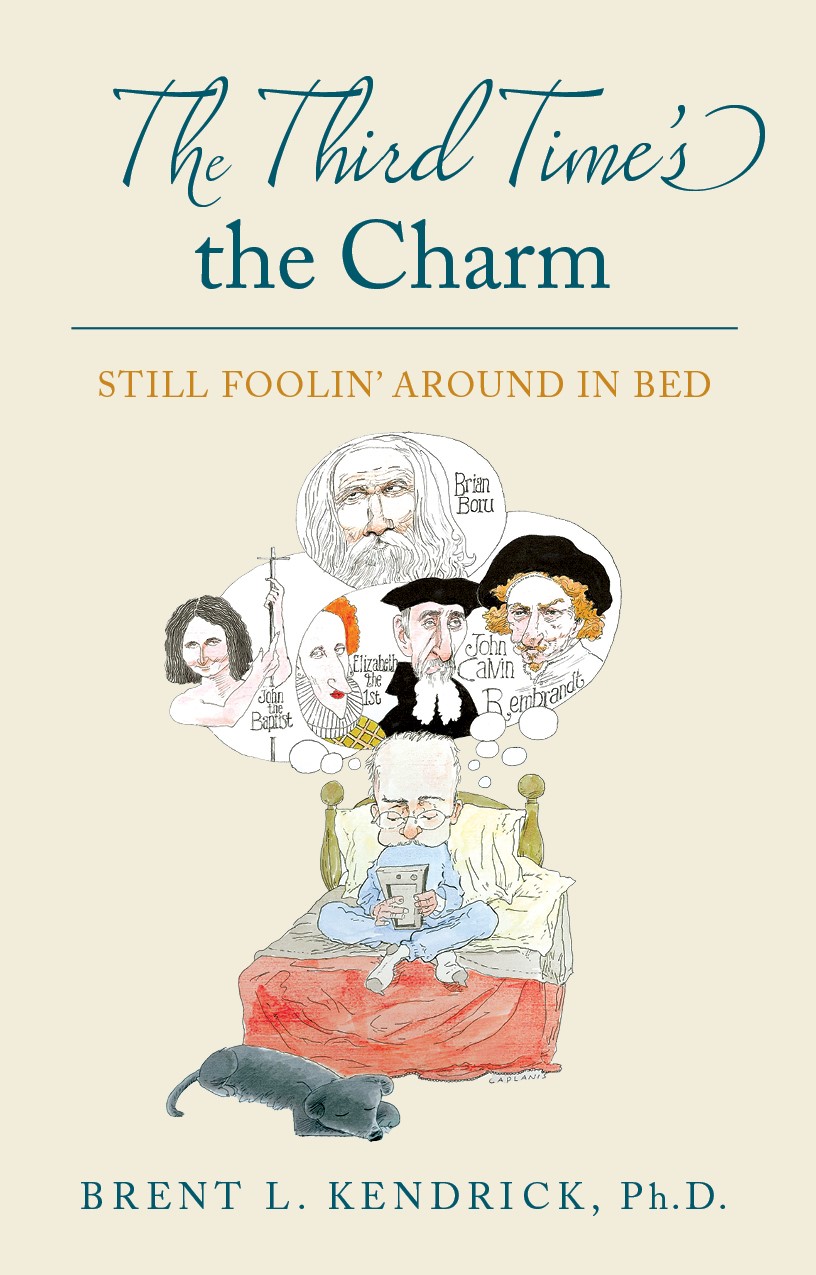
It’s the printed proof of my next book, The Third Time’s the Charm. At 440 pages, it’s a whopper! This brand-new collection of personal essays is drawn from my The Wired Researcher Series. Today, I’m delighted to share the cover art with you. Once again, the art is by acclaimed caricaturist Mike Caplanis. Although he was inspired by the essay “What If I’m Not Who You Think I Am?”, the book’s cover captures the spirit of this collection perfectly—thoughtful, mischievous, and comfortably tucked between the sheets.

This book is close to my heart. It’s a gathering of essays written—yes, literally, as you know already—in bed, where I do my most creative thinking and, often, my most honest writing. I hope these pieces reflect a voice that’s warm, a little witty, deeply rooted in everyday life, and shaped by the rhythms of memory, nature, and reflection.

William Faulkner once referred to his childhood landscape as “a postage stamp of native soil,” and in this collection, I’ve claimed one of my own. These essays rise from the soil that grounds me—Appalachian roots, coal camp memories, gardening, grief, and joy—and reach toward readers everywhere. I hope these pieces help you discover something true in your own story, too.

The book will be available very soon—just a few weeks away. For now, consider this a soft unveiling and a warm invitation. I’ll share more details soon, including where and how to get your copy. Until then, feel free to admire the cover, fluff your pillows, and prepare to join me—in spirit and in story—In Bed.

P.S. If you’d like to be among the first to know when the book is available, keep an eye here—or better yet, follow me if you’re not doing so already.

When the Well Runs Dry: Writers’ Fears about Running Out of Ideas

“A rock pile ceases to be a rock pile the moment a single man contemplates it, bearing within him the image of a cathedral.”

Antoine de Saint-Exupéry (1900–1944; French writer, aviator, and philosopher, best known for The Little Prince. His works explore themes of human connection, imagination, and the search for meaning.)

Knife raised in the air, just a few inches or so above the kitchen counter, I stood there nearly motionless. I’d like to say that it was one of my better knives, maybe my Shun or my Wüsthof. But it wasn’t. I’d like to say that it was about to land on one of my better cutting boards, maybe my Boos or my Ironwood. But it wasn’t. And I’d like to say that I was about to execute some fancy-schmancy cut, maybe Chiffonade or Julienne. But I wasn’t.

I was just standing there with ordinary carrots, celery, and onions arranged on an ordinary cutting board as I minced them with my ordinary paring knife for an ordinary pasta sauce.

But as I stood there, something extraordinary happened in that ordinary moment.

Just as my knife was coming down, Billy Collins’ “I Chop Some Parsley While Listening to Art Blakey’s Version of ‘Three Blind Mice'” seemed to shimmer across the blade. Maybe that was to be expected. I love Billy Collins’ poetry, and, after all, there I stood chopping, and in Collins’ poem, there he stands chopping parsley and dicing onions.

But get this. As he wields his knife, he’s not at all concerned about how or why, in the nursery rhyme—the supposed thrust of his bluesy poetic mirepoix—the mice managed to be in the direct path of the farmer’s wife’s blade. Of course, he’s not. We all know how that story ends. But at that moment, standing in my own kitchen, I had no idea how mine would.

But Collins does something I’ve never seen anyone else do. Instead of focusing on how the mice lost their tails, which we know already, he sets up his own minor tragedy filled with blues and tears by raising questions about their blindness:

Was it congenital?

Was it a common accident?

Did each come to blindness separately,

How did they manage to find one another?

After posing those weighty questions–ones that I dare say most of us have never even vaguely contemplated–Collins gets emotional as he thinks about the mice without eyes and without tails running through moist grass or slipping around a baseboard corner.

Actually, he’s brought to tears, but don’t worry. He has two good covers:

By now I am on to dicing an onion
which might account for wet stinging,
in my own eyes, though Freddie Hubbard’s
mournful trumpet on “Blue Moon,”
which happens to be the next cut,
cannot be said to be making matters any better.

There you have it. Just as the end of Collins’ poem trailed across the blade, my knife landed once more on the veggies, and I remembered what I had been thinking before Billy Collins had the nerve to drag the farmer’s wife’s mice and Art Blakey’s music into my kitchen uninvited.

I was recalling Mary E. Wilkins Freeman, best known for her A Humble Romance and Other Stories as well as A New England Nun and Other Stories. At the start of her acclaimed literary career that spanned nearly a half century, she commented:

I wonder if there is such a thing as working a vein so long that the gold ceases to be gold. There is no use in worrying, for another vein might open.

Despite her concerns, her literary canon powerfully demonstrates that more than one gold vein opened for her. She went on to write 3 plays, 14 novels, 3 volumes of poetry, 22 volumes of short stories, over 50 uncollected short stories and prose essays, and 1 motion picture play.

Freeman’s literary output never ceases to amaze me. As soon as her fears and successes bubbled up in my mind, it seemed that every time I lifted my knife to continue chopping, I thought of other writers and their fears about running out of ideas.

As a writer myself, and especially as a former Creative Writing professor, I’ve always paid attention to the ways writers wrestle with their fears. I always managed to sprinkle writers’ fears and their successes throughout my classes, and these days, I try sprinkling the same reminders throughout my own days of doubt.

What about Stephen King, one of the most prolific and celebrated writers of our time, who has openly feared creative depletion? He once admitted:

“Sometimes I wonder if I’ve already written my best book. And if I have, I’m all done.”

But King’s fears didn’t stop him. He continued to write, producing novels across multiple decades, from Misery to The Green Mile, 11/22/63, and Billy Summers, proving that the well of creativity runs deeper than we sometimes believe.

What about Margaret Atwood, best known for The Handmaid’s Tale, who has openly acknowledged her anxiety about running out of ideas? She once said:

“I live in fear of running out of ideas. I tell my subconscious to keep the pipeline full.”

But Atwood’s fears didn’t stop her. She has continued to produce groundbreaking fiction, essays, and poetry well into her later years, including The Testaments, which won the Booker Prize decades after her first major successes.

What about Isaac Asimov, the visionary mind behind Foundation and I, Robot, who, despite his prolific output, still feared creative emptiness? He once asked:

“What if suddenly I can’t think of anything? What if the words stop coming?”

But Asimov’s fears didn’t stop him. He went on to publish over 500 books across multiple genres—science fiction, history, and even chemistry—proving that creativity is not finite but ever-expanding.

What about Louisa May Alcott, best known for Little Women, who felt the pressure of creative exhaustion, particularly because she wrote at a relentless pace to support her family? She once confessed in her journal:

“I can only wander and wait, wishing I could rush into a new book with the old eagerness.”

But Alcott’s fears didn’t stop her. Despite her anxieties, she went on to write Little Men and Jo’s Boys, along with numerous other novels, short stories, and essays that secured her place in literary history.

What about Neil Gaiman, the imaginative force behind American Gods and Coraline, who has openly admitted that the idea of creative depletion haunts him? He once said:

“People ask me where I get my ideas from, and I feel like they should be asking, ‘How do you keep from running out of ideas?’ Because that’s what terrifies me.”

But Gaiman’s fears didn’t stop him. He has continued crafting captivating stories across novels, graphic novels, and television, proving that creativity is a muscle that strengthens with use, not one that simply wears out.

What about Maya Angelou, the legendary poet and memoirist, who feared that one day her words might simply stop? She once admitted:

“I have written eleven books, but each time I think, ‘Uh oh, they’re going to find out now. I’ve run a game on everybody, and they’re going to find me out.’”

But Angelou’s fears didn’t stop her. She continued to write, speak, and inspire, producing Even the Stars Look Lonesome, Letter to My Daughter, and numerous volumes of poetry that touched lives around the world.

And what about Christopher Isherwood, best known for The Berlin Stories (which inspired Cabaret), who worried about creative stagnation, especially as he aged. He once wrote:

“I kept asking myself: What am I really doing? Do I have anything left to say?”

But Isherwood’s fears didn’t stop him. He went on to write A Single Man, one of the most important gay novels of the 20th century, as well as an acclaimed series of autobiographical works well into his later years.

My reveries into literary fears and successes could have lasted forever. But just as I finished with Isherwood, I looked down at my ordinary carrots, celery, and onions arranged on an ordinary cutting board, and I realized that I had finished mincing them with my ordinary paring knife.

In that moment, I remembered that my reverie had not started with Mary E. Wilkins Freeman and Billy Collins at all. It had commenced with me standing there, wondering: What would I do if I ran out of ideas? What would I do if I worked my literary vein so much that whatever little gold it might have ceased to be gold?

But I can’t worry about that right now. I have a few book titles to my own credit, with two more to be added this year. For now, I’ll continue to contemplate the ordinary truths that surround me in my ordinary world.

Who knows. Maybe one day, history will add my name to the list of writers who feared running out of ideas—but never actually did.

In Defense of Memoir Writers

“The universal does not attract us until housed in an individual.”

Ralph Waldo Emerson (1803–1882; American essayist, lecturer, philosopher, and poet who led the Transcendentalist movement of the mid-19th century. Known for his influential essays including Self-Reliance and The Over-Soul.)

Memoirists writers are shamelessly self-centered, and I ought to know. I’m one of ’em. And of course, I know that you really want to know why I used ’em instead of them.

You do want to know, don’t you? You don’t?

Well, this is where things start to get dicey, because I’m going to tell you anyway.

I chose ’em instead of them because the former seemed more casual and playful and, in my mind, it makes me feel comfortable bashing the hell out of ’em since I’m bashing the hell out of myself at the same time. Now you know.

Aren’t you glad that I told you? You’re not?

No problem. Like I said. We’re shamelessly self-centered.

Now that I’ve cleared the air about that one teensy-weensy word choice–it was a choice, of course, though I’m not sure ’em should count as a word–let me tell you how the title of today’s post bullied its way to the top.

You do want to know, don’t you? You don’t?

Well, I’m betting that you know exactly what’s coming next. You’re right. I’m going to tell you anyway. Like I said. We’re shamelessly self-centered.

Originally, today’s post was titled “An Apologia for Memoirists.” Clever, no? I thought so, too, despite the way the word apologia looks. It may look like an apology, but it is not an apology at all. Au contraire. It is a staunch defense of something.

Let me give you an example of an old and famous apologia. I’m thinking of Plato’s Apologia Socratis, the legal self-defense that Socrates spoke at his own trial for impiety and corruption. He was defending himself against the charges of corrupting the youth and of not believing in acknowledged and accepted gods.

After thinking about that example, I decided that apologia was a poor word choice for inclusion in the title of today’s post. As I have just demonstrated, its meaning is easily misconstrued. Beyond that, its pronunciation is not easy either.

Is it “apuh-low-jeeuh?”

or

Is it “apuhlow-jee-uh?”

Damned if I know. And if I don’t know how to pronounce a word, I’ll be damned if I’m going to use it.

So, in a touch or two on my Smartphone, I struck right through An Apologia and replaced it with two words that are easily pronounced and readily understood: In Defense.

There. I’ve straightened out Apologia. Now, let me explain why I scrapped Memoirists. I suppose any reader who knows what a memoir is would know–or quickly deduce– that a memoirist is “a person who writes memoirs.” Don’t you detest circular definitions like that? I do. But you can’t blame me for it! Blame dictionary.com. That’s where the definition came from, and that’s why I put it in quotes. I may go ’round in circles, but I would never give you a circular definition. I’d spit it out exactly as it is. A memoirist is someone like me who takes the raw material of their life—its triumphs, trials, quirks, and quiet moments—and shapes it into a narrative that not only reflects their truth but connects with the truths of others.

That definition is mine, and I like it. However, I scrapped Memoirists for an entirely different reason. If you think pronouncing Memoir is an exercise in tongue-mouth calisthenics, try pronouncing Memoirists:

● mem-wahr-ists

or

● mem-wawr-ists

Well, maybe it rolls off your tongue just fine, but it gets stuck to the roof of my mouth. And, I don’t know about you, but when something sticks to the roof of my mouth, I get rid of it as quickly as possible.

That’s just what I did with Memoirists. I got rid of it. Quickly. In just a touch or two on my Smartphone, I struck right through part of Memoirists and replaced it with Memoir Writers. I know. Two words instead of one. Fine. What I lost in word count, I gained in mouth feel.

It took a while, but now you know–even if you had no desire in knowing–everything you never wanted to know about the origin of the title In Defense of Memoir Writers. Like I said. We’re shamelessly self-centered.

Now, I’m certain that you want to know why I feel the need to defend myself and other memoir writers. You do want to know, don’t you? You don’t?

Well, I’m betting that you know exactly what’s coming …

Like I said. We’re shamelessly self-centered. Right? I mean, after all, we share all of the intimate details of our lives with the entire world as if they give a rat’s ass about our world. But we do it anyway. Is that self-centered or what?

Take me, for example. I may have one-upped Anne Sexton who commented, “I tell so much truth in my poetry that I’m a fool if I say more.” I don’t know how many words are in her canon–she does have a canon, you know, though I shudder at the thought–but since 2021 when my blog shifted focus from research to memoir, I’ve spewed out nearly 300,000 words. My God. I’m taken aback. How is it possible that I have shared so much about me, especially when I tell writers that there’s no me in memoir. If they looked closely, they would see for themselves that there is a me in the word, and, like I’ve said all along, memoir writers like me are shamelessly self-centered. This post proves it. After all that I’ve written who would think that I could write more, but here I am, dragging you along to somewhere I think you might want to be for a few minutes–perhaps leading you to somewhere you might even want to stay a while to rest, perhaps to heal.

I shudder at the things that I have shared with you. I do. You know as much about me as I know about myself, and if you don’t know it off the top of your head–and that’s how certain I am that I matter to you–you can find it by foolin’ around in my blog. Let me zing you with a few things, and as I do, I wonder–I just wonder–whether you would put yourself out there for all the world to know.

You know that I’m so full of myself that I fully believe that I helped my Mother give me birth so that I could start charting new territories in my brand-new world.

You know that as my mother preached I wiped away the tears that fell from women’s eyes, some of them slain in the Spirit and hopping from the back of one pew to the next, all the way up to the front of the church and then all the way back again, never missing a jump and never suffering a fall.

You know that when I hold out my right hand to you, you’re grasping the hand that my Father held tight after he nearly cut it off accidentally while butchering a chicken.

You know the challenges that I faced as a gay guy born in the Bible-Belt in the late 1940s, growing up there in the 1950s and 1960s, trying my best to stay true to my authentic self.

You know that I chase dreams and never let go, even if it takes me 50 years as it took me to become an English professor.

You know that the praying hands my Mother and I witnessed in the lid of my Father’s coffin took us both by surprise with the words, “May God hold you in the palm of His hand until we meet again,” holding for me, and me alone, a lasting message.

You know that after my Mother’s burial, I took my hands–strong from the strength of hers–and released from their cage three white doves, flying upward, perhaps at that same mysterious moment when my mother found her way back home and celebrated her arrival with outstretched hands.

You know that when I wrote my late partner’s obituary, it was as if angel wings brushed across the page, just as magically as Allen brushed across and touched our life together.

Equally important, you know that I sometimes ignore dust bunnies and cobwebs; that I get ideas for writing everywhere, even when biking or weeding; that I notice smells like dill and black snakes; and that when I’m not having real guests, I’m conjuring up imaginary ones.

You know all these things and so much more about me because of one thing that I keep on doing right here in my blog post. Week after week after week, I take my bony index finger, hook the side of my metaphorical homespun curtains, and pull them back gently so that you can see through the fragile glass pane and catch glimpses of my world–past, present, and future. Creation. Faith. Survival. Authenticity. Perseverance. Grace. Transcendence. Love. Imagination.

From that perspective, it occurs to me that maybe memoir writers like me aren’t shamelessly selfish after all. Maybe we take our triumphs, trials, quirks, and quiet moments and try to shape them into a narrative that not only reflects our truths as we know them but also connects with your own truths as you glimpse into your world–past, present, and future.

Maybe memoir writers like me aren’t shamelessly selfish at all. Instead, maybe, just maybe, we’re shamelessly selfless—willing to sacrifice our private selves so that something universal can emerge from the personal. Even if the greater good is one solitary soul, needing an oar to stay afloat, it’s in the act of revealing our individual stories that we reflect something far larger than ourselves.

Maybe that’s our truest calling—not selfishness, but selflessness. And perhaps that’s the best defense I can offer for memoir writers like me.

Page 415 of 415: The Power of Showing Up (Even in Bed)

“Dripping water hollows out stone, not through force but through persistence.”

Ovid (43 BCE – 17/18 CE; Roman poet best known for his works Metamorphoses and The Art of Love. his works shaped Western literature and narratives of perseverance.)

Voila! As I finished uploading the last essay into my MS Word document, I glanced at the upper-right corner and smiled:

Page 415 of 415

Wow! That’s a lot of pages.

And when I looked down at the lower-left corner, my smile stretched from ear to ear:

100,740 words

Wow! That’s a lot of words.

Yet, the more that I thought about it, the more I realized that it’s really not a big deal.

Here’s why. I write in bed every night. Every single night. Got it? It has nothing to do with being in the mood. Nothing to do with being inspired. It has everything to do with showing up. Everything to do with showing up as a “writer in bed,” 365 nights a year. From that perspective, if I look at the total word count, I’m writing around 276 words a night. That’s not a lot.

But here’s the thing—once I set the goal, I follow through. Same time. Same place. Night after night. A fierce determination to write until I’m sleepy.

The payoff? Immense.

● A blog post, every week.

● A 415-page manuscript, totaling 100,740 words.

It gets better. As a result of showing up–as a result of follow-through–those words and those pages are now in the hands of my publisher, and my third collection of essays will be out this spring. The Third Time’s the Charm: Still Foolin’ Around in Bed.

Now you know. My writing secret is out.

I show up. I’m present. I write.

Then I follow through. I carry my writing intent forward, determined to have a blog post ready every Monday morning. Determined to have a collection of 52 or so creative nonfiction essays ready at the end of the year.

There’s a beautiful simplicity in what I’m doing that points to something true. Much of success, growth, and connection in life happens because we keep showing up and following through. Even if we’re not perfect, that steady presence builds momentum.

As we enter the first full week of 2025, we can all benefit from that truth especially as we tackle our New Year’s resolutions, even if we made just one.

One resolution is the lump sum of how many I made! It has nothing to do with my nighttime writing. Instead, it has to do with my morning biking routine, something I’ve done indoors for decades. Every day, without fail, I mount my faithful Schwinn and aim to hit at least 15 miles daily, most days 20. I’m attentive. I pedal 20-23 miles per hour, always exceeding Fitbit’s Zone minutes, customized just for me.

Several weeks ago, however, Fitbit launched a Cardio Load feature that intrigued me. It’s similar to Training Load metrics seen in high-end fitness watches (like Garmin or Polar), but Fitbit simplifies it for everyday users like me to easily track and interpret their progress. It measures the strain that my cardiovascular system experiences during physical activity. It reflects the cumulative impact of my workouts over time, helping me understand how hard my heart is working and whether I’m training too much, too little, or just right.

As might be expected, my biking routine had pedaled me perfectly into the cardiovascular sweet spot of excellence. But guess what? When it comes to Cardio Load, it’s not sweet at all. The first day that I tried it–biking the same way I’ve biked forever and a day–I discovered that I didn’t hit my recommended Cardio Load at all. Damn!

I knew at once what my resolution would be. Keep on biking with a goal of hitting my daily Cardio Load recommendations. It’s not easy. I have to pedal at least 23-24 miles per hour, plus I have to bike in longer stints to achieve intensity. I can tell when I get into my zone: it’s like crossing into fire—my legs pumping molten steel and my lungs drinking in the heat. My skin hums, sweat rolls in rivulets, but beneath it all, I feel power—sharp and alive, burning just right.

Easy? Hell no. But I am resolved to show up every day and follow through with the Cardio Load that Fitbit recommends for me. I know fully well that my body will face a learning curve, but I’m committed to biking my way to improved endurance and fitness. Every day, I’ll be hopping on my Schwinn, fiercely determined to chase down my Cardio Load and crush it!

Fitness and health resolutions are probably at the top of your list, too—exercising more, losing weight, meditating, or maybe just getting better sleep. Whatever your goal, it’s not about overhauling your life overnight. It’s about showing up—one walk, one salad, one deep breath at a time. Small shifts add up, and before you know it, you’ve walked hundreds of miles or made it through January without stress-eating half your pantry.

Or maybe you’ve decided to focus on personal growth and education. Maybe you resolved to read more books, to learn a new skill or hobby, to take a class, to continue your formal education, or to journal regularly. Whatever your goal, it’s not about mastering everything at once. It’s about showing up—one chapter, one class, one messy journal entry at a time. Growth isn’t loud and immediate; it’s quiet and steady, and those small steps lead to bigger shifts before you even realize it.

Chances are good that many of you made resolutions aimed at strengthening your relationships and social life. Maybe you resolved to communicate more effectively, spend more quality time with family and friends, meet new people and expand your social circles, or strengthen your romantic relationships. Whatever your goal, it’s not about grand gestures. It’s about showing up—one call, one coffee date, one honest conversation at a time. Relationships grow in the quiet spaces we choose to fill with presence and care.

Even if you didn’t make it a formal resolution—though I’m betting you did—we can all work on improving our mindset and perspective. Maybe this year you want to let go of grudges, worry less, stop sweating the small stuff, or practice gratitude. Perhaps you just want to be more present in the moment. Whatever your goal, it’s not about perfecting your outlook overnight. It’s about showing up—one deep breath, one pause, one small shift in focus at a time. The mind, like anything else, grows stronger with steady attention and care.

And what about your determination this year to give back and engage more with your community? Maybe you want to volunteer regularly, take part in local initiatives, or donate to causes close to your heart. Whatever your goal, it’s not about making startling, sweeping changes. It’s about showing up—one hour, one act of kindness, one moment of service at a time. The smallest efforts ripple outward, and before you know it, you’re part of something larger than yourself.

Maybe at the top of your list are spiritual and inner growth resolutions. Perhaps you’re looking to deepen your practice through meditation, prayer, or daily reflection. Maybe you want to live with more intention—focusing on mindfulness and being present. Or you might feel drawn to reconnect with nature, simplifying life by clearing distractions and grounding yourself in what truly matters. Maybe, just maybe, you’re leaning in—trusting the process of living, embracing faith, patience, and the unknown.

Whatever your goal, it’s not about achieving enlightenment overnight. It’s about showing up—one quiet moment, one breath, one step toward stillness at a time. The soul, like anything else, finds its way forward through presence and gentle persistence.

Of course, plenty of other resolutions might top your list this year—ones I won’t dive into but are just as worthy of your focus. Maybe you’re aiming to advance your career, start a new project, or finally wrangle your calendar into submission. Perhaps finances are front and center—saving more, paying down debt, or planning for the future. Or maybe this is the year you let loose, travel more, dive into creative passions, and rediscover what brings you joy.

Whatever your goal, the same truth applies. It’s not about conquering everything in one fell swoop. It’s about showing up—one task, one small win, one brushstroke at a time. Progress happens quietly, and before long, those little moments stack up into something bigger than you imagined.

Here we are—the first full week of the New Year—riding high on resolutions we’ve made but probably won’t keep. But it doesn’t have to be that way. Life isn’t about whims or midnight promises made in a champagne haze. Real change doesn’t happen because the clock strikes twelve. It happens when we show up the next morning—and the one after that—and follow through.

The stroke of midnight might spark the idea, but it’s the steady steps after that turn resolutions into something real. That’s how I ended up with 415 pages, 100,740 words, and another book in the works—one sleepy night at a time.

15,000 Views and Counting: A Symphony of Words and Readers

“To toot one’s own horn is to sound the music of one’s journey. And today, my friends, the notes are jubilant, triumphant, unmistakably heartfelt, and wrapped in a little holiday cheer!”

–TheWiredResearcher (b. 1947; self-effacing educator, essayist, Green Mountain scholar, and Humourist—patiently awaiting long-overdue New York Times recognition.)

Beloved readers–of all ages and from all corners of the globe–I’m going to toot my horn proudly today!

At 11:22am today, my blog hit 15,000 views in 2024! Is that a special Christmas gift or what!

Let me pause and let that sink in: FIFTEEN. THOUSAND. VIEWS.

Can you hear the confetti cannons? Feel the glitter raining down? That’s the energy I’m channeling today. Because let’s be honest—this doesn’t happen by accident. It’s the result of showing up week after week, pouring my heart and soul into every post, and, most importantly, connecting with YOU, my remarkable readers.

If you’re like me, you know that milestones mean more when you see where they began. Let’s rewind:

2021: 3,940 views. A small but solid readership.

2022: 6,655 views. Growth doubling and momentum building.

2023: 7,313 views. Steady, heartfelt engagement.

2024: 15,000 views… and the year isn’t over yet!

From 3,940 to 15,000 in just a few years—this isn’t just growth. It’s a story of connection. It’s a story of us.

What Does 15,000 Look Like?

It looks like 140 countries—stretching from the United States’ plains and mountain ranges to Afghanistan’s rugged peaks, India’s vibrant deserts and Himalayas, and France’s vineyards, all the way to Zimbabwe’s sweeping savannahs. It looks like comments from faithful followers. It looks like early risers sipping coffee as they dive into my Monday morning musings. It looks like connections that transcend borders, reminding us all of the power of words.

The Greatest Hits (According to You!)

As we bask in this milestone, let’s revisit the top-ten posts that you’ve loved the most this year:

Glimpses of My Mother’s Hands.” A tribute to the tender, industrious, and spiritual hands that shaped my life and my memories.

Vermont’s Literary Daughter.” An exploration of the legacy of Mary E. Wilkins Freeman and my ongoing mission to keep her voice alive.

Confessions of an Editor.” A revealing journey of editing Freeman’s collected letters, complete with a never-before-shared self-review.

When Lilacs Meet Algorithms.” A dance between the timeless poetry of Walt Whitman and the cutting-edge potential of AI.

From Dusty Folder to Digital Ink.” A scholarly tale of rediscovery, dedication, and the joy of research.

“From Stars to Soil.” A nostalgic return to childhood gardening and the realization that it gave me a profound appreciation for the interconnectedness and sacredness of all life.

“My Mother’s Dress.” A story exploring how a dress that my mother made for herself included her hopes, her visions, her aspirations, and her dreams for her family and her world.

“Sister’s Hands.” A celebration of decades of selfless love, compassion, and service.

“My Taxing Review.” A humorous exploration of opening personal archives as a way to create a rich personal narrative.

“Not Alone.” A triumphant tale of my own Coming Out.

A Milestone Worth Celebrating

Fifteen thousand views aren’t just numbers—they’re stories, connections, and a shared love of learning. Each one represents someone who paused in their day to engage with my words. Together, we’ve created a space where ideas flourish, where history meets memoir, where research mingles with creativity, and where we never stop asking the big questions.

The Future Is Bright

What’s next? More posts that inspire, challenge, and delight. More glimpses into the magic of the everyday. More stories that remind us why we love the written word.

To everyone who has ever clicked, read, commented, or shared—THANK YOU. You are the symphony that makes this blog sing. And as the music swells, I can’t help but toot my own horn just a little louder.

Because today, it’s not just my achievement—it’s ours.

Here’s to 15,000 views—and the countless stories and connections that brought us here.