The Rust Whisperer

“Nature does not hurry, yet everything is accomplished.”

—Lao Tzu (6th century BCE. Founder of Taoism. His teachings focus on harmony with nature, patience in becoming, and the quiet power of letting life unfold in its own time.)

Every time I walked to my Jeep and looked toward the forest’s edge, I chuckled. Smack dab in front of me was a contraption the likes of which I had never seen in my life. Actually, I made it and even gave it a name. The Rust Spa.

“Say whaaaaat?” someone just rasped.

Yes. The Rust Spa. It didn’t take me long to come up with the idea. It works so well that I may apply for a patent and sell it to US Steel, the company that owns the trademark for Corten. You may know it as COR-TEN.

Either way–and rather ironically as you will discover–the COR stands for COrrosion Resistance and the TEN stands for TENsile strength. Corten is well-known for aging gracefully and creating a deep, natural tone as “the thickened oxide forms.” For me, that translates to aging gracefully as plain ole rust appears, and I actually love the deep rich natural brownish-red tone that metal takes on over time.

That’s exactly why I bought myself a Corten planter–for its trademark rusty patina. Of course, I realized when I bought it, that rusting would take time.

I knew it would take a long, long time when the planter arrived, and I opened the box. Behold! Sleek. Clean. Almost smug in its shine. Smooth bare metal, cool to the touch, untouched by time. No rust, no streaks, no signs of surrender. Just raw, industrial silver. It was so pristine it practically glinted in the morning sun, as if daring me to try to change it.

Change it, however, I would, and I knew my resolve from the start. In a bottle, I mixed equal parts of white vinegar and hydrogen peroxide with one tablespoon of salt per cup of liquid. Then I positioned the Corten planter on a stump near the forest’s edge, and every three hours or so, I sprayed it evenly like a soft mist of time.

After just a few applications, the raw steel started to shift—deep ochre streaks rippled down the surface, gathering in drips and blooms that caught the light like burnished velvet. The edges darkened, the face mottled, and the rust arrived quietly.

But I was eager for a little more fanfare. In that moment–and let history take note–I came up with the idea that will ensure my infamy: The Rust Spa. I wanted to speed up the alchemy. Easy peasy. I misted the planter with my magic spray of time. I put it inside a black yard bag to trap heat and moisture, both ideal for rust formation. Then, to keep it all in place, I inverted the delivery box and placed it on top. Voila! The Rust Spa.

The Rust Spa worked its quiet magic. When I disrobed the planter, it sat proudly on its stump throne, no longer silver and self-conscious, but cloaked in a deep, burnished rust. Its warm, mottled patina caught the light in uneven streaks, each drip and blush a quiet testament to time, to weather, to letting go. It no longer shouted; it hummed. And in that stillness, it held a beauty—neither flashy nor fresh but seasoned and settled. With a coat of boiled linseed oil, I sealed the patina in place, locking in that rich, rusty finish like a photograph of time itself.

Now, locked in time, it graces my deck in the middle of a rustic, wrought-iron table with stone top.

It’s there in all my comings and goings, and every time I cast admiring glances in its direction, I cast backward glances to my own life, to all the times when I wished to be older so that I could experience sooner all the things that I would experience later on at the appointed time.

When I was eleven and twelve, I was eager to be a teenager, so I could do the “cool stuff.” Looking back, I’m not certain what the “cool stuff” was. We didn’t have a car. We didn’t have a telephone. We had a TV, but why would I stay up late? For what? As for choices, I was known for making my own and for making them my way. Still, I wanted to fast forward my life. I wanted my own Rust Spa.

After I reached my teenage years, I was eager to be sixteen. Even though we didn’t have a family car, my sister and her husband lived next door. Judy taught me how to drive, and I thought that I had arrived when I got my driver’s license. I’m not sure why. I suppose I dreamt of driving off into the sunset with the gay date that I didn’t have in the Chevy that I didn’t own. Still, I wanted to fast forward my life. I wanted my own Rust Spa.

Then, of course, I was so eager to be eighteen, so I could get away from all the limitations of my home, my town, and my place. I did. I went to college in fast pursuit of me, myself, more authentic than the one I wasn’t really able to be in my home, my town, and my place. How ironic that I always went back on holidays and breaks. Still, I wanted to fast forward my life. I wanted my own Rust Spa.

With my degree in hand, I was eager to start climbing the rungs of my career ladder. That’s just what I did, and it ended up being a twofer. I landed a position at The Library of Congress, at home in the place with all of the books. And I found myself living on Capitol Hill, at home with me as a gay guy, realizing that I wasn’t alone. Still, I wanted to fast forward my life to a place where I could learn more. I wanted my own Rust Spa.

The place turned out to be the University of South Carolina in Columbia, where I earned my doctor’s degree in philosophy and became an expert in American Literature, British Literature, Handpress Bibliography, and, more important, where I learned that an education softens character and keeps it from being cruel. Still, I wanted to fast forward my life to a place where I had been before: home. I wanted my own Rust Spa.

I circled back home to DC and the Library of Congress. A place of emotional grounding where I felt whole, safe, and—authentic. A place where I sensed spiritual and intellectual belonging. A place where I could elevate self-acceptance from fleeting to permanent. A place where I could wrap my arms around all with all that my mother taught me as a child about diversity, equity, and inclusion and, at the same time, widen my embrace to include gender identity and sexual orientation. A place where, through the power of my pen, I soared to heights higher than I ever dreamt that words could fly. Still, I was eager to be what I had dreamt of being since the third grade: a college English professor. I wanted my own Rust Spa.

Laurel Ridge Community College opened the door, and the dream was fulfilled. Imagine! Me–a professor. A desire to stretch my students helped me stand on tiptoe looking at the bright futures of more than 7,000 students for twenty-three years. And beyond fulfilling the professional dream was realizing another one. Falling in love and exchanging wedding rings. Two men living their lives openly. Proud. Explanations? None. The happiness of our twenty-year love outlives Allen’s unexpected death. Still, I was eager to write my final chapters. I wanted my own Rust Spa.

I’m writing them now as one more part of Reinvention. Ask all who know me. I did not reTIRE because I ain’t no ways tired. In fact, I’ve been reinventing myself forever, with every twist and turn of my journey. This most recent started in 2023, and it’s turning out to be one of the most creative and productive times of my life. Five published books with others in progress. Speaking engagements several times a year, including a few that showcase not only my hopes for AI to save us from ourselves but also my hopes for online dating to spirit another Mr. Right my way so that we can co-author the closing chapters together–his, mine, ours.

And here’s where I start to chuckle again. My Corten planter had absolutely nothing to do with achieving its exquisite and inexplicable patina. I did it by speeding up the process in my Rust Spa. I kept applying my mist of time until it achieved the look that I wanted. Then, I sealed it for all eternity.

And so it is with me. Despite all the times down through the years when I wished to be older so that I could experience sooner all the things that I would experience later on at the appointed time, I could do little more than wish and dream.

In reality, I had no more control over achieving my aged patina than my planter had. It’s been a journey filled with yearnings. To arrive. To become.

In reality, every time I was eager to be “somewhere next,” I had to wait on time to take me there.

In reality, I can no more see my finish than my planter can see its.

Yet I know that it’s seasoned.

Yet I know that it’s settled.

Yet I know that it’s not finished.

Still, of this much I am certain. When the appointed time comes, soft and magical mists will seal in place patinaed perfection.
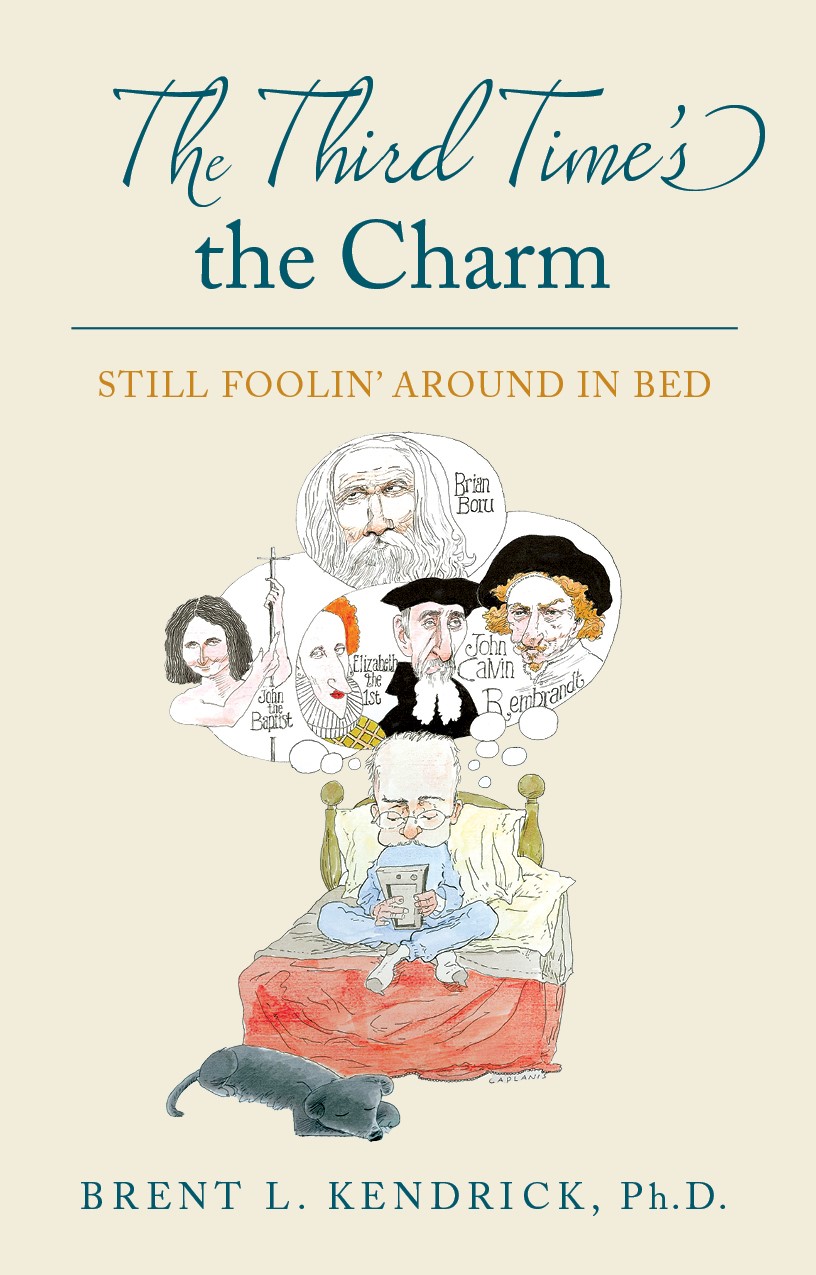
A Glimpse Beneath the Covers (Book Covers, That Is)

“Embrace the glorious mess that you are.”

–Elizabeth Gilbert (b. 1969. American author best known for her memoir Eat, Pray, Love, which became a global bestseller and cultural phenomenon. Her work blends introspection, humor, and an embrace of life’s messiness—much like the spirit behind my modest The Third Time’s the Charm.)

Guess what arrived in the mail today?

(Hint: it isn’t another gardening catalog—though those are always welcome at my house.)

It’s the printed proof of my next book, The Third Time’s the Charm. At 440 pages, it’s a whopper! This brand-new collection of personal essays is drawn from my The Wired Researcher Series. Today, I’m delighted to share the cover art with you. Once again, the art is by acclaimed caricaturist Mike Caplanis. Although he was inspired by the essay “What If I’m Not Who You Think I Am?”, the book’s cover captures the spirit of this collection perfectly—thoughtful, mischievous, and comfortably tucked between the sheets.

This book is close to my heart. It’s a gathering of essays written—yes, literally, as you know already—in bed, where I do my most creative thinking and, often, my most honest writing. I hope these pieces reflect a voice that’s warm, a little witty, deeply rooted in everyday life, and shaped by the rhythms of memory, nature, and reflection.

William Faulkner once referred to his childhood landscape as “a postage stamp of native soil,” and in this collection, I’ve claimed one of my own. These essays rise from the soil that grounds me—Appalachian roots, coal camp memories, gardening, grief, and joy—and reach toward readers everywhere. I hope these pieces help you discover something true in your own story, too.

The book will be available very soon—just a few weeks away. For now, consider this a soft unveiling and a warm invitation. I’ll share more details soon, including where and how to get your copy. Until then, feel free to admire the cover, fluff your pillows, and prepare to join me—in spirit and in story—In Bed.

P.S. If you’d like to be among the first to know when the book is available, keep an eye here—or better yet, follow me if you’re not doing so already.

When the Well Runs Dry: Writers’ Fears about Running Out of Ideas

“A rock pile ceases to be a rock pile the moment a single man contemplates it, bearing within him the image of a cathedral.”

—Antoine de Saint-Exupéry (1900–1944; French writer, aviator, and philosopher, best known for The Little Prince. His works explore themes of human connection, imagination, and the search for meaning.)

Knife raised in the air, just a few inches or so above the kitchen counter, I stood there nearly motionless. I’d like to say that it was one of my better knives, maybe my Shun or my Wüsthof. But it wasn’t. I’d like to say that it was about to land on one of my better cutting boards, maybe my Boos or my Ironwood. But it wasn’t. And I’d like to say that I was about to execute some fancy-schmancy cut, maybe Chiffonade or Julienne. But I wasn’t.

I was just standing there with ordinary carrots, celery, and onions arranged on an ordinary cutting board as I minced them with my ordinary paring knife for an ordinary pasta sauce.

But as I stood there, something extraordinary happened in that ordinary moment.

Just as my knife was coming down, Billy Collins’ “I Chop Some Parsley While Listening to Art Blakey’s Version of ‘Three Blind Mice'” seemed to shimmer across the blade. Maybe that was to be expected. I love Billy Collins’ poetry, and, after all, there I stood chopping, and in Collins’ poem, there he stands chopping parsley and dicing onions.

But get this. As he wields his knife, he’s not at all concerned about how or why, in the nursery rhyme—the supposed thrust of his bluesy poetic mirepoix—the mice managed to be in the direct path of the farmer’s wife’s blade. Of course, he’s not. We all know how that story ends. But at that moment, standing in my own kitchen, I had no idea how mine would.

But Collins does something I’ve never seen anyone else do. Instead of focusing on how the mice lost their tails, which we know already, he sets up his own minor tragedy filled with blues and tears by raising questions about their blindness:

Was it congenital?

Was it a common accident?

Did each come to blindness separately,

How did they manage to find one another?

After posing those weighty questions–ones that I dare say most of us have never even vaguely contemplated–Collins gets emotional as he thinks about the mice without eyes and without tails running through moist grass or slipping around a baseboard corner.

Actually, he’s brought to tears, but don’t worry. He has two good covers:

By now I am on to dicing an onion
which might account for wet stinging,
in my own eyes, though Freddie Hubbard’s
mournful trumpet on “Blue Moon,”
which happens to be the next cut,
cannot be said to be making matters any better.

There you have it. Just as the end of Collins’ poem trailed across the blade, my knife landed once more on the veggies, and I remembered what I had been thinking before Billy Collins had the nerve to drag the farmer’s wife’s mice and Art Blakey’s music into my kitchen uninvited.

I was recalling Mary E. Wilkins Freeman, best known for her A Humble Romance and Other Stories as well as A New England Nun and Other Stories. At the start of her acclaimed literary career that spanned nearly a half century, she commented:

I wonder if there is such a thing as working a vein so long that the gold ceases to be gold. There is no use in worrying, for another vein might open.

Despite her concerns, her literary canon powerfully demonstrates that more than one gold vein opened for her. She went on to write 3 plays, 14 novels, 3 volumes of poetry, 22 volumes of short stories, over 50 uncollected short stories and prose essays, and 1 motion picture play.

Freeman’s literary output never ceases to amaze me. As soon as her fears and successes bubbled up in my mind, it seemed that every time I lifted my knife to continue chopping, I thought of other writers and their fears about running out of ideas.

As a writer myself, and especially as a former Creative Writing professor, I’ve always paid attention to the ways writers wrestle with their fears. I always managed to sprinkle writers’ fears and their successes throughout my classes, and these days, I try sprinkling the same reminders throughout my own days of doubt.

What about Stephen King, one of the most prolific and celebrated writers of our time, who has openly feared creative depletion? He once admitted:

“Sometimes I wonder if I’ve already written my best book. And if I have, I’m all done.”

But King’s fears didn’t stop him. He continued to write, producing novels across multiple decades, from Misery to The Green Mile, 11/22/63, and Billy Summers, proving that the well of creativity runs deeper than we sometimes believe.

What about Margaret Atwood, best known for The Handmaid’s Tale, who has openly acknowledged her anxiety about running out of ideas? She once said:

“I live in fear of running out of ideas. I tell my subconscious to keep the pipeline full.”

But Atwood’s fears didn’t stop her. She has continued to produce groundbreaking fiction, essays, and poetry well into her later years, including The Testaments, which won the Booker Prize decades after her first major successes.

What about Isaac Asimov, the visionary mind behind Foundation and I, Robot, who, despite his prolific output, still feared creative emptiness? He once asked:

“What if suddenly I can’t think of anything? What if the words stop coming?”

But Asimov’s fears didn’t stop him. He went on to publish over 500 books across multiple genres—science fiction, history, and even chemistry—proving that creativity is not finite but ever-expanding.

What about Louisa May Alcott, best known for Little Women, who felt the pressure of creative exhaustion, particularly because she wrote at a relentless pace to support her family? She once confessed in her journal:

“I can only wander and wait, wishing I could rush into a new book with the old eagerness.”

But Alcott’s fears didn’t stop her. Despite her anxieties, she went on to write Little Men and Jo’s Boys, along with numerous other novels, short stories, and essays that secured her place in literary history.

What about Neil Gaiman, the imaginative force behind American Gods and Coraline, who has openly admitted that the idea of creative depletion haunts him? He once said:

“People ask me where I get my ideas from, and I feel like they should be asking, ‘How do you keep from running out of ideas?’ Because that’s what terrifies me.”

But Gaiman’s fears didn’t stop him. He has continued crafting captivating stories across novels, graphic novels, and television, proving that creativity is a muscle that strengthens with use, not one that simply wears out.

What about Maya Angelou, the legendary poet and memoirist, who feared that one day her words might simply stop? She once admitted:

“I have written eleven books, but each time I think, ‘Uh oh, they’re going to find out now. I’ve run a game on everybody, and they’re going to find me out.’”

But Angelou’s fears didn’t stop her. She continued to write, speak, and inspire, producing Even the Stars Look Lonesome, Letter to My Daughter, and numerous volumes of poetry that touched lives around the world.

And what about Christopher Isherwood, best known for The Berlin Stories (which inspired Cabaret), who worried about creative stagnation, especially as he aged. He once wrote:

“I kept asking myself: What am I really doing? Do I have anything left to say?”

But Isherwood’s fears didn’t stop him. He went on to write A Single Man, one of the most important gay novels of the 20th century, as well as an acclaimed series of autobiographical works well into his later years.

My reveries into literary fears and successes could have lasted forever. But just as I finished with Isherwood, I looked down at my ordinary carrots, celery, and onions arranged on an ordinary cutting board, and I realized that I had finished mincing them with my ordinary paring knife.

In that moment, I remembered that my reverie had not started with Mary E. Wilkins Freeman and Billy Collins at all. It had commenced with me standing there, wondering: What would I do if I ran out of ideas? What would I do if I worked my literary vein so much that whatever little gold it might have ceased to be gold?

But I can’t worry about that right now. I have a few book titles to my own credit, with two more to be added this year. For now, I’ll continue to contemplate the ordinary truths that surround me in my ordinary world.

Who knows. Maybe one day, history will add my name to the list of writers who feared running out of ideas—but never actually did.

In Defense of Memoir Writers

“The universal does not attract us until housed in an individual.”

—Ralph Waldo Emerson (1803–1882; American essayist, lecturer, philosopher, and poet who led the Transcendentalist movement of the mid-19th century. Known for his influential essays including Self-Reliance and The Over-Soul.)

Memoirists writers are shamelessly self-centered, and I ought to know. I’m one of ’em. And of course, I know that you really want to know why I used ’em instead of them.

You do want to know, don’t you? You don’t?

Well, this is where things start to get dicey, because I’m going to tell you anyway.

I chose ’em instead of them because the former seemed more casual and playful and, in my mind, it makes me feel comfortable bashing the hell out of ’em since I’m bashing the hell out of myself at the same time. Now you know.

Aren’t you glad that I told you? You’re not?

No problem. Like I said. We’re shamelessly self-centered.

Now that I’ve cleared the air about that one teensy-weensy word choice–it was a choice, of course, though I’m not sure ’em should count as a word–let me tell you how the title of today’s post bullied its way to the top.

You do want to know, don’t you? You don’t?

Well, I’m betting that you know exactly what’s coming next. You’re right. I’m going to tell you anyway. Like I said. We’re shamelessly self-centered.

Originally, today’s post was titled “An Apologia for Memoirists.” Clever, no? I thought so, too, despite the way the word apologia looks. It may look like an apology, but it is not an apology at all. Au contraire. It is a staunch defense of something.

Let me give you an example of an old and famous apologia. I’m thinking of Plato’s Apologia Socratis, the legal self-defense that Socrates spoke at his own trial for impiety and corruption. He was defending himself against the charges of corrupting the youth and of not believing in acknowledged and accepted gods.

After thinking about that example, I decided that apologia was a poor word choice for inclusion in the title of today’s post. As I have just demonstrated, its meaning is easily misconstrued. Beyond that, its pronunciation is not easy either.

Is it “a–puh-low-jee–uh?”

or

Is it “a–puh–low-jee-uh?”

Damned if I know. And if I don’t know how to pronounce a word, I’ll be damned if I’m going to use it.

So, in a touch or two on my Smartphone, I struck right through An Apologia and replaced it with two words that are easily pronounced and readily understood: In Defense.

There. I’ve straightened out Apologia. Now, let me explain why I scrapped Memoirists. I suppose any reader who knows what a memoir is would know–or quickly deduce– that a memoirist is “a person who writes memoirs.” Don’t you detest circular definitions like that? I do. But you can’t blame me for it! Blame dictionary.com. That’s where the definition came from, and that’s why I put it in quotes. I may go ’round in circles, but I would never give you a circular definition. I’d spit it out exactly as it is. A memoirist is someone like me who takes the raw material of their life—its triumphs, trials, quirks, and quiet moments—and shapes it into a narrative that not only reflects their truth but connects with the truths of others.

That definition is mine, and I like it. However, I scrapped Memoirists for an entirely different reason. If you think pronouncing Memoir is an exercise in tongue-mouth calisthenics, try pronouncing Memoirists:

● mem-wahr-ists

or

● mem-wawr-ists

Well, maybe it rolls off your tongue just fine, but it gets stuck to the roof of my mouth. And, I don’t know about you, but when something sticks to the roof of my mouth, I get rid of it as quickly as possible.

That’s just what I did with Memoirists. I got rid of it. Quickly. In just a touch or two on my Smartphone, I struck right through part of Memoirists and replaced it with Memoir Writers. I know. Two words instead of one. Fine. What I lost in word count, I gained in mouth feel.

It took a while, but now you know–even if you had no desire in knowing–everything you never wanted to know about the origin of the title In Defense of Memoir Writers. Like I said. We’re shamelessly self-centered.

Now, I’m certain that you want to know why I feel the need to defend myself and other memoir writers. You do want to know, don’t you? You don’t?

Well, I’m betting that you know exactly what’s coming …

Like I said. We’re shamelessly self-centered. Right? I mean, after all, we share all of the intimate details of our lives with the entire world as if they give a rat’s ass about our world. But we do it anyway. Is that self-centered or what?

Take me, for example. I may have one-upped Anne Sexton who commented, “I tell so much truth in my poetry that I’m a fool if I say more.” I don’t know how many words are in her canon–she does have a canon, you know, though I shudder at the thought–but since 2021 when my blog shifted focus from research to memoir, I’ve spewed out nearly 300,000 words. My God. I’m taken aback. How is it possible that I have shared so much about me, especially when I tell writers that there’s no me in memoir. If they looked closely, they would see for themselves that there is a me in the word, and, like I’ve said all along, memoir writers like me are shamelessly self-centered. This post proves it. After all that I’ve written who would think that I could write more, but here I am, dragging you along to somewhere I think you might want to be for a few minutes–perhaps leading you to somewhere you might even want to stay a while to rest, perhaps to heal.

I shudder at the things that I have shared with you. I do. You know as much about me as I know about myself, and if you don’t know it off the top of your head–and that’s how certain I am that I matter to you–you can find it by foolin’ around in my blog. Let me zing you with a few things, and as I do, I wonder–I just wonder–whether you would put yourself out there for all the world to know.

You know that I’m so full of myself that I fully believe that I helped my Mother give me birth so that I could start charting new territories in my brand-new world.

You know that as my mother preached I wiped away the tears that fell from women’s eyes, some of them slain in the Spirit and hopping from the back of one pew to the next, all the way up to the front of the church and then all the way back again, never missing a jump and never suffering a fall.

You know that when I hold out my right hand to you, you’re grasping the hand that my Father held tight after he nearly cut it off accidentally while butchering a chicken.

You know the challenges that I faced as a gay guy born in the Bible-Belt in the late 1940s, growing up there in the 1950s and 1960s, trying my best to stay true to my authentic self.

You know that I chase dreams and never let go, even if it takes me 50 years as it took me to become an English professor.

You know that the praying hands my Mother and I witnessed in the lid of my Father’s coffin took us both by surprise with the words, “May God hold you in the palm of His hand until we meet again,” holding for me, and me alone, a lasting message.

You know that after my Mother’s burial, I took my hands–strong from the strength of hers–and released from their cage three white doves, flying upward, perhaps at that same mysterious moment when my mother found her way back home and celebrated her arrival with outstretched hands.

You know that when I wrote my late partner’s obituary, it was as if angel wings brushed across the page, just as magically as Allen brushed across and touched our life together.

Equally important, you know that I sometimes ignore dust bunnies and cobwebs; that I get ideas for writing everywhere, even when biking or weeding; that I notice smells like dill and black snakes; and that when I’m not having real guests, I’m conjuring up imaginary ones.

You know all these things and so much more about me because of one thing that I keep on doing right here in my blog post. Week after week after week, I take my bony index finger, hook the side of my metaphorical homespun curtains, and pull them back gently so that you can see through the fragile glass pane and catch glimpses of my world–past, present, and future. Creation. Faith. Survival. Authenticity. Perseverance. Grace. Transcendence. Love. Imagination.

From that perspective, it occurs to me that maybe memoir writers like me aren’t shamelessly selfish after all. Maybe we take our triumphs, trials, quirks, and quiet moments and try to shape them into a narrative that not only reflects our truths as we know them but also connects with your own truths as you glimpse into your world–past, present, and future.

Maybe memoir writers like me aren’t shamelessly selfish at all. Instead, maybe, just maybe, we’re shamelessly selfless—willing to sacrifice our private selves so that something universal can emerge from the personal. Even if the greater good is one solitary soul, needing an oar to stay afloat, it’s in the act of revealing our individual stories that we reflect something far larger than ourselves.

Maybe that’s our truest calling—not selfishness, but selflessness. And perhaps that’s the best defense I can offer for memoir writers like me.

Page 415 of 415: The Power of Showing Up (Even in Bed)

“Dripping water hollows out stone, not through force but through persistence.”

—Ovid (43 BCE – 17/18 CE; Roman poet best known for his works Metamorphoses and The Art of Love. his works shaped Western literature and narratives of perseverance.)

Voila! As I finished uploading the last essay into my MS Word document, I glanced at the upper-right corner and smiled:

● Page 415 of 415

Wow! That’s a lot of pages.

And when I looked down at the lower-left corner, my smile stretched from ear to ear:

● 100,740 words

Wow! That’s a lot of words.

Yet, the more that I thought about it, the more I realized that it’s really not a big deal.

Here’s why. I write in bed every night. Every single night. Got it? It has nothing to do with being in the mood. Nothing to do with being inspired. It has everything to do with showing up. Everything to do with showing up as a “writer in bed,” 365 nights a year. From that perspective, if I look at the total word count, I’m writing around 276 words a night. That’s not a lot.

But here’s the thing—once I set the goal, I follow through. Same time. Same place. Night after night. A fierce determination to write until I’m sleepy.

The payoff? Immense.

● A blog post, every week.

● A 415-page manuscript, totaling 100,740 words.

It gets better. As a result of showing up–as a result of follow-through–those words and those pages are now in the hands of my publisher, and my third collection of essays will be out this spring. The Third Time’s the Charm: Still Foolin’ Around in Bed.

Now you know. My writing secret is out.

I show up. I’m present. I write.

Then I follow through. I carry my writing intent forward, determined to have a blog post ready every Monday morning. Determined to have a collection of 52 or so creative nonfiction essays ready at the end of the year.

There’s a beautiful simplicity in what I’m doing that points to something true. Much of success, growth, and connection in life happens because we keep showing up and following through. Even if we’re not perfect, that steady presence builds momentum.

As we enter the first full week of 2025, we can all benefit from that truth especially as we tackle our New Year’s resolutions, even if we made just one.

One resolution is the lump sum of how many I made! It has nothing to do with my nighttime writing. Instead, it has to do with my morning biking routine, something I’ve done indoors for decades. Every day, without fail, I mount my faithful Schwinn and aim to hit at least 15 miles daily, most days 20. I’m attentive. I pedal 20-23 miles per hour, always exceeding Fitbit’s Zone minutes, customized just for me.

Several weeks ago, however, Fitbit launched a Cardio Load feature that intrigued me. It’s similar to Training Load metrics seen in high-end fitness watches (like Garmin or Polar), but Fitbit simplifies it for everyday users like me to easily track and interpret their progress. It measures the strain that my cardiovascular system experiences during physical activity. It reflects the cumulative impact of my workouts over time, helping me understand how hard my heart is working and whether I’m training too much, too little, or just right.

As might be expected, my biking routine had pedaled me perfectly into the cardiovascular sweet spot of excellence. But guess what? When it comes to Cardio Load, it’s not sweet at all. The first day that I tried it–biking the same way I’ve biked forever and a day–I discovered that I didn’t hit my recommended Cardio Load at all. Damn!

I knew at once what my resolution would be. Keep on biking with a goal of hitting my daily Cardio Load recommendations. It’s not easy. I have to pedal at least 23-24 miles per hour, plus I have to bike in longer stints to achieve intensity. I can tell when I get into my zone: it’s like crossing into fire—my legs pumping molten steel and my lungs drinking in the heat. My skin hums, sweat rolls in rivulets, but beneath it all, I feel power—sharp and alive, burning just right.

Easy? Hell no. But I am resolved to show up every day and follow through with the Cardio Load that Fitbit recommends for me. I know fully well that my body will face a learning curve, but I’m committed to biking my way to improved endurance and fitness. Every day, I’ll be hopping on my Schwinn, fiercely determined to chase down my Cardio Load and crush it!

Fitness and health resolutions are probably at the top of your list, too—exercising more, losing weight, meditating, or maybe just getting better sleep. Whatever your goal, it’s not about overhauling your life overnight. It’s about showing up—one walk, one salad, one deep breath at a time. Small shifts add up, and before you know it, you’ve walked hundreds of miles or made it through January without stress-eating half your pantry.

Or maybe you’ve decided to focus on personal growth and education. Maybe you resolved to read more books, to learn a new skill or hobby, to take a class, to continue your formal education, or to journal regularly. Whatever your goal, it’s not about mastering everything at once. It’s about showing up—one chapter, one class, one messy journal entry at a time. Growth isn’t loud and immediate; it’s quiet and steady, and those small steps lead to bigger shifts before you even realize it.

Chances are good that many of you made resolutions aimed at strengthening your relationships and social life. Maybe you resolved to communicate more effectively, spend more quality time with family and friends, meet new people and expand your social circles, or strengthen your romantic relationships. Whatever your goal, it’s not about grand gestures. It’s about showing up—one call, one coffee date, one honest conversation at a time. Relationships grow in the quiet spaces we choose to fill with presence and care.

Even if you didn’t make it a formal resolution—though I’m betting you did—we can all work on improving our mindset and perspective. Maybe this year you want to let go of grudges, worry less, stop sweating the small stuff, or practice gratitude. Perhaps you just want to be more present in the moment. Whatever your goal, it’s not about perfecting your outlook overnight. It’s about showing up—one deep breath, one pause, one small shift in focus at a time. The mind, like anything else, grows stronger with steady attention and care.

And what about your determination this year to give back and engage more with your community? Maybe you want to volunteer regularly, take part in local initiatives, or donate to causes close to your heart. Whatever your goal, it’s not about making startling, sweeping changes. It’s about showing up—one hour, one act of kindness, one moment of service at a time. The smallest efforts ripple outward, and before you know it, you’re part of something larger than yourself.

Maybe at the top of your list are spiritual and inner growth resolutions. Perhaps you’re looking to deepen your practice through meditation, prayer, or daily reflection. Maybe you want to live with more intention—focusing on mindfulness and being present. Or you might feel drawn to reconnect with nature, simplifying life by clearing distractions and grounding yourself in what truly matters. Maybe, just maybe, you’re leaning in—trusting the process of living, embracing faith, patience, and the unknown.

Whatever your goal, it’s not about achieving enlightenment overnight. It’s about showing up—one quiet moment, one breath, one step toward stillness at a time. The soul, like anything else, finds its way forward through presence and gentle persistence.

Of course, plenty of other resolutions might top your list this year—ones I won’t dive into but are just as worthy of your focus. Maybe you’re aiming to advance your career, start a new project, or finally wrangle your calendar into submission. Perhaps finances are front and center—saving more, paying down debt, or planning for the future. Or maybe this is the year you let loose, travel more, dive into creative passions, and rediscover what brings you joy.

Whatever your goal, the same truth applies. It’s not about conquering everything in one fell swoop. It’s about showing up—one task, one small win, one brushstroke at a time. Progress happens quietly, and before long, those little moments stack up into something bigger than you imagined.

Here we are—the first full week of the New Year—riding high on resolutions we’ve made but probably won’t keep. But it doesn’t have to be that way. Life isn’t about whims or midnight promises made in a champagne haze. Real change doesn’t happen because the clock strikes twelve. It happens when we show up the next morning—and the one after that—and follow through.

The stroke of midnight might spark the idea, but it’s the steady steps after that turn resolutions into something real. That’s how I ended up with 415 pages, 100,740 words, and another book in the works—one sleepy night at a time.

15,000 Views and Counting: A Symphony of Words and Readers

“To toot one’s own horn is to sound the music of one’s journey. And today, my friends, the notes are jubilant, triumphant, unmistakably heartfelt, and wrapped in a little holiday cheer!”

–TheWiredResearcher (b. 1947; self-effacing educator, essayist, Green Mountain scholar, and Humourist—patiently awaiting long-overdue New York Times recognition.)

Beloved readers–of all ages and from all corners of the globe–I’m going to toot my horn proudly today!

At 11:22am today, my blog hit 15,000 views in 2024! Is that a special Christmas gift or what!

Let me pause and let that sink in: FIFTEEN. THOUSAND. VIEWS.

Can you hear the confetti cannons? Feel the glitter raining down? That’s the energy I’m channeling today. Because let’s be honest—this doesn’t happen by accident. It’s the result of showing up week after week, pouring my heart and soul into every post, and, most importantly, connecting with YOU, my remarkable readers.

If you’re like me, you know that milestones mean more when you see where they began. Let’s rewind:

● 2021: 3,940 views. A small but solid readership.

● 2022: 6,655 views. Growth doubling and momentum building.

● 2023: 7,313 views. Steady, heartfelt engagement.

● 2024: 15,000 views… and the year isn’t over yet!

From 3,940 to 15,000 in just a few years—this isn’t just growth. It’s a story of connection. It’s a story of us.

What Does 15,000 Look Like?

It looks like 140 countries—stretching from the United States’ plains and mountain ranges to Afghanistan’s rugged peaks, India’s vibrant deserts and Himalayas, and France’s vineyards, all the way to Zimbabwe’s sweeping savannahs. It looks like comments from faithful followers. It looks like early risers sipping coffee as they dive into my Monday morning musings. It looks like connections that transcend borders, reminding us all of the power of words.

The Greatest Hits (According to You!)

As we bask in this milestone, let’s revisit the top-ten posts that you’ve loved the most this year:

● “Glimpses of My Mother’s Hands.” A tribute to the tender, industrious, and spiritual hands that shaped my life and my memories.

● “Vermont’s Literary Daughter.” An exploration of the legacy of Mary E. Wilkins Freeman and my ongoing mission to keep her voice alive.

● “Confessions of an Editor.” A revealing journey of editing Freeman’s collected letters, complete with a never-before-shared self-review.

● “When Lilacs Meet Algorithms.” A dance between the timeless poetry of Walt Whitman and the cutting-edge potential of AI.

● “From Dusty Folder to Digital Ink.” A scholarly tale of rediscovery, dedication, and the joy of research.

● “From Stars to Soil.” A nostalgic return to childhood gardening and the realization that it gave me a profound appreciation for the interconnectedness and sacredness of all life.

● “My Mother’s Dress.” A story exploring how a dress that my mother made for herself included her hopes, her visions, her aspirations, and her dreams for her family and her world.

● “Sister’s Hands.” A celebration of decades of selfless love, compassion, and service.

● “My Taxing Review.” A humorous exploration of opening personal archives as a way to create a rich personal narrative.

● “Not Alone.” A triumphant tale of my own Coming Out.

A Milestone Worth Celebrating

Fifteen thousand views aren’t just numbers—they’re stories, connections, and a shared love of learning. Each one represents someone who paused in their day to engage with my words. Together, we’ve created a space where ideas flourish, where history meets memoir, where research mingles with creativity, and where we never stop asking the big questions.

The Future Is Bright

What’s next? More posts that inspire, challenge, and delight. More glimpses into the magic of the everyday. More stories that remind us why we love the written word.

To everyone who has ever clicked, read, commented, or shared—THANK YOU. You are the symphony that makes this blog sing. And as the music swells, I can’t help but toot my own horn just a little louder.

Because today, it’s not just my achievement—it’s ours.

Here’s to 15,000 views—and the countless stories and connections that brought us here.

Extra! Extra! Read All About It! A Blog Is Born!

“Somewhere, something incredible is waiting to be known.”

–Carl Sagan (1934–1996; astronomer and science communicator who inspired millions through his work on Cosmos and popular science writing.)

Tell me to do something, and I probably won’t do it. It smacks too much of being ordered around. No, thank you. Most of the time–though not always–I prefer to do the bossing.

On the other hand, suggest that I do something–maybe even challenge me to do something–and I’ll probably do it. Yes, thank you. I thrive on encouragement.

That’s exactly how today’s post began. One of my followers–my Linden Correspondent (LC)–suggested that the world at large might be revved and ready to know how my wired blog began! I thought LC’s suggestion was splendid, especially since my blog just celebrated its 12th anniversary. What better time than now to share the electrifying backstory.

With a growing readership of 13,782 (and counting!), I like to think my blog has found its niche. My readers value my blog for what it is today: a succession of riveting and captivating creative nonfiction essays that appear magically every Monday morning just in time for that first cup of coffee–that is for early risers who get their brew going early. That’s why I make a point of posting before 7am. While I sip on my coffee and savor what I wrote, I like to think that the entire world is doing the same thing.

Every Monday morning, you’ll find me in my reading chair with Ruby—my 60-pound lapdog—perusing my post while she peruses me. Sometimes, I smile and say aloud for her amusement:

“Wow, Kendrick! That’s a remarkable sentence. If you keep cranking out little gems like that, maybe one day you’ll end up somewhere as someone’s endnote.”

Yep. An endnote. Ironically, I guess that’s where we all end up: Someone’s endnote.

That’s not such a bad thing, you know. An endnote here. An endnote there. It seems to me that achieving a memorable, perhaps quotable phrase here and there is probably far wiser than having the entire canon of my work ricocheting around the world.

Stop and think about it for a minute or three. Look, for example, at what Benjamin Franklin achieved as a writer. Let’s focus on his Poor Richard’s Almanack, published annually from 1732 to 1758—nearly a quarter of a century of wit and wisdom.

Most people today can recall only a handful of Franklin’s most famous sayings, like:

● “Early to bed and early to rise makes a man healthy, wealthy, and wise.”
● “A penny saved is a penny earned.”
● “No gains without pains.”

Please tell me, Dear Reader, that you know those sayings, for if you don’t, you surely won’t know these:

● “Well done is better than well said.”
● “Three may keep a secret, if two of them are dead.”
● “If you would not be forgotten, as soon as you are dead and rotten, either write things worth reading, or do things worth writing.”

Indeed, Franklin managed to do both: he wrote things worth reading and did things worth writing. And, as I like to say:

“Endnoted.”

But let me take you back to where I began: the beginning of this blog.

I am so sorely tempted to say:

“It was a dark and stormy night …”

And that’s exactly what I would say, but if I said that I would have to note that Edward Bulwer-Lytton opened his 1830 novel, Paul Clifford with those words. As much as I hate to say it, because I am a stickler on documentation, I have grown weary of all the endnoting that I keep noting. Let us then move on to something that requires no noting.

Whew! I don’t know about you, but I feel notably relieved already.

LC must be relieved, too, to see that, at last, I’m getting around to sharing with the world the story behind the birth of my blog. But, as they say, every blog has its story, and mine is no exception.

Here’s what’s fascinating. Today, I am known around the world for my weekly memoir blog posts talking about anything from Aging to Zippers and about everything in between.

But when the idea for my blog came to me in 2012, I had a sharp, narrow, scholarly focus. I was working on my application for the VCCS Chancellor’s Commonwealth Professorship Program. At the heart of my application was the scholarly research that I wanted to do with a remarkable collection of Colonial American essays, songs, poems, and advertisements published pseudonymously under the name of “The Humourist” in the South Carolina Gazette during 1753-1754. The unique essays had never been reprinted, so they remained “hidden” and “undiscovered,” so to speak, in that newspaper. Further, no one knew who wrote the essays. Well, I was 99% certain that I knew, but I needed to do additional research and analysis to confirm my suspicions. In that sense, my project was a literary “whodunit” involving three things.

First, I planned to prepare a critical, annotated edition of the essays.

Second, I planned to develop a convincing case for authorial attribution based on a preponderance of internal evidence as well as on stylometrics.

Third, throughout the process of preparing the critical, annotated edition and developing a case for authorial attribution, I planned to give the essays a “close reading.” I was reminded of a quote by Robert Frost:

“We go to college to be given one more chance to learn to read in case we haven’t learned in high school. Once we have learned to read, the rest can be trusted to add itself unto us.”

I always shared that wisdom with my students. Learning to read—really read—gets to the heart of what we want our students to do, not just in English classes but across the board. When students slow down and give a text a close reading, critical thinking and intellectual discovery follow.

As Frost knew so well, that is what “learning to read” is all about. Further, when students learn how to really read, they can construct their own intellectual inquiries: “the rest can be trusted to add itself unto us.”

I always shared that belief—and approach—with my students without fail. I showed them how to learn to read, class after class, reading assignment after reading assignment, as I gave whatever literary selection we were reading my own close reading and as I made my own discoveries about a text. They were intrigued not only by my process but also by the discoveries that I made simply because of my dogged determination to give a text—any text—a close reading.

In my application, that’s precisely what I proposed to do with “The Humourist” essays. I wanted the opportunity to give the essays such a close reading that I would be able not only to establish a scholarly, annotated edition but also to identify the author.

I was really happy with that part of my application, but I knew that I needed something more. I needed a way to share my scholarly work on a regular basis with my colleagues and my students so that they could benefit, too.

I needed an idea. As I sat there on that January 8th evening, well into the third or fourth or maybe even fifth revision of my application, I started thinking about Daniel Boorstin (1975-1987), twelfth Librarian of Congress. A champion of accessibility, he worked to open the library to the public in symbolic and practical ways. He placed picnic tables and benches on Neptune Plaza, transforming it into a space for community gatherings. He initiated mid-day concerts and famously removed the chains from the majestic bronze doors at the first-floor west entrance leading to the Great Hall of the Jefferson Building. When told it would create a draft, he replied, “Great—that’s just what we need.”  In a bold move, he even stopped the practice of searching visitors.

At that time, I worked at the Library of Congress as an editor of the National Union Catalog, Pre-1956 Imprints, and I well remember the occasion when the bronze doors were opened. If I am not mistaken, it was on this occasion that I heard Dr. Boorstin say:

“You never know when an idea is about to be born.“

His comment lingered, and since hearing it, I made a point to keep track of when my own ideas were born.

So it came to be. While thinking about Boorstin, ideas, and my project, I exclaimed to myself:

“Blog it!”

I knew that a blog would allow me to share with the entire world my challenges, discoveries, and joys of research.

I knew that a blog would allow me to share with others this remarkable collection of Colonial American essays, songs, poems, and advertisements. The Encyclopedia of the Essay (ed. Tracy Chevalier, 1997) placed “The Humourist” essays in the tradition of Samuel Johnson’s Rambler essays and observed that they are the only “full-fledged literary” works to have appeared in the South Carolina Gazette. Years earlier, J. A. Leo Lemay (du Pont Winterthur Professor of English at the University of Delaware) had noted in A Bibliographical Guide to the Study of Southern Literature (1969) that the essays should be edited, published, and the author identified.

This was hot! I knew that I could make “stuffy” literary research come alive in a blog. Colleagues and students and scholars and the world at large would love it. I knew they would because who wouldn’t love essays on par with Benjamin Franklin’s “Silence Dogood Letters”? Get this, too. Franklin had direct ties to the South Carolina Gazette and possibly to the author of “The Humourist” essays.

I knew, too, that aside from being in the essay tradition itself, a blog would allow me to share my project with faculty and students throughout the Virginia Community College System (VCCS), from the beginning of my work and every step of the way through completion. I realized that a blog would allow me to capture my personal experiences on a regular and ongoing basis: my work, my methods, my discoveries, my challenges and frustrations, and my joys.

I knew that a blog would allow me to do in the virtual world—using a heretofore unstudied literary work—exactly what I did in my classroom with literary works that appear in our textbooks: turn my blog followers on to the beauty of giving a text a close reading and turn them my on to “learning how to read,” showing them that once they learned how to read all else would be given to them.

That same evening, I came up with a working title: The Wired Researcher.  I Googled it and was delighted to discover that no such blog existed.

As I often do, I emailed a former student—a lover of language and words and ideas—to get her take on my blog idea.

She responded immediately:

The word “wired” will catch the attention of …The Young.  They’ll think you are “hip.”

You’ll need a logo.  You’ll need T-shirts with the logo on them.  You need pens that say, “The Wired Researcher.”  “Sold in libraries everywhere.”  “Guaranteed to make study more exciting.” Oh, boy, I see tie-ins!

Clearly my former student was as wired as I was—perhaps that’s why I valued her opinions as highly as I did—but her email response gave affirmation to the title of the blog that had been born.

Here’s where the birth of the blog starts to get really sweet. I was awarded the Chancellor’s Commonwealth Professorship (2012-2014).

My first announcement appeared on October 19, 2012. It was short!

“Welcome to The Wired Researcher! Blog posts will begin on November 26, 2012.”

True to my promise, on November 26, I published “Opportunity Knocks Twice in the Virginia Community College System.” That post included the first of the historical essays that served as the nucleus for my project: “The Humourist” (November 26, 1753). Yep. Choosing to launch my blog on November 26, the same day that the Humourist launched his essays, was deliberate, and if I must say so myself, I think it was a stroke of genius!

And so, The Wired Researcher was born—not just as a blog, but as a way for me to share my love of research with a world eager to learn about my discoveries.

Now you have the inside scoop. If you want to know more, simply go back to the beginning and read all the posts from the start. But whatever you do, please make certain that you read “Colonial Charleston’s Biggest Literary Mystery Is Solved!” Yep. I solved the literary whodunit that captured me in the first place. Then you have to read “Three Special Shout-Outs!” because behind every success story are lots of people who deserve praise and thanks!

Wait! Wait! Don’t go yet. I have one or two more things to share.

When my blog started, I had around 1,750 views a year, representing 33 countries. So far this year, it has soared to an impressive 13,782 views from 152 countries! I must be writing something right!

To each and every one of you, My Dear Readers–then, now, and all along the way–a special shout-out!

To my Linden Correspondent (LC), who tossed out the idea that I share the story behind the blog, I extend a supercalifragilisticexpialidocious thank-you! (As Mary Poppins would say, nothing else captures the exuberance quite right!)

I look forward to a future of Mondays, inspired by the joy of discovery and by the connections that I’m making with all of you.

P. S. The joy of sharing new ideas awaits us all!

The Ghost of Palmyra Church Road

“Memory is the diary that we all carry about with us.”

—Oscar Wilde (1854–1900; Irish playwright, poet, and author known for his wit, flamboyant style, and sharp social criticism as well as for his role in the aesthetic movement, which emphasized beauty and art for art’s sake.)

Sometimes, I wonder when a routine in our lives becomes a ritual. They are different, of course. Routines are often performed out of necessity or habit. Rituals carry a sense of purpose, mindfulness, or emotional significance. I suppose a routine can turn into a ritual when its meaning grows beyond its original purpose—when the participants become more conscious of the act itself, savoring it, reflecting on its importance, or incorporating personal values into it.

I’m thinking, for example, of an afternoon drive that my late partner and I used to take daily down a nearby country road meandering along the banks of the Shenandoah River. It started as little more than a way to while away the time between Allen’s arrival home from his 7a.m. to 3p.m. shift at our local hospital until the start of our 5 o’clock cocktail hour and dinner prep.

We always took my Jeep. Allen didn’t like its bumpy ride, but since I was willing to drive, he put up with it. It didn’t take long before we both realized the routine had shifted from its original intent. It became a time when Allen could share the highlights of his day as a surgical technologist, and I could share highlights of mine as an English professor. Then, we savored being with one another, moving along, cocooned in quiet.

Now, heading out for that same drive feels different. I’m alone, but the road is still filled with echoes of those drives with Allen. The gravel crunches beneath the tires, a reminder that I’m traveling at a slower pace—though I still catch myself thinking in we. As I drive down our rutted road, the bumps and jolts are as familiar as ever, almost comforting, as if the past rides along with me into the present. I’m never in too much of a hurry. After all, I know that venturing down means that I’ll have to come back up eventually.

Fall has arrived. The goldenrod along the roadside catches my eye because it often made its way back home into floral arrangements. The landscape changes as I transition from the gravel onto the hard surface of the county road. It meanders along steep banks, the guardrails dented woefully from cars that couldn’t quite manage the turns. The sound of the tires shifts too, now whirring on the pavement as the engine hums along at a modest speed—never more than thirty-five, even though the road stretches out ahead.

Leaving behind the George Washington National Forest, I see the Shenandoah Valley open up into a vast, sweeping view of mountains—beyond them, West Virginia. Mailboxes line the road, clinging to its edge like sentinels. The curves of the road feel like a roller coaster, and I slow down as I near the North Fork of the Shenandoah River. It’s instinct now, my pause to check the depth of the water below, watching as it glides under the bridge.

I pass through Edinburg, a town where unoccupied buildings look as cared for as the rest. I find myself wondering what brought people here in the first place and what keeps them here now. Stony Creek runs by Edinburg Mill, built a decade or so before the Civil War. Just beyond is the cemetery, always a reminder, as if I ever needed one, that a little ways further is where we always used to turn left onto Palmyra Church Road.

I turn there today. This stretch is all too familiar. It’s paved but without markings to show the center of the road, the travel lanes, or the road’s edges. Massanutten Mountain looms straight ahead. I slow down even slower, savoring the ride, stretching out the trip as long as I can. I realize that I have no compelling destination. This trip is about the road itself, the memories, the connection to this place, and the quiet reflection it brings.

The speed limit drops to 25, and the road stretches out ahead. For now, it’s just me and the country road. There’s nothing behind me that I can see and nothing ahead of me but that same winding road.

Soon, I approach a grassy field stretching along the banks of the Shenandoah River. The grass, tall and dry, ready to bow down for a twin-engine plane’s landing. Small cones dot the nearly invisible runway, glowing at night like distant stars, guiding the landing, and then leading to a small, weathered hangar. In times past, we would sometimes glimpse a small plane resting at the far end of the field, its presence quiet and still. We never saw the pilot, if one ever existed. These days, the plane is gone, as if it never was. The field lies empty, waiting.

A little further along, I do a double take to my left as I see Palmyra Church of the Brethren. I’m not sure that Allen and I ever saw it on any of our drives. If we did, neither of us commented. I’m not surprised. It’s a modest church with white wooden siding, a metal roof, and a small steeple that adds a traditional touch. A brick chimney on one side adds to the rural charm. The front entrance is simple, with a door accessed by steps and a metal railing, alongside a wooden ramp. No one is there. The absence of people turns quiet into stark, making the church feel even more secluded if not abandoned.

I pause and cannot help but wonder why a road meandering along the mighty Shenandoah River would bear the name of a church so plain and inconspicuous that it’s easily unseen. Yet, even as I wonder, I know. For the dwindled few, it’s still a house of worship. And then I pause again. Seeing no cemetery. I wonder: where do they bury their dead?

I leave those wonderings behind me as I start looking ahead, hoping to see the small, thin woman that Allen and I used to see as she walked the road, her steps so soft they seemed to barely touch the ground. She was always beneath a large, open black umbrella, shielding her, sometimes from sun or rain or snow, but more often than not, from nothing more than open sky and passersby. Her pace seemed slower than the passage of time itself, as if she were floating rather than walking. Her face leaned down toward a cell phone held delicately in one hand, her eyes locked on its screen. She appeared ethereal, her presence more like a drifting shadow, but there was an undeniable humanity about her—fragile and real.

Allen and I worried about her. We broke our quiet to talk about her. Where was she going? Where had she been? Where was her home? How far away from home was she? Who was waiting there for her return? She seemed so other-worldly that I started calling her The Ghost of Palmyra Church Road. We always wondered whether we would see her on our next drive. We always did, every time, though in a different spot every time, always somewhere further back or somewhere further ahead. Over time, we warmed to her, and we waved softly. It took her longer, but the time came when she warmed back, shyly and slowly, as if to freeze time itself with the lift of her mittened hand.

Something about her presence always felt timeless. Today, she’s not here.

The rumble of tires against the pavement breaks the quiet as I approach a small bridge to my right, spanning this narrow section of the Shenandoah River, connecting to Old Valley Pike. Sometimes, if we were pressed for time, Allen and I would turn here and head back home.

Usually, though, we weren’t in a hurry, and we’d continue down the road where, from this point, it became Red Bank Road. Expansive farmlands open to my right, framed by wooden fences holding on to the Civil War. These fields, too, are dry and dusty.

To my right, I catch glimpses of the Shenandoah River through the sycamore. Rounding the last turn, I’m aware that the speed limit rises to 45 as I approach Mount Jackson. I could easily turn around and retrace the drive as Allen and I used to do as part of our ritual. But I don’t. I know that The Ghost of Palmyra Church Road is no more likely to appear than the plane that’s disappeared from the field. They coexist with the church that has no people and no cemetery–echoes in my memory.

As the landscape shifts and as the signs of the times creep back in, the quiet truth shatters my silence.

This time, I’m driving alone, my right hand resting on the Jeep’s console, no longer holding Allen’s hand in mine.

This time, I realize. Allen is gone.

This time, I realize. The ritual is gone.

This time, I realize. I’m driving home.

This is just another country road.

The Albatross Effect: How Letting Go Set Me Free

“Letting go gives us freedom, and freedom is the only condition for happiness.”

— Thich Nhat Hanh (1926-2022; a Vietnamese Buddhist monk and peace activist known for his teachings on mindfulness and compassion.)

It all started a week or so ago. I remember with great clarity that it was on a Monday. I woke up feeling a weight around my neck, something I hadn’t noticed before. It was subtle but persistent, almost like wearing a heavy choker. At first, I tried to dismiss it, thinking it was just a minor inconvenience. But as the hours passed, the weight grew more noticeable. I felt uneasy, as if something was slightly off, casting a shadow over my thoughts.

The next day, the weight was unmistakable. It was heavier than I expected, plus it seemed to be tightening. Simple tasks became more cumbersome, and I became acutely aware of something that I could not escape. The burden started to affect my mood, causing frustration to build.

By the third day, the albatross felt like an anchor dragging me down. I was tired and irritable, and my patience was wearing thin. It seemed to point me toward a deeper problem or unresolved issue that I knew I shouldn’t ignore. Despair started to set in as I tried to identify the problem and figure out how to escape the torment.

Finally, on the fourth day, while relaxing on my deck in the early sunrise, the albatross looked at me, and in that fleeting glance, I saw the source of the nearly unbearable weight. Brace yourself. You might not believe what I’m about to reveal. Here goes. The weight was coming from the blog post that I was working on for the next Monday.

The realization stunned me. Actually, it mortified me. Here’s why. I knew exactly where I was going with the post, and I had drafted more than half of it. But get this. I didn’t like the opening paragraphs. I hadn’t liked them from the start, I kept telling myself day after day that those paragraphs would fall into place as I got closer to the post’s ending.

I was wrong. They didn’t fall into place, and I wasn’t willing to let that albatross hang around my neck any longer. I found myself saying out loud to myself as I sat there, sipping coffee:

“Give it up, Kendrick. Just give it up.”

I didn’t mean that I should delete the draft. I just meant that I should put it on the back burner until its time had come. As soon as I gave it up, the albatross that had become unbearable let go of me and flew away. I felt an immediate sense of lightness and relief. The burden that once felt insurmountable was gone, and I was overwhelmed by a wave of elation. I felt a profound sense of freedom. The contrast between the heaviness of the past few days and the newfound lightness made the relief even more exhilarating. I was finally free.

With the albatross gone, my mind was free to soar, and a brand-new idea for a post came to me immediately, filling me with renewed energy. As I continued sipping my coffee, I cobbled together a really rough draft of what I wanted the new post to become. All day long, I kept the post on my mental backburner. That night, in bed with my Smartphone in hand, I completed the post rather effortlessly and published it the following Monday: “When the Heat Is On, Cue the Vacay!“

Letting go of the writer’s albatross that had been weighing me down for days allowed me to cue my own metaphorical vacay. Now, here I am sharing my specific challenge and my specific solution, hoping that it will speak to other writers out there. Sometimes, you simply have to let go of an idea that has possessed you if it becomes a deadly weight instead of wings that give flight. Letting go does not mean abandoning. It means putting the idea aside until it calls you back and begs you to give it the attention that you need to give it. The two of you–your idea and you as the writer–are the only ones who will know when the time is right.

For me, it took about two weeks. After “When the Heat Is On, Cue the Vacay!“, I moved on to “Listening to the Unsaid.” The next week, I returned to my albatross post, and I knew immediately what I needed to do with the first few paragraphs. Whitman and Emerson reached out to my spirit, and as soon as I gave them a home in my post, everything else fell into place for “Digging Deeper: A Gardening Lesson Applied to Life.”

In the end, letting go of the albatross allowed me to discover some new creative wings. By acknowledging the weight and releasing my grip, I freed myself to explore new ideas and approaches.

If you’re a writer, hold on to the truth that I have shared. Sometimes, the best way to make progress is to let go and cue your own vacay–embracing the freedom to create and enjoy the journey.

If you’re not a writer, reflect on this nugget of truth as well. It might help you, too. Just as a writer’s stubbornness can turn a blog post into an albatross, so too can our refusal to release emotional baggage turn relationships into anchors, holding us back from sailing into calmer waters. Or our insistence on controlling every detail turns projects into burdensome backpacks, weighing us down on the journey to success. And what about those stubborn habits we cling to, even when they no longer serve us? Don’t they become the equivalent of a ball and chain, hindering our progress toward a healthier, happier life? In each case, the albatross effect whispers a haunting question: What weight am I shouldering that’s keeping me from soaring? Sometimes, letting go of our personal albatrosses is the only way to find freedom.

Sometimes, we need to let go, not necessarily abandoning our responsibilities or aspirations, but releasing the grip of our ego, our fears, or our need for control. By doing so, we create space for new ideas, new experiences, and new growth to emerge. May we all find the courage to release our albatrosses and let them fly away so that we might discover the liberating power of letting go.

When the Heat Is On: Cue the Vacay!

“You don’t have to be rich to travel well.”

–Eugene Fodor (1905–1991; notable American travel writer and editor best known for founding Fodor’s Travel Publications).

All right, everyone, indulge me for a moment and imagine something a bit out of the ordinary.

Close your eyes and conjure up an image the likes of which I’ll guarantee you’ve never seen before. Picture a man in his 70s, proudly sporting a ponytail that flutters like a whimsical flag in the breeze, perched precariously atop his chimney. Clad in well-worn flip flops and cut-off blue-jean shorts that reveal a pair of weathered but surprisingly spry and some-say-sexy legs, he stands with the kind of balance that suggests he’s either a seasoned acrobat or a silly fool blissfully unaware of danger.

From this lofty perch, he’s gazing out over the Shenandoah Valley below, his eyes twinkling like a mischievous elf’s, while the mountains in the distance seem to be returning their own salubrious salutation. With all the gusto of a wired researcher on a caffeine overdose, he belts out the Hallelujah Chorus at full volume, his voice soaring like a defiant eagle. His performance is a grand spectacle of unbridled joy and unequaled eccentricity, turning the chimney into his personal stage and the sky into his private audience.

In case you’re wondering who this daring rooftop performer is and why he’s carrying on such shenanigans, lean in close, and I’ll tell you. It’s me! I’m celebrating what appears to be the temporary end of an exhausting heat wave and drought by having my own imaginary rooftop concert that would make any diva proud. After enduring what felt like a never-ending barrage of scorching temperatures and parched landscapes, I figured it was high time for a little over-the-top jubilation. And if there’s anything that I love, it’s everything over-the-top.

Cooler temps and rain seem to be headed our way, and I’m embracing the arrival of this much-needed relief with the kind of exuberance that only a seasoned professor of hot weather clichés could cobble together. It’s been so blisteringly hot that I nearly froze to death, but I didn’t. Instead, I’ve become a connoisseur of every sun-scorched saying you can imagine. I’ve spent weeks sweating buckets, trying not to fry like an egg on the hood of my Gladiator, and lamenting the fact that my car seats are doubling as personal saunas. I’ve become a pro at grumbling about the weather, wondering whether my walkway pavers were actually sizzling, and dreaming of anything that wasn’t a mirage.

Guess what else I did during the sweltering days that are temporarily behind us? I put off more tasks than Carter’s got liver pills! Yep. The heat and drought have been an excuse, whether I was avoiding the garden beds that have turned into dust bowls or ignoring other projects that seemed like too much effort in a heatwave. I’ve postponed weedwhacking, repairing the leaky faucet that’s been dripping like a leaky faucet (because, let’s face it, who wants to fix a sink when it feels like you’re living inside an oven?), and even organizing the loft, which has somehow become a haphazard shrine to summer’s oppressive heat.

Guess what else I did? I decided that I needed to take a vacation! Yep. You heard me right. I decided that I needed some good old-fashioned downtime. But dayum! Before I could even plan to take it, I found myself all curled up and relaxed with the Oxford English Dictionary (OED) so that I could find out all about the vacation that the dreaded heat and drought convinced me that I needed to take.

As might be expected, our kith and kin Across the Pond used the word vacation as a noun long before we did, all the way back in 1405:

“Whan he hadde leyser and vacacion ffrom oother worldly ocupacion” (Chaucer, Wife of Bath’s Tale Prologue l. 683).

Isn’t that fascinating? Of course it is. More fascinating, though, is the fact that we Americans used it first as a verb in 1866:

“Whether Winter or summer, … threading the filthy lands of the Ghetto or vacationing among the islands, Mr. Howells found Venice … a theme for constant studies” (Round Table 8 September 90/2).

Now that I’m all squared away on the word vacation, I think I’ll spend just another second or two finding out when the phrase take a vacation was first used. You might have known it. The OED has the scoop:

“Smoke Jordan tried hard to get him to … maybe take a vacation, Florida’s nice. ‘Get yourself wheeled up and down like an icky banker?’” (D. Baker, Young Man with Horn, 1938)

What the OED does not disclose is fascinating as well, and I wouldn’t know it if I had not wanted to find out who “D. Baker” is. As it turns out, Dorothy Baker was an American novelist who loved jazz. In fact, her Young Man with Horn was based on real-life jazz cornet player Bix Beiderbecke. Even better is this hot tidbit: the novel was made into a 1950 movie featuring such hotties as Kirk Douglas, Doris Day, Lauren Bacall, Juano Hernández, and Beiderbecke’s friend and collaborator Hoagy Carmichael.

Well, these word trips are turning out to be as much fun as a vacay! OMG! Did I just use that word? Well, I did, and since my OED is still open (virtually), I just have to see when vacay was first used. I’m betting that it was coined by an American. Those Brits have no problem when they need to stoop to conquer, but they would never think about stooping low enough to truncate a word. Well, I was right. Vacay was first used in 1992:

“He said he was going on vacay and would give me something after he gets back” (Re: More on getting Gigs in rec. music. makers 14 January, Usenet newsgroup., accessed 13 Sept. 2013).

Just a sec, though. I might be wrong to claim the first usage as American. The OED‘s citation is rather shabby, in my opinion, and I can’t determine the authorship with any certainty. Lector: Cave a fidem non probatis.

I shall not, then, trust my initial claim, but I shall trust my subsequent claim that the next usage of the word vacay was American. It appeared in 1995 in the Pittsburg-Post Gazette:

“The convertible … was my Mom’s, we were on vacay” (16 July g8/2).

As for va-cay, vakay, and va-kay–those variant spellings of vacay–the OED has not seen fit to include them at all. I find that rather strange, however, since I am certain that I have seen them in use somewhere or other, perhaps right here in my blog. Ab ridiculo ad sublimem transire.

Hooey phooey is all that I have to say. Leave it to me to turn a vacation into a bunch of malarkey!

However, in case you’re thinking that you might need a vacation, let me help you. If you find yourself nodding along to any of the subsequent scenarios, it’s time to cue the vacay:

● Work: Your boss thinks “work-life balance” means balancing more work on your plate. Your to-do list looks like a never-ending scroll of doom. You start dreaming about spreadsheets. You feel like a juggler on a unicycle, minus the thrill. Yep. Cue the vacay!

● Social Media: You’ve scrolled so much that you start liking your own posts. You find yourself in a deep rabbit hole, liking posts from three years ago, and you’re contemplating the philosophical implications of cat memes. Yep. Cue the vacay!

● Family Gatherings: Your aunt asks (for the 15th time) why you’re still single. You’re dodging advice and daydreaming about automated responses. Yep. Cue the vacay!

● Dieting: You’re on a diet of kale smoothies and quinoa bowls, and you start dreaming about burgers and ice cream like they’re forbidden treasures from a lost civilization. Yep. Cue the vacay!

● Home Improvement Projects: Your “quick” weekend project turns into a month-long renovation of ginormous proportions, complete with a gazillion trips to the hardware store and questionable structural changes. Yep. Cue the vacay!

● News: You’re considering a bunker in the backyard. Dystopian novels of doom and gloom look cheerful compared to your news feed. Yep. Cue the vacay!

● Dating Apps: You’re swiping so much that it feels like a full-time job. Your thumb is sore, your eyes are glazed over, and every profile starts to blend into one amor(ph)ous blob. Yep. Cue the vacay!

● Exercise Regimens: Your workout routine feels more like a medieval torture session. You’re dreading your workouts more than a trip to the dentist. Yep. Cue the vacay!

● Parenting: “Me time” means locking yourself in the bathroom with a chocolate bar. Your rare escape feels like a luxury retreat. Yep. Cue the vacay!

● Blogging: Your efforts to craft engaging content week after week during a record-breaking heat wave and drought feel like an endless marathon. You’re standing on the chimney singing the Hallelujah Chorus. Yep. Cue the vacay!

Dayum! Dayum!! Dayum!!! Here I’ve done gone and paved the way for me to have a perfectly legit blogging vacay this week, and wouldn’t you just know it! I’ve done gone and cranked out today’s blog anyway! Phooey!

Clearly, my brain has been baking in the sun too long. Tuff. I’ll keep right on gazing from my imaginary chimney perch, realizing that, sometimes, the best way for me to break free from the grind and the heat is to let my imagination run wild and embrace the breeze of a little bit of whimsical madness.

I hope that you, Dear Reader, find your own rooftop, whether real or metaphorical, and that you sing your heart out when the world gets a little too hot to handle. Whether it’s a break from work, social media, family, or even blogging, taking a vacay isn’t just about escaping the heat—it’s about rediscovering the joy in life’s little quirks and celebrating them with gusto.

Cheers to your vacay! Wherever it leads you, may it be as epic and freeing as my rooftop concert over the Shenandoah Valley.