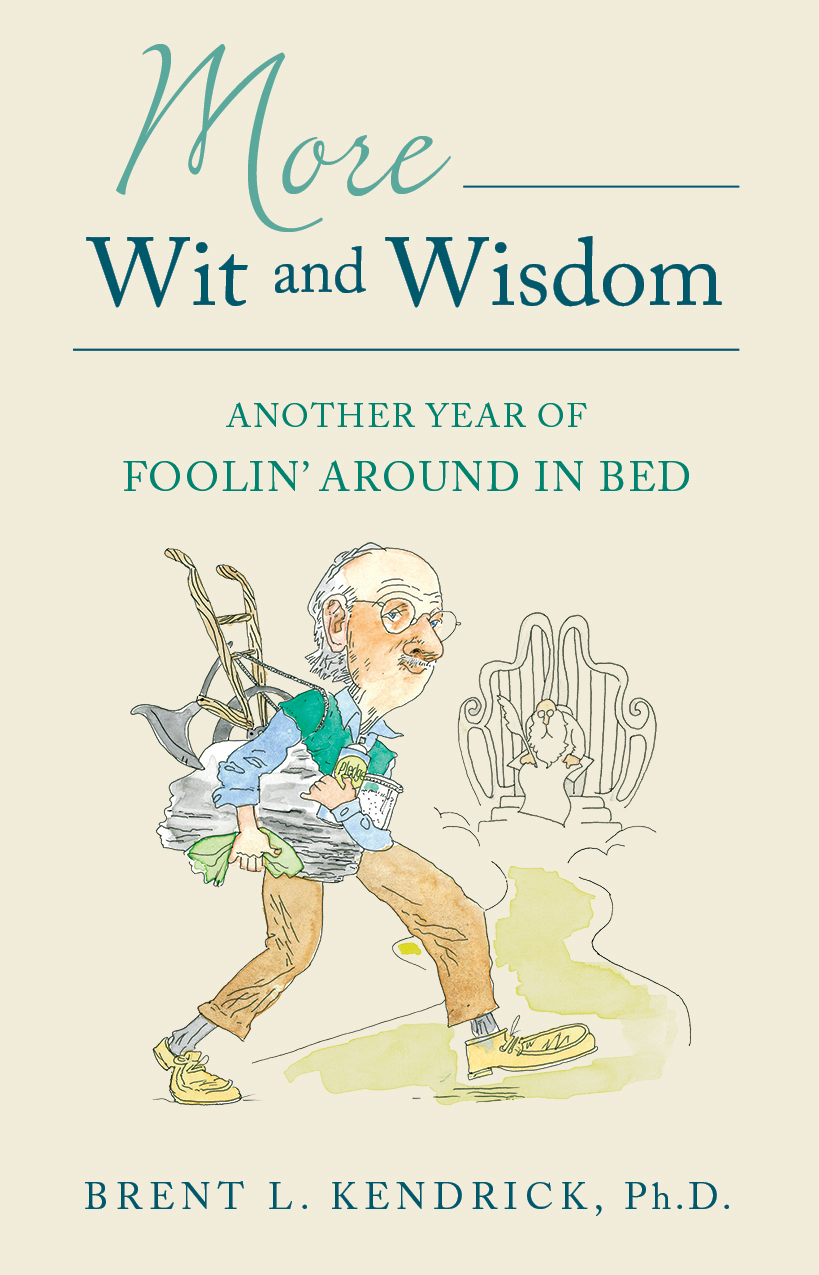
Unveiling the Cover: Get Ready for More Wit and Wisdom!

“The joy of publishing is in sharing your stories with the world and knowing that they’ll live on long after you’re gone.”

–Maya Angelou (1928-2014; a renowned American author, poet, and Civil Rights activist whose works explore themes of identity, race, and resilience.)

Dear Readers, gather ’round!

The moment we’re all eagerly waiting for is just around the corner. That’s right—my new book, More Wit and Wisdom: Another Year of Foolin’ Around in Bed–is getting closer and closer to its grand debut in late April, and boy, oh boy, do I have some juicy updates to share with you!

I’m thrilled to announce that I’ve personally PDFed every single one of the 380 interior pages, ensuring that each word, each sentence, shines as bright as a star in my mountaintop night sky. Proofing? Poof! Completed!

Whoever you are and wherever you are, your unwavering support means the world to me. More Wit and Wisdom: Another Year of FoolinAround in Bed isn’t just ink on paper. It’s a journey shared across 88 countries with 7,320 readers from the Shenandoah Valley to Okinawa.

But wait, wait! Don’t go! There’s one more thing. Feast your eyes upon the cover art for this new upcoming literary escapade. Just imagine it gracing your bookshelf, waiting to be cracked open and devoured, page by page. It will be available in hardback and paperback from Amazon, Barnes and Noble, and, hopefully, your own hometown bookstore. (Drumming up anticipation yet?)

Grand Publication Debut of a Soon-to-Be American Classic Expected by the End of April 2024. (Cover art by acclaimed illustrator, Mike Caplanis.)

Let Your Light Shine Bright

won’t you celebrate with me
what i have shaped into
a kind of life? i had no model.
born in babylon
both nonwhite and woman
what did i see to be except myself?
i made it up
here on this bridge between
starshine and clay,
my one hand holding tight
my other hand; come celebrate
with me that everyday
something has tried to kill me
and has failed.

–Lucille Clifton (1936-2010; “won’t you celebrate with me”; acclaimed poet and writer who overcame significant obstacles related to race, gender, and economic adversity; a Chancellor of the Academy of American Poets; Poet Laureate for the State of Maryland; and Distinguished Professor of Humanities at St. Mary’s College of Maryland)

Sometimes late at night when my words grow tired of dancing and I grow tired of waiting for the dance to begin anew, I let music waltz me off to sleep. Recently, I drowsed off to Susan Boyle singing “I Dreamed a Dream” from Les Miserable. Instantly, I remembered her appearance on Britain’s Got Talent (2009, Episode 1, April 11). I was mesmerized across time’s timeless expanse. I knew then, and I know now, exactly why. In part, it’s because of the poignant lyrics that evoke raw and vulnerable emotions:

I dreamed a dream in time gone by
When hope was high and life worth living
I dreamed that love would never die
I dreamed that God would be forgiving

In part, it’s because of Boyle’s powerful, soulful, resonant, evocative, and captivating voice.

However, more than the voice and more than the lyrics is this. Susan Boyle overcame great odds and landed a triumphant second-place finish. Her performance left everyone reeling, including the judges:

Piers Morgan: Without a doubt, that was the biggest surprise that I have had in three years on this show. When you stood there with that cheeky grin and said, ‘I want to be like Elaine Paige,’ everyone was laughing at you. No one is laughing now. That was a stunning, an incredible performance. Amazing. I’m reeling from shock. I don’t know about you two.

Amanda Holden: I am so thrilled because I honestly think that everybody was against you. I honestly think that we were all being very cynical, and I think that’s the biggest wake-up call ever, and I just want to say that it was a complete privilege listening to that.

Simon Cowell: Susan, I knew the minute that you walked out onto that stage that we were going to hear something extraordinary, and I was right. […] Susan, you’re a little tiger, aren’t you?

Then, the moment of truth: the voting and the final word:

Cowell: Susan Boyle, you can go back to the village with your head held high. It’s three yesses.

Cowell’s comment–“Go back to the village with your head held high”--resonates with all of us. Something in us makes us root for the underdog–“everybody was laughing at you”–because we’re hoping that someone out there is rooting for us when others are laughing.

Susan Boyle’s performance that night catapulted her into fame and stardom and set me to thinking about other underdogs whom I admire because they overcame seemingly herculean obstacles to achieve success, sometimes breaking barriers, always reminding us that the human spirit can prevail against all odds.

Immediately, I started thinking about underdogs from my home state of West Virginia. In an instant, Pearl S. Buck, author of The Good Earth and the first American woman to win the Nobel Prize in Literature, came to mind. With equal speed, I was ready to exclude her because I wasn’t certain that she had really faced obstacles on her path to fame. Then I remembered. Born in Hillsboro, the daughter of missionaries, she spent much of her early life in China. Without a doubt, she faced monumental challenges growing up as a minority in a different culture, and her early years were marked by poverty and social isolation.

Closer to where I grew up is Bill Withers, known for his acclaimed hits like “Lean on Me” and “Ain’t No Sunshine” and heralded as the Bruce Springsteen of the African-American community. Born in Slab Fork, a coal mining town, Withers grew up in a poor, working-class family and rose above those obstacles. His soulful and heartfelt songs have left a lasting impact on the music industry.

Still within spitting distance of where I grew up is Katherine Johnson from White Sulphur Springs. She was a pioneering mathematician and physicist known for her contributions to NASA’s early space programs. Her story gained widespread recognition with the release of the movie Hidden Figures, which highlighted the overlooked contributions of African-American women mathematicians to the space race.

And what about Homer Hickman, who grew up in the coal mining community of Coalwood? Inspired by the launch of the Soviet satellite Sputnik in 1957, he pursued a career in rocketry. Hickman’s story is depicted in the memoir Rocket Boys, later adapted into the film October Sky. He overcame the challenges of his mining town upbringing and became a NASA engineer.

Obviously, I can’t leave out Jeannette Walls who spent part of her life in Welch–just a stone’s throw from Coalwood–and went on to write The Glass Castle. Her memoir details her unconventional and challenging childhood, growing up in poverty with her eccentric and nomadic family. It has received widespread acclaim for its honest portrayal of resilience and determination in the face of adversity.

I thought, too, of Don Knotts, actor and comedian best known for his role as Barney Fife on The Andy Griffith Show. Born in Morgantown, he grew up in a family that struggled financially during the Great Depression. As a child, he was known for his lanky frame and high-strung personality, but he used humor as a way to cope with social awkwardness and to connect with others.

All of those West Virginians–and I could talk about others who resonate with me, including Chuck Yeager, Mary Lou Retton, Brad D. Smith, and John Nash–showcase the resilience and determination to be found time and time again as underdogs overcome obstacles–whatever they may be–and achieve success that inspires each of us and helps us believe:

“If they can do it, I can, too.”

By and large, my West Virginia anchors of hope overcame economic and cultural barriers. But here’s the beauty of it all. Anchors of hope can be found everywhere in the world, in every field of endeavor that we attempt, and in every obstacle that we face.

Among writers, I would note James Baldwin, an African American and openly gay writer, who faced the dual challenges of racial and sexual discrimination during a time of significant social upheaval. His eloquent and unapologetic writing style made him a prominent figure in the Civil Rights Movement and an influential voice for the LGBTQ+ community.

Another writer who transformed obstacles into insightful and controversial Broadway plays is Edward Albee, whose life was far from easy. Adopted into a wealthy family when he was just 18 days old, he never felt a sense of connection with his parents and instead felt alienated from them because of their high morality. Growing up gay in the 1930s and 1940s posed immense challenges for Albee–at home and beyond–yet he stood strong, celebrated his sexual orientation, celebrated the larger LBGT+ community of Greenwich Village and the world. At the time of his death in 2016, he was hailed as America’s greatest playwright.

I’m thinking about others who defied gender norms and achieved success, people like Christina Tosi founder and co-owner of Milk Bar, serving as its chef and chief executive officer. Food & Wine magazine included her in their 2014 list of “Most Innovative Women in Food and Drink.”

I’m thinking as well of Dr. Carla Hayden who made history by becoming the first woman and the first African American to serve as the Librarian of Congress. She overcame gender and racial barriers to become a trailblazer in the field of librarianship. Her leadership exemplifies resilience and the ability to break down barriers in traditionally male-dominated professions.

In the political realm, what about Shirley Chisholm (first African-American woman in Congress) or the late Sandra Day O’Connor (first female justice of the United States Supreme Court) or Barack Obama (first African American to be elected President of the United States)?

What about overcoming mental health challenges and financial hardship as Vincent Van Gogh did? He produced some of the most iconic and influential works in the history of art, demonstrating the transformative potential of creativity in the face of personal adversity.

Or can you imagine being born with no limbs? I’m thinking now of Nick Vujicic who overcame that immense physical challenge to become one of the most important motivational speakers today, delivering a message of resilience, gratitude, and the limitless potential of the human spirit.

These are just a few of my anchors of hope. I could go on and on with others, each representing a unique testament to the human spirit. Chuck Close (who triumphed over physical disabilities in art), and Misty Copeland (who shattered barriers in ballet) embody the resilience and determination that inspire me. Denzel Washington (rising from a challenging childhood to acclaim in acting) and Beverly Cleary (whose pioneering work defied gender norms in children’s literature) exemplify the power of perseverance. Dr. Ben Carson’s journey from poverty and academic struggles to a renowned neurosurgeon and Jay-Z’s success in overcoming the challenging environment of Brooklyn’s Marcy Projects showcase the transformative potential within adversity. Mark Zuckerberg (who faced skepticism and legal challenges in Facebook’s origins) and Elon Musk (who overcame personal and financial struggles in Tesla and SpaceX’s early days) reflect the tenacity of visionary entrepreneurs. Morgan Freeman (defying age norms with a career renaissance in his fifties) and Laura Ingalls Wilder (achieving fame at 65 with her Little House series) symbolize that hope and success know no age limits. Each is an additional anchor, proving that obstacles can be stepping stone’s to greatness.

I celebrate my anchors of hope all year long, but I do so even more during December. It’s a month chockfull of celebrations, starting with Hanukkah, moving on to St. Nicholas Day, Bodhi Day, Las Posadas, The Feast of Our Lady of Guadalupe, Yule, Christmas, and ending with Kwanzaa. Each carries a unique message of hope, transcends boundaries, and unifies us in the spirit of optimism and shared celebration. What better time than now to celebrate the triumph of the human spirit against all odds and to gift ourselves with an extra measure of hope.

And you? Who are your anchors of hope? Reflect on them. Celebrate them. Hold them close to your heart. As you do, don’t forget the unsung heroes who can also be anchors of hope. A mother’s resilience, a father’s unwavering support, a brother’s camaraderie, a sister’s understanding, a teacher’s guidance, and a neighbor’s kindness—anchors, each and every one. With their unspoken sacrifices and steadfast presence, they embody extraordinary strength within ordinary moments, reminding us that greatness resides not only in fame but also in the uncharted territories of love, connection, and the indomitable spirit of the human heart.

As you reflect, remember this as well. Someone, somewhere, might be looking to you as their everyday hero who has achieved success against all odds. Someone, somewhere, might be looking to you as their anchor of hope.

Be the light that someone else needs to see. Shine bright. Shine bright.

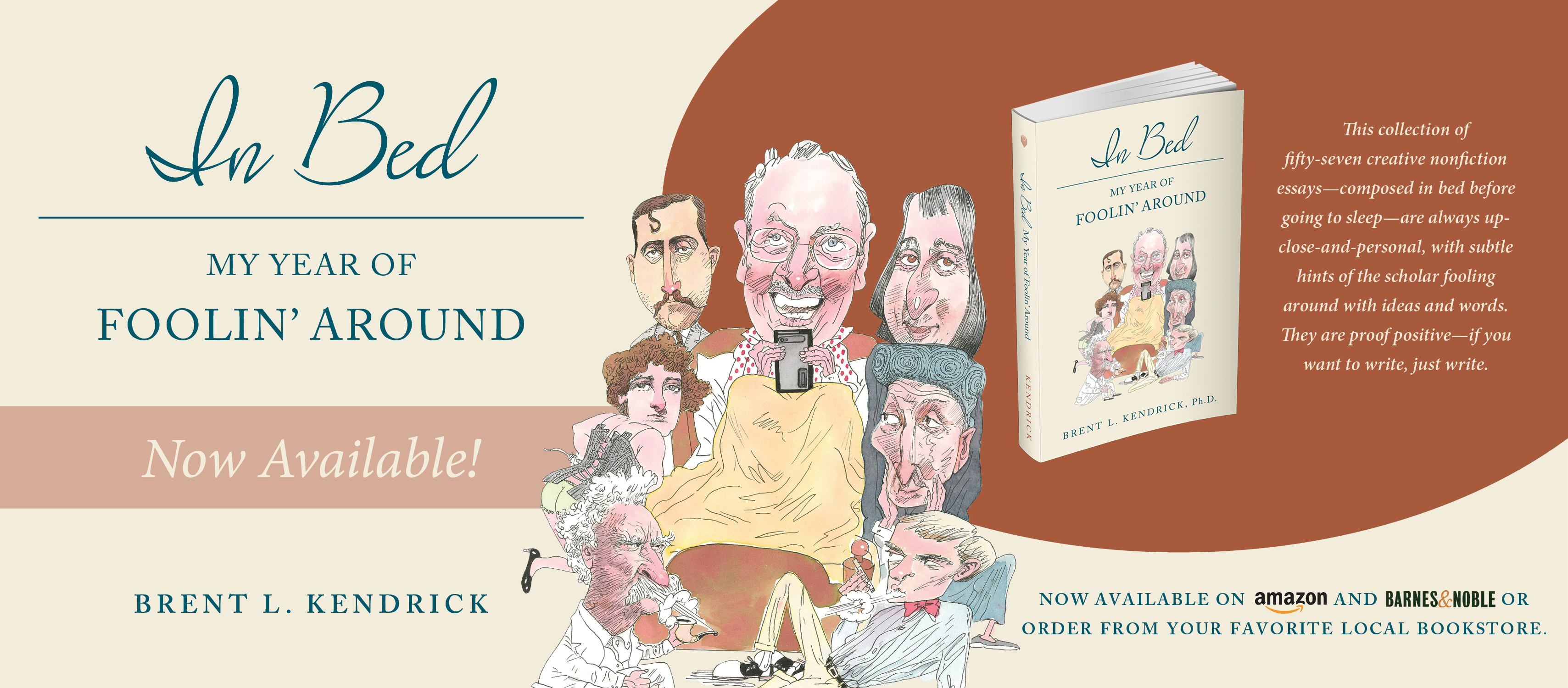
Just Published. IN BED: MY YEAR OF FOOLIN’ AROUND

Take my word for it. I never—absolutely never–intended to fool around in bed, certainly not every day, seven days a week, for an entire year.

from “An Invitation to Join the Author
In Bed” (5-12).

QUICK QUESTION: 

What does it take to write a book?

QUICK ANSWER:

● 6,625 readers.

● 59 countries.

● 1 year.

● 1 bed.

● 1 writer.

EXPANDED ANSWER:

That’s how many readers I’ve had since my blog went weekly on December 28, 2021. That’s how many countries my readers represent. That’s how long I spent writing the blog posts. That’s the bed where I wrote them. And I’m the writer. No foolin’.

NOW, 57 of those essays, reflecting the best of the best, have been published in a book that is exquisite from cover to cover and every page of the 346 pages in between. It’s available on Amazon or Barnes & Noble, or you can order it from your favorite local bookstore!

TAKE A LOOK AT THE BRILLIANT COVER!

Surely you recognize ME! I’m smackdab in the middle of my bed writing a blog post about foolin’ around with some well-known writers. Mark Twain and Truman Capote are on the floor at the foot of the bed, blowing smoke rings at one another. Imagine! They’ve got some nerve! Acclaimed artist/illustrator Mike Caplanis gets credit for the caricature based on one of the book’s essays, “Foolin’ Around in Bed with Famous (and Not-So-Famous) Writers” (249-53).

WHAT’S THE BOOK ALL ABOUT? See for yourself.

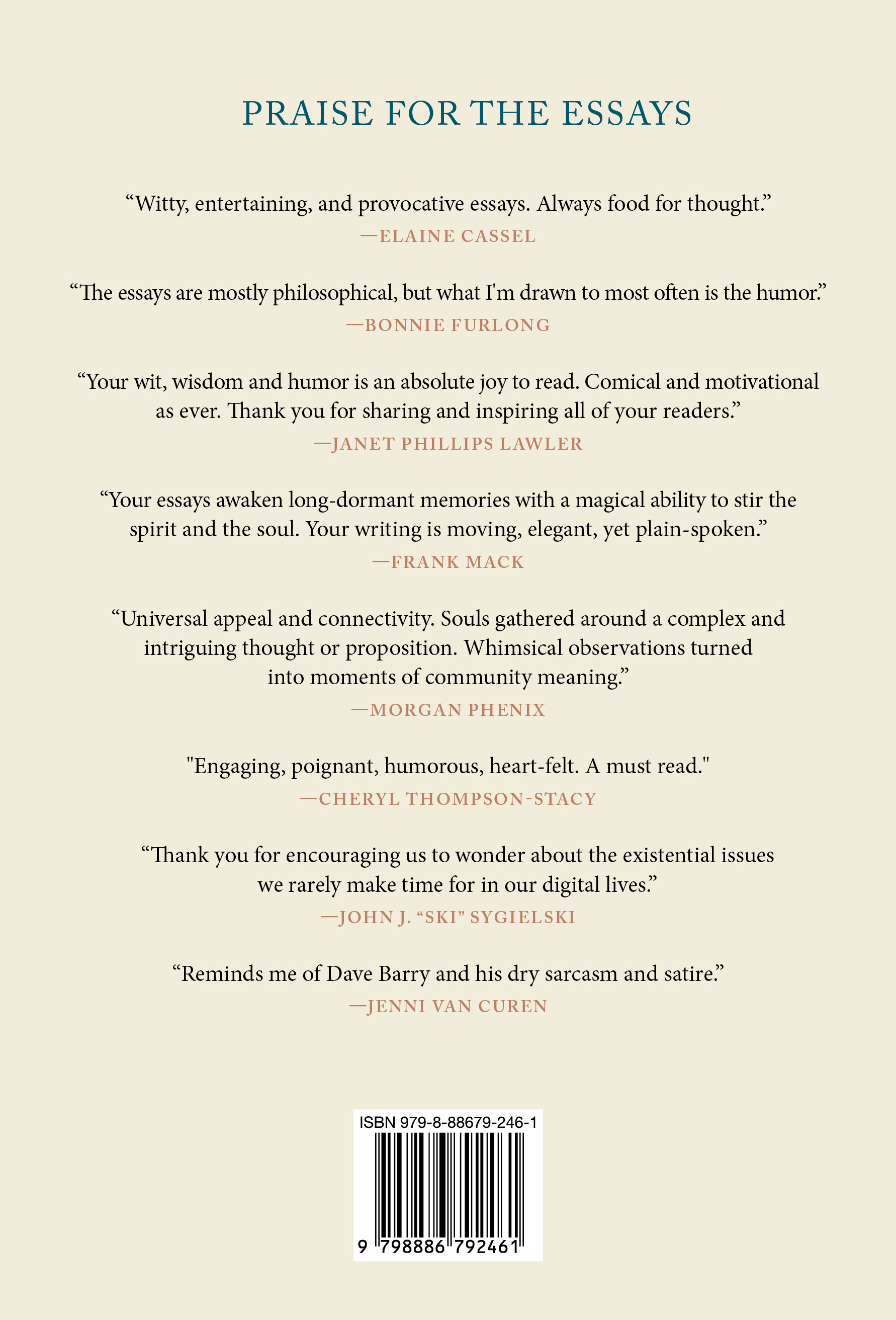
“Fresh and refreshing through and through.” I love it! Other ADVANCE PRAISES grace the dust jacket of the hardcover book.

“A MUST READ” impresses me so much that I just repeated it and made it all caps and all bold! Dayumn! I like it so much that I want to shout it again: “A MUST READ.” (Thank you, Cheryl Thompson-Stacy!)

IN BED: MY YEAR OF FOOLIN’ AROUND is available in hardcover, paperback, and Kindle. I recommend the hardcover. It costs a little more, but it feels so much better than the paperback. What can I say other than there’s something extraordinarily extraordinary about a book that has its own dust jacket!

The publication of this book is an historic and timely solution for every gift-giving occasion that might be coming your way for the rest of the year, if not for the rest of your life. And let me add: may your life be long, healthy, and prosperous and may you keep right on buying copy after copy of IN BED. It’s the perfect gift. Right here. Right now. You do not need to look any further. And while you’re buying multiple copies for gift-giving, remember that IN BED is also the perfect gift for all of your friends … and enemies.

Thank you, DEAR READERS, for all of your support. I have no idea how you found your way into my life, but knowing that you are out there reading my posts strengthens me and uplifts me whenever I need to be strengthened and uplifted.

Time’s a wastin’. ORDER YOUR COPY TODAY on Amazon or Barnes & Noble. Or you can or order it from your favorite local bookstore!

It’s Not a Corset. Don’t Force It.

Is it a corset
or primal wave?
Don’t try to force it.

–from Elaine Mitchell’s “Form”

Lately, I’ve been thinking a lot about writing. I have no doubt that it’s because I’ve been writing these posts faithfully every week for nearly an entire year. And I have no doubt that it’s also because I’m teaching Creative Writing this semester. Naturally, I spend lots of my time talking with aspiring writers about writing.

In fact, when I met with my students last week, we did two, one-minute reflections.

For the first, we reflected on the joy of writing. Let me share some of their responses:

● Creating my own world.

● Finding words that describe my own feelings.

● Gaining an understanding of my own life.

● Discovering something about my own identity.

● Daydreaming.

● Letting my thoughts spew out.

● Getting it done–the rhythm, the music, the wish, the dream, and the fear.

For the second reflection, we tackled the challenges of writing. Again, let me share:

● Getting started.

● Finding an interesting topic.

● Putting myself into my writing.

● Encouraging my paragraphs to talk to one another.

● Choosing which idea to explore.

● Connecting the beginning, the middle, and the end.

● Accepting my writing as it is.

I had planned a third reflection, but we ran out of time. Here’s what it would have been: discoveries about writing.

For this one, I’ll take the lead, sharing my own ideas, based largely on what I’ve discovered about writing as I wrote my weekly blog posts this year.

By and large, what I’ve discovered has been by way of reminders. To start, writing isn’t easy. It isn’t spontaneous. And it isn’t magical.

Here’s something else that I have rediscovered. Writing is work. It’s hard work. It’s lots of hard work.

Work. Hard work. Lots of hard work. That’s my mantra these days when I’m working with other aspiring writers. I front-load the conversation: get ready for rich, robust, and heavy mental lifting.

At the same time, over the last year I’ve reminded myself–and others–that even though the hard art of writing isn’t magical, it is filled with magical moments.

Let me share some of mine.

Magical Moment. Getting hooked on an idea that makes my world fade away.

Magical Moment.  Letting an idea explode in my mind as magically as Pop Rocks explode in my mouth.

Magical Moment. Focusing on old-soul insights that have come back to me from far, far away and from long, long ago.

Magical Moment. Fooling around with organizing what I’m writing until I get comfy with one structure that pulls me in close and whispers, “Yes. Let’s do it.”

Don’t get too excited by these moments. They are magical. But let me remind you: they are not magic.

And trust me. The next part–the actual writing–has no magic at all. Sometimes, it might not even have magical moments. The actual writing can be grueling, if not downright defeating, especially since first drafts never hit the mark. Never. Mine don’t, at any rate. Sometimes, even my 13th draft doesn’t seem quite right. How’s this for a confession? Sometimes, I’ve gone as high as 22 drafts. Admittedly, the differences between any two drafts are sometimes majorly minor, and the changes will be unknown forever to all except me. Nonetheless, the work of writing–of revising–goes on and on and on.

And writers keep at it. I keep at it, knowing that what I write will never be perfect, but knowing, too, that at some point it’s as good as it’s going to get.

What I have discovered as well is the simple fact that my scholarly writing is in many ways far easier than writing my personal essays like today’s post. My own scholarly work on The Humourist as well as on Mary E. Wilkins Freeman, for example, has singleness of purpose and focus. Easy-peasy, lemon-squeezy.

On the other hand, writing my weekly blog is more challenging, mainly because I don’t focus on the same topic every week. My topics change. As reluctant as I am to admit it, I’ll admit it anyway: I’m never sure from one week to the next exactly what topic will bubble up.

That’s not to say that I don’t have lots of ideas for my posts. I do. I have plenty. In fact, whenever I have an idea for a post, I immediately start a WordPress draft. I give it a working title, and I include as many notes as possible so that when I return, I can glide back into my thinking and writing groove.

Right now, for example, I have 25 drafts in various stages of completion, ranging from “The Power of Showing Up” to “Dating after Twenty-Two” to “Mishaps Make Memories.” I suppose I could also mention “Working Out a Plan” or “A Horrorscopic Week” or “What My Father Saw.” Or I could mention that I might have “My Gardening Attire” finished by next week. I might. But, on the other hand, I might not.

I’m not trying to generate future blog traffic by teasing you with alluring and inviting titles that may or may not morph into posts. Simply put, I have come to the realization that my ideas must germinate in the dark caverns of mindfulness and mindlessness. They must sprout and pop up whenever they are ready for the light of day. No sooner. No later.

All of my tentative topics and all of their accompanying draft notes are simply placeholders. Nothing more.

Yet it occurs to me that maybe they are far more than mere placeholders.

They are talismans. Not to bring me power. Not to bring me luck. But rather to bring me back to the illuminated intensity of the split second when an idea sought refuge within me and pleaded for a some-day home.

What I have discovered, then, is that I need lots and lots of talismans. They are my antidote to the numbness and paralysis that I know fully well will set in if I have no writing options. I don’t write well when my storehouse of options is empty. When that happens, I feel that I have forced myself into the all-too-tight corset of being compelled to write on one topic and one topic only.

On the other hand, when I have many, many topics, one of them might be precisely the one that captures my fancy precisely when my fancy needs to be captured.

It won’t have anything to do with talismanic luck. And it won’t have anything to do with magic.

It will have everything to do with my willingness to let my ideas take their own shape, whatever those shapes might be, without being corseted, without being laced up, and without being forced.

I want my ideas:

● to leave themselves ample space to move around in.

● to do what they want to do.

● to be what they want to be.

It’s really straightforward. My greatest discovery about my own writing is my everlasting need to unlace the corset that constricts my thoughts. It’s my everlasting need to let my ideas breathe and expand freely, whenever and however they wish.

Ricocheting Around Inside My Blog!

I love words. In fact, I’m a word enthusiast. No, actually, I’m a word aficionado. I like the way words look, the way they sound, and the way they require me to rearrange and reposition my tongue and lips and teeth! I like the “mouth feel.”

I love euphonious words, especially: supine, scissors, fantabulous, panacea, disambiguate, luscious, discombobulate, scintilla, tremulous, orbicular, woebegone, sonorous, ethereal, pop, holler, britches, entwine, hullabaloo, phantasmagorical, serendipity, slew, velvety, liminal, dusk, ever, and even meniscus.

I love euphonious phrases, too: thread the needle, rev the engine, a touch ticklish, doplar sonar, sweet and sour, bad’s the best, or one of my own creation–recalled from a dream that I once dreamt–blue-pigeon-feather happy.

However, all of my favorite melodious phrases and words pale in comparison to the phrase considered by many linguists (who study phonaesthetics and know all about the properties of sound) to be the most beautiful word in the English language: cellar door! I was flabbergasted when I made that discovery, but matters of sound are so momentous and so weighty that lengthy debates surround them. For example, many people attribute the coinage of cellar door to fantasy writer J. R. R. Tolkien who used it in his 1955 speech “English and Welsh.” But as American lexicographer Grant Barrett established in his February 11, 2010, New York Times article aptly titled, “Cellar Door,” we must give credit to Shakespearean scholar Cyrus Lauron Hooper who used cellar door in his 1903 novel Gee-Boy.

Sometimes one of these little beauties gets stuck inside my head and manifests a fierce determination not to go away. For example, the melodious word ricochet has been bouncing around in there for an epoch at least—perhaps even longer—and it’s not alone. It’s flourishing there as part of an entire phrase—an entire stanza, actually—from “The Lanyard,” a poem by Billy Collins, former United States Poet Laureate:

The other day I was ricocheting slowly
off the blue walls of this room,
moving as if underwater from typewriter to piano,
from bookshelf to an envelope lying on the floor,
when I found myself in the L section of the dictionary
where my eyes fell upon the word lanyard.

Mind you: I don’t mind the fact that the stanza from the poem and the word ricochet won’t go away. I love poetry just as much as I love melodious words and phrases. And who doesn’t love Billy Collins?

And it’s easy to understand why this particular stanza from Billy Collins’ poem would linger in my mind. Like the speaker in his poem—presumably Collins himself—I, too, have been ricocheting slowly off the walls of my home library, moving from my cluttered desk with my personal computer (where I carry out my home-style professorial responsibilities) to my even more cluttered farm table with my considerably smaller tablet (where I fulfill whatever it is that I achieve when I write—whatever writing is—and where I first began this blog on November 26, 2012.

And continuing to compare myself to the speaker in Collins’ “The Lanyard” so that I might perhaps stop the word ricochet from ricocheting around in my head, I, too, am moving from my professorial computer to my writerly tablet, from stacks of papers on the former to stacks of books and two envelopes on the latter.

And it is on the two envelopes that my eyes fall even as I type this post. It is on the two envelopes that my eyes have been falling for several years. And it is on the two envelopes that my eyes will forever fall until I muster courage to open them.

My blog followers will perhaps remember those two envelopes, first mentioned in my December 31, 2014, post:

I have in my possession copies of critical Alexander Gordon manuscripts obtained from libraries in Scotland and England. Although I have had the packages for several months, I have not opened them yet because I know that the contents will take my Humourist research to new heights, and I have had neither time nor nerve to make the journey.

However, January 2015 will place me exactly where I need to be in terms of time and nerve to open the packages, review the manuscripts, and share my findings with you, right here in this blog.

So, there! Now you know! Those two envelopes are still on my desk waiting to be opened. I cannot claim that I have not had time, for I have had time aplenty. And I cannot claim that I have not had nerve to open the envelopes because I remain confident that the contents will take my Humourist research to new heights and higher ground.

In reality, I have no more time now than before, and I have no more nerve now than before. But what I do have now is the knowledge that now is the right time to write. Simply put, I have created the space, and I have allowed myself to enter. (Thank you, Natalie Goldberg, for reminding me:

…we never question the feasibility of a football team practicing long hours for one game; yet in writing we rarely give ourselves the space for practice (Writing Down the Bones: Freeing the Writer Within).

So I am ricocheting slowly off the walls of my library for three reasons and three reasons only.

Ricochet Reason One. I have been away from my blog for so long that the resulting space is galatic, a perfect home for the word ricochet. And as I type, I cannot help but wonder: Is it really the word ricochet that is bouncing off vacuum space? Or is it really guilt? Perhaps both, but, now—on this momentary reflection—I suspect the latter. And that’s perfectly fine because my guilt makes me perfectly American, or, as Ezra Pound said about Robert Frost, “vurry Amur’k’n” (Dear Editor: A History of Poetry in Letters, edited by Joseph Parisi and Stephen Young).

Just by writing what I have written here, I have given rest to reason one. What a blessed relief.

Ricochet Reason Two. I cannot help but wonder about my followers—my blog followers. At one point, they numbered well over 100, and the blog had more than 5,000 visits from people in exactly 100 countries. Not bad for a blog dedicated to the challenges of research, specifically—for now, at least—to the challenge of identifying the author of a group of noteworthy and heretofore pseudonymous Colonial American essays.

Are any of the faithful still with me? I wonder.

And if I post, will they read what I have to say? Will anyone? And if no one reads, will I have written anything at all, really?

It is very much the same as the proverbial old question, “If a tree falls in a forest and no one is around to hear it, does it make a sound?” 

Philosophers have long argued that sound, colour, taste, smell and touch are all secondary qualities which exist only in our minds. We have no basis for our common-sense assumption that these secondary qualities reflect or represent reality as it really is. So, if we interpret the word ‘sound’ to mean a human experience rather than a physical phenomenon, then when there is nobody around there is a sense in which the falling tree makes no sound at all. […] Without a measuring device to record it, there is a sense in which the recognisable properties of quantum particles such as electrons do not exist, just as the falling tree makes no sound at all. (Jim Baggett, Quantum Theory: If a Tree Falls in the Forest …).

Followers, be my measure. If you are out there, measure me with comment.

And if you are not yet following, follow. (I am reminded of the Iowa corn farmer in Field of Dreams and the voice that he heard telling him to build a baseball diamond, “If you build it, he will come.” The farmer built it, and they came. Perhaps in my rebuilding, my followers will come. If you do, measure me with your comments, too.)

Just by writing what I have written here, I have given rest to reason two as well. Again, what a blessed relief.

Ricochet Reason Three. Of the two envelopes waiting to be opened—those two parcels that will take my Humourist research to new heights—which shall I open first? The one from Scotland measuring 14 x 10/16 inches and weighing a hefty 17.21 ounces? (Is bigger better?) Or the one from England, measuring 6 x 3/4 inches and weighing a nearly weightless 1.16 ounce? (Do good things really come in small packages?)

To give rest to reason three—and be thrice blessed—I must open both envelopes. 

Perhaps what I face is like picking petals off a daisy: “I love him. I love him not.” However, in this instance, both envelopes are equally good and the last petal will be an affirmation.

Or, maybe, a more apt comparison would be to Frank Stockton’s famous American short story “The Lady, or the Tiger?” published in The Century magazine in November 1882. In the story, a young man must choose between two doors. Behind one, a beautiful lady. Behind the other, an awful, relentless tiger.

Stockton leaves his readers with an open ending:

And so I leave it with all of you: Which came out of the opened door,—the lady, or the tiger?

For me, both doors—both envelopes, if you will—are equally good and both will be auspicious and bodacious.

Unlike Stockton, however, I will be straightforward and honest. I will let you know what I find not only in the first envelope but also in the second. In fact, I will chronicle each and every detail as I open the envelopes and as I discover the joys that await me.

This I promise: in next week’s post, I will write all, right here.

Literary Mysteries: Solved and Unsolved

“A lot of the fun lies in trying to penetrate the mystery; and this is best done by saying over the lines to yourself again and again, till they pass through the stage of sounding like nonsense, and finally return to a full sense that had at first escaped notice.” —Anthony Hecht

Dare I confess how gratified I have been with my blog’s traffic since it began a week ago today?  Well, I am!

  • 446 views (including 1 from the United Kingdom!)
  • 38 followers

Not bad stats for my first week.  Now bad at all for a first-time blogger.  Thank you!

And since I am confessing, let me confess something else:  I’ve shared my joy—and my amazement—with a handful of folks in my close circle, and, over and over again, they have replied enthusiastically with the likes of:

“WOW!  Doesn’t surprise me a BIT!!!!!  Everybody wants to know who wrote those essays!”

Some of your comments affirm:

“Ahhh…everyone loves a good mystery!” 

“Oooh, I love a good mystery! … I look forward to watching you unravel this centuries old mystery.”

To be certain, I’m hooked on the mystery, too:  who was The Humourist?  Preparing a critical edition of his essays will be straightforward—well, to the extent that scholarly research is ever straightforward.  On the other hand, identifying the author will require keen analysis and extensive research in order to make a conclusive (and, if not conclusive, then convincing) case that will stand up to scrutiny and review.

Solving the mystery hinges to a large degree on internal clues to be extracted from the essays.  Looking at the Humourist’s November 26, 1753, essay, we find three clues already.

Clue One: One of my followers—soyfig, in fact—picked up on this one by writing:  “I had to read the Humourist’s first essay three times before I began to understand it!  They certainly wrote on a higher plane then than now!”

Indeed.  Whoever he is, the Humourist is erudite.  In one short essay, he provides a sweeping overview of literary tastes, going all the way back to “Days of monkish Ignorance” and continuing on up to novel writing that reigned in his own time.  

Clue Two Whoever he is, the Humourist seems fascinated by the past.  He opens his first essay with a quote from Horace, and he refers to the past several times in that essay:  “If we make a Retrospect into past Times” and “various Tastes of Mankind in the former ages.”

Clue ThreeWhoever he is, the Humourist seems to have an intense interest in painting:  “as an inducement to the World to read my Paper, they may shortly expect a Present of my Picture.”  However, as we shall discover next week in his December 10, 1753, essay, “as it is impossible to procure it [the painting] in any reasonable time, if the painter be allowed to shew his skill or do justice to my person, I shall therefore beg my readers patience, and present them with a true sketch of my figure in print.”

What a mystery!  What a puzzle!

As I move ahead with my efforts to solve the mystery, I have another confession to make:  I love the task of transcribing the Humourist essays—of sitting at my computer, typing away on the keyboard.

Typing.  I love it:  typing!  It’s not nearly as poetic as the suggestion that Anthony Hecht offers up for penetrating a mystery:  “saying over the lines to yourself again and again, till they pass through the stage of sounding like nonsense, and finally return to a full sense that had at first escaped notice.”  

Typing.  It’s probably more akin to what Carl Jung says about mysteries:

“Often the hands will solve a mystery that the intellect has struggled with in vain.”

In that sense, then, as I transcribe the Humourist’s essays—as I type them—my hands are helping me become familiar with the essence of his literary outpourings, character by character, letter by letter, word by word, paragraph by paragraph, essay by essay.  My hands are helping me become familiar with his style.  My hands are helping me see what he put in—and what he left out!

After I have typed one of his essays once or twice—actually, I typed his November 26, 1753, essay three times—I can say with some degree of certainty:  I know that essay well.

I know that essay even better because I have done what I always do with documents:  I checked the Readability Statistics.  So, here’s Clue Four.  Whoever he is, the readability statistics for the Humourist’s November 26, 1753, essay are as follows:

Counts

  • Words:  444
  • Characters:  2181
  • Paragraphs:  20
  • Sentences:  13

Averages

  • Sentences per Paragraph:  1.3
  • Words per Sentence:  24.6
  • Characters per Word:  4.6

Readability

  • Passive Sentences:  15%
  • Flesch Reading Ease: 56.7
  • Flesch-Kincaid Grade Level:  10.3

Admittedly, these readability statistics are skewed because the Humourist quotes other writers rather extensively in his first essay.  Nonetheless, it is a beginning.

As we move to future essays—and as I continue doing what I have begun doing—all the clues will converge, and I am certain that the Humourist himself will lead me to discovering who he is.

But I digress.  My scheme for sharing Humourist essays with you will be in the same fashion that he shared them with the world:  weekly.  This week, however, he did not publish an essay.  (His next one will appear on December 10.)

Therefore, as I contemplated my post for this week, I was intrigued by how intrigued my readers were by the mystery—by my efforts to solve this literary whodunit—and I was particularly smitten by “soyfig’s” comment:

“A different mystery has been solved.”

Continue reading