Poor Brentford Gives a Writerly Upbraiding


The writer who goes hunting ideas too aggressively usually returns with nothing but metaphors and poison ivy.” — Poor Brentford Lee. Reluctant naturalist and persistent thorn in his writerly side since 1947.


“Phooey!”

I swear on a stack of books yet to be written that’s exactly what Poor Brentford said.

And get this. He had the nerve to say it smack dab in the middle of a conversation with Gary while I was explaining that maybe, just maybe, I’d come up with something to write about while gardening.

“It’s not easy coming up with all these blog ideas.”

“But you seem to have more ideas than there are days.”

“I don’t know about that, but I came up with one right now. You’ll see.”

I wouldn’t be the first writer, of course, looking for something to write about.

I guess, truth be told, we all go hunting for material.

And precisely at that thought I heard:

“Phooey!”

Luckily, Gary did not hear Poor Brentford who was just getting started.

“It goes without saying that you’ll start your catalogue of examples with your Lady.”

“Of course I will. Mary E. Wilkins Freeman was notorious for writing about the people and happenings where she lived. And who, pray tell, knows that better than I?”

“Oh, Lord,” Poor Brentford moaned. “Must I listen one more time to your recitation of local influences in her Pembroke, People of Our Neighborhood, The Debtor …”

“Stop it. Stop it right there. That’s not fair. You know fully well that I don’t think I’ve ever said such a thing about those novels, but I could. She did.”

“What, then, were you going to corner me with?”

“Well, I was simply going to say that Freeman owned up to her literary heists.”

“Right. Sure, she did. Like she owned up to being ten years younger than she really was.”

Poor Brentford, I could tell, was a little more cantankerous than usual, so I decided to shut him up with proof.

“Here’s what she wrote a friend, and I quote, word for word: ‘Monday afternoon, I went a-hunting material too: We went to an old lady’s birthday-party. But …’:

He interrupted me mid-sentence.

“I’ve heard it before. Heard it all before, word by word: ‘… all I saw worth writing about there was a poor old dog who had been chained thirteen years, because he bit a man once, in his puppy-hood.'”

Poor Brentford was right, of course. I’ve written often about that poor puppy and how Freeman gave him a new life as Caesar in her “A New England Nun,” unaware perhaps that his resurrection in that story was linked inextricably and forever to sexual repression.

But was he kind enough to let me do it one more time? Of course not.

“You need to get new examples that will grab your readers’ attention the way that poor puppy grabbed Freeman’s heart.”

Before I could agree or disagree or even ask what writers he had in mind, he gave me a litany that lasted so long I needed a fresh shave. And get this. He had them all neatly organized by categories. It was disgusting. I mean he started off with the obvious, writers like Freeman who really did go looking. The way Henry David Thoreau did in Walden. Or Hemingway as he chased wars and bullfights and deep-sea fishing. Or Joan Didion’s notebooks capturing her fleeting impressions. He even had a list of counterparts across the Pond but before he could bless me with Dickens and his kith and kin, he lost his train of thought and started telling me about writers who made use of strange incidents.

Frankenstein grew out of a ghost-story contest during a rainy vacation.

Alice’s Adventures in Wonderland began as an improvised story told to amuse a child on a boat ride.

The Metamorphosis reportedly sprang from the absurd question: what if a man woke up as an insect?

● The Strange Case of Dr Jekyll and Mr. Hyde was inspired by a dream.

I listened attentively, storing up those examples with every intent to use them in something or other one day or another, but I stood up and objected vehemently when he had the nerve to expect me to follow along with his discussion of the intertextual path that some writers had taken as they wrote famous works based on other folks’ famous works. Ulysses parallels The Odyssey. Rosencrantz and Guildenstern Are Dead as a spin off from Hamlet. I had heard enough. More than enough.

“All right, Poor Brentford. Let’s make a truce. Let’s sign a pact. Let’s forget that I ever mentioned my hope of finding a blog idea to write about.”

I paused. He paused. We stared at one another.

“If you do, you’ll be sorry.”

“It won’t be the first time, I’m sure. But if you’ll excuse me, I have to garden so that I’ll find something to write about.”

“You’re wasting your time. When’s the last time that you ever went looking for an idea and found one?”

I started to reply, but he cut me short.

“Did it ever occur to you that you’ve got this writerly thing of yours all reversed?”

“Thing? Writerly thing?” Spit it out. What’s your point?”

“My point,” Poor Brentford said, with the air of a man who has been waiting his entire existence to say exactly this, “is that you didn’t find your ideas. Your ideas found you.”

I opened my mouth.

“Don’t.”

I closed it.

“Take your Lady. Do you honestly believe you went looking for Mary E. Wilkins Freeman? Or did she reach up out of some footnote or bibliography and grab you by the collar in 1973 and simply refuse to let go? Because last time I checked, she still hasn’t.”

I said nothing, which, as Poor Brentford knows perfectly well, is as good as an admission.

“More than fifty years, Brent. Fifty years she has had you. And you have the audacity—the sheer pomposity—to sit there and tell Gary you went looking for something to write about while gardening. How generous of you. How magnanimous. How utterly beside the point.

“And then there’s Alexander Gordon.”

He said it quietly, exactly the way Poor Brentford delivers his most devastating blows.

“You didn’t find The Humourist. The Humourist found you. He waited. Two hundred and nineteen years, give or take. Sitting in the only complete run of the South-Carolina Gazette in existence—survived earthquakes, fires, wars, and hurricanes, mind you—and then reached up out of a footnote in 1973 and grabbed a graduate student by the collar. And here you are, fifty-some years later, still in his grip. Still writing. Still talking about him at libraries.”

He paused for effect. He has always been insufferably good at pauses.

“They found you, Brent. Both of them. In the same year, no less. And they have never once seen fit to release you. How breathtakingly, magnificently pompous to think that you in your infinite wisdom found them.

I sat down, flummoxed.

“What on earth am I supposed to do with that? I don’t have all the time in the world, you know, to come up with ideas.”

Maybe,” Poor Brentford said, “that’s the whole point of this writerly thing I’m trying to help you understand.”

He settled back with an expression I hadn’t seen before. Not smug. Not cantankerous. Almost kind.

“Ideas,” he said, “are not sitting around waiting for you to come find them. They are, if you’ll permit me, already in motion. Floating. Drifting. Looking for the right home. The right mind. The right heart. They pass over some people entirely–perfectly nice people, mind you, and perfectly intelligent people–and move on. Then they find someone like you and they simply settle. Take up residence. Refuse to leave.”

I started to say something.

“Freeman settled in 1973. Gordon settled in 1973. The same year, Brent. Do you think that was your doing?”

I did not.

“Ideas are not hunted. They are not chased down like a rabbit hopping through your briary ravine.”

He folded his hands with great finality.

“They arrive. Always have. Always will. The only question that matters—the only question that ever has—is whether the writer is the kind of person who opens the door and makes a home.”


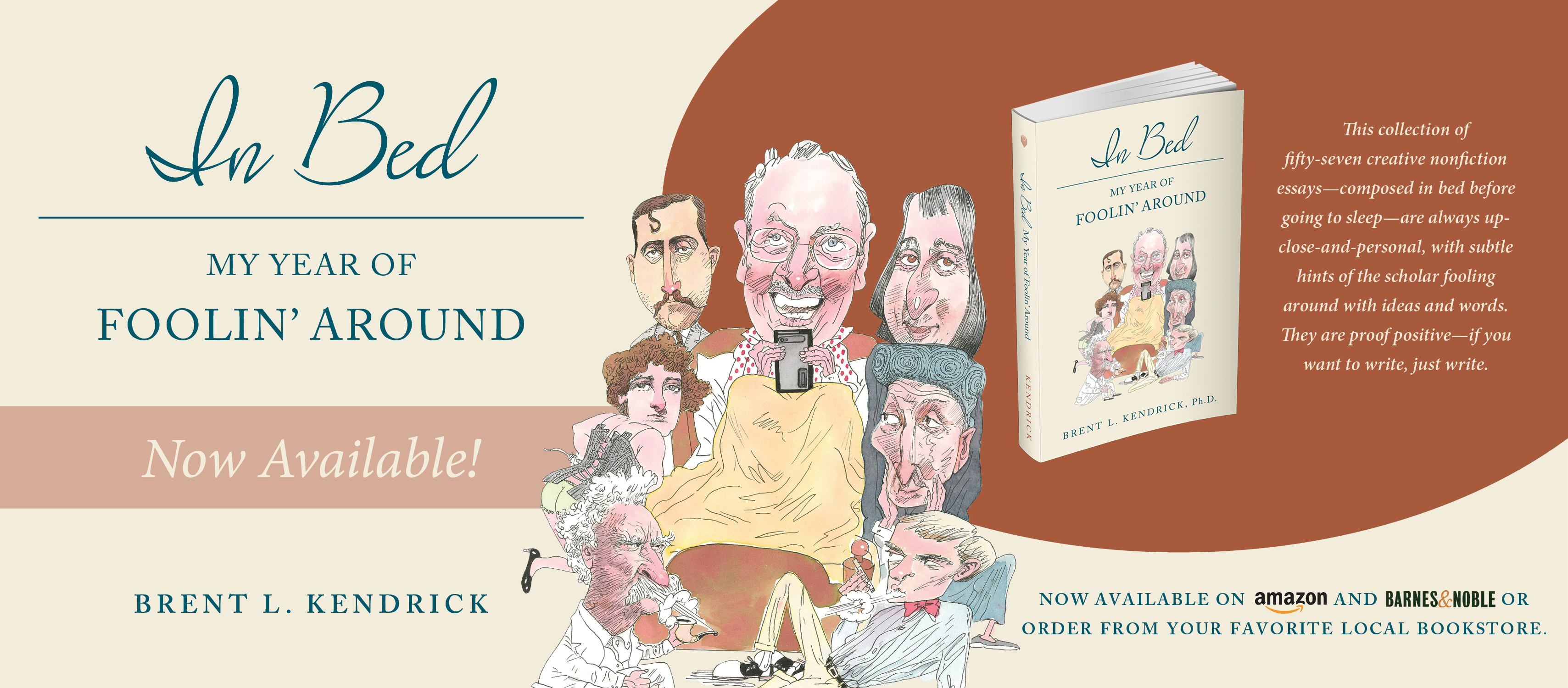
Just Published. IN BED: MY YEAR OF FOOLIN’ AROUND

Take my word for it. I never—absolutely never–intended to fool around in bed, certainly not every day, seven days a week, for an entire year.

from “An Invitation to Join the Author
In Bed” (5-12).

QUICK QUESTION: 

What does it take to write a book?

QUICK ANSWER:

● 6,625 readers.

● 59 countries.

● 1 year.

● 1 bed.

● 1 writer.

EXPANDED ANSWER:

That’s how many readers I’ve had since my blog went weekly on December 28, 2021. That’s how many countries my readers represent. That’s how long I spent writing the blog posts. That’s the bed where I wrote them. And I’m the writer. No foolin’.

NOW, 57 of those essays, reflecting the best of the best, have been published in a book that is exquisite from cover to cover and every page of the 346 pages in between. It’s available on Amazon or Barnes & Noble, or you can order it from your favorite local bookstore!

TAKE A LOOK AT THE BRILLIANT COVER!

Surely you recognize ME! I’m smackdab in the middle of my bed writing a blog post about foolin’ around with some well-known writers. Mark Twain and Truman Capote are on the floor at the foot of the bed, blowing smoke rings at one another. Imagine! They’ve got some nerve! Acclaimed artist/illustrator Mike Caplanis gets credit for the caricature based on one of the book’s essays, “Foolin’ Around in Bed with Famous (and Not-So-Famous) Writers” (249-53).

WHAT’S THE BOOK ALL ABOUT? See for yourself.

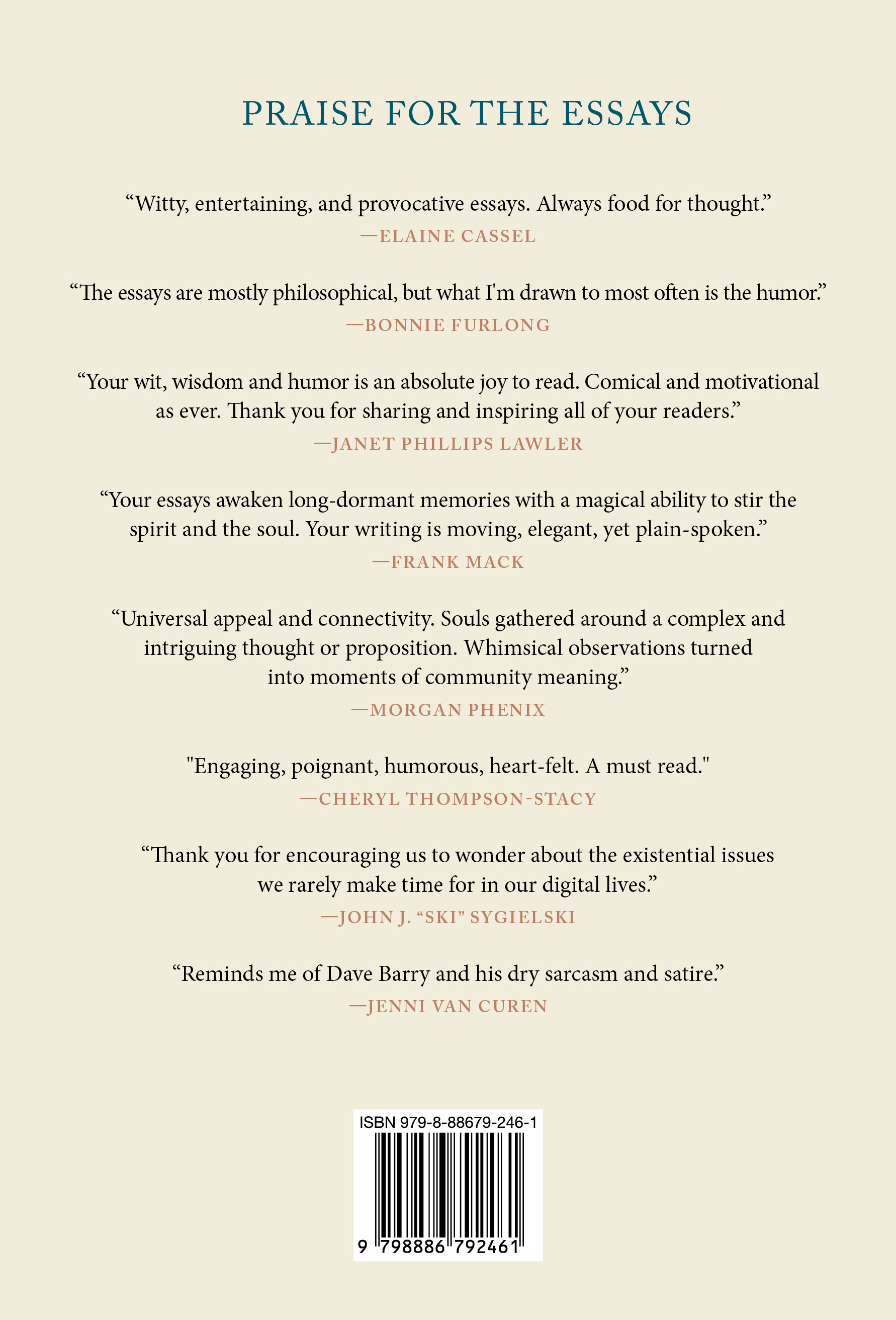
“Fresh and refreshing through and through.” I love it! Other ADVANCE PRAISES grace the dust jacket of the hardcover book.

“A MUST READ” impresses me so much that I just repeated it and made it all caps and all bold! Dayumn! I like it so much that I want to shout it again: “A MUST READ.” (Thank you, Cheryl Thompson-Stacy!)

IN BED: MY YEAR OF FOOLIN’ AROUND is available in hardcover, paperback, and Kindle. I recommend the hardcover. It costs a little more, but it feels so much better than the paperback. What can I say other than there’s something extraordinarily extraordinary about a book that has its own dust jacket!

The publication of this book is an historic and timely solution for every gift-giving occasion that might be coming your way for the rest of the year, if not for the rest of your life. And let me add: may your life be long, healthy, and prosperous and may you keep right on buying copy after copy of IN BED. It’s the perfect gift. Right here. Right now. You do not need to look any further. And while you’re buying multiple copies for gift-giving, remember that IN BED is also the perfect gift for all of your friends … and enemies.

Thank you, DEAR READERS, for all of your support. I have no idea how you found your way into my life, but knowing that you are out there reading my posts strengthens me and uplifts me whenever I need to be strengthened and uplifted.

Time’s a wastin’. ORDER YOUR COPY TODAY on Amazon or Barnes & Noble. Or you can or order it from your favorite local bookstore!

In Bed with Famous (and Not-So-Famous) Writers

“I’m going to bed,” really means, “I’m going to lie in bed and … write.” 

Brent L. Kendrick (aka “The Wired Researcher”)

Chances are good that you did a double take when you saw the title of today’s post. You may have exclaimed, “No way! I’ve read this already.”

Nope. You haven’t. If the title seems familiar, you’re probably thinking of “Spaces and Habits of Famous (and Not-So-Famous) Writers.” But don’t worry. I’ve changed things up: this post has a brand-new set of linen sheets.

And if you aren’t thinking that you’ve read this post before, you are probably asking yourself, “What’s going on with the Good Professor’s seeming propensity for being in bed?”

Excellent question! I won’t try to pull the sheets over your eyes. It’s simple. “In Bed” makes the title catchy. It certainly makes me lie down and take notice. You’ll take notice, too, when I tell you that, on average, we spend 33 years of our life in bed: 26 years, sleeping; 7 years, trying to doze off.

If the “In Bed” part didn’t grab your attention, “with writers” surely did!

And I’ll bet I know what you’re thinking right now. Come on. Fess up. You’re wondering what they’re doing in bed. And now you’ve got me wondering, too. I’ll be right back.

Thanks for your patience. I had to do a little research. If you were wondering whether they were having…you know...sex, you won’t be impressed by the answer that I just discovered. On average, having…you know…takes up only about one third of a year (117 days) in the course of our entire life. Ironically, people think about having…you know...nearly 19 times a day. I guess we spend far more time thinking about having…you know…than we do enjoying…having you know.

Sadly, I suspect that the 117 days of romance is substantially lower with writers, particularly those who write in bed. I doubt that they would want to be interrupted with their word play. Maybe that’s why William Byrd II (Colonial Virginia aristocrat and man of letters; member of the Governor’s Council; and founder of Richmond, VA) had a fondness for romantic interludes on the billiard table. “He what?” someone gasped in disbelief. Yep. I tease you not. For your own in-bed reading, check out The Secret Diary of William Byrd of Westover (1709-1712). The content of his diary remained a secret until the 1940s when it was decoded. Now I know that I have whetted your literary appetite. Here, let me tease you more with an excerpt from his diary:

“in the afternoon my wife and I had a little quarrel which I reconciled with a flourish. It is to be observed that the flourish was on the billiard table.”

Now you know why he wrote his diary in code. Check it out, but not now. Or, if you must, please come back and finish this post.

But let’s get our writers back in bed where we found them to begin with.

For what it’s worth, I was in bed already, and I intend to stay there, smackdab in the middle. After all, it’s my bed, and in bed is where I write my blog posts. But I’m the not-so-famous writer mentioned in the title, so enough about me. Let’s snuggle up with some famous writers who wrote in bed, and, for the time being they can join me in mine.

Surprisingly, not many writers actually write in bed. That suits me just fine. Although my bed is big–fit for a queen–I still need to be able to pull up the sheets and get comfy.

Little chance of my doing that any time soon. Long-legged Mark Twain has jumped in already. What a bed hog: writing and smoking at the same time. He’s got some nerve! “Just try it in bed sometime. I sit up with a pipe in my mouth and a board on my knees, and I scribble away. Thinking is easy work, and there isn’t much labor in moving your fingers sufficiently to get the words down” (New York Times, “How Mark Twain Writes in Bed,” April 12, 1902).

Joining Twain is Edith Wharton, author of The Age of Innocence. (Well, maybe, innocent, but, after all, she is in bed with Twain even if I am the one who put the two side by side.) Wharton liked to write in bed because it freed her from wearing her corset, thereby liberating her thoughts. Now, at least, we all know where she kept her mind.

And I suppose we have to invite Truman Capote to hop in. He’s often quoted as saying: “I am a completely horizontal author. I can’t think unless I’m lying down, either in bed or stretched on a couch and with a cigarette and coffee handy.”

On the other side of the bed–to my right–let’s put some European writers. For bed-balance, we’ll add three only, arranged in the same gender order as the Americans: Boy. Girl. Boy.

To my right, William Wordsworth. He wrote his poems in bed in complete darkness, and, if he lost a sheet of paper in bed, he started over. It was easier than rummaging around under the sheets. Thank God for small mercies.

On his right is Dame Edith Sitwell who slept in a coffin from time to time. Without a doubt, she’ll enjoy being in bed for a change, especially since she once commented, “All women should have a day a week in bed.” That’s all fine and dandy as long as they’re not in my bed.

To Sitwell’s right is Marcel Proust, right on the edge of the bed. Writing in bed was not a quirk for him. It was a requirement. Age and illness forced him to stay in bed, and it was in bed where he completed Remembrance of Things Past as well as In Search of Lost Time. On the edge of the bed seemed perfect so that he could get in and out with greater ease.

OMG! I just heard a loud thud. Did you? Let me take a look. Sure enough. The not-so-famous American writer who thought up these shenanigans in the first place is at it again. He has pushed the European writers right out of the bed onto the floor.

Oh, no. I just heard another thud, though not quite as loud. Let me lean across the bed and have a look-see. As I live and breathe! Capote, Wharton, and Twain are all piled up on the Oriental rug. Twain is still smoking his pipe. Wharton is suddenly looking for her corset. And Capote is leaning back, still smoking his cigarette. Maybe he and Twain can blow smoke at one another while Wharton laces up her corset.

Well, at least the Americans landed softly. I really meant no harm, but I had no choice other than to kick the three of them out, too. Seven in my bed was six too many.

I don’t know about you, but it’s perfectly clear to me that writers–whether famous or not-so-famous–make strange bedfellows.