The Place: Charleston, SC. The Venue: Charleston Library Society. The Moment: October 1.

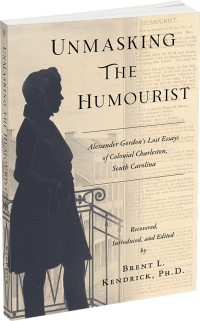
This week’s post is arriving early, because in just a few days I will step into a room filled with history and voices that refuse to fade. On October 1, the Charleston Library Society—the oldest cultural institution in the South and the second-oldest circulating library in the nation—will host the launch of my Unmasking The Humourist: Alexander Gordon’s Lost Essays of Colonial Charleston, South Carolina.

Why Charleston? Because the city itself is part of the story. It was here, in November 1753, that Alexander Gordon began publishing his Humourist essays in The South-Carolina Gazette. Through wit and irony, Gordon held up a mirror to colonial society, skewering hypocrisy, praising learning, and questioning authority. His essays pulsed with the contradictions of a city that was both refined and raw, elegant and quarrelsome. Charleston was his stage, and for nearly three centuries his voice remained hidden in the fragile pages of a newspaper few had cause to revisit.

That is, until now.

The Charleston Library Society is not just the venue for this launch—it is the very repository that safeguarded the Gazette itself, preserving the faint ink on brittle pages that carried Gordon’s words into the future. Founded in 1748, just five years before The Humourist first appeared, the Library has weathered fires, wars, earthquakes, and centuries of change. Its shelves and archives testify to the endurance of ideas—and to the truth that words matter. To stand in this place and reintroduce Gordon’s voice is both an author’s honor and a literary historian’s homecoming.

This launch also falls on a milestone: 272 years since the first Humourist essay appeared in Charleston. That span of time is almost unimaginable. Empires have risen and fallen, nations have been born, wars have been fought, and yet these essays—sharp, funny, insightful—still breathe. They remind us that human folly, ambition, vanity, and hope are constants. Gordon was not writing only for 1753. He was writing for us.

For me, this book represents years of research and a kind of detective work: following a trail of clues, comparing voices, weighing evidence, and finally piecing together the case for Gordon’s authorship. It is scholarship, yes—but it is also a story of recovery. Of bringing back a writer who deserved to be remembered, who deserves a place in our understanding of American letters.

And so, on October 1, Unmasking The Humourist will take its first public bow in the very city that first gave it life.

If you are in or near Charleston, I would be delighted to see you at the Charleston Library Society. If you are far away, I hope you will celebrate with me from wherever you are.

Because this launch is not just mine—it belongs to every reader who believes in the power of words to survive, to provoke, to amuse, and to endure.
About the Book

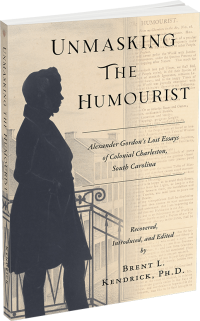
This edition definitively establishes Alexander Gordon (c. 1692–1754)—antiquarian, Egyptologist, scholar, singer, and later Clerk of His Majesty’s Council of South Carolina—as the author of The Humourist essays, restoring his rightful place in literary history.

The Introduction confirms Gordon’s authorship and provides the necessary historical context surrounding the essays and their publication in The South-Carolina Gazette.

The Humourist Essays section presents the complete authoritative text. Each essay is introduced with a detailed headnote offering historical context, exploring key themes, and situating the essay within broader literary and cultural traditions. These headnotes also clarify references, highlight rhetorical and satirical techniques, and connect The Humourist to its periodical essay tradition. Following each essay, explanatory notes supply annotations that illuminate historical allusions, linguistic nuances, and biographical details, making the essays more accessible to modern readers while preserving their original wit and bite.

The Afterword suggests areas for future scholarship—richer literary analysis of Gordon’s techniques, his engagement with Charleston’s intellectual and political life, his later years in South Carolina, and his place in transatlantic literary traditions. This volume thus serves both as a definitive authorship study and as a definitive text, laying a foundation for future research.

Finally, the Appendix corrects a 277-year-old historical error that mistakenly attributed to Gordon a natural history of South Carolina. This archival correction not only restores the record but also underscores the importance of rigorous scholarship—whether in reclaiming a forgotten author’s voice or in ensuring that legacy is preserved with accuracy.

Unmasking The Humourist: Alexander Gordon’s Lost Essays of Colonial Charleston, South Carolina is available now:

Amazon and Barnes & Noble

All proceeds from the sale of this book will be donated to The Virginia Foundation for Community College Education

Climbing Higher and Higher: 12,000 Views (and Counting!)

“The reader is the final arbiter of a text. Without the reader, the words are silent.”

Margaret Atwood (b. 1939). Canadian poet, novelist, essayist, and critic, one of the most influential literary voices of our time.

My Dear Readers, I blinked yesterday, and suddenly my little corner of the internet tallied 12,000 views for 2025—with three months still to go!

That’s not just a number. It’s 12,000 moments of connection. 12,000 times someone out there paused long enough to read my words, nod, chuckle, roll an eye, or maybe even find a flicker of themselves in my essays.

And here’s the part that stuns me: with this pace, we’re on track to sail past last year’s phenomenal 15,000 peak—a record I once thought unrepeatable. But here we are, repeating (and then some).

The 10 You Loved the Loudest

Every essay I publish is a seed tossed into the world. Some sprout quietly. Some bloom bold and bright. Here are the ten that you watered most generously this year:

Redbuds of Remembrance

A Forgotten Voice, A Solved Mystery—And Soon, A Book

Rise Up with Words. A Declaration for Our Troubled Times

My Altar Ego

The Rust Whisperer

A Week Back to the Future

What Could $40 Million Do—Besides Fund a Parade? A Love Letter to Priorities (with a Side-Eye to A Spectacle)

Learning to Love in New Ways

Finding Love Later in Life—Baggage and All

A Culinary Heist in Broad Daylight

My Thanks

Whether you’ve been here since my first blog post nearly 13 years ago or you just stumbled across my latest musings, you’ve made this milestone possible. I don’t take your presence lightly.

So, here’s to you—my companions in this ongoing experiment of storytelling, memory-making, and meaning-finding. Let’s see how far we can climb before 2025 closes the books.

After all, the numbers matter—but the connections matter more.

Self-Serve

“Talk to yourself like you would to someone you love.”

Brené Brown (b. 1965), American research professor, author, and speaker on vulnerability, courage, and self-worth.

Go ahead! Run reference if you must. You’ll probably confirm what you already suspect. More than once, I’ve asked you to lean in real close and listen as I shout out for all the world to hear something that I think no one in the world should hear. Private should stay private, right? Not always. Here I am about to pull you in and do it all over again.

But this time it’s different. It’s one of those insights I’ve had before—the kind that first comes as a shadow of knowledge, and then, with a turn, reveals itself fully, clad in nothing more than the simplicity that truth always wears.

That’s exactly what happened to me. I was all by myself. My partner Gary—Remember? My Tennessee Gary?—had gone off to Minnesota for his 60th high school reunion and for a family reunion to boot. So it came to be that I dined alone.

I plated my entree with all the attention that might bespeak the 5-star restaurant that I know my kitchen will never be. Yet, I keep right on striving.

The golden-crusted whiting stretched across the plate like a painter’s confident stroke, its edges crisp, its center promising tender flake with the first touch of a fork. Beside it, a tangle of violet cabbage shimmered as though the skillet had coaxed from it not just flavor but light itself—earthy, sweet, and just slightly wild. A sprig of thyme leaned in, whispering green against the purple, while a single blossom, fuchsia and unapologetic, dared to remind me that even supper alone can flirt with beauty.

Then, an hour or so later, I was ready for dessert. Don’t you dare tell anyone—especially Gary—but since I was alone, I decided that a store-bought dessert would do.

It was tiramisu with all the makings of a showstopper—moist sponge, creamy layers, a hint of coffee and chocolate—but there it sat, in its plastic box, reminding me that sometimes dessert doesn’t need fanfare to be enjoyed.

“Fine. I’ll enjoy it straight from the plastic box.”

Just when I was about to grab a fork (but not a plastic one, mind you), I decided that it needed proper plating, too.

It only took a second for me to turn store-bought into five-star. The tiramisu rose in creamy, coffee-kissed layers, draped with curls of chocolate that caught the light just so. Against the deep black plate, a scarlet bloom blazed like a velvet exclamation point, transforming a humble slice into a scene-stealer. Every bite promised richness, every glance was pure seduction on porcelain.

In no time at all, I had done for myself what I do for us all the time. In no time at all, I had done for myself what I would have done for me and Gary if we had been sharing the table that night. I had lifted something ordinary into something memorable. I had taken the plastic box off the table and replaced it with care, intention, beauty. In that small act—so quick, so simple—I realized that I had given myself the very same attention I so easily give to the life we are building together. And I had done it when it mattered just as much—I was alone.

We forget, don’t we? Especially when we are alone. We fall into the trap of thinking that we have to wait for company, for celebration, for some special someone before we let ourselves live five-star. But that’s not so. We don’t have to wait, nor should we. We should use the special napkins every day, especially when we’re alone. We should have flowers on the table every day, especially when we’re alone. We should bring forth all of life’s little graces, especially when we’re alone.

We should always see ourselves as the guest of honor—especially when we are alone, even when the chair across from us is empty.

We should remind ourselves that this kind of self serve isn’t selfish and it’s not uppity. It’s simply a way that we can say “Yes” to ourselves. It’s pulling the good wine from the rack, even on a Tuesday night. It’s plating coleslaw in a little bowl instead of scooping it from the mixing dish. It’s lighting the fireplace in October simply because the first chill makes you want to. It’s cueing up Black Gospel or Acoustic Chill while kneading bread, letting the room swell with music as much as with sourdough. It’s slipping into my favorite blue linen shirt, even if no one but Ruby will see me in it. These are the gestures that matter most—especially when we are alone.

These “alone” moments count. Every single one of them counts. And if we don’t serve ourselves with dignity, who else will?

So, My Dear Readers, let me raise a glass to the hydrangeas cut and arranged, to the figs sliced and drizzled, to the silver chest opened on an ordinary weeknight. Here’s to the quiet supper for one that still deserves a sprig of thyme, and to the tiramisu that—freed from its plastic coffin—reminds me that even the humblest store-bought sweet can rise to the level of celebration.

Because self serve is never second best.
It is the altar we lay with linen and light.
It is the chalice filled, the bread broken, the sweetness offered.
It is the music of a knife against porcelain,
the fragrance of thyme rising like incense,
the candle flame trembling like a prayer.

Let the plate gleam.
Let the glass catch the last gold of evening.
Let the blossom burn bright against the dark.
Let the feast of one be as radiant as the feast of many.

Be the guest of honor. Your own.
Be the blessing at the table. Your own.
Be the flame, the flower, the feast. Your own trinity.

Even when we are alone.
Especially when we are alone.

Let’s never–for even a moment–forget:
We are enough.

A Reckoning

“Some of us think holding on makes us strong, but sometimes it is letting go.”

Hermann Hesse (1877–1962), German-Swiss novelist and Nobel Prize laureate, best known for Siddhartha, Steppenwolf, and The Glass Bead Game.

Believe it or not, a week or so ago, the past rose up and slapped me across the face. No, it didn’t leave a bruise, but it left behind something I’m still thinking about.

The slap started when I walked into my office. At first glance, it looks impressive. The lamp casts a golden pool across my glass-top computer desk, giving the whole space a glow that almost convinces me I’ve got things under control. The Oriental rug circles wide and bold underfoot, all rich blues and reds that make the room feel grounded, important, and maybe even a little too proud of itself. Books and papers rise in uneven towers, but in that first glance, they seem less like clutter and more like credentials—proof that I’ve been busy living, working, collecting. Even the cows in the painting on the wall keep a calm eye on the scene, as if to say,

“Carry on, Mtn Prof. You’ve got this.”

But as I walk through the door, the illusion collapses. What looked like a tidy study becomes a landscape of leaning towers and stubborn archives. Books crowd tables in uneven stacks, some open, some shut tight, all demanding to be dealt with. Boxes huddle together on the floor, their labels promising order—but their bulging edges betray the lie. Folders spill their contents, paper curling like leaves that refuse to fall from the tree. A shirt slouches over the back of a chair, a plaid witness to resolve slipping into resignation.

Everywhere I turn, something insists on being noticed. Woven baskets perch on top of files, as if even the containers need containers. The desk is less a surface than a staging ground for half-made decisions. Another painting on the back wall gazes out of its pasture, unblinking, as though it’s been watching me circle this mess for years. It has. It’s not chaos exactly—it’s accumulation. Layer upon layer, a sediment of living, each piece waiting for me to finally decide whether it still belongs.

It isn’t permanent chaos. The boxes say as much, their sharp edges and taped seams hinting at better days ahead—days when decisions will be made, order restored, and space reclaimed. For now, it’s not just an office; it’s a staging area where the past collides with the present, where choices will shape the future. Every pile, every stack, every half-forgotten guidebook, and every dog-eared folder is here because I pulled it out of hiding and chose to face it. In that sense, the clutter is not failure but progress. It’s the visible proof that I’m reckoning with the past, one piece at a time.

I’ll continue to reckon, and I’ll keep on making progress. I know I will. But I know, too, that I can’t rid myself of a lifetime of artifacts in one day. Take the CDs, for instance. Three rows deep. Wedged into the lowest shelf of the floor-to-ceiling bookcase at the far end of the office. They’ve been squirreled away there for years. Waiting. Ralph Stanley leans against Sting, Nina Simone keeps company with Mahalia Jackson, and Susan Boyle dreams her dream right next to the Chuck Wagon Gang. It’s less a collection than a timeline—decades of moods, memories, and seasons pressed into plastic cases. But here’s the thing. I don’t have the heart to get rid of them in one fell swoop. And besides, maybe I don’t want to get rid of them all. Maybe I don’t need to get rid of them all. But I can’t hang on just to hang on. Each one becomes a decision. Which will serenade me today? Into the future? Which has already sung its last song?

Other choices are easier. Travel guides, for instance. Like Fodor’s Greece and Frommer’s Greece on $35 a Day. Both hopelessly outdated, their covers promising adventures I never took. They carry missed possibilities but not regret. Into the discard pile they go. Or the box of Library of Congress business cards, embossed with the proud gold seal of my past career. They once carried weight, proof of my role in the world’s premier library. Now? Nothing more than relics of a past identity. They go into the discard pile, too. The work, the years, the meaning, and the memories? They stay.

Other choices are so easy they’re no brainers. My Frost shelf, for instance: concordances, centennial essays, letters, the familiar black-and-green spines that have followed me across decades. They stay. The same goes for my Mary E. Wilkins Freeman books, lined up in their muted blues and browns. They’re not just books; they’re part of my scholarly DNA. No question, no hesitation. They stay.

Then there are some things whose fate I know as soon as my touch awakens forgottenness. My college copy of Hemingway’s The Old Man and the Sea, margins crammed with the notes of an eighteen-year-old who thought he already knew something about struggle. It stays. My copy of Gibran’s The Prophet, inscribed by a fraternity brother—a book I’ve carried long past the days of Greek letters and youthful certainties. It stays.

A three-by-five oil painting of the covered bridge in Philippi, West Virginia? It’s no masterpiece, but it hardly needs to be. I crossed those boards more times than I remember during my years at Alderson-Broaddus College, each passage a kind of bridge between my coal camp past and the life I was building in the present. The brushstrokes may be clumsy, the colors a bit too bright, but none of that matters. It stays.

A small stack of cassettes holds my mother’s voice on magnetic ribbon. One, dated 11/12/81, is labeled I Take a Stroll and Cause Worry among the Worry Warts. The cassettes may be obsolete, but her voice? Never. Alongside them rests the Bible she gave me when I left for college, her handwriting in the front marking it as mine, though I’ve always known it was hers first.

And the kettle bottom resting heavy on my desk—a flat, round stone that once fell from mine roofs where my father worked fifty years. In those seams, a kettle bottom was a miner’s dread, dropping without warning, too often killing the man beneath it. This one didn’t. My father walked away again and again, spared by chance or grace. These pieces stay—not for their weight, but for his, for hers, and for mine.

Tucked nearly into oblivion is a small 4-H patch from fourth grade, meant to be sewn onto a jacket I didn’t have. But I never needed the jacket to know the four H’s—head, heart, hands, health embroidered in me long before I understood mottos or mission statements. They shaped how I worked, how I cared, and how I learned to give myself to something larger. That patch will never leave me. Some things you don’t outgrow; they simply grow with you.

The things in my office are only the visible part of the past. The rest doesn’t sit on shelves—it lives in memory, in relationships, in faith, in regret, in longing. Those pieces weigh just as much, sometimes more. They, too, must be faced, not in sweeping generalizations, but one by one, moment by moment, decision by decision.

Because that’s how the past works. Even though we can’t erase it, we can’t carry all of it forward either. We have to make hard choices, keeping only what steadies us and letting go of the rest. That’s the only way we’ll have room for life to keep unfolding. Room for the present to breathe. Room for the future to arrive. Room to move forward without being smothered by what came before.

I’m glad the past slapped me across the face. It taught me what we all eventually learn: the only way to live fully in the present, and prepare for the future, is to reckon with the past—seen and unseen, tangible and intangible—piece by piece, choice by choice. The past, the present, and the future are never separate. They are one continuum of time. One long sorting. One steady choosing. One true becoming.

The Demons We All Wrestle

“You may have to fight a battle more than once to win it.”

— Margaret Thatcher (1925–2013)
British Prime Minister, nicknamed the “Iron Lady” for her fierce persistence.

Swearing is not my thing. But right now—for once, maybe even on a stack of Bibles (to my Mother’s eternal horror)—I’m going to do it anyway. I swear that my daily demons line themselves up every night when I go to bed, watching as I lie there all peaceful like, orchestrating my next-day goals.

I see them out of the corner of my eye, leaning in, peering, looking carefully as I tap, tap my list on my phone.

And you know what? I swear, they’re waiting for me the next morning.

More often than not, they show up as soon as I start my biking, maybe because that’s how I start my day, right after coffee. I know that if I don’t bike then, I won’t bike at all. The first demon arrives before I even lace my shoes. It whispers:

“Why so early? You’ve got other things you need to do first. You can bike later.”

Nice try. But I’m on to that trick. I know that when it comes to biking, later never comes.

Another one comes at me from a different angle.

“Today? You’ve been doing this every day. You need a break. Take the day off.”

“Get behind me, Satan! I’m biking as usual.”

But get this. By mile three, another demon shows up:

“You’ll never finish.”

I keep pedaling, but the demons keep coming. By mile seven, I’m hearing:

“Yeah. Your butt sure is sore. If you keep going, it’s going to be sore as hell tomorrow.”

I keep on going. And so it goes, on and on through all the miles—10, 15, 20—riding against a whole Satanic chorus, chasing me faster and faster and faster.

Fiercely determined. Fiercely persistent. Fiercely anchored. That’s how I win the biking battle. Usually.

The next demon that hounds me is procrastination. Don’t get me wrong—I know better. I know the wisdom about “breaking things down,” about taking the first step, about Ben Franklin’s truth that “little strokes fell great oaks.” But when I’m staring at the big picture, the demon of procrastination is quick to pounce.

It starts yammering:

“It’s too much. You don’t even know where to start. Better put it off until tomorrow. You’ll see it clearer then, rested and fresh.”

And the sly part is—it sounds almost reasonable. That’s how this demon works. It pretends it’s looking out for me. But I know the truth: once I give in, tomorrow becomes the next day, and the next day, and soon the oak is still standing, unscarred.

So I fight. I start small. One tap of the keys, one page, one email sent. A single stroke against the oak.

Fiercely determined. Fiercely persistent. Fiercely anchored. That’s how I win the procrastination battle. Usually.

I have other demons, of course. But they’re far too personal to divulge for all the world to know. I’m not about to share them.

Like the demon that tells me that my writing will never be good enough to be discovered by a magazine or a newspaper syndicate.

Or the demon that mocks long-range planning at my age, reminding me that there’s far more behind me than there will ever be ahead.

And I’m certainly not going to tell you about the demon that wonders what waits on the other side of the great divide—the same divide every one of us will cross, where all have gone before to face the mysteries of beyond forever.

Like I said, they’re way too personal. So I’ll keep them to myself.

But I’ve gotten to the point in my life that my demons don’t embarrass me anymore because I know that to be human is to battle the demons that strive to undo us.

And besides, we all have our demons. You do, too. Some of them may be the same as mine.

Or maybe you have the demon of worry, who shows up right on schedule, carrying a suitcase that never unpacks. The demon of regret, who loves to remind us of choices we can’t un-choose, words we can’t un-say. The demon of loneliness, who doesn’t bother knocking—just slips in and makes himself at home.

Or the demon of disappointment who lingers when the prize you’ve chased turns out to be a shadow.

Or what about weariness, when the weight of the day presses like red Virginia clay, and every step feels heavier than the last.

And then there’s doubt—the slyest demon of them all—always ready with the same question:

“Are you sure you’re enough?”

These aren’t strangers to you or to me or to any of us. They’re regulars. They know the way in. They don’t need an invitation.

I’m fairly certain that I heard someone somewhere right now screaming in disbelief:

“Get real. Those don’t count as demons at all compared to the ones that I’m battling.”

I hear you. I understand. I’ve been blessed because I’ve never had to deal with the demons of addiction—alcohol, drugs, gambling. Or the demons of abuse—physical, emotional, sexual—the kind that scar the body and the soul.

I’ve never faced the demon of homelessness, not knowing where I’d sleep. Or the demon of hunger, not knowing where my next meal would come from.

I’ve been spared the demon of crushing poverty, the one that never lets you breathe free. And I’ve never lived under the demon of war, with its bombs and sirens and losses that can’t be counted.

But it seems to me—and yes, I know my limited experience might make this sound overly simplistic—whatever demon we face, we have to be fiercely determined. We have to be fiercely persistent. We have to be fiercely anchored. That’s how we win our daily battles with whatever demons come after us.

But let me emphasize here one key word that I emphasized earlier. Usually.

Being fiercely determined, being fiercely persistent, and being fiercely anchored enables us to win our battles daily. Usually.

But as we all know, some days we lose the battle. We all do. And when we lose, it stings. The demons strut, they jeer, they claim the day as theirs. They would have us believe that losing once means losing for good.

But they’re wrong.

Because a lost battle is not a lost war. It’s a stumble, not a surrender. And tomorrow—always tomorrow—the fight begins again.

The demons will be there, lined up and waiting, whispering their same old lies. And we’ll be there, too. Fiercely determined. Fiercely persistent. Fiercely anchored. Ready to face them.

We may not win every day. Sometimes, we do. Sometimes, we don’t. But we show up anyway. Because being human has never been about living without demons. It’s about never letting them have the last word.

And in case you’re wondering, let me assure you. They’ll be back. But guess what? We’ll be back—bruised, stubborn, laughing, and still ready to wrestle.

I Hear Educators Singing: Paying It Forward

“Teachers are those who use themselves as bridges, over which they invite their students to cross; then, having facilitated their crossing, joyfully collapse, encouraging them to create bridges of their own.”

Nikos Kazantzakis (1883–1957), Greek novelist and philosopher, best known for Zorba the Greek.

Whenever I think of Labor Day—not just today, the official day of celebration, but at any time of the year—I hear Walt Whitman’s poem, “I Hear America Singing.”

In spirit, it remains one of the most comprehensive and inclusive celebrations of labor I know. Whitman exalts the varied carols of America: mechanics, carpenters, boatmen, masons, shoemakers, wood-cutters, mothers, wives, girls, fellows—

“Each singing what belongs to him or her and to none else.”

Even though Whitman’s intent was to celebrate all labor, I’ve often wished he had stretched his litany further: to nurses and caregivers, to social workers and librarians, to the quiet hands who stock shelves at dawn or clean buildings long after everyone else has gone home. So many vital songs go unsung. And yet, by inference, perhaps he did include them—since he was singing America itself, and since his deepest wish was to be the poet of Democracy, the poet of the people, all people.

I especially wish–maybe with a touch of occupational selfishness–that he had included educators—those whose labor shapes every other voice in the chorus. Educators labor not with saw or chisel, but with patience, persistence, and vision—tools just as demanding as Whitman’s mechanics and masons. Their labor is not confined to the classroom or the clock. For many—certainly for me—it was twenty-four hours a day, seven days a week. I went to bed thinking about my students and woke up thinking about them again. Lessons, endless papers, worries, hopes—and encouragement, too—followed me everywhere. Teaching was never a job; it was a calling that claimed my whole self. Like countless other educators, I gave my students my all—and then more.

Educators also give second chances, ignite new beginnings, and shape futures that might otherwise have been lost.

A day never passes that I don’t think about one or more of the bridge builders who taught me—my third-grade teacher who handed me Robert Frost’s poems and lit a lifelong love of language, or my high school biology teacher who welcomed us to his desk day after day, giving us not just knowledge but his time, his presence, himself. My college and university professors, too, showed me that education was not a finish line but a lifelong pursuit. Their labor was quiet, personal, and lasting.

I know this firsthand. I walked the bridge that educators built for me, and in time I became a builder myself—pouring my own labor into students, carrying them forward just as others once carried me.

And when I needed a bridge of my own, the Virginia Community College System gave me not just one opportunity, but two. In 1998 after I left the Library of Congress, it opened the door for me to finally live my childhood dream of teaching English. And years later, through the Chancellor’s Commonwealth Professorship Program, it offered me something even rarer—a second chance to complete research I had set aside nearly forty years earlier. That truth has reshaped how I see education itself. It’s not only about beginnings. It’s also about returnings. Sometimes, opportunity does knock twice. The Virginia Community College System gave me mine.

It gave me that second chance with Unmasking The Humourist: Alexander Gordon’s Lost Essays of Colonial Charleston, South Carolina. What began as a graduate paper in 1973—sparked by the encouragement of mentors like Calhoun Winton and J. A. Leo Lemay—has at last found its full voice. The forgotten essays of colonial Charleston have their rightful place in American literary tradition, and I have had the rare privilege of finishing the work I once left behind.

That’s why I dedicated Unmasking The Humourist to the Virginia Community College System and its educators:

―For the Virginia Community College System―
───────────────
Dedicated to transforming lives and expanding possibilities throughout its 23 colleges, proving that education is not just about learning, but about unlocking potential, shaping futures, and ensuring that no great idea goes unfinished.

And because words alone weren’t enough, I decided to act on that dedication. I have never forgotten the benefactors—sometimes unseen, sometimes unknown—who helped carry me across my own bridge: from a coal camp childhood to a college classroom, to a professor’s life I once only dreamed of. Their quiet generosity made my journey possible.

All proceeds from the sale of this book
will be donated to
The Virginia Foundation for Community College Education

On this Labor Day, I hear Whitman’s chorus again. It grows stronger, more complete, when we hear the steady song of educators—singing what belongs to them, and to none else. Their song is the bridge that carries not just students, but all of us, forward.