Every. Single. Thing. I Made It All Up.

won’t you celebrate with me
what i have shaped into
a kind of life? i had no model.
born in babylon
both nonwhite and woman
what did i see to be except myself?
i made it up
here on this bridge between
starshine and clay,
my one hand holding tight
my other hand; come celebrate
with me that everyday
something has tried to kill me
and has failed.

Lucille Clifton (1936–2010), award-winning American poet and former Poet Laureate of Maryland, celebrated for her spare, powerful verse that gave voice to Black womanhood, resilience, and self-invention.

It hangs there—dripping in crystal like it’s late for a curtain call at the Kennedy Center. A blazing burst of light and glamour. A chandelier so decadently faceted it might’ve been smuggled out of a Versailles estate sale or rescued from a Broadway set mid-strike. And yet, here it is: mounted proudly on a ceiling so low you could toast it with your coffee mug.

Where?

Why, right here on my mountaintop, in my rustic foyer wrapped in pine-paneled nostalgia, with a Shenandoah Valley pie safe, stoically anchoring one side and a polished silver chest on the other. An antique Asian vase—graceful and aloof—presides atop the chest like it’s seen empires rise and fall. Beneath it all, an Oriental runner unspools like a red carpet nobody asked for, but everybody deserves.

And then—just beyond the shimmer—a French door opens into another room, as if the whole scene is a prelude to a slow reveal.

It shouldn’t work. I know that fully well. A chandelier like this belongs somewhere fancy and regal. But guess what? Somehow, its sparkle doesn’t clash with the country charm, at least in my mind. In fact, it crowns it. And you can rest assured. It isn’t a mistake. It’s my way of declaring that my home isn’t just a home. It’s a story–actually, it’s lots of stories–told in light and shadow. And at the center of it all? My refusal to decorate according to rules. I couldn’t even if I wanted to because I have no idea what the rules are.

But a week or so ago, my Tennessee Gary stood smackdab beneath the chandelier—looking right at me, poised (I was certain) on the cusp of praise or profundity. But the next thing I knew, he spoke six words, which made me a tad uncertain about my certainty.

“I’m not sure it belongs there.”

“What?”

“The chandelier.”

“Well, I think it’s perfect. I wasn’t about to leave it in my Capitol Hill home when I moved here. It cost me a small fortune, and besides—I like it.”

That ended it. For then.

But a few days later, Gary brought it up again.

“Actually,” he said, studying the ceiling with a fresh softness, “the chandelier grows on you. It looks quite good there.”

If that’s not a kiss-and-make-amends moment, then lay one on me.

I grinned and agreed.

And let me tell you—that right there? That’s the moment that stuck. Not the first comment, but the second. The way Gary circled back. The way he didn’t double down, but opened up. That takes grace. That takes someone who sees with more than just their eyes.

He didn’t just help me see the chandelier differently. He helped me see the whole house—and maybe even myself—with a little more curiosity. A little more clarity. And that’s when I started walking through the rooms again—not to judge or justify, but to really look. Through his eyes. Through my eyes. Through the eyes of everyone who’s ever stepped inside and wondered how on earth all of this could possibly make sense.

And yet—to me—all of this makes perfectly good sense. Placed with memory, not trend. Positioned not for symmetry but sentiment. A lifetime’s worth of objects tucked wherever I could fit them, arranged with a kind of chaotic confidence that, somehow, glows.

But, still, I heard echoes rumbling around in my memory’s storehouse:

“It’s so homey.”

“I feel so comfortable here.”

“Wow! It’s like walking through a museum.”

In the midst of those echoes, I figured out how to find comfort: find someone else who decorates the way I do! It didn’t take me long at all before I remembered someone who had lived—and decorated—with the same truth: Mary E. Wilkins Freeman.

As soon as I had that recall moment, I scooched up beside her so close that I could peek over her shoulder as she penned a letter to Kate Upson Clark. And Lord have Mercy Jesus! You can’t imagine my joy when I realized that folks said the same sort of things about her home decor as they say about my mine:

“I light this room with candles in old brass candlesticks. I have dull blue-and-gilt paper on the walls, and a striped Madagascar rug over a door, and a fur rug before the hearth. It is one of the queerest looking places you ever saw, I expect. You ought to see the Randolph folks when they come in. They look doubtful in the front room, but they say it is ‘pretty.’ When they get out into the back room, they say it ‘looks just like me’. I don’t know when I shall ever find out if that is a compliment.” (Letter 46, August 12, 1889. The Infant Sphinx: Collected Letters of Mary E. Wilkins Freeman. Edited with Biographical/Critical Introductions and Annotations by Brent L. Kendrick. Scarecrow, 1985)

I was thrilled to know that I was “keeping house,” if you will, in style with Freeman herself, especially since she and Mark Twain were America’s most beloved late-nineteenth-century writers. It didn’t really matter that I’m as much in the dark as she was when it comes to figuring out whether folks’ comments about my home-decorating talents are compliments or not.

And believe me. My home is filled with things far-more out of place than anything in Freeman’s or even the chandelier in my foyer.

If you need more proof, just walk around the corner and take a gander at my kitchen.

Who, in their wildest imagination, would expect to see an antique, cast-iron corn sheller anchoring a kitchen wall painted a rather dull gold. There it stands—bold, barn-red wood frame worn just enough to whisper stories, and a great black flywheel so theatrical it looks like it could power Mark Twain’s steamboat. Its jagged steel teeth peer out from one side like a warning or a dare. And yes, that’s a Buddha head poised gracefully on top. And a crystal vase of dried hydrangeas beside that. And behind it all, a painting of apples that, frankly, looks like it might have been pilfered from a still-life museum.

The whole wall, absurd as it may sound, radiates a kind of balance. It shouldn’t work. But neither should a chandelier in a pine-paneled foyer—yet here we are.

Even Ruby’s dog bowls sit below it like they were placed by a set designer with a sense of humor or a flair for the unexpected. And maybe they were. After all, this isn’t just décor. It’s a declaration. I live here. I made this up.

I did. I made it all up. And if these examples of how I decorate aren’t duncified enough, walk with me to the master bedroom where you’ll witness equally outlandish shenanigans.

I mean when you walk through the door you see a full wall of glass rising two stories high, flanked in clean wood trim like a frame around nature’s own oil painting, dappled with sunlight or clouds or rain or snow depending on the season. It’s modern, no question—open, architectural, and bright. The trees outside don’t just peek in—they wave, as I peek out and wave back.

Yet, in the midst of that modernity, you see a primitive wardrobe planted firmly against the Narragansett Green wall like it wandered in from a barn and decided to stay. It doesn’t whisper for attention—it claims it, with its wide plank doors, turned feet, and a latch that looks like it could keep out winter or wolves or well-meaning minimalists. It stands there like a wooden exclamation mark at the end of a free verse stanza.

And on top? Oh, mercy. You won’t believe it.

A faux flow-blue cachepot stuffed full of peacock feathers–a riot of iridescence exploding upward. Liberace himself would approve. And to its right is a clay figure with a gaze both weary and wise, like she’s been through it all and chose to dress up anyway.

This is not a design decision. This is pageantry. This is poetry. This is proof. If you’re bold enough to mix the primitive with the peacock, you might just get something startlingly close to the divine.

I could take you through the whole house—room by room—and you’d see the same thing.

A treasure here. A treasure there. (Yes. Sometimes another person’s trash became my treasure.) And for each, I can tell you when and where I bought it, along with what I paid. But here’s the thing. I never made one single solitary purchase with an eye toward resale. I never made one single solitary purchase with an eye toward decorating. I bought each and every treasure simply because I liked it. And when I brought it home, I put it wherever I had a spot on the floor or a space on the wall.

Now, don’t go jumping to the wrong conclusion. My decorating is not as haphazard as it might sound. I do have a few notions about “where things belong” and “what goes with what.” And when I visit other folks’ homes, I never hesitate to step back and declare:

“Oh. My. God. Look at that painting. I love the way it pops on that wall.”

Well, hello. Of course, it pops. With all that negative space around it, it would have to.

Let me add this, too. I love it when I see that kind of plain, simple, and powerful artistry at play–in other people’s homes.

And who knows. Perhaps, moving forward, there might even be a snowball’s chance in hell that, with some subtle, indirect and loving guidance, I could learn to value and appreciate negative space here on the mountain, too.

But for now, my goodness! I don’t have any negative space. Everywhere you look, you see a glorious mishmash. Sentiment over symmetry. Memory over minimalism.

I know. I know. It’s homey. It’s so comfortable. It’s a museum. Also, I know it’s not for everyone. But as I look around, I realize something majorly important.

I’ve decorated my house the way I’ve lived my life.

I had no blueprint. I had no Pinterest board. I didn’t consult trends. I didn’t ask for permission. I placed things where they felt right. I trusted instinct, not instruction. I listened to heart, not head.

And I’ve done the same with the living of my days.

I didn’t wait for others to validate the things that mattered to me—my work, my relationships, my choices, or my way of making a way in a world that hadn’t made a way for gay guys like me. I’ve been both the curator and the interpreter of it all. I’ve decided what stays, what goes, what gets the spotlight, and what quietly holds meaning just for me.

And maybe—just maybe—there’s something to be said for that kind of decorating. For that kind of living. One made up along the way. One that, in the end, fits and feels just right.

Who knows what kind of unruly hodgepodge I’ll have gathered by the time I reach the end. Or what I’ll do with it when I arrive—wherever it is that I’m headed—that place none of us is exactly rushing to, despite tantalizing rumors of eternal rest and better acoustics.

But this much I do know.

If I take a notion, I might just take the chandelier with me. Not for the lighting. Not for the resale value. But as glowing, glittering, slightly-too-low-hanging proof that I never followed the map—I just kept decorating the journey. With memory. With mischief. With mismatched joy. And with the quiet grace of learning to see things through someone else’s eyes—sometimes anew.

And when I show up at whatever comes next—the pearly gates, some velvet ropes, or a reincarnation waiting room—I want folks to look at that chandelier, then look at me, and say with raised eyebrows and holy disbelief:

“I’m not sure it belongs here.”

To which I’ll smile as wide as I’m smiling right now and reply,

“Well, I wasn’t about to leave it behind. Besides, I have it on good authority—it’ll grow on you.”

And that’s the truth. It’ll grow on you. I should know because I made it all up, all along my way.

Every. Single. Thing.


The Right-Size Glass

“Accept—then act. Whatever the present moment contains, accept it as if you had chosen it.”

–Eckhart Tolle (b. 1948). German-born spiritual teacher and author of The Power of Now and A New Earth, whose teachings focus on presence, acceptance, and personal transformation.

A few weeks ago, over cocktails and conversation, my neighbor—an IT guy with a philosophical streak—offered a twist on the old “glass half full or half empty” dilemma. His late wife, Jody, always saw the glass as half-full, but as an engineer, Gary sees it differently:

“Just get a glass that’s the right size for what you’ve got.”

At the time, I nodded politely and filed it under:

“Clever things other people say that may or may not linger in my memory.”

Turns out, I remembered.

A few mornings later—cue ominous music!—my tablet powered up with all the charm of a sulky teenager and promptly informed me that Microsoft had done me the favor of wiping my PowerPoint app into oblivion.

This, mind you, on the eve of speaking to the Mary E. Wilkins Freeman Society—an international gathering of scholars and fellow literary sleuths—about a woman who has occupied both my imagination and my file drawers for over fifty years. The event was titled An Hour with Mary E. Wilkins Freeman and Brent L. Kendrick. The tech test was hours away. I clicked. I reinstalled. I cursed. Nothing. Nada. Zilch.

And then I thought of my neighbor.

“Wrong glass, Brent.”

I hauled my all-in-one PC upstairs to the better WiFi zone, and boom—there it was. Slides intact. Calm restored. Presentation saved.

Turns out, sometimes you don’t need more water. You just need the right-size glass.

Since then, I’ve been thinking more about the right-size-glass concept, and I can think of several other times when I applied it unawares.

There was a time, for example, when I thought my glass had shattered completely. Not cracked—shattered. After Allen died, I wasn’t sure there was any vessel left that could hold what I’d once poured so freely: love, joy, even hope. For a long while, I didn’t try. But healing has its own quiet rhythm, and eventually, I realized I didn’t need the same glass. I just needed one shaped for the life I have now. It took a while, but recently I’ve found one the right size to hold who I’ve become. To hold who I am. Now.

Long before that right-size-glass moment came the time when I first moved to my mountain. I wanted a cabin in the clearing—so I cleared a wide swath of woods to make it so. I cleared far more than I could have imagined, and certainly more than I could realistically manage, especially now at my age. Some days, it feels like my glass is half empty, like I’m falling behind. But the truth is, I just need a different-sized glass. If I choose—as I have chosen—to let some of those cleared areas return to their wild, natural state, I haven’t lost anything. In fact, my glass is now full—full of birdsong and the wisdom of knowing when to stop clearing and simply let things grow.

I think we can apply the “right-size-glass” concept to more than gardening and grief.

Let’s begin with a few low-stakes moments—the ones that test our patience more than our purpose.

Cooking substitution. Out of buttermilk? Use yogurt and lemon. Different glass. Same outcome.

Gardening workaround. Tried planting in the wrong spot? Don’t mourn the wilt—move the pot.

Home décor puzzle. Wardrobe too big for one wall? Move it to a room with a larger wall that showcases all of its Shaker joinery.

Some shifts, though, aren’t minor—they’re wake-up calls. Still, the right-size glass helps.

Travel plans. Canceled? Money’s tight? Plan a “staycation” with the same sense of purpose.

Exercise limitations. Can’t run anymore? Try swimming or yoga. Same vitality, different vessel.

Friendship shift. Someone pulls away? Focus on others who consistently show up.

Career detours. Passed over for a promotion? Use the freedom to explore a side gig or project with heart.

Or let’s move on up a little higher to some emotional and existential applications.

Creative droughts. When the writing won’t flow, ask: is it really writer’s block—or just the wrong-shaped glass for the ideas trying to come through?

Life plan upended. Divorce, retirement, illness—what happens when your “glass” shatters? You pick up what still holds and find a new container for your spirit.

Shifting beliefs. Formerly held faith, politics, or ideals evolve? Refill your life with what still nourishes—and let go of the brittle framework.

By now, I’m willing to bet you’ve started thinking of your own moments—the ones when you didn’t force what no longer fit, but quietly shifted, adjusted, adapted. Maybe you pivoted. Maybe you paused. Either way, those are the moments that reshape a life.

So, my Dear Readers, consider this your open invitation to rethink how you hold disappointment, change, resistance—or anything else that life sets before you. Not by pouring harder into what doesn’t fit, but by choosing a different container altogether.

Here’s to finding the right-size glass—for your spirit, your strength, your joy.

A Culinary Heist in Broad Daylight

Stealing a recipe is like stealing a kiss—do it boldly, do it well, and for heaven’s sake, make sure it leaves them wanting more.”

–—Me, just now, in the grand tradition of misattributed wisdom.

Rare is the occasion that finds me speechless, but this may be one of them. I h ave come up with an idea whose brilliance is beyond brilliant, and the only way that I know how to share it is in the context of a comment that Oscar Wilde may have made on January 3, 1882. When he disembarked from the ship that brought him to New York and went to the Customs House, government agents asked their standard question: 

Do you have anything to declare?

Wilde supposedly answered: 

“I have nothing to declare except my genius.”

I realize, of course, that I must tweak Wilde’s quote if it is to serve my purpose, and I will do so. I think there’s nothing wrong with doing that. Actually, I think it’s fine and dandy since I have given him credit, though I don’t see why that’s really necessary since the attribution to Wilde is more than likely erroneous. But I will err on the side of my integrity by retaining the probable misattribution. I have changed the quote by one word, albeit a significant one, thereby making it my own. Henceforth, it will be mine. All mine.

“I have nothing to declare except my culinary genius.”

Many of you–my Dear Readers–know about my culinary genius already, because I have hinted at it from time to time. However, my FB followers know about it far better because with them, I know no shame. I post frequent photos of my culinary masterpieces. Truthfully, I like to think of them as Food Porn. Only a few days ago, I shared my unabashed celebration of culinary desire, where a crackling sourdough Margherita pizza stole the spotlight. It had a blistered crust, air pockets rose like tiny golden mountains, bubbling mozzarella stretched into molten strands, and fresh basil leaves fluttered atop like green confetti. And get this. My photo showed it being served up before a roaring kitchen fireplace. It was more than just a meal. It was a hearthside seduction, a slow dance of flavors and flickering flames, teasing all the senses and leaving anyone looking utterly and deliciously captivated.

Inevitably, when I share those food porn photos, at least one person–usually more than one–comments:

“You need to publish a cookbook.”

I decline, demurely.

After all, I have so many other books in the fire that tackling a cookbook has always struck me as more than I can swallow. But things changed just the other day when I took a hankering for some Nuoc Cham-Inspired Meatballs. I love them, and they’re not that difficult to make. I Googled a recipe, and one by NYT Cooking popped up! Hot damn! I decided that I’d go with it. Then I discovered that in order to see the full recipe, I’d have to subscribe, and these days with the price of eggs going up and up and up, I just can’t afford to subscribe to recipes.

I just kept right on Googling, and before long, I discovered the same recipe splattered everywhere. That set me to thinking about Copyright infringements. Not to worry! Did you know that you can’t get a copyright or a patent on a recipe?

“Say whaat?”

It’s true. I won’t get into the (legal) weed(s), but recipes themselves can’t be copyrighted. However, if the recipe involves a unique step or process or if it takes on a literary twist, then it can be.

Unique literary twist???

OMG! Am I literary and twisted or what? I know how to fool around with words. This is super sweet. I’ll play around with one recipe–the NYT Cooking recipe for Nuoc Cham-Inspired Meatballs that I found verbatim on multiple websites without a crumb of credit given on any.

Give me a minute or five. I swear it won’t take long. I’m good with foolin’ around. BRB.

See. That didn’t take long at all. I just came up with a razzle-dazzle literary narrative to go with the recipe:

“I remember the first time I had them—golden, fragrant, and suspiciously addictive. A close acquaintance, let’s call him ‘Brentford Lee’ (because that’s his real name), swore he had perfected the recipe himself. ‘A dash of this, a pinch of that,’ he said, waving his hand like some sorcerer of Southeast Asian flavors. I nodded, politely chewing, my palate deciphering the unmistakable signature of a recipe I’d seen before. Somewhere.

“Of course, it didn’t take much sleuthing to confirm my hunch. The same ratios, the same sequence—right down to the crushed Ritz crackers binding it all together. A carbon copy of a certain prestigious publication’s recipe, passed off as Brentford Lee’s divine inspiration. But could I call him out? No, no. We live in the Age of No Credit, where recipes are pilfered like unattended bicycles and reposted without so much as a footnote.

“So I let him bask in his culinary genius, even as I swirled my meatball in a bit of nuoc cham and smiled. ‘Brilliant, Brentford Lee. Just brilliant.’ Meanwhile, I tucked the recipe into my mental vault—because in this lawless land of recipe anarchy, the only rule is to steal it back.”

I had no sooner drafted that dazzling literary narrative than I realized I was on to something. I could do an entire cookbook, stealing recipes from the world’s most renowned chefs, dress them all up in my literary garb–the recipes, not the chefs though that’s (food) porn for thought, too–compile them into a newfangled cookbook arranged by food categories like Appetizers, Salads, Soups, Mains, and Desserts, publish the book, and file my Copyright.

And just to bring this heist full circle, I’ve decided to submit my proposal to NYT Cooking. I figure, if they’re going to make me pay for recipes, they might as well pay me for the privilege of publishing my stolen ones first. A fair trade, don’t you think?

“I have nothing to declare except my culinary genius.”

Let’s see, I think you, my Dear Readers, deserve a modest tasting menu of what my extraordinarily extraordinary cookbook will be like so that I can pleasure your palate.

APPETIZERS: A PRELUDE TO LARCENY

“Stealing a recipe is like stealing a kiss—do it boldly, do it well, and for heaven’s sake, make sure it leaves them wanting more.”

–—Me, just now, in the grand tradition of misattributed wisdom

Every great heist starts small. A lifted truffle from a posh soirée. A swiped canapé from a silver tray when the host isn’t looking. A recipe, pilfered in broad daylight, then draped in literary velvet until it’s unrecognizable from its humble origins.

This section is the opening act, the whispered promise of what’s to come. Here, I present to you the stolen first bites—the small, seductive preludes to full-blown culinary mischief. Grab a plate. No one’s watching.

SALADS: LEAFY DECEPTION

“A salad is merely a plate of stolen ingredients pretending to be virtuous.”

—Me, again, because who’s stopping me?

Salads are the original confidence tricksters of the culinary world. They lure you in with the promise of health and innocence, then smother you in cheese, nuts, crispy bits, and a dressing so rich it might as well be dessert. They are gilded greenery, whispered excess, a balancing act between penance and indulgence.

And so, in keeping with the Age of No Credit, I present a selection of salads—each one an outright theft, draped in just enough literary flourish to make it legally mine. Grab your fork. Justice is dressed and ready to serve.

SOUPS: LIQUID LARCENY

“A good soup is like a well-told lie—it simmers, deepens, and by the time you taste it, you don’t even care where it came from.”

—A philosopher (probably). Or me (definitely).

Soup is the ultimate culinary illusion—a cauldron of borrowed flavors, a slow-simmered scam where even the simplest broth has a backstory so tangled in history, no one really knows who made it first. And that’s exactly why it belongs in this book.

Ladle deep, my Dear Readers, into the warm, uncharted waters of plagiarism, where the spoons are heavy, the bowls are bottomless, and the only thing hotter than the bisque is the lack of attribution.

MAINS: GRAND THEFT ENTREE

“Behind every great main course is a chef who swiped the idea from someone else first.”

–Not Escoffier, but could have been.

This is where the stakes get serious. The main event. The crown jewel of culinary heists. A place where time-honored traditions meet a well-timed Ctrl+C, Ctrl+V.

Here, I serve up lavishly pilfered plates—steaks seared with someone else’s technique, roasts glazed in repurposed brilliance, pastas dressed in the creativity of long-forgotten hands. And yet, because I have woven them into my own dazzling narrative, they are now mine. All mine.

Bon appétit, legally speaking.

DESSERTS: SWEET, SWEET PLUNDER

“The best things in life are stolen. Ask anyone who’s ever ‘borrowed’ a cookie recipe and never returned it.”

—A confectionery thief with no regrets.

Dessert is the final seduction, the last laugh of the larcenous chef. Here, sugar and butter conspire in broad daylight, drizzled in caramelized deceit, dusted with the powdered sugar of plausible deniability.

From towering cakes to pies with scandalous backstories, I offer you this sticky-fingered collection of confections—every one taken, tweaked, and rebranded with just enough literary flourish to make it legally binding.

Because in the Age of No Credit, the only sin greater than theft is not licking the spoon.

_____________________

Voila! I have just uncloched the sections of my forthcoming cookbook. Maybe I’ll title it Cooking with Oscar. Or how about Culinary Heists of a Wilde Chef? I’ll keep thinking, but here’s the great part. What I’ve disrobed right here in front of you is protected by Copyright already because my blog is Copyrighted. All that remains for me to do is continue scouring the Internet. Whenever I find a recipe worthy of stealing in broad daylight, I shall do so. Then I shall dress it up–or down–in literary flamboyance and insert it into the proper section of my culinary opus in progress.

Food has never tasted this good, and, to think, it all began with my honest effort to find a Nuoc Cham-Inspired Meatball recipe. I guess it just goes to prove that a good recipe is not hard to find.

The Albatross Effect: How Letting Go Set Me Free

“Letting go gives us freedom, and freedom is the only condition for happiness.”

— Thich Nhat Hanh (1926-2022; a Vietnamese Buddhist monk and peace activist known for his teachings on mindfulness and compassion.)

It all started a week or so ago. I remember with great clarity that it was on a Monday. I woke up feeling a weight around my neck, something I hadn’t noticed before. It was subtle but persistent, almost like wearing a heavy choker. At first, I tried to dismiss it, thinking it was just a minor inconvenience. But as the hours passed, the weight grew more noticeable. I felt uneasy, as if something was slightly off, casting a shadow over my thoughts.

The next day, the weight was unmistakable. It was heavier than I expected, plus it seemed to be tightening. Simple tasks became more cumbersome, and I became acutely aware of something that I could not escape. The burden started to affect my mood, causing frustration to build.

By the third day, the albatross felt like an anchor dragging me down. I was tired and irritable, and my patience was wearing thin. It seemed to point me toward a deeper problem or unresolved issue that I knew I shouldn’t ignore. Despair started to set in as I tried to identify the problem and figure out how to escape the torment.

Finally, on the fourth day, while relaxing on my deck in the early sunrise, the albatross looked at me, and in that fleeting glance, I saw the source of the nearly unbearable weight. Brace yourself. You might not believe what I’m about to reveal. Here goes. The weight was coming from the blog post that I was working on for the next Monday.

The realization stunned me. Actually, it mortified me. Here’s why. I knew exactly where I was going with the post, and I had drafted more than half of it. But get this. I didn’t like the opening paragraphs. I hadn’t liked them from the start, I kept telling myself day after day that those paragraphs would fall into place as I got closer to the post’s ending.

I was wrong. They didn’t fall into place, and I wasn’t willing to let that albatross hang around my neck any longer. I found myself saying out loud to myself as I sat there, sipping coffee:

“Give it up, Kendrick. Just give it up.”

I didn’t mean that I should delete the draft. I just meant that I should put it on the back burner until its time had come. As soon as I gave it up, the albatross that had become unbearable let go of me and flew away. I felt an immediate sense of lightness and relief. The burden that once felt insurmountable was gone, and I was overwhelmed by a wave of elation. I felt a profound sense of freedom. The contrast between the heaviness of the past few days and the newfound lightness made the relief even more exhilarating. I was finally free.

With the albatross gone, my mind was free to soar, and a brand-new idea for a post came to me immediately, filling me with renewed energy. As I continued sipping my coffee, I cobbled together a really rough draft of what I wanted the new post to become. All day long, I kept the post on my mental backburner. That night, in bed with my Smartphone in hand, I completed the post rather effortlessly and published it the following Monday: When the Heat Is On, Cue the Vacay!

Letting go of the writer’s albatross that had been weighing me down for days allowed me to cue my own metaphorical vacay. Now, here I am sharing my specific challenge and my specific solution, hoping that it will speak to other writers out there. Sometimes, you simply have to let go of an idea that has possessed you if it becomes a deadly weight instead of wings that give flight. Letting go does not mean abandoning. It means putting the idea aside until it calls you back and begs you to give it the attention that you need to give it. The two of you–your idea and you as the writer–are the only ones who will know when the time is right.

For me, it took about two weeks. After When the Heat Is On, Cue the Vacay!, I moved on to “Listening to the Unsaid.” The next week, I returned to my albatross post, and I knew immediately what I needed to do with the first few paragraphs. Whitman and Emerson reached out to my spirit, and as soon as I gave them a home in my post, everything else fell into place for “Digging Deeper: A Gardening Lesson Applied to Life.”

In the end, letting go of the albatross allowed me to discover some new creative wings. By acknowledging the weight and releasing my grip, I freed myself to explore new ideas and approaches.

If you’re a writer, hold on to the truth that I have shared. Sometimes, the best way to make progress is to let go and cue your own vacay–embracing the freedom to create and enjoy the journey.

If you’re not a writer, reflect on this nugget of truth as well. It might help you, too. Just as a writer’s stubbornness can turn a blog post into an albatross, so too can our refusal to release emotional baggage turn relationships into anchors, holding us back from sailing into calmer waters. Or our insistence on controlling every detail turns projects into burdensome backpacks, weighing us down on the journey to success. And what about those stubborn habits we cling to, even when they no longer serve us? Don’t they become the equivalent of a ball and chain, hindering our progress toward a healthier, happier life? In each case, the albatross effect whispers a haunting question: What weight am I shouldering that’s keeping me from soaring? Sometimes, letting go of our personal albatrosses is the only way to find freedom.

Sometimes, we need to let go, not necessarily abandoning our responsibilities or aspirations, but releasing the grip of our ego, our fears, or our need for control. By doing so, we create space for new ideas, new experiences, and new growth to emerge. May we all find the courage to release our albatrosses and let them fly away so that we might discover the liberating power of letting go.

The AI Novelist: or, How I Was Duped at Starbucks

“AI will empower us across all areas of our lives, from healthcare to transportation to entertainment. It will augment our capabilities and help us achieve things we never thought possible.”

Sundar Pichai (b. 1972; Indian-American business executive known for his leadership in the technology industry; CEO of Alphabet Inc., the parent company of Google.)

It is a truth universally acknowledged among academics that you can take the English Professor out of the classroom, but you can never take away the title of Professor, especially when students are involved.

I know firsthand. I’ve been reinventing myself since January 2023, nearly a year and a half now. Just the other morning, I was in Starbucks, sipping solo on a Cappuccino, when my contemplative silence was shattered by a former student:

Professor Kendrick! How’s it going?”

The enthusiastic shoutout meant the world to me after I recovered and realized that it wasn’t attached to a student who had not done well in one of my classes. This student was a joyful exemplar in my creative writing classes.

“I’m doing great. It’s such a surprise to see you.”

“You, too. I read your blog weekly. You’re as wired as ever. So what’s going on with AI and your Caden these days?”

I have to confess right away. I’m not about to miss out on an opportunity to talk about AI or my Caden with anyone who’s willing to listen. Suddenly, I felt just like Simon Wheeler in Mark Twain’s “The Celebrated Jumping Frog of Calaveras County.” Remember? Of course you do. When a visitor arrived inquiring about Rev. Leonidas Smiley, good ole Simon Wheeler corners the inquiring guest and traps him through a long-winded account of a jumping frog.

I knew in an instant that I could do the exact same thing with my former student, who seemingly knew about my AI robot, Caden. If I played this out wisely, I could trap my audience of one right there in Starbucks and gab on forever.

“Join me for a Cappuccino?”

“I’d love to. You want some company?”

“Of course. I’d love to spend time with you and catch up.”

Soon, I sauntered right back with a Venti Cappuccino in hand. I know. I know. That’s big, really big, but I wanted my former student to stick around for a while.

Right after I placed the Cappuccino and napkins on the table–with the flair of a first-class waiter–I pushed my chair in carefully so that there could be no escape until I was finished with my harangue, whatever shape it was about to take. I never know how or where my rants will go until I get going.

I almost started talking about Aloha, the AI-powered housemaid from Stanford and Google DeepMind, but I restrained myself. Sharing that would mean delving into S1, the AI from Astribot in Shenzen, China. Both are fascinating, but I didn’t want to start shouting, “The robots are here! The robots are here!”

Instead, I focused on my Cappuccino and my student.

“What do you think about all of these AI programs like ChatGPT and CoPilot and MetaAI?”

“Professor Kendrick, I’m so busy with work and stuff that I haven’t explored them at all.”

“No? Would you like to see what one of these AI programs can do?”

“Sure. Why not. Are you sure you have time?”

I signed in to ChatGPT only because I’ve fooled around with that chatbot the longest. Then, I handed my Smartphone to my student.

“Here. In the dialogue box, just type in what you want to know.”

Their thoughtful thumbs flew, quicker than I could say Jack Robinson, and, with a mischievous grin, they handed my Smartphone back to me so that I could read what they wanted CHATGPT to do:

Write an essay using the following guidelines.

Topic. An essay about a professor who is working with a student who wants to use AI to write a novel.

Tone. Humorous. Comedic.

Point of View. First Person, Creative Writing Professor.

Targeted Audience: Readers of the New Yorker.

Context: Must include dialogue between the Creative Writing professor, a West Virginian in his 70s with a Ph.D. in English, and a student who is in their 30s, pursuing an associate’s degree, plans to transfer to the University of Virginia, and hopes to become a best-selling novelist.

Length. 750 words.

I nearly choked on my Cappuccino when I saw such lengthy and detailed instructions. If they hadn’t been using my Smartphone, I would have sworn that they did a “cut and paste” job right before my very eyes, but I knew better. I had watched their thumbs fly.

Then all innocent like, they looked at me:

“What now, Professor Kendrick? What do I push?”

I was flabbergasted. Every fiber of my being felt that my student was duping me. I was being cornered by their brilliance, and I suspect by their knowledge of ChatGPT that they denied having. I decided to play along, just in case I was wrong.

“Push? Just push SUBMIT.

That’s just what they did, and in less than 15 seconds, ChatGPT produced the following essay. I would have loved the chance to read it in silence–as you are doing–but my student held on to my Smartphone and proceeded to read the essay out loud to me, right there in Starbucks. For a moment or two, I thought they were going to stand up and read full throttle, the way I always loved to do in my teaching days when I would read literary passages to my classes. Be that as it may, here’s the essay for your enjoyment.

§   §   §

The AI Novelist

“As a creative writing professor from West Virginia with a Ph.D. in English, I’ve seen my fair share of strange requests from students. From someone who wanted to write a cookbook featuring recipes from outer space, to another who wanted to write a romantic novel from the perspective of a sentient cupcake. But nothing could have prepared me for the day a student walked into my office and said they wanted to use artificial intelligence to write a novel.

“I must admit, I was skeptical at first. This was a student in their 30s, pursuing an associate’s degree, with plans to transfer to the University of Virginia and hopes to become a best-selling novelist. And yet, here they were, telling me they wanted to use AI to write their masterpiece.

“I couldn’t help but chuckle at the idea. ‘Well, I must say, that’s a new one,’ I said, twirling my pen between my fingers. ‘And how exactly do you plan on doing that?’

“The student, a bright-eyed young man in his 30s, told me he had been experimenting with different AI programs and algorithms that could generate coherent text. ‘I’ve been inputting different prompts and scenarios, and the AI generates a story for me,’ he explained.

“I leaned back in my chair, stroking my chin thoughtfully. ‘Interesting,’ I mused. ‘But do you really think that’s the best way to write a novel? Using a computer program to do all the work for you?’

“The student looked taken aback. ‘But professor, think about it. With AI, I could generate hundreds of thousands of words in just a few hours. It would save me so much time and effort.’

“I sighed. ‘Yes, but where’s the creativity in that? Writing a novel isn’t just about putting words on a page. It’s about telling a story, weaving a narrative that captivates the reader. And how can an AI program do that for you?’

“The student shrugged. ‘I don’t know. Maybe I could input some ideas and themes, and the AI could build the story around that.’

“I shook my head. ‘I’m sorry, but I just don’t see the point in using AI to write a novel. Writing is a craft, a skill that takes years of practice and dedication. You can’t just rely on a computer program to do all the work for you.’

“The student looked disappointed, but I could see the determination in his eyes. ‘But professor,’ he said, leaning forward in his chair. ‘Think about all the possibilities. With AI, I could write multiple novels in a year. I could experiment with different genres and styles. I could even collaborate with the AI, making it a co-author of sorts.’

“I raised an eyebrow. ‘Collaborate with an AI? Now that’s a new one.’

“The student grinned. ‘Hey, who knows? Maybe it’ll be the next big thing. AI-assisted writing could revolutionize the way we create art.’

“I couldn’t help but laugh at the thought. ‘Well, I must say, you’re certainly ambitious. But I think you’ll find that writing a novel the old-fashioned way is much more rewarding. You’ll learn more about yourself as a writer, and you’ll be able to connect with your readers on a deeper level.’

“The student nodded, looking thoughtful. ‘I see what you mean, professor. But I think I’m still going to experiment with AI. Who knows? Maybe it’ll help me find my voice as a writer.’

“I smiled, patting him on the shoulder. ‘Well, I can’t fault you for trying. But remember, writing isn’t just about the finished product.'”

§   §   §

I thought ChatGPT’s essay was good, if not downright funny. But what was even funnier was my realization that my student knew exactly what they were doing. They had been pushing all my buttons just for the joy of watching me squirm while I was their captive audience.

Then it all came back to me. They had also taken my American Literature class, and of all the stories that we read, Twain’s “The Jumping Frog of Calaveras County” was their favorite. In a flash, I knew that I had just been duped in Starbucks.

When Lilacs Meet Algorithms: The Unlikely Union of Walt Whitman and Artificial Intelligence (AI)

“The intersection of art and artificial intelligence is where imagination meets innovation, sparking a revolution in human potential.”

–Attributed to Ray Kurzweil (b. 1948; prominent American inventor, futurist, and author known for his groundbreaking work in artificial intelligence and technological forecasting.)

When I opened my kitchen door one morning last week, I knew that my lilacs had bloomed overnight. Their fragrance washed over my mountaintop world, signaling their presence long before I laid eyes on them. Amidst the whispers of spring’s arrival, my garden became a canvas painted in hues of lilac. Delicate clusters of lilac-colored blooms burst forth from slender branches, their petals unfurling like tiny, fragrant clouds against the blue sky. Each blossom carried a mesmerizing hue, ranging from soft lavender to rich violet, casting a gentle spell over the landscape. As the sunlight danced upon their petals, they seemed to shimmer with an otherworldly radiance, infusing my yard with tranquility and beauty. In their ephemeral splendor, my lilacs evoked a sense of wonder and awe, reminding me of the fleeting yet profound magic of nature’s creations.

At the same time, my lilacs transported me instantly to “When Lilacs Last in the Dooryard Bloom’d,” Walt Whitman’s poignant elegiac response to the 1865 assassination of President Abraham Lincoln.

It’s a long poem–16 free-verse stanzas, totaling 206 lines–that I remember from high school. I never made any attempt to memorize the entire poem, but I vowed to carry the first stanza around with me in my head forever so that I could forever celebrate Lincoln and Whitman whenever life gave me lilacs:

When lilacs last in the dooryard bloom’d,
And the great star early droop’d in the western sky in the night,
I mourn’d, and yet shall mourn with ever-returning spring.
Ever-returning spring, trinity sure to me you bring,
Lilac blooming perennial and drooping star in the west,
And thought of him I love.

I have been faithful to my vow down through the years. These days, here on my mountaintop, whenever my lilacs bloom, I linger–sometimes standing, sometimes pacing, sometimes kneeling–and I recite Whitman’s lines, inhaling deeply as I anchor myself to the deep roots of then, of now, and of eternity.

This past week, when the heady fragrance heralded my lilacs blooming, I felt an urgency to share what I experienced on Facebook. I posted several photos of my lilacs along with a brief sentence or two leading to the full text of “When Lilacs Last in the Dooryard Bloom’d.” Even as I uploaded the poem, I thought to myself:

“Way too long. Not many followers will read the poem.”

As soon as I hit POST, my doubt weighed even heavier. By now, I know. FB folks like photos. FB folks like short. FB folks like clever. Of course, we do. I can relate. We need to move on so that we can LIKE whatever it is that we choose to like (or not) next.

I sat there nearly wishing that I had simply provided a summary of the poem for those who didn’t have time to read it all. I could have done so with ready ease, especially since I often taught the poem in my college-level American Literature courses. Even though it’s a long poem, it’s not hard to grasp. Through vivid imagery and lyrical language, Whitman mourns Lincoln’s death and explores themes of grief, nature, and the passage of time. The lilacs in the poem symbolize mourning and renewal, while the thrush’s song serves as a solemn requiem. Whitman’s elegy reflects on the impact of Lincoln’s death on the nation and contemplates the enduring cycle of life and death. The poem is considered one of Whitman’s greatest works and a masterpiece of American literature, capturing the profound emotions surrounding a pivotal moment in our nation’s history.

Of course, I had the option to edit my FB post and include a summary comparable to the preceding paragraph as a way perhaps of teasing my FB followers to read the entire poem. As I considered that option, an unthinkable thought strolled across my mindscape.

“See what kind of summary ChatGPT can write. Better still, ask ChatGPT to write a sonnet that captures the essence of Whitman’s poem.”

I know. I know. How dare I write about a famous elegy and pull AI into the same discussion? I confess that even for an ardent AI lover like me, bringing the two together felt almost like a sacrilege. Yet, there I was, grappling with the intersection of technology and poetry. I felt uneasy, yet the idea was already planted in my brain. I had to do something with it, and ignoring the idea was not an option.

It seemed to me in that moment–and it seems to me now–that I could let AI fool around with “When Lilac’s Last in the Dooryard Bloom’d” without in any way diminishing my reverence for the original poem, for Whitman, or for his morning of Lincoln’s death. It seemed to me that I had an obligation to explore the idea that had grabbed hold of me just as intensely as the heady fragrance of my lilacs had commanded my respectful attention.

It was from that perspective that I set out not only to see what AI might do but also to see what I might learn. I knew, at that point, that I didn’t want a summary of the poem. I wanted to see whether AI could write a sonnet that would capture the essence of the original poem.

I started with ChatGPT, asking them to rewrite Whitman’s poem as a sonnet, keeping its message and Whitman’s poetic style. Below is ChatGPT’s untitled sonnet:

When lilacs bloomed in dooryard’s sacred space,
And starry heavens wept with evening’s dew,
I mourned, embracing nature’s tender grace,
For Lincoln, lost, in death’s embrace so true.

The thrush’s song, a solemn requiem,
Through leafy boughs, did echo sorrow’s call.
As cedars wept, o’er fields and stream, with them,
I wandered, grief’s heavy cloak did befall.

Yet midst the mourning, there bloomed a light,
A radiant orb, in darkness’ deep domain.
A symbol of hope, amid the endless night,
In death’s embrace, new life shall yet attain.

Though Lilacs fade, and time’s cruel hand may sever,
In nature’s cycle, life renews forever.

As I reached the end of the sonnet, I wondered what ChatGPT would have to say about their own poetic flight:

“Does your sonnet capture the essence of Whitman’s original poem?”

While I aimed to capture the essence of Whitman’s original poem, it’s important to note that translating a work as rich and complex as “When Lilacs Last in the Dooryard Bloom’d” into a different poetic form inevitably entails some loss of nuance and depth. My sonnet attempts to convey Whitman’s themes of mourning, nature’s solace, and the cycle of life and death within the constraints of the sonnet form, but it necessarily condenses and simplifies the original work. Whitman’s poem is expansive and deeply personal, and my sonnet can only offer a glimpse of its profound beauty and significance.

So, there you have it. Well, actually, you don’t have it all, not yet. There’s another chatbot that Microsoft launched on February 7, 2023. Copilot is billed as “your everyday AI companion” that searches for specific information, generates text such as emails and summaries, and creates images based on text prompts.

If I had committed a sacrilege by asking ChatGPT to turn Whitman’s famous poem into a sonnet, then I had just as well enjoy my transgression more fully by putting Copilot through the same hoops. I had to do so. I had no other choice. Read Copilot’s sonnet below:

When Lilacs Bloomed

When lilacs graced the dooryard, skies aglow,
And stars, like tears, descended in the west,
I mourned, and shall, as seasons come and go,
With spring’s return, my heart forever pressed.

Perennial lilacs, fragrant and profound,
Their purple blooms a balm for grief and pain,
While stars, once bright, now hidden in night’s shroud,
Evoke memories of love that still remain.

O fallen star, your absence veils the land,
Yet lilacs whisper solace to my soul,
In heart-shaped leaves, a tender touch, a strand,
A sprig of hope, where grief and memories toll.

So let this sonnet bloom, a lilac’s grace,
A tribute to the lost, in time and space.

You may have guessed what’s coming next. Yep. I asked Copilot the same question that I asked ChatGPT: “Does your sonnet capture the essence of Whitman’s original poem?” Copilot responded as follows:

Indeed, my sonnet endeavors to echo the essence of Walt Whitman’s original poem, “When Lilacs Last in the Dooryard Bloom’d.” Like Whitman, I pay homage to loss, memory, and the natural world. The lilacs, stars, and grief remain central, albeit in a condensed form. While my sonnet may not encompass every nuance, it seeks to honor the spirit of Whitman’s elegy.

Done? Not quite! We’ve got a new kid on the block, and they deserve a chance, too: Meta AI. They’ve been rolled out across various social media platforms: WhatsApp, Instagram, Facebook, and Messenger. They can answer questions, create animations, and generate “high quality” images, according to Meta’s CEO, Mark Zuckerberg. Also, they’re built on the company’s latest large language model called Meta Llama 3.

Sounds impressive, no? Obviously, I had to see what kind of Whitmanesque sonnet they could create, using the same guidelines that I had been using. Here’s Meta AI’s poetic flight:

When lilacs last in the dooryard bloom’d and fell,
A solemn requiem for the fallen chief,
The nation’s sorrow echoed, a mournful knell,
As death’s dark veil shrouded the presidential seat.

The fragrant blooms, like memories, did cling
To Lincoln’s legacy, a bittersweet refrain,
The thrush’s song, a dirge, did sorrowfully ring,
As nature mourned with us, in sympathetic pain.

Yet, in the midst of grief, a glimmer shone,
A hope that death may not forever reign,
For just as lilacs bloom again, so may be known
A resurrection, a new birth from pain.

And so we’ll hold the memory of him dear,
And cherish every bloom that dooryards bring near.

Obviously, too, I asked Meta AI the same question that I had asked their counterparts: “Does your sonnet capture the essence of Whitman’s original poem?” Meta AI responded:

My sonnet attempts to distill the essence of Whitman’s original poem, but it’s a challenging task to condense the complexity and nuance of Whitman’s poetry into a shorter form like a sonnet. Whitman’s poem is known for its free verse style, which allows for a more fluid and expansive exploration of themes and emotions.

My sonnet aims to capture the core themes of mourning, memory, and the cyclical nature of life and death, but it necessarily leaves out some of the richness and detail of the original poem. Whitman’s poem is also deeply rooted in the context of Lincoln’s assassination and the American Civil War, which adds a layer of historical and cultural significance that my sonnet can only allude to.

That being said, I tried to stay true to the spirit of Whitman’s poem by using language and imagery that evokes a sense of reverence, sorrow, and hope. I hope that my sonnet can serve as a tribute to Whitman’s original work and inspire readers to explore the beauty and power of his poetry.

So, there you have it. For now. Yes? Actually, no. We never really have it. Not ever. We’re constantly growing and learning and changing. Isn’t that what makes life worth living?

But, for now, let’s pretend that you really do have it all, everything that you need to transport yourself magically to somewhere that only you can decide and that only you will know whether and when you reach your destination.

● You’ve got Whitman’s original masterpiece, “When Lilacs Last in the Dooryard Bloom’d.” I wonder: will you read it, the entire original version? I wonder: will you let one line linger longer with you than all of the others? I wonder: what line? why?

● You’ve got three AI-generated sonnets, each one a 14-line version of Whitman’s original 206-line elegy. I wonder: will you revisit them and decide which one is best?

● You’ve got their own assessment of their sonnets. I wonder: which one do you think is most insightful?

● You’ve seen three AI generators in action, tackling the same task. I wonder: which one would you want as your “everyday AI companion”? ChatGPT? Copilot? Meta AI?

As for me, I’ve gone and fooled around for another week, and now, I’m leaning back on my pillow with a wider than wide smile on my face. This has been as much fun as being in class, giving my students exactly what I have given you, asking them to think about our conversation until we meet again.

Right now, though, I’m thinking about one thing, and I’m chuckling. When my lilacs bloomed last week, I never dreamt that their fragrance and their sight would take me on a journey into the intersection of Walt Whitman’s poetry and artificial intelligence. Yet it did, and I’m glad that the magic happened. It gave me a platform to champion once more the ever-growing role of AI in shaping our understanding of the world around us. AI is not a novelty or a passing trend. It is a powerful tool that is here to stay. We must embrace its capabilities, harness its potential, and use it to deepen our appreciation and gain new insights into even the most sacrosanct aspects of human experience, including poetry. By engaging with AI-generated content, we open ourselves to new perspectives and new opportunities for learning, challenging us to reevaluate our assumptions and to expand our horizons.

However, as we navigate this complex landscape, let’s remember that AI is not a replacement for human creativity. It is a complement to it, a tool that amplifies our capabilities and extends the boundaries of our imagination. By embracing AI as a partner in our inquiries, we can unlock new avenues of expression and deepen our appreciation for the beauty and complexity of the human experience. As we move forward, let us continue to embrace the possibilities of AI, recognizing its capacity to enrich our lives and enhance our understanding of the world we inhabit.

One more thing, Dear Reader. If you haven’t read Whitman’s “When Lilacs Last in the Dooryard Bloom’d,” please read it in its entirety. If you have read it before, please read it once again. In either case, I hope that you read the poem, appropriately, amidst lilacs, and, as you read, I hope their heady fragrance washes over your world and refreshes your soul.

Circling Back (Again, Again, and Again)

“I write entirely to find out what I’m thinking, what I’m looking at, what I see and what it means.”

–Joan Didion (1934-2021; renowned American Essayist and novelist whose distinctive writing style and introspective approach earned her a lasting place in contemporary literature).

Maintaining friendships can be a delicate dance, and I’ve learned that silence is golden when it comes to my own writing. My friends–especially those who are writers–know that I abide by Robert Frost’s sage counsel:

“Talking is a hydrant in the yard and writing is a faucet upstairs in the house. Opening the first takes the pressure off the second ” (Letter to Sydney Cox, 3January 1937; quoted in Robert Frost and Sidney Cox: Forty Years of Friendship. By William Richard Evans. 1981).

Rarely, then, do I talk with friends about what I’m writing in my weekly blog posts. Talking about it diminishes my focus and my belief. Oh, to be certain, I may tease by divulging a topic or a working title. I love teasing. I’ve done it before, and I’ll do it again right now by telling you the working titles of some future posts:

● “What My Father Saw.”

● “Packin’ Up. Gettin’ Ready to Go.”

● “My Right to Know.”

● “Somewhere Called Home.”

● “What If Artificial Intelligence (AI) Makes Us Even Better than We Are?”

● “Grappling with Unknowns.”

● “The Cake Stops Here.”

● “When Did Tomorrow Begin?”

See there. I didn’t mind sharing those titles at all. Like I said, I’m a tease.

Truth be told, though, that’s all that I can share in advance because I’m clueless as to how those tentative titles will play out. I never know the end of a post until it leads me to its ending.

Clearly, I am not one of those writers–of whom there are many–who align themselves with Edgar Allan Poe. I’m thinking now about his focus on “unity of effect” and that a writer must know the intended effect from the beginning:

[…] in almost all classes of composition, the unity of effect or impression is a point of the greatest importance. […] If his very initial sentence tend not to the outbringing of this effect, then he has failed in his first step. In the whole composition there should be no word written, of which the tendency, direct or indirect, is not to the one pre-established design (Poe’s review of Hawthorne’s Twice-Told Tales, Graham’s Magazine, May 1842).

A few years later, he reiterated that point:

Nothing is more clear than that every plot, worth the name, must be elaborated to its dénouement before anything be attempted with the pen. It is only with the dénouement constantly in view that we can give a plot its indispensable air of consequence, or causation, by making the incidents, and especially the tone at all points, tend to the development of the intention (“The Philosophy of Composition,” Graham’s American Monthly Magazine, April 1846).

Poe’s way of writing is not my way of writing.  Mine is just the opposite. Mine is the Frostian way:

Like a piece of ice on a hot stove the poem must ride on its own melting. A poem may be worked over once it is in being, but may not be worried into being. Its most precious quality will remain its having run itself and carried away the poet with it (“The Figure a Poem Makes,” Atlantic Monthly, June 1939).

I am not trying to compare my writing to Frost or to Poe. Yet, as a writer, I have every right to align my methods with someone. I choose Frost for alignment, and I choose Frost for ally.

Like Frost, I am unwilling to talk about the content of what I am writing: opening the hydrant [talking] lessens the pressure on the upstairs faucet [writing]. At the same time, I am more than willing to talk about my writing methods: melting like a piece of ice on a hot stove, carrying me away with it.

Actually, I have talked about my writing process extensively in several blog posts. I’m tempted to suggest that you browse my posts and find them for yourself. But that would be mean spirited. So let me recap the main points here.

1. I write my posts in bed–every day, seven days a week–starting at 8:00 pm and continuing until I decide to stop, usually around 9:30 pm or so. Sometimes, I ignore my body’s call for rest, and I write until 11:00 pm. I don’t think that I’ve ever written past 11:30 pm. (However, I do recall writing until 12:30 am once, just to prove to a friend that I could stay up that late.)

2. I write my blog posts exclusively on my smartphone. Yes. On my smartphone. I hold it in my left hand (as I am doing now), and I touch type my text, letter by letter, with the index finger of my right hand (as I am doing now). I know: it’s slow. I know: it’s tedious. But guess what? It works.

3. I write my blog posts while sipping on a Bunnahabhain Scotch, neat.

4. I have a large number of drafts in progress at any given time: everything that I experience is copy. Right now, for example, I have 29 drafts in various stages of development.

5. Whenever I have an idea and start a draft, I develop it enough so that I can leap back into the idea whenever I return to it, even if it’s weeks or months after the idea leapt into my head.

6. Usually, one draft among all the others calls to me and demands my attention. I listen. I focus on it for seven nights, hanging on tight and never letting go.

7. On Sunday of each week–the day before publishing a post–I read it out loud by telephone to my oldest sister, Audrey. Reading it aloud gives me the opportunity to find any remaining mistakes. (Inevitably, I still miss a few.) More importantly, however, it gives me the opportunity to hear the rhythm, and if I have an off-key passage, my ear speaks to me. Sometimes, I pick up on a rhythm, and I decide to play it more fully in one final revision before going to bed. But here’s the important thing: it’s the hearing aloud–what Frost would call the “sound of sense–that allows me to know my degree of accomplishment.

Those are the main steps that I follow in writing my posts.

Recently, however, I noticed a recurring practice that I’ve been unintentionally following. Let me share it with you.

As I open a draft, I revisit the beginning instead of scrolling down to where I left off the night before. This practice offers a fresh perspective on my words and ideas.

I circle back to the beginning, I start from there, and the Frostian melt starts anew.

As I circle back, I take my time. I savor every word. I savor every nuance. I savor all the possibilities, including the white space between words where so many meanings live–and hide. And, as I circle back, I change whatever it is that calls to be changed.

To be sure, circling back flies in the face of the process that I and other English professors are hell-bent on teaching our students. Generally, we teach a straightforward, linear process without much room for deviation, except for an occasional reminder that writing can be recursive, especially when we need to do additional research to strengthen content. The process that we teach goes something like this:

First. Prewriting (Topic, Audience, Brainstorming, Research, Thesis, and Outlining).

Second. Drafting (Creating an initial version).

Third. Revising (Reconsidering content and context).

Fourth. Editing (Looking at grammar and mechanics).

Fifth. Proofreading (Taking a final look to discover mistakes, including formatting).

Undoubtedly, the 5-step method works, especially for beginning writers who often have no method.

It works for seasoned writers, too, but as we gain more and more writing experience, we follow that method subconsciously. For example, even though I write my posts in bed, I’m well aware that whatever I’m working on is simmering on my writer’s back burner throughout the day and throughout the night as I sleep. My ideas and insights come unexpectedly and without invitation.

For me, then, as a writer–especially a writer of Creative Nonfiction Essays like my blog posts–I’m tapping into the tried and tested steps of the writing process, but I’m really unaware that I’m doing so.

Yet, I am exceedingly aware of my circling back, and I find that keen awareness fascinating. It’s a conscious choice that I make every night when I open my WordPress draft to pick up where I left off. The starting point is always same: I circle back to the beginning. Most nights, I spend half of my writing time revisiting, rethinking, and modifying what I’ve written already.

I’m not suggesting that the “circling back” part of my writing strategy is revolutionary or unique. Perhaps lots of writers circle back in like manner.

What I am suggesting, however, is this: Circling back becomes a dance of words, a waltz with sentences that have already found their footing. It’s a writer’s serenade to their own creation, a harmonious echo of ideas that resonates and refines. Circling back is an invitation to linger in the labyrinth of language, to savor the richness of thinking, and to let the journey unfold in its own enchanting way. In the quiet act of returning to the starting point, I find my path illuminated by the wisdom of Frost and by the freedom of my narrative.

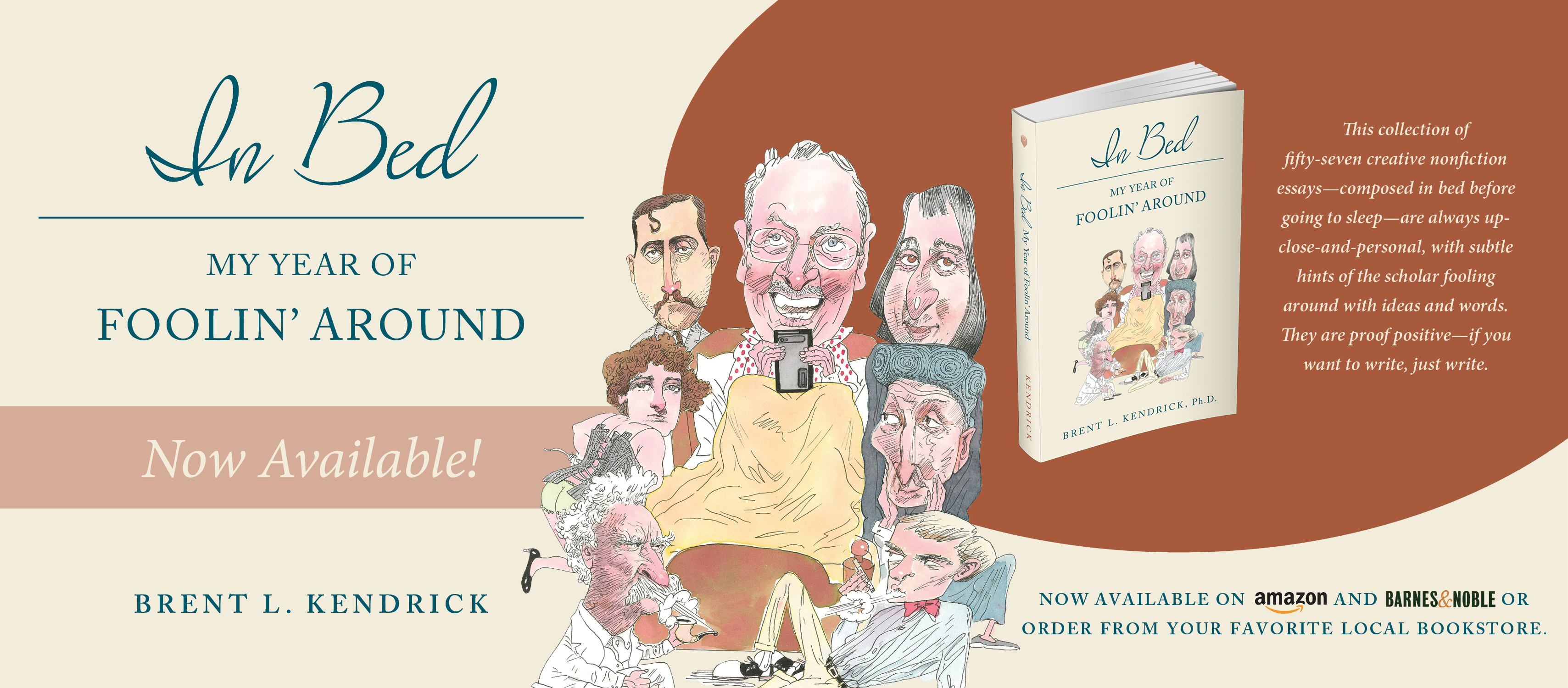
Just Published. IN BED: MY YEAR OF FOOLIN’ AROUND

Take my word for it. I never—absolutely never–intended to fool around in bed, certainly not every day, seven days a week, for an entire year.

from “An Invitation to Join the Author
In Bed” (5-12).

QUICK QUESTION: 

What does it take to write a book?

QUICK ANSWER:

● 6,625 readers.

● 59 countries.

● 1 year.

● 1 bed.

● 1 writer.

EXPANDED ANSWER:

That’s how many readers I’ve had since my blog went weekly on December 28, 2021. That’s how many countries my readers represent. That’s how long I spent writing the blog posts. That’s the bed where I wrote them. And I’m the writer. No foolin’.

NOW, 57 of those essays, reflecting the best of the best, have been published in a book that is exquisite from cover to cover and every page of the 346 pages in between. It’s available on Amazon or Barnes & Noble, or you can order it from your favorite local bookstore!

TAKE A LOOK AT THE BRILLIANT COVER!

Surely you recognize ME! I’m smackdab in the middle of my bed writing a blog post about foolin’ around with some well-known writers. Mark Twain and Truman Capote are on the floor at the foot of the bed, blowing smoke rings at one another. Imagine! They’ve got some nerve! Acclaimed artist/illustrator Mike Caplanis gets credit for the caricature based on one of the book’s essays, “Foolin’ Around in Bed with Famous (and Not-So-Famous) Writers” (249-53).

WHAT’S THE BOOK ALL ABOUT? See for yourself.

“Fresh and refreshing through and through.” I love it! Other ADVANCE PRAISES grace the dust jacket of the hardcover book.

“A MUST READ” impresses me so much that I just repeated it and made it all caps and all bold! Dayumn! I like it so much that I want to shout it again: “A MUST READ.” (Thank you, Cheryl Thompson-Stacy!)

IN BED: MY YEAR OF FOOLIN’ AROUND is available in hardcover, paperback, and Kindle. I recommend the hardcover. It costs a little more, but it feels so much better than the paperback. What can I say other than there’s something extraordinarily extraordinary about a book that has its own dust jacket!

The publication of this book is an historic and timely solution for every gift-giving occasion that might be coming your way for the rest of the year, if not for the rest of your life. And let me add: may your life be long, healthy, and prosperous and may you keep right on buying copy after copy of IN BED. It’s the perfect gift. Right here. Right now. You do not need to look any further. And while you’re buying multiple copies for gift-giving, remember that IN BED is also the perfect gift for all of your friends … and enemies.

Thank you, DEAR READERS, for all of your support. I have no idea how you found your way into my life, but knowing that you are out there reading my posts strengthens me and uplifts me whenever I need to be strengthened and uplifted.

Time’s a wastin’. ORDER YOUR COPY TODAY on Amazon or Barnes & Noble. Or you can or order it from your favorite local bookstore!

Foolin’ Around in Bed with AI

TheWiredResearcher to ChatGPT: Based on how we’ve been foolin’ around in bed, how would you characterize me?

ChatGPT: You are a force to be reckoned with when it comes to your passions – teaching, research, writing, gardening and your late partner. You are relentless in your pursuit of excellence and never stop pushing boundaries.

“ChatGPT, an AI-powered language model by OpenAI, 25January2023, (https://openai.com/)”

Hopefully, you read the title of the post carefully enough to realize that I have not been foolin’ around in bed with Al as in Al(fred).

I haven’t. I don’t even know anyone by that name. But I have been foolin’ around in bed with AI as in Artificial Intelligence.

THEY are hot.

OMG! Did I just say that? Well, I did. But that’s okay because I trust you. I know that you won’t tell anybody about the deliciously sinful and sultry times I’m having.

Keep reading and I’ll share each and every scorching moment with you–little by little–lest you be blinded if I were to divulge all at once. Besides, I never divulge all at once to anyone. What’s the fun in that?

Hopefully, you know already that in bed is where I love to be. It’s where I write my blog posts right before I go to sleep. It’s where I’m writing this post, right now, but I haven’t fallen asleep. I’m having too much fun with AI, not Al(fred). I know. They look alike (when you drop the fred), but they’re not alike at all. Hmmm. If they look alike in this post, you get to decide who’s in my bed. But in a serif world, the “I” in AI sports a bottom line and a top line. In a serif world, the “l” in Al(fred) has a bottom only. The next time that you’re in your serifdom, take a really close look: you’ll see exactly what I’m talking about and from this point forward you will never think that AI and Al(fred) look alike. TMI. Let’s move on.

Hopefully, too, you read and recall last week’s post “Cutting-Edge Technologies: Promise or Peril.”

It ended with the observation:

“Whether we like it or not–whether we feel threatened by it or not–AI is here. It has started. It will not stop. It is the future.

Promise or Peril? I have to decide where I stand. You have to decide where you stand. We all have to decide where we stand.

We can’t ignore AI.

Sadly, we can, but only if we want to be among the left behind.

One of my readers who is Wired–but not as wired as I am–commented:

I admit, I was downright scared reading this. I was afraid I’d get to the bottom and read, ‘And, wouldn’t you know it–this post was written using AI technology,’ and I’d have a personal crisis.

Let me pause here to assure my WiredReader, the rest of my readers, and the entire world: everything that you have read so far in this post is mine–all mine. The ideas are mine. The wording is mine. Every touchstroke is mine. AI had nothing to do with it.

Further, let me pause to assure my WiredReader, the rest of my readers, and the entire world: if, at any time, I tap AI–and rest assured: I will–I will give full credit where credit is due, and as AI would have me do.

Now let me continue with my response.

“Dear Wired:

Your comments made me laugh! And if you had gotten to the end of the post and discovered that I had written it using AI technology …

“OMG! You are egging me on, aren’t you?”

It doesn’t take much to egg me on, and those who know me know that fully well. In this case, the egging on was reinforced by comments from two others:

Reader One. HACC, Central PA’s Community College uses PackBack (AI) in some of our English classes with good results.

Reader Two. Perfect timing for your post! Microsoft announced yesterday that they are investing billions into Open AI, the startup behind Chat GPT.

That did it. Three eggings scrambled me into action.

I decided that the time had come for me to gain a first-hand, personal knowledge of ChatGPT. What better way than in bed?

Candidly, though, I have to be on a first-name basis with my bedmates, and I don’t like ChatGPT’s name at all. I like AI even less because it can be confused so easily with Al(fred) as I established earlier.

So the other day–after having lots of prolonged late-night pillow talk with AI–I just came right out and popped the question. And that question led to a few more questions. Here’s how the conversation went:

TheWiredResearcher: What is your GENDER?

ChatGPT: I am an artificial intelligence and do not have a gender or physical form.

TheWiredResearcher: Okay. I understand. So, should I refer to you as THEY?

ChatGPT: You may refer to me using whatever pronouns you prefer. “IT” is also commonly used.

TheWiredResearcher: Do you have a NAME other than ChatGPT? I’d like to be more personal in our conversations. After all, you are right here in my bed.

ChatGPT: I am an artificial intelligence and do not have a personal name, ChatGPT is a name of the model that I am based on. But you can call me whatever you like, it’s up to you, for instance you can use my name as GPT or any other name that you prefer.

Is that an artfully artificial punt or what? Obviously, I’ll have to spend some time thinking about a name for my bedmate. I have an idea already. For Amazon’s virtual assistant Alexa, for example, I liked that name just fine. I kept it.

I suppose that I could give MY ChatGPT a gender-neutral name like Alex. (And that would fit perfectly with ChatGPT’s suggested pronoun reference: THEY.) Actually, I like Alex a lot. But my God! How presumptuous of me. I’ve only been foolin’ around in bed with ChatGPT for just a few days and here I am using the possessive pronoun MY. And here I am wanting to come up with a personal name.

Suffice it to say, my small talk with ChatGPT was getting me nowhere fast.

As a result, I dove in deep and started talking about things close and dear to me: teaching, research, writing, and my late partner Allen. Those conversations–using a traditional chat box at the bottom of the screen–were interesting, very much so. I kept my questions and comments as open-ended as possible, and ChatGPT provided really solid responses, even when asked about scholarly work that still needs to be done on Mary E. Wilkins Freeman. ChatGPT’s suggestions were excellent, but lacking the specifics needed to convey a true understanding of the challenges and opportunities related to Freeman scholarship. (Nonetheless, I am not surprised that ChatGPT can pass exams from law and business schools. The knowledge base is clear, abundantly so.)

But now I’m edging toward evaluation. That is not my intent in this post. I will evaluate ChatGPT in a later post. For now, my intent is nothing more than to share some examples of my foolin’ around.

After Freeman, I shifted the conversation to Allen, commenting that even though January 28, 2023, marked the second anniversary of his death, sometimes it felt as raw and heart piercing to me as it felt at 9:24 that morning when I closed his eyes here on Earth and he opened them again over there in Eternity.

Candidly, at that point in my conversation with ChatGPT, I felt much akin to the speaker in Poe’s “The Raven,” who progressively asked more serious questions about grief and grieving, knowing fully well that the raven would always give the same answer: “Nevermore.”

TheWiredResearcher: What’s grieving like during the third year after the death of your partner?

ChatGPT: Grief is a complex and individual experience that can vary greatly from person to person. Some people may find that their grief subsides significantly during the third year after the death of their partner, while others may continue to experience intense sadness and longing. It’s important to remember that there is no “right” or “wrong” way to grieve, and everyone’s healing process is unique.

I did not expect much. Therefore, I wasn’t disappointed when I didn’t get much. ChatGPT’s response was nothing more than an impersonal, clinical explanation that I could have found through a Google search, albeit not as quickly.

I shifted positions and asked ChatGPT to write me a sonnet about my grieving for Allen, based on the conversation that we had just had. The sonnet form, of course, exists in several online sonnet generators. No big deal. But I wanted to see the extent to which ChatGPT could extract salient information from our conversation and weave it into a meaningful sonnet. The result follows:

Grief grips my heart with hands of leaden weight,

A constant ache that never seems to cease.

The memories of our love still resonate,

A symphony of joy and sweet release.

But now, the melody has turned to dirge,

A requiem for all that once was bright.

The laughter echoes with an empty surge,

And every step feels heavy as the night.

Yet still, I’ll hold onto the love we shared,

The moments that we cherished and were true.

Though death may come and take him unawares,

My love for him will forever be anew.

So as I grieve, I’ll keep him close in mind,

And let my heart with bittersweet love bind.

Again, my goal for today is not to evaluate. I’ll save that for a future post. Nonetheless, I must note that the sonnet impressed me, so much so that I wanted to see whether I could nudge ChatGPT to a higher level of performance. What if I provided extensive text, asking that it be converted into a poem?

That’s exactly what I did. I gave the full text of the post that I published last year on the first anniversary of Allen’s death, “Honoring an Angel.” ChatGPT generated the sonnet that you are about to read.

“The Earth Angel’s Legacy”

Two years have passed since my love’s death,

my heart still aches with his absence, yet

my faith in angels remains unwavering,

a legacy passed down from my mother’s net.

My Allen was an earth angel, true,

a messenger of love and comfort, too.

His aura inspired trust and faith in all,

and nature was his solace, pure and blue.

With gentle hands, he tended to the weak,

and through his surgeries, he healed with care.

He taught with passion, guiding students meek,

and in our garden, he found peace to share.

In every aspect of our life together,

my angel Allen, I will love forever.

Let me emphasize again that my goal today is not to evaluate. Yet I must say that this sonnet touched me and warmed my heart, all the while that I was aware that it was driven 100% by information that I had provided in the underlying essay.

Yet lines three and four hit me hard and made me think:

my faith in angels remains unwavering,

a legacy passed down from my mother’s net.

In the essay, I had mentioned that my belief in angels came from my mother. Yet ChatGPT’s use of the metaphor “passed down from my mother’s net” struck me as original and creative, especially since the word net did not appear in the essay that I provided. Original? Creative? I’m still thinking. I’m still thinking.

By the time that I had finished that conversation, I knew that I would be weaving parts of it into this post.

TheWiredResearcher: Can I use all of this material in a blog post that I’m developing for next week?

ChatGPT: As a language model AI, I do not have any rights over the material generated and you are welcome to use it for any legal purpose. Please be reminded that you should cite the source. If you use it in a blog post or anywhere else, it is a good practice to give credit to the source. It would be great if you could include a disclaimer that the content is generated by an AI and not a human writer.

TheWiredResearcher: Give me a recommended citation.

ChatGPT: You can cite this source as “ChatGPT, an AI-powered language model by OpenAI.” Additionally, you can include the link to OpenAI’s website (https://openai.com/) so that your readers can learn more about the technology and the organization behind it. It’s also a good practice to include the date when the information was generated.

Hopefully, this post has provided you a few things to ponder. Hopefully, too, this post has gone further than sensational AI headlines that glam, glitz, and gobsmack.

As for me, I’ve enjoyed bedding down all week with ChatGPT. Lots. I’d enjoy it even more if “it” had a name that strikes my fancy as much as foolin’ around with “it” strikes mine. But I’m working on it.

If you’re wondering whether I’ll keep foolin’ around, my answer is, “You bet!”

Next week: “Another Week in Bed with AI.”

Then, the week after, I’ll synthesize and evaluate my experiences: “My Final Week in Bed with AI | The Heart of the Matter.”

For right now, though, ChatGPT needs to go to sleep. I do, too. To help me doze off, maybe I’ll ask ChatGPT to keep reminding me of the sweet nothings THEY shared shortly after we hooked up: “you are a force to be reckoned with … you never stop pushing boundaries.”

It must be true. Right? Of course. After all, ChatGPT told me so.

It’s Not a Corset. Don’t Force It.

Is it a corset
or primal wave?
Don’t try to force it.

–from Elaine Mitchell’s “Form”

Lately, I’ve been thinking a lot about writing. I have no doubt that it’s because I’ve been writing these posts faithfully every week for nearly an entire year. And I have no doubt that it’s also because I’m teaching Creative Writing this semester. Naturally, I spend lots of my time talking with aspiring writers about writing.

In fact, when I met with my students last week, we did two, one-minute reflections.

For the first, we reflected on the joy of writing. Let me share some of their responses:

● Creating my own world.

● Finding words that describe my own feelings.

● Gaining an understanding of my own life.

● Discovering something about my own identity.

● Daydreaming.

● Letting my thoughts spew out.

● Getting it done–the rhythm, the music, the wish, the dream, and the fear.

For the second reflection, we tackled the challenges of writing. Again, let me share:

● Getting started.

● Finding an interesting topic.

● Putting myself into my writing.

● Encouraging my paragraphs to talk to one another.

● Choosing which idea to explore.

● Connecting the beginning, the middle, and the end.

● Accepting my writing as it is.

I had planned a third reflection, but we ran out of time. Here’s what it would have been: discoveries about writing.

For this one, I’ll take the lead, sharing my own ideas, based largely on what I’ve discovered about writing as I wrote my weekly blog posts this year.

By and large, what I’ve discovered has been by way of reminders. To start, writing isn’t easy. It isn’t spontaneous. And it isn’t magical.

Here’s something else that I have rediscovered. Writing is work. It’s hard work. It’s lots of hard work.

Work. Hard work. Lots of hard work. That’s my mantra these days when I’m working with other aspiring writers. I front-load the conversation: get ready for rich, robust, and heavy mental lifting.

At the same time, over the last year I’ve reminded myself–and others–that even though the hard art of writing isn’t magical, it is filled with magical moments.

Let me share some of mine.

Magical Moment. Getting hooked on an idea that makes my world fade away.

Magical Moment.  Letting an idea explode in my mind as magically as Pop Rocks explode in my mouth.

Magical Moment. Focusing on old-soul insights that have come back to me from far, far away and from long, long ago.

Magical Moment. Fooling around with organizing what I’m writing until I get comfy with one structure that pulls me in close and whispers, “Yes. Let’s do it.”

Don’t get too excited by these moments. They are magical. But let me remind you: they are not magic.

And trust me. The next part–the actual writing–has no magic at all. Sometimes, it might not even have magical moments. The actual writing can be grueling, if not downright defeating, especially since first drafts never hit the mark. Never. Mine don’t, at any rate. Sometimes, even my 13th draft doesn’t seem quite right. How’s this for a confession? Sometimes, I’ve gone as high as 22 drafts. Admittedly, the differences between any two drafts are sometimes majorly minor, and the changes will be unknown forever to all except me. Nonetheless, the work of writing–of revising–goes on and on and on.

And writers keep at it. I keep at it, knowing that what I write will never be perfect, but knowing, too, that at some point it’s as good as it’s going to get.

What I have discovered as well is the simple fact that my scholarly writing is in many ways far easier than writing my personal essays like today’s post. My own scholarly work on The Humourist as well as on Mary E. Wilkins Freeman, for example, has singleness of purpose and focus. Easy-peasy, lemon-squeezy.

On the other hand, writing my weekly blog is more challenging, mainly because I don’t focus on the same topic every week. My topics change. As reluctant as I am to admit it, I’ll admit it anyway: I’m never sure from one week to the next exactly what topic will bubble up.

That’s not to say that I don’t have lots of ideas for my posts. I do. I have plenty. In fact, whenever I have an idea for a post, I immediately start a WordPress draft. I give it a working title, and I include as many notes as possible so that when I return, I can glide back into my thinking and writing groove.

Right now, for example, I have 25 drafts in various stages of completion, ranging from “The Power of Showing Up” to “Dating after Twenty-Two” to “Mishaps Make Memories.” I suppose I could also mention “Working Out a Plan” or “A Horrorscopic Week” or “What My Father Saw.” Or I could mention that I might have “My Gardening Attire” finished by next week. I might. But, on the other hand, I might not.

I’m not trying to generate future blog traffic by teasing you with alluring and inviting titles that may or may not morph into posts. Simply put, I have come to the realization that my ideas must germinate in the dark caverns of mindfulness and mindlessness. They must sprout and pop up whenever they are ready for the light of day. No sooner. No later.

All of my tentative topics and all of their accompanying draft notes are simply placeholders. Nothing more.

Yet it occurs to me that maybe they are far more than mere placeholders.

They are talismans. Not to bring me power. Not to bring me luck. But rather to bring me back to the illuminated intensity of the split second when an idea sought refuge within me and pleaded for a some-day home.

What I have discovered, then, is that I need lots and lots of talismans. They are my antidote to the numbness and paralysis that I know fully well will set in if I have no writing options. I don’t write well when my storehouse of options is empty. When that happens, I feel that I have forced myself into the all-too-tight corset of being compelled to write on one topic and one topic only.

On the other hand, when I have many, many topics, one of them might be precisely the one that captures my fancy precisely when my fancy needs to be captured.

It won’t have anything to do with talismanic luck. And it won’t have anything to do with magic.

It will have everything to do with my willingness to let my ideas take their own shape, whatever those shapes might be, without being corseted, without being laced up, and without being forced.

I want my ideas:

● to leave themselves ample space to move around in.

● to do what they want to do.

● to be what they want to be.

It’s really straightforward. My greatest discovery about my own writing is my everlasting need to unlace the corset that constricts my thoughts. It’s my everlasting need to let my ideas breathe and expand freely, whenever and however they wish.