Poor Brentford Gives a Writerly Upbraiding


The writer who goes hunting ideas too aggressively usually returns with nothing but metaphors and poison ivy.” — Poor Brentford Lee. Reluctant naturalist and persistent thorn in his writerly side since 1947.


“Phooey!”

I swear on a stack of books yet to be written that’s exactly what Poor Brentford said.

And get this. He had the nerve to say it smack dab in the middle of a conversation with Gary while I was explaining that maybe, just maybe, I’d come up with something to write about while gardening.

“It’s not easy coming up with all these blog ideas.”

“But you seem to have more ideas than there are days.”

“I don’t know about that, but I came up with one right now. You’ll see.”

I wouldn’t be the first writer, of course, looking for something to write about.

I guess, truth be told, we all go hunting for material.

And precisely at that thought I heard:

“Phooey!”

Luckily, Gary did not hear Poor Brentford who was just getting started.
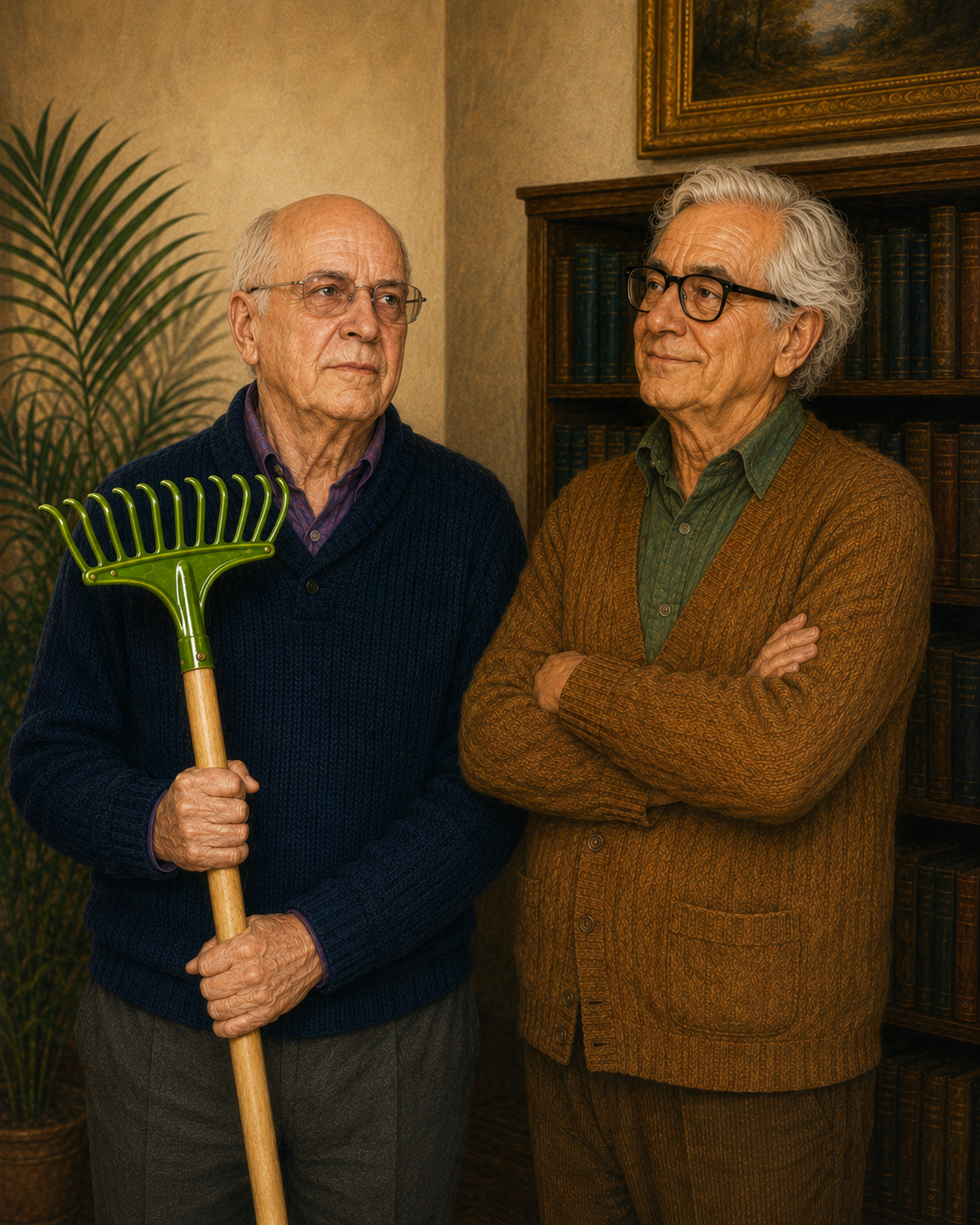
“It goes without saying that you’ll start your catalogue of examples with your Lady.”

“Of course I will. Mary E. Wilkins Freeman was notorious for writing about the people and happenings where she lived. And who, pray tell, knows that better than I?”

“Oh, Lord,” Poor Brentford moaned. “Must I listen one more time to your recitation of local influences in her Pembroke, People of Our Neighborhood, The Debtor …”

“Stop it. Stop it right there. That’s not fair. You know fully well that I don’t think I’ve ever said such a thing about those novels, but I could. She did.”

“What, then, were you going to corner me with?”

“Well, I was simply going to say that Freeman owned up to her literary heists.”

“Right. Sure, she did. Like she owned up to being ten years younger than she really was.”

Poor Brentford, I could tell, was a little more cantankerous than usual, so I decided to shut him up with proof.

“Here’s what she wrote a friend, and I quote, word for word: ‘Monday afternoon, I went a-hunting material too: We went to an old lady’s birthday-party. But …’:

He interrupted me mid-sentence.

“I’ve heard it before. Heard it all before, word by word: ‘… all I saw worth writing about there was a poor old dog who had been chained thirteen years, because he bit a man once, in his puppy-hood.'”

Poor Brentford was right, of course. I’ve written often about that poor puppy and how Freeman gave him a new life as Caesar in her “A New England Nun,” unaware perhaps that his resurrection in that story was linked inextricably and forever to sexual repression.

But was he kind enough to let me do it one more time? Of course not.

“You need to get new examples that will grab your readers’ attention the way that poor puppy grabbed Freeman’s heart.”

Before I could agree or disagree or even ask what writers he had in mind, he gave me a litany that lasted so long I needed a fresh shave. And get this. He had them all neatly organized by categories. It was disgusting. I mean he started off with the obvious, writers like Freeman who really did go looking. The way Henry David Thoreau did in Walden. Or Hemingway as he chased wars and bullfights and deep-sea fishing. Or Joan Didion’s notebooks capturing her fleeting impressions. He even had a list of counterparts across the Pond but before he could bless me with Dickens and his kith and kin, he lost his train of thought and started telling me about writers who made use of strange incidents.

Frankenstein grew out of a ghost-story contest during a rainy vacation.

Alice’s Adventures in Wonderland began as an improvised story told to amuse a child on a boat ride.

The Metamorphosis reportedly sprang from the absurd question: what if a man woke up as an insect?

● The Strange Case of Dr Jekyll and Mr. Hyde was inspired by a dream.

I listened attentively, storing up those examples with every intent to use them in something or other one day or another, but I stood up and objected vehemently when he had the nerve to expect me to follow along with his discussion of the intertextual path that some writers had taken as they wrote famous works based on other folks’ famous works. Ulysses parallels The Odyssey. Rosencrantz and Guildenstern Are Dead as a spin off from Hamlet. I had heard enough. More than enough.

“All right, Poor Brentford. Let’s make a truce. Let’s sign a pact. Let’s forget that I ever mentioned my hope of finding a blog idea to write about.”

I paused. He paused. We stared at one another.

“If you do, you’ll be sorry.”

“It won’t be the first time, I’m sure. But if you’ll excuse me, I have to garden so that I’ll find something to write about.”

“You’re wasting your time. When’s the last time that you ever went looking for an idea and found one?”

I started to reply, but he cut me short.

“Did it ever occur to you that you’ve got this writerly thing of yours all reversed?”

“Thing? Writerly thing?” Spit it out. What’s your point?”

“My point,” Poor Brentford said, with the air of a man who has been waiting his entire existence to say exactly this, “is that you didn’t find your ideas. Your ideas found you.”

I opened my mouth.

“Don’t.”

I closed it.

“Take your Lady. Do you honestly believe you went looking for Mary E. Wilkins Freeman? Or did she reach up out of some footnote or bibliography and grab you by the collar in 1973 and simply refuse to let go? Because last time I checked, she still hasn’t.”

I said nothing, which, as Poor Brentford knows perfectly well, is as good as an admission.

“More than fifty years, Brent. Fifty years she has had you. And you have the audacity—the sheer pomposity—to sit there and tell Gary you went looking for something to write about while gardening. How generous of you. How magnanimous. How utterly beside the point.

“And then there’s Alexander Gordon.”

He said it quietly, exactly the way Poor Brentford delivers his most devastating blows.

“You didn’t find The Humourist. The Humourist found you. He waited. Two hundred and nineteen years, give or take. Sitting in the only complete run of the South-Carolina Gazette in existence—survived earthquakes, fires, wars, and hurricanes, mind you—and then reached up out of a footnote in 1973 and grabbed a graduate student by the collar. And here you are, fifty-some years later, still in his grip. Still writing. Still talking about him at libraries.”

He paused for effect. He has always been insufferably good at pauses.

“They found you, Brent. Both of them. In the same year, no less. And they have never once seen fit to release you. How breathtakingly, magnificently pompous to think that you in your infinite wisdom found them.

I sat down, flummoxed.

“What on earth am I supposed to do with that? I don’t have all the time in the world, you know, to come up with ideas.”

Maybe,” Poor Brentford said, “that’s the whole point of this writerly thing I’m trying to help you understand.”

He settled back with an expression I hadn’t seen before. Not smug. Not cantankerous. Almost kind.

“Ideas,” he said, “are not sitting around waiting for you to come find them. They are, if you’ll permit me, already in motion. Floating. Drifting. Looking for the right home. The right mind. The right heart. They pass over some people entirely–perfectly nice people, mind you, and perfectly intelligent people–and move on. Then they find someone like you and they simply settle. Take up residence. Refuse to leave.”

I started to say something.

“Freeman settled in 1973. Gordon settled in 1973. The same year, Brent. Do you think that was your doing?”

I did not.

“Ideas are not hunted. They are not chased down like a rabbit hopping through your briary ravine.”

He folded his hands with great finality.

“They arrive. Always have. Always will. The only question that matters—the only question that ever has—is whether the writer is the kind of person who opens the door and makes a home.”

Circling Back (Again, Again, and Again)

“I write entirely to find out what I’m thinking, what I’m looking at, what I see and what it means.”

–Joan Didion (1934-2021; renowned American Essayist and novelist whose distinctive writing style and introspective approach earned her a lasting place in contemporary literature).

Maintaining friendships can be a delicate dance, and I’ve learned that silence is golden when it comes to my own writing. My friends–especially those who are writers–know that I abide by Robert Frost’s sage counsel:

“Talking is a hydrant in the yard and writing is a faucet upstairs in the house. Opening the first takes the pressure off the second ” (Letter to Sydney Cox, 3January 1937; quoted in Robert Frost and Sidney Cox: Forty Years of Friendship. By William Richard Evans. 1981).

Rarely, then, do I talk with friends about what I’m writing in my weekly blog posts. Talking about it diminishes my focus and my belief. Oh, to be certain, I may tease by divulging a topic or a working title. I love teasing. I’ve done it before, and I’ll do it again right now by telling you the working titles of some future posts:

● “What My Father Saw.”

● “Packin’ Up. Gettin’ Ready to Go.”

● “My Right to Know.”

● “Somewhere Called Home.”

● “What If Artificial Intelligence (AI) Makes Us Even Better than We Are?”

● “Grappling with Unknowns.”

● “The Cake Stops Here.”

● “When Did Tomorrow Begin?”

See there. I didn’t mind sharing those titles at all. Like I said, I’m a tease.

Truth be told, though, that’s all that I can share in advance because I’m clueless as to how those tentative titles will play out. I never know the end of a post until it leads me to its ending.

Clearly, I am not one of those writers–of whom there are many–who align themselves with Edgar Allan Poe. I’m thinking now about his focus on “unity of effect” and that a writer must know the intended effect from the beginning:

[…] in almost all classes of composition, the unity of effect or impression is a point of the greatest importance. […] If his very initial sentence tend not to the outbringing of this effect, then he has failed in his first step. In the whole composition there should be no word written, of which the tendency, direct or indirect, is not to the one pre-established design (Poe’s review of Hawthorne’s Twice-Told Tales, Graham’s Magazine, May 1842).

A few years later, he reiterated that point:

Nothing is more clear than that every plot, worth the name, must be elaborated to its dénouement before anything be attempted with the pen. It is only with the dénouement constantly in view that we can give a plot its indispensable air of consequence, or causation, by making the incidents, and especially the tone at all points, tend to the development of the intention (“The Philosophy of Composition,” Graham’s American Monthly Magazine, April 1846).

Poe’s way of writing is not my way of writing.  Mine is just the opposite. Mine is the Frostian way:

Like a piece of ice on a hot stove the poem must ride on its own melting. A poem may be worked over once it is in being, but may not be worried into being. Its most precious quality will remain its having run itself and carried away the poet with it (“The Figure a Poem Makes,” Atlantic Monthly, June 1939).

I am not trying to compare my writing to Frost or to Poe. Yet, as a writer, I have every right to align my methods with someone. I choose Frost for alignment, and I choose Frost for ally.

Like Frost, I am unwilling to talk about the content of what I am writing: opening the hydrant [talking] lessens the pressure on the upstairs faucet [writing]. At the same time, I am more than willing to talk about my writing methods: melting like a piece of ice on a hot stove, carrying me away with it.

Actually, I have talked about my writing process extensively in several blog posts. I’m tempted to suggest that you browse my posts and find them for yourself. But that would be mean spirited. So let me recap the main points here.

1. I write my posts in bed–every day, seven days a week–starting at 8:00 pm and continuing until I decide to stop, usually around 9:30 pm or so. Sometimes, I ignore my body’s call for rest, and I write until 11:00 pm. I don’t think that I’ve ever written past 11:30 pm. (However, I do recall writing until 12:30 am once, just to prove to a friend that I could stay up that late.)

2. I write my blog posts exclusively on my smartphone. Yes. On my smartphone. I hold it in my left hand (as I am doing now), and I touch type my text, letter by letter, with the index finger of my right hand (as I am doing now). I know: it’s slow. I know: it’s tedious. But guess what? It works.

3. I write my blog posts while sipping on a Bunnahabhain Scotch, neat.

4. I have a large number of drafts in progress at any given time: everything that I experience is copy. Right now, for example, I have 29 drafts in various stages of development.

5. Whenever I have an idea and start a draft, I develop it enough so that I can leap back into the idea whenever I return to it, even if it’s weeks or months after the idea leapt into my head.

6. Usually, one draft among all the others calls to me and demands my attention. I listen. I focus on it for seven nights, hanging on tight and never letting go.

7. On Sunday of each week–the day before publishing a post–I read it out loud by telephone to my oldest sister, Audrey. Reading it aloud gives me the opportunity to find any remaining mistakes. (Inevitably, I still miss a few.) More importantly, however, it gives me the opportunity to hear the rhythm, and if I have an off-key passage, my ear speaks to me. Sometimes, I pick up on a rhythm, and I decide to play it more fully in one final revision before going to bed. But here’s the important thing: it’s the hearing aloud–what Frost would call the “sound of sense–that allows me to know my degree of accomplishment.

Those are the main steps that I follow in writing my posts.

Recently, however, I noticed a recurring practice that I’ve been unintentionally following. Let me share it with you.

As I open a draft, I revisit the beginning instead of scrolling down to where I left off the night before. This practice offers a fresh perspective on my words and ideas.

I circle back to the beginning, I start from there, and the Frostian melt starts anew.

As I circle back, I take my time. I savor every word. I savor every nuance. I savor all the possibilities, including the white space between words where so many meanings live–and hide. And, as I circle back, I change whatever it is that calls to be changed.

To be sure, circling back flies in the face of the process that I and other English professors are hell-bent on teaching our students. Generally, we teach a straightforward, linear process without much room for deviation, except for an occasional reminder that writing can be recursive, especially when we need to do additional research to strengthen content. The process that we teach goes something like this:

First. Prewriting (Topic, Audience, Brainstorming, Research, Thesis, and Outlining).

Second. Drafting (Creating an initial version).

Third. Revising (Reconsidering content and context).

Fourth. Editing (Looking at grammar and mechanics).

Fifth. Proofreading (Taking a final look to discover mistakes, including formatting).

Undoubtedly, the 5-step method works, especially for beginning writers who often have no method.

It works for seasoned writers, too, but as we gain more and more writing experience, we follow that method subconsciously. For example, even though I write my posts in bed, I’m well aware that whatever I’m working on is simmering on my writer’s back burner throughout the day and throughout the night as I sleep. My ideas and insights come unexpectedly and without invitation.

For me, then, as a writer–especially a writer of Creative Nonfiction Essays like my blog posts–I’m tapping into the tried and tested steps of the writing process, but I’m really unaware that I’m doing so.

Yet, I am exceedingly aware of my circling back, and I find that keen awareness fascinating. It’s a conscious choice that I make every night when I open my WordPress draft to pick up where I left off. The starting point is always same: I circle back to the beginning. Most nights, I spend half of my writing time revisiting, rethinking, and modifying what I’ve written already.

I’m not suggesting that the “circling back” part of my writing strategy is revolutionary or unique. Perhaps lots of writers circle back in like manner.

What I am suggesting, however, is this: Circling back becomes a dance of words, a waltz with sentences that have already found their footing. It’s a writer’s serenade to their own creation, a harmonious echo of ideas that resonates and refines. Circling back is an invitation to linger in the labyrinth of language, to savor the richness of thinking, and to let the journey unfold in its own enchanting way. In the quiet act of returning to the starting point, I find my path illuminated by the wisdom of Frost and by the freedom of my narrative.