“The first porch is where you find your voice. The second porch is where your voice finds others.” —Poor Brentford Lee (b. 1947. Keeper of two porches, one mountain, one dog, and an inexhaustible supply of things worth saying—none of which he has to say alone anymore, thanks to his partner, Gary.)
Dear Faithful Readers,
You’ve been here with me on the porch since—well, some of you since the very beginning, back when I built it as nothing more than a place where you could pull up a chair and talk with me about the joys, challenges, and discoveries of research. We kept right on doing that from 2012 to 2021 when I decided to make the porch a little more fun by bringing you weekly creative nonfiction essays.
I’m still at it. Nearly 750,000 words later. Yes, you read it right. Foolin’ around in bed every night with ideas and words adds up. I’m spurred on by you, my Dear Readers, whose numbers keep increasing annually! Last year, we shared more than 35,000 views right here on the porch.
But I’ve built a brand-new porch, and I want you to be the first to know about it.
Don’t worry, though. I’m not leaving The Wired Researcher porch. It will remain open virtually forever. Same Monday mornings. Same voice–mine, with Poor Brentford’s voice chiming in from time to time. We’ll both be there, waiting for you.
I just heard someone shout out:
“So, why are you building a new porch? What’s that all about?”
Well, for starters, it has better lighting, and it might just bring in more neighbors for all of us to visit and exchange ideas.
I’m counting on you to check it out. I’ve named the second porch The Kendrick Chronicles.
“Where on earth is this new porch of yours?”
Gracious me! You know that I like to take my time–slow and easy like. In a sec, I’ll give you the link so that you can check it out for yourself. And when you do, go ahead and Subscribe! From that point forward, my essays–ever goldern new one that hits the world, every Monday morning like a neighbor who always brings something worth reading and never overstays his welcome–will find their way directly to your Inbox.
You can find this new porch of mine in Substack. Here’s the link:
“What will I find when I get to this new porch of yours?”
Why, gracious me! You’ll find a comfy chair with your name on it and a handful of your favorite essays with my name on ’em:
● Redbuds of Remembrance
● Learning to Love in New Ways
● I Am Afraid
● Poor Brentford Cleans the Wax Out of His Ears
● Two, Together
● Glimpses of My Mother’s Hands
● The Ghost of Palmyra Church Road
● Truths Half-Told. Letters Half-Burned. A Legacy Waiting to Be Fully Heard.
● Carrying the Bags of Colonial America’s Humourist
And get this. If you subscribe, next week you’ll get an essay about a kitchen disaster beyond belief: “Oh, No! No Sourdough!” And the week after that, “What We Know. What We Believe.” It may be the most complete thing I’ve ever written about who I am and what I believe about what comes next.
So go on now. Pull up a chair. Same voice. Wider porch.
“Give a man a mask and he will tell you the truth.”
—Oscar Wilde (1854–1900), Irish playwright, novelist, critic, and a master of wit, paradox, and social satire.
Humor means different things to different people.
Sometimes it appears when something almost goes wrong but doesn’t. The tension releases, and everyone exhales at once.
Sometimes the biggest laughs come when someone names a behavior we all recognize but rarely admit—family habits, social pretenses, small vanities we pretend not to see in ourselves.
Humor lets people say risky things safely. We soften criticism with a joke. We test opinions indirectly. We disagree without declaring war.
Sometimes humor does something even simpler: it lets strangers feel briefly aligned. People who laugh together feel, if only for a moment, that they belong to the same world.
I can relate to all of those kinds of humor.
But lately I’ve been tapping into another kind of humor. Laughing at myself.
Because here I am, at this stage of life, carrying the bags of a Colonial American writer who performed behind his own joke for nearly 275 years.
He wrote in Charleston, South Carolina, in 1753 and 1754 under the pseudonym The Humourist. I eventually identified him as Alexander Gordon—antiquarian, playwright, former operatic tenor, Egyptologist, and Clerk of His Majesty’s Council—and published the essays in my book Unmasking The Humourist: Alexander Gordon’s Lost Essays of Colonial Charleston, South Carolina.
Right now, I’m laughing out loud as I finish typing that last paragraph. It captured all the necessary details in so short a fashion that a reader who doesn’t know about my work might think it was easy.
It wasn’t and that’s no laughing matter.
I started working on these pseudonymous essays in 1973, and it took me decades of on-again-off-again research to solve what was the greatest mystery in all of American literature. Who wrote the essays that were right up there with Benjamin Franklin’s?
I solved the mystery by giving the essays a close reading and by developing a precise profile of the pseudonymous author.
He shows deep classical learning; fluency in music and theater; detailed knowledge of colonial legislative procedure; access to the printing process; and—most strikingly—specialized antiquarian expertise, including repeated, highly technical references to Egyptian mummies.
That last detail matters—hold on to it.
Serendipity helped. While combing the South Carolina Gazette for anything that might name the author outright, I stumbled on an obituary for Alexander Gordon, Clerk of His Majesty’s Council. The obituary didn’t identify him as The Humourist, but as I dug further, Gordon’s life and learning aligned almost point for point with the profile my close reading had built—especially the mummy trail.
Egyptology was not casual learning in colonial Charleston. Yet the essays speak in depth about mummies, and Gordon’s will independently inventories Egyptian paintings and drawings and an unpublished manuscript on Egyptian history. When the essays and the archival record illuminate one another so precisely, alternative candidates disappear. The mask does not merely fit. It belongs—and suddenly the performance comes into focus.
With Gordon restored to authorship, the essays change. They stop being a curiosity and become something far more interesting: a sustained experiment in humor and performance inside the colonial newspaper itself.
Attribution reveals design. What once appeared as scattered satire resolves into a deliberate experiment—using humor, performance, and print itself to create a conversation between writer and public.
Recently, I explored that angle for a talk at the South Central Society for Eighteenth-Century Studies in a paper titled “Pleasure, Play, and the Colonial Press: Unmasking The Humourist in Eighteenth-Century Charleston” — I realized something unexpected.
The real story is no longer the mystery.
Now that the mystery has been solved, the authorship established, and the essays restored to print in Unmasking The Humourist: Alexander Gordon’s Lost Essays of Colonial Charleston, South Carolina (2025), readers can finally approach them not as an attribution puzzle but as a serious contribution to colonial American literature — and to eighteenth-century humor itself.
What emerges is humor doing real cultural labor.
Gordon deploys mock-serious moralizing, feigned modesty, fabricated correspondence, and theatrical self-presentation to probe colonial life. He stages debates with himself, parodies authority, and moves constantly between sincerity and self-mockery. Humor here is not decoration or diversion. It becomes a way of negotiating civility, reputation, and power in a city both ambitious and anxious.
Just as important, the humor is local. Charleston is not London or Boston. Gordon writes within a transatlantic essay tradition, yet his satire is tuned to a specific press, a specific readership, and the particular pressures of a provincial colonial capital learning how to see itself.
One of his most sophisticated devices is fabricated correspondence. Figures such as Alice Wish-For’t, Urbanicus, Calx Pot-Ash, and Peter Hemp enter the newspaper as letter writers, each occupying a recognizable social position. Alice Wish-For’t blends patriotic seriousness with playful irony, turning courtship into commerce as she urges Carolina to favor its own “manufactures.” Urbanicus performs civic refinement, respectfully cataloguing Charleston’s dangers until earnest reform quietly becomes satire. Calx Pot-Ash and Peter Hemp speak as commodities seeking settlement, reducing questions of empire and policy to negotiations among trade goods.
Equally telling is where these voices write from — England, Sweden, Russia. Distance lends authority while keeping Charleston firmly at the center. The newspaper becomes a stage upon which local life is judged through transatlantic eyes.
Of course, Gordon writes all the letters himself.
Yet the illusion matters. Humor manufactures sociability, creating the sense of an engaged public responding in real time. The newspaper becomes not a lecture but a space of play, populated by voices entering and exiting as if directed from behind the curtain.
That play extends even further — to authorship itself. Rather than locating comedy only in scenes of leisure, Gordon repeatedly turns writing into the joke. The Humourist exists entirely in print, negotiating with readers, printers, and critics while never stepping outside the role he has invented. Apologies, promises of reform, threats of retirement, and editorial decisions mimic literary authority even as they quietly undermine it. Print culture itself becomes performance.
At moments he turns this playfulness toward authority directly. In a mock proclamation issued by Apollo, styled “King, Ruler, and sole Arbiter of Parnassus,” poetry is regulated like civil law, offending writers condemned in language borrowed from official decrees. The humor lies not simply in exaggeration but in recognition: authority, literary and political alike, depends on performance.
By this point, the pattern becomes unmistakable. The newspaper has become a stage. Voices circulate, authority performs itself, and meaning moves through print while a hidden author directs the scene.
The experiment reaches its height in the Humourist’s carefully managed disappearance. His farewell dramatizes authorship itself, insisting he will never again “enter the Lists of Authorism.” Timing, posture, and voice — the very tools of authority — become part of the joke he appears to control.
Here humor shifts away from events and toward the performance of authorship itself, as the writer gradually becomes part of the joke he has created.
Once we recognize that experiment, we can finally ask a larger question:
“What, exactly, did my scholarly research really recover?”
Not just an author’s name. Not just a solved literary mystery.
What returns is pleasure—yhe pleasure of wit, play, and performance in the colonial press.
These essays can now be read, taught, and argued over not as anonymous artifacts, but as the work of a specific and remarkably complex mind. They invite us to reconsider early American literature not as solemn beginnings, but as lively experimentation — writers testing ideas about society, behavior, and power through laughter.
I keep carrying Gordon’s bags.
From Charleston, where he wrote them. To Deltaville. To Pinehurst. And wherever the conversation goes next.
Because if humor helped him speak safely to his own century, perhaps it can help us hear him clearly in ours and remind us that one of the sharpest, funniest voices in Colonial American literature was never lost.
He was simply waiting for the joke to land.
So I keep carrying the bags—following the voice that once spoke from behind the mask, wherever the road leads.
“The meaning of the past is never finished.” Hannah Arendt (1906–1975). From her Between Past and Future (1961), where she argues that history is not closed or complete, but morally alive, awaiting renewed attention, responsibility, and understanding.
Last week, I found my way to a small library tucked behind a hardware store in Deltaville, Virginia. It was the sort of place you might drive past without ever knowing it was there—a quiet, cream-colored building softened by climbing vines and brightened by a mural where hummingbirds hovered and monarchs drifted above a riot of painted flowers. A sailboat logo and a modest white sign announced Middlesex County Public Library — Deltaville Branch, a name that made the place feel both official and intimate at once. Nothing about it was grand, but everything about it felt intentional. Step through the doors, and you are immediately reminded why libraries endure: they do not shout their importance; they simply keep offering it.
I had been invited to speak about Unmasking The Humourist: Alexander Gordon’s Lost Essays of Colonial Charleston, South Carolina, a project that has occupied a surprising amount of my life. But as I stood there, in a room filled with people who had given their afternoon to books, it became clear that what I was really there to talk about was not a colonial essayist at all. It was about the invisible network of librarians, teachers, archivists, and patient institutions that had made that work possible.
Nothing I have written would exist without them. Not the book. Not the essays. Not even the questions that led me to them.
For most of us, research looks solitary. A scholar in a reading room. A book on a desk. A voice speaking from a distant century. But none of that happens without a vast, quiet scaffolding behind it, made up of people who catalog, preserve, teach, fund, and protect the materials that others one day come to use.
Libraries quietly hold information—sometimes for centuries—without knowing who will need it, or when, or why. They preserve voices long after those voices have gone silent, trusting that someday someone will come along prepared to listen carefully.
That afternoon in Deltaville, surrounded by that small but devoted group of Library Friends, I realized I was standing inside the visible tip of something much larger. A chain of care that stretches across generations, linking a colonial newspaper, a Charleston library, a community college system, and a branch library in the heart of the Chesapeake Bay.
My own place in that chain began long before I knew it. When I was a graduate student in the early 1970s, I stumbled across a series of anonymous essays published in the 1750s in The South-Carolina Gazette. A leading scholar, Leo LeMay, had remarked that they were among the finest essays in all of early American literature and had urged that someone edit them, publish them, and identify their author. The challenge sat there for decades, unanswered.
What allowed me to return to it was not individual brilliance, but institutional grace. I spent twenty-five years at the Library of Congress, learning how archives think and how preservation outlasts any single lifetime. Later, the Virginia Community College System gave me something just as precious when I turned fifty: the chance to become an English professor, a dream I had carried since childhood. And then, when I was named Chancellor’s Professor, it gave me a two-year appointment that provided something more precious than funding. It provided time. Time to think. Time to return to unfinished questions. Time to do the kind of slow, careful work that real discovery requires.
That is why educators and educational institutions matter so deeply in this story. They do not just transmit knowledge; at their best, they grant permission. Permission to linger with a problem. Permission to follow a hunch. Permission to trust that careful thinking is worth the investment.
Being in Deltaville also gave me something I had not realized I was missing: the chance to thank Glenn DuBois in person. Glenn was Chancellor during two important turning points of my professional life. He was Chancellor when the Virginia Community College System first welcomed me into the classroom at age fifty, and he was Chancellor again years later when I was named Chancellor’s Professor, the appointment that made this work possible.
We rarely get to look someone in the eye and say, simply and honestly, “You changed my life.” But that afternoon, in a small library behind a hardware store, I did. It was one of those moments when gratitude stops being abstract and becomes something you can actually feel in the room.
The essays I eventually brought back into the light turned out to belong to Alexander Gordon, a Scottish-born scholar and singer who lived in colonial Charleston. But authorship matters because it allows us to place a voice in a life, a mind in a world, and a text in a tradition.
There is a Jewish folk belief that a person dies twice: once when the body stops, and again when their name is spoken for the last time. If that is so, then archives are a kind of moral infrastructure, designed to keep names from slipping into that second death. Every catalog entry, every preserved page, every carefully tended collection is an act of faith in the future.
So is education. When the Virginia Community College System opened its doors to me in midlife, it did not just give me a job. It gave me a second beginning. Without that second chance, the first version of my curiosity would have remained unfinished.
All of this came together for me in that small Deltaville library. A place without marble columns or grand staircases, but full of the same quiet dignity that animates every serious library anywhere. People had gathered not to be dazzled, but to listen. To care. To take part in the long human habit of keeping stories alive.
Today, Gordon’s voice is no longer anonymous. His essays are no longer orphans. A lost body of work has been restored to its author, and a chapter of early American literary history has been set right. That restoration belongs not just to a scholar or a book, but to the institutions that made it possible—to libraries that guard knowledge, to educators who foster discovery, and to communities that believe the past is worth preserving.
All proceeds from my book go to the Virginia Foundation for Community College Education, which feels exactly right. Libraries and community colleges share the same moral instinct: they exist to hold doors open, not to keep people out.
I left Deltaville with a deeper gratitude for the fact that nothing we do alone ever really is. Behind every footnote stands a librarian. Behind every discovery stands a teacher. Behind every second act stands an institution willing to say yes.
And behind every recovered voice stands a chain of quiet, faithful human hands, passing something forward because they believe someone, someday, will need it.
This week’s post is arriving early, because in just a few days I will step into a room filled with history and voices that refuse to fade. On October 1, the Charleston Library Society—the oldest cultural institution in the South and the second-oldest circulating library in the nation—will host the launch of my Unmasking The Humourist: Alexander Gordon’s Lost Essays of Colonial Charleston, South Carolina.
Why Charleston? Because the city itself is part of the story. It was here, in November 1753, that Alexander Gordon began publishing his Humourist essays in The South-Carolina Gazette. Through wit and irony, Gordon held up a mirror to colonial society, skewering hypocrisy, praising learning, and questioning authority. His essays pulsed with the contradictions of a city that was both refined and raw, elegant and quarrelsome. Charleston was his stage, and for nearly three centuries his voice remained hidden in the fragile pages of a newspaper few had cause to revisit.
That is, until now.
The Charleston Library Society is not just the venue for this launch—it is the very repository that safeguarded the Gazette itself, preserving the faint ink on brittle pages that carried Gordon’s words into the future. Founded in 1748, just five years before The Humourist first appeared, the Library has weathered fires, wars, earthquakes, and centuries of change. Its shelves and archives testify to the endurance of ideas—and to the truth that words matter. To stand in this place and reintroduce Gordon’s voice is both an author’s honor and a literary historian’s homecoming.
This launch also falls on a milestone: 272 years since the first Humourist essay appeared in Charleston. That span of time is almost unimaginable. Empires have risen and fallen, nations have been born, wars have been fought, and yet these essays—sharp, funny, insightful—still breathe. They remind us that human folly, ambition, vanity, and hope are constants. Gordon was not writing only for 1753. He was writing for us.
For me, this book represents years of research and a kind of detective work: following a trail of clues, comparing voices, weighing evidence, and finally piecing together the case for Gordon’s authorship. It is scholarship, yes—but it is also a story of recovery. Of bringing back a writer who deserved to be remembered, who deserves a place in our understanding of American letters.
And so, on October 1, Unmasking The Humourist will take its first public bow in the very city that first gave it life.
If you are in or near Charleston, I would be delighted to see you at the Charleston Library Society. If you are far away, I hope you will celebrate with me from wherever you are.
Because this launch is not just mine—it belongs to every reader who believes in the power of words to survive, to provoke, to amuse, and to endure.
About the Book
This edition definitively establishes Alexander Gordon (c. 1692–1754)—antiquarian, Egyptologist, scholar, singer, and later Clerk of His Majesty’s Council of South Carolina—as the author of The Humourist essays, restoring his rightful place in literary history.
The Introduction confirms Gordon’s authorship and provides the necessary historical context surrounding the essays and their publication in The South-Carolina Gazette.
The Humourist Essays section presents the complete authoritative text. Each essay is introduced with a detailed headnote offering historical context, exploring key themes, and situating the essay within broader literary and cultural traditions. These headnotes also clarify references, highlight rhetorical and satirical techniques, and connect The Humourist to its periodical essay tradition. Following each essay, explanatory notes supply annotations that illuminate historical allusions, linguistic nuances, and biographical details, making the essays more accessible to modern readers while preserving their original wit and bite.
The Afterword suggests areas for future scholarship—richer literary analysis of Gordon’s techniques, his engagement with Charleston’s intellectual and political life, his later years in South Carolina, and his place in transatlantic literary traditions. This volume thus serves both as a definitive authorship study and as a definitive text, laying a foundation for future research.
Finally, the Appendix corrects a 277-year-old historical error that mistakenly attributed to Gordon a natural history of South Carolina. This archival correction not only restores the record but also underscores the importance of rigorous scholarship—whether in reclaiming a forgotten author’s voice or in ensuring that legacy is preserved with accuracy.
Unmasking The Humourist: Alexander Gordon’s Lost Essays of Colonial Charleston, South Carolina is available now:
“Somewhere, an editor is waiting to fall in love with what I’ve written. That’s not ego. That’s faith.”
—Brent L. Kendrick (b. 1947). Blogger, literary scholar, creative nonfiction writer (who loves to fool around in bed), and once-upon-a-time professor who splits his reinvention time between restoring lost voices of American literature and discovering new ways to live, love, laugh, and write with meaning. He’s been sighted in the mountains of Virginia. (Authorial aside to all editors: Sit up and take notice—because if you snooze, you lose. This dude’s relatively cheap, cleans up well, once got compared to Garrison Keillor by someone in Tennessee, and yes—he’ll bake sourdough and seduce the annotations, headnotes, footnotes, and endnotes into (mis)behaving.)
Stats?
Oh. Sorry. I don’t mean my vitals. Though I do check them daily. Why not? My Fitbit provides it all, right on my wrist. Heart rate. Breathing rate. Temp. Heart rate variability. Blood oxygenation. Stress. So, yeah. I check those first thing every morning when I wake up.
I meant another set of stats that matter to me.
My WordPress stats.
I like to know how many people are checking out my blog on any given day.
I like to know what countries they’re from.
I especially like to know what posts they’re reading. That info lets me know what’shot and what’snot. Every now and then, I lean in and almost let myself believe that what’shot mightjustbeme. I do. Really. I do. Especially when I see hits on my AboutMe or AboutMyBlog or ContactMe pages. Like the time one lone reader from Lithuania clicked through twelve posts in an hour—and paused on “About Me.” I remember thinking:
“This is it. This is my moment.”
I guess I figure that if someone is going to all the trouble of background snooping, they’re probably on the verge of being the genius who goes down in history as the one who discovered me, thus ensuring that I go down neither unfootnoted nor unnoted.
Me? Discovered?
Don’t scoff! Stranger things have happened, you know. I mean, I wouldn’t be the first writer catapulted into history and literary fame by an editor with deep belief and keen vision.
One writer who has just been catapulted into history comes to mind immediately.
Alexander Gordon (c. 1692-1754).
Did I just hear you gasp:
“Who’s that?”
Surely, I did not, for if you don’t know who he is, then you must not be the faithful follower I know you to be.
If you’re following me–my blog, I should add for your clarity and my protection–then you know that I recently finished a book about Alexander Gordon, the long-forgotten colonial satirist who published his literary works pseudonymously in The South-Carolina Gazette in 1753-54 under the name The Humourist, and then—like so many voices history forgets—he vanished. No one knew who he was. One scholar asked. But he didn’t bother to find out. No one else did, either. Then I came along. I had a lot of curiosity. I had a tolerance for long hours in dusty archives. Eventually, I had a hunch, and I discovered a clue.
So don’t tell me that a writer getting discovered is a myth. I just did that very thing with Alexander Gordon. Guess what else? It occurs to me that he now stands as the first American writer to be thrust by an editor into fame.
Yes. That’s true and, I’ll make that claim. Right here. Right now.
Someone just upbraided me:
“Excuse me. You’re wrong. Anne Bradstreet was the first.”
Being upbraided is something up with which I will not put.
“So ekscuuuuuuuuuuse meeeeee! You’re wrong.”
Here’s why.
I know. I know. You’re probably thinking about her one and only book The Tenth Muse Lately Sprung Up in America. In case you don’t know the story surrounding its 1650 publication, it goes like this. Her brother-in-law John Woodbridge spirited her manuscript off to England and published it behind her back, unbeknownst to her.
Bradstreet herself seems to back up that claim, especially in her “The Author to Her Book” offering up her well-known and oft-quoted lament:
Thou ill-form’d offspring of my feeble brain, Who after birth didst by my side remain, Till snatched from thence by friends, less wise than true, Who thee abroad, expos’d to publick view, Made thee in raggs, halting to th’ press to trudge, Where errors were not lessened (all may judg).
How convenient for Bradstreet. Her posturing created a persona of Puritan modesty and aversion to recognition as compelling as the narrative of her “stolen” book of poetry—the very tale that helped catapult her into public view.
But here’s the thing. Actually, two things. First, Woodbridge was not her editor. Second, despite the storybook notion that Bradstreet considered her womanly role subordinate to the role of Puritan men, scholars maintain that it was “a propaganda campaign” launched by Bradstreet and her family. I’m thinking particularly of Charlotte Gordon’s “Humble Assertions: The True Story of Anne Bradstreet’s Publication of The Tenth Muse,” maintaining that Bradstreet was not surprised by the publication of her book and that, in fact, she was actively involved in its publication.
So there! Bradstreet does not beat Alexander Gordon when it comes to the first American writer thrust into fame by an editor.
But let me not digress from the claim that I am making. Think as long and as hard as you will about American writers between the publication of The Tenth Muse and the publication of the Humourist essays, and if you can come up with someone else who can seize the claim, reach out to me, and I’ll blog it. Better still, reach out to me, and we’ll co-blog it.
But I won’t hold my breath. The Humourist remained pseudonymous from his first November 26, 1753, essay through his final notice on April 9, 1754, known but to God. That is until I came along and solved the greatest literary mystery in perhaps all of American literature. I unmasked The Humourist and revealed him to be none other than Alexander Gordon, clerk of His Majesty’s Council in South Carolina.
Now, through my dogged determination, my literary sleuthing, and my scholarly editing, Gordon will be known forever more and throughout the world as the acclaimed author of the Humourist essays, among the liveliest and most original voices in Colonial American Literature, right up there and on par with Ben Franklin’s Silence Dogood essays.
Needless to say, there have been other American writers who were brought into public view by editors–all boasting just a smidgen of modesty, of course, comparable to mine–who knew talent when they saw it.
I’m thinking of my lady Mary E. Wilkins Freeman and my book The Infant Sphinx: Collected Letters of Mary E. Wilkins Freeman. Although I edited the letters, provided thorough annotations, and wrote biographical introductions to the book itself and each of its five sections, I’m not the editor who discovered her on her way to literary stardom.
Credit for that goes to someone else. Here’s the brief backstory. Freeman started her career as a children’s writer but then extended her literary efforts into the realm of adult short stories. Lippincott’s, Century, and the Atlantic rejected her “Two Old Lovers.” Then she sent it to Mary Louise Booth, editor of Harper’s Bazar, who read the story three different times during three different moods, as was her custom, and accepted it for publication in the March 31, 1883, issue. From that point forward, Freeman wrote regularly for the Harper’s Bazar and Harper’s Monthly, and, in fact, Harper & Brothers became her regular publisher.
In a way, then, it was Mary Louise Booth’s editorial acumen that escorted Freeman into the international literary acclaim she continues to enjoy even today, though in fairness to Freeman, her talent was such that it would have found its way into the spotlight in one way or another. Talent will always out.
I could go on and on with this litany of writers who were discovered by editors, sometimes against the odds. I’m tempted to say that I won’t, but on second thought, I think that I will share with you snippets of some paired writers and editors who come to mind.
I’ll start with Flannery O’Connor, so well known for her bold and unconventional Southern Gothic voice. It was Robert Giroux, an editor at Harcourt who believed in her debut novel, Wise Blood, and guided it into print—despite its eccentric style and religious overtones.
Or what about Jack Kerouac? His On the Road was originally a 120-foot scroll—raw, unfiltered, and “unpublishable.” But Viking Press editor Malcolm Cowley saw gold and helped shape it into the beat-generation classic it became.
Then we’ve got a postal worker with a cult following in underground poetry circles: Charles Bukowski. He caught the attention of John Martin at Black Sparrow Press. Martin offered him a year’s salary to quit his job and write full time. It was the start of a prolific and gritty career.
No doubt you know the minimalist voice of Raymond Carver. His works might have stayed buried had it not been for Gordon Lish at Esquire. Lish gave Carver his break, though not without some brutal edits.
Closer to me and my situation in many ways is Frank McCourt, who, as a retired teacher in his 60s, wrote Angela’s Ashes. Nan Graham at Scribner wept when she read it and championed it into publication. Oh. My. It won the Pulitzer. It sold millions. My kingdom for a Nan.
And if McCourt was close to me occupationally—educator turned writer; I, of course, am still living according to most recent news reports—then I have to mention Jeanette Walls, whose roots are close to mine since we’re both West Virginians. Her memoir The Glass Castle was going nowhere fast until editor Deb Futter read it and saw its power. Her support turned it into a bestseller and reshaped what memoir could be.
And last but perhaps most important to the hope that I carry (like a well-worn talisman) that an editor will discover me and, in a poof, turn me into star dust is Andy Weir. He self-published his The Martian chapter by chapter online. Julian Pavia at Crown Publishing read it, loved it, and bought it. The novel became a bestseller and hit film.
Oh. My. God. I’m doing exactly what Weir did. I’m publishing all of my Foolin’ Around in Bedessays right here, week by week. Once again, my kingdom for a Pavia unless a Nan has already catapulted my bed into fame.
I could share other snippets, but I confess. Right now, I’m in a pickle. But don’t worry. I have a way out. It will work for me, and, as you are about to see, it will work for you too.
I’m going to do what Margaret Atwood did in her story “Happy Endings.” I’m going to give you options.
A. What happens next? Don’t be so impatient. History is based on facts and evidence. Come back for the ending when the ending is written.
B. What happens next? DearReader, you know exactly what comes next. Yours truly–Brent(ford) L(ee) Kendrick–aka TheWiredResearcher—keeps right on doing what he’s been doing with his writing and his research. And he keeps right on hoping that an editor–a believer—is out there, poised and ready to do for him what he’s just done for Alexander Gordon.
Not just this blog. Not just my Foolin’ Around in Bed essays. But Gordon. Freeman. Years of words, research, story, and sweat. A whole body of work—waiting for the right editor/reader to say: “This one. This voice.”
“Which ending do you like?” someone queried.
I much prefer B. After all, keepin’ on keepin’ on is the road I’m traveling. Even if it is the one less traveled by, it makes all the difference. Especially when it leads past the stats and toward the stars. (Whew! What a relief. I figured out a way to bring Robert Frost into this post. It’s been too long–far too long.)
Besides, putting aside my own preference for an ending, I have no doubt in the world that right now, an editor is out there who believes in me, who might be scrolling through my “About Me,” pausing over a sentence, clicking “Contact Me,” and thinking:
“Thisone. Thisvoice.”
OMG. I just felt the earth shift.
I did. I really did.
Did you?
No? You didn’t?
Don’t worry. Be happy.Somewhere, right now, someone’s opening a drawer, clicking a link, or flipping a page—and everything’s about to begin.
“The pursuit of historical truth requires rigorous attention to evidence, but also imagination—an ability to see beyond the silences.”
—Eric Foner (b. 1943), Columbia University historian and Pulitzer Prize–winning author of The Fiery Trial.
It began with a clue. A slip of language. A name tucked too neatly into silence.
For years, The Humourist was one of colonial America’s most compelling mysteries: a sharp, satirical voice that burst onto the front page of The South-Carolina Gazette in 1753 and 1754—then disappeared without a trace.
No signature. No farewell. Just a trail of dazzling essays and a question no one could quite answer: Who was he?
What followed, for me, was part scholarship, part sleuthing. I tracked language patterns, pored over wills, newspapers, shipping records, and marginalia. I followed leads from Charleston to Edinburgh and back again. And finally, I solved the puzzle, and the answer emerged:
Alexander Gordon—a Scottish-born antiquarian and early Egyptologist, who would eventually serve as Clerk of His Majesty’s Council in South Carolina. A man educated in Enlightenment thought, fluent in satire, and bold enough to take aim at power in a bustling port city where reputation was currency.
The mystery is solved. But Unmasking The Humourist doesn’t just name the man—it restores his voice.
This authoritative and definitive edition brings Gordon’s essays back into circulation for the first time in nearly 270 years, fully annotated and critically framed, with a scholarly introduction that explores Gordon’s identity, influences, and the forces that led to his disappearance from literary memory.
Why These Essays Matter
The Humourist columns are more than colonial curiosities. They are early American satire at its finest—witty, incisive, and rich with transatlantic influence. Gordon’s essays place Charleston on the literary map, not as a provincial outpost, but as a vibrant participant in the Enlightenment-era conversation about politics, identity, and the press.
This book marks a breakthrough in how we understand the American essay tradition. It challenges the idea that colonial literature was all sermons and pamphlets. Here, we meet a writer who was sharp, worldly, and unafraid to poke fun at hypocrisy—whose pen was as powerful as any pulpit or platform of his day.
A Milestone Moment
Today, I submitted the final corrections to the publisher, along with keywords, pricing, and metadata. The next step is the printed proof—then, in due time, the book itself.
It’s a strange and beautiful feeling. Emily Dickinson said it best:
“After great pain, a formal feeling comes.”
This project has spanned decades. It has taken me deep into archival records, across centuries of silence, and finally into the steady light of historical clarity.
And Now?
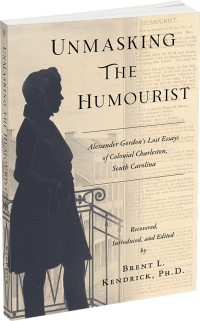
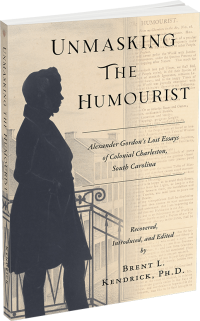
I’m proud to share the cover—front and back. Because The Humourist, like all great stories, deserves both.
Launch Details?
Not quite yet. But soon. The typeset is locked. The voice is ready.
This fall, a long-lost satirist steps out of the colonial shadows—and into the modern light.


 The Wired Researcher