A Banner Year, Gently Told

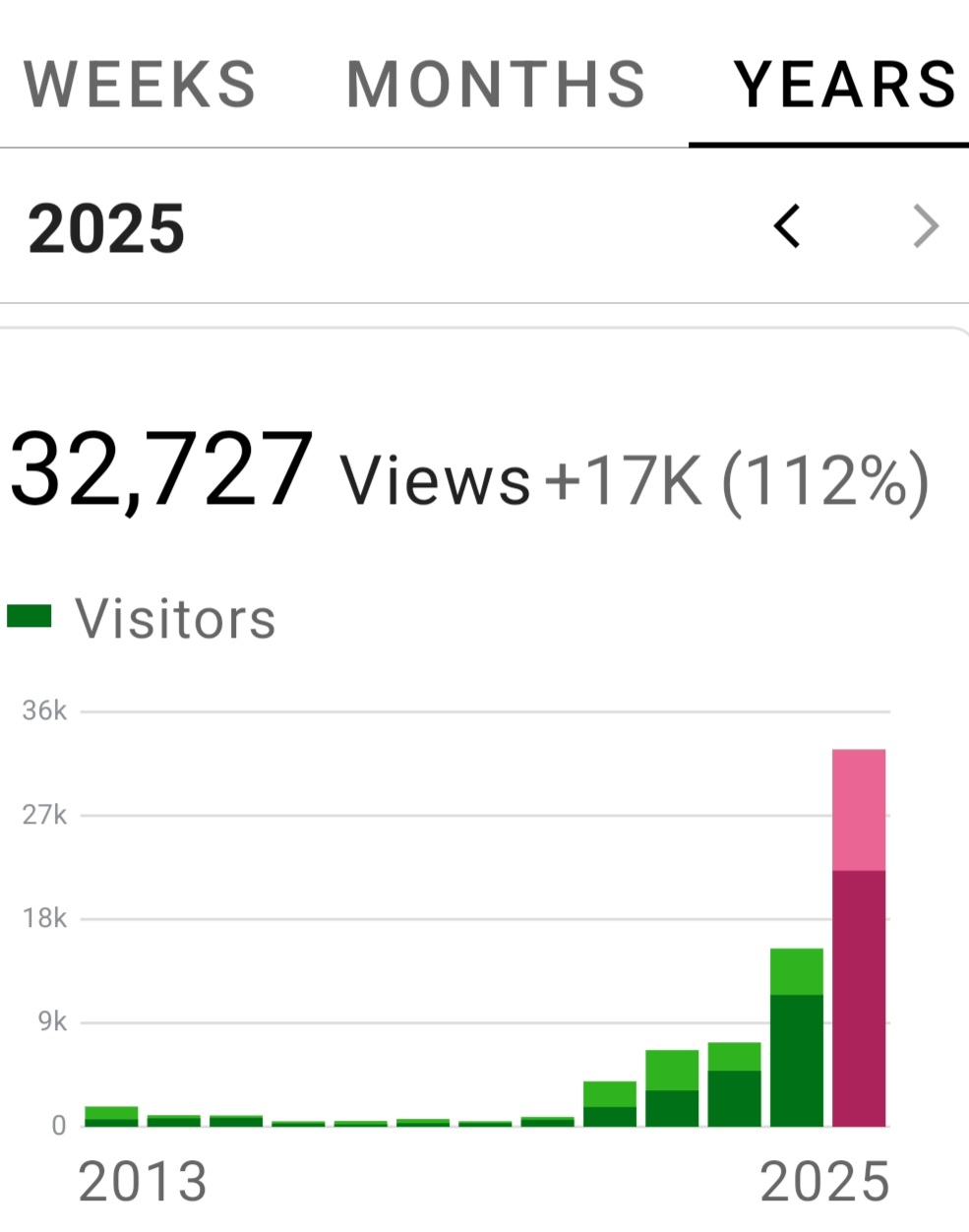
As this year draws to a close, I want to thank you for visiting my blog 32,727 times.

That didn’t happen overnight. And it didn’t happen by accident.

This year, more people found their way here than ever before—slowly, steadily, and often by returning. Compared with last year, readership grew significantly, not because anything went viral, but because the writing kept meeting the right readers at the right moment.

Growth, the quiet way,

These pages have held many things:

● 18th-century satire and present-day kitchens.
● Scholarship and softness.
● Books, biscuits, dogs, devotion, memory, love.

Some posts traveled far. Others found only a handful of readers. But every one was written with care—and read with attention.

I don’t think of these as clicks.

I think of them as moments of shared presence in a distracted world.

You made this a banner year.

If you were one of the 32,725:

● thank you for reading,
● thank you for lingering,
● thank you for making this a place worth returning to.

Here’s to a year shaped by patience, curiosity, and generosity of spirit—and to whatever quiet magic comes next.

Wired with wonder,
Brent

An Open Letter to a Sudden Surge

The MtnHouse
December 11, 2025

Dear Sudden Surge,

You took me by surprise again this morning. As always, when I awakened, I checked my Fitbit to see how my heart did overnight. Then I checked WordPress to see how my readers were doing.

And there you were. Another thousand views. A quiet jolt to the chart. Numbers climbing when I wasn’t looking.

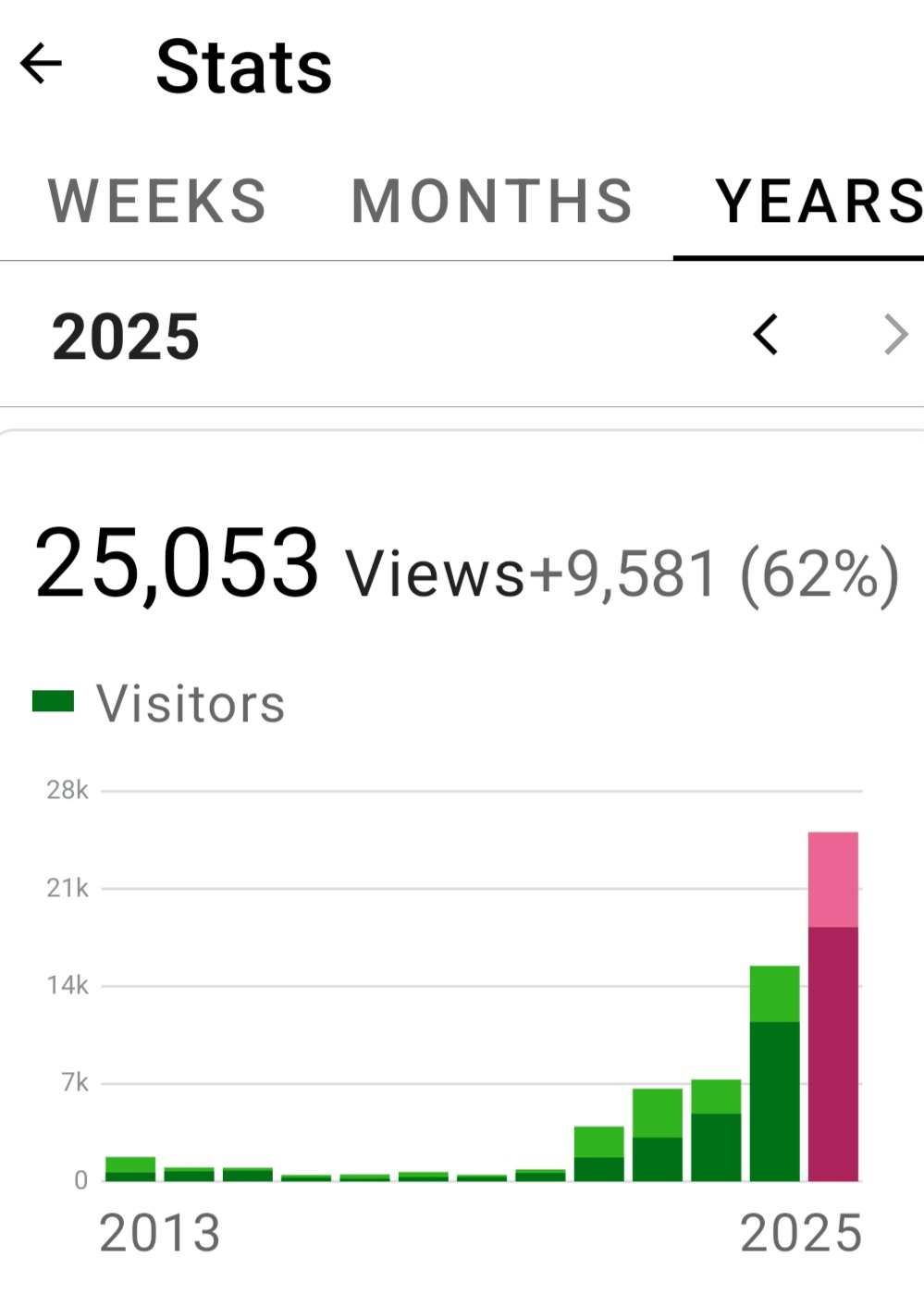
You’ve been dancing higher and higher since October, when I passed 15,000 and figured I’d reached my high-water mark. I even wrote a piece of thanks back then, thinking I’d said all there was to say. But now here we are—December 11th—and this little corner of the internet has gathered 25,053 views.

I’ve done nothing different. I have no flashy headlines. I have no trending hashtags. I just keep following the same rhythm: writing essays born from memory in a home filled with love. I just keep foolin’ around with words and ideas.

So why now, after all these years?

That question hangs gently in the room with me. It’s not demanding an answer. It’s simply inviting a reflection. Maybe something shifted in the writing. Maybe it’s more expansive. Maybe it’s more lived-in. Maybe it’s a voice carrying a steadier warmth now. Maybe it’s grief that’s softened into grace. Maybe it’s love that arrived not with fanfare, but with a quiet hand stretched out in invitation. Maybe it’s all of those things. Maybe. And add to all those maybes one more. Maybe it’s readers sharing with readers.

Gary, of course, doesn’t ask to be written about. But his presence is here, between the lines, in the patience of a paragraph, the steadiness of tone, the way I’ve learned to let silence do some of the talking.

Ruby, on the other hand, insists on being written about, whether she’s nosing me away from my smartphone or curling up in solidarity as I revise for the twenty-fifth time. She is, as always, the keeper of the tempo, the mistress of the move.

So this isn’t an open letter to public stats. It’s a letter to something deeper. It’s a letter to what it means to keep writing when no one’s watching, and then to wake up and find that someone was.

My essays aren’t meant to dazzle. And I know: they don’t. They’re just small acts of holding up the light, one weekly reflection at a time. The fact that they’re being read, now more than ever, tells me something I didn’t expect: quiet honesty still finds its way.

Thank you, Sudden Surge, for reminding me that patience has its own reward, that consistency is a kind of faith, and that somewhere out there, readers are still pausing to linger with a slow essay from the mountain.

I don’t know what this upturn means, or where it leads. But I do know I’ll keep showing up with my smartphone in hand and love at my side.

Wired with wonder and gratitude,
Brent

The Shape of a Surge

20,062 Reasons to Be Grateful

“I would maintain that thanks are the highest form of thought.”

—G. K. Chesterton (1874–1936,). influential English essayist whose sharp wit, moral clarity, and human warmth made him one of the most quoted thinkers of his time.

My blog surprised me again this week. Back in October, I crossed 15,000 views and thought I’d reached my high-water mark for the year. Now, barely a month later, I’m staring at an even bigger number:

20,062 views—with a full month still to go.

That’s more than last year, more than the year before, and more than I ever expected from this little mountain corner of mine. Apparently, these memoir stories I write from a quiet oasis in the wilderness of Virginia keep finding their way into far-off places—and into the hands and hearts of readers I’ll never meet yet somehow feel connected to all the same.

Reasons to Be Grateful

But 20,062 isn’t really a number. Not to me.

It’s the sum of moments someone chose to spend with my words. It’s a cup of coffee that went cold on a stranger’s table because they lingered. It’s a pause in someone’s busy day. It’s a late-night scroll where someone said, without ever typing the words, “I’ll stay a little longer.” Twenty thousand tiny gestures of yes in a world full of noise.

And the deeper truth behind that math—the part I keep circling back to—is that this milestone isn’t about reach or visibility or bragging rights. It’s about what it represents in the long arc of a life. I’ve lived enough years, and carried enough stories, to know that readers don’t show up unless something in the writing rings true. They don’t return unless the voice feels familiar, honest, worth sitting with. They certainly don’t keep climbing toward 20,000 unless the stories hold something real.

So this isn’t a celebration of views.

It’s a quiet acknowledgment that I’ve kept faith with my own voice—through reinvention, through loss, through love found unexpectedly, through the strange and luminous chapters that have made up this year. And somehow, astonishingly, readers have kept faith with me.

And yes, threaded into the margins—without ever mentioning Gary by name—is the quiet steadiness that has shaped this year in ways I’m still learning to articulate. Love doesn’t call attention to itself; it simply widens the edges of your life. It softens how you move through the world, deepens the tone of your voice, and reminds you that being read is wonderful, but being seen—fully, gently, without hurry—is something else entirely.

This year, more than any before, has reminded me that showing up with a story is an act of hope. And reading one is, too. Somewhere in that exchange—when the writing meets the reading—something human and steady is created. Something that matters.

So here I sit, on a chilly Thanksgiving week, taking in this milestone not as a trumpet blast but as a simple moment of gratitude. Gratitude for the readers who knock on my digital door day after day. Gratitude for the chance to tell the stories I’ve carried for decades. Gratitude for the ways this year has widened, softened, and surprised me—and for the quiet presence that keeps teaching me that the best stories are the ones we live, not just write.

I didn’t expect this climb to 20,062. But I’m grateful for every step, every reader, every quiet yes.

And with a month still to go, I’ll just say it now—

Thank you.

Thanksgiving Shenanigans with Poor Brentford Lee

Benjamin Franklin had Poor Richard.
TheWiredResearcher has Poor Brentford Lee

and welcomes him back as a guest contributor—
louder than a sardine timer and twice as slippery
to sanctify
our Thanksgiving tables
with a bold mix of satire and sass.

Discerning readers like you, My Dear Friends, have no doubt noticed that from time to time, I write my posts under what I would call my nom de plume, Poor Brentford Lee. I like it, especially since it always makes me feel that I’m right up there in American letters right beside Ben Franklin and his famed Poor Richard.

I suspect it is with me as it was with Franklin. Using a nom de plume allows me to say things that I might have better sense than to say under my real name.

Anyway, I like Poor Brentford Lee enough that I let him grab hold of my smartphone and tap his heart away to share whatever it is he insists on sharing about Thanksgiving!

And this, My Dear Friends, is precisely where I step aside and let Poor Brentford take over. He’s already clearing his throat, poised to pontificate about Thanksgiving and give you a mouthful about all the other holidays we might celebrate. Or not.

Take it away, Poor Brentford…

Law me, Child, you would think folks would leave well enough alone and let Thanksgiving shine on its own once a year. But no. One day’s not enough for some people. They’ve gone and populated the whole turkey week with holidays!

Where shall I begin and how shall I spit out all the celebrations making every day on my calendar look like parchment with measles.

I’ll tell you here and now. Lace your girdle. Tighten your suspenders. Better still. Do both.

“Who? Me?”

“Yes. You. You tin-bellied Buzzard.”

And no. It is not true, the rumor that you may have heard that Ben Franklin wanted the buzzard to be declared America’s national bird. (And even if he had, he would not have endorsed eating it for Thanksgiving instead of turkey. So don’t let my nonsense bother your pretty little mind nary a whit when you sit down and take a gander at the golden bird on your table. It’s a turkey. And, besides, a turkey by any other name tastes the same.) But he did prefer the turkey over the Bald Eagle–which was, is, and forever shall be America’s national bird. He thought the eagle had “bad moral character” whereas the turkey was a bird “of courage.” But I assure you, Franklin never advocated that the turkey–or buzzard–be elevated to a national symbol.

But let’s get back to this bird of courage, with my genuine assurance that you’ll be stuffed by the time yours is done. (And it may be already.)

Do you realize that just a few days ago–Monday, November 24–folks celebrated:

Celebrate Your Unique Talent Day. (Law me, Child, half of us still haven’t identified a talent, and the other half are busy showing theirs off on Facebook. Settle down and smooth your feathers. We’re all special just as we are.)

D. B. Cooper Day. (Lord help us! Who in their stuffed mind celebrates a masked, unidentified airplane hijacker? Pass the gravy, please—and make it strong.)

International Au Pair Day. (Bless their ambitious little hearts. Raising other people’s children while living in their basements. That’s not a holiday—that’s a calling.)

National Brand Day. (Because nothing says Thanksgiving spirit like corporate logos. Law me twice and hand me a napkin.)

National Fairy Bread Day. (Child, that’s just white bread with butter and sprinkles. The Australians have some nerve calling it a delicacy. Bless their festive little hearts.)

National Sardines Day. (Well, thank you! I think I will. Pass the saltines, please. Those fishies may be little, but they sure pack the omegas. Goodness, no. No need to open the windows. Light a candle? Have you lost your mind? Eat some sardines and chill.)

Land’s sake. That’s just Monday’s shenanigans.

I won’t dare trot my way through Tuesday and Wednesday, and when we get to Thanksgiving Day (the granddaddy of all American feasts), we’ve got at least five other celebrations dotting up my measled calendar—including Turkey-Free Thanksgiving. (I’m about to faint. Run fetch the smelling salts, please.) And Pins and Needles Day. (No doubt all the turkeys in the land are on theirs. My stars, even the Macy’s balloons look nervous.)

And don’t get me started on what follows on Friday. It’s none other than Black Friday, but Poor Brentford calls it National Lose Your Religion Day.

Thank your lucky un-plucked feathers that brings us to December, filled with an entire navigation of celebratory days that won’t get stuck in anybody’s craw.

The month barely opens before we’re knee-deep in Advent (which starts on November 30 this year—law me, Sweetheart, some of us are still digesting stuffing and the rest of us are remembering that we meant to buy candles).

Then comes December 8, the Feast of the Immaculate Conception (a reminder that December still knows how to be holy before the cookies take over).

December 10 brings Human Rights Day (which, given the state of the world, ought to be celebrated daily, loudly, and with snacks).

December 12 offers the Feast of Our Lady of Guadalupe (a celebration so radiant it could light a path clear across the Shenandoah), and December 13 arrives with Saint Lucy’s Day (bless their bright little candles; it’s the one holiday where setting fire to your hair is considered festive).

And then, Sugar, December 21 rolls in with the Winter Solstice (the shortest day of the year—when the sun says “I’m tired” and slips behind the hills before Poor Brentford has found his reading glasses).

December 24 is Christmas Eve (the day we all lie and say “just one more cookie”), December 25 is Christmas Day (the grandmammy of gift wrap and gravy boats), and December 26 brings the first day of Kwanzaa and Boxing Day (a pair of celebrations that stretch the season just a little sweeter and a little longer).

Finally, December 31 lurches toward us as New Year’s Eve (when half the country watches the ball drop and the other half drops before the ball does).

And before you start thinking December has nothing left to get stuck in your craw, Dear One, let Poor Brentford assure you otherwise. We haven’t even touched the other December shenanigans—those bafflin’, bedazzlin’, bubble-blowin’ celebrations that make a body wonder who’s in charge of this calendar.

Take Package Protection Day (Law me, Sweetheart, if your packages need protection, it’s already too late).

Then there’s Bathtub Party Day (Heavens no. These bubbles are reserved for… well, that’s none of your business).

Put On Your Own Shoes Day arrives next (bless their slow little hearts—and who, pray tell, was puttin’ ’em on before today?).

National Letter Writing Day finally appears (fetch me a quill and ink pot pen before the feeling passes), followed closely by Weary Willie Day (and aren’t we all, after this calendar?).

Then up pops Dewey Decimal System Day (now kiss my librarian grits—this is a holiday worthy of humanity), and International Mountain Day (Child, here in the Shenandoah, every day is Mountain Day, even Tuesday).

Fast-forward a bit and December tosses out National Whiners’ Day (celebrated mostly by folks returning gifts they don’t deserve), followed by Still Need To Do Day (my to-do list fainted dead away—fetch the smelling salts), and finally Make Up Your Mind Day (if only—Poor Brentford’s been undecided since the first time he picked up a pen).

As for me, I’ve made up my mind that I’ve stuffed you with enough celebrations already, and I’m not about to puff up my feathers and strut around with more. Land’s sake alive! If I got going on all the celebrations we won’t be celebrating in 2026, I’d be here forever and you’d be reading even longer. (One reader told me just a feather or two ago that I was getting pretty windy.)

Now, before you fan yourself and declare that Poor Brentford has lost the last marble he was ever loaned, let me tell you something plain and true. All this fussin’ and frettin’ over holidays—big ones, little ones, ridiculous ones—might seem like the carryings-on of a nation that’s plum run out of sense. But Sugar, I don’t think that’s it at all. Not deep down.

I think we keep inventing these goldurned celebrations because we’re hungry for each other. Hungry for community, for belonging, for a reason—any reason—to stop the world long enough to say, “I’m here, you’re here, thank heavens we made it another day.”

We are a scattered people trying to stitch ourselves back together with whatever thread we can find—peppermint bark, bathtub bubbles, mountain days, turkey days, even days devoted to weary Willies and packages that need protecting. It’s laughable, yes. But it’s also a kind of hope. A kind of reaching.

And if you ask me—and you didn’t, but here I go anyway—I think we ought to take these foolish little observances and set them right on the Thanksgiving table alongside the mashed potatoes and cranberry sauce. Call them what they are:

Laughable Blessings.

Because heaven knows we need reasons to laugh. We need excuses to gather. We need bright spots—silly or sacred—that remind us we belong to one another, even on the days we feel most alone.

So Child, if some little holiday comes along and tickles your wishbone or nudges your heart, pull up a chair at your Thanksgiving table and let it sit a spell. Celebrate it. Laugh at it. Give thanks for it.

Light a candle. Bake a pie. Wear the dress or don’t (but mercy, cover the essentials). Put on your own shoes—today or tomorrow.

Because in the end, Thanksgiving isn’t only about turkeys and table linens. It’s about noticing the small things—absurd, tender, holy—that remind us how lucky we are to be here at all.

And that, My Dear Readers, is a blessing worth celebrating on Thanksgiving and every day of the year.


Poor Brentford Says

Eat well. Laugh loudly.
And Sweetheart, if life insists on giving you
a celebration for every day on the calendar…
count them as blessings — even the laughable ones
.

Lifted Higher and Higher

“Stories are the communal currency of humanity.”

—Terry Tempest Williams (b. 1955. American writer and environmental activist whose lyrical essays explore the intersections of personal narrative, place, and ecological stewardship.)

Something snuck up on me yesterday.

I was talking on the phone with my 90-year-old sister when I glanced down at my smartphone, saw my WordPress dashboard—and nearly did a spit take.

Over 15,188 views this year already!

That’s already more than all of 2024, and we still have October, November, and December to go. Apparently, my little mountain corner has gone global again—and I couldn’t be more grateful.

To every one of you, My Dear Readers, who reads, comments, shares, or quietly lingers over a sentence or two: thank you. You’ve turned this space into a community of curiosity, compassion, and laughter. Every click, every view, every thoughtful message reminds me that words still matter—and that connection runs deeper than algorithms.

Your Top 10 Favorites of 2025 (So Far)

Every year tells its own story through what readers choose. This year’s list made me smile. It’s a mix of reflection, resilience, and rediscovery—with a dash of irreverence (because, well, it’s me or Poor Brentford Lee or maybe both).

“I Am Afraid” — A wake-up call for our country—and a reminder of who we still can be.

“The Place: Charleston” — The launch of my Unmasking The Humourist: Alexander Gordon’s Lost Essays of Colonial Charleston, South Carolina.

“Redbuds of Remembrance” — Even loss can bloom in the right season.

“FramilySaid™: For When Family Isn’t Enough” — A reminder that your worth doesn’t need a witness. Show up for yourself.

“Rise Up with Words. A Declaration for Our Troubled Times” — In these politically charged times — when so many people feel hopeless, unheard, and unseen — words matter more than ever.

“My Altar Ego” — “‘I be fabulous. You be fabulous, too.”

“The Rust Whisperer” — Aging is a journey filled with yearnings. To arrive. To become.

“What Could $40 Million Do—Besides Fund a Parade? A Love Letter to Priorities (with a Side-Eye to A Spectacle)” — History is watching. Are you?

“A Week Back to the Future” — How my sister’s Remington Rand typewriter changed my life.

“Finding Love Later in Life—Baggage and All” — Proof that love comes to those who believe.

Looking Ahead

There’s still more to come before year’s end—new essays, reflections, maybe even a few surprises that have been sitting in my drafts waiting for the right moment. Perhaps even one or two guest posts by our famed and acclaimed Poor Brentford Lee.

I can’t promise I’ll always be profound, but I can promise I’ll keep showing up with authenticity, honesty, humor, and heart.

Thank you, My Dear Readers, for being here, for reading, and for reminding me—every day—that a single voice can still find an echo.

Climbing Higher and Higher: 12,000 Views (and Counting!)

“The reader is the final arbiter of a text. Without the reader, the words are silent.”

Margaret Atwood (b. 1939). Canadian poet, novelist, essayist, and critic, one of the most influential literary voices of our time.

My Dear Readers, I blinked yesterday, and suddenly my little corner of the internet tallied 12,000 views for 2025—with three months still to go!

That’s not just a number. It’s 12,000 moments of connection. 12,000 times someone out there paused long enough to read my words, nod, chuckle, roll an eye, or maybe even find a flicker of themselves in my essays.

And here’s the part that stuns me: with this pace, we’re on track to sail past last year’s phenomenal 15,000 peak—a record I once thought unrepeatable. But here we are, repeating (and then some).

The 10 You Loved the Loudest

Every essay I publish is a seed tossed into the world. Some sprout quietly. Some bloom bold and bright. Here are the ten that you watered most generously this year:

Redbuds of Remembrance

A Forgotten Voice, A Solved Mystery—And Soon, A Book

Rise Up with Words. A Declaration for Our Troubled Times

My Altar Ego

The Rust Whisperer

A Week Back to the Future

What Could $40 Million Do—Besides Fund a Parade? A Love Letter to Priorities (with a Side-Eye to A Spectacle)

Learning to Love in New Ways

Finding Love Later in Life—Baggage and All

A Culinary Heist in Broad Daylight

My Thanks

Whether you’ve been here since my first blog post nearly 13 years ago or you just stumbled across my latest musings, you’ve made this milestone possible. I don’t take your presence lightly.

So, here’s to you—my companions in this ongoing experiment of storytelling, memory-making, and meaning-finding. Let’s see how far we can climb before 2025 closes the books.

After all, the numbers matter—but the connections matter more.

Gratitude: The Best Dish on Your Thanksgiving Menu

“Gratitude unlocks the fullness of life. It turns what we have into enough, and more.”

–Melody Beattie (b. 1948; American self-help author, known for her bestseller Codependent No More.)

Lean in close and listen to America gathering ’round for Thanksgiving:

“Oh my goodness, look at that turkey!”

“Mmm, do you smell that? I think it’s the rosemary!”

“Would you look at this spread? It’s a work of art!”

“Ooh, I can’t wait to dive into those mashed potatoes!”

“Save me a piece of pecan pie—no, make that pumpkin and pecan!”

“Pass me the sourdough rolls—they look so fluffy!”

“Is that sage in the stuffing? Smells amazing!”

“Wow, check out the glaze on that ham—it’s shining like caramel!”

“Even the cranberry sauce is sparkling!”

“Oh, wait! I need a picture of this before we did in!”

As everyone takes in the scene, their excitement quiets into warm smiles.

“All right, everyone, lean in! Let’s get a group selfie!”

“Come on, squeeze in! Come on. Get closer. We’re all family here!”

“Say ‘Thanksgiving!‘”

Conversations like that will be heard in more than 85% of American homes this Thursday, as families, friends, neighbors, and even community groups come together to celebrate Thanksgiving. These days, the notion of “family” has become so inclusive that many people call the day “Friendsgiving.”

Here’s the beauty of it all. Regardless of what we call the day and regardless of whether we’re celebrating as a group or alone, it’s a day to appreciate relationships, health, opportunities, or simple pleasures. It’s a day that lets us stand together on the common ground of gratitude regardless of who we’re with, what we believe, or what we’re having for dinner.

But when the meal is over, and everyone trots home, I hope that each of us takes one part of Thanksgiving with us, to enjoy daily, all year long. It’s the best part. It needs no cooking. All it needs is practice, slow daily practice. I’m talking about gratitude.

Hopefully, you’re already practicing gratitude. It’s not that hard to do.

I know some people who keep a gratitude journal. They take the time every day to write about the good in their lives. Maybe it’s something as simple and as subtle as the warmth of sunlight coming through a window. The specifics don’t matter; what matters is taking the time to notice the overlooked, appreciate small kindnesses, and celebrate resilience, beauty, and connection. They’re celebrating the things in life that matter to them–whatever those things might be, even on challenging days and through trying times.

Ironically, maintaining a gratitude journal doesn’t work for me. I prefer acknowledging my gratitude by metaphorically bowing to my blessings throughout the day.

It starts the moment I wake up to Ruby’s unconditional love—one that forgives bedhead and morning breath—and stays with me throughout the day, loyal companion by my side.
Every day, I’m grateful for my dog.

It’s there when I look at my Fitbit to check my health stats or when I use my Smartphone to connect with the world or when I use ChatGPT to glimpse into the future unfolding before my eyes.
Every day, I’m grateful for my technology.

It’s there in the small acts of self-care, from soaking in a warm tub to sipping Bunnahabhain Scotch, neat, as I write my blog posts in bed. These moments remind me to slow down and truly savor life.
Every day, I’m grateful for my rituals that restore.

It’s there in the joy of seasonal celebrations, like Thanksgiving or my birthday, where meaningful meals and thoughtful traditions mark the passage of time.
Every day, I’m grateful for the rhythms that shape my year.

It’s there in the legacy I’m building—mentoring others, inspiring through teaching, and leaving a lasting mark through my writing and endowed scholarships.
Every day, I’m grateful for the chance to make a difference.

It’s there in my sense of humor, which allows me to find lightness in life’s challenges and keep my perspective balanced and grounded.
Every day, I’m grateful for the gift of laughter.

It’s there in my endless curiosity, whether I’m exploring advances in AI or delving into Mary E. Wilkins Freeman research. These pursuits keep me engaged and growing.
Every day, I’m grateful for the spark of life-long learning.

It’s there in the sanctuary I’ve created in my home, nestled on a mountaintop—a place overflowing with peace, security, and the stories of my life.
Every day, I’m grateful for the home that holds me tight.

It’s there in the memories of family and friends—those I loved and sometimes lost, yet whose love continues to buoy me. Their presence lingers in the stories we shared, the lessons they taught, and the warmth they left behind, reminding me that love endures beyond time.
Every day, I’m grateful for the love that never leaves me.

It’s there in the joy of cooking, whether I’m perfecting a recipe, having friends in for dinner, or conjuring up new ways to use up my sourdough.
Every day, I’m grateful for getting turned on in my kitchen.

It’s there in my health and active lifestyle, in the moments spent biking, gardening, or simply moving through the day with energy and purpose.
Every day, I’m grateful for the strength to keep on keeping on.

It’s there in my connection to nature, whether I’m tending peonies in the garden or reflecting on life’s deeper truths.
Every day, I’m grateful for all the lessons of the earth that reach up, grab me, and make me take notice.

It’s there in the purposeful work I do, from my research projects to my blogging to my public speaking, which bring fulfillment and meaning to my days.
Every day, I’m grateful for the power of purpose.

It’s there in all my hopes and dreams—for myself, for my family, my friends, and for the Earth that is my home. It’s in the vision of a brighter tomorrow, a kinder world, and a deeper connection to the beauty around me.
Every day, I’m grateful for the possibilities that lie ahead.

It’s there in my spiritual growth and the personal transformation that comes from understanding interconnectedness and embracing life’s deeper mysteries.
Every day, I’m grateful for the wisdom to seek guidance.

It’s there in the freedom to live authentically, to be true to who I am in my work, relationships, and values, with courage and joy.
Every day, I’m grateful for the life I’m living.

These moments of gratitude don’t just enrich my days—they also shape who I am and how I move through the world.

My moments of gratitude, both small and profound, create a steady foundation for my life.

My moments of gratitude remind me that gratitude isn’t reserved just for special occasions like Thanksgiving but can be with me every day.

My moments of gratitude keep me singing a happy song all day, even on days that are challenging and trying.

My moments of gratitude boost my happiness and my optimism, and they nurture my positive mindset.

My moments of gratitude help me appreciate others, and they strengthen my relationships. When I make others feel good, I feel better.

My moments of gratitude prompt me to take better care of myself always and in all ways.

My moments of gratitude keep me resilient by helping me accentuate the positives, even in the face of setbacks.

My moments of gratitude foster a glass-full outlook on life and remind me that my worth is defined not by others, but by how I live each moment.

Together, these moments of gratitude create a life filled with meaning and joy. It doesn’t take a holiday or a feast to remind me—it’s there, every day, in the small and the grand, in the fleeting moments and the lasting impacts. And here’s the beauty of it all: gratitude is a practice we can all share. So why not start today? Pause, look around, and bow to the blessings in your life. They’re already there, waiting for you to notice—and for you to give daily thanks.

Abandon Hope? Not a Chance!

“Hope is being able to see that there is light despite all of the darkness.”

Desmond Tutu (1931–2021; a South African Anglican bishop, social rights activist, leading figure in the struggle against apartheid, and an enduring global symbol of hope and resilience.)

Sometimes, a recollection gets trapped in my mind and won’t exit, even when I open a door. One memory paid me a visit weeks ago, and it’s still lingering. I’ve decided that the best way to get rid of it is to write about it, send it out into the world, and let it take up residence in other people’s minds. So, here: it’s yours now.

The memory is from 1968. Student attitudes on college campuses–even at a conservative school like Alderson-Broaddus, where I was a junior–were marked by activism and rejection of traditional norms and authority. Fueled by the counterculture movement, we protested for civil rights, opposed the Vietnam War, and championed various social justice causes, shaping a decade defined by idealism and dissent.

Some of that spirit spilled over into the classroom and sometimes made some of us bolder than we might otherwise have been.

It certainly made me bolder that spring when I was taking a three-credit World Literature course. We focused heavily on Dante Alighieri’s epic poem The Divine Comedy, widely considered to be the pre-eminent work in Italian literature and one of the greatest works of Western literature. Divided into three parts–Inferno, Purgatorio, and Paradiso–the poem explores the state of the soul after death and its journey toward God.

My classmates and I felt challenged by Dr. Callison’s rigor and her insistence that we gain an in-depth understanding of this acclaimed literary work. We did, as I recall, and we even grew to like the poem, playfully sprinkling our daily conversations with some of its famous lines.

Nonetheless, we all felt anxious as exam day approached. I decided to be bold and comedic by making a banner to put above our classroom door so that my classmates would see it as they walked in to take the exam. I created the banner alone, told no one about it, went to our classroom in Old Main, and hung the banner well in advance. There–in a position of prominence for my classmates and Dr. Callison to see as they entered–was a line from the Inferno section of The Divine Comedy as Dante passes through the gate of Hell:

“Abandon hope all ye who enter here.”

I wanted the banner to be a grim but humorous reminder that as we faced the Hellish torments of Dr. Callison’s exam, we could neither be redeemed nor rescued.

Everyone stared at the banner as they entered the classroom and proceeded to their seats. Some laughed. Some gasped. All questioned: “Who would dare be so bold, especially in Dr. Callison’s class?” Some even speculated that she was the prankster. I sat there quietly, hoping to look as innocent as one of the souls headed toward Paradise.

My countenance worked. No one suspected me, not even Dr. Callison when she walked through the door. To our surprise, she burst into laughter and continued laughing as she handed out bluebooks and wished us well on the exam.

I’ve thought about that day often down through the years, not because of my bold banter–revealed here for the first time ever–but rather because of my take on the famous line, “Abandon hope all ye who enter here.” I understood the literal interpretation of the line precisely. It’s a warning to all who enter Hell that they are leaving behind all hope of salvation or escape. It sets the tone for the suffering and despair that pervades Hell, emphasizing the eternal nature of the punishment awaiting the damned souls within.

However, as a student then–and as a lifelong learner now–I find that literature takes on richer dimensions when looked at metaphorically.

I saw Dante’s poetic line then–and I see it now–as a caution against entering into a state of despair or hopelessness. It suggests that giving in to despair is like crossing a threshold into a mental or emotional Hell, where recovery becomes incredibly difficult if not impossible. It’s a warning to maintain hope and resilience even in challenging circumstances. Otherwise, we will create our own Hell and live in it right here on earth.

Don’t get me wrong. I know despair. Who doesn’t experience despair during moments of profound loss, such as the death of a loved one, the end of a significant relationship, or the loss of a job? We all do. Who doesn’t experience despair when grappling with chronic illness or debilitating injury, especially if it hinders our ability to pursue our passions or maintain our independence? We all do. Who doesn’t experience despair when feeling overwhelmed by financial struggles, loneliness, or a sense of purposelessness? We all do.

Although I understand the nature of despair, it seems to me that embracing a positive and optimistic mindset can be a powerful antidote to despair.

Years ago, I made a conscious decision that my glass would always be “half full” and that I would actively cultivate a positive outlook on life, even in the face of challenges. That approach has served me well.

Let me share with you some of the strategies that I use to foster positivity and optimism.

I strive to find joy in everyday moments. I cultivate mindfulness by being fully present and appreciating the simple pleasures of life, whether it’s a beautiful sunset on my mountaintop, a delicious meal in my kitchen, or a heartfelt conversation with a stranger.

I work hard at practicing positive thinking. When negative thoughts come my way–and they do–I reframe them in a more positive light. When I have problems–and I do–I shift my focus and dwell in the realm of solutions.

I make a point every day of counting my blessings. Sometimes, I carve out time to reflect on the things that I’m grateful for. However, more often than not, I take time to be grateful each time I’m aware of a blessing. I find that approach to gratitude lets me be in constant celebration of what I have.

I do my best to surround myself with positivity. I listen to uplifting music, and I spend time with optimistic and supportive people who uplift and encourage. Positivity is contagious.

I make living a healthy lifestyle a priority. I know that my physical well-being directly influences my mental and emotional health. Indoor biking is a priority for me, along with nutritious eating, adequate sleep, and meditation. All of those things work together to keep me upbeat and resilient.

I do my best to practice self-compassion. I try to be kind to myself when the going is rough, and I try to treat myself with the same compassion and understanding that I offer others who would be facing similar challenges.

I believe in laughter. I don’t have to work too hard to find humor in life through books, jokes, spending time with friends who make me laugh, or, best of all, laughing at being me. Humor provides relief and perspective in tough times.

I’ve saved my best strategy for last because it’s the one that I know I can rely on the most. I cultivate a sense of faith or belief in the overall goodness of life and humanity. I trust and believe that, despite challenges, humanity’s inherent thrust toward greatness and goodness will prevail.

I must add that because I work to stay positive doesn’t mean that I ignore or deny negative emotions. I don’t. I acknowledge them while consciously choosing to focus on the positive aspects of life and maintaining hope for the future.

As I look back on that bold act of hanging the banner, I realize how much it symbolizes a pivotal lesson from my college years—maintaining hope and resilience in the face of adversity. That memorable day in Dr. Callison’s class reaffirmed for me that humor and a positive outlook can transform even the most daunting challenges into manageable experiences.

Now, decades later, I believe that lesson remains relevant. We all encounter moments of despair, but we don’t have to surrender to them. By fostering positivity and optimism, we can navigate life’s hardships more effectively. The strategies I’ve outlined—practicing gratitude, surrounding ourselves with positive influences, and embracing humor—serve as a powerful toolkit against despair.

Ultimately, the famous line from Dante’s Inferno serves as a cautionary reminder not just of the perils of Hell, but of the importance of hope in our daily lives. By choosing to see our glass as half full, we can maintain a sense of purpose and joy, even amid difficulties. Let’s embrace the enduring message that hope and resilience can guide us through even the darkest times.

Glimpses of My Mother’s Hands

“Mothers hold their children’s hands for a short while, but their hearts forever.”

–Unknown

On top of my bedroom chest of drawers is a pair of studio portraits of my father and my mother. They’re hand-colored originals, each measuring 3 inches by 4 inches, taken a year or so after my parents’ 1932 marriage. The portraits are in hinged gold frames. My father is on the left. My mother is on the right. A lamp behind illuminates both.

Right now, as I lie in bed, I’m focusing on my mother. Even though her portrait is five feet or so away, she is as clear to my sight as if she were right beside my bed. I’m glimpsing into a distant past, where memories of her linger like whispers.

She’s seated on a bench, wooden, perhaps. The artistic backdrop transports me outdoors. Trees frame the scene, a tall one behind her, their branches reaching skyward, and shorter ones in the background, on the bank of a calm body of water, perhaps a serene river.

She’s wearing a dark dress with short sleeves and a deep-cut neckline, accentuated by a glistening leaf-shaped brooch.

Her finger-waved hair, parted in the middle, falls softly just below her ears. Her eyes are dark and intense, with a gaze that seems to pierce through the image. They are surrounded by her soft, light skin tone, which provides a striking contrast. Their depth and intensity draw me in and make me wonder. What secrets lie hidden behind them? What stories and dreams do they hold? Are they looking into the depths of the world, seeking answers and understanding? Are they inviting me to join in their quest for knowledge?

Her features captivate and mesmerize me, regardless of how often I look at her portrait. Somehow, though, I seem to see my mother’s hands the most. Their contours are soft and graceful, and the fingers curve delicately, one hand gently clasping the other hand.

I see my mother’s hands the most because I know her hands the best.

My mother’s hands are engaging hands. Her hands held mine when I was but a child, and we scurried down the path behind our home where two boulders stood sentinel on either side as colored snow fell down in green and pink and blue flakes, making me believe in magic. Her hands held mine when I was a few years older, and she led me outdoors when our world was covered in snow and showed me how to lie down in stillness, moving arms and legs left and right to create angel wings, making me believe in flight. Her hands held mine a few years later when our world was green with summer and led me to lie down in warm grass, eyes skyward, discovering cloud figures, pointing out the details to one another so vividly that each could see brand new worlds of our own imaginings, making me believe in sharing visions so that others might see.

My mother’s hands are cooking hands. Her hands could transform pinto beans, onions, cornbread, buttermilk, and sweet potato cobbler into a feast, making me want it weekly. Her hands could turn a 25-pound turkey into a bronzed Thanksgiving dinner that rivaled Norman Rockwell’s iconic oil painting Freedom from Want, making art come alive in our own coal camp kitchen. Her hands could measure out with perfection all the ingredients for any dish from any cuisine that she had tasted with no need for recipe and with no need for measurements, teaching me to trust my senses.

My mother’s hands are versatile hands. Her hands could make our clothing without pattern, simply by taking our measure with her hands, making me aware that some things are more felt than seen. Her hands could cut my hair using scissors, comb, and the soft stretch of her fingers, reinforcing in my mind the marriage of expertise and craftsmanship. Her hands could take a pastry brush and turn a greased baking sheet or cake pan into a perfect likeness of Christ, making me see Holiness in the everyday.

My mother’s hands are industrious hands. Her hands could transform a grassy field into a kaleidoscope of gladiolas or dahlias, bursting with vibrant hues, teaching me to see potential in the ordinary. Her hands could hold her side of a wooden pole stretched through handles of a galvanized tub, carrying water to the garden, making me realize that many hands can carry heavy loads. Her hands could hang wallpaper with finesse, demonstrating how effort can elevate even the smallest task to art.

My mother’s hands are inclusive hands. Her hands always opened wide the door, welcoming everyone as guests into our home, making me value open-heartedness and acceptance of others, regardless of differences. Her hands always set a place for them at our modest table, making me understand that meager becomes abundance when shared with others. Her hands always held theirs in loving celebration and thanksgiving, making me a witness to the genuine communion of mankind.

My mother’s hands are nurturing hands. Her hands cared for her father and her mother in times when they could not take care of themselves, impressing on me the importance of helping others. Her hands cared for my dad and me and all my siblings, even when our hands might well have lessened the weight that she carried in hers, showing me that strength comes with sacrifice. Her hands took pine rosin to hold tight and heal the gash in my foot, the scar on my sole still a reminder of what she had learned from her mother’s hands, helping me appreciate generational know-how and wisdom.

My mother’s hands are writing hands. Her hands penned sermons when she pastored a church, making me realize that the intellect can lead the heart to be slain by the Holy Spirit. Her hands sent letters out into the world to those she knew well and to those she hardly knew at all, making me see that the power of words reaches beyond the pulpit. Her hands discovered typewriter keys late in life, determined that hand tremors would not tame her self-expression, making me realize the strength of determination.

My mother’s hands are spiritual hands. Her hands joined the hands of other warriors, praying over me as a child with polio, making me–one of the lucky, uncrippled survivors–a believer in the power of prayer. Her hands walked their way through her Bible and her commentary books–from cover to cover–more than thirty times in her lifetime, making me know the richness to be gained through close readings and research. Her hands clapped, sending thunderous applause into the Heavens to show her thankfulness and gratitude, making me know the joy of praise.

My mother’s hands are clasped hands. As she lay in her casket after her funeral, I removed her rings, took her hands and clasped one gently on top of the other, leaned in for a farewell kiss, and, then, closed the lid.

After her burial, my hands–strong from the strength of hers–released from their cage three white doves, flying upward toward the celestial realm, perhaps at that same mysterious moment when my mother found her way back home and celebrated her arrival with outstretched hands.

§ § §

Bertha Pearl Witt Kendrick (May 16, 1912–May 30, 2010)