
“Like an old friend waiting on the porch, Poor Brentford appears at the entrance to each section, tips his hat, shares a thought, and invites readers to come a little farther along.”
Drumroll, please!
The moment absolutely no one has been waiting for has arrived!
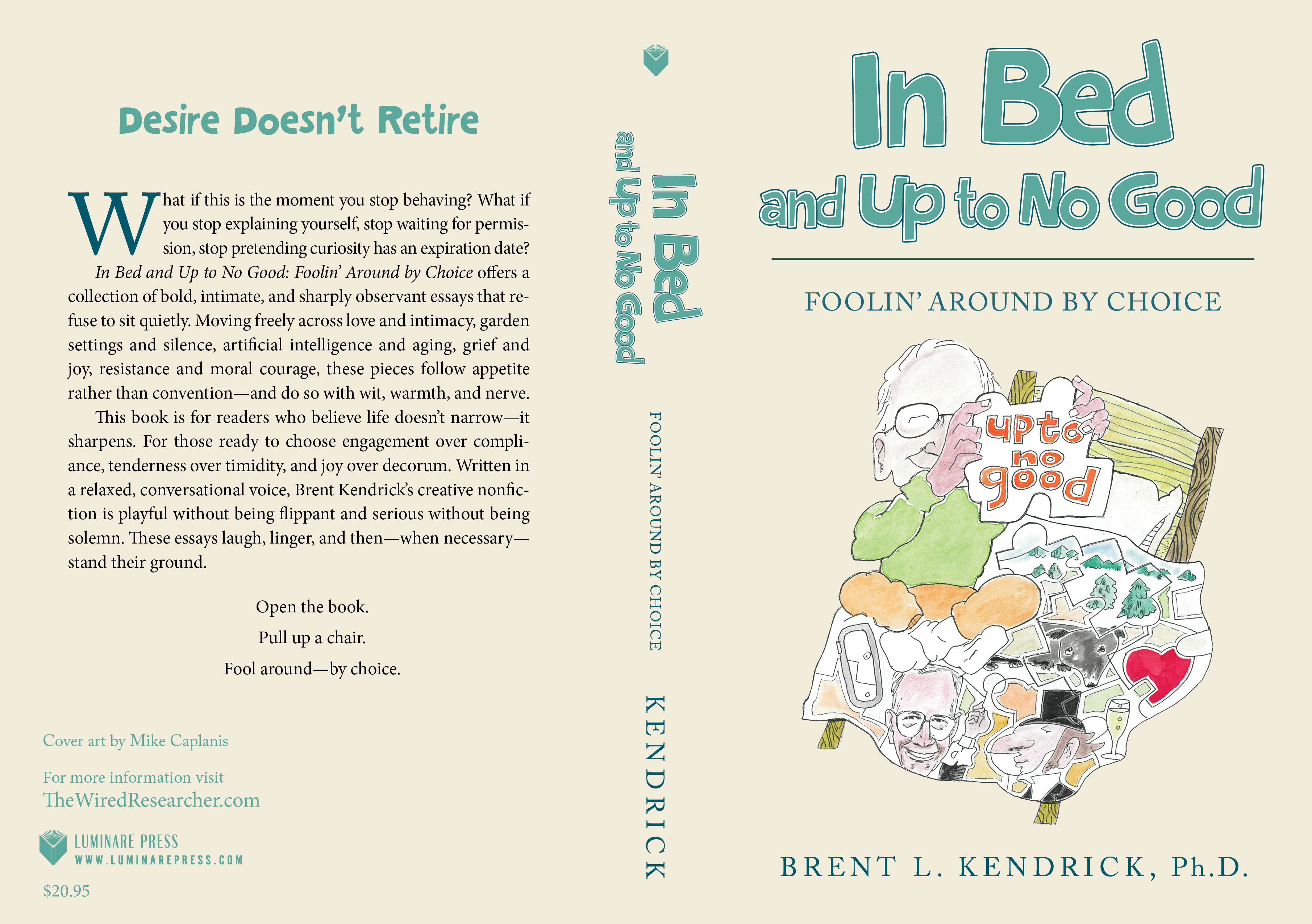
I’m pleased to announce that Up to No Good, the fifth book in The Wired Researcher Series and my fourth In Bed book, is now available.
But before I tell you where to find it, let me tell you why it’s different.
For the past several years, I’ve been foolin’ around in bed. Stop right there! Don’t you dare call the authorities. I’m talking about writing.
The first volume appeared in 2023. Two more followed. Each gathered together a year’s worth of essays from The Wired Researcher, preserving them much as they originally appeared—one after another, week after week, moving steadily forward through time.
There was something honest about that approach. Readers experienced the essays in much the same order that I lived them.
But while assembling this fourth volume, I discovered something that surprised me.
A collection gathers.
A book shapes.
The distinction may sound small, but it changed everything.
For the first time, I stopped thinking primarily about chronology and started thinking about conversation.
● What happens when essays written months apart find themselves side by side?
● What emerges when humor sits next to heartbreak?
● What new meaning appears when an essay about gardening quietly speaks to one about grief, love, aging, democracy, memory, or biscuits?
The more I explored those questions, the more I realized that this volume wanted to become something different.
Not merely a collection.
A book.
A reading experience.
In the introduction, I explain that these essays are grouped “by the questions they worry, the moments they linger over, the emotional weather they share.”
That simple shift transformed the project.
Essays began speaking to one another.
Patterns emerged.
Themes surfaced that I hadn’t fully recognized when writing the individual pieces.
Then something else happened.
Poor Brentford Lee got involved.
Those of you who have followed my blog know Poor Brentford—the mountain philosopher, accidental theologian, occasional dispenser of homespun wisdom, and longtime observer of life’s oddities and wonders.
In earlier volumes, Poor Brentford mostly wandered in and out of individual essays.
This time, he grabbed hold of the entire book.
As the sections took shape, Poor Brentford somehow appointed himself official greeter, introducing each one with a bit of homespun wisdom uniquely his own.
“Most of what saves us wasn’t planned. It just kept growing anyway.”
“Everybody’s handed something they didn’t order. The rest is choice.”
“We were just boxwoods until someone believed we could be part of something beautiful.”
Frankly, I’m not sure I had much say in the matter.
Poor Brentford can be bodacious that way.
The result is that he now wanders throughout the book, standing at the entrance to every section, tipping his hat, offering a thought, and inviting readers to come a little farther along.
In many ways, Poor Brentford became the connective thread that helped transform a collection of essays into a unified reading experience.
Instead of moving week by week through a calendar year, readers move through twelve thematic landscapes:
What Grows, Teaches explores gardens, reinvention, second chances, patience, and grace.
What We Do with What We’re Given examines mishearings, limitations, temptations, acceptance, and the choices that shape a life.
Chosen Ground asks what it means to belong—to a place, to a memory, and ultimately to ourselves.
Those We Carry reflects on the people who continue to live within us long after they are gone.
Plagiarism À La Carte celebrates borrowing, influence, recipes, wit, and the occasional joyful act of making something unmistakably your own.
What We Lean On explores the quiet structures that steady us through uncertainty, solitude, and change.
On Our Own Terms examines aging, authenticity, self-authorship, and the liberating realization that we no longer need permission to be ourselves.
Giving Forward honors educators, mentors, benefactors, and all those who quietly build bridges for others.
Together, One ventures into fascinating territory where human curiosity meets artificial intelligence and asks what happens when we learn alongside the tools we create.
Literary Wanderings follows books, writers, forgotten voices, and the ideas that continue to shape us.
Choosing Love Again explores something I never expected to experience at this stage of life: the extraordinary privilege of falling in love once more.
And finally, When Democracy Falters gathers essays written from the conviction that citizenship is not a spectator sport and that silence carries consequences of its own.
Looking back, I realize that what changed wasn’t merely the arrangement of the essays.
What changed was the way I saw them.
Teaching literature for decades trained me to look beneath the surface, to ask how individual parts contribute to larger meanings. Somewhere along the way, I began applying that same close reading to my own writing.
The result is this book.
Some readers will recognize essays they first encountered on the blog. I hope they do. But I also hope they’ll discover something new in the conversations those essays now have with one another.
Others will be encountering many of these pieces for the first time.
Either way, my hope is that readers will find themselves lingering.
Laughing.
Remembering.
Questioning.
Growing.
Perhaps even falling a little more deeply in love with life itself.
After all, that’s what these essays have been teaching me all along.
In Bed and Up to No Good: Foolin’ Around by Choice is now available through Amazon and Barnes & Noble.
If you’d like to see what happens when a collection becomes a book—and when Poor Brentford appoints himself tour guide—I’d be honored to have you join me for the journey.
And as always, thank you for reading. Without readers, essays are merely conversations waiting to happen.

