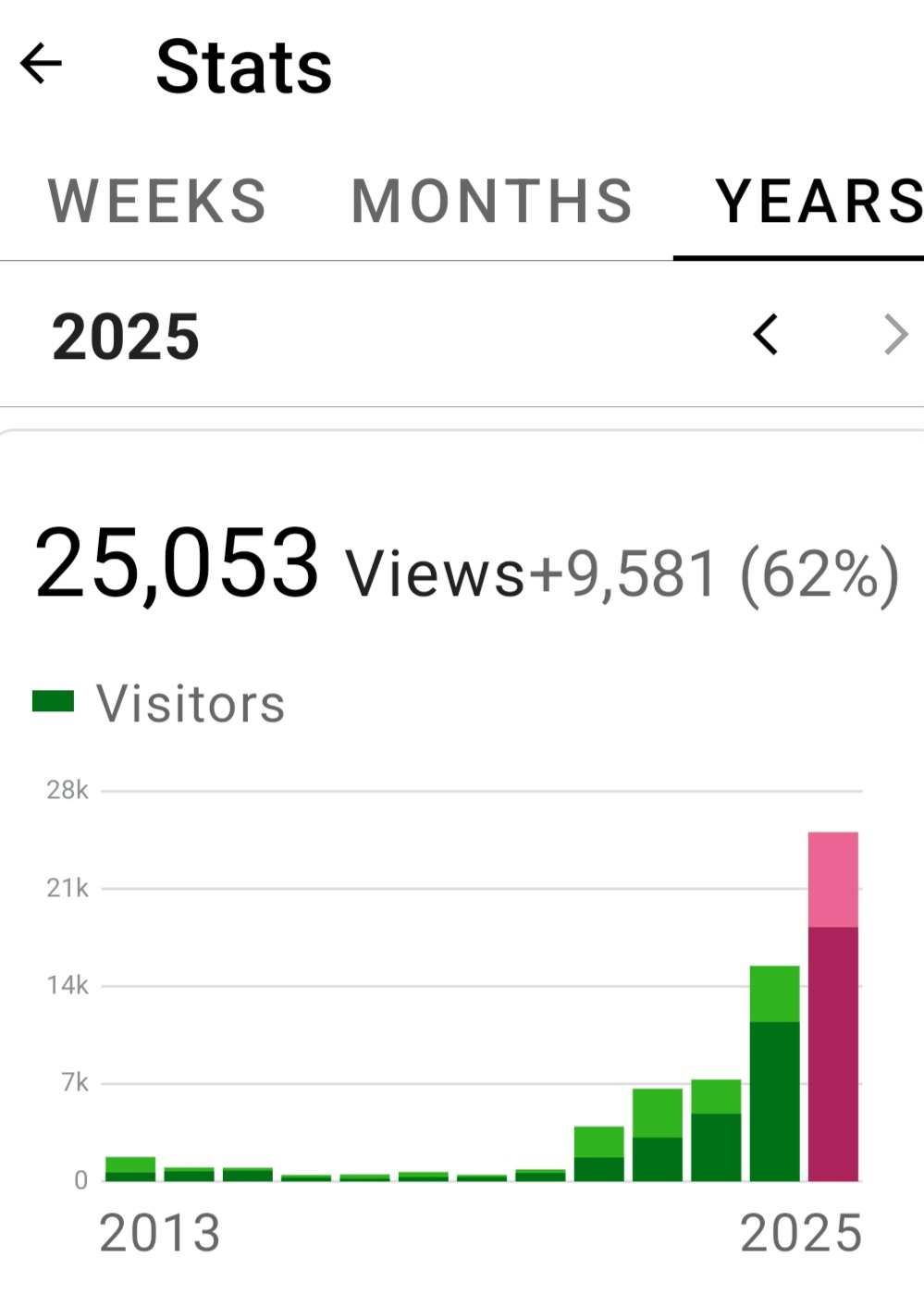
You took me by surprise again this morning. As always, when I awakened, I checked my Fitbit to see how my heart did overnight. Then I checked WordPress to see how my readers were doing.
And there you were. Another thousand views. A quiet jolt to the chart. Numbers climbing when I wasn’t looking.
You’ve been dancing higher and higher since October, when I passed 15,000 and figured I’d reached my high-water mark. I even wrote a piece of thanks back then, thinking I’d said all there was to say. But now here we are—December 11th—and this little corner of the internet has gathered 25,053 views.
I’ve done nothing different. I have no flashy headlines. I have no trending hashtags. I just keep following the same rhythm: writing essays born from memory in a home filled with love. I just keep foolin’ around with words and ideas.
So why now, after all these years?
That question hangs gently in the room with me. It’s not demanding an answer. It’s simply inviting a reflection. Maybe something shifted in the writing. Maybe it’s more expansive. Maybe it’s more lived-in. Maybe it’s a voice carrying a steadier warmth now. Maybe it’s grief that’s softened into grace. Maybe it’s love that arrived not with fanfare, but with a quiet hand stretched out in invitation. Maybe it’s all of those things. Maybe. And add to all those maybes one more. Maybe it’s readers sharing with readers.
Gary, of course, doesn’t ask to be written about. But his presence is here, between the lines, in the patience of a paragraph, the steadiness of tone, the way I’ve learned to let silence do some of the talking.
Ruby, on the other hand, insists on being written about, whether she’s nosing me away from my smartphone or curling up in solidarity as I revise for the twenty-fifth time. She is, as always, the keeper of the tempo, the mistress of the move.
So this isn’t an open letter to public stats. It’s a letter to something deeper. It’s a letter to what it means to keep writing when no one’s watching, and then to wake up and find that someone was.
My essays aren’t meant to dazzle. And I know: they don’t. They’re just small acts of holding up the light, one weekly reflection at a time. The fact that they’re being read, now more than ever, tells me something I didn’t expect: quiet honesty still finds its way.
Thank you, Sudden Surge, for reminding me that patience has its own reward, that consistency is a kind of faith, and that somewhere out there, readers are still pausing to linger with a slow essay from the mountain.
I don’t know what this upturn means, or where it leads. But I do know I’ll keep showing up with my smartphone in hand and love at my side.
“You may have to fight a battle more than once to win it.”
— Margaret Thatcher (1925–2013) British Prime Minister, nicknamed the “Iron Lady” for her fierce persistence.
Swearing is not my thing. But right now—for once, maybe even on a stack of Bibles (to my Mother’s eternal horror)—I’m going to do it anyway. I swear that my daily demons line themselves up every night when I go to bed, watching as I lie there all peaceful like, orchestrating my next-day goals.
I see them out of the corner of my eye, leaning in, peering, looking carefully as I tap, tap my list on my phone.
And you know what? I swear, they’re waiting for me the next morning.
More often than not, they show up as soon as I start my biking, maybe because that’s how I start my day, right after coffee. I know that if I don’t bike then, I won’t bike at all. The first demon arrives before I even lace my shoes. It whispers:
“Why so early? You’ve got other things you need to do first. You can bike later.”
Nice try. But I’m on to that trick. I know that when it comes to biking, later never comes.
Another one comes at me from a different angle.
“Today? You’ve been doing this every day. You need a break. Take the day off.”
“Get behind me, Satan! I’m biking as usual.”
But get this. By mile three, another demon shows up:
“You’ll never finish.”
I keep pedaling, but the demons keep coming. By mile seven, I’m hearing:
“Yeah. Your butt sure is sore. If you keep going, it’s going to be sore as hell tomorrow.”
I keep on going. And so it goes, on and on through all the miles—10, 15, 20—riding against a whole Satanic chorus, chasing me faster and faster and faster.
Fiercely determined. Fiercely persistent. Fiercely anchored. That’s how I win the biking battle. Usually.
The next demon that hounds me is procrastination. Don’t get me wrong—I know better. I know the wisdom about “breaking things down,” about taking the first step, about Ben Franklin’s truth that “little strokes fell great oaks.” But when I’m staring at the big picture, the demon of procrastination is quick to pounce.
It starts yammering:
“It’s too much. You don’t even know where to start. Better put it off until tomorrow. You’ll see it clearer then, rested and fresh.”
And the sly part is—it sounds almost reasonable. That’s how this demon works. It pretends it’s looking out for me. But I know the truth: once I give in, tomorrow becomes the next day, and the next day, and soon the oak is still standing, unscarred.
So I fight. I start small. One tap of the keys, one page, one email sent. A single stroke against the oak.
Fiercely determined. Fiercely persistent. Fiercely anchored. That’s how I win the procrastination battle. Usually.
I have other demons, of course. But they’re far too personal to divulge for all the world to know. I’m not about to share them.
Like the demon that tells me that my writing will never be good enough to be discovered by a magazine or a newspaper syndicate.
Or the demon that mocks long-range planning at my age, reminding me that there’s far more behind me than there will ever be ahead.
And I’m certainly not going to tell you about the demon that wonders what waits on the other side of the great divide—the same divide every one of us will cross, where all have gone before to face the mysteries of beyond forever.
Like I said, they’re way too personal. So I’ll keep them to myself.
But I’ve gotten to the point in my life that my demons don’t embarrass me anymore because I know that to be human is to battle the demons that strive to undo us.
And besides, we all have our demons. You do, too. Some of them may be the same as mine.
Or maybe you have the demon of worry, who shows up right on schedule, carrying a suitcase that never unpacks. The demon of regret, who loves to remind us of choices we can’t un-choose, words we can’t un-say. The demon of loneliness, who doesn’t bother knocking—just slips in and makes himself at home.
Or the demon of disappointment who lingers when the prize you’ve chased turns out to be a shadow.
Or what about weariness, when the weight of the day presses like red Virginia clay, and every step feels heavier than the last.
And then there’s doubt—the slyest demon of them all—always ready with the same question:
“Are you sure you’re enough?”
These aren’t strangers to you or to me or to any of us. They’re regulars. They know the way in. They don’t need an invitation.
I’m fairly certain that I heard someone somewhere right now screaming in disbelief:
“Get real. Those don’t count as demons at all compared to the ones that I’m battling.”
I hear you. I understand. I’ve been blessed because I’ve never had to deal with the demons of addiction—alcohol, drugs, gambling. Or the demons of abuse—physical, emotional, sexual—the kind that scar the body and the soul.
I’ve never faced the demon of homelessness, not knowing where I’d sleep. Or the demon of hunger, not knowing where my next meal would come from.
I’ve been spared the demon of crushing poverty, the one that never lets you breathe free. And I’ve never lived under the demon of war, with its bombs and sirens and losses that can’t be counted.
But it seems to me—and yes, I know my limited experience might make this sound overly simplistic—whatever demon we face, we have to be fiercely determined. We have to be fiercely persistent. We have to be fiercely anchored. That’s how we win our daily battles with whatever demons come after us.
But let me emphasize here one key word that I emphasized earlier. Usually.
Being fiercely determined, being fiercely persistent, and being fiercely anchored enables us to win our battles daily. Usually.
But as we all know, some days we lose the battle. We all do. And when we lose, it stings. The demons strut, they jeer, they claim the day as theirs. They would have us believe that losing once means losing for good.
But they’re wrong.
Because a lost battle is not a lost war. It’s a stumble, not a surrender. And tomorrow—always tomorrow—the fight begins again.
The demons will be there, lined up and waiting, whispering their same old lies. And we’ll be there, too. Fiercely determined. Fiercely persistent. Fiercely anchored. Ready to face them.
We may not win every day. Sometimes, we do. Sometimes, we don’t. But we show up anyway. Because being human has never been about living without demons. It’s about never letting them have the last word.
And in case you’re wondering, let me assure you. They’ll be back. But guess what? We’ll be back—bruised, stubborn, laughing, and still ready to wrestle.
The knock at the door was as gentle as any I had ever heard before, yet it frightened me with its persistence. After all, it was the middle of the night, and I rarely have visitors here on my mountain, and when I do, I anticipate their arrival and meet them in the walkway.
After a while, my curiosity overcame my fear. I went to the kitchen door and opened it. There, not on all fours, but standing as upright and erect as any human I had ever seen was my dog Hazel.
Lit by the spill of the floodlights—like some mythic creature caught mid-transformation—Hazel looked less like a pet and more like a story I hadn’t yet written: fifty-nine pounds of sinewy poise, all confidence and oversized paws planted with purpose. Her coat shimmered with its reddish golden shades of ember and mischief—Husky in spirit, Shepherd in legacy, and wholly herself.
Her tail curled tight; her head slightly tilted—alert, noble, a whisper of the wild. Her ears twitched once as if tuning in to something I would never hear. And her eyes? They saw, as if piercing through the darkness that found me standing there.
She wasn’t waiting. She was watching. And in that moment, so was I—awed by her stillness, her strength, and a quiet reminder of something I had yet to remember.
And, as naturally as anything you would never expect a dog to say, she looked at me:
“I’m just a monkey. I’m a howler.”
Then I awakened. Amused. Grinning. Lying there in bed. Musing. Hazel. Fifteen years of fierce love, muddy pawprints, and conversations that needed no translation, except in dreams.
As I lay there, I realized the dream’s significance. In a way, it was the oldest kind of magic: a name spoken often comes true.
For years and years and years, Hazel’s bark reminded me of a monkey. Not just any monkey—a howler. One of those wild-voiced beings that belt their souls into the sky from treetop pulpits at dawn. Her bark had that same deep, echoing wildness—less a request than a proclamation.
Some dogs bark. Hazel declared.
And so it came to be. I would say to her over and over again:
“You’re just a monkey! You’re a howler.”
She didn’t seem offended. If anything, I think she took it as a compliment. Obviously, Hazel was not a monkey, nor could she become one. Except in my dream.
But here’s the thing:
She became what I had named her.
And that truth deserves repeating:
She became what I had named her.
That dream set me to thinking long and hard about what it means to name.
To Name.
I started wondering when the phrase was first used and in what context. And if you know me as I know you do, you know that I headed off to the Oxford English Dictionary (OED) where I discovered that it was first used in Old English:
“[Hælend] gefregn hine huætd ðe tonoma is? & cuæð to him here tonoma me is, forðon monig we sindon” (Lindisfarne Gospels Mark v. 9).
Right! That doesn’t look like English to you either, does it? Let’s look at the translation.
“[The Savior] asked him, ‘What is your name?’ And he said to him, ‘My name is Legion, for we are many.'”
It’s a well-known moment in the Gospels—Jesus (the Hælend) encountering a man possessed by demons. The phrase “My name is Legion, for we are many” comes from Mark 5:9 (and Luke 8:30), rendered above in Old English.
This is an incredible example of what happens when we name something. The name Legion does far more than identify. It reveals nature, condition, and moral alignment. When Jesus asks for a name, he isn’t just asking for a label—he’s uncloaking the essence of what possesses the man.
Did you catch that? A name reveals essence.
And I ask you–right here, right now, as I am about to do–to start thinking about names swirling around in your head. Maybe the names associated with you: the names that others call you.
As you reflect, let me share with you the significance of the names swirling around in my head.
The Names that Others Called Me.
The first that I remember was not my given name—Brentford Lee. Rather, it was LittleMisterSunshine. My mother gave me that name because—as she loved to tell others, including me–I was born smiling and radiating happiness. Now, 77 years later? Others say that I’m still smiling. Still radiating happiness.
Clearly, my mother saw the essence of who I am and named it.
Or how’s this? My siblings, for as far back as I can remember, had another way of naming me. They always called me different.
“You don’t look like us.
“You don’t talk like us.
“You don’t walk like us.
“You’re different.“
Truth be told, I was different, and I knew it. Ironically and for my own well-being, when they called me different, I leaned into it as compliment rather than condemnation.
It didn’t take me long, however, until I came to feel and understand the word they weren’t naming, the word that others, later, named. Queer. Either way–and even though I continued to see myself as special, a way of looking at myself that would stay with me for a lifetime, even now–it was a label of notquite, a soft-spokenexile and an unspokenache.
Clearly, my siblings and others saw my essence—and named it.
And I ask you—right here, right now, as I am about to do—to think about the names you’ve claimed for yourself. Not the ones others gave you. The ones you whispered into being. The ones that changed how you stood in the world.
As you reflect, let me share with you the significance of the names swirling around in my head.
The Names that I Called Myself.
The first that I remember was when I was in the third grade. Professor. Can you imagine anything more outlandish than that coming from a coal-camp kid in a town with not one professor? I have no idea where I had heard the word or came to know it. But I knew that in order to be a professor–in order to teach in a college or university—I would have to earn the highest degree conferred in my field. I picked English because I believed—no, I knew—that words mattered. Yes, words could wound. I had learned firsthand how they could cut to the soul. But I also knew something else. Words could heal. Words could save. Words could give wings.
I earned my Ph.D. in literature. I became a college professor—”full” no less. And when students called me Dr. Kendrick at the institutions where I taught–the University of South Carolina, the Library of Congress, and Laurel Ridge Community College–in deference to my degree, I always suggested Professor in deference to the earliest name I called myself–the name that captured my essence.
More recently, I call myself Reinventor. I came up with that name at the start of 2023–after my 23-year career at Laurel Ridge. Most folks retire. Not me. I’ve never liked the word—because right there in the middle of retired is tired. Trust me. I ain’t no ways tired. I have more books to write–far more than the five I’ve already published since 2023. I have more life to live than the one I’ve lived. I have more love to give than the love I’ve given. My colleagues and friends may call themselves retired—and that’s fine. But me? I’ll keep saying I’m a reinventor. It’s not just who I am now. It’s who I’m still becoming.
These days, I call myself Writer. I’ve always been one—researching, digging, unraveling stories. But since reinventing myself, being a writer has taken on a new, truer shape. I write in bed every night, publish my blog posts every Monday morning, and every year, I bring forth a new book of creative nonfiction essays, stories that bear my name and my soul.
I’ve branched out, too—seeing through to publication my Unmasking The Humourist: Alexander Gordon’s Lost Essays of Colonial Charleston, South Carolina and immersing myself a two-volume biography of Mary E. Wilkins Freeman, a labor of love and legacy.
Yes, right now, the name I call myself is Writer. It captures the essence of who I am— what I do, what I am becoming, and who I cannot stop being.
As we continue reflecting on the power of names, I ask you—right here, right now, as I am about to do—to think about names that wound others, perhaps forever or perhaps giving them a transformative moment to heal.
The Names that Wound or Heal.
The first that comes to mind is a word in Countee Cullen’s “Incident.” It’s painful—inflicted on an innocent child, standing at the edge of razzle-dazzle wonder.
Once riding in old Baltimore, Heart-filled, head-filled with glee, I saw a Baltimorean Keep looking straight at me.
Now I was eight and very small, And he was no whit bigger, And so I smiled, but he poked out His tongue and called me, “Nigger.”
I saw the whole of Baltimore From May until December: Of all the things that happened there That’s all that I remember.
What the speaker in the poem remembers being called Nigger. One word. It shattered an eight-year-old’s heart—and likely left a lifetime crack.
It’s haunting—how a single word, spoken with cruelty, can eclipse everything else.
I’ve known that kind of eclipse, too. Different.Queer.Faggot.Fag. Words I never asked for—words that crawled in and clung, no matter how often I repeated what my mother had taught me:
“Sticks and stones may break my bones, but words can never hurt me.”
Of course, they hurt, but I rose above the pain, smoothing over my soul like a balm the names that lifted me—Little Mister Sunshine, and the one I whispered in those early, tender years—Professor. But here’s the strange and saving truth: I didn’t start to heal until I explicitly named the sexual dimension of myself. Ironically, I had to declare it publicly before I could begin to claim the healing I didn’t yet realize I needed. I had to say gay—not in a whisper, not in code, but openly. Aloud. Loud. In front of the world.
Gay.
Only then could I begin to gather all the pieces I’d hidden away. The softness. The brilliance. The full shape of who I was—who I had always been. One word. My word. Spoken not with shame, but with quiet certainty. And for the first time, I didn’t flinch. I stood. Proud. With that naming, I finally gave myself permission to shine—fully and fiercely, without apology.
I have one more request–one more “ask” of you–as we grapple with what might just be the most powerful part of naming. I ask you—right here, right now, as I am about to do—what are the names we whisper when we reach for meaning? The names we murmur in awe, in need, in love? The names we give the force that calls us?
The Names We Call the Force that Calls.
Whenever I think that thought–and the older I get, the more often I think it–I recall Bill Gaither’s interview with acclaimed Gospel singer Jessy Dixon–one of my favorites. Gaither was bold and direct as the interview neared its end:
“When your time comes—as it will surely come for each of us—what do you want people to remember about you?”
After a soft pause, the answer came with quiet certainty:
“Tell them I am redeemed.”
In those five words, Jessy Dixon named–and claimed–the essence of his destiny.
Redeemed.
I can’t help but wonder: what name rises up in you when you reach for meaning? God? Creator? Oversoul? Spirit? Light? Love? Source? Mystery?
And in my wonder, I’m mindful that names like those are what we call the ungraspable—the presence that nudges us forward, the light that finds us when we didn’t even know we were lost. We reach for names when we reach for meaning. And whatever we call it—it calls us, too.
Whatever name you use, My Dear Reader— whoever you are, wherever you are:
Say it loud and clear.
Speak it like it matters— because it does.
Speak it like it carries the full weight of your becoming— because it does.
Let the world see the essence of who you are.
Name it— knowing that names have power.
Remember: you are enough— not despite all the names you carry, but because of them.
You are every name you’ve claimed and every name you have yet to whisper into being.
And when the time comes— I hope you’ll speak your name as boldly as I speak mine.
Let others know: their names can never hurt you.
But your name? It roots you deep in everything that matters— your truth, your becoming, your essence.
“Accept—then act. Whatever the present moment contains, accept it as if you had chosen it.”
–Eckhart Tolle (b. 1948). German-born spiritual teacher and author of The Power of Now and A New Earth, whose teachings focus on presence, acceptance, and personal transformation.
A few weeks ago, over cocktails and conversation, my neighbor—an IT guy with a philosophical streak—offered a twist on the old “glass half full or half empty” dilemma. His late wife, Jody, always saw the glass as half-full, but as an engineer, Gary sees it differently:
“Just get a glass that’s the right size for what you’ve got.”
At the time, I nodded politely and filed it under:
“Clever things other people say that may or may not linger in my memory.”
Turns out, I remembered.
A few mornings later—cue ominous music!—my tablet powered up with all the charm of a sulky teenager and promptly informed me that Microsoft had done me the favor of wiping my PowerPoint app into oblivion.
This, mind you, on the eve of speaking to the Mary E. Wilkins Freeman Society—an international gathering of scholars and fellow literary sleuths—about a woman who has occupied both my imagination and my file drawers for over fifty years. The event was titled An Hour with Mary E. Wilkins Freeman and Brent L. Kendrick. The tech test was hours away. I clicked. I reinstalled. I cursed. Nothing. Nada. Zilch.
And then I thought of my neighbor.
“Wrong glass, Brent.”
I hauled my all-in-one PC upstairs to the better WiFi zone, and boom—there it was. Slides intact. Calm restored. Presentation saved.
Turns out, sometimes you don’t need more water. You just need the right-size glass.
Since then, I’ve been thinking more about the right-size-glass concept, and I can think of several other times when I applied it unawares.
There was a time, for example, when I thought my glass had shattered completely. Not cracked—shattered. After Allen died, I wasn’t sure there was any vessel left that could hold what I’d once poured so freely: love, joy, even hope. For a long while, I didn’t try. But healing has its own quiet rhythm, and eventually, I realized I didn’t need the same glass. I just needed one shaped for the life I have now. It took a while, but recently I’ve found one the right size to hold who I’ve become. To hold who I am. Now.
Long before that right-size-glass moment came the time when I first moved to my mountain. I wanted a cabin in the clearing—so I cleared a wide swath of woods to make it so. I cleared far more than I could have imagined, and certainly more than I could realistically manage, especially now at my age. Some days, it feels like my glass is half empty, like I’m falling behind. But the truth is, I just need a different-sized glass. If I choose—as I have chosen—to let some of those cleared areas return to their wild, natural state, I haven’t lost anything. In fact, my glass is now full—full of birdsong and the wisdom of knowing when to stop clearing and simply let things grow.
I think we can apply the “right-size-glass” concept to more than gardening and grief.
Let’s begin with a few low-stakes moments—the ones that test our patience more than our purpose.
● Cooking substitution. Out of buttermilk? Use yogurt and lemon. Different glass. Same outcome.
● Gardening workaround. Tried planting in the wrong spot? Don’t mourn the wilt—move the pot.
● Home décor puzzle. Wardrobe too big for one wall? Move it to a room with a larger wall that showcases all of its Shaker joinery.
Some shifts, though, aren’t minor—they’re wake-up calls. Still, the right-size glass helps.
● Travel plans. Canceled? Money’s tight? Plan a “staycation” with the same sense of purpose.
● Exercise limitations. Can’t run anymore? Try swimming or yoga. Same vitality, different vessel.
● Friendship shift. Someone pulls away? Focus on others who consistently show up.
● Career detours. Passed over for a promotion? Use the freedom to explore a side gig or project with heart.
Or let’s move on up a little higher to some emotional and existential applications.
● Creative droughts. When the writing won’t flow, ask: is it really writer’s block—or just the wrong-shaped glass for the ideas trying to come through?
● Life plan upended. Divorce, retirement, illness—what happens when your “glass” shatters? You pick up what still holds and find a new container for your spirit.
● Shifting beliefs. Formerly held faith, politics, or ideals evolve? Refill your life with what still nourishes—and let go of the brittle framework.
By now, I’m willing to bet you’ve started thinking of your own moments—the ones when you didn’t force what no longer fit, but quietly shifted, adjusted, adapted. Maybe you pivoted. Maybe you paused. Either way, those are the moments that reshape a life.
So, myDear Readers, consider this your open invitation to rethink how you hold disappointment, change, resistance—or anything else that life sets before you. Not by pouring harder into what doesn’t fit, but by choosing a different container altogether.
Here’s to finding the right-size glass—for your spirit, your strength, your joy.
“I tried so hard to do nothing that I accidentally did everything I needed.”
— Poor Brentford Lee (born 1947 and born again today).
Long, long ago I learned to not complain about the weather. For me, it was not a hard lesson to master. I love weather. I love how it arrives unbothered by plans, how it doesn’t ask permission to shift. Rain seeps, sun scorches, wind whispers or howls—all of it a steady reminder that the world turns whether I make a list or not. Seasons don’t hustle. They don’t perform. They simply become what they are, and in that quiet becoming, I find permission to do the same.
And so it is that I often find myself luxuriating in my bathtub–sunny days, rainy days, snowy days. Any day in any weather will do for a good old-fashioned soak. It’s especially good in a real tub like mine. Cast-iron enamel. Please tell me that no others are manufactured. Or if you tell me that they are, please have my smelling salts handy.
Let’s be clear: my bathtub is not clawfoot elegant, but it’s deep enough to pretend. When I slide in, I tell myself that I’m taking time to be. But I know the truth. I’ve turned soaking into an event that I do.
Usually, it’s not much of an event or a do. It doesn’t need to be since I don’t need much. Water. Hot. Always hot. None of this lukewarm nonsense for me. If I’m going to bother drawing a bath, I want it to steam like a sultry Shenandoah Valley morning, rolling up from the tub like fog curling along the Seven Bends of the Shenandoah.
Getting the water that I need is not as straightforward as you might think. No. It’s not. Even though I live on a mountain, I do not draw it from my well. It’s pumped from my deep well and flows through copper pipes indoors, as befits a mountain man with a porcelain tub. And, of course, mine has proper porcelainturns—white handles, chrome collars, and bold Hot and Cold lettering, like a tub straight out of a 1950s film noir. Hot, thank goodness, does bring hot. Cold brings cold. So far, so good. But to adjust the flow, I have to turn both knobs left. Why? Because my plumber, bless his well-meaning hands, apparently installed them backwards. I think. I always thought I turned the hot water knob counterclockwise to turn on the flow and clockwise to turn off the flow. The cold lever is opposite, clockwise to turn on the flow, and counterclockwise to turn it off. It is something like that. Right? Damned if I know anymore. Apparently, I’ve spent years turning one way, only to be met with the smug silence of a faucet that refuses to gush or blush. In this tub, turning is just plumb wrong.
I guess it’s a small metaphor for life, really. Just when you’re sure you’re doing it correctly—hot water flowing, intentions pure, and everything else on course—you realize the universe wants you to turn the other way.
But before I turn the other way and step into the tub–which is, I must warn you, the stage on which I will be soaking, ruminating, and possibly overdoing it for the rest of this essay—I must direct the stage lights toward something magnificent. Close your eyes for a sec. Okay. Now open, look down, and let your eyes feast upon my …
… bubble bath.
Yes. I do use bubble bath. Lord knows it’s not for the scent—though I admit, I have a weakness for sandalwood. And lavender. But let the record show: I allow lavender only in the tub. Nowhere else. A mountain man like me has standards and has to stand by them.
I tell myself that it’s not for the fragrance. It’s for the foam. Even though I reveal to you, MyDearReaders, far more than I should, I want to assure you that I do have a modicum of modesty. A bubble here, a bubble there—tastefully arranged to preserve an illusion of decency. Let’s just say the bubbles know where to gather.
Yep. That’s about all I need for one of my regular soaks. A tub. Hot water. Bubble bath.
But let’s face it. Every once in a blue moon, a mountain man needs a little spice. I’m no exception, even though I confess to being more than a little exceptional.
It’s on those blue-moon occasions that I line up a full production. Then, believe you me. I don’t just take a bath. I stage a bath.
I arrange things just so on my Broadway altar: mug of chamomile tea (because sometimes wine in a stemmed and fluted Baccarat feels like too much doing), one candle (the fancy one that I don’t even own, but begrudgingly burn anyway), and three colognes that I don’t own yet, each vying for my American Express card that I do own. Imagine. Three bottles lined up like contestants on The Bachelor: Mountain-Man Bathroom Edition. It’s far more than cologne drama. It’s downright Shakespearean. It’s The Mountain meets The Globe.
It opens with a cologne smackdown.
Baie 19: (sniffily) “Let’s not pretend I’m not the one Poor Brentford truly wants. I’m rainfall and memory. I’m the whisper of longing on damp skin. I’m practically poetry in a bottle.”
Oud Wood: (with velvet growl) “Poetry’s lovely, dear, but I’m seduction that lingers. I’m cashmere confidence. I’m what Tennessee Gary leans in to smell twice.”
Patchouli Absolu:(swaggering) “Children, please. I’m the heartbeat of the forest and the soul of a vinyl jazz LP. I’m Poor Brentford in full earthy glory. He doesn’t wear me, he becomes me.”
Baie 19: “You smell like a commune.”
Oud Wood:“You smell like wet pebbles.”
Patchouli Absolu: “And you both smell like insecurity.”
ME (overwhelmed on one of my rare occasions when I know how it feels to feel overwhelmed, which is not overwhelmingly often): “You’re all exhausting. No one’s coming over. I’m about to confess my sins to the lefty-tighty, righty loosey faucet and cry into the loofah that I neither have nor want.”
They fall silent. I choose. None. Scentless, I splash around in the tub like a mountain man who moonlights in musicals.
Then what do I do? I lean back, all the way back, and I start confessing. The bubbles gather ’round in all the right places like gossiping parishioners. The faucet stares. Ruby settles nearby with the look of a creature who’s seen this show before, seen it all before, all too often.
I speak.
“Forgive me, tub, for I have over-functioned.”
Drip.
“I said I was going to be. Just be. Instead, look at what I’ve done. I’ve curated a still-life. I folded the towel just so. I fluffed my own ego like it was company. I …”
Drip. Drip.
“… I checked my smartphone. Three times. I told myself I wouldn’t, but what if he texted? What if he sensed my aching soul? Oh, do not ask me, “Who?” You tease. Please be still. Surely, you know exactly who. Surely, you do. You do, don’t you?”
Ruby raises one eye and promptly closes it again. Even she doesn’t buy my shameless shenanigans.
“And yes,” I whisper, “I lit the special candle that I don’t have. The one I said I was saving. For what? For when? Who knows. I guess I was saving it for this moment of low-grade thirst.”
Replies? None. Not one. No, not one single solitary reply. I suspect judgment. Is that what exfoliating looks like? Is that how it feels? Judgment?
I confess one more thing. Doing this being thingy that I’m supposed to be doing ain’t easy. But what’s a mountain man to do when he be soakin’ in a tub?
The very question made some of the less bashful bubbles pop, just as I brought on stage everything that I’ll need to play out my after-the-rain weather act—the one I fully plan on doing.
I’ll harness my weedwhacker around me like medieval armor and march into the yard. Oh. Don’t get alarmed. I’ll don all my clothes so that the scorching sun will not be led into temptation. No doubt the overgrowth in the lower yard and along the rutted road will wave at me and thrash about, like green adversaries, defiant and smug.
And I, in true Don Quixote theatrics at their finest, will tilt my weedwhacker and tackle it all, tackle it all already, as I have tackled it all already so often already in the past.
And I will be noble.
And I will be productive.
And I will be heroic.
And I will let the rains come and the winds blow. Ruby, smarter than I, will bolt for shelter. But I will stay. Drenched. Steaming. And—without even trying—I will finally be. Just… be.
Wet. Ridiculous. Peaceful. Winded. My trusty weedwhacker by my side. But I will have achieved being.
That is the theme, isn’t it, of whatever it is that I’ve got goin’ on in this here tub? Right? The daily tug-of-war between doing and being.
I want to be at peace, but now I’ve done gone and plotted out all the steps and ruined it.
I want to be still, but now I’ve done gone and ended up writing about the stillness.
I want to be the mountain man who soaks in sandalwood and lavender in a porcelain tub with porcelain faucets that can’t figure out which way to turn.
But I also want to be the mountain man who hosts, cooks, flirts, loves, writes books, directs theatrical Broadway tub shows, and maybe gets a text from someone–in Tennessee?–who says, “You smell good—even when you don’t wear cologne, especially when you don’t wear cologne.”
And here, mydearReaders, is the moment when the lights begin to dim ever so faintly, the audience leans in more spellbound than before, and Poor Brentford steps on stage–front and center, fully wrapped in his towel (or is he fully wrapt?)–for his soliloquy that he never dreamt of speaking, let alone rehearsing:
“I tried so hard to do nothing that I accidentally did everything I needed.
“I made peace with three colognes I dreamt about, one candle that I don’t own but burn at both ends anyway, a tub with faulty faucets, and me– myself, just as I am.
“I let the bubbles baptize my busy mind.
“And when I stepped out—wrinkled, radiant, ridiculoos—I realized:
“‘I be fabulous.’
“I also realized: ‘You be fabulous, too.’
“So. Listen up. Go now. Take a soak, with or without bubble bath.
“I may not have gone where I intended to go, but I think I have ended up where I needed to be.”
—Douglas Adams (1952–2001. Best known for his 1979 novel The Hitchhiker’s Guide to the Galaxy, a blend of science fiction, sharp wit, and existential insight.)
Home was just a few miles away–ten at best–and I knew exactly how to get there. I could have done it blindfolded. But as I headed home, I decided to fool around with my Jeep’s navigation system. Just for fun. Just for the hell of it.
● Start ENGINE
● Press NAV
● Select HOME
● Press GO!
Getting home have been easier. I knew that a gentle voice would tell me just what to do and when to do it.
● Please proceed to the highlighted route
● At end of the road, turn left on Hoover Road
● Turn left
I decided to turn right. That’s where my fun began.
● Route recalculated
● At end of the road, turn right
● In one thousand feet turn right
● Take the next right onto I-81 toward Edinburg
No way. I wasn’t about to hop on the Interstate, head south to Edinburg, then backtrack on Rt. 11 toward home.
I ignored the commands. I kept right on going while my Jeep’s voice kept right on trying to change my mind:
● Route recalculation. Make a U-turn where possible.
Eventually, I decided that I needed to stop foolin’ around. It was obvious–and I knew it anyway–that my Jeep’s navigation system would keep redirecting me with each of my wrong turns until I reached home.
But that little joyride made me realize something. I may not be the world’s best when it comes to getting from one place to the next, but I’ve always managed to find my way. Even in the days of printed road maps, I got where I needed to go. I highlighted my routes in yellow so I could see them clearly. And even when I forgot the map, I figured that I’d end up in the right place if I followed the road signs, stayed mindful of cardinal directions, and paid attention to my brain’s compass. It always seemed to work.
These days, with GPS built into every vehicle, I may not always take the shortest route. But I trust my Jeep’s system enough to head off anywhere, barely noticing my surroundings, confident that I’ll get a heads-up when it’s time to turn.
Still, after that bit of foolin’ around, I found myself scratching my head and wondering:
Do I extend that same trust to the systems that guide my life’s journey?
Do you?
In truth, we have navigational systems for nearly everything that matters—health, learning, careers, relationships, aging, and faith. We know the basics. We’ve heard about them. We’ve read about them. We’ve lived long enough to know that they work. But how often do we trust them? How often do we follow their cues with the same confidence that we give a GPS?
Take health, for example. The map isn’t mysterious: eat real food, move your body, sleep enough, manage your stress, hydrate, and laugh once in a while. We’ve seen the studies. We’ve heard it from doctors and mothers and friends who’ve faced wake-up calls. And still, we drive right past the obvious. We skip meals or eat meals that barely qualify as such. We stay up late, ignore symptoms, and postpone appointments. The check engine light flashes, and we figure we’ll deal with it next week.
And then there’s education. Curiosity and critical thinking are clearly marked paths. We’re told to keep learning, keep questioning, and keep evolving. And yet, how many of us treat learning like something that ends with a diploma or a degree? Or reject new ideas because they don’t come from their usual route? We scroll more than we study and nod along more than we inquire. We’d rather feel certain than feel stretched.
When it comes tocareers, we’ve got entire industries built around career navigation—assessments, mentors, and step-by-step plans. We’re advised to find meaning, stay flexible, and avoid burnout. But those signs are easy to ignore when the faster route promises more money, more status, or just less fear. We trade direction for acceleration, only to find we’re speeding toward a place we never meant to go.
Even in relationships, we know the guidance there too: communicate, be honest, show up, listen, say thank you, and forgive. Don’t just speak—connect. Love is not a mystery novel. And yet we sabotage, assume, ghost, or stay silent. We expect relationships to work without maintenance. And when they don’t, we blame the other driver instead of checking the map.
Aging? There’s no avoiding this road. Ask me. I know. But there is a way to travel it. Let go of what no longer fits. Befriend your limits. Gather your joys and carry them with you. The people who age well usually do it with humor, grace, and a willingness to take new roads—even slower ones. But many of us cling to the idea that if we just hit the gas hard enough, we can outrun time. Spoiler alert: we can’t.
And faith—whatever form that takes. Every tradition has its own kind of compass. Not a GPS, no. There’s no turn-by-turn audible voice telling you exactly what to do. But there is the inner voice–the compass that knows, even when the map is blank. And there are coordinates: love, service, awe, humility, and compassion. Yet faith may be one of the hardest to trust because we’re not 100% certain of the destination. At best, we have a hope that we will arrive. In the meantime, faith requires that we keep on moving, even when the road ahead is unknown and sometimes dark.
I scratch my head again, and I wonder: Why is it so easy to trust the voice in our vehicles–and so hard to trust the wisdom we’ve already been given?
I think I know. Maybe it’s because GPS promises certainty. It offers fast answers, smooth roads, and an almost soothing illusion that we are in control. Life doesn’t work that way. Life meanders. It doubles back. It throws in detours, delays, and dead ends. And unlike our vehicles’ voices, the inner systems that help us live well—truly live—don’t shout. They speak softly in hushed tones. They require attention. They assume we’re willing to participate.
Still, I wonder: what if we gave those quiet inner systems the same trust that we give the GPS?
What if we followed the map toward health, education, careers, relationships, aging, and faith—not perfectly, but faithfully? What if, when we made a wrong turn, we heard a calm voice say: Don’t worry. Recalculating. What if we believed it?
Maybe then we’d realize that we were never really lost. We were just rerouted, always headed in the right direction–home.
“When you realize there is nothing lacking, the whole world belongs to you.”
—Lao Tzu (6th century BCE; ancient Chinese philosopher and founder of Taoism. His teachings emphasize harmony with the natural flow of life.)
Ta-TUM. Ta-TUM. Ta-TUM.
With rhythmic precision, it keeps pounding just like my heart.
But it’s not my heart.
It’s my mind, beating to the same rhythm, chanting.
I want. I want. I want.
In my most recent chant, I wanted Francesco Mattano’s famed Peposo, a traditional Tuscan Red Wine Beef Stew. It’s so simple with just a few ingredients: garlic, beef, salt, coarsely ground black pepper, a bouquet garni, and red wine. Simmered for several hours and served up in a well of buttered polenta, it’s the recipe’s clean simplicity that makes it so sinfully delicious.
Altroché! That’s just what I wanted–an entree promising good-to-the-last-bite deliciousness. At the same time, I was well aware that I had leftover pork tenderloin as well as chicken salad.
Once upon a time, I would have rushed off to the grocery store, bought the provisions for Peposo, and celebrated another culinary triumph.
These days, however, even though my wants are as rhythmic as my heart, I am pulling back as I try to reconcile what Iwant with what Ihave.
With food, for example, I wanted Francesco’s stew, but I had pork tenderloin and chicken salad already prepared. The craving was there, but so was a perfectly good meal.
Take books, for example. I’ve dedicated decades of my life to Mary E. Wilkins Freeman, and I’ve amassed a significant collection. But I want to chase after one more obscure letter or document that will make my already rich archive even richer.
What about dating? I want romance—not out of need, but out of hope. My life is full and meaningful, yet I’d love to share it with someone who brings his own fullness—a shared life made richer by both of us.
Even in garden centers, new specimen evergreens whisper, “Take me. Plant me.” But I already have a beautiful Zen-like landscape.
I’m also trying to reconcile what I want with what I need.
I might want dessert, but what I need is a meal that aligns with my health goals. I’m cutting out sweets but keeping nightly Bunnahabhain—for balance!
When it comes to fitness, I might want quick results, but I need consistency not as much in biking as in weight training. At my age–no, at any age–real strength comes from steady, intentional effort.
What about my writing? I want more time to write, but I need to manage my other commitments more wisely so that I have the time I need.
Even in relationships, I want certainty, but I need to let connections unfold naturally—his rhythm, my rhythm, coming into step together.
The more I realize that I don’t need everything I want and that, in reality, I already have what I need, the more I’m discovering new dimensions of freedom.
What had been a constant search for more, whether material things, achievements, or validation, has given way to peace.
What had been a scarcity mindset has become a focus on embracing abundance—not in excess, but in sufficiency.
What had been a notion that having more means being more has yielded to the realization that I’m already enough.
What had been impulse is now intentional as I make choices that nourish me rather than just satisfy my fleeting cravings.
I’m shifting from grasping to gratitude, from craving to contentment.
I’m no longer mistaking wants for purpose. I’m recognizing that growth, connection, and presence matter more.
I’m starting to trust the rhythm of life, just like I trust the rhythm of my own heart.
My heart beats on, steady and sure— not demanding, just existing.
It thumps a lesson that I’m learning: I don’t have to chase every want. What I need is already here—or on its way, arriving in the fullness of time.
“Nature does not hurry, yet everything is accomplished.”
—Lao Tzu (6th century BCE. Founder of Taoism. His teachings focus on harmony with nature, patience in becoming, and the quiet power of letting life unfold in its own time.)
Every time I walked to my Jeep and looked toward the forest’s edge, I chuckled. Smack dab in front of me was a contraption the likes of which I had never seen in my life. Actually, I made it and even gave it a name. The Rust Spa.
“Say whaaaaat?” someone just rasped.
Yes. The Rust Spa. It didn’t take me long to come up with the idea. It works so well that I may apply for a patent and sell it to US Steel, the company that owns the trademark for Corten. You may know it as COR-TEN.
Either way–and rather ironically as you will discover–the COR stands for COrrosion Resistance and the TEN stands for TENsile strength. Corten is well-known for aging gracefully and creating a deep, natural tone as “the thickened oxide forms.” For me, that translates to aging gracefully as plain ole rust appears, and I actually love the deep rich natural brownish-red tone that metal takes on over time.
That’s exactly why I bought myself a Corten planter–for its trademark rusty patina. Of course, I realized when I bought it, that rusting would take time.
I knew it would take a long, long time when the planter arrived, and I opened the box. Behold! Sleek. Clean. Almost smug in its shine. Smooth bare metal, cool to the touch, untouched by time. No rust, no streaks, no signs of surrender. Just raw, industrial silver. It was so pristine it practically glinted in the morning sun, as if daring me to try to change it.
Change it, however, I would, and I knew my resolve from the start. In a bottle, I mixed equal parts of white vinegar and hydrogen peroxide with one tablespoon of salt per cup of liquid. Then I positioned the Corten planter on a stump near the forest’s edge, and every three hours or so, I sprayed it evenly like a soft mist of time.
After just a few applications, the raw steel started to shift—deep ochre streaks rippled down the surface, gathering in drips and blooms that caught the light like burnished velvet. The edges darkened, the face mottled, and the rust arrived quietly.
But I was eager for a little more fanfare. In that moment–and let history take note–I came up with the idea that will ensure my infamy: The Rust Spa. I wanted to speed up the alchemy. Easy peasy. I misted the planter with my magic spray of time. I put it inside a black yard bag to trap heat and moisture, both ideal for rust formation. Then, to keep it all in place, I inverted the delivery box and placed it on top. Voila! The Rust Spa.
The Rust Spa worked its quiet magic. When I disrobed the planter, it sat proudly on its stump throne, no longer silver and self-conscious, but cloaked in a deep, burnished rust. Its warm, mottled patina caught the light in uneven streaks, each drip and blush a quiet testament to time, to weather, to letting go. It no longer shouted; it hummed. And in that stillness, it held a beauty—neither flashy nor fresh but seasoned and settled. With a coat of boiled linseed oil, I sealed the patina in place, locking in that rich, rusty finish like a photograph of time itself.
Now, locked in time, it graces my deck in the middle of a rustic, wrought-iron table with stone top.
It’s there in all my comings and goings, and every time I cast admiring glances in its direction, I cast backward glances to my own life, to all the times when I wished to be older so that I could experience sooner all the things that I would experience later on at the appointed time.
When I was eleven and twelve, I was eager to be a teenager, so I could do the “cool stuff.” Looking back, I’m not certain what the “cool stuff” was. We didn’t have a car. We didn’t have a telephone. We had a TV, but why would I stay up late? For what? As for choices, I was known for making my own and for making them my way. Still, I wanted to fast forward my life. I wanted my own Rust Spa.
After I reached my teenage years, I was eager to be sixteen. Even though we didn’t have a family car, my sister and her husband lived next door. Judy taught me how to drive, and I thought that I had arrived when I got my driver’s license. I’m not sure why. I suppose I dreamt of driving off into the sunset with the gay date that I didn’t have in the Chevy that I didn’t own. Still, I wanted to fast forward my life. I wanted my own Rust Spa.
Then, of course, I was so eager to be eighteen, so I could get away from all the limitations of my home, my town, and my place. I did. I went to college in fast pursuit of me, myself, more authentic than the one I wasn’t really able to be in my home, my town, and my place. How ironic that I always went back on holidays and breaks. Still, I wanted to fast forward my life. I wanted my own Rust Spa.
With my degree in hand, I was eager to start climbing the rungs of my career ladder. That’s just what I did, and it ended up being a twofer. I landed a position at The Library of Congress, at home in the place with all of the books. And I found myself living on Capitol Hill, at home with me as a gay guy, realizing that I wasn’t alone. Still, I wanted to fast forward my life to a place where I could learn more. I wanted my own Rust Spa.
The place turned out to be the University of South Carolina in Columbia, where I earned my doctor’s degree in philosophy and became an expert in American Literature, British Literature, Handpress Bibliography, and, more important, where I learned that an education softens character and keeps it from being cruel. Still, I wanted to fast forward my life to a place where I had been before: home. I wanted my own Rust Spa.
I circled back home to DC and the Library of Congress. A place of emotional grounding where I felt whole, safe, and—authentic. A place where I sensed spiritual and intellectual belonging. A place where I could elevate self-acceptance from fleeting to permanent. A place where I could wrap my arms around all with all that my mother taught me as a child about diversity, equity, and inclusion and, at the same time, widen my embrace to include gender identity and sexual orientation. A place where, through the power of my pen, I soared to heights higher than I ever dreamt that words could fly. Still, I was eager to be what I had dreamt of being since the third grade: a college English professor. I wanted my own Rust Spa.
Laurel Ridge Community College opened the door, and the dream was fulfilled. Imagine! Me–a professor. A desire to stretch my students helped me stand on tiptoe looking at the bright futures of more than 7,000 students for twenty-three years. And beyond fulfilling the professional dream was realizing another one. Falling in love and exchanging wedding rings. Two men living their lives openly. Proud. Explanations? None. The happiness of our twenty-year love outlives Allen’s unexpected death. Still, I was eager to write my final chapters. I wanted my own Rust Spa.
I’m writing them now as one more part of Reinvention. Ask all who know me. I did not reTIRE because I ain’t no ways tired. In fact, I’ve been reinventing myself forever, with every twist and turn of my journey. This most recent started in 2023, and it’s turning out to be one of the most creative and productive times of my life. Five published books with others in progress. Speaking engagements several times a year, including a few that showcase not only my hopes for AI to save us from ourselves but also my hopes for online dating to spirit another Mr. Right my way so that we can co-author the closing chapters together–his, mine, ours.
And here’s where I start to chuckle again. My Corten planter had absolutely nothing to do with achieving its exquisite and inexplicable patina. I did it by speeding up the process in my Rust Spa. I kept applying my mist of time until it achieved the look that I wanted. Then, I sealed it for all eternity.
And so it is with me. Despite all the times down through the years when I wished to be older so that I could experience sooner all the things that I would experience later on at the appointed time, I could do little more than wish and dream.
In reality, I had no more control over achieving my aged patina than my planter had. It’s been a journey filled with yearnings. To arrive. To become.
In reality, every time I was eager to be “somewhere next,” I had to wait on time to take me there.
In reality, I can no more see my finish than my planter can see its.
Yet I know that it’s seasoned.
Yet I know that it’s settled.
Yet I know that it’s not finished.
Still, of this much I am certain. When the appointed time comes, soft and magical mists will seal in place patinaed perfection.
“We were just boxwoods until someone believed we could be part of something beautiful.”
–— Anonymous. Possibly the shy one in the corner.
Ten pots of BuxusMicrophylla, or, as I prefer saying in plain English, Little Missy boxwoods—five per row, glossy green and neatly packed—sit patiently in the open bed of an Army Green Jeep Gladiator. It’s the last Saturday in March, early morning, overcast, but already brushing up against seventy degrees. The air hums with quiet possibility. The gravel drive crunches underfoot, the hills beyond still bare-limbed and watching. The day is waiting, hopeful. So are the boxwoods—waiting, hopeful, wondering—ready to take root in the earth but not yet knowing where.
One other player in this little drama unfolding before us is waiting–hopeful and wondering, too. That would be me. It’s been two weeks since I bought the boxwoods and asked Woodstock Gardens to hold them for me. I had been eyeing the weather forecast, and when I saw that Saturday’s temp would soar to 83°, I knew that the time had arrived for me and the Little Missy boxwoods to perform.
I knew where I wanted to plant them: along a stepped, stone pathway with a wide expanse of gardening space reaching out to the rock wall above that defines the walkway to my kitchen. Down through the years, lots of perennials have flourished there, mainly hardy bananas and lilies. But this past winter, I decided that small, evergreen patches would soften the stones and brighten the landscape year-round.
I expected putting in the Little Missy boxwoods to be straightforward. Position in place. Dig the holes. Tease the tangled root balls. Cover with topsoil. Water. Mulch. Those expectations defined my day, making me confident that I would move on to reclaiming the peony bed in the lower yard by early afternoon.
And so it would have been, I suspect, had I not decided to adjust a rock here and there with an eye toward little more than leveling them as they once were. I knew from the start that leveling one rock would lead to three to five and on and on. But what I didn’t expect was that the rocks would become my focus—not as a distraction from planting, but as a quiet joy, inviting me to sit and let them show me where they wanted to be. As I moved the rocks, the soil spoke to a past that I had created down through the years, with a fierce determination to turn mountain clay into fertile loam.
And there I sat with nowhere that I had to go and with nothing that I had to do other than sit right there, centered in nothing yet in everything.
I glanced at my Fitbit and realized that I would be a 1pm peony-bed no-show. But that didn’t matter. I had spaced my boxwoods exactly where I wanted them to begin with, but now they were framed by rocks whose voice I had heeded. I knew in that moment that this is the way to plant boxwoods.
I could brush this aside just as readily as I cradled the soil carefully around each boxwood.
But I won’t—because this wasn’t just a moment in the garden. It was a quiet revelation.
The stillness of that moment—just me, the rocks, the soil, and the Little Missy boxwoods—stirred something I hadn’t expected. It reminded me of another time I resisted the urge to rush. A time when I could have taken the more efficient path, but chose instead the one that felt truer, even if slower.
Years ago, colleagues and friends encouraged me to publish a selected edition of letters by Mary E. Wilkins Freeman. “It’ll be faster,” they said. “Get it out there. Choose the best, the most representative.” But I couldn’t. I didn’t want to curate a highlight reel. I wanted to listen to her whole voice—every quiet, overlooked, handwritten and typed syllable of it. “If not me, who? If not now, when?”–I mused.
And so, I kept going. Year after year. Archives and attics. Libraries and ledgers. It took a decade, but in the end, The Infant Sphinx: Collected Letters of Mary E. Wilkins Freeman bore an honest title and held honest content. Collected. 585 letters. All. No stone unturned.
What mattered as much as the scholarship was the joy of the journey. The small discoveries. The forgotten details. The moments when her voice, long quiet, seemed to rise again from the page, breathing life into a history nearly lost. Just like those rocks, just like that soil—I had to be still, to listen, to let her show me where she wanted to be.
Years later, my students came along. In my online classes, I interacted with each class as a whole, and with each student as they turned in their work. But I always made it a point to reach out to students who didn’t submit an assignment or who seemed to be slipping away. My messages weren’t elaborate—just a quick, casual “checking in with you.” I never knew where those simple interventions might lead.
More than once, a student replied to say they were struggling—juggling work, family, illness, or grief—and that my short note had stopped them from dropping the course altogether. From giving up.
Those became some of my most memorable teaching moments. I hadn’t said anything profound. I had simply shown up. And somehow, I had rolled away a small stone of darkness and doubt so that a student could glimpse light—and maybe even hope.
In each of these moments, I was doing what didn’t have to be done. No one would have faulted me for skipping a few rocks, publishing a selection of letters, or letting a silent student drift away. But something in me paused. Listened. Chose the slower path. Not because I had to—but because I could. If not me, who? If not now, when?
Maybe that’s the deeper truth. Not every action we take has to change the world. But every time we pause and ask If not me, who?If not now, when?—when we do the thing that doesn’t have to be done—we create the conditions where light can get in. Where roots can reach deeper. Where someone, or something, can grow.
It could be something as simple as picking up the phone to call someone who’s been on your mind. Or checking in on a neighbor whose curtains haven’t opened in days. It might be stopping to thank the cashier who’s clearly having a rough shift. Or finally taking the time to write that note of encouragement, apology, or love.
It could mean speaking up when a voice needs backing. Or standing back to let someone else shine. It might be mentoring a colleague, even when your plate is full. Or walking away from a quick fix to do something the right way, even if no one will notice.
It could be choosing kindness when sarcasm’s easier. Planting hope where cynicism wants to take root. Offering presence when no solution is in sight.
These aren’t dramatic acts. They’re just pauses. Moments when we choose to show up with care. To ask ourselves, If not me, who? If not now, when? And then to listen for the answer.
It’s not about doing more. It’s about doing what matters. Trusting that presence—not perfection—is what carries us forward. And knowing that when we show up, even quietly, the outcome will almost always be better, more beautiful, and far more rewarding.
“Tell me, what is it you plan to do with your one wild and precious life?
—Mary Oliver (1935–2019; American poet celebrated for her keen observations of nature, the human spirit, and the connection between the two. Oliver’s poetry encourages readers to engage deeply with the world around them and to embrace life’s moments with curiosity and intention.)
Crunchy fried chicken, its golden-brown crust crackling with every bite. Check. Pimento cheese potato salad, creamy and tangy, with just enough bite to earn nods of approval. Check. Green beans simmered long and slow, tender and rich with the deep, smoky whisper of a ham hock. Check. Sliced tomatoes, their sun-ripened juices glistening under a light sprinkle of salt. Check. Peach pie cooling on the counter, its buttery crust cradling syrupy, sun-warmed fruit, promising the perfect sweet finish. Check.
Dinner was falling into shape, as country as country could be—homey, solid, the kind of meal that settles deep and satisfies. Except I hadn’t made my sourdough biscuits. And it’s those damned biscuits that caused the problem.
Easy peasy. Sourdough discard. Flour. Butter. Milk. Salt. It’s hard to imagine that such a modest assemblage could rise up to become so flaky and tender, hundreds of layers as light and lofty as billowy clouds. But that always happens, in record time.
Get this. I had all the ingredients lined up, waiting for the gentle touch of my deft hands to spring into action. But with my measure mid-air, I stopped in a heated exchange of self-talk:
“I don’t want to bother.”
“Come on. They only take ten minutes.”
“But everything else is done. Why mess up the kitchen now?”
“Biscuits. You always make biscuits.”
“Not tonight.”
“Come on. Just mix the dough.”
“No.”
“You’ll regret it.”
“No. I won’t.”
I set the measuring cup down, exhaled hard, walked away, and floured one up to “I don’t want to bother.”
I’d like to think that ended my self-talk on that topic. It did, for a while. After all, with a meal that was a culinary triumph by anyone’s standards, who needs biscuits?
But here’s the thing. The next day, those biscuits got on my case. In reality, it wasn’t the biscuits. It couldn’t have been since I didn’t make them. It was the underlying reason for not making them that started eating away at me:
“I don’t want to bother.”
I mean, let’s face it. I could have said any number of things:
“I don’t want to.”
“I’m tired. I need a break.”
“With a spread like that, who needs biscuits?”
I didn’t say any of those things because they just weren’t true. My truth was what I had told myself:
“I don’t want to bother.”
Bother. That’s the word that stuck in my craw. Bother—a term that’s been around since at least 1842, when someone first wrote, “We can’t do it at all, we can’t be bothered.” And here I was, almost two centuries later, falling into the same trap.
Realistically, one single utterance should be no cause for alarm. Right? I’m not so certain.
What if it moved from biscuits to other areas of my life?
What about brushing Ruby, my best dog ever? It would be easier to let it slide.
What about publishing my blog posts, week after week after week? It would be a lot easier to skip a week here, there, forever.
What about pushing through with my daily biking routine? It would be a lot easier to bike fewer miles every day or to skip a day now and then.
What about finishing a major research project? It would be a lot easier to put it aside.
Luckily, I haven’t allowed “I don’t want to bother” to prevail. And look at the results.
I have a well-groomed faithful companion, Ruby. I have a blog with a track record for being published every Monday morning before seven just as regularly as clockwork. I bike 15-20 miles every day, seven days a week, knowing that it never gets easier. I just solved one of America’s greatest literary mysteries–Unmasking The Humourist: Alexander Gordon’s Lost Essays of Colonial Charleston, South Carolina. The Humourist’s incisive voice will now be heard once more.
I hope, especially as I age, that I will never let “I don’t want to bother” prevail. Here’s why.
It seems to me that the more we avoid doing things, the smaller our world becomes. What starts as skipping small inconveniences—like making biscuits or brushing the dog—can gradually turn into avoiding new experiences, opportunities, and relationships. The mindset can shift from “I don’t want to bother” to the even more passive “I can’t be bothered.”
It seems to me that the best experiences in life often require an extra push—whether in personal growth, relationships, or creativity. Habitual avoidance means fewer “What if?” moments that lead to breakthroughs or unexpected joys. Sometimes we find ourselves in a rut, not because we lack talent, intelligence, or resources, but simply because we repeatedly choose the path of least resistance.
It seems to me that friendships and family connections need tending. If “I don’t want to bother” becomes the default, relationships slowly fade through neglect. This can lead to isolation, where we wake up one day and realize we haven’t had a meaningful conversation in weeks or months.
It seems to me that small decisions accumulate. If we regularly skip writing, gardening, dating, or learning new things, we might later look back and wonder, “What did I do with all that time?”
It seems to me that the difference between people who feel satisfied with life and those who feel unfulfilled often comes down to these small moments of effort—choosing to bother when it counts.
Believe me. The next time I serve up a meal like that—or any meal, for that matter—I won’t hesitate. I’ll bother.

 The Wired Researcher