
“The writer who goes hunting ideas too aggressively usually returns with nothing but metaphors and poison ivy.” — Poor Brentford Lee. Reluctant naturalist and persistent thorn in his writerly side since 1947.
“Phooey!”
I swear on a stack of books yet to be written that’s exactly what Poor Brentford said.
And get this. He had the nerve to say it smack dab in the middle of a conversation with Gary while I was explaining that maybe, just maybe, I’d come up with something to write about while gardening.
“It’s not easy coming up with all these blog ideas.”
“But you seem to have more ideas than there are days.”
“I don’t know about that, but I came up with one right now. You’ll see.”
I wouldn’t be the first writer, of course, looking for something to write about.
I guess, truth be told, we all go hunting for material.
And precisely at that thought I heard:
“Phooey!”
Luckily, Gary did not hear Poor Brentford who was just getting started.
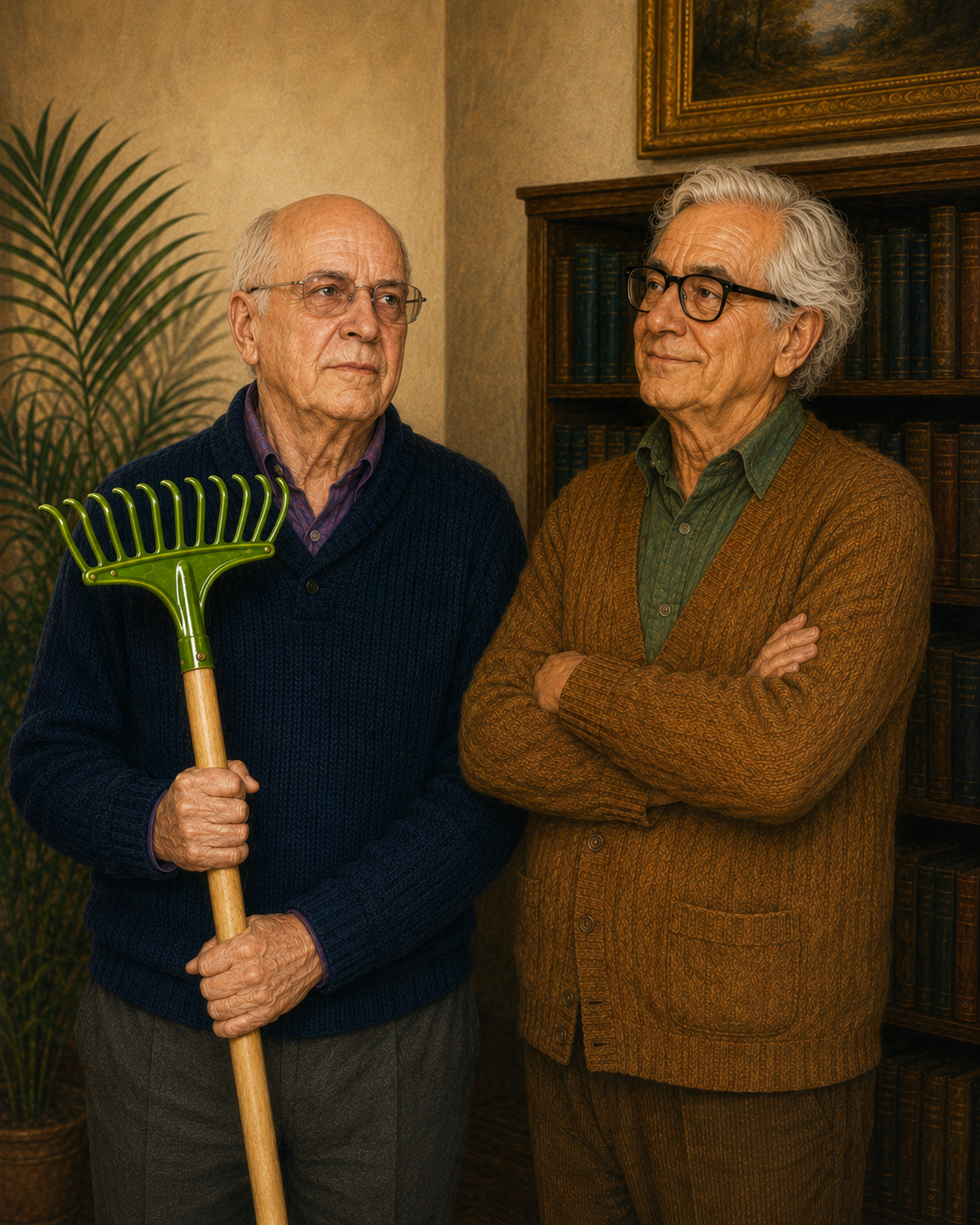
“It goes without saying that you’ll start your catalogue of examples with your Lady.”
“Of course I will. Mary E. Wilkins Freeman was notorious for writing about the people and happenings where she lived. And who, pray tell, knows that better than I?”
“Oh, Lord,” Poor Brentford moaned. “Must I listen one more time to your recitation of local influences in her Pembroke, People of Our Neighborhood, The Debtor …”
“Stop it. Stop it right there. That’s not fair. You know fully well that I don’t think I’ve ever said such a thing about those novels, but I could. She did.”
“What, then, were you going to corner me with?”
“Well, I was simply going to say that Freeman owned up to her literary heists.”
“Right. Sure, she did. Like she owned up to being ten years younger than she really was.”
Poor Brentford, I could tell, was a little more cantankerous than usual, so I decided to shut him up with proof.
“Here’s what she wrote a friend, and I quote, word for word: ‘Monday afternoon, I went a-hunting material too: We went to an old lady’s birthday-party. But …’:
He interrupted me mid-sentence.
“I’ve heard it before. Heard it all before, word by word: ‘… all I saw worth writing about there was a poor old dog who had been chained thirteen years, because he bit a man once, in his puppy-hood.'”
Poor Brentford was right, of course. I’ve written often about that poor puppy and how Freeman gave him a new life as Caesar in her “A New England Nun,” unaware perhaps that his resurrection in that story was linked inextricably and forever to sexual repression.
But was he kind enough to let me do it one more time? Of course not.
“You need to get new examples that will grab your readers’ attention the way that poor puppy grabbed Freeman’s heart.”
Before I could agree or disagree or even ask what writers he had in mind, he gave me a litany that lasted so long I needed a fresh shave. And get this. He had them all neatly organized by categories. It was disgusting. I mean he started off with the obvious, writers like Freeman who really did go looking. The way Henry David Thoreau did in Walden. Or Hemingway as he chased wars and bullfights and deep-sea fishing. Or Joan Didion’s notebooks capturing her fleeting impressions. He even had a list of counterparts across the Pond but before he could bless me with Dickens and his kith and kin, he lost his train of thought and started telling me about writers who made use of strange incidents.
● Frankenstein grew out of a ghost-story contest during a rainy vacation.
● Alice’s Adventures in Wonderland began as an improvised story told to amuse a child on a boat ride.
● The Metamorphosis reportedly sprang from the absurd question: what if a man woke up as an insect?
● The Strange Case of Dr Jekyll and Mr. Hyde was inspired by a dream.
I listened attentively, storing up those examples with every intent to use them in something or other one day or another, but I stood up and objected vehemently when he had the nerve to expect me to follow along with his discussion of the intertextual path that some writers had taken as they wrote famous works based on other folks’ famous works. Ulysses parallels The Odyssey. Rosencrantz and Guildenstern Are Dead as a spin off from Hamlet. I had heard enough. More than enough.
“All right, Poor Brentford. Let’s make a truce. Let’s sign a pact. Let’s forget that I ever mentioned my hope of finding a blog idea to write about.”
I paused. He paused. We stared at one another.
“If you do, you’ll be sorry.”
“It won’t be the first time, I’m sure. But if you’ll excuse me, I have to garden so that I’ll find something to write about.”
“You’re wasting your time. When’s the last time that you ever went looking for an idea and found one?”
I started to reply, but he cut me short.
“Did it ever occur to you that you’ve got this writerly thing of yours all reversed?”
“Thing? Writerly thing?” Spit it out. What’s your point?”
“My point,” Poor Brentford said, with the air of a man who has been waiting his entire existence to say exactly this, “is that you didn’t find your ideas. Your ideas found you.”
I opened my mouth.
“Don’t.”
I closed it.
“Take your Lady. Do you honestly believe you went looking for Mary E. Wilkins Freeman? Or did she reach up out of some footnote or bibliography and grab you by the collar in 1973 and simply refuse to let go? Because last time I checked, she still hasn’t.”
I said nothing, which, as Poor Brentford knows perfectly well, is as good as an admission.
“More than fifty years, Brent. Fifty years she has had you. And you have the audacity—the sheer pomposity—to sit there and tell Gary you went looking for something to write about while gardening. How generous of you. How magnanimous. How utterly beside the point.“
“And then there’s Alexander Gordon.”
He said it quietly, exactly the way Poor Brentford delivers his most devastating blows.
“You didn’t find The Humourist. The Humourist found you. He waited. Two hundred and nineteen years, give or take. Sitting in the only complete run of the South-Carolina Gazette in existence—survived earthquakes, fires, wars, and hurricanes, mind you—and then reached up out of a footnote in 1973 and grabbed a graduate student by the collar. And here you are, fifty-some years later, still in his grip. Still writing. Still talking about him at libraries.”
He paused for effect. He has always been insufferably good at pauses.
“They found you, Brent. Both of them. In the same year, no less. And they have never once seen fit to release you. How breathtakingly, magnificently pompous to think that you in your infinite wisdom found them.“
I sat down, flummoxed.
“What on earth am I supposed to do with that? I don’t have all the time in the world, you know, to come up with ideas.”
“Maybe,” Poor Brentford said, “that’s the whole point of this writerly thing I’m trying to help you understand.”
He settled back with an expression I hadn’t seen before. Not smug. Not cantankerous. Almost kind.
“Ideas,” he said, “are not sitting around waiting for you to come find them. They are, if you’ll permit me, already in motion. Floating. Drifting. Looking for the right home. The right mind. The right heart. They pass over some people entirely–perfectly nice people, mind you, and perfectly intelligent people–and move on. Then they find someone like you and they simply settle. Take up residence. Refuse to leave.”
I started to say something.
“Freeman settled in 1973. Gordon settled in 1973. The same year, Brent. Do you think that was your doing?”
I did not.
“Ideas are not hunted. They are not chased down like a rabbit hopping through your briary ravine.”
He folded his hands with great finality.
“They arrive. Always have. Always will. The only question that matters—the only question that ever has—is whether the writer is the kind of person who opens the door and makes a home.”

