Poor Brentford Cleans the Wax Out of His Ears and Finds Meaning in the Noise and Music of Mistakes


As 2025 comes to its close, Poor Brentford makes his last appearance of the year, offering a final benedictus and inviting us all to lean in, mishear boldly,
and sing in broken harmony “One Lane Zion.”
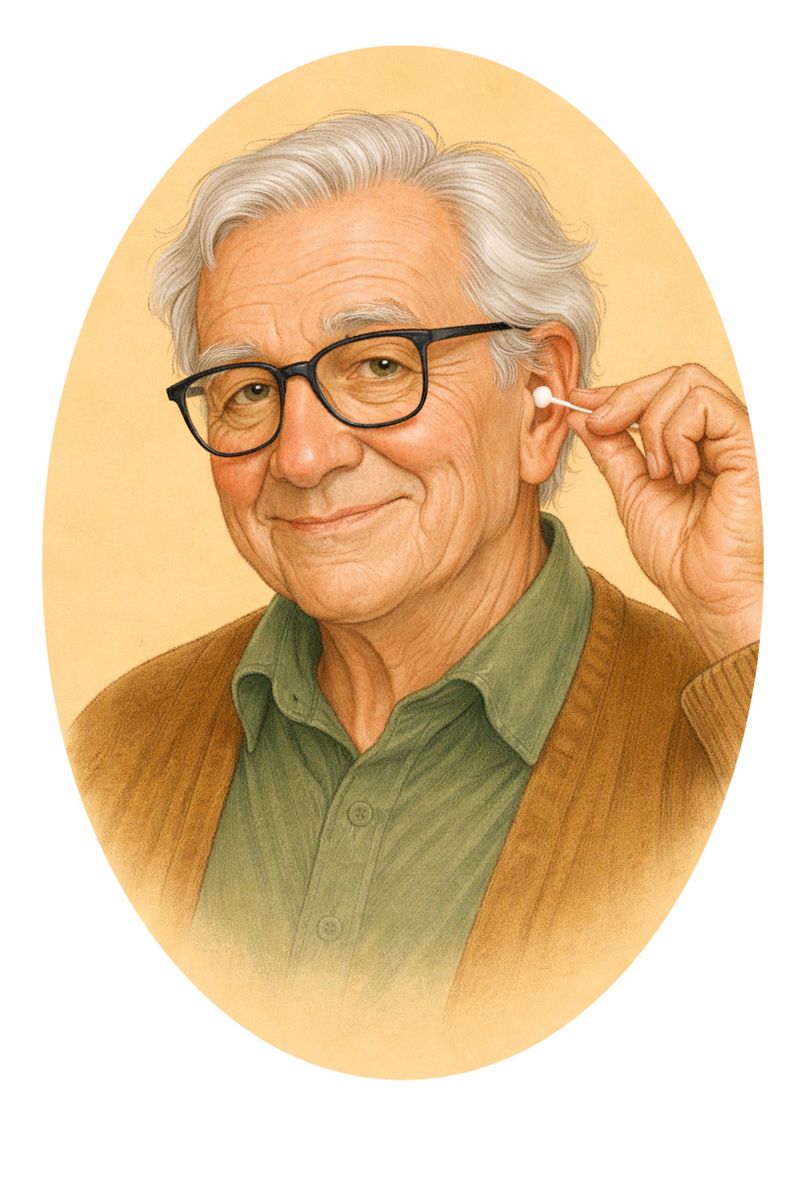

This is a true story. A confession, if you will. It’s the kind my mother used to make before coffee, after coffee, or frankly whenever the mood struck her to entertain herself and whoever else happened to be within earshot.

She’d sit at the Formica-topped, chrome-legged kitchen table, coffee cup in hand, her pinky raised just so, and say, perfectly straight-faced:

“When the Primitive Baptists sang ‘On Him I Can Depend,’ I was absolutely certain they were singing ‘On Him I candy pin.’”

Then she’d pause—just long enough to make you look up—and add:

“I always pictured the Lord wearing a peppermint-striped robe, a nice big bow, and candy pinned all over Him. It was a sweet, sweet comfort to my soul.”

That was my mother. She could turn blasphemy into blessing before breakfast.

I guess mishearing runs in the family. Maybe it all started with her. As I grew older and older, I swear on a stack of leather britches that everyone all over our little coal camp was mishearing things but making sense of them anyhow. Somehow.

When I was little, I guess I always thought everyone heard what I heard. I mean when our little congregation would launch into that grand old harvest hymn, I was sure as heck they were “Bringing in the sheep.” What else could they be bringing in? Say what? Sheaves? No way. We had sheep in the hollers of West Virginia. I had seen one or two, and I was certain that someone needed to do something with them especially when the cold Sheep’s Rain started to fall. It made perfect theological sense to me that the faithful would gather their flocks and present them to the Almighty before supper, or some hungry days, maybe even for supper.

But Lord have mercy. Wait ’til I tell you what my oldest sister swore she heard when the church sang “Oh, How I Love that Man of Galilee.” To this very day, she swears she thought they were praising Galileo. That works, too. Love is love, after all. I just hope she didn’t think that Jesus had a telescope and a strong interest in planetary motion. He didn’t, did He?

So there we were—a family of devout mishearers, certain our Creator managed sheep and celestial calculations all before breakfast.

Our unpainted cinderblock church sat in a dirt field without a sign or even a sign of grass right at the bottom of Pool Room Hill and by the time a hymn rhapsodied its way out the solitary window that someone painted-shut, it was anybody’s guess what the congregation was singing. The hymnals were worn thin, the pianist kept on keeping on with that clickety-clackety thing she did on the ivories, and half the folks sang from memory or eyesight blurred by coal dust and exhaustion.

Here’s an example as good as plenty. “I’ll Fly Away.” Poor Brentford’s dad who didn’t darken a church door in those days, swore what he heard it come up from below was loud and clear:

“I’ll Find a Way.”

Wouldn’t that make perfect sense for a coal miner like him to hear lyrics like that, especially in a coal camp where folks never expected wings anywhere except outside in the chicken coop or inside on a dinner plate. All they hoped for was a break in the company line, a way to keep supper on the table, and the roof patched till payday. Finding a way was its own kind of flight. And Lord knows he found a way.

But then came “In the Sweet By and By,” which Poor Brentford swore was “In the Sweet Buy and Buy.” He figured Heaven must have a company store too, just like the one in Ashland, only this one sold mercy by the pound and grace on credit. Maybe the angels might even mark the bill “Paid in Full,” but till then, you’d better keep your script handy.

One Sunday, right after his daddy got a payday and got back home from playing cards, he heard the choir swell into “Where Could I Go but to the Lord?” But land’s sake. What do you think reached that poor child’s ears? “Where Could I Go but to the Store?” It landed with hard conviction. In a camp where the store kept both your debts and your dinner, the line between salvation and supplies was never quite clear. He pictured the Lord behind the counter, apron dusted in flour, handing out hope with provisions and trusting somebody somewhere to settle up.

In places like that, meaning bent itself toward survival. Hymns, promises, even Heaven had to pass through the same filter as supper and credit—what will keep us going.

And then came the hymn that nearly undid him: “Holy, Holy, Holy.” No doubt Poor Brentford heard “Holey, holey, holey.” He saw it all: Heaven’s laundry line stretched across eternity, robes and socks waving in a golden breeze, each one worn clean through at the knees.

“Makes sense,” he thought. “If you’ve spent your life kneeling, you’ll come through the Pearly Gates with a few holes to show for it.”

Another time, the choir raised its voices for “There Is a Balm in Gilead.” The Cold War was heating up in his early ears and the green window shades were being pulled down every night to keep the Commies from seeing the riches inside all the rickety little houses in the coal camp, and Poor Brentford nearly dove under the pew, sure they were shouting a warning:

“There Is a Bomb in Gilead.”

He scanned the room for a coal mine to run to for safety and muttered, “Lord, if this is the rapture, it’s poorly timed.”

One song though, hit him so hard it nearly made him shut up. It was when he heard one of the church sisters in Christ singing a cappella as best she could but way off key, “Farther Along.” He heard it as “Father Alone.” For once, the mistake didn’t make him laugh. He saw in his mind a weary God sitting by Himself on a cloud, wondering why His children kept wandering off—singing the wrong words but meaning every one of them.

That was the first time mishearing didn’t feel like play. It felt like recognition.

Years later, long after the hymnal pages had crumbled and the ivories had browned, Poor Brentford decided that maybe he should go away, somewhere far away, and get the wax out of his ears and maybe get some schoolhouse so that he could understand things better. Sure enough. He did. You’d never guess what he discovered?

One day, without even looking for it, he stumbled onto a word for what they’d been doing all along. A real word.

Mondegreen.

Turns out it came from a Scottish ballad, where a poor lady was said to have “laid him on the green,” but someone heard it as “Lady Mondegreen.” Poof! Just like that, the misheard lady was granted immortality. Proof! Just like that, a wrong word, held long enough, can become its own kind of truth.

When Poor Brentford learned about that word he laughed out loud. He had been inventing Lady Mondegreens since the cradle and had gone on to fill his whole durn life with saints and shepherds who existed only in the wax between his ears.

And isn’t that just like all of us? The whole world hums along out of tune. You want more proof? Just take a gander at some pop songs:

Jimi Hendrix cried, “’Scuse me while I kiss the sky,” but half of America swore he said, “’Scuse me while I kiss this guy.”

Elton John pleaded, “Hold me closer, tiny dancer,” but we still see him clutching Tony Danza.

Creedence Clearwater Revival warned, “There’s a bad moon on the rise,” though to many of us it will forever be, “There’s a bathroom on the right.”

Poor Brentford’s verdict on ’em all?

“These all work fine. Kissin’, bathrooms, Tony Danza—whatever gets you through the verse.”

But here’s what caught him off guard. He realized the same muscle that bends words into comfort bends meaning too. We don’t just mishear lyrics; we reinterpret life until it sings in our key.

A miner hears “I’ll Find a Way.”

A child hears “In the Sweet Buy and Buy.”

A lonely church sister hears “Father Alone.”

Maybe that’s not error at all. Maybe it’s hope doing what hope does best—repairing what’s broken. Maybe that’s the thing about mishearing: sometimes, by pure accident, you stumble into truth. Because really, what’s faith if not a lifelong attempt to make sense of what we can’t quite hear?

We catch snatches. We fill in the blanks. We call it belief.

Of one thing, though, Poor Brentford is certain. The holey Holy doesn’t wholly mind. Maybe Heaven even keeps a special choir—the Mishearing Saints—singing merrily off-script but in tune with the heart.

Even now, I reckon meaning still passes through the same old filter—what helps us hold on, what helps us make it through the night.

So listen up. As 2026 trollops its way in, go on and clean the wax out of your own durn ears.

When you do, Lord knows what you’ll hear. Maybe you’ll find out why folks have been laughin’.

Happy New Ear.

FramilySaid™: For When “Bless Your Heart” Isn’t Enough

Benjamin Franklin had Poor Richard.
TheWiredResearcher now welcomes a guest contributor:
Poor Brentford Lee,
who has agreed to sanctify our troubled times
with a bold mix of satire and sass.

Approved by ole Ben Franklin.
Improved by Poor Brentford Lee

“Forgiveness is divine—but FramilySaid™ is faster and comes in gummable gummies.”

-— Poor Brentford Lee (b. 1947). Unlicensed. Unfiltered. Unapologetically adopted.
Known for saying the quiet part loud, he’s back by popular demand (and at least one cease-and-desist letter). Seasoned expert in nothing but experience. Sourdough connoisseur. Self-declared inventor of emotional supplements. Hangs out somewhere between a heavenly blessing and A HOMEMADE biscuit (preferably sourdough).

Years and years ago, in one of my brilliant moments—you know, the kind that arrive somewhere between misplacing your glasses and finding your purpose—I concocted a miracle elixir. An emotional balm. A psychological salve. A chewable sacrament.

And I’m convinced—when it’s finally patented, mass-produced, and widely distributed—it will relieve the world of all its wounds and arrows of outrageous fortune.

Or, at the very least, it will help you forget them for a little while. And really, isn’t that what the world needs most right now? Not advice. Not enlightenment. Not deep therapy.

All you need is Forgetfulness.

Chances are good that if you’re reading this—and have not forgotten—you’re an Oldie-Goldie who still remembers when love was all you needed, and your hips didn’t pop when you bent over.

But friend, times have changed. Now what the world needs isn’t just love—it’s a little bit of blessed, blissful forgetfulness.

So in the spirit of rock legends and gospel truths, I offer you an updated version of the Beatles’ classic. Hum along. Or gum along. Or just pretend you know the tune and clap on the offbeat:

All You Need Is Forgetfulness (Redux)
(with apologies to Lennon & McCartney—and gratitude, too)

There’s nothing they can say that can’t be un-heard
No shame so deep it can’t be deterred
No burn so old it can’t be un-spurred
You can let it go

All you need is forgetfulness
(Da-da-da-da-da)
All you need is forgetfulness
(Sing it like you mean it)
All you need is forgetfulness, forgetfulness
Forgetfulness is all you need

(Slide whistle optional. Biscuit in hand, sourdough preferred.)

Yep. That’s it. All you need is forgetfulness. Not the kind that sneaks up on you in your golden years, when you can’t remember who you bit when you meant to kiss or where you were going with your pants unzipped or where you’ve been with a bowl of popcorn when you went to get strawberries. No—I’m talking about on-demand forgetfulness. Reliable, immediate, with controlled-release options for holidays, family reunions, and any Sunday when your phone rings before you’ve had time to check your Fitbit to make sure you made it through the night.

That, My Dear Readers, is where FramilySaid™ comes in.

They mean well. They always do—those “bless your heart” people. But sometimes, what your framily says can lodge itself right in the soft tissue of your soul, like a splinter from the communion table.

That’s why I made FramilySaid™—not FDA-approved (yet), but clinically proven (by yours truly) to dull the sting of being emotionally ignored by people who should know better. In gummable form, naturally.

A Quick Word about the Name.

FramilySaid™ is exactly what it sounds like. It’s a mountain prof’s fusion of friends, family, and the things they’ve said—bless ’em.

Because sometimes, it’s the people closest to you (by blood—or, in my case, by adoption—history, or shared casserole) whose words linger just a little too long. Who don’t mean to hurt you but somehow do. Who support you privately … but not publicly. Who say “I love you” but never with the clincher: “just the way you are.”

When they speak and zing you with their petty little barbs? FramilySaid™ can help you. Un-hear it. Un-feel it. Un-bother yourself entirely.

A New Kind of Relief.

I developed this product in a dimly lit, emotionally unstable lab located precisely between my kitchen and a moment of near-epiphany. FramilySaid™ is the first over-the-counter solution specifically designed to help you temporarily forget your people. Not all of them, bless ’em. Just the ones whose “support” lost all its elasticity because you’re doing all the emotional heavy lifting.

Get this. FramilySaid™ is so hip that it comes in gummy form. Flavors include Denial-Drop Cherry and Emotional Support Butterscotch. Easy to chew. Easy to swallow. No dentures? No problem. Just gum it and go.

I just heard a panicked soul (bless their heart) blurt out:

“How can I get me some?”

Well, bless your little heart. It’s so simple. Go online–or use your phone app–and in just a few clicks you’ll be consulting with a doctor named “Jeff” who is definitely certified but not necessarily licensed. Within days or maybe even as soon as yesterday—Poof! A discreet brown package arrives at your door—just like your sex toys arrive, but with more dignity—and fewer batteries.

Anyway, from that point forward, you’ve got protection from friends and family. Take FramilySaid™ when the text message lands wrong. Take it when the smile feels fake. Take it when someone who “loves you no matter what” leaves your partner off the guest list.

Take it. Just take it. Now, that wasn’t so bad, was it.

Now go ahead. Swallow your truth with a buttery sourdough biscuit, included free, one for every FramilySaid™ gummy included in your order. Remember: Cheaper by the Baker’s Dozen.

Now breathe. Breathe again. You’ve got this.

Situations When You Might Need a Gummy.

Situation #1. You call with good news—any kind of news, really—and they respond with:

“Oh, that’s… nice.”

You smile politely. Take a FramilySaid™ gummy. Let the world blur at the edges.

And what would Poor Brentford Lee do? Why, he’d just sigh and say:

“Law me, child…”

And then he’d smile sweetly, fold his napkin with precision, and add demurely:

“Well, bless your little pea-pickin’ heart. Would you pass the sourdough biscuits?”

Situation #2. You share something meaningful—a photo, a milestone, a moment—and get nothing but a thumbs-up emoji.

You chew slowly. Cinnamon apathy floods your tongue.

And what would Poor Brentford Lee do? He’d lean back, fan himself once, and say:

“Why, don’t you worry that pretty little head of yours nary one bit.”

Then, with that same cool smile, he’d add:

“Well, bless your little heart. Would you pass the sourdough biscuits? I need me ‘nuther one”

Situation #3. You confide in someone you thought might be a safe space. Instead, they tilt their head like a golden retriever hearing static and say:

“Well, as long as you’re happy.”

You double your dosage and erase five awkward conversations from memory.

And what would Poor Brentford Lee do? Why, he’d just sigh and say:

“Law me, child… we are officially rationing warmth now.”

And then he’d smile sweetly, fold his napkin precisely, and add demurely:

“Well, bless your little heart. Them sourdough biscuits sure are good. Can I have just one more? Not the whole basket. Thank you kindly.”

Situation #4. Someone finally asks:

“How did you two old geysers meet anyway?”

But get this. Their tone sounds more like a customs agent than a curious soul.

You suddenly feel like a suspect in your own joy. FramilySaid™ softens the interrogation.

And what would Poor Brentford Lee do? He’d lift one eyebrow, cross his silverware, and murmur:

“Law me, child. Love ain’t no interview.”

Then he’d smile–all teeth, all grace–and whisper at his loudest:

“Well, bless your little heart. I think I’ll have another sourdough biscuit—maybe two if you’re feeling generous.”

Situation #5. On one of your hardest days ever in your entire ancient life, you look up at the sky—not metaphorically, but really look—and ask:

“God? Really? After all I’ve done to live with grace, to love deeply, to forgive… and this is still where I land?”

That’s when you reach for the God-level dose. FramilySaid™ won’t answer the prayer. But it will quiet the ache long enough for you to refill your hope.

And what would Poor Brentford Lee do? He’d blink once, breathe deep, and say,

“Law me, child. Even Heaven can ghost you sometimes.”

Then with a reverent nod upward:

“Well, bless your eternal heart. Hand me a biscuit. The everlastin’ kind.”

™ … ™ … ™

Final Notes from the Founder.

Every time you take FramilySaid™, you’ll forget for a spell. You’ll feel better for a spell.
Might smile, hum a tune, maybe even whistle while folding your fitted sheets.

But eventually—inevitably—you’ll sit real still. And your heart will tap you on the shoulder and say:

“This ache? It don’t need numbing. It needs naming.”

And you’ll remember:

“It wasn’t the forgetting that healed you. It was remembering the friendship and kinship you truly deserve.

So go ahead. Declare what you need. Claim your joy. Refill your prescriptions for love, laughter, and a little holy audacity.

And if someone still doesn’t get it?

“Well, bless their little hearts. Just hand ’em one of those perpetual sourdough biscuits and smile like you mean it.”

Coming Soon from the Maker of FramilySaid™.

Because sometimes one generic gummy just isn’t enough, the Maker offers you some specific options:

SisterStrength™ – For passive-aggression that’s been simmering since the day before forever.

CousinClear™ – When you can’t remember which cousin sells snake-oils and which one married his ex’s sister brother’s husband.

UncleMute™ – One dose silences three stories about the Civil Wah he and his kin are still fightin’.

MatriarchMax™ – For that layered guilt, always served hot, always with a side of pie—and a smile.

HolidayProlonged Release™ – Kicks in during grace and peaks after the second round of green bean casserole.

A Final, Final Word from the Maker—Yours and Mine—The Big One Who Always Gets the Last Word.

Forgetting isn’t what you need, child.
Remembering what you’re worth?
Dagnabbit. That’s exactly what you need.
That’s the real prescription.
(Signed, sealed, and delivered by Poor Brentford Lee, totally unlicensed but highly seasoned.)

While you’re remembering, just reach up and hand me a sourdough biscuit, swallow your pride, go ahead and make up with your low-down, no-good Framily. And then? Move it. Move it. Move it—as fast as a tumbleweed in a windstorm.

And don’t forget Poor Brentford Lee, sitting here, there, and everywhere–all smiles–saying to himself for no one else to hear:

“Law me. Won’t you lay one on me? No, no. Not a biscuit—though they are mighty fine. Just a blessing, child. That’s all I ever needed.”

Poor Brentford Says

“Your worth doesn’t need a witness.
Show up for yourself.
That’s the real feast.”

Show Me What You Wrote

“The act of writing is the act of discovering what you believe.”

— David Hare (b. 1947.) British playwright and screenwriter, whose works probe truth, belief, and the human condition.

Sometimes in the hush of evening, when the lamp spills its amber light and the world grows gentle, I watch. His head tilts slightly, caught by the glow, and suddenly, the years loosen their grip. The lines that life has written across his face soften; the jaw loosens, light as breath; the mouth, so often set in quiet thought, curves with the ease of youth. His eyes, clear and steady, seem to brighten from within, carrying a spark that belonged first to a boy and then to a young man. Slowly, the present thins. I see him slipping into his past. Fifty. Thirty. Twenty. And then, for the briefest moment, the man beside me becomes the eighteen-year-old he once was—time erasing each layer, revealing what was always there: the young man, quietly returning.

As I glance elsewhere in the room, I see an artifact from his past—one that has crossed time and threshold to find its place in ours: the grand piano. Massive and unyielding, it took four men to wrestle it off the truck and ease it through the doorway. Yet here it rests, polished wood catching the lamplight, waiting.

At this moment, I still hear the sound as his hands moved across the piano earlier in the day—measured, assured, easy. And I heard “For All We Know” rise into the room, each note carrying a hush that reached backward in time. The melody was not just music; it was memory, and it wrapped itself around him, around me, around the room itself. Ruby retreated to the bed, but not fully at rest. She leaned forward, her body stretched long, her head angled as far as she dared—as though even she knew the swell of sound carried us into places layered and deep. She held herself at the edge, cautious not to tumble into the wandering past, into the chasms of memory, beckoning us toward knowing and truth.

Elsewhere in the room, near the piano, another layer from the past peels back. Hanging on the wall is a sepia-toned etching—Salena Gazebo, number 8 of only 200, signed by the artist Carl Johnson. The lines are delicate, deliberate: the curving path, the quiet trees, the pavilion standing open like an invitation. It feels less like a structure than a memory, as if the paper itself breathed it into being. When I look at it, I sense not just the gazebo, but the moments once lived beneath it—the warmth of gatherings, the hush of twilight, the whispered vows of past lovers who lingered there. Dream and truth blur, as though the etching had captured not a place at all but a pulse of longing and a flicker of knowledge, carrying us softly toward knowing and truth.

In another room, on top of the chest of drawers, rest family photographs. Portraits, a chorus of faces gathered through years, smiling, standing, caught in stillness. They look out across the room with a quiet weight, less about who they are than the collective feel they give: belonging, continuity, the insistence that life moves forward even as it circles back. They do not need names to speak; their presence alone is enough.

Nearby, on a table, sits something smaller, more ordinary yet no less enduring: an iron toast holder. His grandmother’s. On his mother’s side? Or, maybe, his father’s? The lineage matters less than the fact that he kept it, carried it through moves and years, never discarding, never forgetting. The metal holds more than memories of bread he may never have seen toasted. It holds a thread of persistence, a reason to keep even the smallest objects close.

In the dining room, on a side table, another artifact gleams in silver relief: The Last Supper, framed, gifted to his maternal grandparents on their fiftieth wedding anniversary. Sacred and commemorative at once, it shimmers with devotion, not only to faith but also to family. The silver has traveled down through generations, carried into his keeping, held as though letting go would diminish more than memory. It is a marker of continuity, of reverence, of love that lasted long enough to be honored.

And then there is the little boy riding a dog—a keepsake that belonged first to his father when his father was a child, before his life was cut tragically short. A small porcelain figure, a child astride a loyal companion, frozen in time. Yet in that figure is more than innocence; it is a bridge across absence, a way of knowing a father he never met. It survived when the man did not, passed on to him as both wound and inheritance, loss and gift. That little boy on the dog rides still through the years, carrying ache and legacy.

Through these artifacts, I glimpse the man I already know and love, his story unfolding in fragments that matter. In the little boy riding the dog, I see both wound and inheritance, a bridge across absence. In the Last Supper, I see reverence, devotion, love honored and passed along. In the iron toast holder, I see endurance, the instinct to keep and carry even what is small. In the family photographs, I see continuity, lives pressed together across generations. In the drawing of the gazebo, I see invitation and hush—the twilight blur where dreams fade into memory and truth. And in the grand piano, I hear the melody that threads them all together—still rising, still echoing, ever playing in the quiet of his soul.

These artifacts matter to him and, now, to me. I could point to others. But I won’t. Yet one more remains, quiet and insistent, the truest of them all—not carved in silver or pressed into porcelain, but carried in ink and idea. His 1965 high-school graduation essay. He was co-valedictorian. He was eighteen.

It rests inside his high-school yearbook, the Bluejay, its cover deep blue and gilt, its pages a mosaic of faces, cheers, and world events already turning into history. And there, slipped carefully between those pages, lies his speech—typed, carried through six decades of moves and seasons. The paper holds its shape, and the words stand sure, preserved as though waiting for their moment to be read again. In its keeping, I see more than memory; I see devotion—the instinct to preserve not only what he did but who he was becoming. It is an artifact, yes, but it is also a testament, held safe in the place that marked his youth and carried forward into the man he is now.

I smiled and whispered:

“Show me what you wrote.”

He lifted the page, holding it in his hands, just as he held it onstage sixty years ago. Soft at first, his voice grew firmer as he returned to the beliefs that had steadied him even then: that learning gives life its shape, that responsibility gives it weight, that hope gives it breath, and that perseverance gives it endurance. Sixty years have passed, yet as he read, I heard not only the boy addressing his classmates but the man beside me—the same convictions intact, the same spirit enduring.

In those moments, as his voice stretched back and returned to me across the decades, I realized that of all his artifacts, this was the richest. My partner, Gary T. Knutson, wrote those words in youth. They carried him into a future he could not yet imagine. And they anchor him still—steadying him in the present, guiding him toward tomorrow. The piano may sing, the photographs may remember, the silver may gleam, the porcelain boy may still ride—but they can only point, only hint. His own words, fragile on paper yet alive in spirit, opened the door wider. They revealed not just what he kept but who he was becoming, and who he still is.

That is the power of words—not just Gary’s words, but all our words. They outlast objects, outshine heirlooms, outlive even memory. In them can be found who we are when all else has been stripped away—values, beliefs, longings, the essence of self, laid bare. And more than that, words do not simply keep; they move. They persuade and console, ignite and endure. They reveal who we were, and they shape who we might yet become. That is their gift, and their power—becoming, in a way, stronger than stone.

Show me what you wrote, and I’ll see who you are—then, now, and still becoming. For words outlast memory and outshine the heirlooms we keep. They carry the essence. They carry the longing. And they proclaim the truths we’ve always held.

A Reckoning

“Some of us think holding on makes us strong, but sometimes it is letting go.”

Hermann Hesse (1877–1962), German-Swiss novelist and Nobel Prize laureate, best known for Siddhartha, Steppenwolf, and The Glass Bead Game.

Believe it or not, a week or so ago, the past rose up and slapped me across the face. No, it didn’t leave a bruise, but it left behind something I’m still thinking about.

The slap started when I walked into my office. At first glance, it looks impressive. The lamp casts a golden pool across my glass-top computer desk, giving the whole space a glow that almost convinces me I’ve got things under control. The Oriental rug circles wide and bold underfoot, all rich blues and reds that make the room feel grounded, important, and maybe even a little too proud of itself. Books and papers rise in uneven towers, but in that first glance, they seem less like clutter and more like credentials—proof that I’ve been busy living, working, collecting. Even the cows in the painting on the wall keep a calm eye on the scene, as if to say,

“Carry on, Mtn Prof. You’ve got this.”

But as I walk through the door, the illusion collapses. What looked like a tidy study becomes a landscape of leaning towers and stubborn archives. Books crowd tables in uneven stacks, some open, some shut tight, all demanding to be dealt with. Boxes huddle together on the floor, their labels promising order—but their bulging edges betray the lie. Folders spill their contents, paper curling like leaves that refuse to fall from the tree. A shirt slouches over the back of a chair, a plaid witness to resolve slipping into resignation.

Everywhere I turn, something insists on being noticed. Woven baskets perch on top of files, as if even the containers need containers. The desk is less a surface than a staging ground for half-made decisions. Another painting on the back wall gazes out of its pasture, unblinking, as though it’s been watching me circle this mess for years. It has. It’s not chaos exactly—it’s accumulation. Layer upon layer, a sediment of living, each piece waiting for me to finally decide whether it still belongs.

It isn’t permanent chaos. The boxes say as much, their sharp edges and taped seams hinting at better days ahead—days when decisions will be made, order restored, and space reclaimed. For now, it’s not just an office; it’s a staging area where the past collides with the present, where choices will shape the future. Every pile, every stack, every half-forgotten guidebook, and every dog-eared folder is here because I pulled it out of hiding and chose to face it. In that sense, the clutter is not failure but progress. It’s the visible proof that I’m reckoning with the past, one piece at a time.

I’ll continue to reckon, and I’ll keep on making progress. I know I will. But I know, too, that I can’t rid myself of a lifetime of artifacts in one day. Take the CDs, for instance. Three rows deep. Wedged into the lowest shelf of the floor-to-ceiling bookcase at the far end of the office. They’ve been squirreled away there for years. Waiting. Ralph Stanley leans against Sting, Nina Simone keeps company with Mahalia Jackson, and Susan Boyle dreams her dream right next to the Chuck Wagon Gang. It’s less a collection than a timeline—decades of moods, memories, and seasons pressed into plastic cases. But here’s the thing. I don’t have the heart to get rid of them in one fell swoop. And besides, maybe I don’t want to get rid of them all. Maybe I don’t need to get rid of them all. But I can’t hang on just to hang on. Each one becomes a decision. Which will serenade me today? Into the future? Which has already sung its last song?

Other choices are easier. Travel guides, for instance. Like Fodor’s Greece and Frommer’s Greece on $35 a Day. Both hopelessly outdated, their covers promising adventures I never took. They carry missed possibilities but not regret. Into the discard pile they go. Or the box of Library of Congress business cards, embossed with the proud gold seal of my past career. They once carried weight, proof of my role in the world’s premier library. Now? Nothing more than relics of a past identity. They go into the discard pile, too. The work, the years, the meaning, and the memories? They stay.

Other choices are so easy they’re no brainers. My Frost shelf, for instance: concordances, centennial essays, letters, the familiar black-and-green spines that have followed me across decades. They stay. The same goes for my Mary E. Wilkins Freeman books, lined up in their muted blues and browns. They’re not just books; they’re part of my scholarly DNA. No question, no hesitation. They stay.

Then there are some things whose fate I know as soon as my touch awakens forgottenness. My college copy of Hemingway’s The Old Man and the Sea, margins crammed with the notes of an eighteen-year-old who thought he already knew something about struggle. It stays. My copy of Gibran’s The Prophet, inscribed by a fraternity brother—a book I’ve carried long past the days of Greek letters and youthful certainties. It stays.

A three-by-five oil painting of the covered bridge in Philippi, West Virginia? It’s no masterpiece, but it hardly needs to be. I crossed those boards more times than I remember during my years at Alderson-Broaddus College, each passage a kind of bridge between my coal camp past and the life I was building in the present. The brushstrokes may be clumsy, the colors a bit too bright, but none of that matters. It stays.

A small stack of cassettes holds my mother’s voice on magnetic ribbon. One, dated 11/12/81, is labeled I Take a Stroll and Cause Worry among the Worry Warts. The cassettes may be obsolete, but her voice? Never. Alongside them rests the Bible she gave me when I left for college, her handwriting in the front marking it as mine, though I’ve always known it was hers first.

And the kettle bottom resting heavy on my desk—a flat, round stone that once fell from mine roofs where my father worked fifty years. In those seams, a kettle bottom was a miner’s dread, dropping without warning, too often killing the man beneath it. This one didn’t. My father walked away again and again, spared by chance or grace. These pieces stay—not for their weight, but for his, for hers, and for mine.

Tucked nearly into oblivion is a small 4-H patch from fourth grade, meant to be sewn onto a jacket I didn’t have. But I never needed the jacket to know the four H’s—head, heart, hands, health embroidered in me long before I understood mottos or mission statements. They shaped how I worked, how I cared, and how I learned to give myself to something larger. That patch will never leave me. Some things you don’t outgrow; they simply grow with you.

The things in my office are only the visible part of the past. The rest doesn’t sit on shelves—it lives in memory, in relationships, in faith, in regret, in longing. Those pieces weigh just as much, sometimes more. They, too, must be faced, not in sweeping generalizations, but one by one, moment by moment, decision by decision.

Because that’s how the past works. Even though we can’t erase it, we can’t carry all of it forward either. We have to make hard choices, keeping only what steadies us and letting go of the rest. That’s the only way we’ll have room for life to keep unfolding. Room for the present to breathe. Room for the future to arrive. Room to move forward without being smothered by what came before.

I’m glad the past slapped me across the face. It taught me what we all eventually learn: the only way to live fully in the present, and prepare for the future, is to reckon with the past—seen and unseen, tangible and intangible—piece by piece, choice by choice. The past, the present, and the future are never separate. They are one continuum of time. One long sorting. One steady choosing. One true becoming.

As a Matter of Stats

“Somewhere, an editor is waiting to fall in love with what I’ve written. That’s not ego. That’s faith.”

—Brent L. Kendrick (b. 1947). Blogger, literary scholar, creative nonfiction writer (who loves to fool around in bed), and once-upon-a-time professor who splits his reinvention time between restoring lost voices of American literature and discovering new ways to live, love, laugh, and write with meaning. He’s been sighted in the mountains of Virginia. (Authorial aside to all editors: Sit up and take notice—because if you snooze, you lose. This dude’s relatively cheap, cleans up well, once got compared to Garrison Keillor by someone in Tennessee, and yes—he’ll bake sourdough and seduce the annotations, headnotes, footnotes, and endnotes into (mis)behaving.)

Stats?

Oh. Sorry. I don’t mean my vitals. Though I do check them daily. Why not? My Fitbit provides it all, right on my wrist. Heart rate. Breathing rate. Temp. Heart rate variability. Blood oxygenation. Stress. So, yeah. I check those first thing every morning when I wake up.

I meant another set of stats that matter to me.

My WordPress stats.

I like to know how many people are checking out my blog on any given day.

I like to know what countries they’re from.

I especially like to know what posts they’re reading. That info lets me know what’s hot and what’s not. Every now and then, I lean in and almost let myself believe that what’s hot might just be me. I do. Really. I do. Especially when I see hits on my About Me or About My Blog or Contact Me pages. Like the time one lone reader from Lithuania clicked through twelve posts in an hour—and paused on “About Me.” I remember thinking:

“This is it. This is my moment.”

I guess I figure that if someone is going to all the trouble of background snooping, they’re probably on the verge of being the genius who goes down in history as the one who discovered me, thus ensuring that I go down neither unfootnoted nor unnoted.

Me? Discovered?

Don’t scoff! Stranger things have happened, you know. I mean, I wouldn’t be the first writer catapulted into history and literary fame by an editor with deep belief and keen vision.

One writer who has just been catapulted into history comes to mind immediately.

Alexander Gordon (c. 1692-1754).

Did I just hear you gasp:

“Who’s that?”

Surely, I did not, for if you don’t know who he is, then you must not be the faithful follower I know you to be.

If you’re following me–my blog, I should add for your clarity and my protection–then you know that I recently finished a book about Alexander Gordon, the long-forgotten colonial satirist who published his literary works pseudonymously in The South-Carolina Gazette in 1753-54 under the name The Humourist, and then—like so many voices history forgets—he vanished. No one knew who he was. One scholar asked. But he didn’t bother to find out. No one else did, either. Then I came along. I had a lot of curiosity. I had a tolerance for long hours in dusty archives. Eventually, I had a hunch, and I discovered a clue.

“What happened next?” you ask.

I found him. I pieced together the man behind the pen. I wrote him back into existence. Now, he lives once more for all the world—including you—to read and enjoy again. Unmasking The Humourist: Alexander Gordon’s Lost Essays of Colonial Charleston.

So don’t tell me that a writer getting discovered is a myth. I just did that very thing with Alexander Gordon. Guess what else? It occurs to me that he now stands as the first American writer to be thrust by an editor into fame.

Yes. That’s true and, I’ll make that claim. Right here. Right now.

Someone just upbraided me:

“Excuse me. You’re wrong. Anne Bradstreet was the first.”

Being upbraided is something up with which I will not put.

So ekscuuuuuuuuuuse meeeeee! You’re wrong.”

Here’s why.

I know. I know. You’re probably thinking about her one and only book The Tenth Muse Lately Sprung Up in America. In case you don’t know the story surrounding its 1650 publication, it goes like this. Her brother-in-law John Woodbridge spirited her manuscript off to England and published it behind her back, unbeknownst to her.

Bradstreet herself seems to back up that claim, especially in her “The Author to Her Book” offering up her well-known and oft-quoted lament:

Thou ill-form’d offspring of my feeble brain,
Who after birth didst by my side remain,
Till snatched from thence by friends, less wise than true,
Who thee abroad, expos’d to publick view,
Made thee in raggs, halting to th’ press to trudge,
Where errors were not lessened (all may judg).

How convenient for Bradstreet. Her posturing created a persona of Puritan modesty and aversion to recognition as compelling as the narrative of her “stolen” book of poetry—the very tale that helped catapult her into public view.

But here’s the thing. Actually, two things. First, Woodbridge was not her editor. Second, despite the storybook notion that Bradstreet considered her womanly role subordinate to the role of Puritan men, scholars maintain that it was “a propaganda campaign” launched by Bradstreet and her family. I’m thinking particularly of Charlotte Gordon’s “Humble Assertions: The True Story of Anne Bradstreet’s Publication of The Tenth Muse,” maintaining that Bradstreet was not surprised by the publication of her book and that, in fact, she was actively involved in its publication.

So there! Bradstreet does not beat Alexander Gordon when it comes to the first American writer thrust into fame by an editor.

But let me not digress from the claim that I am making. Think as long and as hard as you will about American writers between the publication of The Tenth Muse and the publication of the Humourist essays, and if you can come up with someone else who can seize the claim, reach out to me, and I’ll blog it. Better still, reach out to me, and we’ll co-blog it.

But I won’t hold my breath. The Humourist remained pseudonymous from his first November 26, 1753, essay through his final notice on April 9, 1754, known but to God. That is until I came along and solved the greatest literary mystery in perhaps all of American literature. I unmasked The Humourist and revealed him to be none other than Alexander Gordon, clerk of His Majesty’s Council in South Carolina.

Now, through my dogged determination, my literary sleuthing, and my scholarly editing, Gordon will be known forever more and throughout the world as the acclaimed author of the Humourist essays, among the liveliest and most original voices in Colonial American Literature, right up there and on par with Ben Franklin’s Silence Dogood essays.

Needless to say, there have been other American writers who were brought into public view by editors–all boasting just a smidgen of modesty, of course, comparable to mine–who knew talent when they saw it.

I’m thinking of my lady Mary E. Wilkins Freeman and my book The Infant Sphinx: Collected Letters of Mary E. Wilkins Freeman. Although I edited the letters, provided thorough annotations, and wrote biographical introductions to the book itself and each of its five sections, I’m not the editor who discovered her on her way to literary stardom.

Credit for that goes to someone else. Here’s the brief backstory. Freeman started her career as a children’s writer but then extended her literary efforts into the realm of adult short stories. Lippincott’s, Century, and the Atlantic rejected her “Two Old Lovers.” Then she sent it to Mary Louise Booth, editor of Harper’s Bazar, who read the story three different times during three different moods, as was her custom, and accepted it for publication in the March 31, 1883, issue. From that point forward, Freeman wrote regularly for the Harper’s Bazar and Harper’s Monthly, and, in fact, Harper & Brothers became her regular publisher.

In a way, then, it was Mary Louise Booth’s editorial acumen that escorted Freeman into the international literary acclaim she continues to enjoy even today, though in fairness to Freeman, her talent was such that it would have found its way into the spotlight in one way or another. Talent will always out.

I could go on and on with this litany of writers who were discovered by editors, sometimes against the odds. I’m tempted to say that I won’t, but on second thought, I think that I will share with you snippets of some paired writers and editors who come to mind.

I’ll start with Flannery O’Connor, so well known for her bold and unconventional Southern Gothic voice. It was Robert Giroux, an editor at Harcourt who believed in her debut novel, Wise Blood, and guided it into print—despite its eccentric style and religious overtones.

Or what about Jack Kerouac? His On the Road was originally a 120-foot scroll—raw, unfiltered, and “unpublishable.” But Viking Press editor Malcolm Cowley saw gold and helped shape it into the beat-generation classic it became.

Then we’ve got a postal worker with a cult following in underground poetry circles: Charles Bukowski. He caught the attention of John Martin at Black Sparrow Press. Martin offered him a year’s salary to quit his job and write full time. It was the start of a prolific and gritty career.

No doubt you know the minimalist voice of Raymond Carver. His works might have stayed buried had it not been for Gordon Lish at Esquire. Lish gave Carver his break, though not without some brutal edits.

Closer to me and my situation in many ways is Frank McCourt, who, as a retired teacher in his 60s, wrote Angela’s Ashes. Nan Graham at Scribner wept when she read it and championed it into publication. Oh. My. It won the Pulitzer. It sold millions. My kingdom for a Nan.

And if McCourt was close to me occupationally—educator turned writer; I, of course, am still living according to most recent news reports—then I have to mention Jeanette Walls, whose roots are close to mine since we’re both West Virginians. Her memoir The Glass Castle was going nowhere fast until editor Deb Futter read it and saw its power. Her support turned it into a bestseller and reshaped what memoir could be.

And last but perhaps most important to the hope that I carry (like a well-worn talisman) that an editor will discover me and, in a poof, turn me into star dust is Andy Weir. He self-published his The Martian chapter by chapter online. Julian Pavia at Crown Publishing read it, loved it, and bought it. The novel became a bestseller and hit film.

Oh. My. God. I’m doing exactly what Weir did. I’m publishing all of my Foolin’ Around in Bed essays right here, week by week. Once again, my kingdom for a Pavia unless a Nan has already catapulted my bed into fame.

I could share other snippets, but I confess. Right now, I’m in a pickle. But don’t worry. I have a way out. It will work for me, and, as you are about to see, it will work for you too.

I’m going to do what Margaret Atwood did in her story “Happy Endings.” I’m going to give you options.

A. What happens next? Don’t be so impatient. History is based on facts and evidence. Come back for the ending when the ending is written.

B. What happens next? Dear Reader, you know exactly what comes next. Yours truly–Brent(ford) L(ee) Kendrick–aka TheWiredResearcher—keeps right on doing what he’s been doing with his writing and his research. And he keeps right on hoping that an editor–a believer—is out there, poised and ready to do for him what he’s just done for Alexander Gordon.

Not just this blog. Not just my Foolin’ Around in Bed essays. But Gordon. Freeman. Years of words, research, story, and sweat. A whole body of work—waiting for the right editor/reader to say: “This one. This voice.”

“Which ending do you like?” someone queried.

I much prefer B. After all, keepin’ on keepin’ on is the road I’m traveling. Even if it is the one less traveled by, it makes all the difference. Especially when it leads past the stats and toward the stars. (Whew! What a relief. I figured out a way to bring Robert Frost into this post. It’s been too long–far too long.)

Besides, putting aside my own preference for an ending, I have no doubt in the world that right now, an editor is out there who believes in me, who might be scrolling through my “About Me,” pausing over a sentence, clicking “Contact Me,” and thinking:

This one. This voice.”

OMG. I just felt the earth shift.

I did. I really did.

Did you?

No? You didn’t?

Don’t worry. Be happy. Somewhere, right now, someone’s opening a drawer, clicking a link, or flipping a page—and everything’s about to begin.

It’s just a matter of time and a matter of stats.

Tell Them Who I Am

“Who do you say that I am?”

Jesus, Matthew 16:15

The knock at the door was as gentle as any I had ever heard before, yet it frightened me with its persistence. After all, it was the middle of the night, and I rarely have visitors here on my mountain, and when I do, I anticipate their arrival and meet them in the walkway.

After a while, my curiosity overcame my fear. I went to the kitchen door and opened it. There, not on all fours, but standing as upright and erect as any human I had ever seen was my dog Hazel.

Lit by the spill of the floodlights—like some mythic creature caught mid-transformation—Hazel looked less like a pet and more like a story I hadn’t yet written: fifty-nine pounds of sinewy poise, all confidence and oversized paws planted with purpose. Her coat shimmered with its reddish golden shades of ember and mischief—Husky in spirit, Shepherd in legacy, and wholly herself.

Her tail curled tight; her head slightly tilted—alert, noble, a whisper of the wild. Her ears twitched once as if tuning in to something I would never hear. And her eyes? They saw, as if piercing through the darkness that found me standing there.

She wasn’t waiting. She was watching. And in that moment, so was I—awed by her stillness, her strength, and a quiet reminder of something I had yet to remember.

And, as naturally as anything you would never expect a dog to say, she looked at me:

“I’m just a monkey. I’m a howler.”

Then I awakened. Amused. Grinning. Lying there in bed. Musing. Hazel. Fifteen years of fierce love, muddy pawprints, and conversations that needed no translation, except in dreams.

As I lay there, I realized the dream’s significance. In a way, it was the oldest kind of magic: a name spoken often comes true.

For years and years and years, Hazel’s bark reminded me of a monkey. Not just any monkey—a howler. One of those wild-voiced beings that belt their souls into the sky from treetop pulpits at dawn. Her bark had that same deep, echoing wildness—less a request than a proclamation.

Some dogs bark. Hazel declared.

And so it came to be. I would say to her over and over again:

“You’re just a monkey! You’re a howler.”

She didn’t seem offended. If anything, I think she took it as a compliment. Obviously, Hazel was not a monkey, nor could she become one. Except in my dream.

But here’s the thing:

She became what I had named her.

And that truth deserves repeating:

She became what I had named her.

That dream set me to thinking long and hard about what it means to name.

To Name.

I started wondering when the phrase was first used and in what context. And if you know me as I know you do, you know that I headed off to the Oxford English Dictionary (OED) where I discovered that it was first used in Old English:

“[Hælend] gefregn hine huætd ðe tonoma is? & cuæð to him here tonoma me is, forðon monig we sindon” (Lindisfarne Gospels Mark v. 9).

Right! That doesn’t look like English to you either, does it? Let’s look at the translation.

“[The Savior] asked him, ‘What is your name?’ And he said to him, ‘My name is Legion, for we are many.'”

It’s a well-known moment in the Gospels—Jesus (the Hælend) encountering a man possessed by demons. The phrase “My name is Legion, for we are many” comes from Mark 5:9 (and Luke 8:30), rendered above in Old English.

This is an incredible example of what happens when we name something. The name Legion does far more than identify. It reveals nature, condition, and moral alignment. When Jesus asks for a name, he isn’t just asking for a label—he’s uncloaking the essence of what possesses the man.

Did you catch that? A name reveals essence.

And I ask you–right here, right now, as I am about to do–to start thinking about names swirling around in your head. Maybe the names associated with you: the names that others call you.

As you reflect, let me share with you the significance of the names swirling around in my head.

The Names that Others Called Me.

The first that I remember was not my given name—Brentford Lee. Rather, it was Little Mister Sunshine. My mother gave me that name because—as she loved to tell others, including me–I was born smiling and radiating happiness. Now, 77 years later? Others say that I’m still smiling. Still radiating happiness.

Clearly, my mother saw the essence of who I am and named it.

Or how’s this? My siblings, for as far back as I can remember, had another way of naming me. They always called me different.

“You don’t look like us.

“You don’t talk like us.

“You don’t walk like us.

“You’re different.

Truth be told, I was different, and I knew it. Ironically and for my own well-being, when they called me different, I leaned into it as compliment rather than condemnation.

It didn’t take me long, however, until I came to feel and understand the word they weren’t naming, the word that others, later, named. Queer. Either way–and even though I continued to see myself as special, a way of looking at myself that would stay with me for a lifetime, even now–it was a label of not quite, a soft-spoken exile and an unspoken ache.

Clearly, my siblings and others saw my essence—and named it.

And I ask you—right here, right now, as I am about to do—to think about the names you’ve claimed for yourself. Not the ones others gave you. The ones you whispered into being.
The ones that changed how you stood in the world.

As you reflect, let me share with you the significance of the names swirling around in my head.

The Names that I Called Myself.

The first that I remember was when I was in the third grade. Professor. Can you imagine anything more outlandish than that coming from a coal-camp kid in a town with not one professor? I have no idea where I had heard the word or came to know it. But I knew that in order to be a professor–in order to teach in a college or university—I would have to earn the highest degree conferred in my field. I picked English because I believed—no, I knew—that words mattered. Yes, words could wound. I had learned firsthand how they could cut to the soul. But I also knew something else. Words could heal. Words could save. Words could give wings.

I earned my Ph.D. in literature. I became a college professor—”full” no less. And when students called me Dr. Kendrick at the institutions where I taught–the University of South Carolina, the Library of Congress, and Laurel Ridge Community College–in deference to my degree, I always suggested Professor in deference to the earliest name I called myself–the name that captured my essence.

More recently, I call myself Reinventor. I came up with that name at the start of 2023–after my 23-year career at Laurel Ridge. Most folks retire. Not me. I’ve never liked the word—because right there in the middle of retired is tired. Trust me. I ain’t no ways tired. I have more books to write–far more than the five I’ve already published since 2023. I have more life to live than the one I’ve lived. I have more love to give than the love I’ve given. My colleagues and friends may call themselves retired—and that’s fine. But me? I’ll keep saying I’m a reinventor. It’s not just who I am now. It’s who I’m still becoming.

These days, I call myself Writer. I’ve always been one—researching, digging, unraveling stories. But since reinventing myself, being a writer has taken on a new, truer shape. I write in bed every night, publish my blog posts every Monday morning, and every year, I bring forth a new book of creative nonfiction essays, stories that bear my name and my soul.

I’ve branched out, too—seeing through to publication my Unmasking The Humourist: Alexander Gordon’s Lost Essays of Colonial Charleston, South Carolina and immersing myself a two-volume biography of Mary E. Wilkins Freeman, a labor of love and legacy.

Yes, right now, the name I call myself is Writer. It captures the essence of who I am—
what I do, what I am becoming, and who I cannot stop being.

As we continue reflecting on the power of names, I ask you—right here, right now, as I am about to do—to think about names that wound others, perhaps forever or perhaps giving them a transformative moment to heal.

The Names that Wound or Heal.

The first that comes to mind is a word in Countee Cullen’s “Incident.” It’s painful—inflicted on an innocent child, standing at the edge of razzle-dazzle wonder.

Once riding in old Baltimore,
Heart-filled, head-filled with glee,
I saw a Baltimorean
Keep looking straight at me.

Now I was eight and very small,
And he was no whit bigger,
And so I smiled, but he poked out
His tongue and called me, “Nigger.”

I saw the whole of Baltimore
From May until December:
Of all the things that happened there
That’s all that I remember.

What the speaker in the poem remembers being called Nigger. One word. It shattered an eight-year-old’s heart—and likely left a lifetime crack.

It’s haunting—how a single word, spoken with cruelty, can eclipse everything else.

I’ve known that kind of eclipse, too. Different. Queer. Faggot. Fag. Words I never asked for—words that crawled in and clung, no matter how often I repeated what my mother had taught me:

“Sticks and stones may break my bones, but words can never hurt me.”

Of course, they hurt, but I rose above the pain, smoothing over my soul like a balm the names that lifted me—Little Mister Sunshine, and the one I whispered in those early, tender years—Professor. But here’s the strange and saving truth: I didn’t start to heal until I explicitly named the sexual dimension of myself. Ironically, I had to declare it publicly before I could begin to claim the healing I didn’t yet realize I needed. I had to say gay—not in a whisper, not in code, but openly. Aloud. Loud. In front of the world.

Gay.

Only then could I begin to gather all the pieces I’d hidden away. The softness. The brilliance. The full shape of who I was—who I had always been. One word. My word. Spoken not with shame, but with quiet certainty. And for the first time, I didn’t flinch. I stood. Proud. With that naming, I finally gave myself permission to shine—fully and fiercely, without apology.

I have one more request–one more “ask” of you–as we grapple with what might just be the most powerful part of naming. I ask you—right here, right now, as I am about to do—what are the names we whisper when we reach for meaning? The names we murmur in awe, in need, in love? The names we give the force that calls us?

The Names We Call the Force that Calls.

Whenever I think that thought–and the older I get, the more often I think it–I recall Bill Gaither’s interview with acclaimed Gospel singer Jessy Dixon–one of my favorites. Gaither was bold and direct as the interview neared its end:

“When your time comes—as it will surely come for each of us—what do you want people to remember about you?”

After a soft pause, the answer came with quiet certainty:

“Tell them I am redeemed.”

In those five words, Jessy Dixon named–and claimed–the essence of his destiny.

Redeemed.

I can’t help but wonder: what name rises up in you when you reach for meaning? God? Creator? Oversoul? Spirit? Light? Love? Source? Mystery?

And in my wonder, I’m mindful that names like those are what we call the ungraspable—the presence that nudges us forward, the light that finds us when we didn’t even know we were lost. We reach for names when we reach for meaning. And whatever we call it—it calls us, too.

Whatever name you use, My Dear Reader
whoever you are, wherever you are:

Say it loud and clear.

Speak it like it matters—
because it does.

Speak it like it carries
the full weight of your becoming—
because it does.

Let the world see
the essence of who you are.

Name it—
knowing that names have power.

Remember: you are enough—
not despite all the names you carry,
but because of them.

You are every name you’ve claimed
and every name you have yet to whisper into being.

And when the time comes—
I hope you’ll speak your name
as boldly as I speak mine.

Let others know:
their names can never hurt you.

But your name?
It roots you deep
in everything that matters—
your truth, your becoming, your essence.

Tell them, one and all, once and for all:

“This is who I am.”

Potluck: The Final Course

“To live in this world you must be able to do three things:
to love what is mortal;
to hold it against your bones knowing your own life depends on it;
and, when the time comes to let it go, to let it go.”

Mary Oliver (1935–2019). Pulitzer Prize–winning poet known for her luminous reflections on nature, love, and loss. With clarity and grace, she reminded us to notice what’s beautiful, to cherish what’s mortal, and to let go when the time comes.

It arrived in a box the size of a dorm fridge—bulky, over-taped, and shipped all the way from upstate New York. Inside, cushioned among layers of newspaper and that crinkly brown packing paper that never quite dies, was one of the first gifts Allen–my late partner–ever gave me: a hefty, cream-colored chamber pot. Topped with a crocheted collar that looked like it belonged on a Shaker bonnet, and packed—ironically, perhaps even poetically—with potpourri.

The scent, when I opened the lid, was a clash of lavender and artificial pine, the kind that tries too hard to smell like memory. I laughed, of course. How could I not? A poo jar filled with petals. Humor as a cover. Humor as a calling card. I appreciated the gesture more than the object. Still do. But the truth is, I never liked the pot. Not even a little. It sat in a corner for a quarter century, quietly collecting cobwebs—and stories I never much wanted to dust off.

And now? I’m finally throwing it away. Guilt-free. It did its duty—delivered its laugh, carried its little memory, sparked a story. That’s enough. I’m keeping the crocheted collar as a relic, a threadbare nod to the better parts of our history. The rest can go.

When I made that decision, I actually chuckled. After all, while I like to think that I’ll be around forever, realistically I’m nearing 78. Why not get rid of the stuff now, while I can decide?

I’m not thinking about dying, but this sort of cleanse exists in lots of cultures.

In Sweden, it’s called döstädning—“death cleaning”—a gentle, forward-thinking ritual of clearing out what no longer serves, so your loved ones don’t have to.

In Japan, danshari encourages letting go of clutter—and the emotional baggage that clings to it—in pursuit of a simpler, freer life.

In the Jewish tradition, it’s the ethical will, where elders pass down their values and stories—sometimes alongside their belongings—so nothing meaningful is left unsaid.

Indigenous communities often give things away before the end, weaving stories into every shared object, turning parting into a generous act of connection.

In Tibetan Buddhism, simplicity before death is a form of spiritual preparation—phowa as a practice of unclinging, both to life and the sock drawer.

Even in Iceland, there’s an unspoken elegance to giving things with meaning—fewer objects, deeper stories.

And down here in the South? We just start handing out heirlooms with a twinkle in our eye:

You’ve always liked this gravy boat, haven’t you?”

Trust me. I’m trying that. But guess what? I can’t give it away, try as I will—not even to dear friends and kinsmen.

Who knows. Maybe they’re Zoomers or Millennials who don’t want to clutter their lives like I’ve cluttered mine.

Turns out, a lot of folks under forty don’t want stuff at all. They want experiences—trips, concerts, quiet hikes, a really good latte in a beautiful cup that isn’t part of a 16-piece set. They lean minimalist and value sustainability. Their souvenirs are screenshots, playlists, and the occasional tattoo. Unless my keepsake comes with a story or a strong aesthetic, it’s probably headed for the thrift shop.

A lot of it has found its way there already. More will follow. The initial shock of letting go isn’t as painful as I expected, and I’m discovering that the pain lessens the more I give to Goodwill. I keep reminding myself that the stuff I’m giving away brought me joy for years and years. Now, it can bring others joy at a far lesser price than I paid.

Aside from recycling joy, I have other reasons for embracing what I think I’ll call giving away the Southern-Comfort way.

For starters, the executors of my trust will thank me in advance for doing now what I had no right to ever expect them to do later. Chances are that you’ll need to give that sentence another read or three. Once you do, move on to the next paragraph, where you’ll find a fact that will brighten up your next cocktail party.

Did you know that the average executor spends 100 to 200 hours just sorting through someone’s personal papers and possessions after they die? I’m not talking taxes or legal work—just the business of sifting through the drawers, the boxes, the files, the “I might need this someday” pile in the hall closet. If the estate is disorganized—or, let’s be honest, lovingly chaotic like mine—it can balloon to 300 hours or more. That’s weeks of someone’s life spent decoding your filing system, hunting down life insurance policies, wondering if a particular shoebox full of rubber bands means anything to anyone. And that’s assuming they live nearby. If they don’t? Add plane tickets, time off work, and emotional exhaustion to the tab.

Well. My executors know what I’m doing, and they’re messaging me their effusive thanks already, along with full encouragement to keep right on gifting in my Southern-Comfort way.

It gives me great pleasure, of course, to extend to them a cheerful “You’re welcome” now because by the time they’re empowered, my power will be limited to what I’ve written. The more I think about it, maybe that’s powerful enough.

But I have another reason, too. Doing what I’m doing lets me be in control. I can make sure that my “gravy boats” are repurposed in a way that lets the gravy keep right on flowing the way that I have in mind.

It makes perfectly good sense to me. Let me pause here to say one more thing. Aside from my Southern-Comfort way of gifting, I had the good sense ages ago to get other parts of my house in order: my will and trust.

And here’s another tidbit you can toss around with the olives and maraschino cherries at your next party.

Did you know that nearly 2 out of 3 Americans die without a will? That’s right—despite all the ads for online services and fill-in-the-blank templates, most folks still manage to ghost the Grim Reaper without so much as scribbling a “To whom it may concern.” And when that happens? The Judge Judy drama begins. We’re talking frozen accounts, snarled inheritances, court-appointed strangers making decisions, and families brawling over Grandma’s gravy boat like it’s the last crouton at Sunday brunch. Honestly, dying without a will is the messiest group project you’ll never get any extra credit for.

Guess what? That 2 out of 3 number I gave you includes the rich and famous, too. When I share some of the details with you, you’ll see for yourself that nothing says “let go of your crap now” like the chaos of dying with no will.

But I’m only going to clue you in on a few. After all, you don’t want to be the center of attention at every cocktail party you won’t get invited to if you keep on talking about things everyone needs to do as part of their own death cleanse ritual. Besides, I only had a little time between Goodwill trips to do my research on famous folks without wills.

But here’s three or five you can work to death.

Can you believe that Honest Abe Lincoln himself never got around to writing a will? Try smoking that in your pipe! The man who preserved the Union didn’t preserve a single line of legal instruction. His estate had to be handled by a probate court, and his son Robert had to manage the distribution. It wasn’t exactly messy, but it was embarrassingly ironic.

Or what about the Queen of Soul herself? Aretha Franklin. Well. Yes and no. Initially, she was thought to have no will—until not one but three handwritten wills were found in random places, including under a couch cushion. Say whaaat? Yep. Wedged in a spot where even a remote shouldn’t go. Her family ended up in a nasty legal fight to determine which scribbled version was valid. Talk about a long-winded story. Not here. Not now. Maybe another time.

And while we’re up in the clouds hitting these high notes, let’s not leave out Prince who–you guessed it–had no will. Nope. Zero. Nothing. But he had lots of estate, estimated at over $150 million. It triggered years of court battles among six siblings (some full, some half), and other people claiming to be heirs. His music rights and assets were tied up in legal red tape for six years.

Then, of course, we have the eccentric billionaire Howard Hughes who died with no will that anyone could provewas real. But then again, was Hughes real? He must have been because what happened after his death was like a three-ring circus. Over 600 people filed claims as heirs, including strangers and distant cousins. One “will” was found in a Mormon church—allegedly leaving money to gas station attendants. Fake? Indeed!

Let me share one more example so that you’ll have five in your repertoire.

It’s my very own DollyMary E. Wilkins Freeman, the writer I’ve studied and loved for decades. How on earth could the writer who was, in terms of dollars and cents, America’s most successful nineteenth-century businesswoman not have had the good sense to have her will in place when she died. It’s strange. She had told many people that she had left them money in it, and she referred to a will as late as August 10, 1929, in a letter to Grace Davis Vanamee (American Academy of Arts and Letters):

“I am returning the letters. It will give me much pleasure to have them placed in the museum.

“They naturally would not mean much to my legal heirs, and The Academy honors me by accepting them. I wish there were more.

“Anything else I have of more intrinsic value, is included in my will, for the Academy museum.” (Letter 506. The Infant Sphinx: Collected Letters of Mary E. Wilkins Freeman. Edited with Biographical/Critical Introductions by Brent L. Kendrick, 1985).

Yet when she died in 1930, no will was brought forward. According to one source, she tore it up the day before. At any rate, her two first cousins renounced their rights of administration and requested that Freeman’s attorney handle her estate. He did.

What gets me is this. Freeman wasn’t careless. She was thoughtful and deliberate. Still, her wishes went unrecorded, or at least unhonored. It stays with me, that quiet unraveling of a life so carefully lived.

Maybe that’s part of why I’ve started sorting now—because legacy deserves more than good intentions. I’m not just making lists. I’m making sure the meaning behind the things—and the things themselves—end up where I intend.

Freeman’s didn’t land with intent. Others were writing her final chapter, filled with unexpected characters. The next of kin list grew. Three other first cousins came forward, plus four more relatives with legal rights.

Suddenly, what might’ve been simple became crowded—with claims, questions, and confusion.

Freeman’s personal property was auctioned, with people flocking to the sale and leaving with prized treasures:

● four-poster bed belonging to her grandmother;

● all the books that she had penned and then inscribed, “To My Dear Husband”; and even

● the William Dean Howells Gold Medal for Distinguished Work in Fiction, awarded to her as its first recipient in 1925.

You may be wondering as I have often wondered. What happened to those and other treasures from her estate? Did they survive? Who has them today?

And into that mix of wonderings let me add that I would perhaps gladly sigh my last breath to touch the volume of Rudyard Kipling’s poetry that she held when she lay down on her bed on the evening of March 13 and died at 7:45pm of a heart attack.

What happened to it? Did it survive? Who owns it now?

So there. Now you have it. Five cocktail snippets. Rich and famous folks who bit the dust without a will and left a dusty trail behind.

As for me, I have my will in place. And just as I’m doing my best to give stuff away in my Southern-Comfort way, I’m doing the same with special collections I’ve spent decades curating—Shenandoah Valley pottery, Freeman books, and Freeman letters. My executors know where they belong, but I’m finding unexpected joy in trying to place things myself. Knowing they’re landing where they’re wanted? That will bring a kind of peace no estate plan ever could. Sweeter still, I’ll know they’ll be where I want them to be—and when it’s all said and done, I won’t be lying there wondering.

With any luck, my last course for this potluck called life might be an extra helping of joy for the journey.

Every. Single. Thing. I Made It All Up.

won’t you celebrate with me
what i have shaped into
a kind of life? i had no model.
born in babylon
both nonwhite and woman
what did i see to be except myself?
i made it up
here on this bridge between
starshine and clay,
my one hand holding tight
my other hand; come celebrate
with me that everyday
something has tried to kill me
and has failed.

Lucille Clifton (1936–2010), award-winning American poet and former Poet Laureate of Maryland, celebrated for her spare, powerful verse that gave voice to Black womanhood, resilience, and self-invention.

It hangs there—dripping in crystal like it’s late for a curtain call at the Kennedy Center. A blazing burst of light and glamour. A chandelier so decadently faceted it might’ve been smuggled out of a Versailles estate sale or rescued from a Broadway set mid-strike. And yet, here it is: mounted proudly on a ceiling so low you could toast it with your coffee mug.

Where?

Why, right here on my mountaintop, in my rustic foyer wrapped in pine-paneled nostalgia, with a Shenandoah Valley pie safe, stoically anchoring one side and a polished silver chest on the other. An antique Asian vase—graceful and aloof—presides atop the chest like it’s seen empires rise and fall. Beneath it all, an Oriental runner unspools like a red carpet nobody asked for, but everybody deserves.

And then—just beyond the shimmer—a French door opens into another room, as if the whole scene is a prelude to a slow reveal.

It shouldn’t work. I know that fully well. A chandelier like this belongs somewhere fancy and regal. But guess what? Somehow, its sparkle doesn’t clash with the country charm, at least in my mind. In fact, it crowns it. And you can rest assured. It isn’t a mistake. It’s my way of declaring that my home isn’t just a home. It’s a story–actually, it’s lots of stories–told in light and shadow. And at the center of it all? My refusal to decorate according to rules. I couldn’t even if I wanted to because I have no idea what the rules are.

But a week or so ago, my Tennessee Gary stood smackdab beneath the chandelier—looking right at me, poised (I was certain) on the cusp of praise or profundity. But the next thing I knew, he spoke six words, which made me a tad uncertain about my certainty.

“I’m not sure it belongs there.”

“What?”

“The chandelier.”

“Well, I think it’s perfect. I wasn’t about to leave it in my Capitol Hill home when I moved here. It cost me a small fortune, and besides—I like it.”

That ended it. For then.

But a few days later, Gary brought it up again.

“Actually,” he said, studying the ceiling with a fresh softness, “the chandelier grows on you. It looks quite good there.”

If that’s not a kiss-and-make-amends moment, then lay one on me.

I grinned and agreed.

And let me tell you—that right there? That’s the moment that stuck. Not the first comment, but the second. The way Gary circled back. The way he didn’t double down, but opened up. That takes grace. That takes someone who sees with more than just their eyes.

He didn’t just help me see the chandelier differently. He helped me see the whole house—and maybe even myself—with a little more curiosity. A little more clarity. And that’s when I started walking through the rooms again—not to judge or justify, but to really look. Through his eyes. Through my eyes. Through the eyes of everyone who’s ever stepped inside and wondered how on earth all of this could possibly make sense.

And yet—to me—all of this makes perfectly good sense. Placed with memory, not trend. Positioned not for symmetry but sentiment. A lifetime’s worth of objects tucked wherever I could fit them, arranged with a kind of chaotic confidence that, somehow, glows.

But, still, I heard echoes rumbling around in my memory’s storehouse:

“It’s so homey.”

“I feel so comfortable here.”

“Wow! It’s like walking through a museum.”

In the midst of those echoes, I figured out how to find comfort: find someone else who decorates the way I do! It didn’t take me long at all before I remembered someone who had lived—and decorated—with the same truth: Mary E. Wilkins Freeman.

As soon as I had that recall moment, I scooched up beside her so close that I could peek over her shoulder as she penned a letter to Kate Upson Clark. And Lord have Mercy Jesus! You can’t imagine my joy when I realized that folks said the same sort of things about her home decor as they say about my mine:

“I light this room with candles in old brass candlesticks. I have dull blue-and-gilt paper on the walls, and a striped Madagascar rug over a door, and a fur rug before the hearth. It is one of the queerest looking places you ever saw, I expect. You ought to see the Randolph folks when they come in. They look doubtful in the front room, but they say it is ‘pretty.’ When they get out into the back room, they say it ‘looks just like me’. I don’t know when I shall ever find out if that is a compliment.” (Letter 46, August 12, 1889. The Infant Sphinx: Collected Letters of Mary E. Wilkins Freeman. Edited with Biographical/Critical Introductions and Annotations by Brent L. Kendrick. Scarecrow, 1985)

I was thrilled to know that I was “keeping house,” if you will, in style with Freeman herself, especially since she and Mark Twain were America’s most beloved late-nineteenth-century writers. It didn’t really matter that I’m as much in the dark as she was when it comes to figuring out whether folks’ comments about my home-decorating talents are compliments or not.

And believe me. My home is filled with things far-more out of place than anything in Freeman’s or even the chandelier in my foyer.

If you need more proof, just walk around the corner and take a gander at my kitchen.

Who, in their wildest imagination, would expect to see an antique, cast-iron corn sheller anchoring a kitchen wall painted a rather dull gold. There it stands—bold, barn-red wood frame worn just enough to whisper stories, and a great black flywheel so theatrical it looks like it could power Mark Twain’s steamboat. Its jagged steel teeth peer out from one side like a warning or a dare. And yes, that’s a Buddha head poised gracefully on top. And a crystal vase of dried hydrangeas beside that. And behind it all, a painting of apples that, frankly, looks like it might have been pilfered from a still-life museum.

The whole wall, absurd as it may sound, radiates a kind of balance. It shouldn’t work. But neither should a chandelier in a pine-paneled foyer—yet here we are.

Even Ruby’s dog bowls sit below it like they were placed by a set designer with a sense of humor or a flair for the unexpected. And maybe they were. After all, this isn’t just décor. It’s a declaration. I live here. I made this up.

I did. I made it all up. And if these examples of how I decorate aren’t duncified enough, walk with me to the master bedroom where you’ll witness equally outlandish shenanigans.

I mean when you walk through the door you see a full wall of glass rising two stories high, flanked in clean wood trim like a frame around nature’s own oil painting, dappled with sunlight or clouds or rain or snow depending on the season. It’s modern, no question—open, architectural, and bright. The trees outside don’t just peek in—they wave, as I peek out and wave back.

Yet, in the midst of that modernity, you see a primitive wardrobe planted firmly against the Narragansett Green wall like it wandered in from a barn and decided to stay. It doesn’t whisper for attention—it claims it, with its wide plank doors, turned feet, and a latch that looks like it could keep out winter or wolves or well-meaning minimalists. It stands there like a wooden exclamation mark at the end of a free verse stanza.

And on top? Oh, mercy. You won’t believe it.

A faux flow-blue cachepot stuffed full of peacock feathers–a riot of iridescence exploding upward. Liberace himself would approve. And to its right is a clay figure with a gaze both weary and wise, like she’s been through it all and chose to dress up anyway.

This is not a design decision. This is pageantry. This is poetry. This is proof. If you’re bold enough to mix the primitive with the peacock, you might just get something startlingly close to the divine.

I could take you through the whole house—room by room—and you’d see the same thing.

A treasure here. A treasure there. (Yes. Sometimes another person’s trash became my treasure.) And for each, I can tell you when and where I bought it, along with what I paid. But here’s the thing. I never made one single solitary purchase with an eye toward resale. I never made one single solitary purchase with an eye toward decorating. I bought each and every treasure simply because I liked it. And when I brought it home, I put it wherever I had a spot on the floor or a space on the wall.

Now, don’t go jumping to the wrong conclusion. My decorating is not as haphazard as it might sound. I do have a few notions about “where things belong” and “what goes with what.” And when I visit other folks’ homes, I never hesitate to step back and declare:

“Oh. My. God. Look at that painting. I love the way it pops on that wall.”

Well, hello. Of course, it pops. With all that negative space around it, it would have to.

Let me add this, too. I love it when I see that kind of plain, simple, and powerful artistry at play–in other people’s homes.

And who knows. Perhaps, moving forward, there might even be a snowball’s chance in hell that, with some subtle, indirect and loving guidance, I could learn to value and appreciate negative space here on the mountain, too.

But for now, my goodness! I don’t have any negative space. Everywhere you look, you see a glorious mishmash. Sentiment over symmetry. Memory over minimalism.

I know. I know. It’s homey. It’s so comfortable. It’s a museum. Also, I know it’s not for everyone. But as I look around, I realize something majorly important.

I’ve decorated my house the way I’ve lived my life.

I had no blueprint. I had no Pinterest board. I didn’t consult trends. I didn’t ask for permission. I placed things where they felt right. I trusted instinct, not instruction. I listened to heart, not head.

And I’ve done the same with the living of my days.

I didn’t wait for others to validate the things that mattered to me—my work, my relationships, my choices, or my way of making a way in a world that hadn’t made a way for gay guys like me. I’ve been both the curator and the interpreter of it all. I’ve decided what stays, what goes, what gets the spotlight, and what quietly holds meaning just for me.

And maybe—just maybe—there’s something to be said for that kind of decorating. For that kind of living. One made up along the way. One that, in the end, fits and feels just right.

Who knows what kind of unruly hodgepodge I’ll have gathered by the time I reach the end. Or what I’ll do with it when I arrive—wherever it is that I’m headed—that place none of us is exactly rushing to, despite tantalizing rumors of eternal rest and better acoustics.

But this much I do know.

If I take a notion, I might just take the chandelier with me. Not for the lighting. Not for the resale value. But as glowing, glittering, slightly-too-low-hanging proof that I never followed the map—I just kept decorating the journey. With memory. With mischief. With mismatched joy. And with the quiet grace of learning to see things through someone else’s eyes—sometimes anew.

And when I show up at whatever comes next—the pearly gates, some velvet ropes, or a reincarnation waiting room—I want folks to look at that chandelier, then look at me, and say with raised eyebrows and holy disbelief:

“I’m not sure it belongs here.”

To which I’ll smile as wide as I’m smiling right now and reply,

“Well, I wasn’t about to leave it behind. Besides, I have it on good authority—it’ll grow on you.”

And that’s the truth. It’ll grow on you. I should know because I made it all up, all along my way.

Every. Single. Thing.


For Mothers Everywhere: Glimpses of My Mother’s Hands

Originally published last year, this remains my most-read—and most-shared—essay. I’m honored to bring it back this Mother’s Day weekend, just as I first wrote it—a quiet tribute to the hands that shaped us all, guiding, giving, and leaving their imprint long after they’re gone.

“Mothers hold their children’s hands for a short while, but their hearts forever.”

–Unknown

On top of my bedroom chest of drawers is a pair of studio portraits of my father and my mother. They’re hand-colored originals, each measuring 3 inches by 4 inches, taken a year or so after my parents’ 1932 marriage. The portraits are in hinged gold frames. My father is on the left. My mother is on the right. A lamp behind illuminates both.

Right now, as I lie in bed, I’m focusing on my mother. Even though her portrait is five feet or so away, she is as clear to my sight as if she were right beside my bed. I’m glimpsing into a distant past, where memories of her linger like whispers.

She’s seated on a bench, wooden, perhaps. The artistic backdrop transports me outdoors. Trees frame the scene, a tall one behind her, their branches reaching skyward, and shorter ones in the background, on the bank of a calm body of water, perhaps a serene river.

She’s wearing a dark dress with short sleeves and a deep-cut neckline, accentuated by a glistening leaf-shaped brooch.

Her finger-waved hair, parted in the middle, falls softly just below her ears. Her eyes are dark and intense, with a gaze that seems to pierce through the image. They are surrounded by her soft, light skin tone, which provides a striking contrast. Their depth and intensity draw me in and make me wonder. What secrets lie hidden behind them? What stories and dreams do they hold? Are they looking into the depths of the world, seeking answers and understanding? Are they inviting me to join in their quest for knowledge?

Her features captivate and mesmerize me, regardless of how often I look at her portrait. Somehow, though, I seem to see my mother’s hands the most. Their contours are soft and graceful, and the fingers curve delicately, one hand gently clasping the other hand.

I see my mother’s hands the most because I know her hands the best.

My mother’s hands are engaging hands. Her hands held mine when I was but a child, and we scurried down the path behind our home where two boulders stood sentinel on either side as colored snow fell down in green and pink and blue flakes, making me believe in magic. Her hands held mine when I was a few years older, and she led me outdoors when our world was covered in snow and showed me how to lie down in stillness, moving arms and legs left and right to create angel wings, making me believe in flight. Her hands held mine a few years later when our world was green with summer and led me to lie down in warm grass, eyes skyward, discovering cloud figures, pointing out the details to one another so vividly that each could see brand new worlds of our own imaginings, making me believe in sharing visions so that others might see.

My mother’s hands are cooking hands. Her hands could transform pinto beans, onions, cornbread, buttermilk, and sweet potato cobbler into a feast, making me want it weekly. Her hands could turn a 25-pound turkey into a bronzed Thanksgiving dinner that rivaled Norman Rockwell’s iconic oil painting Freedom from Want, making art come alive in our own coal camp kitchen. Her hands could measure out with perfection all the ingredients for any dish from any cuisine that she had tasted with no need for recipe and with no need for measurements, teaching me to trust my senses.

My mother’s hands are versatile hands. Her hands could make our clothing without pattern, simply by taking our measure with her hands, making me aware that some things are more felt than seen. Her hands could cut my hair using scissors, comb, and the soft stretch of her fingers, reinforcing in my mind the marriage of expertise and craftsmanship. Her hands could take a pastry brush and turn a greased baking sheet or cake pan into a perfect likeness of Christ, making me see Holiness in the everyday.

My mother’s hands are industrious hands. Her hands could transform a grassy field into a kaleidoscope of gladiolas or dahlias, bursting with vibrant hues, teaching me to see potential in the ordinary. Her hands could hold her side of a wooden pole stretched through handles of a galvanized tub, carrying water to the garden, making me realize that many hands can carry heavy loads. Her hands could hang wallpaper with finesse, demonstrating how effort can elevate even the smallest task to art.

My mother’s hands are inclusive hands. Her hands always opened wide the door, welcoming everyone as guests into our home, making me value open-heartedness and acceptance of others, regardless of differences. Her hands always set a place for them at our modest table, making me understand that meager becomes abundance when shared with others. Her hands always held theirs in loving celebration and thanksgiving, making me a witness to the genuine communion of mankind.

My mother’s hands are nurturing hands. Her hands cared for her father and her mother in times when they could not take care of themselves, impressing on me the importance of helping others. Her hands cared for my dad and me and all my siblings, even when our hands might well have lessened the weight that she carried in hers, showing me that strength comes with sacrifice. Her hands took pine rosin to hold tight and heal the gash in my foot, the scar on my sole still a reminder of what she had learned from her mother’s hands, helping me appreciate generational know-how and wisdom.

My mother’s hands are writing hands. Her hands penned sermons when she pastored a church, making me realize that the intellect can lead the heart to be slain by the Holy Spirit. Her hands sent letters out into the world to those she knew well and to those she hardly knew at all, making me see that the power of words reaches beyond the pulpit. Her hands discovered typewriter keys late in life, determined that hand tremors would not tame her self-expression, making me realize the strength of determination.

My mother’s hands are spiritual hands. Her hands joined the hands of other warriors, praying over me as a child with polio, making me–one of the lucky, uncrippled survivors–a believer in the power of prayer. Her hands walked their way through her Bible and her commentary books–from cover to cover–more than thirty times in her lifetime, making me know the richness to be gained through close readings and research. Her hands clapped, sending thunderous applause into the Heavens to show her thankfulness and gratitude, making me know the joy of praise.

My mother’s hands are clasped hands. As she lay in her casket after her funeral, I removed her rings, took her hands and clasped one gently on top of the other, leaned in for a farewell kiss, and, then, closed the lid.

After her burial, my hands–strong from the strength of hers–released from their cage three white doves, flying upward toward the celestial realm, perhaps at that same mysterious moment when my mother found her way back home and celebrated her arrival with outstretched hands.

The Route Home

“I may not have gone where I intended to go, but I think I have ended up where I needed to be.”

Douglas Adams (1952–2001. Best known for his 1979 novel The Hitchhiker’s Guide to the Galaxy, a blend of science fiction, sharp wit, and existential insight.)

Home was just a few miles away–ten at best–and I knew exactly how to get there. I could have done it blindfolded. But as I headed home, I decided to fool around with my Jeep’s navigation system. Just for fun. Just for the hell of it.

● Start ENGINE

● Press NAV

● Select HOME

● Press GO!

Getting home have been easier. I knew that a gentle voice would tell me just what to do and when to do it.

● Please proceed to the highlighted route

● At end of the road, turn left on Hoover Road

● Turn left

I decided to turn right. That’s where my fun began.

● Route recalculated

● At end of the road, turn right

● In one thousand feet turn right

● Take the next right onto I-81 toward Edinburg

No way. I wasn’t about to hop on the Interstate, head south to Edinburg, then backtrack on Rt. 11 toward home.

I ignored the commands. I kept right on going while my Jeep’s voice kept right on trying to change my mind:

● Route recalculation. Make a U-turn where possible.

Eventually, I decided that I needed to stop foolin’ around. It was obvious–and I knew it anyway–that my Jeep’s navigation system would keep redirecting me with each of my wrong turns until I reached home.

But that little joyride made me realize something. I may not be the world’s best when it comes to getting from one place to the next, but I’ve always managed to find my way. Even in the days of printed road maps, I got where I needed to go. I highlighted my routes in yellow so I could see them clearly. And even when I forgot the map, I figured that I’d end up in the right place if I followed the road signs, stayed mindful of cardinal directions, and paid attention to my brain’s compass. It always seemed to work.

These days, with GPS built into every vehicle, I may not always take the shortest route. But I trust my Jeep’s system enough to head off anywhere, barely noticing my surroundings, confident that I’ll get a heads-up when it’s time to turn.

Still, after that bit of foolin’ around, I found myself scratching my head and wondering:

Do I extend that same trust to the systems that guide my life’s journey?

Do you?

In truth, we have navigational systems for nearly everything that matters—health, learning, careers, relationships, aging, and faith. We know the basics. We’ve heard about them. We’ve read about them. We’ve lived long enough to know that they work. But how often do we trust them? How often do we follow their cues with the same confidence that we give a GPS?

Take health, for example. The map isn’t mysterious: eat real food, move your body, sleep enough, manage your stress, hydrate, and laugh once in a while. We’ve seen the studies. We’ve heard it from doctors and mothers and friends who’ve faced wake-up calls. And still, we drive right past the obvious. We skip meals or eat meals that barely qualify as such. We stay up late, ignore symptoms, and postpone appointments. The check engine light flashes, and we figure we’ll deal with it next week.

And then there’s education. Curiosity and critical thinking are clearly marked paths. We’re told to keep learning, keep questioning, and keep evolving. And yet, how many of us treat learning like something that ends with a diploma or a degree? Or reject new ideas because they don’t come from their usual route? We scroll more than we study and nod along more than we inquire. We’d rather feel certain than feel stretched.

When it comes to careers, we’ve got entire industries built around career navigation—assessments, mentors, and step-by-step plans. We’re advised to find meaning, stay flexible, and avoid burnout. But those signs are easy to ignore when the faster route promises more money, more status, or just less fear. We trade direction for acceleration, only to find we’re speeding toward a place we never meant to go.

Even in relationships, we know the guidance there too: communicate, be honest, show up, listen, say thank you, and forgive. Don’t just speak—connect. Love is not a mystery novel. And yet we sabotage, assume, ghost, or stay silent. We expect relationships to work without maintenance. And when they don’t, we blame the other driver instead of checking the map.

Aging? There’s no avoiding this road. Ask me. I know. But there is a way to travel it. Let go of what no longer fits. Befriend your limits. Gather your joys and carry them with you. The people who age well usually do it with humor, grace, and a willingness to take new roads—even slower ones. But many of us cling to the idea that if we just hit the gas hard enough, we can outrun time. Spoiler alert: we can’t.

And faith—whatever form that takes. Every tradition has its own kind of compass. Not a GPS, no. There’s no turn-by-turn audible voice telling you exactly what to do. But there is the inner voice–the compass that knows, even when the map is blank. And there are coordinates: love, service, awe, humility, and compassion. Yet faith may be one of the hardest to trust because we’re not 100% certain of the destination. At best, we have a hope that we will arrive. In the meantime, faith requires that we keep on moving, even when the road ahead is unknown and sometimes dark.

I scratch my head again, and I wonder: Why is it so easy to trust the voice in our vehicles–and so hard to trust the wisdom we’ve already been given?

I think I know. Maybe it’s because GPS promises certainty. It offers fast answers, smooth roads, and an almost soothing illusion that we are in control. Life doesn’t work that way. Life meanders. It doubles back. It throws in detours, delays, and dead ends. And unlike our vehicles’ voices, the inner systems that help us live well—truly live—don’t shout. They speak softly in hushed tones. They require attention. They assume we’re willing to participate.

Still, I wonder: what if we gave those quiet inner systems the same trust that we give the GPS?

What if we followed the map toward health, education, careers, relationships, aging, and faith—not perfectly, but faithfully? What if, when we made a wrong turn, we heard a calm voice say: Don’t worry. Recalculating. What if we believed it?

Maybe then we’d realize that we were never really lost. We were just rerouted, always headed in the right direction–home.