“Never mistake the undone for the unworthy. The desk may be cluttered. The life is not.”
—Poor Brentford Lee (b. 1947. Altar ego—with an alter ego, too, of course. He ministers and he meddles. Life coach without credentials. Available for lectures, upbraidings, and unsolicited reminders of everything you’ve already accomplished.)
Sometimes we’re our own worst enemies. Maybe, all times. I know I am.
It doesn’t matter how much I get done, it’s always the undone that grabs hold of me in my waking hours and throws me into a tiff.
Just the other day—just as dawn was breaking—I sprang up in bed, asking myself:
“Where did it go? Where did it all go?”
Not my life, mind you. That’s still very much in progress.
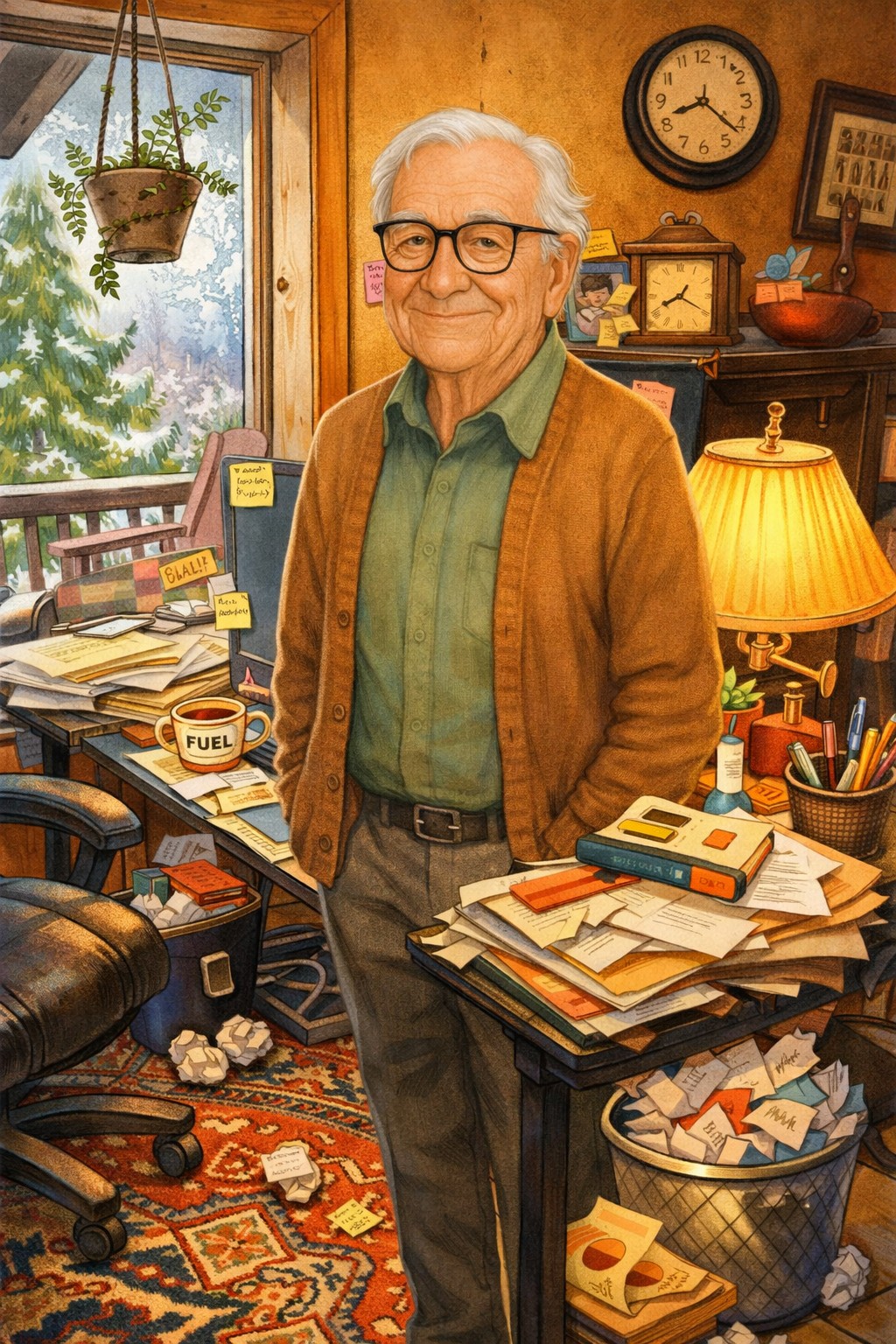
I meant January and February—two months that often keep me snowed in on my mountaintop here in the Shenandoah Valley. And this year—once and for all—they were supposed to be the two perfect months to bring order to chaos. To organize my office.
Boxes. Amazon boxes, to be precise—a small mountain of them, stacked near the woodstove like a cardboard monument to every good intention I’ve ever had. Some are open. Some are not. All of them smile at me. That relentless Amazon smile, curved and cheerful and absolutely unbothered by my shame. I have begun to suspect they are multiplying when I’m not looking.
Desk and worktable. Buried. Buried under manila envelopes, unopened mail, a box of highlighters, a coffee mug that may or may not still contain coffee, and enough paper to reforest a modest hillside. The lamp burns bravely through the chaos like a lighthouse in a nor’easter.
Even the plants have opinions. Two magnificent specimens—sprawling dramatically across their ornate iron stands—have taken matters into their own fronds. One has sent a long, accusatory leaf directly toward my leather chair. As if pointing.
Pointing. Yes, pointing. The same way the ghost of my gray-haired grade school history teacher would point and declare with the wrath of an angry God:
“A cluttered desk is the devil’s workshop.”
And between Mrs. Snyder’s admonitions and my lament—”Where did it go? Where did it all go?”—Poor Brentford appeared as if in a vision rising up from nowhere in particular and everywhere at once.
“Where did it all go, you ask? Where did it all go? I’ll tell you exactly where it went. Pull up a chair if you can find one in that brain of yours, all cluttered now with nonsense.”
I thought I knew for sure where his harangue was headed. But for once he surprised. He did not stoop so low as to rap knuckles with any of the cliches from his repertoire of wisdom.
Not once did I hear,
“Time and tide wait for no one.”
Not once did I hear,
“Make hay while the sun shines.”
I didn’t even hear the one I was certain he would speak with calm certainty,
“Lost time is never found again.”
He didn’t recite any of those things.
Instead, he cleared his throat with great ceremony and delivered his first knuckle rap with the precision of a surgeon and the satisfaction of a man who has been waiting a very long time.
“Only handle it once.”
He let it hang there. Just those four words. Floating in the air above the Amazon boxes and the buried desk and the manila envelopes and the coffee mug of uncertain vintage.
“Your words. Well, Grace Reed’s words, if we’re being precise. Your Copyright Office colleague. The woman whose office was lean, mean, and sparse. The woman whose wisdom you borrowed, researched, published, celebrated, and then—apparently—left to ride around in the Jeep with the junk mail.”
He fixed me with a look that left no room for argument.
“Don’t bemoan where it all went. You know fully well. And you know exactly what to do.”
Then Poor Brentford’s voice softened. Just slightly. Just enough.
“Do you remember what you wrote on January 15th, 2024? You raised your Bunnahabhain to all the tarriers, the delayers, and the occasional shelver. You said, and I quote, ‘Here’s to the to-morrowers, the champions of It can wait until tomorrow, because sometimes tomorrow is just a delay away from today.'”
He smiled. For the first time.
“And do you remember Scarlett?
“She understood something you sometimes forget. Tomorrow is not surrender. Tomorrow is strategy.”
Poor Brentford gestured grandly at the Amazon boxes.
“Your Tara is a little more cardboard than hers. But the principle holds.”
He straightened his jacket.
“The office will get cleaned. One day. Tomorrow, perhaps. Or the day after. Or sometime before the Amazon boxes learn to walk.”
“Scarlett managed. So will you.”
But Poor Brentford wasn’t finished. He stood there, poised to deliver his final and most devastating knuckle rap. Quietly. Almost tenderly.
“Forget the cluttered office for now. I want you to remember something you wrote, something about a young professor who stopped you in a hallway and handed you an offprint with four words inscribed on the front.”
He paused.
“This is life everlasting.”
Another pause. Longer this time.
“You asked whether he was suggesting that we live on forever through what we share with others: ideas immortalized in print. You answered your own question. Here you are, nearly fifty years later, speaking his name. Professor Myerson continues to live.”
He leaned in close.
“And so will you. Through every word you have ever written. Eight books. More than a million words. Scholarship and essays that will outlast every Amazon box in that corner.”
“THAT is your life everlastin’. Now act like it.”
Just when my chair started getting uncomfortable, Poor Brentford had the nerve to tell me to shout out:
“Get behind me, Satan.”
I sprang up at once because in that command I recognized my own mother’s voice. Over and over again I had heard her rebuke the Devil whenever she faced her own pole of proverbial chaos.
Only then did I realize what Poor Brentford had done.
He had serenaded me with snippets of my own advice—counsel I had been publishing right here in this column for years.
I could hardly be offended.
I looked again at the Amazon boxes. The buried desk. The pointing plant.
“The first porch is where you find your voice. The second porch is where your voice finds others.” —Poor Brentford Lee (b. 1947. Keeper of two porches, one mountain, one dog, and an inexhaustible supply of things worth saying—none of which he has to say alone anymore, thanks to his partner, Gary.)
Dear Faithful Readers,
You’ve been here with me on the porch since—well, some of you since the very beginning, back when I built it as nothing more than a place where you could pull up a chair and talk with me about the joys, challenges, and discoveries of research. We kept right on doing that from 2012 to 2021 when I decided to make the porch a little more fun by bringing you weekly creative nonfiction essays.
I’m still at it. Nearly 750,000 words later. Yes, you read it right. Foolin’ around in bed every night with ideas and words adds up. I’m spurred on by you, my Dear Readers, whose numbers keep increasing annually! Last year, we shared more than 35,000 views right here on the porch.
But I’ve built a brand-new porch, and I want you to be the first to know about it.
Don’t worry, though. I’m not leaving The Wired Researcher porch. It will remain open virtually forever. Same Monday mornings. Same voice–mine, with Poor Brentford’s voice chiming in from time to time. We’ll both be there, waiting for you.
I just heard someone shout out:
“So, why are you building a new porch? What’s that all about?”
Well, for starters, it has better lighting, and it might just bring in more neighbors for all of us to visit and exchange ideas.
I’m counting on you to check it out. I’ve named the second porch The Kendrick Chronicles.
“Where on earth is this new porch of yours?”
Gracious me! You know that I like to take my time–slow and easy like. In a sec, I’ll give you the link so that you can check it out for yourself. And when you do, go ahead and Subscribe! From that point forward, my essays–ever goldern new one that hits the world, every Monday morning like a neighbor who always brings something worth reading and never overstays his welcome–will find their way directly to your Inbox.
You can find this new porch of mine in Substack. Here’s the link:
“What will I find when I get to this new porch of yours?”
Why, gracious me! You’ll find a comfy chair with your name on it and a handful of your favorite essays with my name on ’em:
● Redbuds of Remembrance
● Learning to Love in New Ways
● I Am Afraid
● Poor Brentford Cleans the Wax Out of His Ears
● Two, Together
● Glimpses of My Mother’s Hands
● The Ghost of Palmyra Church Road
● Truths Half-Told. Letters Half-Burned. A Legacy Waiting to Be Fully Heard.
● Carrying the Bags of Colonial America’s Humourist
And get this. If you subscribe, next week you’ll get an essay about a kitchen disaster beyond belief: “Oh, No! No Sourdough!” And the week after that, “What We Know. What We Believe.” It may be the most complete thing I’ve ever written about who I am and what I believe about what comes next.
So go on now. Pull up a chair. Same voice. Wider porch.
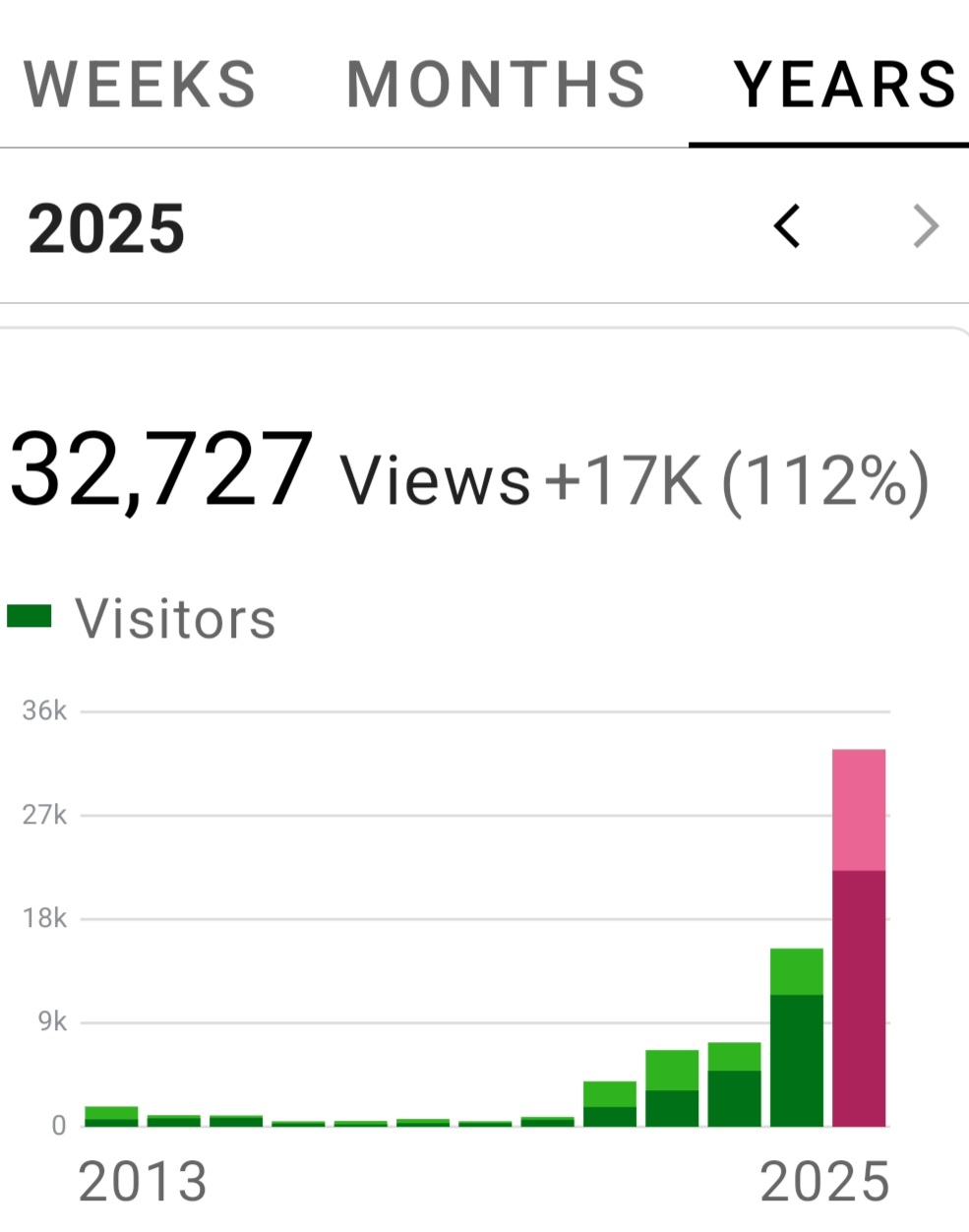
As this year draws to a close, I want to thank you for visiting my blog 32,727 times.
That didn’t happen overnight. And it didn’t happen by accident.
This year, more people found their way here than ever before—slowly, steadily, and often by returning. Compared with last year, readership grew significantly, not because anything went viral, but because the writing kept meeting the right readers at the right moment.
Growth, the quiet way,
These pages have held many things:
● 18th-century satire and present-day kitchens. ● Scholarship and softness. ● Books, biscuits, dogs, devotion, memory, love.
Some posts traveled far. Others found only a handful of readers. But every one was written with care—and read with attention.
I don’t think of these as clicks.
I think of them as moments of shared presence in a distracted world.
You made this a banner year.
If you were one of the 32,725:
● thank you for reading, ● thank you for lingering, ● thank you for making this a place worth returning to.
Here’s to a year shaped by patience, curiosity, and generosity of spirit—and to whatever quiet magic comes next.
You took me by surprise again this morning. As always, when I awakened, I checked my Fitbit to see how my heart did overnight. Then I checked WordPress to see how my readers were doing.
And there you were. Another thousand views. A quiet jolt to the chart. Numbers climbing when I wasn’t looking.
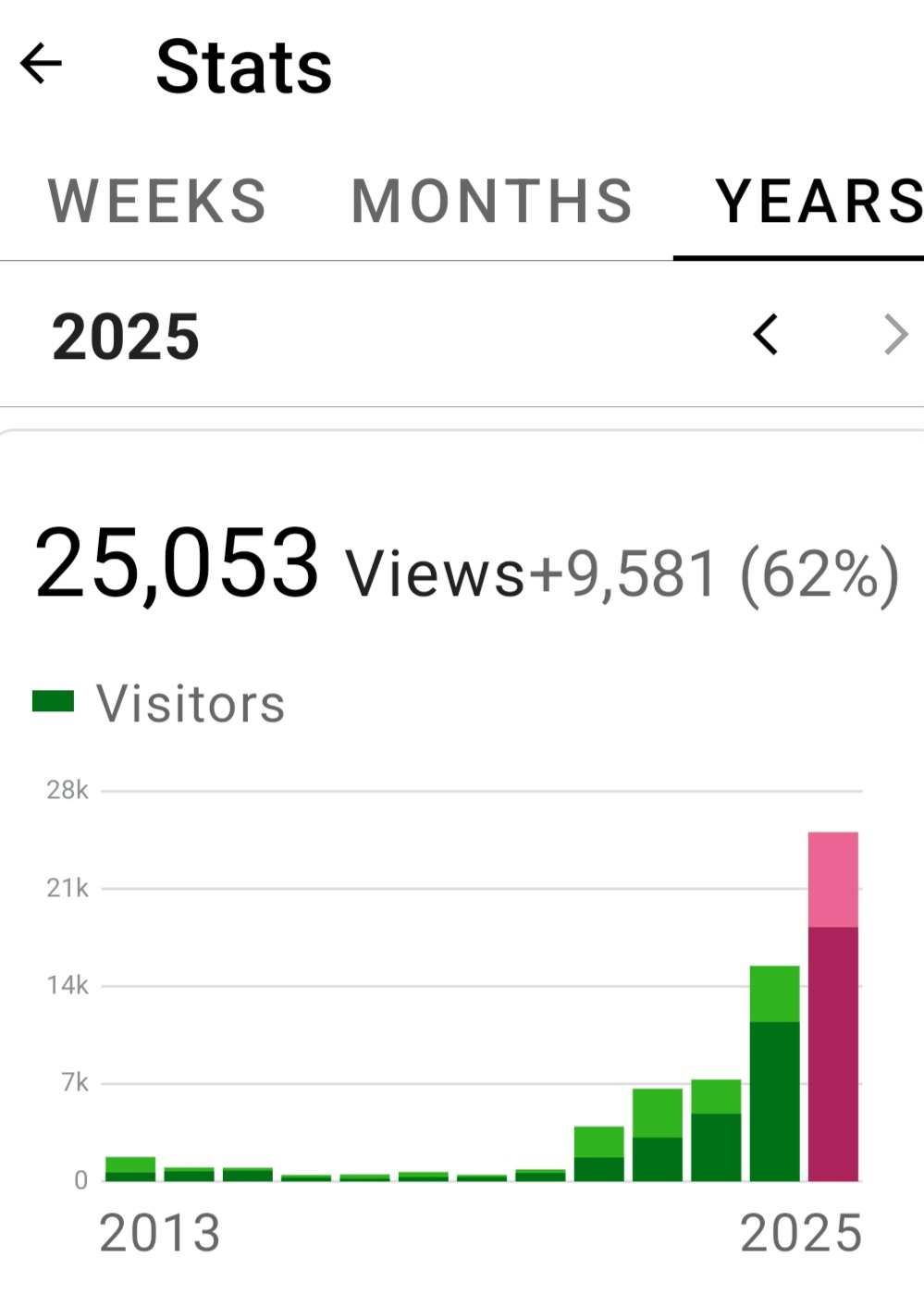
You’ve been dancing higher and higher since October, when I passed 15,000 and figured I’d reached my high-water mark. I even wrote a piece of thanks back then, thinking I’d said all there was to say. But now here we are—December 11th—and this little corner of the internet has gathered 25,053 views.
I’ve done nothing different. I have no flashy headlines. I have no trending hashtags. I just keep following the same rhythm: writing essays born from memory in a home filled with love. I just keep foolin’ around with words and ideas.
So why now, after all these years?
That question hangs gently in the room with me. It’s not demanding an answer. It’s simply inviting a reflection. Maybe something shifted in the writing. Maybe it’s more expansive. Maybe it’s more lived-in. Maybe it’s a voice carrying a steadier warmth now. Maybe it’s grief that’s softened into grace. Maybe it’s love that arrived not with fanfare, but with a quiet hand stretched out in invitation. Maybe it’s all of those things. Maybe. And add to all those maybes one more. Maybe it’s readers sharing with readers.
Gary, of course, doesn’t ask to be written about. But his presence is here, between the lines, in the patience of a paragraph, the steadiness of tone, the way I’ve learned to let silence do some of the talking.
Ruby, on the other hand, insists on being written about, whether she’s nosing me away from my smartphone or curling up in solidarity as I revise for the twenty-fifth time. She is, as always, the keeper of the tempo, the mistress of the move.
So this isn’t an open letter to public stats. It’s a letter to something deeper. It’s a letter to what it means to keep writing when no one’s watching, and then to wake up and find that someone was.
My essays aren’t meant to dazzle. And I know: they don’t. They’re just small acts of holding up the light, one weekly reflection at a time. The fact that they’re being read, now more than ever, tells me something I didn’t expect: quiet honesty still finds its way.
Thank you, Sudden Surge, for reminding me that patience has its own reward, that consistency is a kind of faith, and that somewhere out there, readers are still pausing to linger with a slow essay from the mountain.
I don’t know what this upturn means, or where it leads. But I do know I’ll keep showing up with my smartphone in hand and love at my side.
“I would maintain that thanks are the highest form of thought.”
—G. K. Chesterton (1874–1936,). influential English essayist whose sharp wit, moral clarity, and human warmth made him one of the most quoted thinkers of his time.
My blog surprised me again this week. Back in October, I crossed 15,000 views and thought I’d reached my high-water mark for the year. Now, barely a month later, I’m staring at an even bigger number:
20,062 views—with a full month still to go.
That’s more than last year, more than the year before, and more than I ever expected from this little mountain corner of mine. Apparently, these memoir stories I write from a quiet oasis in the wilderness of Virginia keep finding their way into far-off places—and into the hands and hearts of readers I’ll never meet yet somehow feel connected to all the same.
ReasonstoBeGrateful
But 20,062 isn’t really a number. Not to me.
It’s the sum of moments someone chose to spend with my words. It’s a cup of coffee that went cold on a stranger’s table because they lingered. It’s a pause in someone’s busy day. It’s a late-night scroll where someone said, without ever typing the words, “I’ll stay a little longer.” Twenty thousand tiny gestures of yes in a world full of noise.
And the deeper truth behind that math—the part I keep circling back to—is that this milestone isn’t about reach or visibility or bragging rights. It’s about what it represents in the long arc of a life. I’ve lived enough years, and carried enough stories, to know that readers don’t show up unless something in the writing rings true. They don’t return unless the voice feels familiar, honest, worth sitting with. They certainly don’t keep climbing toward 20,000 unless the stories hold something real.
So this isn’t a celebration of views.
It’s a quiet acknowledgment that I’ve kept faith with my own voice—through reinvention, through loss, through love found unexpectedly, through the strange and luminous chapters that have made up this year. And somehow, astonishingly, readers have kept faith with me.
And yes, threaded into the margins—without ever mentioning Gary by name—is the quiet steadiness that has shaped this year in ways I’m still learning to articulate. Love doesn’t call attention to itself; it simply widens the edges of your life. It softens how you move through the world, deepens the tone of your voice, and reminds you that being read is wonderful, but being seen—fully, gently, without hurry—is something else entirely.
This year, more than any before, has reminded me that showing up with a story is an act of hope. And reading one is, too. Somewhere in that exchange—when the writing meets the reading—something human and steady is created. Something that matters.
So here I sit, on a chilly Thanksgiving week, taking in this milestone not as a trumpet blast but as a simple moment of gratitude. Gratitude for the readers who knock on my digital door day after day. Gratitude for the chance to tell the stories I’ve carried for decades. Gratitude for the ways this year has widened, softened, and surprised me—and for the quiet presence that keeps teaching me that the best stories are the ones we live, not just write.
I didn’t expect this climb to 20,062. But I’m grateful for every step, every reader, every quiet yes.
And with a month still to go, I’ll just say it now—
—Terry Tempest Williams (b. 1955. American writer and environmental activist whose lyrical essays explore the intersections of personal narrative, place, and ecological stewardship.)
Something snuck up on me yesterday.
I was talking on the phone with my 90-year-old sister when I glanced down at my smartphone, saw my WordPress dashboard—and nearly did a spit take.
Over 15,188 views this year already!
That’s already more than all of 2024, and we still have October, November, and December to go. Apparently, my little mountain corner has gone global again—and I couldn’t be more grateful.
To every one of you, My Dear Readers, who reads, comments, shares, or quietly lingers over a sentence or two: thank you. You’ve turned this space into a community of curiosity, compassion, and laughter. Every click, every view, every thoughtful message reminds me that words still matter—and that connection runs deeper than algorithms.
Your Top 10 Favorites of 2025 (So Far)
Every year tells its own story through what readers choose. This year’s list made me smile. It’s a mix of reflection, resilience, and rediscovery—with a dash of irreverence (because, well, it’s me or Poor Brentford Lee or maybe both).
● “I Am Afraid” — A wake-up call for our country—and a reminder of who we still can be.
●“The Place: Charleston” — The launch of my Unmasking The Humourist: Alexander Gordon’s Lost Essays of Colonial Charleston, South Carolina.
There’s still more to come before year’s end—new essays, reflections, maybe even a few surprises that have been sitting in my drafts waiting for the right moment. Perhaps even one or two guest posts by our famed and acclaimed Poor Brentford Lee.
I can’t promise I’ll always be profound, but I can promise I’ll keep showing up with authenticity, honesty, humor, and heart.
Thank you, My Dear Readers, for being here, for reading, and for reminding me—every day—that a single voice can still find an echo.
“The reader is the final arbiter of a text. Without the reader, the words are silent.”
—Margaret Atwood (b. 1939). Canadian poet, novelist, essayist, and critic, one of the most influential literary voices of our time.
My Dear Readers, I blinked yesterday, and suddenly my little corner of the internet tallied 12,000 views for 2025—with three months still to go!
That’s not just a number. It’s 12,000 moments of connection. 12,000 times someone out there paused long enough to read my words, nod, chuckle, roll an eye, or maybe even find a flicker of themselves in my essays.
And here’s the part that stuns me: with this pace, we’re on track to sail past last year’s phenomenal 15,000 peak—a record I once thought unrepeatable. But here we are, repeating (and then some).
The 10 You Loved the Loudest
Every essay I publish is a seed tossed into the world. Some sprout quietly. Some bloom bold and bright. Here are the ten that you watered most generously this year:
Whether you’ve been here since my first blog post nearly 13 years ago or you just stumbled across my latest musings, you’ve made this milestone possible. I don’t take your presence lightly.
So, here’s to you—my companions in this ongoing experiment of storytelling, memory-making, and meaning-finding. Let’s see how far we can climb before 2025 closes the books.
After all, the numbers matter—but the connections matter more.
“To toot one’s own horn is to sound the music of one’s journey. And today, my friends, the notes are jubilant, triumphant, unmistakably heartfelt, and wrapped in a little holiday cheer!”
–TheWiredResearcher (b. 1947; self-effacing educator, essayist, Green Mountain scholar, and Humourist—patiently awaiting long-overdue New York Times recognition.)
Beloved readers–of all ages and from all corners of the globe–I’m going to toot my horn proudly today!
At 11:22am today, my blog hit 15,000 views in 2024! Is that a special Christmas gift or what!
Let me pause and let that sink in: FIFTEEN. THOUSAND. VIEWS.
Can you hear the confetti cannons? Feel the glitter raining down? That’s the energy I’m channeling today. Because let’s be honest—this doesn’t happen by accident. It’s the result of showing up week after week, pouring my heart and soul into every post, and, most importantly, connecting with YOU, my remarkable readers.
If you’re like me, you know that milestones mean more when you see where they began. Let’s rewind:
● 2021: 3,940 views. A small but solid readership.
● 2022: 6,655 views. Growth doubling and momentum building.
● 2024: 15,000 views… and the year isn’t over yet!
From 3,940 to 15,000 in just a few years—this isn’t just growth. It’s a story of connection. It’s a story of us.
What Does 15,000 Look Like?
It looks like 140 countries—stretching from the United States’ plains and mountain ranges to Afghanistan’s rugged peaks, India’s vibrant deserts and Himalayas, and France’s vineyards, all the way to Zimbabwe’s sweeping savannahs. It looks like comments from faithful followers. It looks like early risers sipping coffee as they dive into my Monday morning musings. It looks like connections that transcend borders, reminding us all of the power of words.
The Greatest Hits (According to You!)
As we bask in this milestone, let’s revisit the top-ten posts that you’ve loved the most this year:
● “From Stars to Soil.” A nostalgic return to childhood gardening and the realization that it gave me a profound appreciation for the interconnectedness and sacredness of all life.
● “My Mother’s Dress.” A story exploring how a dress that my mother made for herself included her hopes, her visions, her aspirations, and her dreams for her family and her world.
● “Sister’s Hands.” A celebration of decades of selfless love, compassion, and service.
● “My Taxing Review.” A humorous exploration of opening personal archives as a way to create a rich personal narrative.
● “Not Alone.” A triumphant tale of my own Coming Out.
A Milestone Worth Celebrating
Fifteen thousand views aren’t just numbers—they’re stories, connections, and a shared love of learning. Each one represents someone who paused in their day to engage with my words. Together, we’ve created a space where ideas flourish, where history meets memoir, where research mingles with creativity, and where we never stop asking the big questions.
The Future Is Bright
What’s next? More posts that inspire, challenge, and delight. More glimpses into the magic of the everyday. More stories that remind us why we love the written word.
To everyone who has ever clicked, read, commented, or shared—THANKYOU. You are the symphony that makes this blog sing. And as the music swells, I can’t help but toot my own horn just a little louder.
Because today, it’s not just my achievement—it’s ours.
Here’s to 15,000 views—and the countless stories and connections that brought us here.
“Somewhere, something incredible is waiting to be known.”
–Carl Sagan (1934–1996; astronomer and science communicator who inspired millions through his work on Cosmos and popular science writing.)
Tell me to do something, and I probably won’t do it. It smacks too much of being ordered around. No, thank you. Most of the time–though not always–I prefer to do the bossing.
On the other hand, suggest that I do something–maybe even challenge me to do something–and I’ll probably do it. Yes, thank you. I thrive on encouragement.
That’s exactly how today’s post began. One of my followers–my Linden Correspondent (LC)–suggested that the world at large might be revved and ready to know how my wired blog began! I thought LC’s suggestion was splendid, especially since my blog just celebrated its 12th anniversary. What better time than now to share the electrifying backstory.
With a growing readership of 13,782 (and counting!), I like to think my blog has found its niche. My readers value my blog for what it is today: a succession of riveting and captivating creative nonfiction essays that appear magically every Monday morning just in time for that first cup of coffee–that is for early risers who get their brew going early. That’s why I make a point of posting before 7am. While I sip on my coffee and savor what I wrote, I like to think that the entire world is doing the same thing.
Every Monday morning, you’ll find me in my reading chair with Ruby—my 60-pound lapdog—perusing my post while she peruses me. Sometimes, I smile and say aloud for her amusement:
“Wow, Kendrick! That’s a remarkable sentence. If you keep cranking out little gems like that, maybe one day you’ll end up somewhere as someone’s endnote.”
Yep. An endnote. Ironically, I guess that’s where we all end up: Someone’s endnote.
That’s not such a bad thing, you know. An endnote here. An endnote there. It seems to me that achieving a memorable, perhaps quotable phrase here and there is probably far wiser than having the entire canon of my work ricocheting around the world.
Stop and think about it for a minute or three. Look, for example, at what Benjamin Franklin achieved as a writer. Let’s focus on his Poor Richard’s Almanack, published annually from 1732 to 1758—nearly a quarter of a century of wit and wisdom.
Most people today can recall only a handful of Franklin’s most famous sayings, like:
● “Early to bed and early to rise makes a man healthy, wealthy, and wise.” ● “A penny saved is a penny earned.” ● “No gains without pains.”
Please tell me, Dear Reader, that you know those sayings, for if you don’t, you surely won’t know these:
● “Well done is better than well said.” ● “Three may keep a secret, if two of them are dead.” ● “If you would not be forgotten, as soon as you are dead and rotten, either write things worth reading, or do things worth writing.”
Indeed, Franklin managed to do both: he wrote things worth reading and did things worth writing. And, as I like to say:
“Endnoted.”
But let me take you back to where I began: the beginning of this blog.
I am so sorely tempted to say:
“It was a dark and stormy night …”
And that’s exactly what I would say, but if I said that I would have to note that Edward Bulwer-Lytton opened his 1830 novel, Paul Clifford with those words. As much as I hate to say it, because I am a stickler on documentation, I have grown weary of all the endnoting that I keep noting. Let us then move on to something that requires no noting.
Whew! I don’t know about you, but I feel notably relieved already.
LC must be relieved, too, to see that, at last, I’m getting around to sharing with the world the story behind the birth of my blog. But, as they say, every blog has its story, and mine is no exception.
Here’s what’s fascinating. Today, I am known around the world for my weekly memoir blog posts talking about anything from Aging to Zippers and about everything in between.
But when the idea for my blog came to me in 2012, I had a sharp, narrow, scholarly focus. I was working on my application for the VCCS Chancellor’s Commonwealth Professorship Program. At the heart of my application was the scholarly research that I wanted to do with a remarkable collection of Colonial American essays, songs, poems, and advertisements published pseudonymously under the name of “The Humourist” in the South Carolina Gazette during 1753-1754. The unique essays had never been reprinted, so they remained “hidden” and “undiscovered,” so to speak, in that newspaper. Further, no one knew who wrote the essays. Well, I was 99% certain that I knew, but I needed to do additional research and analysis to confirm my suspicions. In that sense, my project was a literary “whodunit” involving three things.
First, I planned to prepare a critical, annotated edition of the essays.
Second, I planned to develop a convincing case for authorial attribution based on a preponderance of internal evidence as well as on stylometrics.
Third, throughout the process of preparing the critical, annotated edition and developing a case for authorial attribution, I planned to give the essays a “close reading.” I was reminded of a quote by Robert Frost:
“We go to college to be given one more chance to learn to read in case we haven’t learned in high school. Once we have learned to read, the rest can be trusted to add itself unto us.”
I always shared that wisdom with my students. Learning to read—really read—gets to the heart of what we want our students to do, not just in English classes but across the board. When students slow down and give a text a close reading, critical thinking and intellectual discovery follow.
As Frost knew so well, that is what “learning to read” is all about. Further, when students learn how to really read, they can construct their own intellectual inquiries: “the rest can be trusted to add itself unto us.”
I always shared that belief—and approach—with my students without fail. I showed them how to learn to read, class after class, reading assignment after reading assignment, as I gave whatever literary selection we were reading my own close reading and as I made my own discoveries about a text. They were intrigued not only by my process but also by the discoveries that I made simply because of my dogged determination to give a text—any text—a close reading.
In my application, that’s precisely what I proposed to do with “The Humourist” essays. I wanted the opportunity to give the essays such a close reading that I would be able not only to establish a scholarly, annotated edition but also to identify the author.
I was really happy with that part of my application, but I knew that I needed something more. I needed a way to share my scholarly work on a regular basis with my colleagues and my students so that they could benefit, too.
I needed an idea. As I sat there on that January 8th evening, well into the third or fourth or maybe even fifth revision of my application, I started thinking about Daniel Boorstin (1975-1987), twelfth Librarian of Congress. A champion of accessibility, he worked to open the library to the public in symbolic and practical ways. He placed picnic tables and benches on Neptune Plaza, transforming it into a space for community gatherings. He initiated mid-day concerts and famously removed the chains from the majestic bronze doors at the first-floor west entrance leading to the Great Hall of the Jefferson Building. When told it would create a draft, he replied, “Great—that’s just what we need.” In a bold move, he even stopped the practice of searching visitors.
At that time, I worked at the Library of Congress as an editor of the National Union Catalog, Pre-1956 Imprints, and I well remember the occasion when the bronze doors were opened. If I am not mistaken, it was on this occasion that I heard Dr. Boorstin say:
“You never know when an idea is about to be born.“
His comment lingered, and since hearing it, I made a point to keep track of when my own ideas were born.
So it came to be. While thinking about Boorstin, ideas, and my project, I exclaimed to myself:
“Blog it!”
I knew that a blog would allow me to share with the entire world my challenges, discoveries, and joys of research.
I knew that a blog would allow me to share with others this remarkable collection of Colonial American essays, songs, poems, and advertisements. The Encyclopedia of the Essay (ed. Tracy Chevalier, 1997) placed “The Humourist” essays in the tradition of Samuel Johnson’s Rambler essays and observed that they are the only “full-fledged literary” works to have appeared in the South Carolina Gazette. Years earlier, J. A. Leo Lemay (du Pont Winterthur Professor of English at the University of Delaware) had noted in A Bibliographical Guide to the Study of Southern Literature (1969) that the essays should be edited, published, and the author identified.
This was hot! I knew that I could make “stuffy” literary research come alive in a blog. Colleagues and students and scholars and the world at large would love it. I knew they would because who wouldn’t love essays on par with Benjamin Franklin’s “Silence Dogood Letters”? Get this, too. Franklin had direct ties to the South Carolina Gazette and possibly to the author of “The Humourist” essays.
I knew, too, that aside from being in the essay tradition itself, a blog would allow me to share my project with faculty and students throughout the Virginia Community College System (VCCS), from the beginning of my work and every step of the way through completion. I realized that a blog would allow me to capture my personal experiences on a regular and ongoing basis: my work, my methods, my discoveries, my challenges and frustrations, and my joys.
I knew that a blog would allow me to do in the virtual world—using a heretofore unstudied literary work—exactly what I did in my classroom with literary works that appear in our textbooks: turn my blog followers on to the beauty of giving a text a close reading and turn them my on to “learning how to read,” showing them that once they learned how to read all else would be given to them.
That same evening, I came up with a working title: TheWiredResearcher. I Googled it and was delighted to discoverthatnosuchblog existed.
As I often do, I emailed a former student—a lover of language and words and ideas—to get her take on my blog idea.
She responded immediately:
The word “wired” will catch the attention of …The Young. They’ll think you are “hip.”
You’ll need a logo. You’ll need T-shirts with the logo on them. You need pens that say, “The Wired Researcher.” “Sold in libraries everywhere.” “Guaranteed to make study more exciting.” Oh, boy, I see tie-ins!
Clearly my former student was as wired as I was—perhaps that’s why I valued her opinions as highly as I did—but her email response gave affirmation to the title of the blog that had been born.
Here’s where the birth of the blog starts to get really sweet. I was awarded the Chancellor’s Commonwealth Professorship (2012-2014).
My first announcement appeared on October 19, 2012. It was short!
“Welcome to The Wired Researcher! Blog posts will begin on November 26, 2012.”
True to my promise, on November 26, I published “Opportunity Knocks Twice in the Virginia Community College System.” That post included the first of the historical essays that served as the nucleus for my project: “The Humourist” (November 26, 1753). Yep. Choosing to launch my blog on November 26, the same day that the Humourist launched his essays, was deliberate, and if I must say so myself, I think it was a stroke of genius!
And so, The Wired Researcher was born—not just as a blog, but as a way for me to share my love of research with a world eager to learn about my discoveries.
Now you have the inside scoop. If you want to know more, simply go back to the beginning and read all the posts from the start. But whatever you do, please make certain that you read “Colonial Charleston’s Biggest Literary Mystery Is Solved!” Yep. I solved the literary whodunit that captured me in the first place. Then you have to read “Three Special Shout-Outs!” because behind every success story are lots of people who deserve praise and thanks!
Wait! Wait! Don’t go yet. I have one or two more things to share.
When my blog started, I had around 1,750 views a year, representing 33 countries. So far this year, it has soared to an impressive 13,782 views from 152 countries! I must be writing something right!
To each and every one of you, My Dear Readers–then, now, and all along the way–a special shout-out!
To my Linden Correspondent (LC), who tossed out the idea that I share the story behind the blog, I extend asupercalifragilisticexpialidociousthank-you! (As Mary Poppins would say, nothing else captures the exuberance quite right!)
I look forward to a future of Mondays, inspired by the joy of discovery and by the connections that I’m making with all of you.



 The Wired Researcher