“Never mistake the undone for the unworthy. The desk may be cluttered. The life is not.”
—Poor Brentford Lee (b. 1947. Altar ego—with an alter ego, too, of course. He ministers and he meddles. Life coach without credentials. Available for lectures, upbraidings, and unsolicited reminders of everything you’ve already accomplished.)
Sometimes we’re our own worst enemies. Maybe, all times. I know I am.
It doesn’t matter how much I get done, it’s always the undone that grabs hold of me in my waking hours and throws me into a tiff.
Just the other day—just as dawn was breaking—I sprang up in bed, asking myself:
“Where did it go? Where did it all go?”
Not my life, mind you. That’s still very much in progress.
I meant January and February—two months that often keep me snowed in on my mountaintop here in the Shenandoah Valley. And this year—once and for all—they were supposed to be the two perfect months to bring order to chaos. To organize my office.
Boxes. Amazon boxes, to be precise—a small mountain of them, stacked near the woodstove like a cardboard monument to every good intention I’ve ever had. Some are open. Some are not. All of them smile at me. That relentless Amazon smile, curved and cheerful and absolutely unbothered by my shame. I have begun to suspect they are multiplying when I’m not looking.
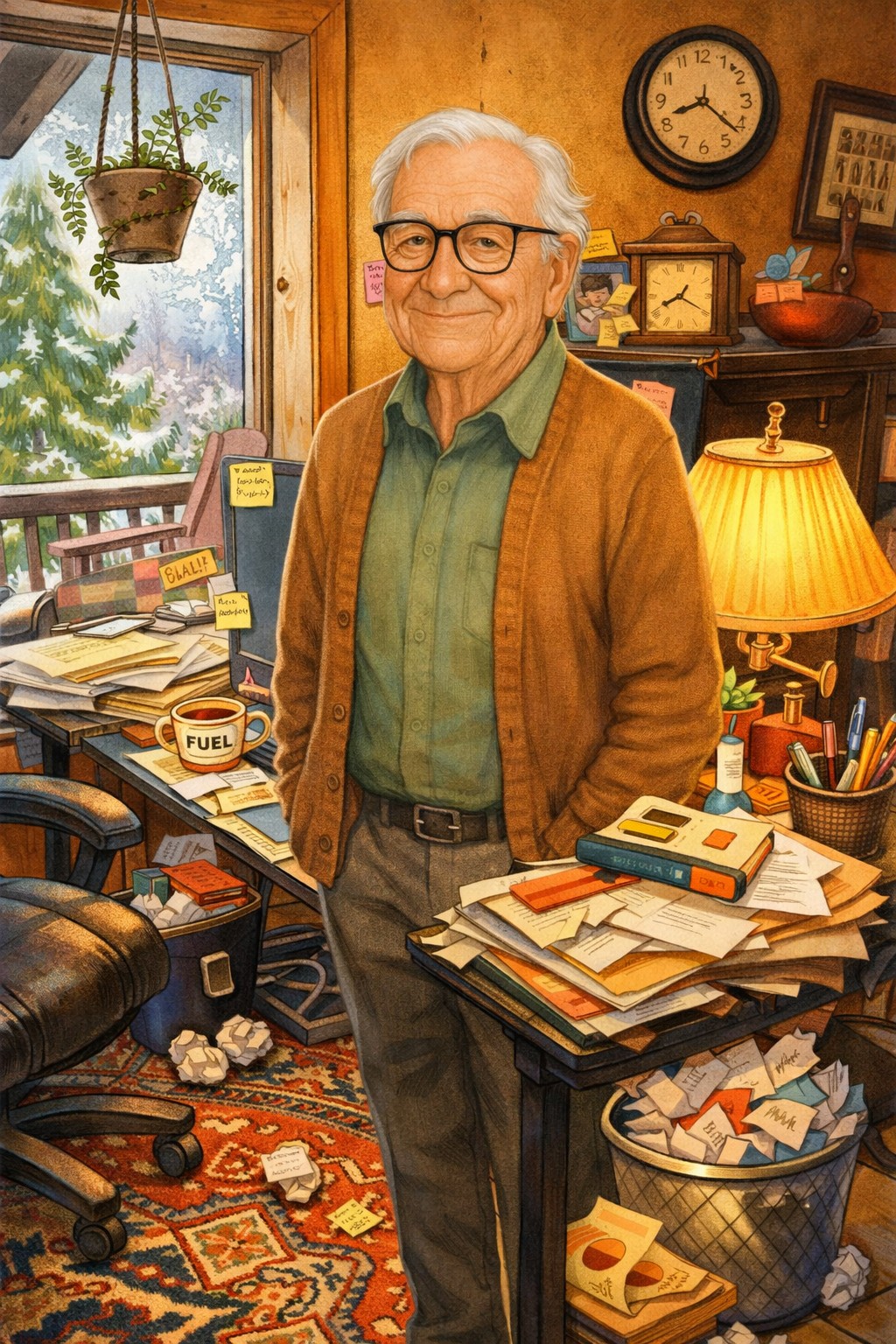
Desk and worktable. Buried. Buried under manila envelopes, unopened mail, a box of highlighters, a coffee mug that may or may not still contain coffee, and enough paper to reforest a modest hillside. The lamp burns bravely through the chaos like a lighthouse in a nor’easter.
Even the plants have opinions. Two magnificent specimens—sprawling dramatically across their ornate iron stands—have taken matters into their own fronds. One has sent a long, accusatory leaf directly toward my leather chair. As if pointing.
Pointing. Yes, pointing. The same way the ghost of my gray-haired grade school history teacher would point and declare with the wrath of an angry God:
“A cluttered desk is the devil’s workshop.”
And between Mrs. Snyder’s admonitions and my lament—”Where did it go? Where did it all go?”—Poor Brentford appeared as if in a vision rising up from nowhere in particular and everywhere at once.
“Where did it all go, you ask? Where did it all go? I’ll tell you exactly where it went. Pull up a chair if you can find one in that brain of yours, all cluttered now with nonsense.”
I thought I knew for sure where his harangue was headed. But for once he surprised. He did not stoop so low as to rap knuckles with any of the cliches from his repertoire of wisdom.
Not once did I hear,
“Time and tide wait for no one.”
Not once did I hear,
“Make hay while the sun shines.”
I didn’t even hear the one I was certain he would speak with calm certainty,
“Lost time is never found again.”
He didn’t recite any of those things.
Instead, he cleared his throat with great ceremony and delivered his first knuckle rap with the precision of a surgeon and the satisfaction of a man who has been waiting a very long time.
“Only handle it once.”
He let it hang there. Just those four words. Floating in the air above the Amazon boxes and the buried desk and the manila envelopes and the coffee mug of uncertain vintage.
“Your words. Well, Grace Reed’s words, if we’re being precise. Your Copyright Office colleague. The woman whose office was lean, mean, and sparse. The woman whose wisdom you borrowed, researched, published, celebrated, and then—apparently—left to ride around in the Jeep with the junk mail.”
He fixed me with a look that left no room for argument.
“Don’t bemoan where it all went. You know fully well. And you know exactly what to do.”
Then Poor Brentford’s voice softened. Just slightly. Just enough.
“Do you remember what you wrote on January 15th, 2024? You raised your Bunnahabhain to all the tarriers, the delayers, and the occasional shelver. You said, and I quote, ‘Here’s to the to-morrowers, the champions of It can wait until tomorrow, because sometimes tomorrow is just a delay away from today.'”
He smiled. For the first time.
“And do you remember Scarlett?
“She understood something you sometimes forget. Tomorrow is not surrender. Tomorrow is strategy.”
Poor Brentford gestured grandly at the Amazon boxes.
“Your Tara is a little more cardboard than hers. But the principle holds.”
He straightened his jacket.
“The office will get cleaned. One day. Tomorrow, perhaps. Or the day after. Or sometime before the Amazon boxes learn to walk.”
“Scarlett managed. So will you.”
But Poor Brentford wasn’t finished. He stood there, poised to deliver his final and most devastating knuckle rap. Quietly. Almost tenderly.
“Forget the cluttered office for now. I want you to remember something you wrote, something about a young professor who stopped you in a hallway and handed you an offprint with four words inscribed on the front.”
He paused.
“This is life everlasting.”
Another pause. Longer this time.
“You asked whether he was suggesting that we live on forever through what we share with others: ideas immortalized in print. You answered your own question. Here you are, nearly fifty years later, speaking his name. Professor Myerson continues to live.”
He leaned in close.
“And so will you. Through every word you have ever written. Eight books. More than a million words. Scholarship and essays that will outlast every Amazon box in that corner.”
“THAT is your life everlastin’. Now act like it.”
Just when my chair started getting uncomfortable, Poor Brentford had the nerve to tell me to shout out:
“Get behind me, Satan.”
I sprang up at once because in that command I recognized my own mother’s voice. Over and over again I had heard her rebuke the Devil whenever she faced her own pole of proverbial chaos.
Only then did I realize what Poor Brentford had done.
He had serenaded me with snippets of my own advice—counsel I had been publishing right here in this column for years.
I could hardly be offended.
I looked again at the Amazon boxes. The buried desk. The pointing plant.
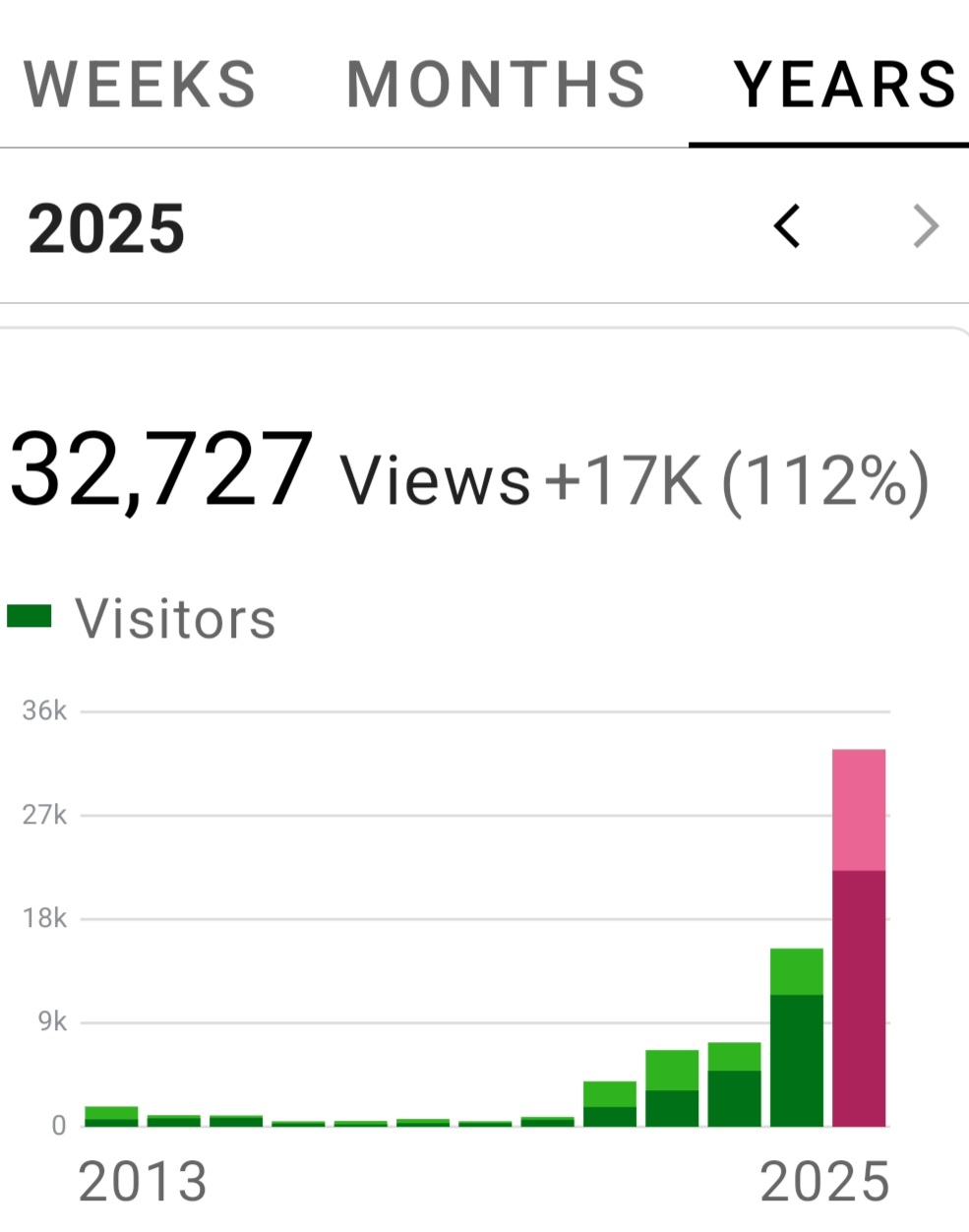
As this year draws to a close, I want to thank you for visiting my blog 32,727 times.
That didn’t happen overnight. And it didn’t happen by accident.
This year, more people found their way here than ever before—slowly, steadily, and often by returning. Compared with last year, readership grew significantly, not because anything went viral, but because the writing kept meeting the right readers at the right moment.
Growth, the quiet way,
These pages have held many things:
● 18th-century satire and present-day kitchens. ● Scholarship and softness. ● Books, biscuits, dogs, devotion, memory, love.
Some posts traveled far. Others found only a handful of readers. But every one was written with care—and read with attention.
I don’t think of these as clicks.
I think of them as moments of shared presence in a distracted world.
You made this a banner year.
If you were one of the 32,725:
● thank you for reading, ● thank you for lingering, ● thank you for making this a place worth returning to.
Here’s to a year shaped by patience, curiosity, and generosity of spirit—and to whatever quiet magic comes next.
You took me by surprise again this morning. As always, when I awakened, I checked my Fitbit to see how my heart did overnight. Then I checked WordPress to see how my readers were doing.
And there you were. Another thousand views. A quiet jolt to the chart. Numbers climbing when I wasn’t looking.
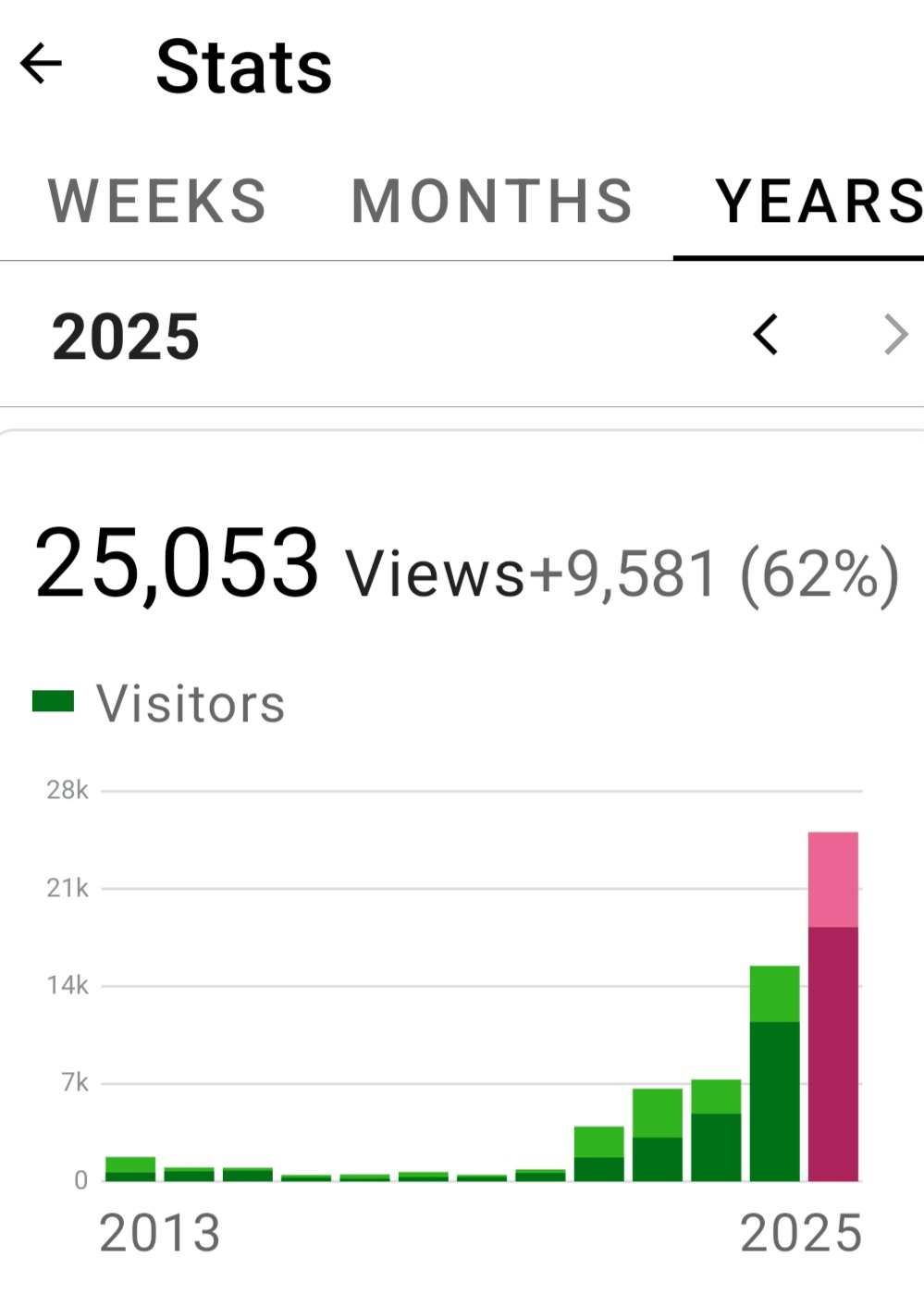
You’ve been dancing higher and higher since October, when I passed 15,000 and figured I’d reached my high-water mark. I even wrote a piece of thanks back then, thinking I’d said all there was to say. But now here we are—December 11th—and this little corner of the internet has gathered 25,053 views.
I’ve done nothing different. I have no flashy headlines. I have no trending hashtags. I just keep following the same rhythm: writing essays born from memory in a home filled with love. I just keep foolin’ around with words and ideas.
So why now, after all these years?
That question hangs gently in the room with me. It’s not demanding an answer. It’s simply inviting a reflection. Maybe something shifted in the writing. Maybe it’s more expansive. Maybe it’s more lived-in. Maybe it’s a voice carrying a steadier warmth now. Maybe it’s grief that’s softened into grace. Maybe it’s love that arrived not with fanfare, but with a quiet hand stretched out in invitation. Maybe it’s all of those things. Maybe. And add to all those maybes one more. Maybe it’s readers sharing with readers.
Gary, of course, doesn’t ask to be written about. But his presence is here, between the lines, in the patience of a paragraph, the steadiness of tone, the way I’ve learned to let silence do some of the talking.
Ruby, on the other hand, insists on being written about, whether she’s nosing me away from my smartphone or curling up in solidarity as I revise for the twenty-fifth time. She is, as always, the keeper of the tempo, the mistress of the move.
So this isn’t an open letter to public stats. It’s a letter to something deeper. It’s a letter to what it means to keep writing when no one’s watching, and then to wake up and find that someone was.
My essays aren’t meant to dazzle. And I know: they don’t. They’re just small acts of holding up the light, one weekly reflection at a time. The fact that they’re being read, now more than ever, tells me something I didn’t expect: quiet honesty still finds its way.
Thank you, Sudden Surge, for reminding me that patience has its own reward, that consistency is a kind of faith, and that somewhere out there, readers are still pausing to linger with a slow essay from the mountain.
I don’t know what this upturn means, or where it leads. But I do know I’ll keep showing up with my smartphone in hand and love at my side.
“I would maintain that thanks are the highest form of thought.”
—G. K. Chesterton (1874–1936,). influential English essayist whose sharp wit, moral clarity, and human warmth made him one of the most quoted thinkers of his time.
My blog surprised me again this week. Back in October, I crossed 15,000 views and thought I’d reached my high-water mark for the year. Now, barely a month later, I’m staring at an even bigger number:
20,062 views—with a full month still to go.
That’s more than last year, more than the year before, and more than I ever expected from this little mountain corner of mine. Apparently, these memoir stories I write from a quiet oasis in the wilderness of Virginia keep finding their way into far-off places—and into the hands and hearts of readers I’ll never meet yet somehow feel connected to all the same.
ReasonstoBeGrateful
But 20,062 isn’t really a number. Not to me.
It’s the sum of moments someone chose to spend with my words. It’s a cup of coffee that went cold on a stranger’s table because they lingered. It’s a pause in someone’s busy day. It’s a late-night scroll where someone said, without ever typing the words, “I’ll stay a little longer.” Twenty thousand tiny gestures of yes in a world full of noise.
And the deeper truth behind that math—the part I keep circling back to—is that this milestone isn’t about reach or visibility or bragging rights. It’s about what it represents in the long arc of a life. I’ve lived enough years, and carried enough stories, to know that readers don’t show up unless something in the writing rings true. They don’t return unless the voice feels familiar, honest, worth sitting with. They certainly don’t keep climbing toward 20,000 unless the stories hold something real.
So this isn’t a celebration of views.
It’s a quiet acknowledgment that I’ve kept faith with my own voice—through reinvention, through loss, through love found unexpectedly, through the strange and luminous chapters that have made up this year. And somehow, astonishingly, readers have kept faith with me.
And yes, threaded into the margins—without ever mentioning Gary by name—is the quiet steadiness that has shaped this year in ways I’m still learning to articulate. Love doesn’t call attention to itself; it simply widens the edges of your life. It softens how you move through the world, deepens the tone of your voice, and reminds you that being read is wonderful, but being seen—fully, gently, without hurry—is something else entirely.
This year, more than any before, has reminded me that showing up with a story is an act of hope. And reading one is, too. Somewhere in that exchange—when the writing meets the reading—something human and steady is created. Something that matters.
So here I sit, on a chilly Thanksgiving week, taking in this milestone not as a trumpet blast but as a simple moment of gratitude. Gratitude for the readers who knock on my digital door day after day. Gratitude for the chance to tell the stories I’ve carried for decades. Gratitude for the ways this year has widened, softened, and surprised me—and for the quiet presence that keeps teaching me that the best stories are the ones we live, not just write.
I didn’t expect this climb to 20,062. But I’m grateful for every step, every reader, every quiet yes.
And with a month still to go, I’ll just say it now—
“The reader is the final arbiter of a text. Without the reader, the words are silent.”
—Margaret Atwood (b. 1939). Canadian poet, novelist, essayist, and critic, one of the most influential literary voices of our time.
My Dear Readers, I blinked yesterday, and suddenly my little corner of the internet tallied 12,000 views for 2025—with three months still to go!
That’s not just a number. It’s 12,000 moments of connection. 12,000 times someone out there paused long enough to read my words, nod, chuckle, roll an eye, or maybe even find a flicker of themselves in my essays.
And here’s the part that stuns me: with this pace, we’re on track to sail past last year’s phenomenal 15,000 peak—a record I once thought unrepeatable. But here we are, repeating (and then some).
The 10 You Loved the Loudest
Every essay I publish is a seed tossed into the world. Some sprout quietly. Some bloom bold and bright. Here are the ten that you watered most generously this year:
Whether you’ve been here since my first blog post nearly 13 years ago or you just stumbled across my latest musings, you’ve made this milestone possible. I don’t take your presence lightly.
So, here’s to you—my companions in this ongoing experiment of storytelling, memory-making, and meaning-finding. Let’s see how far we can climb before 2025 closes the books.
After all, the numbers matter—but the connections matter more.
“Some of us think holding on makes us strong, but sometimes it is letting go.”
—Hermann Hesse (1877–1962), German-Swiss novelist and Nobel Prize laureate, best known for Siddhartha, Steppenwolf, and The Glass Bead Game.
Believe it or not, a week or so ago, the past rose up and slapped me across the face. No, it didn’t leave a bruise, but it left behind something I’m still thinking about.
The slap started when I walked into my office. At first glance, it looks impressive. The lamp casts a golden pool across my glass-top computer desk, giving the whole space a glow that almost convinces me I’ve got things under control. The Oriental rug circles wide and bold underfoot, all rich blues and reds that make the room feel grounded, important, and maybe even a little too proud of itself. Books and papers rise in uneven towers, but in that first glance, they seem less like clutter and more like credentials—proof that I’ve been busy living, working, collecting. Even the cows in the painting on the wall keep a calm eye on the scene, as if to say,
“Carry on, Mtn Prof. You’ve got this.”
But as I walk through the door, the illusion collapses. What looked like a tidy study becomes a landscape of leaning towers and stubborn archives. Books crowd tables in uneven stacks, some open, some shut tight, all demanding to be dealt with. Boxes huddle together on the floor, their labels promising order—but their bulging edges betray the lie. Folders spill their contents, paper curling like leaves that refuse to fall from the tree. A shirt slouches over the back of a chair, a plaid witness to resolve slipping into resignation.
Everywhere I turn, something insists on being noticed. Woven baskets perch on top of files, as if even the containers need containers. The desk is less a surface than a staging ground for half-made decisions. Another painting on the back wall gazes out of its pasture, unblinking, as though it’s been watching me circle this mess for years. It has. It’s not chaos exactly—it’s accumulation. Layer upon layer, a sediment of living, each piece waiting for me to finally decide whether it still belongs.
It isn’t permanent chaos. The boxes say as much, their sharp edges and taped seams hinting at better days ahead—days when decisions will be made, order restored, and space reclaimed. For now, it’s not just an office; it’s a staging area where the past collides with the present, where choices will shape the future. Every pile, every stack, every half-forgotten guidebook, and every dog-eared folder is here because I pulled it out of hiding and chose to face it. In that sense, the clutter is not failure but progress. It’s the visible proof that I’m reckoning with the past, one piece at a time.
I’ll continue to reckon, and I’ll keep on making progress. I know I will. But I know, too, that I can’t rid myself of a lifetime of artifacts in one day. Take the CDs, for instance. Three rows deep. Wedged into the lowest shelf of the floor-to-ceiling bookcase at the far end of the office. They’ve been squirreled away there for years. Waiting. Ralph Stanley leans against Sting, Nina Simone keeps company with Mahalia Jackson, and Susan Boyle dreams her dream right next to the Chuck Wagon Gang. It’s less a collection than a timeline—decades of moods, memories, and seasons pressed into plastic cases. But here’s the thing. I don’t have the heart to get rid of them in one fell swoop. And besides, maybe I don’t want to get rid of them all. Maybe I don’t need to get rid of them all. But I can’t hang on just to hang on. Each one becomes a decision. Which will serenade me today? Into the future? Which has already sung its last song?
Other choices are easier. Travel guides, for instance. Like Fodor’s Greece and Frommer’s Greece on $35 a Day. Both hopelessly outdated, their covers promising adventures I never took. They carry missed possibilities but not regret. Into the discard pile they go. Or the box of Library of Congress business cards, embossed with the proud gold seal of my past career. They once carried weight, proof of my role in the world’s premier library. Now? Nothing more than relics of a past identity. They go into the discard pile, too. The work, the years, the meaning, and the memories? They stay.
Other choices are so easy they’re no brainers. My Frost shelf, for instance: concordances, centennial essays, letters, the familiar black-and-green spines that have followed me across decades. They stay. The same goes for my Mary E. Wilkins Freeman books, lined up in their muted blues and browns. They’re not just books; they’re part of my scholarly DNA. No question, no hesitation. They stay.
Then there are some things whose fate I know as soon as my touch awakens forgottenness. My college copy of Hemingway’s The Old Man and the Sea, margins crammed with the notes of an eighteen-year-old who thought he already knew something about struggle. It stays. My copy of Gibran’s The Prophet, inscribed by a fraternity brother—a book I’ve carried long past the days of Greek letters and youthful certainties. It stays.
A three-by-five oil painting of the covered bridge in Philippi, West Virginia? It’s no masterpiece, but it hardly needs to be. I crossed those boards more times than I remember during my years at Alderson-Broaddus College, each passage a kind of bridge between my coal camp past and the life I was building in the present. The brushstrokes may be clumsy, the colors a bit too bright, but none of that matters. It stays.
A small stack of cassettes holds my mother’s voice on magnetic ribbon. One, dated 11/12/81, is labeled I Take a Stroll and Cause Worry among the Worry Warts. The cassettes may be obsolete, but her voice? Never. Alongside them rests the Bible she gave me when I left for college, her handwriting in the front marking it as mine, though I’ve always known it was hers first.
And the kettle bottom resting heavy on my desk—a flat, round stone that once fell from mine roofs where my father worked fifty years. In those seams, a kettle bottom was a miner’s dread, dropping without warning, too often killing the man beneath it. This one didn’t. My father walked away again and again, spared by chance or grace. These pieces stay—not for their weight, but for his, for hers, and for mine.
Tucked nearly into oblivion is a small 4-H patch from fourth grade, meant to be sewn onto a jacket I didn’t have. But I never needed the jacket to know the four H’s—head, heart, hands, health embroidered in me long before I understood mottos or mission statements. They shaped how I worked, how I cared, and how I learned to give myself to something larger. That patch will never leave me. Some things you don’t outgrow; they simply grow with you.
The things in my office are only the visible part of the past. The rest doesn’t sit on shelves—it lives in memory, in relationships, in faith, in regret, in longing. Those pieces weigh just as much, sometimes more. They, too, must be faced, not in sweeping generalizations, but one by one, moment by moment, decision by decision.
Because that’s how the past works. Even though we can’t erase it, we can’t carry all of it forward either. We have to make hard choices, keeping only what steadies us and letting go of the rest. That’s the only way we’ll have room for life to keep unfolding. Room for the present to breathe. Room for the future to arrive. Room to move forward without being smothered by what came before.
I’m glad the past slapped me across the face. It taught me what we all eventually learn: the only way to live fully in the present, and prepare for the future, is to reckon with the past—seen and unseen, tangible and intangible—piece by piece, choice by choice. The past, the present, and the future are never separate. They are one continuum of time. One long sorting. One steady choosing. One true becoming.
“Somewhere, an editor is waiting to fall in love with what I’ve written. That’s not ego. That’s faith.”
—Brent L. Kendrick (b. 1947). Blogger, literary scholar, creative nonfiction writer (who loves to fool around in bed), and once-upon-a-time professor who splits his reinvention time between restoring lost voices of American literature and discovering new ways to live, love, laugh, and write with meaning. He’s been sighted in the mountains of Virginia. (Authorial aside to all editors: Sit up and take notice—because if you snooze, you lose. This dude’s relatively cheap, cleans up well, once got compared to Garrison Keillor by someone in Tennessee, and yes—he’ll bake sourdough and seduce the annotations, headnotes, footnotes, and endnotes into (mis)behaving.)
Stats?
Oh. Sorry. I don’t mean my vitals. Though I do check them daily. Why not? My Fitbit provides it all, right on my wrist. Heart rate. Breathing rate. Temp. Heart rate variability. Blood oxygenation. Stress. So, yeah. I check those first thing every morning when I wake up.
I meant another set of stats that matter to me.
My WordPress stats.
I like to know how many people are checking out my blog on any given day.
I like to know what countries they’re from.
I especially like to know what posts they’re reading. That info lets me know what’shot and what’snot. Every now and then, I lean in and almost let myself believe that what’shot mightjustbeme. I do. Really. I do. Especially when I see hits on my AboutMe or AboutMyBlog or ContactMe pages. Like the time one lone reader from Lithuania clicked through twelve posts in an hour—and paused on “About Me.” I remember thinking:
“This is it. This is my moment.”
I guess I figure that if someone is going to all the trouble of background snooping, they’re probably on the verge of being the genius who goes down in history as the one who discovered me, thus ensuring that I go down neither unfootnoted nor unnoted.
Me? Discovered?
Don’t scoff! Stranger things have happened, you know. I mean, I wouldn’t be the first writer catapulted into history and literary fame by an editor with deep belief and keen vision.
One writer who has just been catapulted into history comes to mind immediately.
Alexander Gordon (c. 1692-1754).
Did I just hear you gasp:
“Who’s that?”
Surely, I did not, for if you don’t know who he is, then you must not be the faithful follower I know you to be.
If you’re following me–my blog, I should add for your clarity and my protection–then you know that I recently finished a book about Alexander Gordon, the long-forgotten colonial satirist who published his literary works pseudonymously in The South-Carolina Gazette in 1753-54 under the name The Humourist, and then—like so many voices history forgets—he vanished. No one knew who he was. One scholar asked. But he didn’t bother to find out. No one else did, either. Then I came along. I had a lot of curiosity. I had a tolerance for long hours in dusty archives. Eventually, I had a hunch, and I discovered a clue.
So don’t tell me that a writer getting discovered is a myth. I just did that very thing with Alexander Gordon. Guess what else? It occurs to me that he now stands as the first American writer to be thrust by an editor into fame.
Yes. That’s true and, I’ll make that claim. Right here. Right now.
Someone just upbraided me:
“Excuse me. You’re wrong. Anne Bradstreet was the first.”
Being upbraided is something up with which I will not put.
“So ekscuuuuuuuuuuse meeeeee! You’re wrong.”
Here’s why.
I know. I know. You’re probably thinking about her one and only book The Tenth Muse Lately Sprung Up in America. In case you don’t know the story surrounding its 1650 publication, it goes like this. Her brother-in-law John Woodbridge spirited her manuscript off to England and published it behind her back, unbeknownst to her.
Bradstreet herself seems to back up that claim, especially in her “The Author to Her Book” offering up her well-known and oft-quoted lament:
Thou ill-form’d offspring of my feeble brain, Who after birth didst by my side remain, Till snatched from thence by friends, less wise than true, Who thee abroad, expos’d to publick view, Made thee in raggs, halting to th’ press to trudge, Where errors were not lessened (all may judg).
How convenient for Bradstreet. Her posturing created a persona of Puritan modesty and aversion to recognition as compelling as the narrative of her “stolen” book of poetry—the very tale that helped catapult her into public view.
But here’s the thing. Actually, two things. First, Woodbridge was not her editor. Second, despite the storybook notion that Bradstreet considered her womanly role subordinate to the role of Puritan men, scholars maintain that it was “a propaganda campaign” launched by Bradstreet and her family. I’m thinking particularly of Charlotte Gordon’s “Humble Assertions: The True Story of Anne Bradstreet’s Publication of The Tenth Muse,” maintaining that Bradstreet was not surprised by the publication of her book and that, in fact, she was actively involved in its publication.
So there! Bradstreet does not beat Alexander Gordon when it comes to the first American writer thrust into fame by an editor.
But let me not digress from the claim that I am making. Think as long and as hard as you will about American writers between the publication of The Tenth Muse and the publication of the Humourist essays, and if you can come up with someone else who can seize the claim, reach out to me, and I’ll blog it. Better still, reach out to me, and we’ll co-blog it.
But I won’t hold my breath. The Humourist remained pseudonymous from his first November 26, 1753, essay through his final notice on April 9, 1754, known but to God. That is until I came along and solved the greatest literary mystery in perhaps all of American literature. I unmasked The Humourist and revealed him to be none other than Alexander Gordon, clerk of His Majesty’s Council in South Carolina.
Now, through my dogged determination, my literary sleuthing, and my scholarly editing, Gordon will be known forever more and throughout the world as the acclaimed author of the Humourist essays, among the liveliest and most original voices in Colonial American Literature, right up there and on par with Ben Franklin’s Silence Dogood essays.
Needless to say, there have been other American writers who were brought into public view by editors–all boasting just a smidgen of modesty, of course, comparable to mine–who knew talent when they saw it.
I’m thinking of my lady Mary E. Wilkins Freeman and my book The Infant Sphinx: Collected Letters of Mary E. Wilkins Freeman. Although I edited the letters, provided thorough annotations, and wrote biographical introductions to the book itself and each of its five sections, I’m not the editor who discovered her on her way to literary stardom.
Credit for that goes to someone else. Here’s the brief backstory. Freeman started her career as a children’s writer but then extended her literary efforts into the realm of adult short stories. Lippincott’s, Century, and the Atlantic rejected her “Two Old Lovers.” Then she sent it to Mary Louise Booth, editor of Harper’s Bazar, who read the story three different times during three different moods, as was her custom, and accepted it for publication in the March 31, 1883, issue. From that point forward, Freeman wrote regularly for the Harper’s Bazar and Harper’s Monthly, and, in fact, Harper & Brothers became her regular publisher.
In a way, then, it was Mary Louise Booth’s editorial acumen that escorted Freeman into the international literary acclaim she continues to enjoy even today, though in fairness to Freeman, her talent was such that it would have found its way into the spotlight in one way or another. Talent will always out.
I could go on and on with this litany of writers who were discovered by editors, sometimes against the odds. I’m tempted to say that I won’t, but on second thought, I think that I will share with you snippets of some paired writers and editors who come to mind.
I’ll start with Flannery O’Connor, so well known for her bold and unconventional Southern Gothic voice. It was Robert Giroux, an editor at Harcourt who believed in her debut novel, Wise Blood, and guided it into print—despite its eccentric style and religious overtones.
Or what about Jack Kerouac? His On the Road was originally a 120-foot scroll—raw, unfiltered, and “unpublishable.” But Viking Press editor Malcolm Cowley saw gold and helped shape it into the beat-generation classic it became.
Then we’ve got a postal worker with a cult following in underground poetry circles: Charles Bukowski. He caught the attention of John Martin at Black Sparrow Press. Martin offered him a year’s salary to quit his job and write full time. It was the start of a prolific and gritty career.
No doubt you know the minimalist voice of Raymond Carver. His works might have stayed buried had it not been for Gordon Lish at Esquire. Lish gave Carver his break, though not without some brutal edits.
Closer to me and my situation in many ways is Frank McCourt, who, as a retired teacher in his 60s, wrote Angela’s Ashes. Nan Graham at Scribner wept when she read it and championed it into publication. Oh. My. It won the Pulitzer. It sold millions. My kingdom for a Nan.
And if McCourt was close to me occupationally—educator turned writer; I, of course, am still living according to most recent news reports—then I have to mention Jeanette Walls, whose roots are close to mine since we’re both West Virginians. Her memoir The Glass Castle was going nowhere fast until editor Deb Futter read it and saw its power. Her support turned it into a bestseller and reshaped what memoir could be.
And last but perhaps most important to the hope that I carry (like a well-worn talisman) that an editor will discover me and, in a poof, turn me into star dust is Andy Weir. He self-published his The Martian chapter by chapter online. Julian Pavia at Crown Publishing read it, loved it, and bought it. The novel became a bestseller and hit film.
Oh. My. God. I’m doing exactly what Weir did. I’m publishing all of my Foolin’ Around in Bedessays right here, week by week. Once again, my kingdom for a Pavia unless a Nan has already catapulted my bed into fame.
I could share other snippets, but I confess. Right now, I’m in a pickle. But don’t worry. I have a way out. It will work for me, and, as you are about to see, it will work for you too.
I’m going to do what Margaret Atwood did in her story “Happy Endings.” I’m going to give you options.
A. What happens next? Don’t be so impatient. History is based on facts and evidence. Come back for the ending when the ending is written.
B. What happens next? DearReader, you know exactly what comes next. Yours truly–Brent(ford) L(ee) Kendrick–aka TheWiredResearcher—keeps right on doing what he’s been doing with his writing and his research. And he keeps right on hoping that an editor–a believer—is out there, poised and ready to do for him what he’s just done for Alexander Gordon.
Not just this blog. Not just my Foolin’ Around in Bed essays. But Gordon. Freeman. Years of words, research, story, and sweat. A whole body of work—waiting for the right editor/reader to say: “This one. This voice.”
“Which ending do you like?” someone queried.
I much prefer B. After all, keepin’ on keepin’ on is the road I’m traveling. Even if it is the one less traveled by, it makes all the difference. Especially when it leads past the stats and toward the stars. (Whew! What a relief. I figured out a way to bring Robert Frost into this post. It’s been too long–far too long.)
Besides, putting aside my own preference for an ending, I have no doubt in the world that right now, an editor is out there who believes in me, who might be scrolling through my “About Me,” pausing over a sentence, clicking “Contact Me,” and thinking:
“Thisone. Thisvoice.”
OMG. I just felt the earth shift.
I did. I really did.
Did you?
No? You didn’t?
Don’t worry. Be happy.Somewhere, right now, someone’s opening a drawer, clicking a link, or flipping a page—and everything’s about to begin.
“A rock pile ceases to be a rock pile the moment a single man contemplates it, bearing within him the image of a cathedral.”
—Antoine de Saint-Exupéry (1900–1944; French writer, aviator, and philosopher, best known for The Little Prince. His works explore themes of human connection, imagination, and the search for meaning.)
Knife raised in the air, just a few inches or so above the kitchen counter, I stood there nearly motionless. I’d like to say that it was one of my better knives, maybe my Shun or my Wüsthof. But it wasn’t. I’d like to say that it was about to land on one of my better cutting boards, maybe my Boos or my Ironwood. But it wasn’t. And I’d like to say that I was about to execute some fancy-schmancy cut, maybe Chiffonade or Julienne. But I wasn’t.
I was just standing there with ordinary carrots, celery, and onions arranged on an ordinary cutting board as I minced them with my ordinary paring knife for an ordinary pasta sauce.
But as I stood there, something extraordinary happened in that ordinary moment.
Just as my knife was coming down, Billy Collins’ “I Chop Some Parsley While Listening to Art Blakey’s Version of ‘Three Blind Mice'” seemed to shimmer across the blade. Maybe that was to be expected. I love Billy Collins’ poetry, and, after all, there I stood chopping, and in Collins’ poem, there he stands chopping parsley and dicing onions.
But get this. As he wields his knife, he’s not at all concerned about how or why, in the nursery rhyme—the supposed thrust of his bluesy poetic mirepoix—the mice managed to be in the direct path of the farmer’s wife’s blade. Of course, he’s not. We all know how that story ends. But at that moment, standing in my own kitchen, I had no idea how mine would.
But Collins does something I’ve never seen anyone else do. Instead of focusing on how the mice lost their tails, which we know already, he sets up his own minor tragedy filled with blues and tears by raising questions about their blindness:
Was it congenital?
Was it a common accident?
Did each come to blindness separately,
How did they manage to find one another?
After posing those weighty questions–ones that I dare say most of us have never even vaguely contemplated–Collins gets emotional as he thinks about the mice without eyes and without tails running through moist grass or slipping around a baseboard corner.
Actually, he’s brought to tears, but don’t worry. He has two good covers:
By now I am on to dicing an onion which might account for wet stinging, in my own eyes, though Freddie Hubbard’s mournful trumpet on “Blue Moon,” which happens to be the next cut, cannot be said to be making matters any better.
There you have it. Just as the end of Collins’ poem trailed across the blade, my knife landed once more on the veggies, and I remembered what I had been thinking before Billy Collins had the nerve to drag the farmer’s wife’s mice and Art Blakey’s music into my kitchen uninvited.
I was recalling Mary E. Wilkins Freeman, best known for her AHumbleRomanceandOtherStories as well as ANew EnglandNunandOtherStories. At the start of her acclaimed literary career that spanned nearly a half century, she commented:
I wonder if there is such a thing as working a vein so long that the gold ceases to be gold. There is no use in worrying, for another vein might open.
Despite her concerns, her literary canon powerfully demonstrates that more than one gold vein opened for her. She went on to write 3 plays, 14 novels, 3 volumes of poetry, 22 volumes of short stories, over 50 uncollected short stories and prose essays, and 1 motion picture play.
Freeman’s literary output never ceases to amaze me. As soon as her fears and successes bubbled up in my mind, it seemed that every time I lifted my knife to continue chopping, I thought of other writers and their fears about running out of ideas.
As a writer myself, and especially as a former Creative Writing professor, I’ve always paid attention to the ways writers wrestle with their fears. I always managed to sprinkle writers’ fears and their successes throughout my classes, and these days, I try sprinkling the same reminders throughout my own days of doubt.
What about Stephen King, one of the most prolific and celebrated writers of our time, who has openly feared creative depletion? He once admitted:
“Sometimes I wonder if I’ve already written my best book. And if I have, I’m all done.”
But King’s fears didn’t stop him. He continued to write, producing novels across multiple decades, from Misery to The Green Mile, 11/22/63, and Billy Summers, proving that the well of creativity runs deeper than we sometimes believe.
What about Margaret Atwood, best known for The Handmaid’s Tale, who has openly acknowledged her anxiety about running out of ideas? She once said:
“I live in fear of running out of ideas. I tell my subconscious to keep the pipeline full.”
But Atwood’s fears didn’t stop her. She has continued to produce groundbreaking fiction, essays, and poetry well into her later years, including The Testaments, which won the Booker Prize decades after her first major successes.
What about Isaac Asimov, the visionary mind behind Foundation and I, Robot, who, despite his prolific output, still feared creative emptiness? He once asked:
“What if suddenly I can’t think of anything? What if the words stop coming?”
But Asimov’s fears didn’t stop him. He went on to publish over 500 books across multiple genres—science fiction, history, and even chemistry—proving that creativity is not finite but ever-expanding.
What about Louisa May Alcott, best known for Little Women, who felt the pressure of creative exhaustion, particularly because she wrote at a relentless pace to support her family? She once confessed in her journal:
“I can only wander and wait, wishing I could rush into a new book with the old eagerness.”
But Alcott’s fears didn’t stop her. Despite her anxieties, she went on to write Little Men and Jo’s Boys, along with numerous other novels, short stories, and essays that secured her place in literary history.
What about Neil Gaiman, the imaginative force behind American Gods and Coraline, who has openly admitted that the idea of creative depletion haunts him? He once said:
“People ask me where I get my ideas from, and I feel like they should be asking, ‘How do you keep from running out of ideas?’ Because that’s what terrifies me.”
But Gaiman’s fears didn’t stop him. He has continued crafting captivating stories across novels, graphic novels, and television, proving that creativity is a muscle that strengthens with use, not one that simply wears out.
What about Maya Angelou, the legendary poet and memoirist, who feared that one day her words might simply stop? She once admitted:
“I have written eleven books, but each time I think, ‘Uh oh, they’re going to find out now. I’ve run a game on everybody, and they’re going to find me out.’”
But Angelou’s fears didn’t stop her. She continued to write, speak, and inspire, producing Even the Stars Look Lonesome, Letter to My Daughter, and numerous volumes of poetry that touched lives around the world.
And what about Christopher Isherwood, best known for The Berlin Stories (which inspired Cabaret), who worried about creative stagnation, especially as he aged. He once wrote:
“I kept asking myself: What am I really doing? Do I have anything left to say?”
But Isherwood’s fears didn’t stop him. He went on to write A Single Man, one of the most important gay novels of the 20th century, as well as an acclaimed series of autobiographical works well into his later years.
My reveries into literary fears and successes could have lasted forever. But just as I finished with Isherwood, I looked down at my ordinary carrots, celery, and onions arranged on an ordinary cutting board, and I realized that I had finished mincing them with my ordinary paring knife.
In that moment, I remembered that my reverie had not started with Mary E. Wilkins Freeman and Billy Collins at all. It had commenced with me standing there, wondering: What would I do if I ran out of ideas? What would I do if I worked my literary vein so much that whatever little gold it might have ceased to be gold?
But I can’t worry about that right now. I have a few book titles to my own credit, with two more to be added this year. For now, I’ll continue to contemplate the ordinary truths that surround me in my ordinary world.
Who knows. Maybe one day, history will add my name to the list of writers who feared running out of ideas—but never actually did.
“I think 99 times and find nothing. I stop thinking, swim in silence, and the truth comes to me.”
— Attributed to Albert Einstein (1879–1955; physicist whose theory of relativity revolutionized modern science, making him one of the most influential figures in physics.)
“Professor Kendrick, where do writers find their ideas?”
Without a doubt, that’s the question that students in my literature and creative writing classes ask most often. I suppose they think that if I can provide them with answers, they can somehow chart the mysterious path to their own ideas.
I’m always glad to answer the question. Why wouldn’t I? Aside from being an educator, I’m also a writer. I love talking about writers and writing. However, whenever I tackle this question, I do so playfully. I like to tease my students into thinking on their own, so I start out with whimsical suggestions:
● Ideas fall out of the sky.
● Ideas drift in on a breeze, like an uninvited but intriguing guest.
● Ideas pop up while you’re brushing your teeth, hiding among the bristles.
● Ideas sneak in on the back of a grocery list when you’re not paying attention.
● Ideas are delivered by the most unreliable carrier: a stray dog that follows a writer home one day, and voila! A bestseller.
● Ideas arrive like magic—or madness—depending on the deadline.
Of course, there is some truth in my exaggerations. To prove my point, I share with my students what writers themselves have to say. Ironically, writers rarely discuss the origins of their ideas in detail. They prefer leaving them behind a shroud of mystery. Or they discuss their sources in ways that reflect the unpredictability of inspiration.
Fortunately, I know a good number of writers who have been outspoken about how they get their ideas, and I talk about those writers with my students. More often than not, I’ll start with Mark Twain, who wrote about what he knew best: the world around him. Students seem to like that possibility–of working with what they know–and most of them have read The Adventures of Huckleberry Finn. Twain didn’t hesitate to let the world know that he based good ole Huck on a real-life person:
In Huckleberry Finn I have drawn Tom Blankenship exactly as he was. He was ignorant, unwashed, insufficiently fed; but he had as good a heart as ever any boy had. His liberties were totally unrestricted. He was the only really independent person–boy or man–in the community, and by consequence he was tranquilly and continuously happy and envied by the rest of us. And as his society was forbidden us by our parents the prohibition trebled and quadrupled its value, and therefore we sought and got more of his society than any other boy’s. (Twain, Autobiography, 1906)
Twain’s contemporary Mary E. Wilkins Freeman–who shared with him the distinction of being two of America’s most beloved writers at the start of the 20th century–used real life as the springboard for lots of her fiction, too. She focused on what she knew best, and she fictionalized it. She once wrote to Sarah Orne Jewett:
“I suppose it seems to you as it does to me that everything you have heard, seen, or done, since you opened your eyes on the world, is coming back to you sooner or later, to go into stories, and things.” (December 10, 1889, Letter 50, The Infant Sphinx: Collected Letters of Mary E. Wilkins Freeman, ed. Brent L. Kendrick, 1985)
Apparently, lots and lots came back to her, enough that she has more than 40 books to her credit.
As an example of her ability to take the mundane and elevate it to the universal, when I teach Freeman, I generally focus on one of her best short stories, “A New England Nun,” and I share what she wrote to her editor Mary Louise Booth:
“Monday afternoon, I went a-hunting material too: We went to an old lady’s birthday-party. But all I saw worth writing about there was a poor old dog, who had been chained thirteen years, because he bit a man once in his puppy-hood.” (April 28, 1886, Letter 13, The Infant Sphinx: Collected Letters of Mary E. Wilkins Freeman, ed. Brent L. Kendrick, 1985)
Freeman gave “the poor old dog” new life, a name, and heightened symbolism in “A New England Nun,” one of the most poignant explorations of sexual repression in nineteenth century American literature. Students–and readers in general–are fascinated to see how Freeman elevated a commonplace observation to a symbol upon which one of her most famous short stories depends.
More recent writers suggest similar sources for their ideas. Ray Bradbury, for example, once said:
“I don’t need an alarm clock. My ideas wake me.”
His ideas included overheard conversations, dreams, and life’s other magical moments.
Or what about Toni Morrison? She maintained that her ideas were rooted in memories and the people around her:
“The world you live in is always being rewritten; it’s your job to find the narrative.”
From her point of view, stories are all around us, waiting to be discovered through deep observation.
More playful than any of the other writers I’ve mentioned is Neil Gaiman:
“You get ideas from daydreaming. You get ideas from being bored. You get ideas all the time. The only difference between writers and other people is we notice when we’re doing it.”
I like his notion that the writer has to be aware of those fleeting moments of inspiration.
Those are just a few of the writers I call upon to help my students discover their own pathways to their own ideas.
If I were teaching today, I’d continue to explore those writers, but I’d include several more, notably Elizabeth Gilbert, best known for her Eat, Pray, Love. From her point of view, ideas in all aspects of life–not just writing–are all around us, looking for homes.
“I believe that our planet is inhabited not only by animals and plants and bacteria and viruses, but also by ideas. Ideas are a disembodied, energetic life-form. They are completely separate from us, but capable of interacting with us — albeit strangely. Ideas have no material body, but they do have consciousness, and they most certainly have will. Ideas are driven by a single impulse: to be made manifest. And the only way an idea can be made manifest in our world is through collaboration with a human partner. It is only through a human’s efforts that an idea can be escorted out of the ether and into the realm of the actual.” (Big Magic: Creative Living Beyond Fear, 2015)
I’m fascinated by Gilbert’s way of thinking. Her magical complexity attracts me, as does Robertson Davies’ straightforward simplicity about ideas:
“I do not ‘get’ ideas; ideas get me.”
And without a blush of shame, if I were teaching today, I’d talk more fully about sources for my own writing ideas. I did that in years past, but my focus was always on research ideas, unless I happened to be writing creative nonfiction essays with my students. In those instances, I’d workshop my essays with them, always sharing the backstories.
However, writing with my students was a luxury that I enjoyed on rare occasions only. I was too busy giving them feedback on their own creative flights. I suppose my professorial situation was comparable to the cobbler who has no shoes.
These days, though, as a master of reinvention, I’m able to focus on my own creative nonfiction essays, totally separate from my ongoing Mary E. Wilkins Freeman research. As a matter of fact, since starting my reinvention in January 2022, I have two collections of creative nonfiction essays to my credit. In Bed: My Year of Foolin’ Around (2023) was followed by More Wit and Wisdom: Another Year of Foolin’ Around in Bed (2024). And in case you’re picking up on a pattern, I’ll have another book coming out in 2025, tentatively titled The Third Time’s the Charm: More Foolin’ Around in Bed. All of those books–and others that will follow–are part of my The Wired Researcher Series.
I’ve written a lot already about writers and writing. I’m thinking about several posts in particular:
● “The Albatross Effect: How Letting Go Set Me Free”: Sometimes, we need to let go, not necessarily abandoning our responsibilities or aspirations, but releasing the grip of our ego, our fears, or our need for control. By doing so, we create space for new ideas, new experiences, and new growth to emerge.
● “In Praise of Break-Away Moments”: In a world that often pulls us in different directions, these break-away moments are the compass that steers us back to ourselves, to our shared humanity, and to the magical power that transports us to places unseen and emotions unfelt.
● “It’s Not a Corset. Don’t Force It”: My greatest discovery about my own writing is my everlasting need to unlace the corset that constricts my thoughts. It’s my everlasting need to let my ideas breathe and expand freely, whenever and however they wish.
● “Writers: Our Forever-Friends”: Maybe, just maybe, the need to have writers who are our forever-friends, boils down to nothing more than this. They come regardless of what we are facing. They reassure us that goodness and mercy shall prevail. They remind us to grapple with our soul, to grapple with our spirit.
● “Directions to the Magical Land of Ideas”: For me, it seems that whenever I lose myself–whenever I’m doing something that takes me away from me–a door opens and an idea enters, hoping for home and for honor.
In all of those essays, I’m doing what a number of writers whom I’ve mentioned do: exploring my own world. Like them, I also do my best to find in my personal experiences truths that might touch the heart and soul of my readers, whoever and wherever they are.
But one day last week, while doing my indoor biking, listening to Gospel music rock the rafters, it occurred to me that I had never written extensively about the sources for my ideas. But here’s the thing. I didn’t go looking for that idea. I mean, I was just biking and listening to music. Nothing more. Nothing less. And lo! In that ritualistic moment of pedaling and listening, the idea for this post took up residency in my mind.
The idea found its way to me. The idea chose me to be its human partner, just as Gilbert and Davies maintain their ideas find them.
I, too, believe that ideas find their way to me. I’m fascinated by that belief, not so much because that’s how my ideas arrive, but more so because of what’s going on with me when those ideas choose me for their partnership.
I’ve given the “what’s going on with me” a lot of thought, and I’m coming up with some common denominators.
Almost always, I’m engaged in an activity. Biking. Lifting weights. Listening to music. Cooking. Gardening. Hiking.
More often than not, when I’m engaged in those and similar activities, my world stands still. Time stops. Nothing exists except whatever it is that I’m doing. If I had to pick one word to describe what I’m experiencing in those times, I suppose it would be stillness.
Maybe the ideas “out there” looking for human partnerships sense my stillness. Maybe they sense my lostness. Maybe they sense my emptiness. And maybe–just maybe–they believe that I can escort them “out of the ether and into the realm of the actual.”
For now, especially in the absence of any other explanation that I can provide, I’ll hold fast to that belief since it has proven itself true time and time again in my magical world of words. For now, I’ll also hold fast to a smidgen of satisfaction in knowing that what I told my students really is true, especially for a writer like me:
“Ideas drift in on a breeze, like an uninvited but intriguing guest.”
“Letting go gives us freedom, and freedom is the only condition for happiness.”
— Thich Nhat Hanh (1926-2022; a Vietnamese Buddhist monk and peace activist known for his teachings on mindfulness and compassion.)
It all started a week or so ago. I remember with great clarity that it was on a Monday. I woke up feeling a weight around my neck, something I hadn’t noticed before. It was subtle but persistent, almost like wearing a heavy choker. At first, I tried to dismiss it, thinking it was just a minor inconvenience. But as the hours passed, the weight grew more noticeable. I felt uneasy, as if something was slightly off, casting a shadow over my thoughts.
The next day, the weight was unmistakable. It was heavier than I expected, plus it seemed to be tightening. Simple tasks became more cumbersome, and I became acutely aware of something that I could not escape. The burden started to affect my mood, causing frustration to build.
By the third day, the albatross felt like an anchor dragging me down. I was tired and irritable, and my patience was wearing thin. It seemed to point me toward a deeper problem or unresolved issue that I knew I shouldn’t ignore. Despair started to set in as I tried to identify the problem and figure out how to escape the torment.
Finally, on the fourth day, while relaxing on my deck in the early sunrise, the albatross looked at me, and in that fleeting glance, I saw the source of the nearly unbearable weight. Brace yourself. You might not believe what I’m about to reveal. Here goes. The weight was coming from the blog post that I was working on for the next Monday.
The realization stunned me. Actually, it mortified me. Here’s why. I knew exactly where I was going with the post, and I had drafted more than half of it. But get this. I didn’t like the opening paragraphs. I hadn’t liked them from the start, I kept telling myself day after day that those paragraphs would fall into place as I got closer to the post’s ending.
I was wrong. They didn’t fall into place, and I wasn’t willing to let that albatross hang around my neck any longer. I found myself saying out loud to myself as I sat there, sipping coffee:
“Give it up, Kendrick. Just give it up.”
I didn’t mean that I should delete the draft. I just meant that I should put it on the back burner until its time had come. As soon as I gave it up, the albatross that had become unbearable let go of me and flew away. I felt an immediate sense of lightness and relief. The burden that once felt insurmountable was gone, and I was overwhelmed by a wave of elation. I felt a profound sense of freedom. The contrast between the heaviness of the past few days and the newfound lightness made the relief even more exhilarating. I was finally free.
With the albatross gone, my mind was free to soar, and a brand-new idea for a post came to me immediately, filling me with renewed energy. As I continued sipping my coffee, I cobbled together a really rough draft of what I wanted the new post to become. All day long, I kept the post on my mental backburner. That night, in bed with my Smartphone in hand, I completed the post rather effortlessly and published it the following Monday: “When the Heat Is On, Cue the Vacay!“
Letting go of the writer’s albatross that had been weighing me down for days allowed me to cue my own metaphorical vacay. Now, here I am sharing my specific challenge and my specific solution, hoping that it will speak to other writers out there. Sometimes, you simply have to let go of an idea that has possessed you if it becomes a deadly weight instead of wings that give flight. Letting go does not mean abandoning. It means putting the idea aside until it calls you back and begs you to give it the attention that you need to give it. The two of you–your idea and you as the writer–are the only ones who will know when the time is right.
In the end, letting go of the albatross allowed me to discover some new creative wings. By acknowledging the weight and releasing my grip, I freed myself to explore new ideas and approaches.
If you’re a writer, hold on to the truth that I have shared. Sometimes, the best way to make progress is to let go and cue your own vacay–embracing the freedom to create and enjoy the journey.
If you’re not a writer, reflect on this nugget of truth as well. It might help you, too. Just as a writer’s stubbornness can turn a blog post into an albatross, so too can our refusal to release emotional baggage turn relationships into anchors, holding us back from sailing into calmer waters. Or our insistence on controlling every detail turns projects into burdensome backpacks, weighing us down on the journey to success. And what about those stubborn habits we cling to, even when they no longer serve us? Don’t they become the equivalent of a ball and chain, hindering our progress toward a healthier, happier life? In each case, the albatross effect whispers a haunting question: What weight am I shouldering that’s keeping me from soaring? Sometimes, letting go of our personal albatrosses is the only way to find freedom.
Sometimes, we need to let go, not necessarily abandoning our responsibilities or aspirations, but releasing the grip of our ego, our fears, or our need for control. By doing so, we create space for new ideas, new experiences, and new growth to emerge. May we all find the courage to release our albatrosses and let them fly away so that we might discover the liberating power of letting go.


 The Wired Researcher