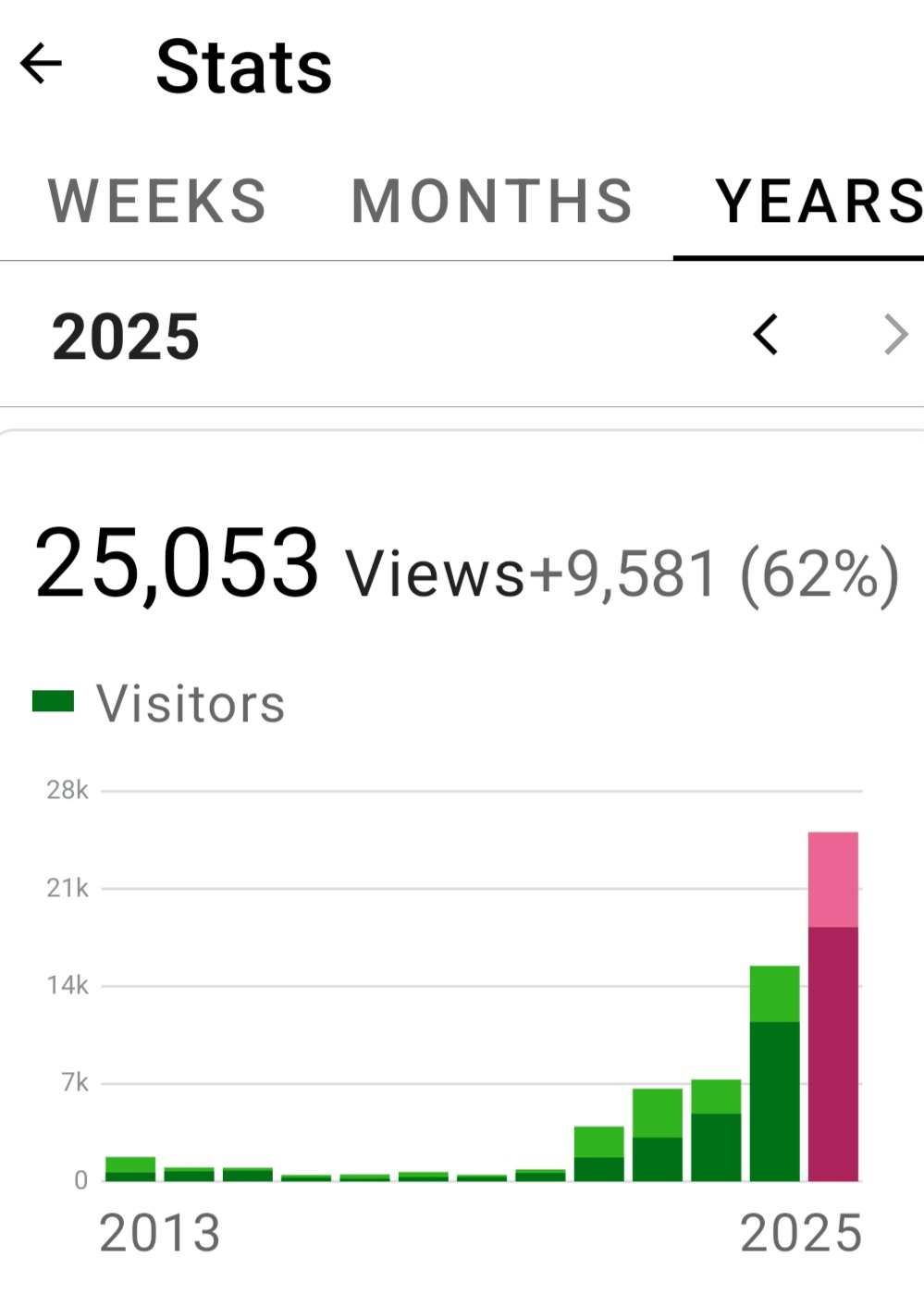
You took me by surprise again this morning. As always, when I awakened, I checked my Fitbit to see how my heart did overnight. Then I checked WordPress to see how my readers were doing.
And there you were. Another thousand views. A quiet jolt to the chart. Numbers climbing when I wasn’t looking.
You’ve been dancing higher and higher since October, when I passed 15,000 and figured I’d reached my high-water mark. I even wrote a piece of thanks back then, thinking I’d said all there was to say. But now here we are—December 11th—and this little corner of the internet has gathered 25,053 views.
I’ve done nothing different. I have no flashy headlines. I have no trending hashtags. I just keep following the same rhythm: writing essays born from memory in a home filled with love. I just keep foolin’ around with words and ideas.
So why now, after all these years?
That question hangs gently in the room with me. It’s not demanding an answer. It’s simply inviting a reflection. Maybe something shifted in the writing. Maybe it’s more expansive. Maybe it’s more lived-in. Maybe it’s a voice carrying a steadier warmth now. Maybe it’s grief that’s softened into grace. Maybe it’s love that arrived not with fanfare, but with a quiet hand stretched out in invitation. Maybe it’s all of those things. Maybe. And add to all those maybes one more. Maybe it’s readers sharing with readers.
Gary, of course, doesn’t ask to be written about. But his presence is here, between the lines, in the patience of a paragraph, the steadiness of tone, the way I’ve learned to let silence do some of the talking.
Ruby, on the other hand, insists on being written about, whether she’s nosing me away from my smartphone or curling up in solidarity as I revise for the twenty-fifth time. She is, as always, the keeper of the tempo, the mistress of the move.
So this isn’t an open letter to public stats. It’s a letter to something deeper. It’s a letter to what it means to keep writing when no one’s watching, and then to wake up and find that someone was.
My essays aren’t meant to dazzle. And I know: they don’t. They’re just small acts of holding up the light, one weekly reflection at a time. The fact that they’re being read, now more than ever, tells me something I didn’t expect: quiet honesty still finds its way.
Thank you, Sudden Surge, for reminding me that patience has its own reward, that consistency is a kind of faith, and that somewhere out there, readers are still pausing to linger with a slow essay from the mountain.
I don’t know what this upturn means, or where it leads. But I do know I’ll keep showing up with my smartphone in hand and love at my side.
—Carl Jung (1875-1961). Swiss psychiatrist and founder of analytical psychology.
My dream life has always been rich, layered, tapestried, and almost theatrical in its staging. I rarely dream about daily life. My dreams take place in cities I’ve never visited, landscapes that I’ve never seen, and eras long before or long after my own. And yet I always feel at home in them.
Usually, everything arrives in extravagant, saturated Technicolor.
But not this one.
Two nights after my seventy-eighth birthday, in the soft slumber between 6:06 and 6:30 a.m., I slipped into a dream unlike any I’ve ever had. It came in intense gradients of black, white, and gray. It was as if my subconscious had switched from paint to charcoal. When I woke, the dream woke with me, fully intact, waiting patiently for me to reflect.
I stood in an indoor space. It was a hall, a room, or perhaps a gathering place, and I was part of a crowd. I couldn’t tell you who the people were. Their faces were blurred, unreal, more like presences than individuals. Witnesses. Shapes. A chorus.
And then—
I saw them.
At first, they appeared as an elderly Black woman who was petite but arresting in presence. Their deeply ebony skin was creased and chiseled, textured like something carved rather than aged. Their hair fell in short, curved bangs and soft, tucked-under curls. Their eyes were dark, bottomless, and profoundly alive. They seemed not so much eyes as portals.
Then they began to twirl.
Slowly. Fluidly. Without strain or wobble. They descended toward the floor as if melting into themselves, spinning in a movement so smooth it seemed beyond anatomy. No catching of balance, no hesitation. It was just a gentle spiraling downward until they were nearly seated on the ground. Then, just as seamlessly, they spiraled upward again, rising on a single leg with the poise of something birdlike. Ancient. Balanced. Perched.
And in that rising, the transformation began.
Their skin tautened, and their features sharpened. The nose took on a beak-like elegance. The cheekbones drew higher. The eyes moved deeper into shadowed hollows. Their face tightened into something more elemental than human. They executed a slow, miraculous somersault. While still balanced on a single leg, they landed perfectly, continuing the twirl without effort, without breathlessness, without age.
By the time they came to stillness, they were statuesque, unshakable, and alive. Their gender had fallen away. What had begun as an old woman had become something older, an archetype, a presence, a force.
Through all of it, they moved with an ease that felt destined. No strain. No doubt. No pause to gather balance. The certainty with which they descended, ascended, transformed, and landed was astonishing. It was more than grace. It was alignment. It was a being doing exactly what they were meant to be doing, as naturally as breathing.
I felt awe. I felt love. A quiet message rose inside me:
Look at what is possible. Look at what we can become.
I call them Ebony.
Dreams this vivid don’t arrive as entertainment. They arrive as instruction. And this one, with its charcoal palette and its slow, impossible choreography, came carrying meaning that was mythic, psychological, and deeply human. Ebony wasn’t a character. Ebony was a message.
Their spiraling descent wasn’t collapse. It wasn’t weakness or age or decline. It was surrender. It was a deliberate returning to earth, to origin, to root.
And their rising wasn’t effort. It wasn’t strain. It wasn’t defiance of gravity. It was emergence. It was a lifting from truth. It was that ancient pattern of down-into-shadow and up-into-light. It was the true rhythm of transformation. It was also the rhythm of aging, if we let it be: not diminishing, but distillation into essence.
As Ebony’s form shifted, the nose sharpened, the cheekbones rose, the eyes deepened. They took on the geometry of a bird. Not literally, but symbolically. Birds see from above. They traverse realms. They carry messages. They balance effortlessly. Ebony became less human and more like an elder spirit, a watcher, a presence that stands at the crossroads between the earthly and the ascendant. Their final perch-like stance didn’t simply look like balance; it looked like perspective.
I wasn’t alone in that dream. I was part of a crowd. Their faces meant nothing, but their presence meant everything. I wasn’t receiving a private telegram. I was witnessing a universal message delivered in a room full of humanity, even if I couldn’t name a single person in it.
What surprised me most wasn’t the transformation. It was the love. I didn’t admire Ebony. I loved them. And that love wasn’t directed outward. It was recognition. I wasn’t watching someone else become extraordinary. I was watching a truth within myself step into view.
And perhaps most striking of all was their certainty. Every motion—the descent, the ascent, the impossible somersault—unfolded with the calm conviction of a being fulfilling its purpose. They weren’t performing. They were revealing. They didn’t try to succeed. They embodied success. Watching Ebony was like watching destiny moving through muscle and bone.
I’ve lived long enough to know that dreams like this don’t arrive to flatter us. They arrive to remind us. To unearth something we’ve forgotten. To widen the frame. To flip the narrative about aging, limitation, and impossibility.
Ebony didn’t come to tell me I’m special. Ebony came to tell me I’m not alone.
Because what unfolded in that charcoal dream happens in quieter ways in every life. We all descend. We all rise. We all tighten into a truer shape than the one we started with. The story of our lives is a long spiral into becoming.
What Ebony modeled with every fluid turn was the power of moving in alignment with our deepest truth, with the certainty of someone fulfilling their purpose. Not arrogance. Not bravado. But a quiet internal knowing:
This is who I am. This is what I’m here for. This is the shape my becoming must take.
Ebony wasn’t hoping to land the somersault. They had already landed it in intention before the body ever followed.
And that, I believe, is the invitation for all of us:
To move toward the life that feels destined. To step into the self that feels true. To let doubt loosen and purpose clarify. To embrace the possibility that becoming doesn’t stop—not with age, not with loss, not with time.
Life doesn’t narrow as we grow older. It deepens.
Sometimes, in the quiet hours before dawn, a presence appears, not to frighten us, but to awaken us. A reminder. A revelation. A truth we’ve grown old enough to finally understand.
“If you light a lamp for someone, it will also brighten your own path.”
— Buddha (Siddhārtha Gautama, c. 563–483 BCE). One of history’s most influential spiritual teachers.
Lost once again. The map was blurred, the faces were turned away, and even my voice felt foreign in my own mouth. I asked for help—and the world, polite but indifferent, kept walking past me.
Then, from the corner of the dream, they came: a quiet order of nuns, habits brushing against the air like whispered prayers. They didn’t question, didn’t doubt, didn’t ask why I’d lost my way. They simply pointed, walked beside me, and led me back—not home, but to shelter.
The next day, in a hall filled with strangers, I stood and wept. A litany rose unbidden from somewhere deep inside my soul:
“You, when others wouldn’t. You who stopped. You who listened. You who saw. You who guided.”
Even in dreams, grace has its own coordinates. It finds the weary traveler and teaches him again how to say thankyou.
If we can rise to that level of grace in our dreams, surely, we can do the same in our waking worlds, not only as we approach tomorrow’s GivingTuesday but also for the days and dreams following.
I’m always moved by GivingTuesday, but here’s what touches me most about all giving on any day. It’s rarely the grand gesture that changes a life. It’s the small one. The held door. The unexpected kindness. The “you, when others wouldn’t.”
History is full of moments when the world pivoted because someone chose to act quietly.
A schoolteacher once told a shy seamstress she had worth. Rosa Parks carried that worth onto a bus—and stayed seated. One small affirmation. One historic refusal to rise.
A girl in a noisy cafeteria slid her tray beside the classmate no one chose. Temple Grandin steadied. And the world gained a scientist who would reshape our understanding of animal behavior with a mind sharpened by that single act of belonging.
A janitor, keys jangling at his side, unlocked a door he technically wasn’t supposed to open. Katherine Johnson stepped through that doorway and, years later, calculated trajectories that sent astronauts safely around the earth and back again. A quiet gesture. A giant leap.
A grieving orphan found milk bottles on her doorstep each morning—paid for by a neighbor who refused to let her go without. Eleanor Roosevelt drank that kindness into her bones and later poured it back into a nation hungry for courage and compassion.
A librarian in rural Arkansas bent one small rule and whispered, “Take as many as you can carry.” Maya Angelou carried the world home in her arms. One book. One voice saved.
A neighbor left warm pies on the porch of a lonely, sick boy. Fred Rogers tasted gentleness—and spent his life serving that same gentleness back to millions.
And once, in a coal camp tucked into the hills of West Virginia, there was a boy with more dreams than dollars. Family scraped together what they could. Hometown folks established a scholarship for books. And a benefactor he never met—a woman with a soft spot for sons of coal miners—left a scholarship in her will. A small legacy. A single key. It opened the doors of Alderson–Broaddus, and he walked through. One quiet kindness at a time, my whole life unfolded.
GivingTuesdaybegan the same way—a small act against a noisy world.
In 2012, while Black Friday and Cyber Monday shouted for our wallets, one community center in New York whispered a different idea: Whatifwesetasidea day togiveinsteadofgrab? No marching band. No corporate roar. Just a fragile invitation to generosity.
From that whisper came a wave.
By 2013, national organizations amplified the call, and tiny local charities set $1,000 goals for school supplies—and met them.
By 2017, corporations began matching donations in the millions, while families sent $10 to local food pantries so children could eat over the weekend.
In 2020, during the hardest months of the pandemic, GivingTuesday saw its greatest surge—global giving and neighborhood kindness flowing side by side, from billion-dollar pledges to collected change for an elderly couple’s grocery delivery.
By 2023, U.S. donors gave over $3.1 billion, even as small wildlife refuges and shelters used single matching gifts to exceed their modest goals.
And 2024 reached new heights: an estimated $3.6 billion donated nationwide. But alongside those vast totals was a tiny nonprofit raising just over $5,000 from 37 supporters—enough to keep its doors open one more year.
Big gestures. Small gestures. All pointing the way.
The nuns in my dream offered direction, compassion, a hand on my elbow saying, “This way.” They changed everything by simply choosing to care. The nuns in my dream led me to shelter.
This GivingTuesday, maybe we can do the same—for someone still searching for the way back.
“I would maintain that thanks are the highest form of thought.”
—G. K. Chesterton (1874–1936,). influential English essayist whose sharp wit, moral clarity, and human warmth made him one of the most quoted thinkers of his time.
My blog surprised me again this week. Back in October, I crossed 15,000 views and thought I’d reached my high-water mark for the year. Now, barely a month later, I’m staring at an even bigger number:
20,062 views—with a full month still to go.
That’s more than last year, more than the year before, and more than I ever expected from this little mountain corner of mine. Apparently, these memoir stories I write from a quiet oasis in the wilderness of Virginia keep finding their way into far-off places—and into the hands and hearts of readers I’ll never meet yet somehow feel connected to all the same.
ReasonstoBeGrateful
But 20,062 isn’t really a number. Not to me.
It’s the sum of moments someone chose to spend with my words. It’s a cup of coffee that went cold on a stranger’s table because they lingered. It’s a pause in someone’s busy day. It’s a late-night scroll where someone said, without ever typing the words, “I’ll stay a little longer.” Twenty thousand tiny gestures of yes in a world full of noise.
And the deeper truth behind that math—the part I keep circling back to—is that this milestone isn’t about reach or visibility or bragging rights. It’s about what it represents in the long arc of a life. I’ve lived enough years, and carried enough stories, to know that readers don’t show up unless something in the writing rings true. They don’t return unless the voice feels familiar, honest, worth sitting with. They certainly don’t keep climbing toward 20,000 unless the stories hold something real.
So this isn’t a celebration of views.
It’s a quiet acknowledgment that I’ve kept faith with my own voice—through reinvention, through loss, through love found unexpectedly, through the strange and luminous chapters that have made up this year. And somehow, astonishingly, readers have kept faith with me.
And yes, threaded into the margins—without ever mentioning Gary by name—is the quiet steadiness that has shaped this year in ways I’m still learning to articulate. Love doesn’t call attention to itself; it simply widens the edges of your life. It softens how you move through the world, deepens the tone of your voice, and reminds you that being read is wonderful, but being seen—fully, gently, without hurry—is something else entirely.
This year, more than any before, has reminded me that showing up with a story is an act of hope. And reading one is, too. Somewhere in that exchange—when the writing meets the reading—something human and steady is created. Something that matters.
So here I sit, on a chilly Thanksgiving week, taking in this milestone not as a trumpet blast but as a simple moment of gratitude. Gratitude for the readers who knock on my digital door day after day. Gratitude for the chance to tell the stories I’ve carried for decades. Gratitude for the ways this year has widened, softened, and surprised me—and for the quiet presence that keeps teaching me that the best stories are the ones we live, not just write.
I didn’t expect this climb to 20,062. But I’m grateful for every step, every reader, every quiet yes.
And with a month still to go, I’ll just say it now—
Benjamin Franklin had Poor Richard. TheWiredResearcher has Poor Brentford Lee and welcomes him back as a guest contributor— louder than a sardine timer and twice as slippery— to sanctify our Thanksgiving tables with a bold mix of satire and sass.
Discerning readers like you, My Dear Friends, have no doubt noticed that from time to time, I write my posts under what I would call my nom de plume, Poor Brentford Lee. I like it, especially since it always makes me feel that I’m right up there in American letters right beside Ben Franklin and his famed Poor Richard.
I suspect it is with me as it was with Franklin. Using a nom de plume allows me to say things that I might have better sense than to say under my real name.
Anyway, I like Poor Brentford Lee enough that I let him grab hold of my smartphone and tap his heart away to share whatever it is he insists on sharing about Thanksgiving!
And this, My Dear Friends, is precisely where I step aside and let Poor Brentford take over. He’s already clearing his throat, poised to pontificate about Thanksgiving and give you a mouthful about all the other holidays we might celebrate. Or not.
Take it away, Poor Brentford…
Law me, Child, you would think folks would leave well enough alone and let Thanksgiving shine on its own once a year. But no. One day’s not enough for some people. They’ve gone and populated the whole turkey week with holidays!
Where shall I begin and how shall I spit out all the celebrations making every day on my calendar look like parchment with measles.
I’ll tell you here and now. Lace your girdle. Tighten your suspenders. Better still. Do both.
“Who? Me?”
“Yes. You. You tin-bellied Buzzard.”
And no. It is not true, the rumor that you may have heard that Ben Franklin wanted the buzzard to be declared America’s national bird. (And even if he had, he would not have endorsed eating it for Thanksgiving instead of turkey. So don’t let my nonsense bother your pretty little mind nary a whit when you sit down and take a gander at the golden bird on your table. It’s a turkey. And, besides, a turkey by any other name tastes the same.) But he did prefer the turkey over the Bald Eagle–which was, is, and forever shall be America’s national bird. He thought the eagle had “bad moral character” whereas the turkey was a bird “of courage.” But I assure you, Franklin never advocated that the turkey–or buzzard–be elevated to a national symbol.
But let’s get back to this bird of courage, with my genuine assurance that you’ll be stuffed by the time yours is done. (And it may be already.)
Do you realize that just a few days ago–Monday, November 24–folks celebrated:
● CelebrateYourUniqueTalentDay. (Law me, Child, half of us still haven’t identified a talent, and the other half are busy showing theirs off on Facebook. Settle down and smooth your feathers. We’re all special just as we are.)
● D. B. Cooper Day. (Lord help us! Who in their stuffed mind celebrates a masked, unidentified airplane hijacker? Pass the gravy, please—and make it strong.)
● International Au Pair Day. (Bless their ambitious little hearts. Raising other people’s children while living in their basements. That’s not a holiday—that’s a calling.)
● National Brand Day. (Because nothing says Thanksgiving spirit like corporate logos. Law me twice and hand me a napkin.)
● National Fairy Bread Day. (Child, that’s just white bread with butter and sprinkles. The Australians have some nerve calling it a delicacy. Bless their festive little hearts.)
● National Sardines Day. (Well, thank you! I think I will. Pass the saltines, please. Those fishies may be little, but they sure pack the omegas. Goodness, no. No need to open the windows. Light a candle? Have you lost your mind? Eat some sardines and chill.)
Land’s sake. That’s just Monday’s shenanigans.
I won’t dare trot my way through Tuesday and Wednesday, and when we get to Thanksgiving Day(the granddaddy of all American feasts), we’ve got at least five other celebrations dotting up my measled calendar—including Turkey-Free Thanksgiving. (I’m about to faint. Run fetch the smelling salts, please.)And Pins and Needles Day.(No doubt all the turkeys in the land are on theirs. My stars, even the Macy’s balloons look nervous.)
And don’t get me started on what follows on Friday. It’s none other than Black Friday, but Poor Brentford calls it National Lose Your Religion Day.
Thank your lucky un-plucked feathers that brings us to December, filled with an entire navigation of celebratory days that won’t get stuck in anybody’s craw.
The month barely opens before we’re knee-deep in Advent (which starts on November 30 this year—law me, Sweetheart, someofusarestilldigestingstuffingandtherestofusarerememberingthatwe meant to buy candles).
Then comes December 8, the Feast of the Immaculate Conception (a reminder that December still knows how to be holy before the cookies take over).
December 10 brings Human Rights Day (which, given the state of the world, ought to be celebrated daily, loudly, and with snacks).
December 12 offers the Feast of Our Lady of Guadalupe (a celebration so radiant it could light a path clear across the Shenandoah), and December 13 arrives with SaintLucy’sDay (bless their bright little candles; it’s the one holiday where setting fire to your hair is considered festive).
And then, Sugar, December 21 rolls in with the Winter Solstice (the shortest day of the year—when the sun says “I’m tired” and slips behind the hills before Poor Brentford has found his reading glasses).
December 24 is Christmas Eve (the day we all lie and say “just one more cookie”), December 25 is Christmas Day (the grandmammy of gift wrap and gravy boats), and December 26 brings the first day of Kwanzaa and Boxing Day (a pair of celebrations that stretch the season just a little sweeter and a little longer).
Finally, December 31 lurches toward us as New Year’s Eve (when half the country watches the ball drop and the other half drops before the ball does).
And before you start thinking December has nothing left to get stuck in your craw, Dear One, let Poor Brentford assure you otherwise. We haven’t even touched the other December shenanigans—those bafflin’, bedazzlin’, bubble-blowin’ celebrations that make a body wonder who’s in charge of this calendar.
Take Package Protection Day (Law me, Sweetheart, if your packages need protection, it’s already too late).
Then there’s Bathtub Party Day (Heavens no. These bubbles are reserved for… well, that’s none of your business).
Put On Your Own Shoes Day arrives next (bless their slow little hearts—and who, pray tell, was puttin’ ’em on before today?).
National Letter Writing Day finally appears (fetch me a quill and ink pot pen before the feeling passes), followed closely by Weary Willie Day (and aren’t we all, after this calendar?).
Then up pops Dewey Decimal System Day (now kiss my librarian grits—this is a holiday worthy of humanity), and International Mountain Day (Child, here in the Shenandoah, every day is Mountain Day, even Tuesday).
Fast-forward a bit and December tosses out National Whiners’ Day (celebrated mostly by folks returning gifts they don’t deserve), followed by Still Need To Do Day (my to-do list fainted dead away—fetch the smelling salts), and finally Make Up Your Mind Day (if only—Poor Brentford’s been undecided since the first time he picked up a pen).
As for me, I’ve made up my mind that I’ve stuffed you with enough celebrations already, and I’m not about to puff up my feathers and strut around with more. Land’s sake alive! If I got going on all the celebrations we won’t be celebrating in 2026, I’d be here forever and you’d be reading even longer. (One reader told me just a feather or two ago that I was getting pretty windy.)
Now, before you fan yourself and declare that Poor Brentford has lost the last marble he was ever loaned, let me tell you something plain and true. All this fussin’ and frettin’ over holidays—big ones, little ones, ridiculous ones—might seem like the carryings-on of a nation that’s plum run out of sense. But Sugar, I don’t think that’s it at all. Not deep down.
I think we keep inventing these goldurned celebrations because we’re hungry for each other. Hungry for community, for belonging, for a reason—any reason—to stop the world long enough to say, “I’m here, you’re here, thank heavens we made it another day.”
We are a scattered people trying to stitch ourselves back together with whatever thread we can find—peppermint bark, bathtub bubbles, mountain days, turkey days, even days devoted to weary Willies and packages that need protecting. It’s laughable, yes. But it’s also a kind of hope. A kind of reaching.
And if you ask me—and you didn’t, but here I go anyway—I think we ought to take these foolish little observances and set them right on the Thanksgiving table alongside the mashed potatoes and cranberry sauce. Call them what they are:
Laughable Blessings.
Because heaven knows we need reasons to laugh. We need excuses to gather. We need bright spots—silly or sacred—that remind us we belong to one another, even on the days we feel most alone.
So Child, if some little holiday comes along and tickles your wishbone or nudges your heart, pull up a chair at your Thanksgiving table and let it sit a spell. Celebrate it. Laugh at it. Give thanks for it.
Light a candle. Bake a pie. Wear the dress or don’t (but mercy, cover the essentials). Put on your own shoes—today or tomorrow.
Because in the end, Thanksgiving isn’t only about turkeys and table linens. It’s about noticing the small things—absurd, tender, holy—that remind us how lucky we are to be here at all.
And that, My Dear Readers, is a blessing worth celebrating on Thanksgiving and every day of the year.
Poor Brentford Says
Eat well. Laugh loudly. And Sweetheart, if life insists on giving you a celebration for every day on the calendar… count them as blessings — even the laughable ones.
“Seeing into the future? Maybe. But the real vision is daring to look closer—at now.”
—Extra E(Ad)dition for a NY Times Essay that didn’t exist on this day in 1947.
The world at large knows fully well that I’m always walking around with something rumbling around in my head. Half a paragraph. A misplaced metaphor. An idea that swears it’s a New Yorker masterpiece if I’d only give it five quiet minutes.
Today, though, it’s something else. It’s a song. If you’ve been around as long as I have—seventy-eight years today, thank you very much—you probably know it, especially if you like high notes of hope and courage.
It’s “I Can See Clearly Now,” released by Johnny Nash in 1972. It hit the Billboard Hot 100, Billboard Adult Contemporary charts, and Cash Box. I’m not surprised. From the moment those opening bars roll in, with that bright, easy rhythm that feels like sunlight tapping at your window, you’re already halfway to feeling better about the world. And then the lyrics land with their uncomplicated hopefulness:
“I can see clearly now, the rain is gone… It’s gonna be a bright, bright sun-shiny day.”
It’s a song that doesn’t pretend to be profound. It is profound because it’s simple, clean, declarative, and certain. The rhythm carries you forward. The lyrics lift you up. It’s optimism set to a beat you can sway to. It’s a three-minute promise that whatever clouds you’re carrying won’t last forever. The doubts that pile up like storm fronts won’t last. The troubles that cling like a stubborn fog won’t last. The little fears that hover just above eye level won’t last. Even the big ones that black out the sky won’t last.
Nash calls them “obstacles in our way,” but we all know what he means. Heartbreaks. Hesitations. Heavy thoughts. Anything that dims the day before it even begins. His song doesn’t erase them. It dissolves them, one bright measure at a time.
So for three minutes, the rain really does feel gone. And even if the sun isn’t shining yet, you believe with full, uncomplicated certainty that it’s on its way.
So there you have it. My. First. Clue!
And somewhere I hear a chorus of readers asking:
Clue to what, exactly?
All right, if you insist, I’ll go ahead and tell you what I was going to tell you anyway.
Like I said, it’s my birthday. You’ve probably already marked your calendars, because I do tend to make a fuss every year.
And yes, I’m talking about my birthday presents. Or rather, my presence.
Every year, I receive lovely gifts, but the silliest, most ridiculous one always comes from me. I buy myself something special—something utterly frivolous—and I wrap it in the most over-the-top paper I can find. Then I write myself a card declaring, in no uncertain terms, how truly spectacular I am.
Because guess what? I am spectacular.
Guess what else? You are, too.
This year’s gift? Well, it’s so far out there I’m not sure I dare tell you what I’ve done.
But I will give you another clue or three, like the one I just gave you.
Vision. It has to do with my eyes.
“Good God, no! I’m not having cataract surgery!”
Why, you’ve got some nerve even thinking such a thing—let alone blurting it out for the world to hear. Maybe in a few years I’ll blurt it out myself, but not this year.
Any guesses? None? Oh, come on. You can do better than this.
All right then—one more hint.
Glasses!
And to that clue I’ll add a question: Do you remember those 3-D glasses we used to wear at the movies? The cardboard ones with one red lens and one blue? The kind that made the screen come alive and sent spaceships flying toward your popcorn, dinosaurs roaring in your lap, and your best friend ducking beside you like it might all be real?
Those gloriously goofy things that made the world look both ridiculous and absolutely amazing at the same time?
Try to remember. You can, I’m sure.
I sure did when I opened the mail not too long ago and saw what I saw. I saw the future coming right at me. Really. Right at me.
I knew immediately: this was it. My birthday splurge.
Might I have a drumroll, please, before my big reveal?
And now, My Dear Readers, I am pleased to announce that I treated myself to …
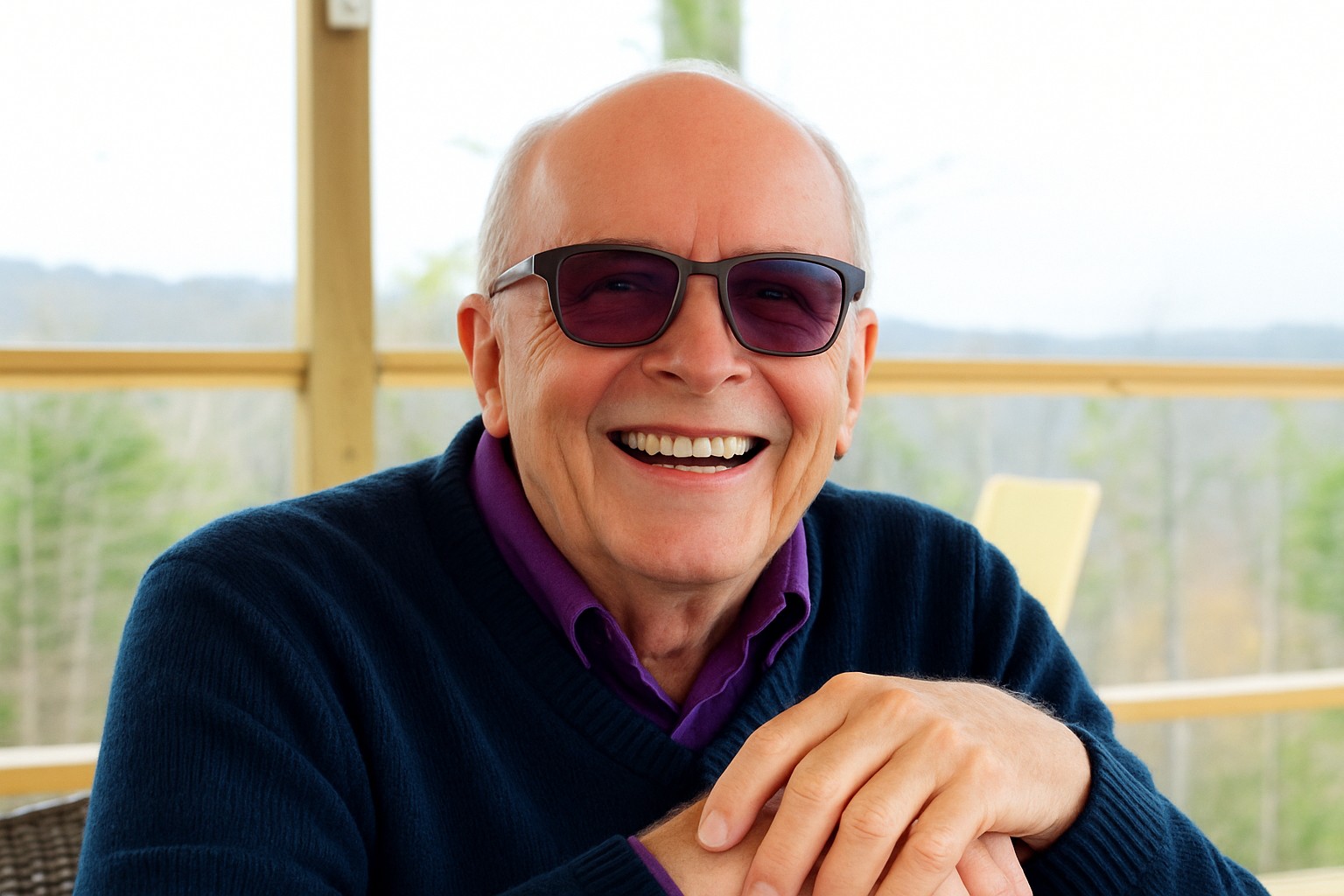
… a pair of sleek, impossibly cool Ray-Ban Meta AI glasses with dark gray frames and purple transition lenses. They’re futuristic enough to make James Bond fumble for the manual. They gleamed like they already knew my secrets. The ad promised, “Experience Meta AI like never before,” and I swear it winked at me.
And yes, I bought them.
I didn’t need them. I just got new glasses in June. But I wanted them because something in me knew this was more than eyewear. This was foresight.
So brace yourself (and maybe pour yourself a dram of Bunnahabhain): I have officially joined the ranks of the cyborg chic.
I’d love to tell you I can see clearly now, to croon along with Johnny Nash, but the truth is—literally speaking—I can’t see much better.
Figuratively? Metaphorically? You bet! I can see better and farther than ever.
I’ve been writing about artificial intelligence since the early chatbots of 2021. I’ve talked about robots, about ChatGPT, about how this strange partnership between humans and machines is unfolding faster than anyone expected—certainly faster than most people are ready for.
And I, for one, don’t want to be left behind blinking in the dust.
I want to experience it. I want to learn from it. I want to understand where it’s leading us—not from the sidelines, but right in the thick of it.
So these glasses aren’t just a frivolous birthday splurge. They’re my passport to the next chapter. They’re literally my lens on the merging of human curiosity and machine intelligence.
That merger is coming, you know, when man and machines become one. It’s called the Singularity. A year or so ago, it was projected for 2037. Now I think futurists will be lucky if it waits five. And if that’s true, then I plan to be ready. I don’t want to be afraid. I don’t want to be resistant. I want to be curious. I want to be awake. I want to be willing to see.
I’ve spent seventy-eight years watching the world evolve in ways my childhood self could never have imagined. And yet, here I am, ready to keep moving forward.
My Ray-Ban Meta glasses are just a step in that direction: a gift to my future self, a wink to the present, and a promise that I’ll keep exploring what’s possible. Because for me, this isn’t just about sight. It’s about vision.
There you have it. Now you know. This seventy-eighth birthday gift might be my best ever from-me-to-me gift. These new AI glasses don’t just sit on my face—they announce something. They say I’m still moving forward, still curious, still willing to step into whatever’s next and report back with a grin.
I didn’t just give myself a gift. I threw down a gauntlet. Johnny Nash didn’t promise perfect vision; he promised guts. These AI glasses may not sharpen every detail, but they supercharge my curiosity. Maybe that’s the real clarity: strapping on the future, stepping into the frame, and letting life rocket toward me in full, outrageous 3-D.
If the future wants to come screaming at my face, fine by me. I’ll meet it head-on, glasses gleaming, ready for the light—and absolutely ready for my close-up, grinning from ear to ear.
“The real voyage of discovery consists not in seeking new landscapes, but in having new eyes.”
—Marcel Proust (1871–1922). from his The Captive (1923), the fifth volume of his seven-part masterpiece In Search of Lost Time. Proust’s exploration of memory and perception reshaped modern literature.
Somewhere I saw it. Everywhere, maybe. Nowhere? Wherever—it grabbed hold of me and wouldn’t let go.
It was the gripping question:
“What would you tell your 18-year-old self?”
It lingered—since forever. Or yesterday? Either way, one morning not long ago, I tried to get rid of it by tossing it out to others—as if the orphaned question might leave me alone once it found a new home.
The replies were as varied as I expected, and as humorous and matter-of-fact, too:
“Buy stock in Apple and Amazon.”
“Be good at life; cultivate a well-rounded lifestyle.”
“Be patient; trust in God.”
“Serve God better.”
“Stay young; don’t age.”
“Be friends with your mom. Spend more time with family. Don’t let important things slide.”
“Don’t worry about impressing anyone other than yourself.”
Almost always, their offerings included a request to hear what I would have told my 18-year-old self. As a result, the question dug itself more deeply into my being, as I stalled by answering:
“I’m still thinking.”
It was true. But I knew I had to answer the question, too, not for them, but for me.
Several possibilities surfaced.
The first was rather light-hearted:
“You don’t have to have it all figured out. Just stay curious, kind, and honest. Don’t waste your energy chasing approval. Learn to cook, listen more than you talk, and remember: dogs and good people can tell when your heart’s true. Oh, and wear sunscreen.”
I dissed it immediately (though it carried some truths). Then I came up with:
“Don’t rush. The world will still be there when you’re ready to meet it. Pay attention to seemingingly insignificant things. They’re where meaning hides. Keep your humor close and your integrity closer. Fall in love, but don’t lose yourself in the process. And when life hands you a fork in the road, check which one smells like supper.”
I didn’t like that any better, though it, too, spoke truth. I was certain I could nail it with a third attempt:
“You think you know who you are right now, but you’re only meeting the opening act. Be kind. Be curious. And don’t confuse noise for meaning. The world rewards loudness, but grace whispers. Listen to that whisper. It’s you, becoming.”
Then six words sauntered past, not so much tinged with regret as with remembrance. Six words. Six.
“Be a citizen of the world.”
Those words had crossed my path before. In fact, I remember exactly when—not the actual date but instead the general timeframe and the location.
It would have been in the early 1980s, when I was working at the Library of Congress. I was standing in the Main Reading Room of the Jefferson Building, as captivated by its grandeur as I had been when I first started working there in 1969.
Above me, light spilled through the dome like revelation. Gold, marble, and fresco conspired to make the air itself feel sacred, as if thought had taken on architecture. Beyond those arches, knowledge waited in silence, breathing through pages and time.
Even now, I can close my eyes and see it: the way the dome seemed to rise into forever—an invitation, a reminder—that the world was larger than any one life, and I was already standing in the heart of it.
As an editor of the National Union Catalog, Pre-1956 Imprints—the “bibliographic wonder of the world”—I knew every alcove, every corridor, every one of its 532 miles of bookshelves, holding more than 110 million items in nearly every language and format. I had walked those miles over and over again doing my editorial research. I had come to learn that knowledge knows no barrier. I had come to learn that it transcends time and place.
At the same time, I decided that I could transcend place, too. With my experience and credentials, I began to imagine working in the world’s great libraries—first the Library of Congress, then The British Library, then the Bibliothèque Nationale de France, then the Biblioteca Nazionale Centrale di Roma.
I didn’t know where the journey would end, but it gave me a dream, a dream of being a citizen of the world of learning.
More than that, it was a dream untainted by pretense—never by the notion of being uppity. Instead, it was a simple dream. I figured that if I had made it from the coal camps of West Virginia to the hallowed halls of our nation’s library, I could pack up whatever it was that had brought me that far and go throughout the world, savoring knowledge and learning—and perhaps, over time, gaining a smidgen of wisdom.
But here’s the catch. If transcending geography is the measure of my dream’s fulfillment—the wanderlust, the scholar’s yearning for marble floors, old paper, and the hum of languages not my own—then, at first glance, I failed. I never made it to any of the world’s great libraries except the Library of Congress.
However, as I look back through my life-lens of 78 years come November 20, I realize that maybe I went beyond the geographic destinations that I set for myself.
I went from the mountains of West Virginia to the monuments of D.C., from there to the marshlands of South Carolina where I earned my Ph.D., from there back home to the monuments, and, from there, at last, to the Shenandoah Valley and college teaching that took me internationally via Zoom and tapped into Open Educational Resources that did away with the restrictive border of printed books.
In a sense, then, although I didn’t cross country borders, I crossed the borders of ideas, with my voice carrying me farther than my feet ever needed to.
I’ve managed to live generously, teach across generations, write with empathy, research with joy, garden with gratitude, cook with curiosity, and love with intentionality. In all of that, I have been that citizen of the world—not by passport stamps, but by curiosity. By compassion. By connection.
Maybe that’s the truth I’d offer my 18-year-old self:
“You don’t have to travel the world to belong to it. You only have to live with your eyes open.”
“You are what you do, not what you say you’ll do.”
— Carl Jung (1875–1961). Swiss psychiatrist and founder of analytical psychology. emphasized that our true selves are revealed not by intention or belief, but by what we live out in daily practice.
There I stood in front of the bathroom mirror, mouth open as wide as possible, POH floss taut around the index finger of my left hand, guided by my thumb and index finger on my right. Working its way between my teeth—down gently to the lowest point of the gum. Down again. Then inward, scraping upward toward light.
If it sounds like deliberate flossing, it is. If it sounds slow and tedious, it is. If it sounds laborious, it is.
But I call it flossing with intentionality.
I’ve been doing it that way since my dental hygienist scolded me:
“You need to work on flossing. You can do better than this.”
She picked up the mirror, held it in front of my face, and proceeded to show me what her words meant. To show me her words in action.
“Hmpfff,” I thought—but I responded cheerfully:
“You mean floss with intentionality?”
She agreed. We both laughed. She had made her point. I had made mine.
Since then, that’s how I’ve flossed. With intentionality. It’s paid off: at my last visit she tossed “perfect” my way. And I’ll keep on doing it that way. With intentionality.
No doubt you got stuck on that word—intentionality—the way floss sometimes gets stuck between teeth. I know. It’s a mouthful. You’re probably thinking: Why not just say intentional? Orintentionally?
Let me explain.
● Intentional is about a single act.
● Intentionally is about how you perform it.
● But intentionality? That’s deeper. That’s aim. That’s purpose. That’s the why behind the what.
Flossing, it turns out, has layers.
I know—this is the point where you’re thinking:
“Jesus, have mercy on us all. He’s found religion in dental hygiene.”
I laughed at myself even as I thought what you might be thinking. But work with me. As I flossed with intentionality—somewhere between my molar and my bicuspid, something clicked—a connection I’ve never made before.
My mind jumped to Flannery O’Connor, and suddenly I understood a moment in “A Good Man Is Hard to Find” that has puzzled me for decades.
It’s one of O’Connor’s most anthologized stories, and it may be her most popular.
The plot is straightforward, even if rather bizarre. A grandmother travels with her son, daughter-in-law, and grandchildren on a road trip from Georgia toward Florida. After a car accident on a remote dirt road, they encounter an escaped criminal called The Misfit and his accomplices. One by one, the family is taken into the woods and killed, ending with the grandmother herself.
Readers are drawn to the grandmother from the start, seeing her as the very picture of a Southern lady in what feels like the 1950s. She dresses with care—crisp dress, lace collar, little violets on her hat—making sure everything is neat enough for strangers to admire, even in a roadside tragedy. Her perfume lingers a touch too long in the air. Her purse never leaves her lap. She pats her hair, straightens her gloves, checks her stockings — always tending the exterior.
She talks about church and Sunday school, but mostly as headlines — what good people ought to do, the kind of families who raised their children right. She’s quick with a reminder of how things used to be, what’s proper, and who counts as “good.” It’s all comfort and fussiness and appearances—a kind of spiritual cosmetics—right up until the trip begins to unravel.
And let’s not forget her lace collar—starched and scratchy, the kind she insists on wearing because a lady must look her best, even for a family car trip. It’s lovely, but it doesn’t quite fit; she’s never worn it enough to get it broken in—maybe like church.
By the time they’re on the road, tiny red hives rise along her neck and forearms, quiet protests from the body against all that starch and striving. She smooths the collar, straightens her gloves, hoping no one notices. She blames the heat, the dust, the damp air — anything but the truth that what she’s wearing isn’t working. The surface still matters more than the comfort underneath.
But what’s charming at first begins to fray. Beneath all that talk of goodness, the grandmother bends the truth with ease. She even smuggles her cat, Pitty Sing, into the car, though her son told her not to — “She didn’t intend for the cat to be left alone in the house,” O’Connor writes. Later, she invents a story about an old plantation with a secret panel, coaxing the family down a road that doesn’t exist. Each little deceit feels harmless enough—until it isn’t.
The children, of course, see straight through her. They don’t have the manners to pretend otherwise. June Star rolls her eyes, John Wesley calls her out, and both treat her nostalgia like background noise on the radio. When she tells them about good manners and better times, they mock her for being old-fashioned, for caring about looks and words that don’t seem to matter anymore. They don’t have the vocabulary to name her superficiality, but they sense it. To them, she’s not a moral guide—she’s just a woman in a hat talking about things that no longer exist–including depth of religion.
By this point, readers are beginning to see through the grandmother just as the children do. But then O’Connor gives the story a twist. The car accident, the dusty road, the sudden appearance of The Misfit—it all happens so fast that readers lose the moral footing they thought they had. As the family is taken into the woods one by one—John Wesley among the first, his name a grim irony in a story where method and faith have both gone missing—we’re left asking the question that won’t stay quiet:
What have they done to deserve this?
Even the grandmother, shallow as she seems, doesn’t deserve what’s coming. So we read on, confused, repelled, hearts racing—until the moment The Misfit raises his gun and fires. It’s shocking not just because of the violence, but because it follows her desperate, Bible-soaked pleading.
Cornered by her own mortality, she does what humans do best—she bargains. For the first time, her words aren’t just social niceties; they’re survival. She reaches for the only language she’s ever trusted—manners and religion—and uses both as bargaining chips.
“Jesus!” the old lady cried. “You’ve got good blood! I know you wouldn’t shoot a lady! I know you come from nice people! Pray! Jesus, you ought not to shoot a lady. I’ll give you all the money I’ve got!”
“Lady,” The Misfit said, looking beyond her far into the woods, “there never was a body that give the undertaker a tip.”
Ironically, she keeps calling him “a good man,” echoing her earlier insistence that goodness can be found if you just name it often enough. But here, that phrase lands differently—less like flattery and more like faith. Deep down, she sees what the story has been telling us all along: even The Misfit, for all his violence, has goodness somewhere buried “at heart.”
She tells him he’s a good man, that he doesn’t come from “common blood.” She insists he could still pray, that Jesus would help him if only he’d ask. Her words tumble out, frantic and uneven—a lifetime of secondhand faith suddenly put to the test. “If you would pray,” she tells him, “Jesus would help you.” But when he replies that Jesus “thrown everything off balance,” she keeps talking, keeps reaching for the right words—the spell that might save her. It’s as if she’s trying to talk her way out of judgment—and maybe she is—but in those final seconds, something shifts. Her words begin to reach beyond fear toward recognition. What she’s said all her life as habit now becomes necessity. The performance becomes real.
And let’s not forget the touch. When the grandmother reaches out and lays her hand on him, calling him one of her own children, he jerks back “as if a snake had bitten him.” It isn’t disgust—it’s recognition. For a flash, he feels the very grace he’s denied all his life. Her touch makes him human again, and that’s what terrifies him. To be seen, to be loved, to be known—that’s a deeper wound than any bullet he’s ever fired.
What happens next isn’t judgment—it’s comprehension. He understands, maybe for the first time, what real goodness requires, and he speaks the line that has confounded readers for decades:
“She would have been a good woman if it had been somebody there to shoot her every minute of her life.”
That’s the key. The Misfit sees what she—and most of us—miss: you can’t talk the truth. You have to live it. The gun isn’t about punishment; it’s about presence—the awareness of consequence, of mortality, of meaning. Under that barrel, the grandmother finally becomes what she’s always pretended to be: awake, honest, human. For a heartbeat, she lives her religion with intentionality.
And that’s where the story turns on us. Because most of us aren’t much different. We go about our days performing goodness—saying the right words, wearing the right smiles, believing that intent counts as action. But it’s not until we’re pressed, tested, or cornered by something real that we discover whether our faith—whatever form it takes—has roots or only ribbons. The challenge, of course, is to live that truth without the gun in our face. To make it real not out of fear, but out of choice.
The Misfit was right, though I doubt he knew how right. Most of us need something to jolt us out of habit—some modern version of a gun to the face—before we remember what matters. But we don’t have to wait for disaster to live with that kind of clarity. We can practice it. Daily. With intentionality.
That’s where the floss comes back in. Standing at my bathroom mirror each morning, I’m not just scraping away plaque; I’m scraping away pretense. It’s slow, it’s tedious, and no one applauds when I do it. But that’s the point. It’s the small, deliberate acts—the ones nobody sees — that keep the decay from setting in.
It’s in washing the dishes instead of leaving them for later. In calling a friend before the guilt of silence sets in. In thanking the grocery clerk by name and meaning it. In forgiving someone who’ll never know they’re forgiven. In noticing the good, not because it’s big, but because it’s there.
And maybe that’s the heart of it—that being a good man, a good woman, a good human being, takes intentionality. Not perfection, not piety, not public virtue, but daily, deliberate choice. To listen when it would be easier to talk. To comfort instead of correct. To admit fault, show mercy, offer grace. To keep showing up, even when no one notices.
Search all the faiths of the world—all the belief systems, ancient or modern, spiritual or secular—and you’ll find the same quiet truths repeating themselves. The words may differ, the rituals may vary, but the qualities that make a human being good are universal. They begin in the heart, move through the hands, and settle in the soul.
O’Connor’s grandmother talked her religion. What she found only in the instant before death, we can find in the ordinariness of life—by choosing to live with purpose, by refusing to let our convictions become costume.
And maybe that’s the simplest form of grace—practice. It’s inward, persistent, lived. Not spectacle. Not show. Quiet, steady practice. Flossing with intentionality, it turns out, isn’t just about teeth. It’s about truth—living it, every minute of our lives.
“The real voyage of discovery consists not in seeking new landscapes, but in having new eyes.”
—Marcel Proust (1871–1922). French novelist, essayist, and critic, best known for In Search of Lost Time, his monumental meditation on memory, perception, and the passage of time.
In my mind’s eye—somewhere on the outer edge of memory—I can still see the garden in all its pristine beauty, bright but fading at the edges, a photograph rather than the living scene.
What I’m seeing had to be a few years after I bought my cozy weekend cabin—in a clearing in the midst of a forest. The lower yard was little more than red Virginia clay speckled with red ant hills–a blank canvas waiting to come into focus. And I was determined to have some plants that would add a touch or two of civilization.
My neighbor, though, was amused by my vision:
“Only a city-slicker,” he quipped, “would move to the mountain and then decide to tame the wilderness.”
His ridicule didn’t bother me one whit. I kept my sights on turning the lower yard into a garden–something bold enough to make even the wilderness take notice.
I started with Paeonia lactiflora–the common garden peony, ironically crowned the King of the Flowers in eighth century China. It seemed perfect and impervious to ants. I triple dug curved beds in the midst of clay, lightened by little more than hope.
But what I’m seeing in my memory’s eye must be after those peonies that became the garden’s backbone were in place. Maybe, even, after I had incorporated into the landscape a triumphantly angled row of three Norwegian Spruce, their weeping branches cascading to the ground. It seemed to me that my mountain needed evergreens every bit as much as it needed civilization.
While that’s close, what I’m seeing must have been a few years later, still. The weeds and briars are gone, and in the very middle of the garden where an oak once stood is a totally civilized black pine, pruned into a cloud-like form, in Japanese niwaki-style, with a stone wall surrounding its stateliness.
And the entire garden is mulched o’er with crisp and clean pathways connecting mulched beds, edged with stones, suggesting order and intention. Even the trees are well-mannered—young and small and respectful—never daring to cast shade on the glamorous peony blooms below.
That vision was when it was new, and so was I, in more ways than the calendar would show. Helping me fulfill the grand design sketched in my head was Allen—my partner at the time and also an avid gardener. We worked together to turn that wild slope into something neighbors would praise as a “mountain oasis.” We hauled soil, set stones, and dug hole after hopeful hole, seeing nothing but promise in every shovel of dirt and imagining a garden that would last forever. It did. For a while. Allen had an artist’s patience, and, together, we believed we could hold beauty in place—keep it from slipping away.
I guess I believed that if I worked hard enough, beauty would freeze in place. I believed I had carved something permanent out of the slope. Something ideal. Something that would stay.
But here’s the truth. Time has a wicked sense of humor, and nature doesn’t do nostalgia. Its light keeps changing; the old scene grows dim, and new growth blocks the view you thought you’d always see.
As the years slipped by—teaching, conferences, a pandemic, Zoom, and Allen’s unexpected death—I realized that just as the seasons kept on turning, the garden kept going, too. The dogwoods shot skyward, spreading like ballroom skirts. The Weeping Spruce filled out and took up more space: “We live here now,” they said with every widening limb. And the weeds? They formed a governing council. They didn’t just visit. They settled in until the once-clear paths vanished from sight.
Every spring, Ruby and I would gaze down from the deck into the garden, and I’d make the very same promise, always aloud:
This year. This is the year I’ll restore it to my original vision.
Restore—it’s such a loaded word. It assumes the past was correct and the future is suspect.
Each year I’d march into the mess with gloves, tools, and determination, trying to resurrect a moment that existed only in my mind’s eye on the outer edge of yesteryear. But no matter how many briars I hacked back or weeds I shamed into submission, I could not get back there. Because there no longer existed.
Somewhere between one spring and the next, I realized the harder I tried to resurrect the past, the less alive it all seemed. And get this. The garden wasn’t asking to be restored. It had never asked to be restored. Instead, it was begging to be reimagined.
Reimagined. Imagine that.
I thought that insight would vanish by morning, but it didn’t. It lingered, like a seed waiting for rain. And sure enough, a few years later, when time seemed to have stopped, I found myself on the deck no longer alone with just Ruby, but now with Gary. We stood there, staring down at what had once been a garden and now looked suspiciously like wilderness—three slightly bewildered land barons trying to determine where the paths used to be.
I announced, with calm and certain confidence, that maybe the best plan was to clear almost everything except the evergreens that had stood their ground—cut it all back, seed grass, and mow it like a civilized lawn. Ruby, ever hopeful, wagged her approval. Gary nodded, already thinking his way silently through the logistics. We were so certain that grass was our destiny that we went ahead and bought a lawn mower—because when you’re unsure what to do, the obvious step is to buy machinery. And we already had a head start: the area below the old peony bed was grass-ish, though it had only ever known the loving snarl of a weedwhacker. We had already agreed that patch would become a smooth little lawn—with a small croquet court, because if we’re going to reinvent life when we’re 78, we might as well do it with wickets.
The next thing we knew, we were down and dirty, creating a free-form stone island in the middle of it all, moving the peonies there where the sun could find them again. So we grabbed gloves and energy—fall being the perfect time to transplant—and began laying stones without anything resembling a plan. What we did have was a revelation. The garden could never be what it once was. And even if it could, it needed a new vision.
When I stopped staring at the old picture in my mind, the living landscape came back into view. What needed restoring wasn’t the garden—it was my way of seeing.
The more I looked and the more Gary and I talked, the more I realized that my original vision wasn’t wrong. It was perfect for then. Yet what once made the garden beautiful cannot make it beautiful now. The land, like life, grows up and changes.
As soon as I accepted that reality, I began seeing the truth elsewhere in my life.
Take my body, for example—it’s demanding a new vision, too. My Fitbit still dutifully tracks every bell and whistle, but these days I’m more interested in a restorative night’s sleep and a decent HRV score. I once carried a vision of myself as a younger man, more muscle, thinner waist. Now I’m content to watch the numbers on the scale edge downward even a little and not have to suck it in quite so much when I button my pants. I used to set goals to prove something; now I set them simply to be a healthier me. Even the mirror reminds me that the younger man I still hope to see there has already faded from the frame.
And my love life? It needed the power of a new vision, too. For years I thought restoration was the aim—to recreate what once was. Now, I know otherwise. In this new season, Gary is beside me — patient, steady, and speaking with a modest, humble confidence that somehow makes even weed-pulling feel like hope. Together we’re designing a new garden and a new future without trying to photocopy our past lives.
Then there’s faith—perhaps the deepest shift of all. The God of my childhood was one cool dude who loved and accepted everybody, including gay guys, even if others didn’t always see His capacity for love. I’m amazed, though, at how He’s grown up, down through the years. These days, He gardens. He celebrates the wild mountain yeasts that make a potent sourdough starter—proof that transformation still rises from what’s alive. He lets life spill over boundaries. He shows me that when I put doctrines, certainties, and old visions aside, mysteries will magically razzle-dazzle me with their brilliance.
Maybe that’s the real work of life: learning to see with new vision, not old memory. When the past dims, the present comes into focus—and as the old hums behind us, it rides in the backseat—useful for perspective, not direction. What matters is the focus of the lens we hold today. To honor what has endured while daring to imagine what might be next. To let our roots deepen while our dreams stretch further.
This isn’t just about one garden, one man, or one patch of earth. The truth keeps repeating itself—in every life, in every heart still clinging to an old picture. And maybe—quietly, gently—we begin to ask ourselves:
● Where in life are we still trying to restore something that has already grown up?
● Where do we need to let go of how it was so we can finally see what it could become?
I’m still sitting with those questions, letting them settle like morning light—revealing what I need to see, one truth at a time.
The garden that once blossomed when I was younger has had its day, and what a day it was. But now, it hums with a new rhythm, a new vision—one taking shape right here, right now. It’s rooted in what has endured, but it’s alive with what’s possible: the life Gary, Ruby, and I are growing into, one season, one heartbeat, one sunrise at a time.
The view keeps changing. So do we. And thank heaven for that.
—Frederick Buechner (1926–2022). American novelist, essayist, and theologian celebrated for finding the sacred in ordinary life and revealing grace in the everyday.
The weedwhacker seemed to swerve to the right automatically, all on its own, drawing my attention to the seedling it had spared.
It was no taller than a thumb sticking out from the ground, standing amidst weeds with shy determination. Its two bright green leaves caught the light like miniature solar panels of hope. Its stem, soft and pale and furry, leaned slightly as if listening for encouragement. Even then, that little plant held a quiet confidence—as if it kmew. It had been planted by chance but saved by grace.
I recognized at once what it was. A cherry tomato plant. What I didn’t know at the start was how it ended up on the ravine side of the house. But looking up, I saw the deck and remembered that I had a pot of cherry tomatoes immediately overhead the summer before. No doubt one had fallen, survived winter’s biting cold and deep snows, and decided to spring up anew.
And there I stood, weedwhacker in hand, faced with a near-end-of-summer decision. I turned off the engine, knelt down, and started clearing out a circle around this bold and unexpected “volunteer”—the name given to plants that come up on their own against all odds.
“Why not,” I thought. “With a little care, it might yield a few homegrown cherry tomatoes I never expected to enjoy this summer.”
And sure enough. I kept its care. It kept its harvest.
Now–just a few nights before an early October freeze–it stands there, as triumphant as any tomato ever stood that weathered an entire growing season.
Now, it rises shoulder-high, a tower of green threaded with promise. Its vines twist around the dark metal frame like gratitude made visible. Tiny green globes cluster along the stems, and lower down, a few ripe ones gleam in red defiance, as if to say, “I told you so.” The leaves still shimmer with a stubborn kind of life, even as the maples beyond it begin to blush.
There’s nothing cultivated about it—no pruning, no fertilizer, no plan. Just persistence and grace, sunlight and chance. And yet here it stands, holding its own in the cooling air, reminding me that survival itself can be a form of beauty.
I’ve been thinking a lot about my “volunteer.” It’s bringing me far more than a modest crop of unexpected cherry tomatoes.
It’s made me realize that volunteers don’t wait for ideal conditions—they take root where chance (or a passing bird) drops them. They don’t ask for permission or perfect soil. They just begin.
It’s the same old truth we’ve all heard before: Bloom where you’re planted. But maybe it’s deeper than that. Maybe it’s: Grow where you’re dropped—in the shadow of a deck, on the far side of life, wherever circumstance has flung you.
I’ve seen it in my own life. Years ago, I applied for one of the most prestigious internship programs in the world—only twelve applicants accepted each year at the Library of Congress. I wasn’t one of them. I remember feeling the sting of that closed door, certain the opportunity had passed me by.
But life has a way of circling back with a wink. A few years later, I found myself not as an applicant, but as the Director of that very program.
Turns out, I didn’t need to be planted there. I just had to be dropped nearby—and let grace do the rest.
My uninvited tomato plant taught me something else as well. Trust the hidden season. Volunteer seeds sleep all winter, cradled in darkness, before quietly awakening at the right time. Growth doesn’t happen on command. It happens in its own good time.
I’m acquainted with that hidden season, too. When I stepped away from teaching a few years ago, I knew that my growing wasn’t over, but I didn’t know what would grow next. I told everyone that I was reinventing myself. Beneath the quiet, growth was germinating—new books, new research, and even new love. What looked like waiting turned out to be preparation. What seemed still was simply the ground beneath me and the spirit within me doing unseen work.
And when the time was right, I did what the volunteer does—I showed up. No fanfare, no grand design, just the simple decision to do it. For me, that meant saying yes to each of those beneath-the-soil quiet callings—to write the books that had been whispering for years, to follow the research wherever it led, and to open my heart to the unexpected tenderness of late love.
That’s the thing about volunteers—they don’t wait for invitation or applause. No one planted them, but they bloom anyway. They don’t ask whether the garden has room or whether their color belongs—they just begin.
And maybe that’s the lesson I needed most. I didn’t have to worry about where my voice fit, or whether the world needed another essay, another story, or even another reiteration of me. I didn’t ask for permission to grow again. I realized it was enough to rise simply because it was my season to do so, trusting there’s sunlight enough for us all.
And here’s another thing about volunteers. They don’t replicate the parent plant exactly. They grow into something recognizably related but distinctly their own.
I’ve come to see that being true to myself doesn’t always mean staying the same. I’m not who I was as the classroom professor, but my impulse to share and to spark curiosity still grows from the same root. The fruit’s changed, that’s all. The lessons I once delivered from a lectern now bloom in essays, in talks, and in conversations that reach farther than any classroom wall. What I’ve learned is that my reinvention isn’t a transplant. It’s a graft. We keep growing from the old stock, but the new branch has its own flavor and its own light.
And, finally, my volunteer has reminded me to continue giving back what I’ve been given. Each seed that grows here will fall and feed the soil for something new. Maybe that’s the best any of us can hope for—to leave behind the nourishment we once received.
In my own small way, that’s what I’m trying to do. The knowledge, encouragement, and faith that once took root in me now find new life in the books I write, the talks I give, and the scholarships I’ve planted for students I may never meet. It’s a kind of composting of the spirit—the slow transformation of gratitude into something that can feed others.
I don’t expect to see everything that grows from it. Few gardeners do. But the joy is in knowing that something will. The volunteer’s real legacy isn’t its own fruit—it’s the next generation of seeds that quietly scatter, waiting for their moment to rise.
Looking back, it still amazes me that it all began with a weedwhacker that swerved on its own. A fraction of an inch the other way, and none of this would have happened—no green tower, no handfuls of sweet tomatoes, no lessons rooted deep enough to feed a soul.
I used to think grace arrived like a grand gesture, something shining and unmistakable. Now I know better. Sometimes grace hums in the hands of someone trimming weeds, sparing one small life without even knowing it.
And so I celebrate them all—the unplanned blessings, the second chances, the overlooked beauties that spring up where no one thought they could. The friendships. The ideas. The late loves. The little resurrections that ask nothing but a bit of light and a chance to grow.
Because in the end, life itself may be one long volunteer—unplanted, unscripted, but somehow still determined to bear fruit.



 The Wired Researcher