“The greatest thing in the world is to know how to belong to oneself.” —Michel de Montaigne (1533-1592). French pioneer of the personal essay.
I tried to blame it on the boots.
I tried to blame it on the coat.
I tried to blame it on the sweater.
I tried to blame it on the scales.
I even tried to blame it on Thanksgiving and Christmas.
But I knew deep down inside that on those occasions I made conscious choices to eat the rich foods that I served up for Gary and me, and sometimes for our guests. Turkey first, of course—sliced generously, then followed by ham, salty and sweet, and later a rack of lamb brought out because it felt like the season called for something a little special. Deep-dish pecan pie, glossy and heavy with syrup. Deep-dish apple pie, still warm, the kind that sinks slightly when the knife goes in. Golden fruitcake—dense, fragrant, unapologetic—cut thin and then, somehow, not so thin. Banana nut bread—the healthy version, of course—on the counter, always ready for just one more slice. Candy dishes everywhere, each one holding something different: chocolates, caramels, peppermints, specialty candies meant for guests but sampled daily. Taffy apple salad. Orange fluff salad. Cranberry sauce—homemade, of course—because it wouldn’t be the holidays without it. Gravy poured generously, more than once. Sourdough dinner rolls torn open while still warm, butter melting into the crumb. And wine—one bottle opened, then another, because it paired well, because it was already there, and because winter evenings stretch long. And it was good. All of it was good.
One or two overindulgences wouldn’t have been so bad. But what started with Thanksgiving rolled into Christmas, kept going through New Year’s, and here I am after a prolonged pig-out snow-in, blaming my weight on scales, sweaters, coats, and boots.
I know better. This is a repeat of last year and the year before, stretching back to the start of memory. All along my satiated journey, I knew what was happening. I sensed it in my body. I felt it in my clothes. I saw it in the mirror. Eventually, my day of reckoning came when I stepped on the scales, gasped, and sighed,
“Enough, Brent. Enough.”
I could veer off into a litany about all the reasons I overindulged. I have no doubt that you’ve heard them all already. Heard them all.
But I’ll plate up a few reasons anyway. Food is how we mark time. Holidays, snow days, long evenings, the stretch between Thanksgiving and New Year’s—meals become punctuation marks. We don’t just eat; we commemorate. One dinner leads to another, then another, until the season itself seems to demand a full plate.
Then there’s winter. The quiet. The staying in. Food keeps us company. It warms the house, fills the hours, shapes the day. A loaf on the counter, something sweet after supper, a little more than usual because there’s nowhere else to go and nothing much else to do.
None of this is shocking. None of this is new. But here’s the thing. Knowing why doesn’t change the outcome. It only explains how easily awareness can lag behind—until one morning, one glance, one number brings it all into focus.
I could dwell on all of that. But chances are you can already relate—whether in your own “appetite” life or in some other corner. You can relate to areas where you’ve lost an awareness—areas that need attention. Maybe it’s your perennial garden beds overtaken by weeds. Maybe it’s your inbox overtaken by junk mail. Maybe it’s your personal and spiritual relationships overtaken by inattention. The list of “maybes” goes on and on.
But here’s the good news. We don’t need to rant and rave. We don’t need to blame our metaphorical sweaters, coats, and scales. And we don’t need to blame ourselves.
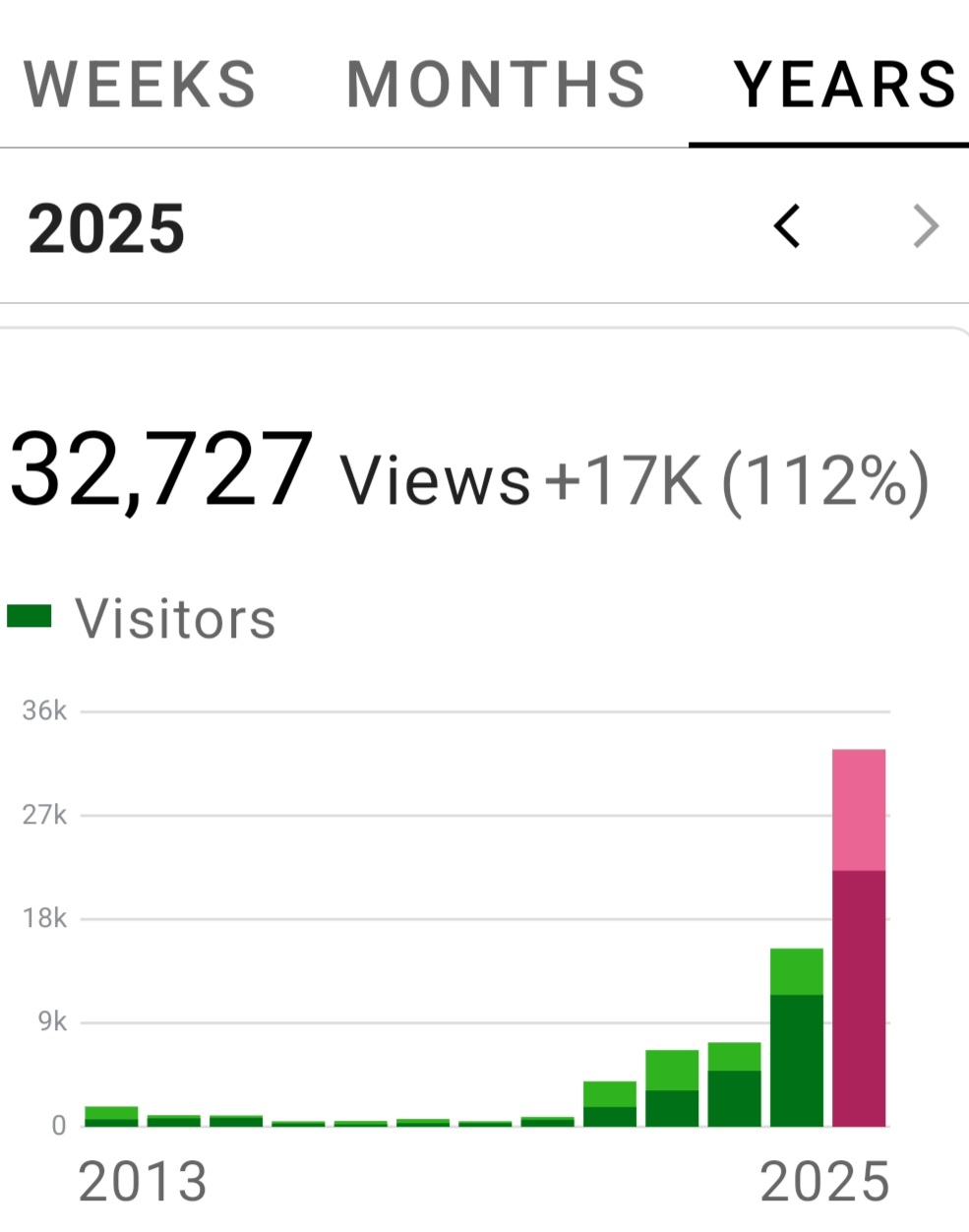
As this year draws to a close, I want to thank you for visiting my blog 32,727 times.
That didn’t happen overnight. And it didn’t happen by accident.
This year, more people found their way here than ever before—slowly, steadily, and often by returning. Compared with last year, readership grew significantly, not because anything went viral, but because the writing kept meeting the right readers at the right moment.
Growth, the quiet way,
These pages have held many things:
● 18th-century satire and present-day kitchens. ● Scholarship and softness. ● Books, biscuits, dogs, devotion, memory, love.
Some posts traveled far. Others found only a handful of readers. But every one was written with care—and read with attention.
I don’t think of these as clicks.
I think of them as moments of shared presence in a distracted world.
You made this a banner year.
If you were one of the 32,725:
● thank you for reading, ● thank you for lingering, ● thank you for making this a place worth returning to.
Here’s to a year shaped by patience, curiosity, and generosity of spirit—and to whatever quiet magic comes next.
You took me by surprise again this morning. As always, when I awakened, I checked my Fitbit to see how my heart did overnight. Then I checked WordPress to see how my readers were doing.
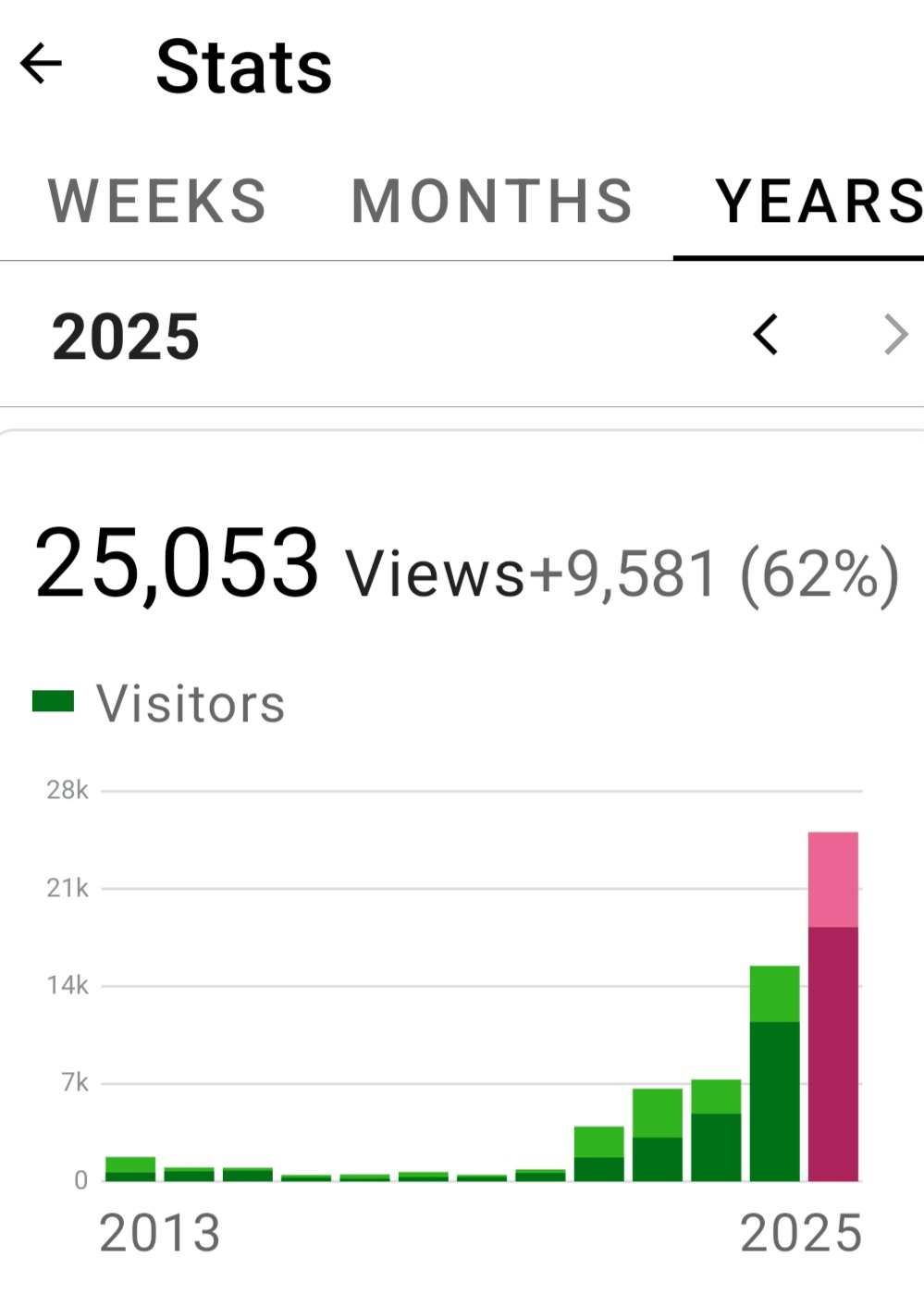
And there you were. Another thousand views. A quiet jolt to the chart. Numbers climbing when I wasn’t looking.
You’ve been dancing higher and higher since October, when I passed 15,000 and figured I’d reached my high-water mark. I even wrote a piece of thanks back then, thinking I’d said all there was to say. But now here we are—December 11th—and this little corner of the internet has gathered 25,053 views.
I’ve done nothing different. I have no flashy headlines. I have no trending hashtags. I just keep following the same rhythm: writing essays born from memory in a home filled with love. I just keep foolin’ around with words and ideas.
So why now, after all these years?
That question hangs gently in the room with me. It’s not demanding an answer. It’s simply inviting a reflection. Maybe something shifted in the writing. Maybe it’s more expansive. Maybe it’s more lived-in. Maybe it’s a voice carrying a steadier warmth now. Maybe it’s grief that’s softened into grace. Maybe it’s love that arrived not with fanfare, but with a quiet hand stretched out in invitation. Maybe it’s all of those things. Maybe. And add to all those maybes one more. Maybe it’s readers sharing with readers.
Gary, of course, doesn’t ask to be written about. But his presence is here, between the lines, in the patience of a paragraph, the steadiness of tone, the way I’ve learned to let silence do some of the talking.
Ruby, on the other hand, insists on being written about, whether she’s nosing me away from my smartphone or curling up in solidarity as I revise for the twenty-fifth time. She is, as always, the keeper of the tempo, the mistress of the move.
So this isn’t an open letter to public stats. It’s a letter to something deeper. It’s a letter to what it means to keep writing when no one’s watching, and then to wake up and find that someone was.
My essays aren’t meant to dazzle. And I know: they don’t. They’re just small acts of holding up the light, one weekly reflection at a time. The fact that they’re being read, now more than ever, tells me something I didn’t expect: quiet honesty still finds its way.
Thank you, Sudden Surge, for reminding me that patience has its own reward, that consistency is a kind of faith, and that somewhere out there, readers are still pausing to linger with a slow essay from the mountain.
I don’t know what this upturn means, or where it leads. But I do know I’ll keep showing up with my smartphone in hand and love at my side.
“The real voyage of discovery consists not in seeking new landscapes, but in having new eyes.”
—Marcel Proust (1871–1922). from his The Captive (1923), the fifth volume of his seven-part masterpiece In Search of Lost Time. Proust’s exploration of memory and perception reshaped modern literature.
Somewhere I saw it. Everywhere, maybe. Nowhere? Wherever—it grabbed hold of me and wouldn’t let go.
It was the gripping question:
“What would you tell your 18-year-old self?”
It lingered—since forever. Or yesterday? Either way, one morning not long ago, I tried to get rid of it by tossing it out to others—as if the orphaned question might leave me alone once it found a new home.
The replies were as varied as I expected, and as humorous and matter-of-fact, too:
“Buy stock in Apple and Amazon.”
“Be good at life; cultivate a well-rounded lifestyle.”
“Be patient; trust in God.”
“Serve God better.”
“Stay young; don’t age.”
“Be friends with your mom. Spend more time with family. Don’t let important things slide.”
“Don’t worry about impressing anyone other than yourself.”
Almost always, their offerings included a request to hear what I would have told my 18-year-old self. As a result, the question dug itself more deeply into my being, as I stalled by answering:
“I’m still thinking.”
It was true. But I knew I had to answer the question, too, not for them, but for me.
Several possibilities surfaced.
The first was rather light-hearted:
“You don’t have to have it all figured out. Just stay curious, kind, and honest. Don’t waste your energy chasing approval. Learn to cook, listen more than you talk, and remember: dogs and good people can tell when your heart’s true. Oh, and wear sunscreen.”
I dissed it immediately (though it carried some truths). Then I came up with:
“Don’t rush. The world will still be there when you’re ready to meet it. Pay attention to seemingingly insignificant things. They’re where meaning hides. Keep your humor close and your integrity closer. Fall in love, but don’t lose yourself in the process. And when life hands you a fork in the road, check which one smells like supper.”
I didn’t like that any better, though it, too, spoke truth. I was certain I could nail it with a third attempt:
“You think you know who you are right now, but you’re only meeting the opening act. Be kind. Be curious. And don’t confuse noise for meaning. The world rewards loudness, but grace whispers. Listen to that whisper. It’s you, becoming.”
Then six words sauntered past, not so much tinged with regret as with remembrance. Six words. Six.
“Be a citizen of the world.”
Those words had crossed my path before. In fact, I remember exactly when—not the actual date but instead the general timeframe and the location.
It would have been in the early 1980s, when I was working at the Library of Congress. I was standing in the Main Reading Room of the Jefferson Building, as captivated by its grandeur as I had been when I first started working there in 1969.
Above me, light spilled through the dome like revelation. Gold, marble, and fresco conspired to make the air itself feel sacred, as if thought had taken on architecture. Beyond those arches, knowledge waited in silence, breathing through pages and time.
Even now, I can close my eyes and see it: the way the dome seemed to rise into forever—an invitation, a reminder—that the world was larger than any one life, and I was already standing in the heart of it.
As an editor of the National Union Catalog, Pre-1956 Imprints—the “bibliographic wonder of the world”—I knew every alcove, every corridor, every one of its 532 miles of bookshelves, holding more than 110 million items in nearly every language and format. I had walked those miles over and over again doing my editorial research. I had come to learn that knowledge knows no barrier. I had come to learn that it transcends time and place.
At the same time, I decided that I could transcend place, too. With my experience and credentials, I began to imagine working in the world’s great libraries—first the Library of Congress, then The British Library, then the Bibliothèque Nationale de France, then the Biblioteca Nazionale Centrale di Roma.
I didn’t know where the journey would end, but it gave me a dream, a dream of being a citizen of the world of learning.
More than that, it was a dream untainted by pretense—never by the notion of being uppity. Instead, it was a simple dream. I figured that if I had made it from the coal camps of West Virginia to the hallowed halls of our nation’s library, I could pack up whatever it was that had brought me that far and go throughout the world, savoring knowledge and learning—and perhaps, over time, gaining a smidgen of wisdom.
But here’s the catch. If transcending geography is the measure of my dream’s fulfillment—the wanderlust, the scholar’s yearning for marble floors, old paper, and the hum of languages not my own—then, at first glance, I failed. I never made it to any of the world’s great libraries except the Library of Congress.
However, as I look back through my life-lens of 78 years come November 20, I realize that maybe I went beyond the geographic destinations that I set for myself.
I went from the mountains of West Virginia to the monuments of D.C., from there to the marshlands of South Carolina where I earned my Ph.D., from there back home to the monuments, and, from there, at last, to the Shenandoah Valley and college teaching that took me internationally via Zoom and tapped into Open Educational Resources that did away with the restrictive border of printed books.
In a sense, then, although I didn’t cross country borders, I crossed the borders of ideas, with my voice carrying me farther than my feet ever needed to.
I’ve managed to live generously, teach across generations, write with empathy, research with joy, garden with gratitude, cook with curiosity, and love with intentionality. In all of that, I have been that citizen of the world—not by passport stamps, but by curiosity. By compassion. By connection.
Maybe that’s the truth I’d offer my 18-year-old self:
“You don’t have to travel the world to belong to it. You only have to live with your eyes open.”
Exultation is the going Of an inland soul to sea, Past the houses — past the headlands — Into deep Eternity —
Bred as we, among the mountains, Can the sailor understand The divine intoxication Of the first league out from land?
–Emily Dickinson (1830–1886; pioneering American poet who explored themes of death, immortality, and nature with unmatched depth.)
Frank is dead, yet he liveth. I have proof. Well, it’s proof enough to satisfy me. I’ll share it with you so you can decide for yourself, as we all must do in the end.
Frank is my friend. My use of the present tense is deliberate. Remember: though he be dead, he liveth.
We became fast friends decades ago in the 1980s when we worked together at the Library of Congress. Frank was an attorney in the General Counsel’s Office; I, Special Assistant for Human Resources. From the start, wordplay cemented our friendship. Frank loved words as much as I, and when it came to verbal banter, Frank outdistanced me often, if not always. He was the perpetual prankster as well. I remember one occasion when his twin visited, and they switched roles. John became the attorney. Frank, the visitor. They duped all of us until well past noon, when Frank decided it was time to fess up, showing everyone the fun of being identical twins.
Beyond his pranks and his verbal banter, Frank commanded trust, and it was the kind of trust that went beyond attorney-client privilege. It was trust forged from seeing moral fiber in action. Frank was no stranger to walking the high road. He and I often walked it together.
Ironically, during those years, Frank and I weren’t friends outside of work. But that didn’t matter. Friends are friends. I will forever remember my last day at work when I took an early retirement. Frank came to my office wearing a deep burgundy casual shirt, one that I had admired time and time again. He smiled, pointed to his shirt, and turned around several times:
“You want it?”
“Of course, I do.”
With all the theatrics he could muster, he unbuttoned his shirt, took it off, twirled it around in the air, and tossed it to me.
“It’s all yours. Enjoy!”
I enjoyed it until its beauty was threadbare. Friends really do that sort of thing, literally and metaphorically. They take the shirt right off their backs and give it to you. Frank was that kind of friend.
Our friendship survived my move to the Shenandoah Valley of Virginia, and, in many ways, it became stronger. We didn’t see one another as often, but our connections seemed deeper and more meaningful because they were more planned and more deliberate.
I remember several special get-togethers that strengthened our already strong bond.
The first was a visit here to my mountaintop when my home was still the weekend cabin that I purchased initially. Frank came up so that he could see what I saw living up here, but he ended up helping me transplant several large Leyland Cypress. One still stands in my lower yard, towering over the landscape. Friends, like trees, stand tall.
The next was a weekend when Frank visited me in Front Royal, where I lived while juggling a teaching schedule across two campuses. I’ll always remember the unexpected snow that started falling while we were out for an evening stroll that seemed to last for hours. Eventually, we stepped inside for a late-night dinner. We were the only diners in a restaurant reminiscent of Edward Hopper’s Nighthawks, with its large glass windows and warm light casting an inviting glow against the stark, quiet night outside. Friends make unexpected joys more joyful.
Fast forward to more recent times. Frank and I decided to meet for lunch from time to time in historic Middleburg, VA, midway between his home in Springfield and mine in Edinburg. Before long, our occasional lunches became monthly rituals, always at the King Street Oyster Bar, always sipping Bombay Sapphire Gin and Tonics, and always sharing several dozen briny oysters on the half shell. When Frank’s wife Barbara joined us for the first time, it was as if I had known her as long as I had known Frank. Friends like that are rare.
Betwixt and between our lunches and our frequent texting were several special celebrations. Thanksgiving of 2022 comes to mind most readily. Frank, Barbara, and their friend James joined me for the day, and I served up a modest feast, including the one thing that Frank had requested: store-bought jellied cranberry sauce. Friends have quirks.
The next spring, Frank and Barbara flew to Burlington, Vermont, for the publisher’s launch of my book Green Mountain Stories by Mary E. Wilkins Freeman, just to make sure that someone came to the event. Friends look out for friends.
In 2024, the Washington Area Group for Print Culture Studies (WAGPCS) invited me to speak at one of their monthly meetings in the Rare Book and Special Collections Division at the Library of Congress. Barbara was instrumental in orchestrating it all. When she first asked me whether I’d be willing to come back and talk, Frank commented that it would be like circling back home. Indeed, it was. I started my career at the Library of Congress in 1969, and it was there that Frank and I engraved our friendship. I loved Frank’s observation so much that I incorporated it into the title of my April 4th talk: “Circling Back Home: Thomas Shuler Shaw, Mary E. Wilkins Freeman, and the Library of Congress.” Frank and Barbara were there for the talk and for dinner afterward. Friends keep friends in their circle.
Frank and I were well aware that our friendship was special. I suppose that’s why every time we met and then parted to go our separate ways, we always turned around, in sync it seemed, to smile and wave goodbye at least once, sometimes twice, as if that goodbye might be forever. Friends know that one day, forever comes.
The last time that Frank and I carried out our turn-around-and-wave-goodbye ritual was last September when we lunched at the King Street Oyster Bar, with John joining us. Frank seemed strong despite having some health issues that his doctors thought might be related to his liver. Within a month or so, Frank was given the grim news that he was in liver failure, with perhaps four months or so to live. He called to tell me. Friends share tragedy, even through tears.
The details of our interactions since then are of little consequence except for my proof that though Frank be dead, he liveth. Here’s how I know.
During one of our conversations, Frank wanted to talk about dying. Conversations about death and dying are so important, yet so many people aren’t comfortable grappling with the topic. Frank knew that I was. We didn’t talk about the art of dying. Instead, we talked about the mystery of the Great Beyond. What awaits us when we are freed from our mortal selves?
We both talked. We both listened. Frank is Catholic. I’m Protestant. We talked about the Christian notion of the Afterlife as a divine manuscript of salvation or separation, with Heaven and Hell serving as eternal footnotes to a life well (or poorly) lived. Barbara is Jewish. We talked about Judaism often leaving the notion of the afterlife intentionally open-ended, a poetic ellipsis, focusing more on righteous living than on what comes after. We talked about the fact that while different world religions script the afterlife differently, each crafts a unique but converging narrative that points toward some form of existence beyond death.
We both agreed that death is not the end. We both agreed that religions, in their diverse and poetic ways, reassure us that the story carries on, that the postscript—whatever its shape—awaits. We reminded one another of the universal longing for connection—across faiths, lives, and time.
I jokingly suggested to Frank that if he died first, which seemed likely, that he should reach out to me somehow and let me know whatever he could let me know. He agreed. Friends reach out to one another, always.
And here’s where proof marches in.
Frank died peacefully on January 13th, at 10:04pm. I didn’t get Barbara’s text message until the next morning.
As I tried to process the weight of Frank’s passing, I turned to one of the things that always brings me solace—Gospel music. I have dozens and dozens of Gospel songs on my playlist, never knowing which song will play first.
“Alexa, shuffle my playlist Gospel.”
The song that started playing gave me goosebumps from head to toe. It was Ralph Stanley, the acclaimed King of Mountain Music, triumphantly singing “When I Wake Up to Sleep No More”:
What a glad thought some wonderful morning Just to hear Gabriel’s trumpet sound When I wake up (When I wake up) To sleep no more
Rising to meet my blessed Redeemer With a glad shout I’ll leave the ground When I wake up (When I wake up) To sleep no more
When I wake up (on some glad morning) To sleep no more (jewels adorning) Happy I’ll be (over in glory) On Heaven’s bright shore (telling the story) With the redeemed of all the ages Praising the One whom I adore When I wake up (when I wake up) To sleep no more
I chuckled, knowing beyond a shadow of a doubt that Frank had just paid me a visit.
True to his word, Frank kept his part of our agreement, and, in listening and believing, I kept mine. Together, we co-scripted the postscript—a reminder that the stories we write with those we love don’t end.
“In a world where we can be anything, let’s choose to walk the red carpet of life with kindness, grace, and a sprinkle of stardust.”
–Lady Gaga (b. 1986, Stefani Joanne Angelina Germanotta; a Grammy Award-winning singer, songwriter, and actress known for her groundbreaking music, bold fashion choices, and advocacy for social justice issues; one of the most influential and iconic figures in contemporary pop culture, captivating audiences worldwide with her unique blend of creativity and authenticity.)
Hey, y’all. Come here, curl up real close to me, get comfy, and listen while I purr. I need to share something with you that I simply dare not share with the world at large. But since you’re special and know how to keep secrets, I’ll share it with y’all. Okay? So, get close while I whisper my secret in your ear:
“The other day, I was lying on my sofa, all innocent and quiet like, and right out of the blue, I was smitten, right there in my living room, in broad daylight! Can you imagine?”
Well, I couldn’t imagine it either, mainly because it came on so sudden like. I mean. I was just lying there, and then Shazam! I had been smitten! Well, actually, that shouldn’t come as too much of a surprise. I’m smitten easily, and I’m smitten hard. Hopefully, you are, too. Right now, I’m smitten by the gorgeous moss, harbinger of an early spring, greening itself in my Koi Pond Waterfalls. I’m smitten, too, by the online photography course I’m taking so that I can take better photographs with my new Samsung Galaxy S24 Ultra. I continue to be smitten by advances in AI, especially by Aloha, a housekeeping humanoid who can cook and clean. (If you dissed me when I announced my Caden last November, I guess I’m getting the first laugh. Ready to hop on board? There’s room!) And, in case you’re wondering–and I know, I just know that some of you are–I have not been smitten by any of the studmuffins who failed to find their way into Anne Lamott’s life or into mine during our respective flings with online dating apps. (For her account, see “My Year on Match.com”; for mine, which matters far more and is really the only one that matters at all, see “My Year on Unmatched.com.”)
I cannot speak for Lamott, but I remain hopeful. I am doing my best to smite the frog at my kitchen door with regular, passionate kisses so that I can practice my pucker and stay in shape. Who knows? I might just have an opportunity to be smitten by a prince. (Princes like good kissers. Just sayin’.)
No doubt you’re wondering what the hell I’ve been smitten by, aside from my nonsense. Chill. I’m about to tell you.
I’ve been smitten by a red carpet. Mind you, though, it’s not just any ole red carpet. It’s THA red carpet that gets rolled out right in front of you to seduce you into a waltz with destiny, leaving you breathless with anticipation and a sprinkle of stardust in your eyes.
Yep. I’m a smitten kitten. Hear me purr? But here’s the thing. The glamour of rolling out the red carpet goes all the way back to ancient Greece, where it was mentioned in Aeschylus’ play Agamemnon describing the king’s return home after winning a battle. His wife Clytemnestra says to him, “Now my beloved, step down from your chariot, and let not your foot, my lord, touch the Earth. Servants, let there be spread before the house he never expected to see … a crimson path.”
Despite its ancient heritage, it was not until the early 20th century that rolling out the red carpet became associated with celebrities and VIPs, particularly in the entertainment industry. The first known reference to a red carpet being used at the premiere of a movie dates back to 1922, when it was laid out for the opening of the Egyptian Theatre in Hollywood.
Since then, the red carpet has become synonymous with prestige, glamour, and exclusivity, particularly at award shows, movie premieres, and high-profile parties. It’s often used to signify that the individuals walking on it are special guests deserving of special treatment and attention.
That certainly was the case during this year’s Grammy Awards, as the red carpet sizzled with music’s biggest stars like Taylor Swift and SZA. Amidst wardrobe changes and rehearsals, the red carpet set the stage for unforgettable fashion moments.
Beyond Hollywood, the red carpet is used in various other contexts as a symbol of importance, honor, and VIP treatment. I dare say that each of us, at one time or another, has said to ourselves or to someone else “I want to roll out the red carpet” to celebrate someone or to jazz up a special occasion.
You’ve probably had enough of my caterwaul, so I’d better roll out THA red carpet that turned me into a smitten kitten. Meow, meow, meow, purr, purr, purr, meow, meow, purr, purr, meow, purr, MEOW!
Like I said, I was lying on my sofa in broad daylight, amusing myself with some TikTok videos when out of nowhere a video featuring Opatija, a picturesque coastal town in Croatia, popped up on my smartphone. But it wasn’t just any ordinary kind of video. It was a red-carpet tourism video, weaving together a rich tapestry of emotions, triumphs, and shared moments. The taglines alone speak volumes:
● Exploring the vibrant tapestry of choices on the red carpet, where every step unveils a world of possibilities.
● In this beautiful world, imagine if every moment mirrored a red carpet affair—filled with smiles, hugs, and unbridled happiness. Let’s choose to embrace the elegance of joy in every step we take.
● Witness the unexpected on the red carpet—a celebration of diversity, love, and transformation.
● Imagine if every moment mirrored a red-carpet affair—filled with smiles, hugs, and unbridled happiness. Let’s choose to embrace the elegance of joy in every step we take.
Typically, a man appears suddenly and rolls out a red carpet in public places, such as sidewalks or parks, treating unsuspecting strangers as if they were celebrities, complete with photographers, fans, and sometimes even limousines. Without fail, the reactions and interactions with the new celebs are amusing and heartwarming, often catching people off guard with the unexpected VIP treatment. The goal is to capture genuine reactions and create humorous situations, so they often approach anyone who happens to be in the vicinity of where they set up the red carpet. This approach helps keep the content unpredictable and inclusive, as they showcase reactions from a variety of individuals.
Typically, the people who walk the red carpet in the videos seem to be surprised by what is happening. Almost always, they are hesitant to step onto the red carpet after it has been rolled out in front of them, even as the tall young man extends his arm graciously and invitingly. Their movements are cautious, almost as if they’re tiptoeing into unfamiliar territory. Their expressions betray a mixture of uncertainty and curiosity, unsure of what awaits them as they traverse this unexpected path. Each step is tentative, as if testing the ground beneath them for stability.
Yet, as they progress further along the scarlet pathway, something remarkable begins to happen. A subtle shift occurs in their demeanor, a gradual transformation fueled by the energy of the moment. Their apprehension gives way to wonder. Their eyes light up with newfound excitement and anticipation. With each stride, they seem to shed the weight of their doubts, stepping into a realm where anything is possible.
As they walk across the red carpet, a sense of liberation washes over them, freeing them from the constraints of everyday life. In this fleeting moment, they are not defined by their roles or responsibilities but by the sheer exhilaration of the experience. Laughter bubbles forth, spontaneous and unrestrained, as they embrace the joy of the unexpected.
Amidst the vibrant tapestry of emotions, the little dramas of life begin to unfold. Strangers become companions, sharing stories and forging connections that transcend the fleeting encounter. Inhibitions are cast aside, replaced by an unbridled sense of camaraderie and belonging. It’s as if the red carpet has become a stage, and they are the stars of their own impromptu performance.
In the end, as they step off the red carpet, their spirits are buoyed by this enchanting journey. Though they return to the routine of their daily lives, they carry with them the indelible imprint of this extraordinary moment—a reminder that magic can be found in the most unexpected places, if only we dare to take that first step.
“Dare to take thatfirst step. “
We can look at that statement in two ways. The people in these little dramas have to dare to take that first step onto the red carpet. Then, and only then, can these magical transformations take place, even if only for a few moments. But let’s not forget the other individuals who are involved in these little dramas: the Croatian video team, who time and time again, dare to roll out the red carpet for strangers whom they encounter. Without the video team, strangers could not become stars.
I cannot help but wonder what our own little corners of our world would be like if we spent some time thinking about ways that we dare roll out the metaphorical red carpet before strangers whom we encounter in our own lives.
It could be as simple as sincerely complimenting someone on something positive about them. Whether it’s their style, smile, or skill, our words can brighten their day. For instance, we might notice someone’s vibrant scarf and express admiration for how it complements their outfit. Their initial surprise might give way to a smile of appreciation, boosting their confidence and spreading warmth.
It could be as simple as performing small, random acts of kindness without expecting anything in return. It could be as simple as holding the door open for someone, helping carry groceries, or simply offering a friendly smile. Imagine seeing someone struggling with heavy bags and offering assistance without hesitation. Their gratitude and relief could radiate as they realize there are still caring strangers in the world.
It could be as simple as striking up conversations with people we encounter in our daily lives. This could be as straightforward as asking how their day is going or commenting on something happening in the community. Picture starting a conversation with someone standing in line at the grocery store and sharing a laugh over a funny observation. Our genuine interest and friendliness might brighten their day and foster a sense of connection.
As I continue to be smitten by the transformative allure of the Opatija tourism videos, where a mere red carpet, a lens, and the sincere desire to infuse fleeting moments with joy can ignite profound change, I am stirred to contemplate our collective capacity to impact the lives of strangers. Perhaps, in our quest to touch hearts, we need not seek grand gestures. Perhaps all that we need to do is strive to live our lives as radiant beacons of kindness and warmth so that with every interaction, we joyfully roll out the red carpet.

 The Wired Researcher