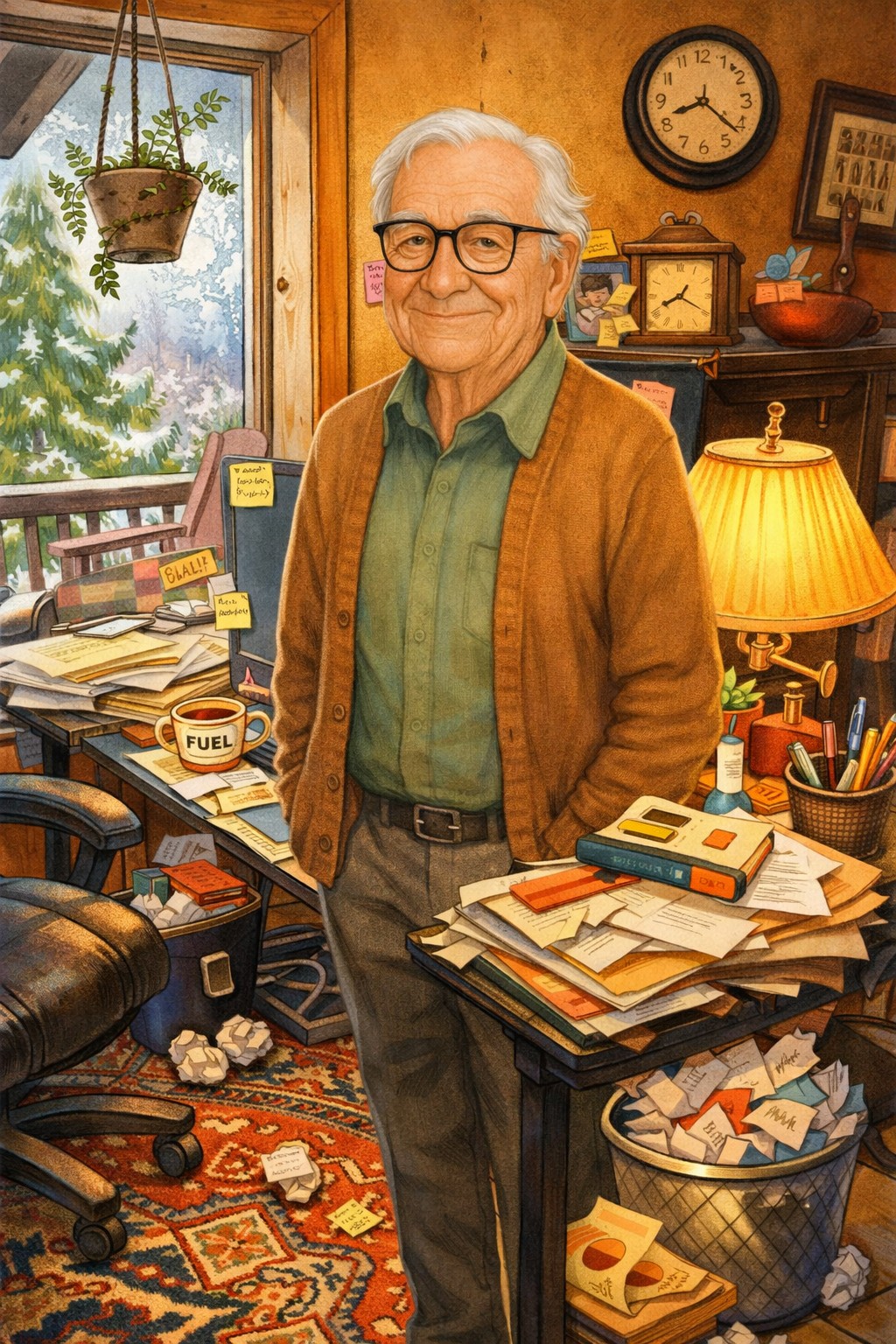
Seeing Clearly Now (Well, Sort Of)

“Seeing into the future? Maybe. But the real vision is daring to look closer—at now.”

—Extra E(Ad)dition for a NY Times Essay that didn’t exist on this day in 1947.

The world at large knows fully well that I’m always walking around with something rumbling around in my head. Half a paragraph. A misplaced metaphor. An idea that swears it’s a New Yorker masterpiece if I’d only give it five quiet minutes.

Today, though, it’s something else. It’s a song. If you’ve been around as long as I have—seventy-eight years today, thank you very much—you probably know it, especially if you like high notes of hope and courage.

It’s “I Can See Clearly Now,” released by Johnny Nash in 1972. It hit the Billboard Hot 100, Billboard Adult Contemporary charts, and Cash Box. I’m not surprised. From the moment those opening bars roll in, with that bright, easy rhythm that feels like sunlight tapping at your window, you’re already halfway to feeling better about the world. And then the lyrics land with their uncomplicated hopefulness:

“I can see clearly now, the rain is gone… It’s gonna be a bright, bright sun-shiny day.”

It’s a song that doesn’t pretend to be profound. It is profound because it’s simple, clean, declarative, and certain. The rhythm carries you forward. The lyrics lift you up. It’s optimism set to a beat you can sway to. It’s a three-minute promise that whatever clouds you’re carrying won’t last forever. The doubts that pile up like storm fronts won’t last. The troubles that cling like a stubborn fog won’t last. The little fears that hover just above eye level won’t last. Even the big ones that black out the sky won’t last.

Nash calls them “obstacles in our way,” but we all know what he means. Heartbreaks. Hesitations. Heavy thoughts. Anything that dims the day before it even begins. His song doesn’t erase them. It dissolves them, one bright measure at a time.

So for three minutes, the rain really does feel gone. And even if the sun isn’t shining yet, you believe with full, uncomplicated certainty that it’s on its way.

So there you have it. My. First. Clue!

And somewhere I hear a chorus of readers asking:

Clue to what, exactly?

All right, if you insist, I’ll go ahead and tell you what I was going to tell you anyway.

Like I said, it’s my birthday. You’ve probably already marked your calendars, because I do tend to make a fuss every year.

And yes, I’m talking about my birthday presents. Or rather, my presence.

Every year, I receive lovely gifts, but the silliest, most ridiculous one always comes from me. I buy myself something special—something utterly frivolous—and I wrap it in the most over-the-top paper I can find. Then I write myself a card declaring, in no uncertain terms, how truly spectacular I am.

Because guess what? I am spectacular.

Guess what else? You are, too.

This year’s gift? Well, it’s so far out there I’m not sure I dare tell you what I’ve done.

But I will give you another clue or three, like the one I just gave you.

Vision. It has to do with my eyes.

“Good God, no! I’m not having cataract surgery!”

Why, you’ve got some nerve even thinking such a thing—let alone blurting it out for the world to hear. Maybe in a few years I’ll blurt it out myself, but not this year.

Any guesses? None? Oh, come on. You can do better than this.

All right then—one more hint.

Glasses!

And to that clue I’ll add a question: Do you remember those 3-D glasses we used to wear at the movies? The cardboard ones with one red lens and one blue? The kind that made the screen come alive and sent spaceships flying toward your popcorn, dinosaurs roaring in your lap, and your best friend ducking beside you like it might all be real?

Those gloriously goofy things that made the world look both ridiculous and absolutely amazing at the same time?

Try to remember. You can, I’m sure.

I sure did when I opened the mail not too long ago and saw what I saw. I saw the future coming right at me. Really. Right at me.

I knew immediately: this was it. My birthday splurge.

Might I have a drumroll, please, before my big reveal?

TRRRRRRRRRA-DA-DA-DA-DA-DA-DA-DA—WHAM-BLAM-KA-THOOOOOOM—FWOOOOSH-CRACKA-LACKA-VROOOOOM—TSSSHHHH-KA-SHIIIIIIINE!

And now, My Dear Readers, I am pleased to announce that I treated myself to

a pair of sleek, impossibly cool Ray-Ban Meta AI glasses with dark gray frames and purple transition lenses. They’re futuristic enough to make James Bond fumble for the manual. They gleamed like they already knew my secrets. The ad promised, “Experience Meta AI like never before,” and I swear it winked at me.

And yes, I bought them.

I didn’t need them. I just got new glasses in June. But I wanted them because something in me knew this was more than eyewear. This was foresight.

So brace yourself (and maybe pour yourself a dram of Bunnahabhain): I have officially joined the ranks of the cyborg chic.

I’d love to tell you I can see clearly now, to croon along with Johnny Nash, but the truth is—literally speaking—I can’t see much better.

Figuratively? Metaphorically? You bet! I can see better and farther than ever.

I’ve been writing about artificial intelligence since the early chatbots of 2021. I’ve talked about robots, about ChatGPT, about how this strange partnership between humans and machines is unfolding faster than anyone expected—certainly faster than most people are ready for.

And I, for one, don’t want to be left behind blinking in the dust.

I want to experience it. I want to learn from it. I want to understand where it’s leading us—not from the sidelines, but right in the thick of it.

So these glasses aren’t just a frivolous birthday splurge. They’re my passport to the next chapter. They’re literally my lens on the merging of human curiosity and machine intelligence.

That merger is coming, you know, when man and machines become one. It’s called the Singularity. A year or so ago, it was projected for 2037. Now I think futurists will be lucky if it waits five. And if that’s true, then I plan to be ready. I don’t want to be afraid. I don’t want to be resistant. I want to be curious. I want to be awake. I want to be willing to see.

I’ve spent seventy-eight years watching the world evolve in ways my childhood self could never have imagined. And yet, here I am, ready to keep moving forward.

My Ray-Ban Meta glasses are just a step in that direction: a gift to my future self, a wink to the present, and a promise that I’ll keep exploring what’s possible. Because for me, this isn’t just about sight. It’s about vision.

There you have it. Now you know. This seventy-eighth birthday gift might be my best ever from-me-to-me gift. These new AI glasses don’t just sit on my face—they announce something. They say I’m still moving forward, still curious, still willing to step into whatever’s next and report back with a grin.

I didn’t just give myself a gift. I threw down a gauntlet. Johnny Nash didn’t promise perfect vision; he promised guts. These AI glasses may not sharpen every detail, but they supercharge my curiosity. Maybe that’s the real clarity: strapping on the future, stepping into the frame, and letting life rocket toward me in full, outrageous 3-D.

If the future wants to come screaming at my face, fine by me. I’ll meet it head-on, glasses gleaming, ready for the light—and absolutely ready for my close-up, grinning from ear to ear.

Looking Back on the Outer Edge of Forever

“The real voyage of discovery consists not in seeking new landscapes, but in having new eyes.”

Marcel Proust (1871–1922). from his The Captive (1923), the fifth volume of his seven-part masterpiece In Search of Lost Time. Proust’s exploration of memory and perception reshaped modern literature.

Somewhere I saw it. Everywhere, maybe. Nowhere? Wherever—it grabbed hold of me and wouldn’t let go.

It was the gripping question:

“What would you tell your 18-year-old self?”

It lingered—since forever. Or yesterday? Either way, one morning not long ago, I tried to get rid of it by tossing it out to others—as if the orphaned question might leave me alone once it found a new home.

The replies were as varied as I expected, and as humorous and matter-of-fact, too:

“Buy stock in Apple and Amazon.”

“Be good at life; cultivate a well-rounded lifestyle.”

“Be patient; trust in God.”

“Serve God better.”

“Stay young; don’t age.”

“Be friends with your mom. Spend more time with family. Don’t let important things slide.”

“Don’t worry about impressing anyone other than yourself.”

Almost always, their offerings included a request to hear what I would have told my 18-year-old self. As a result, the question dug itself more deeply into my being, as I stalled by answering:

“I’m still thinking.”

It was true. But I knew I had to answer the question, too, not for them, but for me.

Several possibilities surfaced.

The first was rather light-hearted:

“You don’t have to have it all figured out. Just stay curious, kind, and honest. Don’t waste your energy chasing approval. Learn to cook, listen more than you talk, and remember: dogs and good people can tell when your heart’s true. Oh, and wear sunscreen.”

I dissed it immediately (though it carried some truths). Then I came up with:

“Don’t rush. The world will still be there when you’re ready to meet it. Pay attention to seemingingly insignificant things. They’re where meaning hides. Keep your humor close and your integrity closer. Fall in love, but don’t lose yourself in the process. And when life hands you a fork in the road, check which one smells like supper.”

I didn’t like that any better, though it, too, spoke truth. I was certain I could nail it with a third attempt:

“You think you know who you are right now, but you’re only meeting the opening act. Be kind. Be curious. And don’t confuse noise for meaning. The world rewards loudness, but grace whispers. Listen to that whisper. It’s you, becoming.”

Then six words sauntered past, not so much tinged with regret as with remembrance. Six words. Six.

“Be a citizen of the world.”

Those words had crossed my path before. In fact, I remember exactly when—not the actual date but instead the general timeframe and the location.

It would have been in the early 1980s, when I was working at the Library of Congress. I was standing in the Main Reading Room of the Jefferson Building, as captivated by its grandeur as I had been when I first started working there in 1969.

Above me, light spilled through the dome like revelation. Gold, marble, and fresco conspired to make the air itself feel sacred, as if thought had taken on architecture. Beyond those arches, knowledge waited in silence, breathing through pages and time.

Even now, I can close my eyes and see it: the way the dome seemed to rise into forever—an invitation, a reminder—that the world was larger than any one life, and I was already standing in the heart of it.

As an editor of the National Union Catalog, Pre-1956 Imprints—the “bibliographic wonder of the world”—I knew every alcove, every corridor, every one of its 532 miles of bookshelves, holding more than 110 million items in nearly every language and format. I had walked those miles over and over again doing my editorial research. I had come to learn that knowledge knows no barrier. I had come to learn that it transcends time and place.

At the same time, I decided that I could transcend place, too. With my experience and credentials, I began to imagine working in the world’s great libraries—first the Library of Congress, then The British Library, then the Bibliothèque Nationale de France, then the Biblioteca Nazionale Centrale di Roma.

I didn’t know where the journey would end, but it gave me a dream, a dream of being a citizen of the world of learning.

More than that, it was a dream untainted by pretense—never by the notion of being uppity. Instead, it was a simple dream. I figured that if I had made it from the coal camps of West Virginia to the hallowed halls of our nation’s library, I could pack up whatever it was that had brought me that far and go throughout the world, savoring knowledge and learning—and perhaps, over time, gaining a smidgen of wisdom.

But here’s the catch. If transcending geography is the measure of my dream’s fulfillment—the wanderlust, the scholar’s yearning for marble floors, old paper, and the hum of languages not my own—then, at first glance, I failed. I never made it to any of the world’s great libraries except the Library of Congress.

However, as I look back through my life-lens of 78 years come November 20, I realize that maybe I went beyond the geographic destinations that I set for myself.

I went from the mountains of West Virginia to the monuments of D.C., from there to the marshlands of South Carolina where I earned my Ph.D., from there back home to the monuments, and, from there, at last, to the Shenandoah Valley and college teaching that took me internationally via Zoom and tapped into Open Educational Resources that did away with the restrictive border of printed books.

In a sense, then, although I didn’t cross country borders, I crossed the borders of ideas, with my voice carrying me farther than my feet ever needed to.

I’ve managed to live generously, teach across generations, write with empathy, research with joy, garden with gratitude, cook with curiosity, and love with intentionality. In all of that, I have been that citizen of the world—not by passport stamps, but by curiosity. By compassion. By connection.

Maybe that’s the truth I’d offer my 18-year-old self:

“You don’t have to travel the world to belong to it.
You only have to live with your eyes open.”

Show Me What You Wrote

“The act of writing is the act of discovering what you believe.”

— David Hare (b. 1947.) British playwright and screenwriter, whose works probe truth, belief, and the human condition.

Sometimes in the hush of evening, when the lamp spills its amber light and the world grows gentle, I watch. His head tilts slightly, caught by the glow, and suddenly, the years loosen their grip. The lines that life has written across his face soften; the jaw loosens, light as breath; the mouth, so often set in quiet thought, curves with the ease of youth. His eyes, clear and steady, seem to brighten from within, carrying a spark that belonged first to a boy and then to a young man. Slowly, the present thins. I see him slipping into his past. Fifty. Thirty. Twenty. And then, for the briefest moment, the man beside me becomes the eighteen-year-old he once was—time erasing each layer, revealing what was always there: the young man, quietly returning.

As I glance elsewhere in the room, I see an artifact from his past—one that has crossed time and threshold to find its place in ours: the grand piano. Massive and unyielding, it took four men to wrestle it off the truck and ease it through the doorway. Yet here it rests, polished wood catching the lamplight, waiting.

At this moment, I still hear the sound as his hands moved across the piano earlier in the day—measured, assured, easy. And I heard “For All We Know” rise into the room, each note carrying a hush that reached backward in time. The melody was not just music; it was memory, and it wrapped itself around him, around me, around the room itself. Ruby retreated to the bed, but not fully at rest. She leaned forward, her body stretched long, her head angled as far as she dared—as though even she knew the swell of sound carried us into places layered and deep. She held herself at the edge, cautious not to tumble into the wandering past, into the chasms of memory, beckoning us toward knowing and truth.

Elsewhere in the room, near the piano, another layer from the past peels back. Hanging on the wall is a sepia-toned etching—Salena Gazebo, number 8 of only 200, signed by the artist Carl Johnson. The lines are delicate, deliberate: the curving path, the quiet trees, the pavilion standing open like an invitation. It feels less like a structure than a memory, as if the paper itself breathed it into being. When I look at it, I sense not just the gazebo, but the moments once lived beneath it—the warmth of gatherings, the hush of twilight, the whispered vows of past lovers who lingered there. Dream and truth blur, as though the etching had captured not a place at all but a pulse of longing and a flicker of knowledge, carrying us softly toward knowing and truth.

In another room, on top of the chest of drawers, rest family photographs. Portraits, a chorus of faces gathered through years, smiling, standing, caught in stillness. They look out across the room with a quiet weight, less about who they are than the collective feel they give: belonging, continuity, the insistence that life moves forward even as it circles back. They do not need names to speak; their presence alone is enough.

Nearby, on a table, sits something smaller, more ordinary yet no less enduring: an iron toast holder. His grandmother’s. On his mother’s side? Or, maybe, his father’s? The lineage matters less than the fact that he kept it, carried it through moves and years, never discarding, never forgetting. The metal holds more than memories of bread he may never have seen toasted. It holds a thread of persistence, a reason to keep even the smallest objects close.

In the dining room, on a side table, another artifact gleams in silver relief: The Last Supper, framed, gifted to his maternal grandparents on their fiftieth wedding anniversary. Sacred and commemorative at once, it shimmers with devotion, not only to faith but also to family. The silver has traveled down through generations, carried into his keeping, held as though letting go would diminish more than memory. It is a marker of continuity, of reverence, of love that lasted long enough to be honored.

And then there is the little boy riding a dog—a keepsake that belonged first to his father when his father was a child, before his life was cut tragically short. A small porcelain figure, a child astride a loyal companion, frozen in time. Yet in that figure is more than innocence; it is a bridge across absence, a way of knowing a father he never met. It survived when the man did not, passed on to him as both wound and inheritance, loss and gift. That little boy on the dog rides still through the years, carrying ache and legacy.

Through these artifacts, I glimpse the man I already know and love, his story unfolding in fragments that matter. In the little boy riding the dog, I see both wound and inheritance, a bridge across absence. In the Last Supper, I see reverence, devotion, love honored and passed along. In the iron toast holder, I see endurance, the instinct to keep and carry even what is small. In the family photographs, I see continuity, lives pressed together across generations. In the drawing of the gazebo, I see invitation and hush—the twilight blur where dreams fade into memory and truth. And in the grand piano, I hear the melody that threads them all together—still rising, still echoing, ever playing in the quiet of his soul.

These artifacts matter to him and, now, to me. I could point to others. But I won’t. Yet one more remains, quiet and insistent, the truest of them all—not carved in silver or pressed into porcelain, but carried in ink and idea. His 1965 high-school graduation essay. He was co-valedictorian. He was eighteen.

It rests inside his high-school yearbook, the Bluejay, its cover deep blue and gilt, its pages a mosaic of faces, cheers, and world events already turning into history. And there, slipped carefully between those pages, lies his speech—typed, carried through six decades of moves and seasons. The paper holds its shape, and the words stand sure, preserved as though waiting for their moment to be read again. In its keeping, I see more than memory; I see devotion—the instinct to preserve not only what he did but who he was becoming. It is an artifact, yes, but it is also a testament, held safe in the place that marked his youth and carried forward into the man he is now.

I smiled and whispered:

“Show me what you wrote.”

He lifted the page, holding it in his hands, just as he held it onstage sixty years ago. Soft at first, his voice grew firmer as he returned to the beliefs that had steadied him even then: that learning gives life its shape, that responsibility gives it weight, that hope gives it breath, and that perseverance gives it endurance. Sixty years have passed, yet as he read, I heard not only the boy addressing his classmates but the man beside me—the same convictions intact, the same spirit enduring.

In those moments, as his voice stretched back and returned to me across the decades, I realized that of all his artifacts, this was the richest. My partner, Gary T. Knutson, wrote those words in youth. They carried him into a future he could not yet imagine. And they anchor him still—steadying him in the present, guiding him toward tomorrow. The piano may sing, the photographs may remember, the silver may gleam, the porcelain boy may still ride—but they can only point, only hint. His own words, fragile on paper yet alive in spirit, opened the door wider. They revealed not just what he kept but who he was becoming, and who he still is.

That is the power of words—not just Gary’s words, but all our words. They outlast objects, outshine heirlooms, outlive even memory. In them can be found who we are when all else has been stripped away—values, beliefs, longings, the essence of self, laid bare. And more than that, words do not simply keep; they move. They persuade and console, ignite and endure. They reveal who we were, and they shape who we might yet become. That is their gift, and their power—becoming, in a way, stronger than stone.

Show me what you wrote, and I’ll see who you are—then, now, and still becoming. For words outlast memory and outshine the heirlooms we keep. They carry the essence. They carry the longing. And they proclaim the truths we’ve always held.

Self-Serve

“Talk to yourself like you would to someone you love.”

Brené Brown (b. 1965), American research professor, author, and speaker on vulnerability, courage, and self-worth.

Go ahead! Run reference if you must. You’ll probably confirm what you already suspect. More than once, I’ve asked you to lean in real close and listen as I shout out for all the world to hear something that I think no one in the world should hear. Private should stay private, right? Not always. Here I am about to pull you in and do it all over again.

But this time it’s different. It’s one of those insights I’ve had before—the kind that first comes as a shadow of knowledge, and then, with a turn, reveals itself fully, clad in nothing more than the simplicity that truth always wears.

That’s exactly what happened to me. I was all by myself. My partner Gary—Remember? My Tennessee Gary?—had gone off to Minnesota for his 60th high school reunion and for a family reunion to boot. So it came to be that I dined alone.

I plated my entree with all the attention that might bespeak the 5-star restaurant that I know my kitchen will never be. Yet, I keep right on striving.

The golden-crusted whiting stretched across the plate like a painter’s confident stroke, its edges crisp, its center promising tender flake with the first touch of a fork. Beside it, a tangle of violet cabbage shimmered as though the skillet had coaxed from it not just flavor but light itself—earthy, sweet, and just slightly wild. A sprig of thyme leaned in, whispering green against the purple, while a single blossom, fuchsia and unapologetic, dared to remind me that even supper alone can flirt with beauty.

Then, an hour or so later, I was ready for dessert. Don’t you dare tell anyone—especially Gary—but since I was alone, I decided that a store-bought dessert would do.

It was tiramisu with all the makings of a showstopper—moist sponge, creamy layers, a hint of coffee and chocolate—but there it sat, in its plastic box, reminding me that sometimes dessert doesn’t need fanfare to be enjoyed.

“Fine. I’ll enjoy it straight from the plastic box.”

Just when I was about to grab a fork (but not a plastic one, mind you), I decided that it needed proper plating, too.

It only took a second for me to turn store-bought into five-star. The tiramisu rose in creamy, coffee-kissed layers, draped with curls of chocolate that caught the light just so. Against the deep black plate, a scarlet bloom blazed like a velvet exclamation point, transforming a humble slice into a scene-stealer. Every bite promised richness, every glance was pure seduction on porcelain.

In no time at all, I had done for myself what I do for us all the time. In no time at all, I had done for myself what I would have done for me and Gary if we had been sharing the table that night. I had lifted something ordinary into something memorable. I had taken the plastic box off the table and replaced it with care, intention, beauty. In that small act—so quick, so simple—I realized that I had given myself the very same attention I so easily give to the life we are building together. And I had done it when it mattered just as much—I was alone.

We forget, don’t we? Especially when we are alone. We fall into the trap of thinking that we have to wait for company, for celebration, for some special someone before we let ourselves live five-star. But that’s not so. We don’t have to wait, nor should we. We should use the special napkins every day, especially when we’re alone. We should have flowers on the table every day, especially when we’re alone. We should bring forth all of life’s little graces, especially when we’re alone.

We should always see ourselves as the guest of honor—especially when we are alone, even when the chair across from us is empty.

We should remind ourselves that this kind of self serve isn’t selfish and it’s not uppity. It’s simply a way that we can say “Yes” to ourselves. It’s pulling the good wine from the rack, even on a Tuesday night. It’s plating coleslaw in a little bowl instead of scooping it from the mixing dish. It’s lighting the fireplace in October simply because the first chill makes you want to. It’s cueing up Black Gospel or Acoustic Chill while kneading bread, letting the room swell with music as much as with sourdough. It’s slipping into my favorite blue linen shirt, even if no one but Ruby will see me in it. These are the gestures that matter most—especially when we are alone.

These “alone” moments count. Every single one of them counts. And if we don’t serve ourselves with dignity, who else will?

So, My Dear Readers, let me raise a glass to the hydrangeas cut and arranged, to the figs sliced and drizzled, to the silver chest opened on an ordinary weeknight. Here’s to the quiet supper for one that still deserves a sprig of thyme, and to the tiramisu that—freed from its plastic coffin—reminds me that even the humblest store-bought sweet can rise to the level of celebration.

Because self serve is never second best.
It is the altar we lay with linen and light.
It is the chalice filled, the bread broken, the sweetness offered.
It is the music of a knife against porcelain,
the fragrance of thyme rising like incense,
the candle flame trembling like a prayer.

Let the plate gleam.
Let the glass catch the last gold of evening.
Let the blossom burn bright against the dark.
Let the feast of one be as radiant as the feast of many.

Be the guest of honor. Your own.
Be the blessing at the table. Your own.
Be the flame, the flower, the feast. Your own trinity.

Even when we are alone.
Especially when we are alone.

Let’s never–for even a moment–forget:
We are enough.

A Reckoning

“Some of us think holding on makes us strong, but sometimes it is letting go.”

Hermann Hesse (1877–1962), German-Swiss novelist and Nobel Prize laureate, best known for Siddhartha, Steppenwolf, and The Glass Bead Game.

Believe it or not, a week or so ago, the past rose up and slapped me across the face. No, it didn’t leave a bruise, but it left behind something I’m still thinking about.

The slap started when I walked into my office. At first glance, it looks impressive. The lamp casts a golden pool across my glass-top computer desk, giving the whole space a glow that almost convinces me I’ve got things under control. The Oriental rug circles wide and bold underfoot, all rich blues and reds that make the room feel grounded, important, and maybe even a little too proud of itself. Books and papers rise in uneven towers, but in that first glance, they seem less like clutter and more like credentials—proof that I’ve been busy living, working, collecting. Even the cows in the painting on the wall keep a calm eye on the scene, as if to say,

“Carry on, Mtn Prof. You’ve got this.”

But as I walk through the door, the illusion collapses. What looked like a tidy study becomes a landscape of leaning towers and stubborn archives. Books crowd tables in uneven stacks, some open, some shut tight, all demanding to be dealt with. Boxes huddle together on the floor, their labels promising order—but their bulging edges betray the lie. Folders spill their contents, paper curling like leaves that refuse to fall from the tree. A shirt slouches over the back of a chair, a plaid witness to resolve slipping into resignation.

Everywhere I turn, something insists on being noticed. Woven baskets perch on top of files, as if even the containers need containers. The desk is less a surface than a staging ground for half-made decisions. Another painting on the back wall gazes out of its pasture, unblinking, as though it’s been watching me circle this mess for years. It has. It’s not chaos exactly—it’s accumulation. Layer upon layer, a sediment of living, each piece waiting for me to finally decide whether it still belongs.

It isn’t permanent chaos. The boxes say as much, their sharp edges and taped seams hinting at better days ahead—days when decisions will be made, order restored, and space reclaimed. For now, it’s not just an office; it’s a staging area where the past collides with the present, where choices will shape the future. Every pile, every stack, every half-forgotten guidebook, and every dog-eared folder is here because I pulled it out of hiding and chose to face it. In that sense, the clutter is not failure but progress. It’s the visible proof that I’m reckoning with the past, one piece at a time.

I’ll continue to reckon, and I’ll keep on making progress. I know I will. But I know, too, that I can’t rid myself of a lifetime of artifacts in one day. Take the CDs, for instance. Three rows deep. Wedged into the lowest shelf of the floor-to-ceiling bookcase at the far end of the office. They’ve been squirreled away there for years. Waiting. Ralph Stanley leans against Sting, Nina Simone keeps company with Mahalia Jackson, and Susan Boyle dreams her dream right next to the Chuck Wagon Gang. It’s less a collection than a timeline—decades of moods, memories, and seasons pressed into plastic cases. But here’s the thing. I don’t have the heart to get rid of them in one fell swoop. And besides, maybe I don’t want to get rid of them all. Maybe I don’t need to get rid of them all. But I can’t hang on just to hang on. Each one becomes a decision. Which will serenade me today? Into the future? Which has already sung its last song?

Other choices are easier. Travel guides, for instance. Like Fodor’s Greece and Frommer’s Greece on $35 a Day. Both hopelessly outdated, their covers promising adventures I never took. They carry missed possibilities but not regret. Into the discard pile they go. Or the box of Library of Congress business cards, embossed with the proud gold seal of my past career. They once carried weight, proof of my role in the world’s premier library. Now? Nothing more than relics of a past identity. They go into the discard pile, too. The work, the years, the meaning, and the memories? They stay.

Other choices are so easy they’re no brainers. My Frost shelf, for instance: concordances, centennial essays, letters, the familiar black-and-green spines that have followed me across decades. They stay. The same goes for my Mary E. Wilkins Freeman books, lined up in their muted blues and browns. They’re not just books; they’re part of my scholarly DNA. No question, no hesitation. They stay.

Then there are some things whose fate I know as soon as my touch awakens forgottenness. My college copy of Hemingway’s The Old Man and the Sea, margins crammed with the notes of an eighteen-year-old who thought he already knew something about struggle. It stays. My copy of Gibran’s The Prophet, inscribed by a fraternity brother—a book I’ve carried long past the days of Greek letters and youthful certainties. It stays.

A three-by-five oil painting of the covered bridge in Philippi, West Virginia? It’s no masterpiece, but it hardly needs to be. I crossed those boards more times than I remember during my years at Alderson-Broaddus College, each passage a kind of bridge between my coal camp past and the life I was building in the present. The brushstrokes may be clumsy, the colors a bit too bright, but none of that matters. It stays.

A small stack of cassettes holds my mother’s voice on magnetic ribbon. One, dated 11/12/81, is labeled I Take a Stroll and Cause Worry among the Worry Warts. The cassettes may be obsolete, but her voice? Never. Alongside them rests the Bible she gave me when I left for college, her handwriting in the front marking it as mine, though I’ve always known it was hers first.

And the kettle bottom resting heavy on my desk—a flat, round stone that once fell from mine roofs where my father worked fifty years. In those seams, a kettle bottom was a miner’s dread, dropping without warning, too often killing the man beneath it. This one didn’t. My father walked away again and again, spared by chance or grace. These pieces stay—not for their weight, but for his, for hers, and for mine.

Tucked nearly into oblivion is a small 4-H patch from fourth grade, meant to be sewn onto a jacket I didn’t have. But I never needed the jacket to know the four H’s—head, heart, hands, health embroidered in me long before I understood mottos or mission statements. They shaped how I worked, how I cared, and how I learned to give myself to something larger. That patch will never leave me. Some things you don’t outgrow; they simply grow with you.

The things in my office are only the visible part of the past. The rest doesn’t sit on shelves—it lives in memory, in relationships, in faith, in regret, in longing. Those pieces weigh just as much, sometimes more. They, too, must be faced, not in sweeping generalizations, but one by one, moment by moment, decision by decision.

Because that’s how the past works. Even though we can’t erase it, we can’t carry all of it forward either. We have to make hard choices, keeping only what steadies us and letting go of the rest. That’s the only way we’ll have room for life to keep unfolding. Room for the present to breathe. Room for the future to arrive. Room to move forward without being smothered by what came before.

I’m glad the past slapped me across the face. It taught me what we all eventually learn: the only way to live fully in the present, and prepare for the future, is to reckon with the past—seen and unseen, tangible and intangible—piece by piece, choice by choice. The past, the present, and the future are never separate. They are one continuum of time. One long sorting. One steady choosing. One true becoming.

Celebrating a Mother, Not My Own

“I do not at all understand the mystery of grace—only that it meets us where we are but does not leave us where it found us.”

Annie Dillard (b. 1945). American essayist whose work reflects the natural world as a mirror for awe and meaning, most memorably in her Pulitzer Prize–winning Pilgrim at Tinker Creek.

What on earth am I doing writing about motherhood in the dog days of summer—the hottest, most humid stretch, when snakes go blind until their molting skin slips over their eyes—especially when I’m celebrating a mother, not my own?

I keep saying to myself:

“This would be perfect for a Mother’s Day post in May.”

But you, my Dear Reader, know that I rarely write to match the calendar—and this post won’t match it, either. That’s not to say I’ve never done it—only that I’ve never done it by design. It’s simply that from time to time an idea collides with an occasion—Mother’s Day or Father’s Day or Thanksgiving or … Hmmmm. Maybe I’ve done it more than I realize.

Anyway, if you browse through my posts, you’ll see the pattern of how I write. When something grabs hold of me and won’t let go, I know I’ve been called to share it—maybe for the greater good, even if it’s just one person who feels the same tug while reading that I felt while writing.

That’s exactly what happened with this post. Memories washed over me from long ago and far away. They had surfaced before, but only as ghostly apparitions drifting in a paused wave. This time, though, I was nearly pulled under by the current.

It began when I uncovered a hand-painted pillow I hadn’t used in years. Bold crimson flowers and curling green leaves still popped against a soft beige background. The piping had faded, and the stuffing had settled into the easy comfort of something well-loved. It was a little worn, and it was a little wistful, but it was still a bright relic from when I was just beginning to find my way.

As soon as I saw the pillow, I started remembering my neighbor who made it. She was an older woman, maybe a few years older than my Mother, but not many. She dressed neatly, always in small-print floral dresses, and, when at home, she always topped her dresses with matching aprons. Ringlets of white hair framed a face that seemed stern at first, but softened the moment she spoke. She had the bearing of someone who kept things in order—herself, her home, her garden, and her place in the community. No one ever doubted that she would follow through on whatever she took on.

Her name was Nell. Nell Barker Harris, but I never called her by her first name. My Mother taught me better. She was always Mrs. Harris to me, though I swear I had the hardest time making Mrs. sound like MIZ-iz. It always rolled off my tongue as MIZ.

My memories of her stretch back to 1958, when my parents bought our home in the subdivision that bore her last name. I had just turned eleven, and I loved exploring the uncharted woods surrounding our home and beyond.

Mrs. Harris and my Mother were good friends, sharing interests in church, cooking and canning, and working the polls on election days.

My Mother thought the world of her, and, looking back, most of what I came to know about her came from my Mother:

MIZ Harris this …” and “MIZ Harris that …” was a constant refrain, especially during summer and fall harvests.

Many were the days my Mother sent me to the Harrises—Nell and her husband Worthy—with fresh vegetables from our garden, or to fetch canning jars—the old timey blue ones with zinc lids—or to swap a recipe.

The Harrises lived close, but their house lay just out of sight from ours. All I had to do was cut across the garden, slip past the barbed-wire fence, run down a slope, and dash up a knoll to reach their faux-stone cottage. It was one of the finer ones in our small town, with more than a hint of upper-middle-class comfort. I’d climb the steps straight to the door, where Mrs. Harris usually met me, fulfilling the errand right there on the stoop.

From those errands and my Mother’s comments, I came to know Mrs. Harris well enough that one December, I went boldly to her house on my own. My sister Judy and I had decided to put up a Christmas tree while our Mother was shopping. I had long had my eyes set on a beautiful white pine—not for Christmas, but for love—growing in the Harris’s woods where I roamed. Off I went to ask if we could cut it down. She agreed, and though the tree seemed to shrink with every drag homeward, Judy and I had it lighted and decorated by the time our Mother returned. She knew exactly how to celebrate the surprise as a tribute to childhood ingenuity.

Another time, my parents sent me over with an idea that I’d dreamt up—again involving white pines. A dead-end dirt road ran between our home and the Harris’s land that we gardened, and we thought it would be beautiful to line its 200-foot stretch with pines. I asked Mrs. Harris if we could dig saplings from her woods. She agreed, though she thought fall would be a wiser planting time.

My parents insisted amongst ourselves that proper planting and deep watering would see them through. They were hardly more than spindly stems with a few scraggly needles, more like Charlie Brown’s Christmas tree than the giants we imagined. Pitiful as they were, they survived the July heat and, in time, grew straight and tall, rising with quiet majesty, as if they had always belonged there.

Later—June 1972, a few years out of college and working at the Library of Congress—I wanted more than the skyward-pointing pines. I wanted the land itself. I found myself in Mrs. Harris’s home, asking if she would sell me the very garden lots my parents and I had tended from pre-teen through early manhood.

I still remember sitting in their parlor that day—dress pants, crisp shirt, and a tie, as if I’d been summoned to defend my undergraduate honor’s thesis. I sat in an overstuffed chair in the corner, its armrests rising up to hold me accountable. The room itself seemed to echo their seriousness and my intent. Mahogany gleamed in the soft light. A large china cabinet dominated one wall, its shelves lined with Blue Willow dishes like the ones my oldest sister Audrey collected. Everything about the space spoke of order and permanence—qualities my Mother had always extolled in Mrs. Harris herself.

Across from me sat Nell and Worthy Harris, steady and composed, firing their questions in quick succession:

Why do you want the land?

Do you plan to build a house there one day?

How will you pay for it?

A bank loan? Do you understand that you’ll need a co-signer?

They had far more questions than I had answers. But a few days later, I rode with the Harrises in their blue-and-white Chevrolet to Raleigh County National Bank, a solemn drive dressed up in chrome and vinyl. I had made the appointment myself, though the banker’s name and face have faded. What remains is the setting: a huge walnut desk topped with thick glass, its surface spread with legal documents that seemed to weigh more than the paper they were printed on.

I signed, and Mrs. Harris co-signed—the literal and the metaphorical deed, both done and dated June 9. She was, after all, the owner of the land. The gleam on my face that day couldn’t have equaled hers, steady and satisfied, as though she had not only sold me a parcel of ground but had also planted me there, rooting me firmly to the very soil where those skyward pines had begun.

But the pillow dragged up one last memory of Mrs. Harris—a dim and shifting one, like an undertow I didn’t see coming.

One year—1965, just a month before graduating from high school—I nominated Mrs. Harris for “Mother of the Year.” She certainly was worthy of the recognition, although she never seemed like my Mother, not even like a mother figure, really. And now, looking back, I wonder whether it was my Mother herself who suggested the nomination. Or maybe it was my oldest sister Audrey. Both of them admired her immensely as one of the pillars of our community and the church that the three of them attended.

Whatever the springboard, I picture myself typing the letter—hunting and pecking as solemnly as if drafting a constitution—and then, with all the earnestness of seventeen, listing her many accomplishments.

I don’t remember a single sentence I wrote in that nomination, only that it won her the recognition we all thought she deserved. What I do remember is the aftermath: her picture in the newspaper, and maybe even a spot on a live radio interview, sharing her reaction:

“I’m just flabbergasted.”

Down through the years, I often found myself wondering how my Mother felt about my nominating Mrs. Harris instead of her. If she carried even a flicker of disappointment, she never showed it. And why would she? For all I know, she may have planted the idea in my head in the first place, speaking of Mrs. Harris with admiration the way she always did.

Years later, my parents came to live with me in DC after my dad suffered a stroke and needed more care than my Mother could manage alone. Audrey and I worked out a plan: summers in their own home, with her nearby to help; winters with me in DC. It was during those ten years that I found myself with a chance to do what I hadn’t done back in high school–nominate my own Mother for recognition as the remarkable woman she was.

The details of my Mother’s nomination are as vague in my memory as Mrs. Harris’s. I am fairly certain it was 1982—the year my parents celebrated their 50th wedding anniversary—and that DC’s “beautiful music station,” WGAY (99.5), sponsored the “Mother-of-the-Month” recognition. I nominated her by focusing on her long marriage to my dad, their six children, and the challenges she faced as an aging woman caring for her invalid husband, ten years her senior. Even though they lived with me, she was the caregiver during the day, and she carried the worry with her to bed at night. That, I believed, made her worthy of being honored.

I had been notified the day before that she had won, and that the radio host would call her live between 7:15 and 7:30 the next morning. I delayed leaving for work until the call came, turning on the radio to listen. The host told her about the award, and she responded in her plain, honest way:

“I am just flabbergasted.”

And here I am, decades later, unsettled by the blur of my memories of the honors given my Mother and Mrs. Harris. I wanted the details to come alive again here, to loom as large now as they did then. So, I went looking for the scoops that might have been reported in the newspapers.

I looked and looked again, but I found no newspaper coverage of my Mother being honored as “Mother of the Month.” That’s fine. My Mother doesn’t need to live in print—she lives on in me. Besides, I know the details by heart. I listened as she heard the radio broadcaster announce her status for all the listening world to hear. The radio station hosted a dinner for her. I pinned their orchid corsage to her dress, drove the two of us to the restaurant, and sat across the table from her.

We dined at The Monocle, seated at one of its linen-draped tables where the Capitol dome seemed near enough to touch. The restaurant buzzed with the voices of staffers and senators, but none of that mattered to me. What mattered was not the food or the setting, but the way she sat taller than usual, radiant with the glow of being truly seen.

I don’t remember the menu. I don’t remember what we ate or drank. What I do remember is my Mother spotlighted there, savoring a moment that was hers alone. She wasn’t the caregiver or the dutiful wife and mother that night. She was the honored radio station guest, my celebrated Mother, and I was lucky enough to be her escort.

I fared better in my search for Mrs. Harris’s recognition. I landed on the newspaper article itself, published in the Beckley Post-Herald on April 15, 1965. I was mistaken about nominating her for Mother of the Year, yet the headline showed I wasn’t far off:

“Shady Spring Woman Is ‘Mrs. Homemaker’”

“Mrs. Homemaker of 1964 and 1965 is the title which was bestowed on Mrs. Worthy Harris of Shady Spring on Saturday afternoon at the annual Home and Sport Show sponsored by Beckley Jaycees.”

It’s a long, long article, taking up nearly a quarter of a page and featuring a full-length photograph of Mrs. Harris holding a silver platter, one of her many gifts, along with a litany of her many talents that left me nodding in remembrance:

“An active member of White Oak Baptist Church, Mrs. Harris teaches crafts such as quilting, copper and leather tooling, refinishing furniture, cooking, canning, silk screening, lamp making, teaches home demonstration club classes, judges community fairs, and does upholstering as a hobby.”

As I continued reading, I realized that I was wrong about something else, too, so wrong that I was beyond flabbergasted:

“In her letter Mrs. [Audrey] Bateman stated, ‘Variety is the spice of life, and truly Mrs. Harris can attribute her zest to living to her many activities which center around her home and community. Her most admirable quality is that she always has time for God, her family, and friends.’”

I read the paragraph three times. Even then, I could only mutter to myself:

“Impossible!”

Surely, I was the one who wrote the nomination—I’d always been the family wordsmith, and the memory still lingers.

It was then that I called Audrey. Surely, she would know. She recalled Mrs. Harris’ recognition, but she was adamant that she had not written that letter, echoing the same sentiment that I had worried about down through the years:

“I wouldn’t dare have written that letter and slighted my own mother.”

Who knows. Maybe I wrote it for her to sign.

The truth lies somewhere in the mix—me, Audrey, and my Mother. All the careful lines blur, all the edges soften, until what’s left is simply presence—fluid, unguarded, and enough.

But now, sixty years after Mrs. Harris’s well-deserved recognition, I suspect it was my Mother herself who lined things up. I’m sure she never dreamt that one day I’d be celebrating her grace—while also celebrating a mother, not my own.


Tell Them Who I Am

“Who do you say that I am?”

Jesus, Matthew 16:15

The knock at the door was as gentle as any I had ever heard before, yet it frightened me with its persistence. After all, it was the middle of the night, and I rarely have visitors here on my mountain, and when I do, I anticipate their arrival and meet them in the walkway.

After a while, my curiosity overcame my fear. I went to the kitchen door and opened it. There, not on all fours, but standing as upright and erect as any human I had ever seen was my dog Hazel.

Lit by the spill of the floodlights—like some mythic creature caught mid-transformation—Hazel looked less like a pet and more like a story I hadn’t yet written: fifty-nine pounds of sinewy poise, all confidence and oversized paws planted with purpose. Her coat shimmered with its reddish golden shades of ember and mischief—Husky in spirit, Shepherd in legacy, and wholly herself.

Her tail curled tight; her head slightly tilted—alert, noble, a whisper of the wild. Her ears twitched once as if tuning in to something I would never hear. And her eyes? They saw, as if piercing through the darkness that found me standing there.

She wasn’t waiting. She was watching. And in that moment, so was I—awed by her stillness, her strength, and a quiet reminder of something I had yet to remember.

And, as naturally as anything you would never expect a dog to say, she looked at me:

“I’m just a monkey. I’m a howler.”

Then I awakened. Amused. Grinning. Lying there in bed. Musing. Hazel. Fifteen years of fierce love, muddy pawprints, and conversations that needed no translation, except in dreams.

As I lay there, I realized the dream’s significance. In a way, it was the oldest kind of magic: a name spoken often comes true.

For years and years and years, Hazel’s bark reminded me of a monkey. Not just any monkey—a howler. One of those wild-voiced beings that belt their souls into the sky from treetop pulpits at dawn. Her bark had that same deep, echoing wildness—less a request than a proclamation.

Some dogs bark. Hazel declared.

And so it came to be. I would say to her over and over again:

“You’re just a monkey! You’re a howler.”

She didn’t seem offended. If anything, I think she took it as a compliment. Obviously, Hazel was not a monkey, nor could she become one. Except in my dream.

But here’s the thing:

She became what I had named her.

And that truth deserves repeating:

She became what I had named her.

That dream set me to thinking long and hard about what it means to name.

To Name.

I started wondering when the phrase was first used and in what context. And if you know me as I know you do, you know that I headed off to the Oxford English Dictionary (OED) where I discovered that it was first used in Old English:

“[Hælend] gefregn hine huætd ðe tonoma is? & cuæð to him here tonoma me is, forðon monig we sindon” (Lindisfarne Gospels Mark v. 9).

Right! That doesn’t look like English to you either, does it? Let’s look at the translation.

“[The Savior] asked him, ‘What is your name?’ And he said to him, ‘My name is Legion, for we are many.'”

It’s a well-known moment in the Gospels—Jesus (the Hælend) encountering a man possessed by demons. The phrase “My name is Legion, for we are many” comes from Mark 5:9 (and Luke 8:30), rendered above in Old English.

This is an incredible example of what happens when we name something. The name Legion does far more than identify. It reveals nature, condition, and moral alignment. When Jesus asks for a name, he isn’t just asking for a label—he’s uncloaking the essence of what possesses the man.

Did you catch that? A name reveals essence.

And I ask you–right here, right now, as I am about to do–to start thinking about names swirling around in your head. Maybe the names associated with you: the names that others call you.

As you reflect, let me share with you the significance of the names swirling around in my head.

The Names that Others Called Me.

The first that I remember was not my given name—Brentford Lee. Rather, it was Little Mister Sunshine. My mother gave me that name because—as she loved to tell others, including me–I was born smiling and radiating happiness. Now, 77 years later? Others say that I’m still smiling. Still radiating happiness.

Clearly, my mother saw the essence of who I am and named it.

Or how’s this? My siblings, for as far back as I can remember, had another way of naming me. They always called me different.

“You don’t look like us.

“You don’t talk like us.

“You don’t walk like us.

“You’re different.

Truth be told, I was different, and I knew it. Ironically and for my own well-being, when they called me different, I leaned into it as compliment rather than condemnation.

It didn’t take me long, however, until I came to feel and understand the word they weren’t naming, the word that others, later, named. Queer. Either way–and even though I continued to see myself as special, a way of looking at myself that would stay with me for a lifetime, even now–it was a label of not quite, a soft-spoken exile and an unspoken ache.

Clearly, my siblings and others saw my essence—and named it.

And I ask you—right here, right now, as I am about to do—to think about the names you’ve claimed for yourself. Not the ones others gave you. The ones you whispered into being.
The ones that changed how you stood in the world.

As you reflect, let me share with you the significance of the names swirling around in my head.

The Names that I Called Myself.

The first that I remember was when I was in the third grade. Professor. Can you imagine anything more outlandish than that coming from a coal-camp kid in a town with not one professor? I have no idea where I had heard the word or came to know it. But I knew that in order to be a professor–in order to teach in a college or university—I would have to earn the highest degree conferred in my field. I picked English because I believed—no, I knew—that words mattered. Yes, words could wound. I had learned firsthand how they could cut to the soul. But I also knew something else. Words could heal. Words could save. Words could give wings.

I earned my Ph.D. in literature. I became a college professor—”full” no less. And when students called me Dr. Kendrick at the institutions where I taught–the University of South Carolina, the Library of Congress, and Laurel Ridge Community College–in deference to my degree, I always suggested Professor in deference to the earliest name I called myself–the name that captured my essence.

More recently, I call myself Reinventor. I came up with that name at the start of 2023–after my 23-year career at Laurel Ridge. Most folks retire. Not me. I’ve never liked the word—because right there in the middle of retired is tired. Trust me. I ain’t no ways tired. I have more books to write–far more than the five I’ve already published since 2023. I have more life to live than the one I’ve lived. I have more love to give than the love I’ve given. My colleagues and friends may call themselves retired—and that’s fine. But me? I’ll keep saying I’m a reinventor. It’s not just who I am now. It’s who I’m still becoming.

These days, I call myself Writer. I’ve always been one—researching, digging, unraveling stories. But since reinventing myself, being a writer has taken on a new, truer shape. I write in bed every night, publish my blog posts every Monday morning, and every year, I bring forth a new book of creative nonfiction essays, stories that bear my name and my soul.

I’ve branched out, too—seeing through to publication my Unmasking The Humourist: Alexander Gordon’s Lost Essays of Colonial Charleston, South Carolina and immersing myself a two-volume biography of Mary E. Wilkins Freeman, a labor of love and legacy.

Yes, right now, the name I call myself is Writer. It captures the essence of who I am—
what I do, what I am becoming, and who I cannot stop being.

As we continue reflecting on the power of names, I ask you—right here, right now, as I am about to do—to think about names that wound others, perhaps forever or perhaps giving them a transformative moment to heal.

The Names that Wound or Heal.

The first that comes to mind is a word in Countee Cullen’s “Incident.” It’s painful—inflicted on an innocent child, standing at the edge of razzle-dazzle wonder.

Once riding in old Baltimore,
Heart-filled, head-filled with glee,
I saw a Baltimorean
Keep looking straight at me.

Now I was eight and very small,
And he was no whit bigger,
And so I smiled, but he poked out
His tongue and called me, “Nigger.”

I saw the whole of Baltimore
From May until December:
Of all the things that happened there
That’s all that I remember.

What the speaker in the poem remembers being called Nigger. One word. It shattered an eight-year-old’s heart—and likely left a lifetime crack.

It’s haunting—how a single word, spoken with cruelty, can eclipse everything else.

I’ve known that kind of eclipse, too. Different. Queer. Faggot. Fag. Words I never asked for—words that crawled in and clung, no matter how often I repeated what my mother had taught me:

“Sticks and stones may break my bones, but words can never hurt me.”

Of course, they hurt, but I rose above the pain, smoothing over my soul like a balm the names that lifted me—Little Mister Sunshine, and the one I whispered in those early, tender years—Professor. But here’s the strange and saving truth: I didn’t start to heal until I explicitly named the sexual dimension of myself. Ironically, I had to declare it publicly before I could begin to claim the healing I didn’t yet realize I needed. I had to say gay—not in a whisper, not in code, but openly. Aloud. Loud. In front of the world.

Gay.

Only then could I begin to gather all the pieces I’d hidden away. The softness. The brilliance. The full shape of who I was—who I had always been. One word. My word. Spoken not with shame, but with quiet certainty. And for the first time, I didn’t flinch. I stood. Proud. With that naming, I finally gave myself permission to shine—fully and fiercely, without apology.

I have one more request–one more “ask” of you–as we grapple with what might just be the most powerful part of naming. I ask you—right here, right now, as I am about to do—what are the names we whisper when we reach for meaning? The names we murmur in awe, in need, in love? The names we give the force that calls us?

The Names We Call the Force that Calls.

Whenever I think that thought–and the older I get, the more often I think it–I recall Bill Gaither’s interview with acclaimed Gospel singer Jessy Dixon–one of my favorites. Gaither was bold and direct as the interview neared its end:

“When your time comes—as it will surely come for each of us—what do you want people to remember about you?”

After a soft pause, the answer came with quiet certainty:

“Tell them I am redeemed.”

In those five words, Jessy Dixon named–and claimed–the essence of his destiny.

Redeemed.

I can’t help but wonder: what name rises up in you when you reach for meaning? God? Creator? Oversoul? Spirit? Light? Love? Source? Mystery?

And in my wonder, I’m mindful that names like those are what we call the ungraspable—the presence that nudges us forward, the light that finds us when we didn’t even know we were lost. We reach for names when we reach for meaning. And whatever we call it—it calls us, too.

Whatever name you use, My Dear Reader
whoever you are, wherever you are:

Say it loud and clear.

Speak it like it matters—
because it does.

Speak it like it carries
the full weight of your becoming—
because it does.

Let the world see
the essence of who you are.

Name it—
knowing that names have power.

Remember: you are enough—
not despite all the names you carry,
but because of them.

You are every name you’ve claimed
and every name you have yet to whisper into being.

And when the time comes—
I hope you’ll speak your name
as boldly as I speak mine.

Let others know:
their names can never hurt you.

But your name?
It roots you deep
in everything that matters—
your truth, your becoming, your essence.

Tell them, one and all, once and for all:

“This is who I am.”

Potluck: The Final Course

“To live in this world you must be able to do three things:
to love what is mortal;
to hold it against your bones knowing your own life depends on it;
and, when the time comes to let it go, to let it go.”

Mary Oliver (1935–2019). Pulitzer Prize–winning poet known for her luminous reflections on nature, love, and loss. With clarity and grace, she reminded us to notice what’s beautiful, to cherish what’s mortal, and to let go when the time comes.

It arrived in a box the size of a dorm fridge—bulky, over-taped, and shipped all the way from upstate New York. Inside, cushioned among layers of newspaper and that crinkly brown packing paper that never quite dies, was one of the first gifts Allen–my late partner–ever gave me: a hefty, cream-colored chamber pot. Topped with a crocheted collar that looked like it belonged on a Shaker bonnet, and packed—ironically, perhaps even poetically—with potpourri.

The scent, when I opened the lid, was a clash of lavender and artificial pine, the kind that tries too hard to smell like memory. I laughed, of course. How could I not? A poo jar filled with petals. Humor as a cover. Humor as a calling card. I appreciated the gesture more than the object. Still do. But the truth is, I never liked the pot. Not even a little. It sat in a corner for a quarter century, quietly collecting cobwebs—and stories I never much wanted to dust off.

And now? I’m finally throwing it away. Guilt-free. It did its duty—delivered its laugh, carried its little memory, sparked a story. That’s enough. I’m keeping the crocheted collar as a relic, a threadbare nod to the better parts of our history. The rest can go.

When I made that decision, I actually chuckled. After all, while I like to think that I’ll be around forever, realistically I’m nearing 78. Why not get rid of the stuff now, while I can decide?

I’m not thinking about dying, but this sort of cleanse exists in lots of cultures.

In Sweden, it’s called döstädning—“death cleaning”—a gentle, forward-thinking ritual of clearing out what no longer serves, so your loved ones don’t have to.

In Japan, danshari encourages letting go of clutter—and the emotional baggage that clings to it—in pursuit of a simpler, freer life.

In the Jewish tradition, it’s the ethical will, where elders pass down their values and stories—sometimes alongside their belongings—so nothing meaningful is left unsaid.

Indigenous communities often give things away before the end, weaving stories into every shared object, turning parting into a generous act of connection.

In Tibetan Buddhism, simplicity before death is a form of spiritual preparation—phowa as a practice of unclinging, both to life and the sock drawer.

Even in Iceland, there’s an unspoken elegance to giving things with meaning—fewer objects, deeper stories.

And down here in the South? We just start handing out heirlooms with a twinkle in our eye:

You’ve always liked this gravy boat, haven’t you?”

Trust me. I’m trying that. But guess what? I can’t give it away, try as I will—not even to dear friends and kinsmen.

Who knows. Maybe they’re Zoomers or Millennials who don’t want to clutter their lives like I’ve cluttered mine.

Turns out, a lot of folks under forty don’t want stuff at all. They want experiences—trips, concerts, quiet hikes, a really good latte in a beautiful cup that isn’t part of a 16-piece set. They lean minimalist and value sustainability. Their souvenirs are screenshots, playlists, and the occasional tattoo. Unless my keepsake comes with a story or a strong aesthetic, it’s probably headed for the thrift shop.

A lot of it has found its way there already. More will follow. The initial shock of letting go isn’t as painful as I expected, and I’m discovering that the pain lessens the more I give to Goodwill. I keep reminding myself that the stuff I’m giving away brought me joy for years and years. Now, it can bring others joy at a far lesser price than I paid.

Aside from recycling joy, I have other reasons for embracing what I think I’ll call giving away the Southern-Comfort way.

For starters, the executors of my trust will thank me in advance for doing now what I had no right to ever expect them to do later. Chances are that you’ll need to give that sentence another read or three. Once you do, move on to the next paragraph, where you’ll find a fact that will brighten up your next cocktail party.

Did you know that the average executor spends 100 to 200 hours just sorting through someone’s personal papers and possessions after they die? I’m not talking taxes or legal work—just the business of sifting through the drawers, the boxes, the files, the “I might need this someday” pile in the hall closet. If the estate is disorganized—or, let’s be honest, lovingly chaotic like mine—it can balloon to 300 hours or more. That’s weeks of someone’s life spent decoding your filing system, hunting down life insurance policies, wondering if a particular shoebox full of rubber bands means anything to anyone. And that’s assuming they live nearby. If they don’t? Add plane tickets, time off work, and emotional exhaustion to the tab.

Well. My executors know what I’m doing, and they’re messaging me their effusive thanks already, along with full encouragement to keep right on gifting in my Southern-Comfort way.

It gives me great pleasure, of course, to extend to them a cheerful “You’re welcome” now because by the time they’re empowered, my power will be limited to what I’ve written. The more I think about it, maybe that’s powerful enough.

But I have another reason, too. Doing what I’m doing lets me be in control. I can make sure that my “gravy boats” are repurposed in a way that lets the gravy keep right on flowing the way that I have in mind.

It makes perfectly good sense to me. Let me pause here to say one more thing. Aside from my Southern-Comfort way of gifting, I had the good sense ages ago to get other parts of my house in order: my will and trust.

And here’s another tidbit you can toss around with the olives and maraschino cherries at your next party.

Did you know that nearly 2 out of 3 Americans die without a will? That’s right—despite all the ads for online services and fill-in-the-blank templates, most folks still manage to ghost the Grim Reaper without so much as scribbling a “To whom it may concern.” And when that happens? The Judge Judy drama begins. We’re talking frozen accounts, snarled inheritances, court-appointed strangers making decisions, and families brawling over Grandma’s gravy boat like it’s the last crouton at Sunday brunch. Honestly, dying without a will is the messiest group project you’ll never get any extra credit for.

Guess what? That 2 out of 3 number I gave you includes the rich and famous, too. When I share some of the details with you, you’ll see for yourself that nothing says “let go of your crap now” like the chaos of dying with no will.

But I’m only going to clue you in on a few. After all, you don’t want to be the center of attention at every cocktail party you won’t get invited to if you keep on talking about things everyone needs to do as part of their own death cleanse ritual. Besides, I only had a little time between Goodwill trips to do my research on famous folks without wills.

But here’s three or five you can work to death.

Can you believe that Honest Abe Lincoln himself never got around to writing a will? Try smoking that in your pipe! The man who preserved the Union didn’t preserve a single line of legal instruction. His estate had to be handled by a probate court, and his son Robert had to manage the distribution. It wasn’t exactly messy, but it was embarrassingly ironic.

Or what about the Queen of Soul herself? Aretha Franklin. Well. Yes and no. Initially, she was thought to have no will—until not one but three handwritten wills were found in random places, including under a couch cushion. Say whaaat? Yep. Wedged in a spot where even a remote shouldn’t go. Her family ended up in a nasty legal fight to determine which scribbled version was valid. Talk about a long-winded story. Not here. Not now. Maybe another time.

And while we’re up in the clouds hitting these high notes, let’s not leave out Prince who–you guessed it–had no will. Nope. Zero. Nothing. But he had lots of estate, estimated at over $150 million. It triggered years of court battles among six siblings (some full, some half), and other people claiming to be heirs. His music rights and assets were tied up in legal red tape for six years.

Then, of course, we have the eccentric billionaire Howard Hughes who died with no will that anyone could provewas real. But then again, was Hughes real? He must have been because what happened after his death was like a three-ring circus. Over 600 people filed claims as heirs, including strangers and distant cousins. One “will” was found in a Mormon church—allegedly leaving money to gas station attendants. Fake? Indeed!

Let me share one more example so that you’ll have five in your repertoire.

It’s my very own DollyMary E. Wilkins Freeman, the writer I’ve studied and loved for decades. How on earth could the writer who was, in terms of dollars and cents, America’s most successful nineteenth-century businesswoman not have had the good sense to have her will in place when she died. It’s strange. She had told many people that she had left them money in it, and she referred to a will as late as August 10, 1929, in a letter to Grace Davis Vanamee (American Academy of Arts and Letters):

“I am returning the letters. It will give me much pleasure to have them placed in the museum.

“They naturally would not mean much to my legal heirs, and The Academy honors me by accepting them. I wish there were more.

“Anything else I have of more intrinsic value, is included in my will, for the Academy museum.” (Letter 506. The Infant Sphinx: Collected Letters of Mary E. Wilkins Freeman. Edited with Biographical/Critical Introductions by Brent L. Kendrick, 1985).

Yet when she died in 1930, no will was brought forward. According to one source, she tore it up the day before. At any rate, her two first cousins renounced their rights of administration and requested that Freeman’s attorney handle her estate. He did.

What gets me is this. Freeman wasn’t careless. She was thoughtful and deliberate. Still, her wishes went unrecorded, or at least unhonored. It stays with me, that quiet unraveling of a life so carefully lived.

Maybe that’s part of why I’ve started sorting now—because legacy deserves more than good intentions. I’m not just making lists. I’m making sure the meaning behind the things—and the things themselves—end up where I intend.

Freeman’s didn’t land with intent. Others were writing her final chapter, filled with unexpected characters. The next of kin list grew. Three other first cousins came forward, plus four more relatives with legal rights.

Suddenly, what might’ve been simple became crowded—with claims, questions, and confusion.

Freeman’s personal property was auctioned, with people flocking to the sale and leaving with prized treasures:

● four-poster bed belonging to her grandmother;

● all the books that she had penned and then inscribed, “To My Dear Husband”; and even

● the William Dean Howells Gold Medal for Distinguished Work in Fiction, awarded to her as its first recipient in 1925.

You may be wondering as I have often wondered. What happened to those and other treasures from her estate? Did they survive? Who has them today?

And into that mix of wonderings let me add that I would perhaps gladly sigh my last breath to touch the volume of Rudyard Kipling’s poetry that she held when she lay down on her bed on the evening of March 13 and died at 7:45pm of a heart attack.

What happened to it? Did it survive? Who owns it now?

So there. Now you have it. Five cocktail snippets. Rich and famous folks who bit the dust without a will and left a dusty trail behind.

As for me, I have my will in place. And just as I’m doing my best to give stuff away in my Southern-Comfort way, I’m doing the same with special collections I’ve spent decades curating—Shenandoah Valley pottery, Freeman books, and Freeman letters. My executors know where they belong, but I’m finding unexpected joy in trying to place things myself. Knowing they’re landing where they’re wanted? That will bring a kind of peace no estate plan ever could. Sweeter still, I’ll know they’ll be where I want them to be—and when it’s all said and done, I won’t be lying there wondering.

With any luck, my last course for this potluck called life might be an extra helping of joy for the journey.

Every. Single. Thing. I Made It All Up.

won’t you celebrate with me
what i have shaped into
a kind of life? i had no model.
born in babylon
both nonwhite and woman
what did i see to be except myself?
i made it up
here on this bridge between
starshine and clay,
my one hand holding tight
my other hand; come celebrate
with me that everyday
something has tried to kill me
and has failed.

Lucille Clifton (1936–2010), award-winning American poet and former Poet Laureate of Maryland, celebrated for her spare, powerful verse that gave voice to Black womanhood, resilience, and self-invention.

It hangs there—dripping in crystal like it’s late for a curtain call at the Kennedy Center. A blazing burst of light and glamour. A chandelier so decadently faceted it might’ve been smuggled out of a Versailles estate sale or rescued from a Broadway set mid-strike. And yet, here it is: mounted proudly on a ceiling so low you could toast it with your coffee mug.

Where?

Why, right here on my mountaintop, in my rustic foyer wrapped in pine-paneled nostalgia, with a Shenandoah Valley pie safe, stoically anchoring one side and a polished silver chest on the other. An antique Asian vase—graceful and aloof—presides atop the chest like it’s seen empires rise and fall. Beneath it all, an Oriental runner unspools like a red carpet nobody asked for, but everybody deserves.

And then—just beyond the shimmer—a French door opens into another room, as if the whole scene is a prelude to a slow reveal.

It shouldn’t work. I know that fully well. A chandelier like this belongs somewhere fancy and regal. But guess what? Somehow, its sparkle doesn’t clash with the country charm, at least in my mind. In fact, it crowns it. And you can rest assured. It isn’t a mistake. It’s my way of declaring that my home isn’t just a home. It’s a story–actually, it’s lots of stories–told in light and shadow. And at the center of it all? My refusal to decorate according to rules. I couldn’t even if I wanted to because I have no idea what the rules are.

But a week or so ago, my Tennessee Gary stood smackdab beneath the chandelier—looking right at me, poised (I was certain) on the cusp of praise or profundity. But the next thing I knew, he spoke six words, which made me a tad uncertain about my certainty.

“I’m not sure it belongs there.”

“What?”

“The chandelier.”

“Well, I think it’s perfect. I wasn’t about to leave it in my Capitol Hill home when I moved here. It cost me a small fortune, and besides—I like it.”

That ended it. For then.

But a few days later, Gary brought it up again.

“Actually,” he said, studying the ceiling with a fresh softness, “the chandelier grows on you. It looks quite good there.”

If that’s not a kiss-and-make-amends moment, then lay one on me.

I grinned and agreed.

And let me tell you—that right there? That’s the moment that stuck. Not the first comment, but the second. The way Gary circled back. The way he didn’t double down, but opened up. That takes grace. That takes someone who sees with more than just their eyes.

He didn’t just help me see the chandelier differently. He helped me see the whole house—and maybe even myself—with a little more curiosity. A little more clarity. And that’s when I started walking through the rooms again—not to judge or justify, but to really look. Through his eyes. Through my eyes. Through the eyes of everyone who’s ever stepped inside and wondered how on earth all of this could possibly make sense.

And yet—to me—all of this makes perfectly good sense. Placed with memory, not trend. Positioned not for symmetry but sentiment. A lifetime’s worth of objects tucked wherever I could fit them, arranged with a kind of chaotic confidence that, somehow, glows.

But, still, I heard echoes rumbling around in my memory’s storehouse:

“It’s so homey.”

“I feel so comfortable here.”

“Wow! It’s like walking through a museum.”

In the midst of those echoes, I figured out how to find comfort: find someone else who decorates the way I do! It didn’t take me long at all before I remembered someone who had lived—and decorated—with the same truth: Mary E. Wilkins Freeman.

As soon as I had that recall moment, I scooched up beside her so close that I could peek over her shoulder as she penned a letter to Kate Upson Clark. And Lord have Mercy Jesus! You can’t imagine my joy when I realized that folks said the same sort of things about her home decor as they say about my mine:

“I light this room with candles in old brass candlesticks. I have dull blue-and-gilt paper on the walls, and a striped Madagascar rug over a door, and a fur rug before the hearth. It is one of the queerest looking places you ever saw, I expect. You ought to see the Randolph folks when they come in. They look doubtful in the front room, but they say it is ‘pretty.’ When they get out into the back room, they say it ‘looks just like me’. I don’t know when I shall ever find out if that is a compliment.” (Letter 46, August 12, 1889. The Infant Sphinx: Collected Letters of Mary E. Wilkins Freeman. Edited with Biographical/Critical Introductions and Annotations by Brent L. Kendrick. Scarecrow, 1985)

I was thrilled to know that I was “keeping house,” if you will, in style with Freeman herself, especially since she and Mark Twain were America’s most beloved late-nineteenth-century writers. It didn’t really matter that I’m as much in the dark as she was when it comes to figuring out whether folks’ comments about my home-decorating talents are compliments or not.

And believe me. My home is filled with things far-more out of place than anything in Freeman’s or even the chandelier in my foyer.

If you need more proof, just walk around the corner and take a gander at my kitchen.

Who, in their wildest imagination, would expect to see an antique, cast-iron corn sheller anchoring a kitchen wall painted a rather dull gold. There it stands—bold, barn-red wood frame worn just enough to whisper stories, and a great black flywheel so theatrical it looks like it could power Mark Twain’s steamboat. Its jagged steel teeth peer out from one side like a warning or a dare. And yes, that’s a Buddha head poised gracefully on top. And a crystal vase of dried hydrangeas beside that. And behind it all, a painting of apples that, frankly, looks like it might have been pilfered from a still-life museum.

The whole wall, absurd as it may sound, radiates a kind of balance. It shouldn’t work. But neither should a chandelier in a pine-paneled foyer—yet here we are.

Even Ruby’s dog bowls sit below it like they were placed by a set designer with a sense of humor or a flair for the unexpected. And maybe they were. After all, this isn’t just décor. It’s a declaration. I live here. I made this up.

I did. I made it all up. And if these examples of how I decorate aren’t duncified enough, walk with me to the master bedroom where you’ll witness equally outlandish shenanigans.

I mean when you walk through the door you see a full wall of glass rising two stories high, flanked in clean wood trim like a frame around nature’s own oil painting, dappled with sunlight or clouds or rain or snow depending on the season. It’s modern, no question—open, architectural, and bright. The trees outside don’t just peek in—they wave, as I peek out and wave back.

Yet, in the midst of that modernity, you see a primitive wardrobe planted firmly against the Narragansett Green wall like it wandered in from a barn and decided to stay. It doesn’t whisper for attention—it claims it, with its wide plank doors, turned feet, and a latch that looks like it could keep out winter or wolves or well-meaning minimalists. It stands there like a wooden exclamation mark at the end of a free verse stanza.

And on top? Oh, mercy. You won’t believe it.

A faux flow-blue cachepot stuffed full of peacock feathers–a riot of iridescence exploding upward. Liberace himself would approve. And to its right is a clay figure with a gaze both weary and wise, like she’s been through it all and chose to dress up anyway.

This is not a design decision. This is pageantry. This is poetry. This is proof. If you’re bold enough to mix the primitive with the peacock, you might just get something startlingly close to the divine.

I could take you through the whole house—room by room—and you’d see the same thing.

A treasure here. A treasure there. (Yes. Sometimes another person’s trash became my treasure.) And for each, I can tell you when and where I bought it, along with what I paid. But here’s the thing. I never made one single solitary purchase with an eye toward resale. I never made one single solitary purchase with an eye toward decorating. I bought each and every treasure simply because I liked it. And when I brought it home, I put it wherever I had a spot on the floor or a space on the wall.

Now, don’t go jumping to the wrong conclusion. My decorating is not as haphazard as it might sound. I do have a few notions about “where things belong” and “what goes with what.” And when I visit other folks’ homes, I never hesitate to step back and declare:

“Oh. My. God. Look at that painting. I love the way it pops on that wall.”

Well, hello. Of course, it pops. With all that negative space around it, it would have to.

Let me add this, too. I love it when I see that kind of plain, simple, and powerful artistry at play–in other people’s homes.

And who knows. Perhaps, moving forward, there might even be a snowball’s chance in hell that, with some subtle, indirect and loving guidance, I could learn to value and appreciate negative space here on the mountain, too.

But for now, my goodness! I don’t have any negative space. Everywhere you look, you see a glorious mishmash. Sentiment over symmetry. Memory over minimalism.

I know. I know. It’s homey. It’s so comfortable. It’s a museum. Also, I know it’s not for everyone. But as I look around, I realize something majorly important.

I’ve decorated my house the way I’ve lived my life.

I had no blueprint. I had no Pinterest board. I didn’t consult trends. I didn’t ask for permission. I placed things where they felt right. I trusted instinct, not instruction. I listened to heart, not head.

And I’ve done the same with the living of my days.

I didn’t wait for others to validate the things that mattered to me—my work, my relationships, my choices, or my way of making a way in a world that hadn’t made a way for gay guys like me. I’ve been both the curator and the interpreter of it all. I’ve decided what stays, what goes, what gets the spotlight, and what quietly holds meaning just for me.

And maybe—just maybe—there’s something to be said for that kind of decorating. For that kind of living. One made up along the way. One that, in the end, fits and feels just right.

Who knows what kind of unruly hodgepodge I’ll have gathered by the time I reach the end. Or what I’ll do with it when I arrive—wherever it is that I’m headed—that place none of us is exactly rushing to, despite tantalizing rumors of eternal rest and better acoustics.

But this much I do know.

If I take a notion, I might just take the chandelier with me. Not for the lighting. Not for the resale value. But as glowing, glittering, slightly-too-low-hanging proof that I never followed the map—I just kept decorating the journey. With memory. With mischief. With mismatched joy. And with the quiet grace of learning to see things through someone else’s eyes—sometimes anew.

And when I show up at whatever comes next—the pearly gates, some velvet ropes, or a reincarnation waiting room—I want folks to look at that chandelier, then look at me, and say with raised eyebrows and holy disbelief:

“I’m not sure it belongs here.”

To which I’ll smile as wide as I’m smiling right now and reply,

“Well, I wasn’t about to leave it behind. Besides, I have it on good authority—it’ll grow on you.”

And that’s the truth. It’ll grow on you. I should know because I made it all up, all along my way.

Every. Single. Thing.


The Right-Size Glass

“Accept—then act. Whatever the present moment contains, accept it as if you had chosen it.”

–Eckhart Tolle (b. 1948). German-born spiritual teacher and author of The Power of Now and A New Earth, whose teachings focus on presence, acceptance, and personal transformation.

A few weeks ago, over cocktails and conversation, my neighbor—an IT guy with a philosophical streak—offered a twist on the old “glass half full or half empty” dilemma. His late wife, Jody, always saw the glass as half-full, but as an engineer, Gary sees it differently:

“Just get a glass that’s the right size for what you’ve got.”

At the time, I nodded politely and filed it under:

“Clever things other people say that may or may not linger in my memory.”

Turns out, I remembered.

A few mornings later—cue ominous music!—my tablet powered up with all the charm of a sulky teenager and promptly informed me that Microsoft had done me the favor of wiping my PowerPoint app into oblivion.

This, mind you, on the eve of speaking to the Mary E. Wilkins Freeman Society—an international gathering of scholars and fellow literary sleuths—about a woman who has occupied both my imagination and my file drawers for over fifty years. The event was titled An Hour with Mary E. Wilkins Freeman and Brent L. Kendrick. The tech test was hours away. I clicked. I reinstalled. I cursed. Nothing. Nada. Zilch.

And then I thought of my neighbor.

“Wrong glass, Brent.”

I hauled my all-in-one PC upstairs to the better WiFi zone, and boom—there it was. Slides intact. Calm restored. Presentation saved.

Turns out, sometimes you don’t need more water. You just need the right-size glass.

Since then, I’ve been thinking more about the right-size-glass concept, and I can think of several other times when I applied it unawares.

There was a time, for example, when I thought my glass had shattered completely. Not cracked—shattered. After Allen died, I wasn’t sure there was any vessel left that could hold what I’d once poured so freely: love, joy, even hope. For a long while, I didn’t try. But healing has its own quiet rhythm, and eventually, I realized I didn’t need the same glass. I just needed one shaped for the life I have now. It took a while, but recently I’ve found one the right size to hold who I’ve become. To hold who I am. Now.

Long before that right-size-glass moment came the time when I first moved to my mountain. I wanted a cabin in the clearing—so I cleared a wide swath of woods to make it so. I cleared far more than I could have imagined, and certainly more than I could realistically manage, especially now at my age. Some days, it feels like my glass is half empty, like I’m falling behind. But the truth is, I just need a different-sized glass. If I choose—as I have chosen—to let some of those cleared areas return to their wild, natural state, I haven’t lost anything. In fact, my glass is now full—full of birdsong and the wisdom of knowing when to stop clearing and simply let things grow.

I think we can apply the “right-size-glass” concept to more than gardening and grief.

Let’s begin with a few low-stakes moments—the ones that test our patience more than our purpose.

Cooking substitution. Out of buttermilk? Use yogurt and lemon. Different glass. Same outcome.

Gardening workaround. Tried planting in the wrong spot? Don’t mourn the wilt—move the pot.

Home décor puzzle. Wardrobe too big for one wall? Move it to a room with a larger wall that showcases all of its Shaker joinery.

Some shifts, though, aren’t minor—they’re wake-up calls. Still, the right-size glass helps.

Travel plans. Canceled? Money’s tight? Plan a “staycation” with the same sense of purpose.

Exercise limitations. Can’t run anymore? Try swimming or yoga. Same vitality, different vessel.

Friendship shift. Someone pulls away? Focus on others who consistently show up.

Career detours. Passed over for a promotion? Use the freedom to explore a side gig or project with heart.

Or let’s move on up a little higher to some emotional and existential applications.

Creative droughts. When the writing won’t flow, ask: is it really writer’s block—or just the wrong-shaped glass for the ideas trying to come through?

Life plan upended. Divorce, retirement, illness—what happens when your “glass” shatters? You pick up what still holds and find a new container for your spirit.

Shifting beliefs. Formerly held faith, politics, or ideals evolve? Refill your life with what still nourishes—and let go of the brittle framework.

By now, I’m willing to bet you’ve started thinking of your own moments—the ones when you didn’t force what no longer fit, but quietly shifted, adjusted, adapted. Maybe you pivoted. Maybe you paused. Either way, those are the moments that reshape a life.

So, my Dear Readers, consider this your open invitation to rethink how you hold disappointment, change, resistance—or anything else that life sets before you. Not by pouring harder into what doesn’t fit, but by choosing a different container altogether.

Here’s to finding the right-size glass—for your spirit, your strength, your joy.