—Bret Lott (b. 1958; American author and memoirist whose themes focus on family, faith, and the complexities of human relationships.)
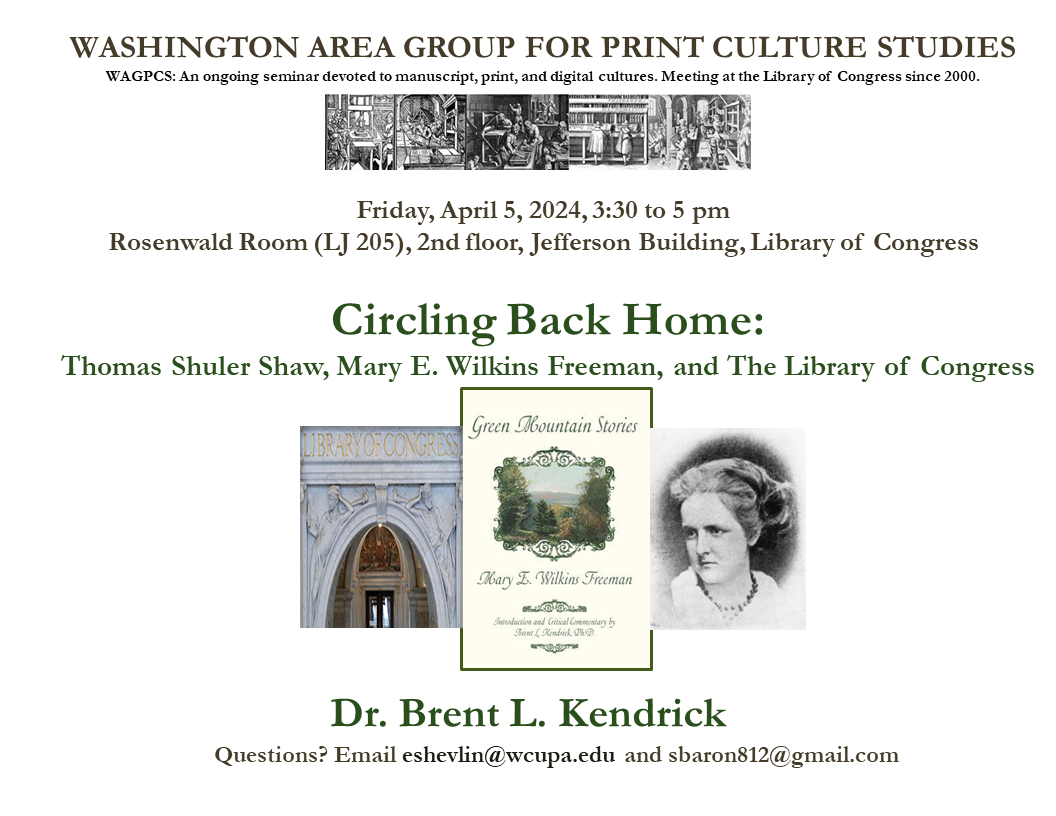
Next week I’ll be circling back home to the Library of Congress (LOC) where I enjoyed a glorious career spanning twenty-five years. I won’t be going home alone. Joining me will be the woman I’ve had an affair with for the last fifty years or so. I’m speaking, of course, of none other than my lady, Mary E. Wilkins Freeman. As part of my ongoing work on my two-volume Dolly: Life and Letters of Mary E. Wilkins Freeman, I’m circling back to LOC’s Rare Book and Special Collections to revisit some important Freeman materials. The beautiful part, however, is that the Washington Area Group for Print Culture Studies (WAGPCS) has invited me to talk about my research. I am thrilled beyond thrilled to be circling back home and to have the opportunity to share my ongoing and exciting work on Freeman.
Below is the abstract of my talk followed by a WAGPCS promotional for the event!
ABSTRACT
On March 15, 1930, the acclaimed American short story writer, Mary E. Wilkins Freeman, passed away. Her legacy, however, continues to resonate. At the turn of the twentieth century, Freeman and Mark Twain stood as America’s most beloved writers. She blazed a trail for women in literature, becoming the first recipient of the William Dean Howells Gold Medal for Distinguished Work in Fiction (awarded by the American Academy of Arts and Letters in 1925). She achieved the distinction of being among the first women elected to membership in the National Institute of Arts and Letters in 1926. Additionally, the bronze doors at the American Academy of Arts and Letters in New York (West 155 Street Administration Building) bear the inscription, “Dedicated to the Memory of Mary E. Wilkins Freeman and the Women Writers of America.”
Enter Thomas Shuler Shaw, a librarian at the Library of Congress, who embarked on an ambitious project in December 1931: writing what would have been the first biography of Mary E. Wilkins Freeman. His goal was to illuminate the life and literary contributions of this remarkable author.
However, fate had other plans. Shaw’s biography, titled A Nineteenth Century Puritan, faced rejection from prominent publishers such as Harper & Brothers, Ladies’ Home Journal, and The Saturday Evening Post. Despite setbacks, Shaw persevered. His meticulously curated scrapbooks and the typescript of his unpublished biography found a home in the Rare Book & Special Collections Division. These artifacts, along with Freeman’s books donated by Shaw to the Library of Congress, provide a rich tapestry of insights into her life and work. Notably, some of these materials reside in the Rare Book/Special Collections, while others find their place in the General Collections.
Fast-forward to 1985. Dr. Brent L. Kendrick, then serving as the Training Coordinator for United States Copyright at the Library of Congress, unveiled a literary treasure: The Infant Sphinx: Collected Letters of Mary E. Wilkins Freeman. Kendrick’s work, enriched by Shaw’s scrapbooks and unpublished biography, delves into Freeman’s correspondence. Through these letters, we glimpse the inner world of a prolific writer who defied conventions and left an indelible mark on American literature.
Fast forward again to May 2023. Kendrick continues his scholarly immersion into Freeman’s world and edits a new edition of her first collection of short stories for adults. Originally published as A Humble Romance and Other Stories in 1887, the book was meant to bear the title Green Mountain Stories. Now, 136 years later, it finally emerges under its intended name: Green Mountain Stories. Kendrick’s edition includes extensive critical commentary, unraveling the intriguing backstory behind this literary transformation.
But Kendrick’s scholarly pursuits don’t end there. Armed with fresh discoveries—significant letters previously absent from his earlier work, The Infant Sphinx—he embarks on a new two-volume project: Dolly: Life and Letters of Mary E. Wilkins Freeman. Vol. I: The New England Years (1852-1901). Vol. II: The New Jersey Years (1902-1930).
With these ongoing scholarly endeavors in mind, Dr. Kendrick returns full circle to the Library of Congress, a place where both he and Shaw once contributed their efforts. Here, he plans to delve once more into Shaw’s meticulously curated scrapbooks and unpublished biography, reexamining their contents to discern fresh insights that could enrich his comprehensive exploration of Freeman’s life and correspondence. This return to the archives not only honors the legacy of Shaw’s dedication but also underscores the enduring significance of the Library of Congress as a nexus for scholarly inquiry into the lives and works of American literary figures.
“You know you’re in love when you can’t fall asleep because reality is finally better than your dreams.“
–Dr. Seuss (Theodor Seuss Geisel, 1904-1991; American author, political cartoonist, poet, animator, and filmmaker, best known for his beloved children’s books, especially The Cat in the Hat AND GREEN Eggs and Ham.
Can you feel it? I can. It’s in the air. It’s everywhere. As the gentle Spring breeze carries the scent of blooming flowers and the melodies of birdsong fill the air, I feel the stirring of something magical. Yep. It’s love. It brings a lump to my throat, and I have to spell it L-U-V.
I’m spellbound. The whispers of renewal make me want to embrace new beginnings and the promise of blossoming romance. I can’t help but think of love, from the budding of tender feelings to the full bloom of enduring connections.
You guessed it. I’m a hopeless romantic. I believe in love at first sight. I believe in falling head-over-heels in love. I believe in being swept off my feet. I believe in being thunderstruck by love. I believe in one true love, love of a lifetime, the perfect match, my other half, my kindred spirit, and my soulmate. If you know of other similar clichés, I probably believe in them, too.
The expression “Love at first sight” has been around for thousands of years, going all the way back to literature and poetry from ancient times. One of the earliest recorded instances is from the Greek philosopher, Plato, in his work “Symposium” (ca. 385-370 BCE). In this dialogue, characters discuss the concept of love, including the idea of “falling in love at first sight.”
Love at first sight–soulmates, if you will–is still very much with us today, so I’m not alone in my love notions. In the United States, for example, the belief in soulmates is fairly common. In fact, I read somewhere not long ago that anywhere from 50% to over 70% of Americans believe in the existence of soulmates or the idea that there is one perfect match for each person.
But what about the rest of Americans who don’t believe in love at first sight? What kind of love do they believe in?
I think I know. Apparently, some people believe in “GrowingintoLove.” Maybe you’re one of them. I had never heard tell of such a thing until recently when I was scrolling through Facebook. I stopped. I stared. Two men were kissing passionately. (Both were extraordinarily handsome lookers, I might add.) But what made me stop and stare was the caption beneath this super-hot Mr. & Mr. duo:
GROWING INTO LOVE GETS BETTER EVERY DAY
“Growing into love.” That’s pretty new to me. I mean, I had to Google it just to wrap my head around the concept. Apparently, it kicks off with basics like mutual respect, understanding, and emotional connection. Starts off all casual, you know. Like, it could stem from friendship, shared values, or just a good old-fashioned sense of compatibility.
But let me pause right there. Honestly, at first glance, this whole “growing into love” idea seems a bit, well, textbook-ish, if you ask me. Like something straight out of a clinical relationship guide or a self-help book.
But hey, let’s soldier on. So, diving into the nitty-gritty, we’re talking about that initial phase where you’re just getting started with this whole “growing into love” deal. It’s all about that spark, that fluttery feeling in your stomach. Yeah, those butterflies. They’re part of the package.
Then, as time goes on, you start building on that initial attraction. Shared experiences, heartfelt conversations, and quality time together deepen the connection. Trust starts to bloom too, thanks to reliability, honesty, and support.
Sure, there might be bumps along the road—disagreements, conflicts, life throwing curveballs your way. But hey, you’re facing those challenges together. Right? It’s like relationship boot camp, strengthening the bond and making it all the more resilient.
As things progress, you might decide to take things to the next level—getting exclusive, maybe moving in together, or even making long-term plans. But hey, let’s remember, it’s all about choice here. No pressure.
And here’s the kicker. Love? It’s not some static thing. It’s a living, breathing entity that needs constant care and attention. You’ve got to keep those lines of communication open, be ready to compromise, and adapt to each other’s ever-evolving needs and desires.
So yeah, call me clueless, but I’m trying to wrap my head around this whole “growing in love” concept. I mean, it’s pretty cool how it acknowledges that building a lasting relationship takes more than just initial attraction. It’s about putting in the work, day in and day out, to nurture something real and meaningful.
I get it. I understand. But I’m still stuck way back there in Spring with love in the air and with love at first sight–the sheer poetry of it all. There’s a romantic allure to the notion of love at first sight that simply can’t be matched by any other approach to love. It’s like stumbling upon a rare, exquisite flower in the midst of a sprawling garden, instantly captivating your senses and drawing you in with its beauty and mystery.
Imagine this: you’re going about your day, minding your own business, when suddenly, across a crowded room your eyes meet theirs, and in that moment, time seems to stand still. There’s a spark, an inexplicable connection that transcends rationality and sweeps you off your feet in an instant.
It’s as if the universe has conspired to bring two souls together, weaving a fate and destiny together and binding you together in an unbreakable bond. There’s no need for words or explanations; the language of the heart speaks volumes, echoing with the resonance of shared dreams and desires.
In that split second, you just know—know that this person is meant to be a part of your life, know that your paths were always destined to intersect, know that you’ve found a kindred spirit who complements your very being in ways you never thought possible.
That’s precisely what happened when my late partner and I met. Our eyes locked, time stood still, and the world faded into the background, leaving only the two of us in a moment of perfect clarity. In that instant, Allen and I both knew our lives were meant to be shared, and our twenty-year love story began with that electrifying connection.
Sure, it may sound like something out of a fairy tale, but isn’t that the magic of love at first sight? It defies logic and reason, transcends the boundaries of time and space, and unites two souls in a symphony of passion and longing.
As much as I appreciate the gradual unfolding of love, my heart will always be drawn back to that fleeting moment of enchantment, where love blossoms like a flower in the springtime, filling the air with its intoxicating fragrance and leaving an indelible mark on our souls.
And you, DearReader? What about you? What about your love? Whether it unfolds gradually like the unfurling of a delicate Spring blossom or strikes suddenly like a bolt of lightning in a stormy Spring sky, always remember this: love, in all its forms, is a testament to the resilience of the human spirit, the capacity for connection, and the enduring power of hope.
“In the midst of winter, I found there was, within me, an invincible summer. And that makes me happy. For it says that no matter how hard the world pushes against me, within me, there’s something stronger – something better, pushing right back.”
Albert Camus (1913-1960; French philosopher, author, and journalist known for his existentialist philosophy and literary contributions; winner of the 1957 Nobel Prize in Literature for his significant literary achievements, which continue to influence existentialist thought.)
One of my greatest joys is watching people succeed against all odds. I write a lot about those triumphs, most recently in my “Let Your Light Shine Bright.” It seemed fitting that I do so since it was December, a month chockfull of celebrations, each carrying a unique message of hope, transcending boundaries, and unifying us in a shared spirit of optimism and celebration.
Most of the people who populated that post–ranging from Susan Boyle to Barack Obama–are out there in the public eye as performers or politicians. Others are out there as motivational speakers. I’m thinking especially of Nick Vujicic, a charismatic and dynamic speaker who captivates audiences with his powerful presence and inspiring message. Born without arms and legs, Nick exudes confidence, warmth, and authenticity as he shares his personal journey of overcoming adversity and finding purpose and joy in life.
His message is one of resilience, faith, and the limitless potential of the human spirit. He encourages listeners to embrace their own uniqueness, overcome obstacles with courage and determination, and live a life of purpose and meaning. Through his words and example, Nick inspires others to believe in themselves, pursue their dreams, and make a positive impact on the world.
While Nick’s triumphs are anything but silent, witnessing his resilience and ability to overcome immense challenges prompted me to think about the unnoticed private triumphs that people experience.
As you might expect from an English professor, I started thinking about the people from my literary world. One by one, characters tiptoed past, whispering their silent triumphs.
Hester Prynne from Hawthorne’s The Scarlet Letter reminded me that her silent triumph came in her resilience and strength in the face of public shaming and ostracism. Branded with the scarlet letter “A” for adultery, she quietly bore her punishment and found redemption through her unwavering love for her daughter, Pearl.
And what about Janie Crawford in Zora Neale Hurston’s novel TheirEyesWereWatchingGod? She underwent a journey of self-discovery and empowerment, ultimately finding her own voice and identity despite societal expectations and pressures. Her silent triumph came from her ability to assert her independence and pursue happiness on her own terms, even in the face of adversity and criticism.
Next Nora Helmer marched dramatically onto the stage of Henrik Ibsen’s ADoll’sHouse. Her silent triumph prevailed at the end of the play when she chose to leave her husband and children in order to seek personal freedom and self-realization despite the societal expectations and conventions of the time.
A more ambiguous and bittersweet silent triumph can be seen in Tom Wingfield from Tennessee Williams’ play The Glass Menagerie. He ultimately chose to leave his overbearing mother and disabled sister in search of his own dreams and aspirations, despite the guilt and responsibility he felt towards them. While his departure may seem selfish, it represented his quest for personal fulfillment and freedom from the constraints of his family’s expectations.
People in short stories have their silent triumphs, too. Consider Sammy in John Updike’s “A&P” who experienced a silent triumph when he quit his job at the supermarket in defiance of his boss’s mistreatment of a group of girls who entered the store wearing bathing suits. The potential consequences of his actions did not keep him from asserting his independence and standing up for what he believed was right.
In James Thurber’s “The Secret Life of Walter Mitty,” the protagonist, Walter Mitty, experienced silent triumphs throughout the story as he escaped into vivid daydreams to cope with his mundane existence. He found solace and fulfillment in his imaginative fantasies, where he became a hero, a pilot, a surgeon, and more. These silent triumphs allowed him to momentarily transcend his ordinary life and find excitement and adventure within his own mind.
Obviously, silent triumphs can be poetic, too. “Home Burial” by Robert Frost is a perfect example of a silent triumph. In this poignant dialogue, a husband and wife mourn their child’s loss differently. While the wife openly expressed her anguish, the husband silently strove to bridge the emotional gap between them, offering solace despite their differing ways of grieving. This silent triumph highlights the power of emotional connection amidst grief.
In Langston Hughes’ “Mother to Son,” the speaker’s resilience in facing life’s challenges is portrayed through the metaphor of a staircase. Despite hardships, she persevered, quietly inspiring her son and readers with her determination to keep climbing. This silent triumph underscored the power of resilience in overcoming adversity.
And, yes, they can triumph on the big screen, too. In TheTriptoBountiful, the victory occurred when the main character, Carrie Watts, finally made her journey back to her childhood home of Bountiful. Despite her age and frailty, Carrie’s determination and resilience shone through as she persisted in her quest to revisit the memories and places of her youth.
In FriedGreenTomatoes, a silent triumph occurred when Evelyn Couch, one of the main characters, underwent a transformation and found her inner strength and confidence. Throughout the film, Evelyn struggled with feelings of invisibility and dissatisfaction with her life. However, her friendship with Ninny Threadgoode and the stories she heard about the lives of the women in Whistle Stop, particularly Idgie and Ruth, inspired her to take control of her own destiny.
But guess what? The journey of silent triumphs extends far, far beyond the pages of literature and the spotlight of public figures. While they serve as poignant examples of silent triumphs, the essence of their victories resonates deeply within each of us. They are not confined to the extraordinary narratives of books or the public eye but are intricately woven into the fabric of our daily lives, waiting to be acknowledged and celebrated.
Conquering fears, whether big or small, such as fear of public speaking, fear of PowerPoint, or fear of rusty observation towers, can be a significant silent triumph. It may involve facing challenges head-on, pushing past comfort zones, and gaining confidence in one’s abilities.
Adopting healthier habits, such as exercising regularly, eating nutritious foods, quitting smoking, or reducing alcohol consumption, can be silent triumphs that contribute to improved well-being and quality of life.
Finding healing and closure from past traumas, heartbreaks, or losses can be a silent triumph. It may involve seeking therapy, practicing self-care, forgiveness, and cultivating resilience in the face of adversity.
Accomplishing personal goals, whether professional, academic, or creative, can be silent triumphs that signify hard work, perseverance, and dedication. It may involve setting SMART (Specific, Measurable, Achievable, Realistic, Time-bound) goals and taking consistent steps towards achieving them.
Speaking out against injustice, discrimination, or oppression, even in small ways like blogs, can be a silent triumph that demonstrates courage, integrity, and moral conviction.
Successfully navigating major life transitions, such as starting a new job, moving to a new city, becoming a parent, or retiringinventing, can be silent triumphs that require adaptability, resilience, and resourcefulness.
Finding peace, contentment, and fulfillment within oneself, despite external circumstances, can be a silent triumph that signifies self-awareness, acceptance, and gratitude.
Performing acts of kindness, generosity, or compassion towards others, without expecting recognition or reward, can be silent triumphs that contribute to building connections, fostering empathy, and making a positive difference in the world.
Challenging and overcoming self-limiting beliefs, insecurities, and negative self-talk can be silent triumphs that lead to increased self-confidence, self-esteem, and self-empowerment.
Discovering passion, purpose, or sense of calling in life can be a silent triumph that brings clarity, direction, and fulfillment. It may involve introspection, exploration, and embracing opportunities for growth and self-discovery.
Many of these triumphs often go unnoticed, obscured by the hustle and bustle of our daily lives, concealed within the folds of routine tasks and responsibilities.
Today, I urge you to pay attention to the silent triumphs of those around you, whether it’s a friend, family member, coworker, or stranger. Offer words of encouragement, support, or recognition to acknowledge the quiet victories that may go unnoticed by others but are meaningful, nonetheless. Extend compassion and appreciation to those around you. Foster a culture of empathy and recognition for the silent triumphs that unite us all.
Today, I encourage you to pause and reflect on the silent triumphs that have shaped your life. Embrace them with gratitude and pride, knowing that they are the threads that weave the tapestry of your existence.
Today, let’s join hands as we celebrate these silent triumphs–mine, yours, and others, real and imagined–knowing that as we do, we honor the essence of our humanity and inspire others to do the same.
Today, let’s salute the quiet heroes among us, whose resilience, courage, and determination light the path for us all. May we continue to cherish and champion these moments of victory, weaving them with pride and gratitude into the collective story of our silent triumphs.
“The joy of publishing is in sharing your stories with the world and knowing that they’ll live on long after you’re gone.”
–Maya Angelou (1928-2014; a renowned American author, poet, and Civil Rights activist whose works explore themes of identity, race, and resilience.)
DearReaders, gather ’round!
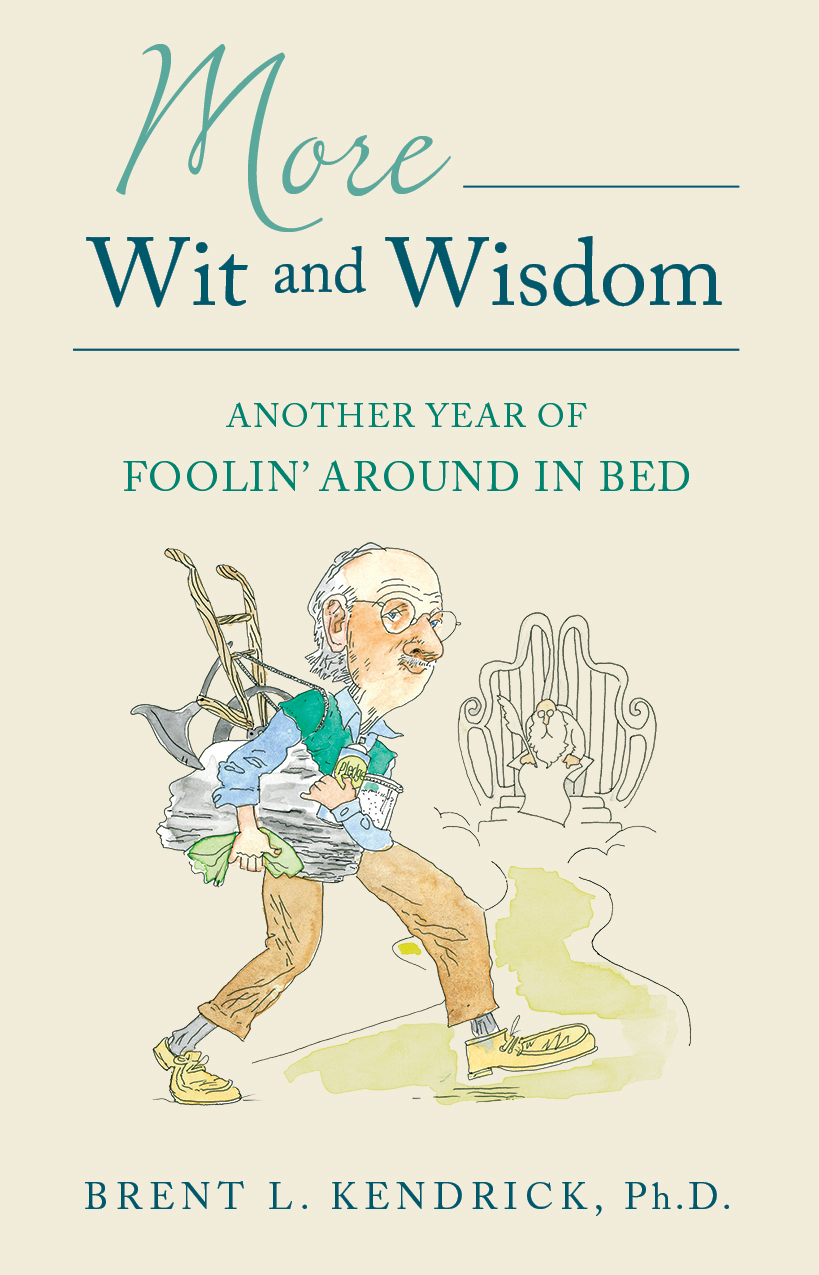
The moment we’re all eagerly waiting for is just around the corner. That’s right—my new book, More Wit and Wisdom: Another Year of Foolin’ Around in Bed–is getting closer and closer to its grand debut in late April, and boy, oh boy, do I have some juicy updates to share with you!
I’m thrilled to announce that I’ve personally PDFed every single one of the 380 interior pages, ensuring that each word, each sentence, shines as bright as a star in my mountaintop night sky. Proofing? Poof! Completed!
Whoever you are and wherever you are, your unwavering support means the world to me. MoreWitandWisdom: AnotherYearofFoolin’ AroundinBed isn’t just ink on paper. It’s a journey shared across 88 countries with 7,320 readers from the Shenandoah Valley to Okinawa.
But wait, wait! Don’t go! There’s one more thing. Feast your eyes upon the cover art for this new upcoming literary escapade. Just imagine it gracing your bookshelf, waiting to be cracked open and devoured, page by page. It will be available in hardback and paperback from Amazon, Barnes and Noble, and, hopefully, your own hometown bookstore. (Drumming up anticipation yet?)
Grand Publication Debut of a Soon-to-Be American Classic Expected by the End of April 2024. (Coverartbyacclaimedillustrator, Mike Caplanis.)
“I learned that courage was not the absence of fear, but the triumph over it. The brave man is not he who does not feel afraid, but he who conquers that fear.”
–Nelson Mandela (1918-2013; a towering figure in the fight against apartheid in South Africa and a symbol of resilience, reconciliation, and forgiveness worldwide.)
Have you ever found yourself sitting in front of your computer, fingerspoisedoverthekeyboard, eyeslockedontheblank screen? The cursor blinks, mocking your indecision. The room holds its breath, waiting for your next move.
Of course you have. We all have. I have, too.
Actually, I had that happen not long ago. I was sitting in front of my computer, enveloped in a curious trance as I looked at my PowerPoint options. Each was a digital beacon of possibilities, beckoning me into a realm where creativity and innovation might dance hand in hand.
My seasoned fingers, once adept at coaxing brilliance from the keys, hovered hesitantly over the mouse, betraying the uncertainty that clouded my thoughts. The screen gazed back at me with patient anticipation, as if urging me to breathe life into the blankness into which I stared.
But as I peered into the depths of the display, my mind became a whirlwind of memories. How many lectures had I crafted with this very tool? How many minds had I ignited with the flicker of a well-placed slide or the resonance of a perfectly timed transition?
And yet, despite my seasoned expertise, I found myself transfixed, caught in the labyrinth of my own imagination. The cursor blinked mockingly, a silent reminder of the silence that echoed through my mind.
I sat there, staring, waiting, realizing that in the digital world of ones and zeros, the true magic lies not in the tools we wield, but in the stories we choose to tell.
Indeed, I had a story to tell. Gina Byrd, Executive Director of the Friends of Handley Library System, had invited me for an “Author Talk” at Bowman Library (Stephens City, VA). My topic? “Reinventing Yourself: Writing Your Next Chapter.”
Several weeks before my talk, Gina and I met at the library so that we could go over logistics.
“Will you be using PowerPoint?”
“No, I don’t think so. I like to walk around the room while I talk.”
It was settled. No PowerPoint.
But when I got back home, the notion swept over me that perhaps I should use PowerPoint. I hesitated for a moment before deciding to reach out to Gina. After all, I had initially dismissed the idea, preferring the freedom of movement without slides. But as I mulled it over, I realized that visual aids could enhance the audience’s understanding of my topic. With a sense of uncertainty If I can keep from it, I fired off an email to Gina:
It occurs to me that I might want to use PowerPoint after all, especially if you all have a remote clicker that I could use as I walk around.
Gina’s prompt reply reassured me:
That’s fine! We have the Clear Touch Panel (it’s basically a huge iPad) and a clicker you can use. If you can bring your presentation on a thumb drive, that would be easiest.
The next day, I talked myself into tackling the PowerPoint presentation.
“Piece of cake. You’re an expert on reinvention. After all, you’ve been reinventing yourself for a lifetime. You’ve got this.”
Sure. Right. Self-talk works most of the time. However, this seemed to be one of those times when it wasn’t working. There I sat, once again, staring at my blank computer screen while PowerPoint stared back at me. Even though I had more than a week to complete the PowerPoint, my mantra was immediate:
“Go on. Just do it. Get it out of the way.”
The glow of the PowerPoint screen beckoned, but I found myself lured instead into chasing the indoor tasks awaiting my attention. The dust bunnies, like mischievous gremlins, taunted me from their hiding places, my laundry begged to be folded and sorted, and my houseplants drooped in silent protest against neglect. As I tackled each chore, a siren call steered me further away from the digital abyss.
The next day, I faced the blank screen once more. It was then that my fear looked back at me. I realized that I had not developed a PowerPoint presentation in more than two years. I realized that I was fearful simply because I was no longer familiar with a task that, in reality, was simple and straightforward.
That settled it. I sat down in front of my computer, determined to develop the presentation, slide by slide. I had no expectation that I would finish it that day, but I resolved to complete a draft. I knew that I had to get past my fear.
The next thing I knew, I found myself ensnared by the choices at my fingertips. Each transition, a delicate balance between subtlety and spectacle, whispered promises of visual delight. Each animation added movement and meaning to static slides. Each carefully selected photograph added depth and resonance to my narrative. The bullets, like soldiers marching in formation, stood ready to deliver their payload of information with precision and clarity. Every click held power, and I was in charge.
I finished my PowerPoint presentation the next day, and I was delighted with it. Actually, I was ecstatic because I had as much fun developing it as I had ever enjoyed in the past.
When I gave my talk at Bowman Library, I realized that my decision to use PowerPoint was a wise one. It helped me navigate my talk smoothly, and, more importantly, it kept everyone engaged. Afterward, several people commented on its effectiveness, with special praise for the transitions, which they felt reinforced the content.
As I drove back home, I started thinking about the PowerPoint battle that I had fought and nearly lost. It would have been so easy for me to have aborted my plan. After all, I hadn’t planned to use PowerPoint initially. But I had changed my mind. What a pity it would have been for me to have lost the battle to the dis-ease that I was experiencing simply because I had not used PowerPoint in more than two years.
Don’t get me wrong. If I were rating the level of my fear, I’d probably give it a 4 on a scale of 10, with 10 being the greatest fear. Actually, that’s not that bad at all, yet it was bad enough to lure me away from the task, not once, not twice, but multiple times.
Without a doubt, I’ve experienced far greater fears in my life. How well I recall getting back on a bicycle after several decades of not riding a bike. There I stood, at the trailhead to the Virginia Creeper Trail, nostalgia tugging at my muscles. The trail stretched downhill before me. I glanced at the path, comforted that Allen–my late partner, who also hadn’t ridden a bike in several decades–was facing the challenge with me. But as I considered the downhill descent, I could neither hide nor disguise my fear. With trembling legs, I pushed off, the wind carrying whispers of both fear and exhilaration. The trail unfolded. I pedaled. I kept on pedaling until I made it to Damascus, 34 miles later, safely past my fear.
More recently, I had a more frightening encounter with a chainsaw. I was finishing a day’s work of taking down some small trees behind my home. I decided to end the job by cutting a sapling. There I stood—a weekend warrior in faded jeans and work boots. The sapling seemed to know exactly how to make the saw bounce back, cut through denim, and rip through flesh, all the way down to but not through my patella—the hinge of leg movement, the guardian of joints. It took twelve stitches and nearly as many weeks to heal my knee.
It took me far longer to bounce back from the deep-seated fear that the chainsaw had instilled. Months passed. Every trip to my basement found me staring at the saw, wondering whether I would ever have the courage to use it again. Determined to conquer the fear, I ordered protective chainsaw chaps. When they arrived, I put them on hesitantly, started the Stihl, and cautiously but triumphantly took down a small tree. I tossed the wood and my fear into the stack for winter fires.
Experiencing fear, especially in certain situations or after a prolonged period of inactivity or after an accident, is a common and normal human response. Fear is a natural part of the human experience.
As a seasoned educator and as a man in his seventies, I’ve seen fear kick ass over and over again as people faced:
● Technology ● Change ● Failure ● Medical Procedures ● Public Speaking ● Rejection ● Regret ● Success ● Letting Go ● Driving ● Aging
The list is endless. But here’s the caution that we all need to hear regardless of who we are or where we are in life. As we navigate life, fear can often stand as a formidable barrier between us and our aspirations. Yet, as I’ve learned through my own experiences, it’s in confronting these fears head-on that we find the true essence of courage and resilience.
I urge you to take a moment to reflect on the fears that may be holding you back—whether it’s the fear of trying something new, the fear of failure, or the fear of the unknown. Embrace these fears not as obstacles but as opportunities for growth and self-discovery.
Just as I conquered my hesitation with PowerPoint, rode a bike after decades, and faced down a chainsaw, you too can overcome the fears that threaten to immobilize you. Step by step, challenge by challenge, you have the power to rewrite your story and embark on a journey of transformation.
I encourage you to take that first step today. Identify one fear that’s lingering in the shadows of your mind and make a commitment to confront it. Whether it’s signing up for that class you’ve been eyeing, reaching out to mend a broken relationship, or simply daring to dream a little bigger—embrace the discomfort, for it’s in pushing past our boundaries that we discover our true potential.
Remember: you are capable of far more than you know. Let’s rise above our fears, embrace the adventure of life, and write the next chapter of our story with courage, resilience, and unwavering determination. The blank page of possibility awaits. Let’s fill it with the triumphs of our bravery.
“In a world where we can be anything, let’s choose to walk the red carpet of life with kindness, grace, and a sprinkle of stardust.”
–Lady Gaga (b. 1986, Stefani Joanne Angelina Germanotta; a Grammy Award-winning singer, songwriter, and actress known for her groundbreaking music, bold fashion choices, and advocacy for social justice issues; one of the most influential and iconic figures in contemporary pop culture, captivating audiences worldwide with her unique blend of creativity and authenticity.)
Hey, y’all. Come here, curl up real close to me, get comfy, and listen while I purr. I need to share something with you that I simply dare not share with the world at large. But since you’re special and know how to keep secrets, I’ll share it with y’all. Okay? So, get close while I whisper my secret in your ear:
“The other day, I was lying on my sofa, all innocent and quiet like, and right out of the blue, I was smitten, right there in my living room, in broad daylight! Can you imagine?”
Well, I couldn’t imagine it either, mainly because it came on so sudden like. I mean. I was just lying there, and then Shazam! I had been smitten! Well, actually, that shouldn’t come as too much of a surprise. I’m smitten easily, and I’m smitten hard. Hopefully, you are, too. Right now, I’m smitten by the gorgeous moss, harbinger of an early spring, greening itself in my Koi Pond Waterfalls. I’m smitten, too, by the online photography course I’m taking so that I can take better photographs with my new Samsung Galaxy S24 Ultra. I continue to be smitten by advances in AI, especially by Aloha, a housekeeping humanoid who can cook and clean. (If you dissed me when I announced my Caden last November, I guess I’m getting the first laugh. Ready to hop on board? There’s room!) And, in case you’re wondering–and I know, I just know that some of you are–I have not been smitten by any of the studmuffins who failed to find their way into Anne Lamott’s life or into mine during our respective flings with online dating apps. (For her account, see “My Year on Match.com”; for mine, which matters far more and is really the only one that matters at all, see “My Year on Unmatched.com.”)
I cannot speak for Lamott, but I remain hopeful. I am doing my best to smite the frog at my kitchen door with regular, passionate kisses so that I can practice my pucker and stay in shape. Who knows? I might just have an opportunity to be smitten by a prince. (Princes like good kissers. Just sayin’.)
No doubt you’re wondering what the hell I’ve been smitten by, aside from my nonsense. Chill. I’m about to tell you.
I’ve been smitten by a red carpet. Mind you, though, it’s not just any ole red carpet. It’s THA red carpet that gets rolled out right in front of you to seduce you into a waltz with destiny, leaving you breathless with anticipation and a sprinkle of stardust in your eyes.
Yep. I’m a smitten kitten. Hear me purr? But here’s the thing. The glamour of rolling out the red carpet goes all the way back to ancient Greece, where it was mentioned in Aeschylus’ play Agamemnon describing the king’s return home after winning a battle. His wife Clytemnestra says to him, “Now my beloved, step down from your chariot, and let not your foot, my lord, touch the Earth. Servants, let there be spread before the house he never expected to see … a crimson path.”
Despite its ancient heritage, it was not until the early 20th century that rolling out the red carpet became associated with celebrities and VIPs, particularly in the entertainment industry. The first known reference to a red carpet being used at the premiere of a movie dates back to 1922, when it was laid out for the opening of the Egyptian Theatre in Hollywood.
Since then, the red carpet has become synonymous with prestige, glamour, and exclusivity, particularly at award shows, movie premieres, and high-profile parties. It’s often used to signify that the individuals walking on it are special guests deserving of special treatment and attention.
That certainly was the case during this year’s Grammy Awards, as the red carpet sizzled with music’s biggest stars like Taylor Swift and SZA. Amidst wardrobe changes and rehearsals, the red carpet set the stage for unforgettable fashion moments.
Beyond Hollywood, the red carpet is used in various other contexts as a symbol of importance, honor, and VIP treatment. I dare say that each of us, at one time or another, has said to ourselves or to someone else “I want to roll out the red carpet” to celebrate someone or to jazz up a special occasion.
You’ve probably had enough of my caterwaul, so I’d better roll out THA red carpet that turned me into a smitten kitten. Meow, meow, meow, purr, purr, purr, meow, meow, purr, purr, meow, purr, MEOW!
Like I said, I was lying on my sofa in broad daylight, amusing myself with some TikTok videos when out of nowhere a video featuring Opatija, a picturesque coastal town in Croatia, popped up on my smartphone. But it wasn’t just any ordinary kind of video. It was a red-carpet tourism video, weaving together a rich tapestry of emotions, triumphs, and shared moments. The taglines alone speak volumes:
● Exploring the vibrant tapestry of choices on the red carpet, where every step unveils a world of possibilities.
● In this beautiful world, imagine if every moment mirrored a red carpet affair—filled with smiles, hugs, and unbridled happiness. Let’s choose to embrace the elegance of joy in every step we take.
● Witness the unexpected on the red carpet—a celebration of diversity, love, and transformation.
● Imagine if every moment mirrored a red-carpet affair—filled with smiles, hugs, and unbridled happiness. Let’s choose to embrace the elegance of joy in every step we take.
Typically, a man appears suddenly and rolls out a red carpet in public places, such as sidewalks or parks, treating unsuspecting strangers as if they were celebrities, complete with photographers, fans, and sometimes even limousines. Without fail, the reactions and interactions with the new celebs are amusing and heartwarming, often catching people off guard with the unexpected VIP treatment. The goal is to capture genuine reactions and create humorous situations, so they often approach anyone who happens to be in the vicinity of where they set up the red carpet. This approach helps keep the content unpredictable and inclusive, as they showcase reactions from a variety of individuals.
Typically, the people who walk the red carpet in the videos seem to be surprised by what is happening. Almost always, they are hesitant to step onto the red carpet after it has been rolled out in front of them, even as the tall young man extends his arm graciously and invitingly. Their movements are cautious, almost as if they’re tiptoeing into unfamiliar territory. Their expressions betray a mixture of uncertainty and curiosity, unsure of what awaits them as they traverse this unexpected path. Each step is tentative, as if testing the ground beneath them for stability.
Yet, as they progress further along the scarlet pathway, something remarkable begins to happen. A subtle shift occurs in their demeanor, a gradual transformation fueled by the energy of the moment. Their apprehension gives way to wonder. Their eyes light up with newfound excitement and anticipation. With each stride, they seem to shed the weight of their doubts, stepping into a realm where anything is possible.
As they walk across the red carpet, a sense of liberation washes over them, freeing them from the constraints of everyday life. In this fleeting moment, they are not defined by their roles or responsibilities but by the sheer exhilaration of the experience. Laughter bubbles forth, spontaneous and unrestrained, as they embrace the joy of the unexpected.
Amidst the vibrant tapestry of emotions, the little dramas of life begin to unfold. Strangers become companions, sharing stories and forging connections that transcend the fleeting encounter. Inhibitions are cast aside, replaced by an unbridled sense of camaraderie and belonging. It’s as if the red carpet has become a stage, and they are the stars of their own impromptu performance.
In the end, as they step off the red carpet, their spirits are buoyed by this enchanting journey. Though they return to the routine of their daily lives, they carry with them the indelible imprint of this extraordinary moment—a reminder that magic can be found in the most unexpected places, if only we dare to take that first step.
“Dare to take thatfirst step. “
We can look at that statement in two ways. The people in these little dramas have to dare to take that first step onto the red carpet. Then, and only then, can these magical transformations take place, even if only for a few moments. But let’s not forget the other individuals who are involved in these little dramas: the Croatian video team, who time and time again, dare to roll out the red carpet for strangers whom they encounter. Without the video team, strangers could not become stars.
I cannot help but wonder what our own little corners of our world would be like if we spent some time thinking about ways that we dare roll out the metaphorical red carpet before strangers whom we encounter in our own lives.
It could be as simple as sincerely complimenting someone on something positive about them. Whether it’s their style, smile, or skill, our words can brighten their day. For instance, we might notice someone’s vibrant scarf and express admiration for how it complements their outfit. Their initial surprise might give way to a smile of appreciation, boosting their confidence and spreading warmth.
It could be as simple as performing small, random acts of kindness without expecting anything in return. It could be as simple as holding the door open for someone, helping carry groceries, or simply offering a friendly smile. Imagine seeing someone struggling with heavy bags and offering assistance without hesitation. Their gratitude and relief could radiate as they realize there are still caring strangers in the world.
It could be as simple as striking up conversations with people we encounter in our daily lives. This could be as straightforward as asking how their day is going or commenting on something happening in the community. Picture starting a conversation with someone standing in line at the grocery store and sharing a laugh over a funny observation. Our genuine interest and friendliness might brighten their day and foster a sense of connection.
As I continue to be smitten by the transformative allure of the Opatija tourism videos, where a mere red carpet, a lens, and the sincere desire to infuse fleeting moments with joy can ignite profound change, I am stirred to contemplate our collective capacity to impact the lives of strangers. Perhaps, in our quest to touch hearts, we need not seek grand gestures. Perhaps all that we need to do is strive to live our lives as radiant beacons of kindness and warmth so that with every interaction, we joyfully roll out the red carpet.
—Socrates (470-399 BCE; classical Greek philosopher best known for his Socratic method, which aims to elicit truth by asking questions and engaging in dialogue.)
One of my favorite short stories is Mark Twain’s “The Celebrated Jumping Frog of Calaveras County” (1865). No doubt you’ve read it, too, and will recall how old garrulous Simon Wheeler traps the narrator with a long-winded tale about a man named Jim Smiley and his famous jumping frog. Wheeler’s rambling accounts of Jim Smiley’s exploits appeal to me, especially as they become increasingly elaborate and exaggerated. Smiley and Wheeler are portrayed as eccentric characters with idiosyncratic behaviors and quirks. Who can forget Smiley’s obsession with betting on animals or Wheeler’s folksy storytelling. The premise of the entire story—a man who trains a frog to jump competitively and then loses a bet because the frog has been tampered with—is inherently absurd, adding to the comedic tone.
More than any of those dimensions, however, I like the story’s situational humor. The narrator is “backed into a corner” by Simon Wheeler and unable to escape until the end of his monotonous monologue. If you look at the story closely, you will discover that everything from the fourth paragraph all the way up to and including the next to the last paragraph is enclosed in quotation marks. This setup creates a sense of trapped amusement. The narrator is helpless in the face of Wheeler’s relentless storytelling and remember, as well, that Wheeler physically corners the narrator with his chair, thereby adding a visual element to the absurd humor.
The juxtaposition of the narrator’s predicament and Wheeler’s obliviousness to his captive audience adds a richness to the subtle humor. Here’s why. Even if readers are not consciously aware of that aspect of the story–that the narrator is literally backed into a corner–it seems to me that they pick up on it intuitively because we can all relate to feeling trapped in real-life situations where we are unable to escape.
Twain succeeded in tapping into a universal experience that readers understand. It’s a perfect “been there, done that” moment.
No doubt, you’ve been there, done that, too. Remember that party where you found yourself cornered by the resident “over-sharer”? They regale you with the intricate details of their recent colonoscopy, leaving you desperately searching for an escape route while nodding along, trapped in a vortex of TMI. Hopefully, over time, you came to terms with your boundaries, and you’re comfortable with giving an assertive but diplomatic response:
“I appreciate your openness, but I have to admit, discussing medical procedures makes me a bit squeamish. Let’s shift the conversation to something more lighthearted.”
Such a response communicates your discomfort with the topic, sets a clear boundary in a respectful manner, redirects the conversation without dismissing the other person, and maintains a friendly and polite tone.
Or maybe your friends dragged you off to a karaoke bar, and despite your protests that you couldn’t carry a tune to save your life, they insisted that you join in. As you droned an off-key rendition of “Every Breath You Take,” you felt like a reluctant participant in a musical hostage situation.
Getting backed into a corner by peers happens over and over again until we take time to reflect on our personal boundaries with a determination to be more assertive. When we gain insights into those areas, we know our limits, we know how to stand firm, and we know how to say “no.”
Or maybe you got backed into a corner at a family gathering where you’re bombarded with questions about your career, relationship status, and future plans. Despite your discomfort, you navigated the awkward interrogations with forced smiles and vague answers, feeling trapped in a whirlwind of familial expectations and scrutiny.
How can you avoid feeling trapped in future family gatherings? Consider your comfort level with discussing personal topics. Set your own boundaries. Once again, by gaining insights into those areas, you can navigate future events with greater ease and respond to questions assertively and confidently.
Hopefully, you’re getting my point. We’re all backed into corners by family and friends in social situations where we never expected to be in the corner, feeling so uncomfortable.
But if we seize those encounters as opportunities to examine why we felt uncomfortable, to clarify in our own minds our beliefs, to understand the nature of our boundaries, and to resolve to assert ourselves, we can navigate future social situations like that with far greater confidence, simply because we took the time to examine ourselves.
I am reminded of something that acclaimed writer Mary E. Wilkins Freeman once said:
Sometimes I believe that the greatest thing a man’s friends can do for him is to drive him in a corner with God.
Whoever, whatever, whenever, wherever or even if God is, we all know exactly what Freeman has in mind. It’s that final moment of reckoning when we are accountable unto ourselves.
But here’s the thing. Why wait for friends? More likely than not, our friends are too polite. More likely than not, our friends are too nonconfrontational. More likely than not, our friends are too diplomatic. Let’s not wait, then, for our friends to drive us in a corner. Let’s not expect God to be in the corner waiting for us, either. Let’s just go on and do it. Let’s just go ahead and back ourselves into our own uncomfortable corners so that once and for all, we have to address major issues that we can’t escape. Let’s not avoid them. Let’s not pay lip service to them. Let’s not talk out of both sides of our mouths about them. Let’s simply back ourselves into our respective corners, examine the issues, and discover where we stand.
God knows that I’ve lived long enough to back myself into lots of corners. For some, I’ve been in them so often and so long that they’re rounded. For others, I’ve just gotten in them, and I’m discovering their recency, their rawness, and their sharpness. Let me share some of my corners. As you read about mine, be mindful that I am not trying to convince you to share my beliefs. You’ve got your own beliefs and your own corners–soft or hard. At the same time, I am encouraging you to back yourself into your own corners and to examine your issues and concerns in private before the world forces you to examine them in public.
One of my corners deals with Racism and Discrimination. Growing up in West Virginia coal camps alongside African Americans, Whites, Greeks Hispanics, Jews, Italians, and Hungarians, I witnessed the power of unity and mutual respect. Our dads worked together in the mines; our moms cooked together in the kitchens; and we kids played together in the yards. We recognized each other’s humanity and worth. Today, I cringe when I witness racism and discrimination that cast a dark shadow over all of us. I am pained as I examine the harsh reality of ongoing injustices and the destructive impact of discrimination. Yet, I remain steadfast in my belief in the interconnectedness of humanity and our entitlement to equal rights. Simply acknowledging the problem isn’t sufficient; we must actively advocate for change and dismantle oppressive structures. By standing in solidarity with marginalized communities and confronting racism abd discrimination head-on, we can move towards a more just and cohesive society. Every individual, regardless of race or background, deserves to be valued and respected. It’s time to build a future where equality and inclusion are the cornerstones of our society.
The Russia-Ukraine War and the Israel-Gaza Crisis leave me speechless in disbelief as I examine the issues in my corner. How can this be happening in our world today? The unprovoked invasion by Russia into Ukraine and the attacks from Gaza into Israel are stark reminders of the fragility of peace and stability in our world. In these tumultuous times, I firmly believe that the United States and other nations must stand together on the side of justice and righteousness. We cannot turn a blind eye to aggression and violence. It’s imperative for the international community to rally behind efforts for peace, diplomacy, and the protection of innocent lives. We must advocate for dialogue, de-escalation, and respect for international law to ensure a safer and more just world for all.
Another corner that I’m examining is Artificial Intelligence (AI). As a staunch AI supporter, I’m deeply concerned by the lack of awareness surrounding its potential and our collective responsibility in shaping its trajectory for the greater good of mankind. AI has the power to revolutionize countless aspects of our lives, from healthcare to transportation, education to entertainment. However, without careful consideration and ethical oversight, there’s a risk of unintended consequences and misuse. We must advocate for transparency, accountability, and inclusivity in the development and deployment of AI technologies. By promoting education and fostering informed dialogue, we can ensure that AI is harnessed responsibly to benefit humanity as a whole, rather than serving narrow interests or exacerbating existing inequalities. Let’s work together to shape a future where AI serves as a force for progress and empowerment, guided by principles of ethics, empathy, and equity.
You’ll find me in a corner, too, with Global Warming. It terrifies me. Its effects are undeniable. Extreme weather and melting ice caps make it clear. Our planet is in crisis. I’m so alarmed that I even contemplate solutions like space colonization. But while this idea may gain traction, it shouldn’t be our first resort. Instead, urgent action is needed. Transitioning to renewables and reducing emissions are crucial steps. The time for change is now. We must prioritize Earth’s preservation, ensuring space colonization remains a last resort.
My next corner is a hard one because discussing politics has never been my cup of tea. But with a Presidential Election ahead of us–presumably between President Biden and Donald Trump–I feel compelled to examine where I stand. Key issues like the economy, world trade, green investments, race, and criminal justice weigh heavily on my mind. In those areas–and others–President Biden earns my support with his comprehensive plans and commitment to progress. However, there’s one more crucial factor that will sway my vote: morality and decency. In this election, every vote cast will shape the narrative of a major morality play. The character and integrity of our leaders matter deeply. It’s about more than policies; it’s about the soul of our nation. I believe President Biden embodies the values of empathy, integrity, and decency that are essential for effective leadership. While I may not agree with every decision or policy, I trust that President Biden will lead with compassion and integrity, prioritizing the well-being of all Americans. At the end of the day, my vote for him may just tip the scales towards a more just and compassionate future.
Economic Inequality hits home for me, too. As the son of a West Virginia coal miner whose family often lived from paycheck to paycheck, I know firsthand all about economic inequality. Despite some progress, I still see in my own community the struggle of living on an inadequate minimum wage. It’s frustrating to witness marginalized groups face barriers to advancement, especially when it comes to leadership roles and fair pay. Addressing these issues demands systemic change in workplaces. Additionally, the current minimum wage barely covers basic needs, widening the wealth gap. I firmly believe in raising the minimum wage, implementing fair tax policies, and investing in education as crucial steps. We must break barriers so that everyone can have a shot at a better future.
What can I say about my LGBTQ+ corner? I’m intimately familiar with the journey of self-discovery, self-examination, and the courage it takes to live authentically. Growing up, I carried the weight of my identity, aware of my differences before I even started school. All along my journey, I assumed that everyone knew that I was gay. However, it wasn’t until I reached the age of 50 and found my soulmate that I felt emboldened to “come out.” I had Allen’s support. I had Emerson’s backing, expressed so eloquently in his “Self-Reliance.” My colleagues, my students, and my friends made me know the warmth and authenticity of their embraces, yet I encountered unexpected pushback, rebuke, and rejection from some members of my own family. My personal journey underscores the importance of advocating for LGBTQ+ rights. While we’ve made significant progress, regressive actions both domestically and internationally threaten the rights and protections we’ve fought for. Discriminatory laws persist, jeopardizing the hard-won gains of the LGBTQ+ community. From rollbacks on protections for transgender individuals to the criminalization of same-sex relationships, the fight for equality continues. Despite the challenges we face, I remain steadfast in my belief in our right to live authentically, free from discrimination. We must persevere in our advocacy efforts, challenging discriminatory practices and demanding equality for all LGBTQ+ individuals. Together, we can work towards a future where LGBTQ+ individuals are fully recognized, respected, and afforded the same rights as everyone else.
In addition to these societal challenges, what about Women’s Rights? The persisting inequities within homes and workplaces, coupled with debates on reproductive autonomy, require examination, too. The burden of domestic responsibilities disproportionately falls on women, intertwining with workplace disparities like the unyielding gender pay gap. Conversations surrounding women’s reproductive rights, notably access to abortions, remain a contentious battleground. Addressing these issues isn’t merely a call for justice; it’s an urgent plea for societal transformation. Let us back ourselves into the corners of these crucial discussions, questioning norms, challenging biases, and advocating for a world where women stand on equal ground in every facet of life.
I’ve saved my overarching corner for last. Am I my brother’s keeper? Absolutely. Yes. It doesn’t matter whether you’re gay or straight; poor or wealthy; Democrat or Republication; believer in climate change or not; for or against AI; Russian or Ukrainian; Jew or Palestinian; African American, White, Greek Hispanic, Italian, Hungarian, or any other cultural group. My conviction runs deep and is rooted in my belief that we are all interconnected, all part of the same human family. My brother isn’t just a blood relative; they’re every person I encounter, every life I touch. Witnessing and examining the struggles and injustices faced by one or faced by all fuels my passion for advocacy and compassion. It’s not enough to stand idly by; I am compelled to act, to uplift, and to support those in need. Whether through lending a helping hand, speaking out against injustice, or simply offering a listening ear, I embrace my role as my brother’s keeper. Together, we can build a world where empathy and solidarity reign, where every individual is valued and empowered to thrive.
Obviously, numerous other issues weigh heavily on my spirit, too. Environmental Sustainability. Healthcare Access. Education Equity. Immigration Reform. Their significance is not lost on me. Often, I’m in my corner examining them, too.
I know all too well that life’s demands and distractions can easily cause us to sidestep uncomfortable truths and to skirt prickly issues that challenge our beliefs and convictions. However, I maintain that one of the most enlightening experiences we can gift ourselves is to willingly back ourselves into a corner, metaphorically speaking, where we are compelled to confront and examine the depths of our convictions and the authenticity of our beliefs. By immersing ourselves in situations that demand introspection and self-examination, we open the door to profound personal growth and a deeper understanding of ourselves and the world around us.
I didn’t intend for today’s post to end up being a call to action. Yet, it is. I’m asking that we examine our core beliefs about the issues that matter most to us. We don’t have to march out onto the world’s stage and be advocates if we’re uncomfortable being front and center, wearing the shield of our beliefs. However, when the world comes to us–as it most assuredly will, at parties, at family gatherings, among peers, or even at work–I hope that we are bold enough not only to share our beliefs but also to stand by them.
Today, I challenge you to examine your life and to examine the issues that surround not only you but also the rest of the world. Go on. Do it. Back yourself into a corner.
Ooh, somebody, ooh (somebody) Anybody find me somebody to love? (Can anybody find me someone to love)
–Freddie Mercury (1946-1991; legendary British singer-songwriter, best known as the charismatic frontman of the band Queen; the quote is from their song “Somebody to Love.”)
Some people say that imitation is the sincerest form of flattery. Maybe so. Personally, I’ve never been one to imitate. I’ve always marched to the beat of my own drum. Yet, way back in 2013, I ran across an essay by Anne Lamott, a New York Times best-selling author and one of my favorite writers. The title was straight to the point: “My Year on Match.com.” In case you don’t know about Match.com, don’t feel bad. At that time, I didn’t either. I’m not certain that I had even heard about it. After all, I was happily partnered and had no desire to know about online dating apps. But I like Lamott a lot and decided to read the essay to find out whether she succeeded in spicing up her life with a studmuffin that she picked up on a dating app.
As I expected, Lamott was as candid, witty, reflective, and self-deprecating as I had always found her to be. Indeed, her essay builds upon her experiences using an online dating app, but she takes it up a notch by exploring themes of self-discovery, resilience, and the importance of authenticity in relationships. It’s a well-structured essay as well as an entertaining read, so I started using it in my Creative Writing classes. It seemed to me that my students couldn’t do better than to imitate Lamott’s memoir style of writing.
Fast forward nearly a decade, and I found myself imitating Lamott, too, in a roundabout way. My partner had died at the start of 2021, and two years or so into my grieving, I started thinking that maybe I should try dating once again. Why not? Doing so would in no way diminish the special relationship that Allen and I had for 20 years. Doing so would in no way diminish the love that we shared and the love that I still feel. Irreplaceable is just that: irreplaceable.
At the same time, like all human beings, I crave companionship and connection, someone with whom I can share experiences, conversations, and life’s moments. Dating might do just that. Equally important, it would be great to have someone who understands, accepts, and offers a sense of emotional security. Dating might do just that. And let’s not forget about being able to engage in shared interests and activities, which can bring joy, excitement, vibrancy, and fulfillment to daily life. Gardening. Cooking. Hiking. Embracing. Kissing. Snuggling. Dating mightdo just that.
Those notions aren’t new ones for me. If you follow my blog regularly–and I am confident that you do–you will recall that I’ve written about this dating thingy already in my “Dating after Twenty-Three.” Obviously, there’s no way–there’s just no way–that I could have written a post as silly as that one without giving some serious thought to the prospect of getting back out there into the dating scene. You bet. I had.
Those ponderings were fueled, in part, by Lamott’s essay. After all, she and I have lots in common. We’re both writers. (All right, fine. I’m not a New York Times best-selling author, yet.) She’s single. I’m single. She’s looking for a man. I’m looking for a man. She wrote about her online dating experience, and here I am writing about mine. Her essay appeared in Salon. Well, mine is appearing here in my blog. Who knows. With luck, it might get picked up by The Advocate or OutMagazine or even Queerty. Simply put, I figured that if Lamott could bring dating apps into my world, so too could I bring them into your world.
However, I confess. Thinking about joining a dating app frightened the hell out of me. It was frightening for Lamott, too:
“I’d done so many scary things in my life, but this might be the scariest. At the age of 58, I joined a dating site.”
That sentence caused me to ghost Lamott for a while. I was downright nasty:
“Stop whining, Anne! You’re a SWF ISO SWM. So what if you’re 58? You can look ahead and behind and find some good stuffds.
“Try being a 76-year-old GWM ISO GWM in the Shenandoah Valley of Virginia.
“Then and only then can you talk about scary.”
All right. I realize that maybe I need to pause here and explain some of those initialisms that I just tossed out. They might be as new to you as they were to me before I tried this online dating thingy.
● SWF ISO SWM stands for Single White Female in Search of Single White Male.
● GWM ISO GWM stands for Gay White Male in Search of Gay White Male.
And, please, please, please, let me explain one more initialism for you in case life makes you take up with a dating app. RN does not stand for Registered Nurse as I, in my naïveté, believed. It stands for RightNow. I will say no more. But I will advise you to be cautious of that initialism unless, of course, you’re looking for RN.
Then, of course, there’s another initialism I should warn you about in case you decide you’re going to imitate me. Dating is fine and dandy, but what I’m really looking for is a date that might become a serious and meaningful relationship that might lead to a Long-Term Relationship. Toward that end and with the intent to be fully candid and transparent, I included LTR in my profile. Bad move. I discovered that in many circles, LTR stands for Leather. Now I know. Now they know. I limit mine to my shoes, my belt, and my book bag. My profile now reads: “ISO meaningful dates leading to possible Long-Term Relationship.”
Finding out the deeper meaning of LTR and RN might well be my most frightening discovery in my online dating experience. I mean, after all, I fell for it. At my age, who wouldn’t look more than once at a man who’s a registered nurse. Well, he wasn’t, and I’m still lookin’.
Notwithstanding near-encounters of the casual, leather kind, I’ve been imitating Lamott for nearly a year, and I certainly have a thing or three to share, and I’ll do so right here, right now. So, let’s see. How shall I begin to spit out all the butt-ends of my dating ways? It’s simple. I’ll begin at the beginning when I, armed with nothing but a smartphone, unbelievable naïveté that borders on stupidity, and a questionable sense of humor, tackled a virtual world of dating sites, each boasting to be the ultimate game-changer. Check out their come-ons:
● Love: Only a Click Away. (This might have beenwhere I was introduced to RN.)
● Start Your Love Story Today. (Sadly, everybody out there seems to have a love story. Most are tragedies.)
● There’s much more fun after 50. (Says who? Take me to your leader. RN.)
● A shared interest is just the beginning. (Yep. I’m pretty sure thisiswhere I found LTR. Not shared. Not interested. Next.)
● This is the year to focus on yourself, boost confidence, and attract genuine connections! (Sure. 899 views and 12 likes. What a confidence booster. Those numbers really pump me up.)
● It’s never too late to experience the beauty of togetherness. Join today and find that special someone who will make “together” your favorite place to always be. (Sweet. Sure. Gimme time to buy some Velcro.)
● Don’t waste more time on casual flings. See who our experts match you with, for free. Take our free compatibility quiz today!
I learned fast that the assessments tend to be pretty reliable. I learned even faster that “free” isn’t. What’s the point of belonging to a dating app if I can’t see profile photos and can’t message? If you want to see and if you want to say, get ready to pay. Like I said, “free” isn’t. Everything comes with a price, including online dating.
Then, I learned that online dating isn’t as secure as I expected. Scammers sneak under the radar. Check out this one.
“Hey. I just met my new boyfriend. Otherwise, I’d like to connect with you. But I showed your profile to a friend who likes you a lot and lives near you. Here’s his email: IHopeYouFallforThis.net.”
What else? Despite the sophisticated assessments and matching algorithms, all of my matches around my own age look like frogs! As for the ones that make my heart pitter-patter, most are in California or New York City. But guess what? Those potential matches are usually way younger than my age preference. I’m not interested in guys under 45. Forty-five is calculated based on a scientifically established compatibility formula: half my age plus 7. Anyway, some of those guys nearly threw me into AFib because sometimes they threw me a wink or a smile. But here’s the thing. Just as soon as I revived myself with smelling salts and mustered up the courage to return a smile, they had disappeared. Well, it doesn’t matter anyway. I’ve decided to use my own formula for calculating the lower compatibility age for my dates. I’m thinking along the lines of half my age + half my age + “guaranteed annuity.”
Don’t get me wrong. I have had some near successes. I’m thinking about the match who was a year older than I, had a chiseled face, and checked off all the right boxes in all the right places. He kept me awake, dreaming about endless possibilities until I dozed off with endless possibilities chasing me in my sleep. I “liked” all of his attributes. He “liked” all of mine, too. We were a perfect mutual admiration society. What did I do the next morning? What did I do? I logged back on to suggest a real-time date. And what did I discover? What did I discover? He had deleted his profile. Next.
Not to despair, though. One match remains, and one is all that it takes. Plus, he’s not a frog. Actually, he’s damned handsome and super butch. More, our compatibility scores are off the charts. I look and look and look. Yep. He seems perfect. But he’s three hours away, and he seems as cautious as I. Nonetheless, we’ve exchanged a smile or two, a “like” or two, and a message or two. Right now, I’m waiting to see whether he responds to my message that I sent him this morning inviting him to lunch. Rest assured, I have a strategy for how we can meet in the middle for a grand lunch, assuming that he answers and that his profile has not disappeared when I attempt to reply.
While I wait, hoping for the courtesy of his reply, if I were asked to rate my online dating experience so far, I would give it a big fat zero. Dating experience? When? Where? Oh, to be sure. I’ve had a few entertaining Vibe Checks via secure video. By mutual agreement, they did not lead to dates. Through one, however, I now have a newfound daily messaging buddy.
Believe it or not, I’ve actually had some fun. Right now, for example, Unmatched.com seems to be recycling all the profiles. I look. I scream:
“Seen them all! Seen them all already.”
Does it matter if I “liked” him in the past? Maybe his memory isn’t as good as mine. Maybe this time around, he’ll “like” me back. Hope springs eternal.
Also, I’ve learned a lot. I mean, really. I have. I just need to stop liking every Tom, Dick, and Harry coming down the app. Also, I think that I would much rather be in a bar seeing the eye-candy in person and in action. But, hey, I would probably end up with one drink too many and find myself at home with one of the frogs that I’ve managed to avoid successfully online.
But you know what else? Through all the ups and downs, the frogs and fleeting connections, I’ve discovered a treasure trove of emotions that transcend the swipe of a screen. Whether it’s the warmth of a genuine conversation, the laughter sounded over shared interests, or the spark ignited by a thoughtful message, each interaction reminds me of the beauty that surrounds me.
As I reflect on my journey through online dating, I’m reminded of the longing for companionship, connection, and shared experiences that initially spurred me into this adventure. Yet, amidst this pursuit, I realize the importance of staying true to myself. I know now more than ever that I’ve never been one to imitate. I’ve always marched to the beat of my own drum, and that’s a rhythm I intend to continue, joyfully chanting my blessings. My entire life has been filled with love, joy, and contentment. Until Mr. Right arrives, I revel in my autonomy, finding joy in my passions and savoring life’s pleasures independently. This journey has taught me the beauty of self-discovery and embracing life’s twists with open arms.
Cheers to adventure! Cheers to never losing sight of the magic, even on Unmatched.com.
Yes. I really do consider my birthday to be a special occasion. And, yes, as I have disclosed before with candor and transparency, I really do buy myself birthday gifts in advance. I have them wrapped in over-the-top paper and tied in fancy ribbons and bows. I include a note reminding myself of what an extraordinarily special and one-of-a-kind guy that I am. Then I hide the gifts so that I’ll be surprised on my special day. If I don’t love myself, how can others love me? That’s true for you, too. Love yourself.
Actually, reflecting on self-love and my birthday posts is what got me to thinking about today’s post. Many people struggle with self-love because of negative self-perceptions, comparison to others, fear of selfishness, and emotional baggage. However, we need to remember that self-love is essential for our overall well-being, and we need to prioritize self-care, self-compassion, and self-acceptance. By cultivating a deeper sense of love and appreciation for ourselves, we can experience greater resilience, fulfillment, and authenticity.
What better time of year to show ourselves some self-love than on Valentine’s Day, which is fast upon us, heralding a flurry of romantic gestures and heartfelt sentiments. Obviously, Valentine’s Day is associated with romantic love and expressions of affection between couples and lovers. Obviously, too, Valentine’s Day has morphed over time to encompass broader expressions of love and affection, including friends and family. We’re talking more than 250 million roses; more than 150 million cards; more than 36 million heart-shaped boxes of chocolate; millions of romantic dinners out at fancy restaurants; and lots of gifts, averaging around $196 each.
Cards. Roses. Chocolates. Dinner. Gifts. All for special people on Valentine’s Day.
I hope that you show the special people in your life how much you love them on Valentine’s Day. Showing others that we love them nurtures the roots of connection, fostering a sense of belonging and solidarity that transcends boundaries and enriches our shared human experience.
I hope that those who think you’re special show their love for you on Valentine’s Day. It’s good to be reminded that we are valued, worthy of affection, and capable of inspiring joy in others. In the embrace of love, we find the courage to flourish, to reach higher, and to bloom into the fullest expression of ourselves.
But, more, I hope that you take time in the midst of these Valentine’s Day gestures, coming and going, to wrap your arms around yourself and to remind yourself of how special you are. Celebrate your own inner Cupid. Loving yourself nurtures the roots of your being. Loving yourself helps you cultivate resilience. Loving yourself helps you find solace in your own company. Loving yourself helps you embrace the beauty of your imperfections and your brokenness. Loving yourself radiates outward and brightens the world around you.
With that in mind, let me offer you a little gift that might help you move a little closer toward self-love. It’s an Emily Dickinson poem. It has nothing to do with love, yet it has everything to do with love. I was smitten as soon as I thought of the poem, and it occurred to me that the lines of her poem, expanded with some prose of my own, might serve as a compass to guide you through the day. Let her words coupled with mine serve as a roadmap to self-discovery and love. So, amidst the bustling festivities, let this post be a steadfast companion–a suitor if you will–illuminating your path. I hope that in some small way, it helps you find the inspiration and courage that you might need to walk in harmony throughout the day with your inner Cupid. Be bold. Put your one hand in the other and hold tight. In loving yourself, you will unlock the boundless potential within, paving the way for a Valentine’s Day filled not only with outward expressions of affection but also with a profound sense of self-worth and empowerment.
§ § §
I’ll tell you how the Sun rose –
Maybe start your Valentine’s Day by getting up early so that you can see the sun rise. Then enjoy your favorite breakfast. Go ahead: indulge in a sugar splurge of heart-shaped pancakes and maple syrup. Damn! Why not include a large caramel latte? Do whatever you want that best suits you, but be sure to take time to appreciate yourself and your journey.
A Ribbon at a time
After breakfast, take a moment to reflect on your journey of self-discovery and growth. Here’s a wild idea, but it’s no more outlandish that my buying birthday gifts for myself. Cut ribbons to celebrate each major step forward in your life, each lesson learned, and each milestone reached in your journey of self-love and acceptance. Write affirmations on the ribbons and tie them around items in your home as reminders of your worth and inner strength. Let the ribbons reign supreme for a few days. Turn on a ceiling fan and let them flutter in the breeze. See how you feel.
The Steeples swam in Amethyst –
Look out your windows and really take time to see what you see. What’s out there, inviting you? Maybe go outdoors and commune with nature. Believe it or not, Nature will hear you and will respond to your need whatever it may be. Let the morning light bathe you in all of your favorite colors, real and imagined. Be reminded of how important it is to nurture your own spirit. Be present and grounded in the beauty of the world around you and appreciate the love that you have for yourself.
The news like Squirrels ran–
When you get back home, focus on the knowledge and information that you need to nourish your mind and soul. Engage with the world around you, staying informed and educated, knowing that self-awareness and personal growth are integral parts of self-love. Spend some time learning something new or engaging in a hobby that brings you joy and happiness.
The Hills untied their Bonnets–
Hopefully, you’re starting to feel rejuvenated. Go ahead and let your hair down, perhaps literally and metaphorically. Celebrate your independence and ability to thrive on your own, nurturing the love you have for yourself.
The Bobolinks begun–
In the afternoon, listen to the rhythm of your own heartbeat and dance naked with yourself in front of a mirror. Embrace the freedom to be yourself fully and unapologetically. Remind yourself that happiness comes from within and that true fulfillment is found in embracing who you are rather than in forcing yourself to be who others would have you be.
Then I said softly to myself–
As the day draws to a close, whisper sweet nothings to yourself, Practice self-affirmations and positive self-talk: “I am enough.” “I embrace my worthiness.” “I am deserving of love and happiness.”
That must have been the Sun!
As the sun sets on Valentine’s Day, let yourself thrill to the realization that you have witnessed the unknown: the sun! Remind yourself that even on the cloudiest of days and even in the darkest of times, your inner light is bright and can lead. Be grateful for the love you have for yourself, knowing that it is the foundation upon which all other love is built.
How he set – I know not –
As the sun dips below the horizon, casting a golden glow over the world, remind yourself that you don’t need to know everything. Sometimes, it’s enough just to witness the beauty of a sunset or the laughter of a child or the feeling of warmth from a hug.
There seemed a purple stile
In the evening light, envision the steps that you have climbed in your life, the steps that led you to greater heights of self-discovery and acceptance. Be reminded that the path may be winding and uncertain, but it is also filled with possibilities. Lean in and ready yourself for whatever lies ahead.
That little Yellow boys and girls
Embrace your inner child and celebrate aspects of yourself that are playful, curious, and full of joy. Blow bubbles. Watch as they float and pop. Have a pillow fight with an imaginary friend. Fall asleep reading yourself a bedtime story out loud.
Were climbing all the while–
As you climb higher and higher towards a greater sense of self-awareness and self-acceptance, your journey may be challenging at times, but it is also deeply rewarding. Recognize the strength and resilience within yourself as you continue to climb towards greater self-love and acceptance.
Till when they reached the other side –
Day by day, you will make progress, and eventually, your self-love will bring you closer and closer to living authentically and wholeheartedly.
A Dominie in Gray –
Be your own Dominie–your own teacher–guiding you with compassion and insight as you navigate the complexities of loving yourself fully and unconditionally. Acknowledge the presence of your inner guide and teacher and trust their wisdom and guidance.
Put gently up the evening Bars –
As the evening descends, embrace the idea of setting boundaries and creating space for self-care and reflection. Let the evening bars remind you to honor your own needs and prioritize your well-being, knowing that self-love requires nurturing and protection.
And led the flock away –
As you bid farewell to the day, gently wrap your arms around yourself, give yourself the big hug that you deserve, and enjoy some of those scrumptious chocolates that hopefully you put on your pillow, just for you. You deserve them.
§ § §
Valentine’s Day will come, and Valentine’s Day will go. Yet, we can carry forward the love. By loving ourselves wholly and unconditionally, we not only enrich our own lives but also, we inspire others to do the same. May every day be filled with self-love, self-compassion, and self-acceptance. May we awaken every day to “I’ll tell you how the sun rose” as a gentle reminder to embrace our inner Cupid who resides within forever.
–William Shakespeare (1564-1616; widely regarded as one of the greatest writers in the English language and the world’s pre-eminent dramatist. The quote is from his The Merchant of Venice, 1600.)
Aversion is a strong word, and I don’t use it often. However, on reflection, somewhere along the way, I may have said that I had a strongaversion toward something or other. My aversion must not have been too strong, however, or I would remember. But I don’t. And I don’t think I’ve ever used any of its synonyms either. I’m thinking of abhorrence, abomination, detestation, loathing, repugnance, and revulsion. Those words sound dreadful, and I’m certain that I’ve never been averse enough to anything to make me use dreadful-sounding words. I have a strong aversion to them all.
Besides, I don’t need to use those words. For me, it’s very simple. If I don’t like something, I come right out and say so. I’m not one to pussyfoot around. Let me give you an example of my directness.
I do not like to dust.
Got it? Well, in case not, let me be bold.
I do not like to dust.
Don’t get me wrong. I don’t mind dusting every month or five or when houseguests come once in a Blue Moon. But dusting every week or–God forbid–every day is for Dust Bunnies or people who need to get a life.
I suppose that I might be more inclined to dust if the dust did not return so quickly. But it does, at least here on my Mountain. I can dust one day, and I swear on a stack of dust cloths that I can see the dust settling in and getting all comfy the next day. I stare. I glare. It stands its dusty ground on all my furniture while I walk around the entire house, staring and glaring and lamenting:
“Ruby, where does all this dust come from?”
Ruby’s my dog, and, of course, she does not care, and she does not answer me, but she Velcros me everywhere, looking every bit as perplexed as I look.
I have every right to be perplexed. After all, it’s just Ruby and me, and we live quiet lives. We are not rambunctious at all. Our walks through the house are calm and civilized as behooves a lady and a gentleman and cannot possibly be responsible for raising dust. Besides, I vacuum weekly, so while I may raise hell over that chore, after I finish vacuuming, there’s certainly no dust to raise. Moreover, now that it’s winter, my windows are closed, so I can’t blame my neighbors who rarely go up and down our dusty road anyway.
So, I can’t help but wonder:
“Where does all this dust come from.”
I have no idea, but there’s not a snowball’s chance in Hell that I’ll let daily dusting become a part of my daily routine. There’s just no way. I’ll just look the other way. Out of sight. Out of mind.
Still, though, I know that the dust is there, lurking and snickering, so from time to time, I’m a sucker for too-good-to-be-true products promising to take my dust away. More often than not, they take my breath away and my money, too.
I mentioned one of those times in “Sherlock on the Summit: Solving the Mysteries of My Mountain Abode,” noting that Pledge and I had had a good thing going for a long time. Then I saw an advertisement for Endust. The product gave me such royally high hopes that I stopped saying AD-ver-tize-ment as we Americans pronounce the word, and I shifted to the more highfalutin British pronounciation, ad-VERT-is-ment. I was incredibly eager to try Endust, and I did. Sadly, eager turned to anger. Endust did not end my dust, it caused me to end my fidelity to Pledge, and it caused more than one neighbor to raise an eyebrow as I sprinkled ad-VERT-is-ment into our conversations, standing there like a durned fool all garbed up for gardening with a weedwhacker in my hand. I discovered that my linguistic charades were as ridiculoos as Endust’s claim to end dust.
I didn’t get too upset because I’m a quick learner. I just kept my eyes open for other sure-fire products guaranteed to end my dust, and I resolved to do so with an open, dust-free mind, fiercely determined to evaluate the dusty claims objectively.
Then, out of the blue, I saw two AD-ver-tize-ments with real-life endorsements:
1. “I have a friend who doesn’t dust anymore. His secret? An air purifier.”
2. “Let us do the dusting. (Loved by Health, USA Today, Popular Science, Forbes.)”
Hot dayum. My unprayed prayers had been answered. An air purifier would be the end to my dust and to my Endust. Sure. Without a dust mite in the world, air purifiers carry with them some mighty high price tags, but I kept right on looking anyway. Next thing I knew, I started seeing a gazillion ad-VERT-is-ments for air purifiers. Clearly, if I did my homework and checked all the unboastful and unexaggerated product claims, I might never have to dust again, or at least not more than once in a Blue Moon.
If you’ve got your own dust, then listen up to some of the other claims that seduced me into a wanton afternoon or three.
“Once Cl-r-f–n is plugged-in, a small generator inside starts releasing negative ions [that] … attach to other floating particles until they may become too heavy to float [and] eventually fall out of the air and onto the floor.”
Hey! Is that great or what? I just love the cautionary may. But think about it for a minute. If all of those particles don’t fall out of the air, my house will be a veritable Dust Bowl. If they do fall onto the floor, I might be freed from my dust cloth, but I won’t be freed from pushing the vacuum. Sounds like a Lose/Lose to me.
Next, please.
“If You’re Sick of Cleaning Up Pet Hair Every Day, You’re Gonna Want to Check Out This Air Purifier.”
Well, I’m going from dreadful to more dreadful. Dusting every day is one thing, but cleaning up pet hair every day is something else. Anyway, Ruby’s old enough to clean up after herself.
Up next is one that’s gotta be legit because it traps fur and dander, and it touts itself as the Tesla of air purifiers.
“Removes 99.97% of pollen and dust from your air. True HEPA + Traps pet fur and dander so you can enjoy more furry together time.”
Okay. I’m beginning to see a pattern! All of this dust and stuff is because of our pets:
“Just because you have pets, doesn’t mean you should have to breathe in their hair. In laboratory studies, users saw cleaner air in just minutes. 99.99% reduction in pollen, pet dander and dust. You’re just 30 minutes away from noticeably cleaner air quality.”
That’s all fine and well, but the next ad-VERT-is-ment made me stop dead in my dust.
“Put the dust rag down! Stop dusting in 2024. Let S-ns do the dirty work. No matter where you put it, S-ns gives you a happier, healthier home. Cleans 1560 sq. ft every hour. HEPA 13 Filtration eliminates dust, dander, + more. Activated Carbon removes odors, chemicals, + more. So quiet you won’t even notice it’s there.”
OMG! My prayed prayers have been answered. Dust no more. Well, it did not take me long to order my own personal, dust-no-more S-ns. When it arrived and I unpacked it, I thought I had died and gone to a dustless Heaven. It’s my own sleek obsidian marvel, with a surface as smooth as midnight silk under my fingertips. It emanates a gentle hum, akin to the soft resonance of “OHM” in a tranquil sanctuary. Its subtle blue lights dance like celestial whispers, casting a serene aura, while a symphony of purification unfolds within, whispering promises of crisp, purified air.
Lordy. Lordy. Dust no more. I love it. And I love how readily it reminds me of how pure and dust free my home is. It actually measures particles in the air, and I can see at a glance my Air Quality Index (AQI):
● 0-74. Good
● 75-149. Moderate
● 150+. Poor
Oh. Joi! My AQI from the start has remained more or less at 5! WOW! (I am a little disappointed that it doesn’t have an AQI rating that would show mine as Excellent. Good, like dust, has never settled well with me.) Sometimes, if I’ve moved my purifier from my bedroom to the kitchen, it will jump to 9 or maybe 16. The other day, I sounded silent alarm after I fried a pork chop. My chop was delicious. My air quality, with the sensor at 79, was moderate. Big deal. It sure did smell good! But with S-ns’ HEPA 13 filtration and its activated carbon, the air was clear in a jiff, and I was OHMing once again.
Most of the time, I keep my S-ns in my bedroom, along with a humidifier and a heat pump. The purifier hums softly like a flute, cleansing the air with delicate precision. The humidifier emits a gentle mist akin to the soothing chords of a harp, adding moisture to the atmosphere. Completing the trio, the heat pump thrums steadily like a bass drum, circulating warmth throughout the room. Together, they create a symphony of comfort, blending harmoniously to orchestrate a serene ambiance.
That’s what I tell myself at any rate. But what would I know? Ruby and I are sound asleep, snoring our duet, while my three-piece orchestra plays all night long. As for the dust, I have to tell myself the truth. If I don’t dust anymore, it sure as hell won’t be because my S-ns Air Purifier eliminated the need. Everything’s as dusty as ever, and to dust it all off, I’m now aware of dog hairs that had escaped my attention before. If I don’t dust anymore, it will be because I choose not to dust.
What can I say for myself? I still don’t like to dust, and there’s still not a snowball’s chance in Hell that I’ll let daily dusting become a part of my daily routine. There’s just no way.
Having lived with my S-ns since Thanksgiving, I must declare that my thankfulness is far less than my pre-purchase hopes. I suppose that I could return it, but I’ve fallen in love with my little sleek obsidian marvel and its peaceful OHMing. Besides, I didn’t keep the box that it came in. What to do? What to do? I’ll just keep the dang thing as a reminder of the strongaversion that I have toward ad-VERT-is-ments that are too good to be true.