Mallet. Ball. Wicket.


“There is always one more shot worth believing in.”
—Brent L. Kendrick (b. 1947)


My feet were planted firmly and deliberately on the ground, slightly wider than shoulder width. My body, relaxed and balanced. One hand rested at waist level atop the mallet handle while the other settled lower, wherever comfort and habit had taught it to belong. The mallet hung naturally between my legs, its head poised just behind the ball. I lowered my eyes and followed an invisible line from the center of the ball toward my target. Everything aligned—the ball, the mallet, the distant wicket.

I knew exactly what would come next. With a smooth pendulum swing, I would send the mallet forward, hopefully striking the exact middle of the ball with the center of the mallet head. Just a clean, controlled stroke followed by an easy, unforced follow-through.

Before the mallet could complete its journey, my eyes wandered across the court. It sloped. It dipped. It rose unexpectedly. Grass gave way to patches of dirt. Dirt surrendered to weeds. A ball aimed carefully at a wicket might obey the player—or it might obey the slope. Every shot demanded adjustment. Every turn required patience. Success depended as much on adaptation as skill.

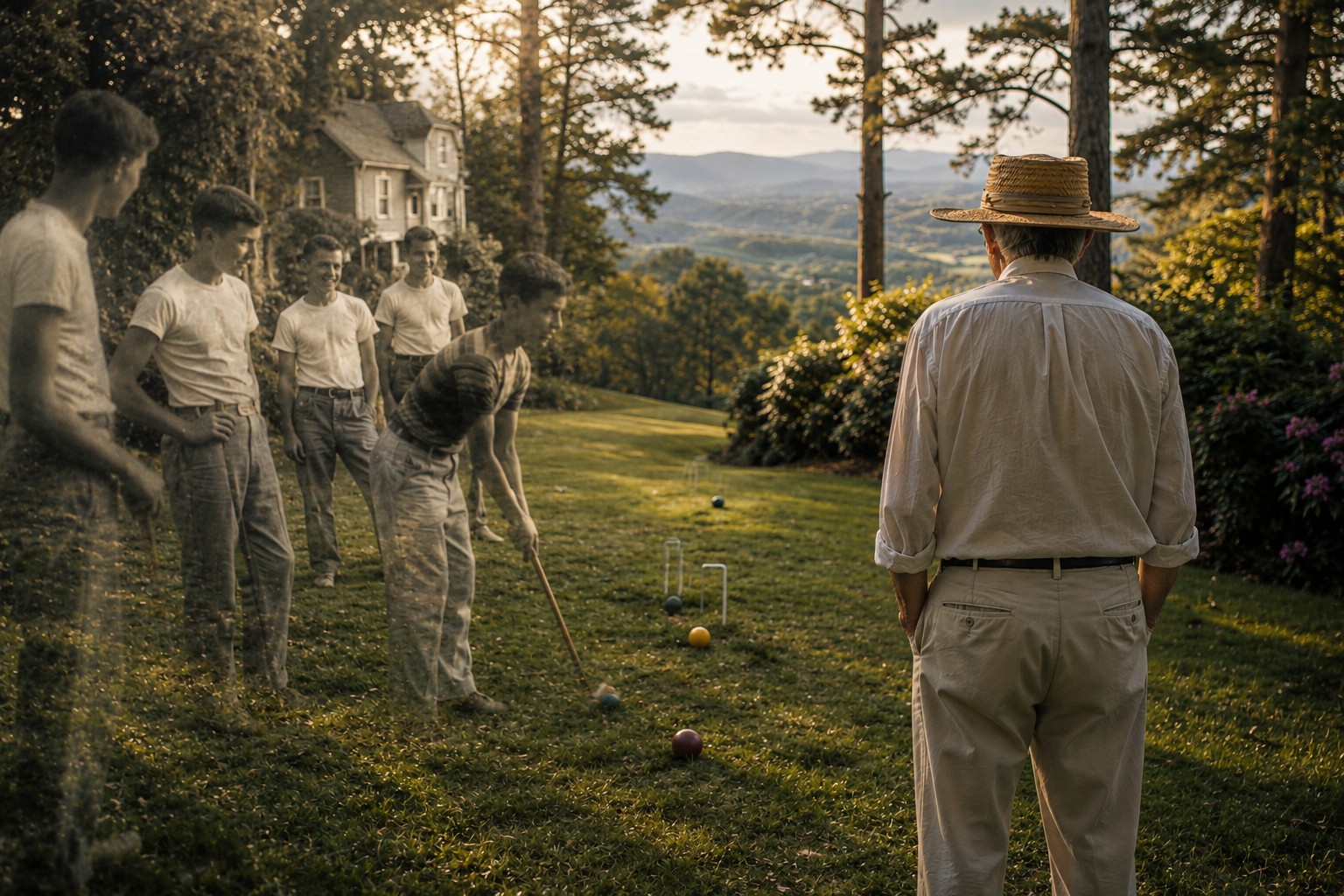
The course occupied a small clearing below the house, tucked among towering trees and surrounded by gardens that had spent decades settling into the mountain. From some spots, the Shenandoah Valley peeked through the foliage below. From others, the trees enclosed the court in a world of their own. Sunlight filtered through the leaves overhead, scattering patches of light and shadow across the grass. No two shots looked quite the same.

A croquet purist would likely find fault with nearly everything about it. The ground wasn’t level. The grass wasn’t uniform. Roots lurked beneath the surface. Gravity inserted itself into nearly every decision. Yet the court possessed a certain stubborn charm. It was not the court one might design from scratch. It was the court the mountain allowed. It was the court that Gary designed, determined to play here on the mountain.

My body remembered this. It had known this posture longer than the mountain had known this court.
To reach that court, I had to climb up a steep flight of concrete steps and walk through a loosely hinged metal gate that opened onto a long expanse of turf, cut close and tight. The starting point was a little way ahead, not far from the double clothesline stretched tight between two iron T’s. It was a narrow yard behind a white, clapboard colonial house across the road where I lived. Looking uphill beyond the fence, I could just barely see the roofline of a small cottage midway up the mountain. Looking to the end of the yard, the grass seemed to end where a fence had once been and where a grove of white pines towered over their needled floor, shading the two-story brick house in their midst.

The court began at the start of the clothesline, continued across the grass, and double-diamonded its way through an expansive and steep pine-needled slope behind the neighboring brick house, where the air turned cool and sharp with the smell of pine. On that court, too, a ball aimed carefully at a wicket might obey the player—or it might obey the slope. Every shot demanded adjustment. Every turn invited improvisation. Success depended as much on imagination as skill.

“You’re taking too long,” Gary called.

The mallet met the ball with a satisfying crack. My burgundy ball started confidently toward the waiting white wicket before surrendering, inch by inch, to the quiet persuasion of gravity.

Gary, shaded beneath his floppy blue sun hat, watched it drift off course and laughed. Beneath the broad brim of my straw hat, I laughed too. There we stood, two old men peering from beneath oversized brims, smelling of sunscreen and freshly cut grass, both convinced that the next shot would surely behave itself.

It didn’t.

Our next shots were even worse. Both balls gathered speed, raced gleefully downhill, crossed the boundary, and disappeared into the weeds. We looked at one another for a moment, then burst into laughter—the kind born of disbelief, optimism, and the certainty that we’d simply climb the hill and try again.

We retrieved our balls, walked back uphill, and tried again.

The older boys—home from college for the summer—were already waiting, mallets in hand. Impossibly slim in their side-tabbed trousers and white T-shirts, bronzed and unworried by the sun, they stood with the easy confidence of boys who belonged to the game. The air around them carried the faint, exotic drift of Jade East. Word traveled fast in a small town. They knew. Before I had even reached the gate, the squabbling began—whose team I would join, whose side would have me. I stepped into my place among them, planted my feet, lowered my eyes to the ball, and looked toward the waiting wicket.

That summer lived inside those arguments over me. I was one of them—not the youngest tag-along, not the kid from across the road, but a player worth having. Damned good, if the squabbling meant anything. The laughter came easily there, too. Cheers rose when a ball slipped cleanly through a wicket. Groans turned into laughter when it didn’t. Before the echoes faded, someone was already settling over the next shot, convinced this one would be different.

The wicket waited.

So did the slope.

So did the laughter.

Hands settled comfortably on well-worn mallets.

Feet found familiar ground.

Eyes followed an invisible line toward a distant wicket.

Everything aligned.

The mallet. The ball. The wicket.

And for one suspended moment, before the swing began, there was only belief that the ball would find its line.

When the Heat Is On: Cue the Vacay!

“You don’t have to be rich to travel well.”

–Eugene Fodor (1905–1991; notable American travel writer and editor best known for founding Fodor’s Travel Publications).

All right, everyone, indulge me for a moment and imagine something a bit out of the ordinary.

Close your eyes and conjure up an image the likes of which I’ll guarantee you’ve never seen before. Picture a man in his 70s, proudly sporting a ponytail that flutters like a whimsical flag in the breeze, perched precariously atop his chimney. Clad in well-worn flip flops and cut-off blue-jean shorts that reveal a pair of weathered but surprisingly spry and some-say-sexy legs, he stands with the kind of balance that suggests he’s either a seasoned acrobat or a silly fool blissfully unaware of danger.

From this lofty perch, he’s gazing out over the Shenandoah Valley below, his eyes twinkling like a mischievous elf’s, while the mountains in the distance seem to be returning their own salubrious salutation. With all the gusto of a wired researcher on a caffeine overdose, he belts out the Hallelujah Chorus at full volume, his voice soaring like a defiant eagle. His performance is a grand spectacle of unbridled joy and unequaled eccentricity, turning the chimney into his personal stage and the sky into his private audience.

In case you’re wondering who this daring rooftop performer is and why he’s carrying on such shenanigans, lean in close, and I’ll tell you. It’s me! I’m celebrating what appears to be the temporary end of an exhausting heat wave and drought by having my own imaginary rooftop concert that would make any diva proud. After enduring what felt like a never-ending barrage of scorching temperatures and parched landscapes, I figured it was high time for a little over-the-top jubilation. And if there’s anything that I love, it’s everything over-the-top.

Cooler temps and rain seem to be headed our way, and I’m embracing the arrival of this much-needed relief with the kind of exuberance that only a seasoned professor of hot weather clichés could cobble together. It’s been so blisteringly hot that I nearly froze to death, but I didn’t. Instead, I’ve become a connoisseur of every sun-scorched saying you can imagine. I’ve spent weeks sweating buckets, trying not to fry like an egg on the hood of my Gladiator, and lamenting the fact that my car seats are doubling as personal saunas. I’ve become a pro at grumbling about the weather, wondering whether my walkway pavers were actually sizzling, and dreaming of anything that wasn’t a mirage.

Guess what else I did during the sweltering days that are temporarily behind us? I put off more tasks than Carter’s got liver pills! Yep. The heat and drought have been an excuse, whether I was avoiding the garden beds that have turned into dust bowls or ignoring other projects that seemed like too much effort in a heatwave. I’ve postponed weedwhacking, repairing the leaky faucet that’s been dripping like a leaky faucet (because, let’s face it, who wants to fix a sink when it feels like you’re living inside an oven?), and even organizing the loft, which has somehow become a haphazard shrine to summer’s oppressive heat.

Guess what else I did? I decided that I needed to take a vacation! Yep. You heard me right. I decided that I needed some good old-fashioned downtime. But dayum! Before I could even plan to take it, I found myself all curled up and relaxed with the Oxford English Dictionary (OED) so that I could find out all about the vacation that the dreaded heat and drought convinced me that I needed to take.

As might be expected, our kith and kin Across the Pond used the word vacation as a noun long before we did, all the way back in 1405:

“Whan he hadde leyser and vacacion ffrom oother worldly ocupacion” (Chaucer, Wife of Bath’s Tale Prologue l. 683).

Isn’t that fascinating? Of course it is. More fascinating, though, is the fact that we Americans used it first as a verb in 1866:

“Whether Winter or summer, … threading the filthy lands of the Ghetto or vacationing among the islands, Mr. Howells found Venice … a theme for constant studies” (Round Table 8 September 90/2).

Now that I’m all squared away on the word vacation, I think I’ll spend just another second or two finding out when the phrase take a vacation was first used. You might have known it. The OED has the scoop:

“Smoke Jordan tried hard to get him to … maybe take a vacation, Florida’s nice. ‘Get yourself wheeled up and down like an icky banker?’” (D. Baker, Young Man with Horn, 1938)

What the OED does not disclose is fascinating as well, and I wouldn’t know it if I had not wanted to find out who “D. Baker” is. As it turns out, Dorothy Baker was an American novelist who loved jazz. In fact, her Young Man with Horn was based on real-life jazz cornet player Bix Beiderbecke. Even better is this hot tidbit: the novel was made into a 1950 movie featuring such hotties as Kirk Douglas, Doris Day, Lauren Bacall, Juano Hernández, and Beiderbecke’s friend and collaborator Hoagy Carmichael.

Well, these word trips are turning out to be as much fun as a vacay! OMG! Did I just use that word? Well, I did, and since my OED is still open (virtually), I just have to see when vacay was first used. I’m betting that it was coined by an American. Those Brits have no problem when they need to stoop to conquer, but they would never think about stooping low enough to truncate a word. Well, I was right. Vacay was first used in 1992:

“He said he was going on vacay and would give me something after he gets back” (Re: More on getting Gigs in rec. music. makers 14 January, Usenet newsgroup., accessed 13 Sept. 2013).

Just a sec, though. I might be wrong to claim the first usage as American. The OED‘s citation is rather shabby, in my opinion, and I can’t determine the authorship with any certainty. Lector: Cave a fidem non probatis.

I shall not, then, trust my initial claim, but I shall trust my subsequent claim that the next usage of the word vacay was American. It appeared in 1995 in the Pittsburg-Post Gazette:

“The convertible … was my Mom’s, we were on vacay” (16 July g8/2).

As for va-cay, vakay, and va-kay–those variant spellings of vacay–the OED has not seen fit to include them at all. I find that rather strange, however, since I am certain that I have seen them in use somewhere or other, perhaps right here in my blog. Ab ridiculo ad sublimem transire.

Hooey phooey is all that I have to say. Leave it to me to turn a vacation into a bunch of malarkey!

However, in case you’re thinking that you might need a vacation, let me help you. If you find yourself nodding along to any of the subsequent scenarios, it’s time to cue the vacay:

Work: Your boss thinks “work-life balance” means balancing more work on your plate. Your to-do list looks like a never-ending scroll of doom. You start dreaming about spreadsheets. You feel like a juggler on a unicycle, minus the thrill. Yep. Cue the vacay!

Social Media: You’ve scrolled so much that you start liking your own posts. You find yourself in a deep rabbit hole, liking posts from three years ago, and you’re contemplating the philosophical implications of cat memes. Yep. Cue the vacay!

Family Gatherings: Your aunt asks (for the 15th time) why you’re still single. You’re dodging advice and daydreaming about automated responses. Yep. Cue the vacay!

Dieting: You’re on a diet of kale smoothies and quinoa bowls, and you start dreaming about burgers and ice cream like they’re forbidden treasures from a lost civilization. Yep. Cue the vacay!

Home Improvement Projects: Your “quick” weekend project turns into a month-long renovation of ginormous proportions, complete with a gazillion trips to the hardware store and questionable structural changes. Yep. Cue the vacay!

News: You’re considering a bunker in the backyard. Dystopian novels of doom and gloom look cheerful compared to your news feed. Yep. Cue the vacay!

Dating Apps: You’re swiping so much that it feels like a full-time job. Your thumb is sore, your eyes are glazed over, and every profile starts to blend into one amor(ph)ous blob. Yep. Cue the vacay!

Exercise Regimens: Your workout routine feels more like a medieval torture session. You’re dreading your workouts more than a trip to the dentist. Yep. Cue the vacay!

Parenting: “Me time” means locking yourself in the bathroom with a chocolate bar. Your rare escape feels like a luxury retreat. Yep. Cue the vacay!

Blogging: Your efforts to craft engaging content week after week during a record-breaking heat wave and drought feel like an endless marathon. You’re standing on the chimney singing the Hallelujah Chorus. Yep. Cue the vacay!

Dayum! Dayum!! Dayum!!! Here I’ve done gone and paved the way for me to have a perfectly legit blogging vacay this week, and wouldn’t you just know it! I’ve done gone and cranked out today’s blog anyway! Phooey!

Clearly, my brain has been baking in the sun too long. Tuff. I’ll keep right on gazing from my imaginary chimney perch, realizing that, sometimes, the best way for me to break free from the grind and the heat is to let my imagination run wild and embrace the breeze of a little bit of whimsical madness.

I hope that you, Dear Reader, find your own rooftop, whether real or metaphorical, and that you sing your heart out when the world gets a little too hot to handle. Whether it’s a break from work, social media, family, or even blogging, taking a vacay isn’t just about escaping the heat—it’s about rediscovering the joy in life’s little quirks and celebrating them with gusto.

Cheers to your vacay! Wherever it leads you, may it be as epic and freeing as my rooftop concert over the Shenandoah Valley.