Flip the Narrative


“The facts may remain the same. The narrative doesn’t have to.”
—Brent L. Kendrick (b. 1947).


I’ve written it before and I’ll write it again.

Flip the narrative.

You read it right. But I want you to read it again.

Flip the narrative.

When the daily news overwhelms you, flip the narrative.

When technology frightens you, flip the narrative.

When society disappoints you, flip the narrative.

When family and friends let you down, flip the narrative.

When your body reminds you that you’re getting older, flip the narrative.

When life seems to be shrinking, flip the narrative.

When hope begins to flicker, flip the narrative.

And if you think you know what I’m going to say next, I’m making my point.

Flip the narrative.
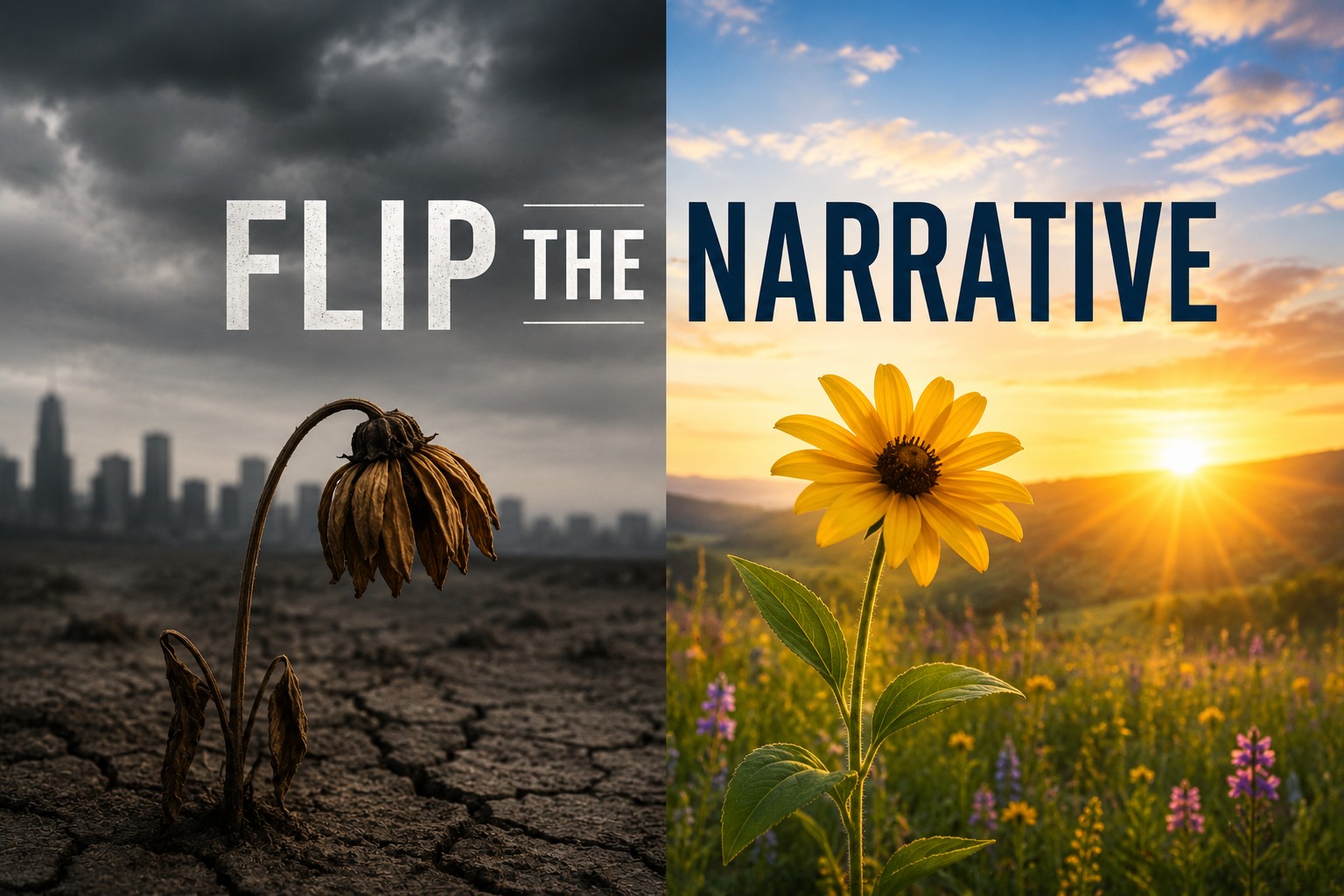
Flip the narrative because the daily news is not the whole story. Headlines are paid to interrupt your breakfast, not to nourish your soul. They shine spotlights on what is broken, while millions of quiet acts of kindness slip by unnoticed every single day. If all you read is the news, you will eventually believe darkness has won. It hasn’t. Flip the narrative.

Flip the narrative because technology is neither angel nor devil. It is a tool, and tools have no conscience of their own. We lend them ours. Every generation has feared the next invention, certain it would be the one to finally replace the human heart. It never has. The hands change. The fear stays the same. Flip the narrative.

Flip the narrative because society is more than its loudest voices. Every day, strangers hold doors, volunteers serve meals, neighbors check on neighbors, teachers stay late, and someone somewhere chooses grace over anger. Those stories rarely make the evening news, but they make the world worth living in. Flip the narrative.

Flip the narrative because the people who love us are gloriously, frustratingly human. They disappoint us. We disappoint them. If we measure every relationship by its failures, we will eventually stand alone. Better to count forgiveness as often as we count offenses. Better to remember that imperfect love is still love. Flip the narrative.

Flip the narrative because every birthday steals something and gives something back. Your knees may protest. Your memory may hesitate. Your hair may surrender. But wisdom quietly takes a seat beside you. Perspective grows stronger. Small things become precious. You stop trying to impress everyone and start noticing what truly matters. Flip the narrative.

Flip the narrative because a life that seems to be shrinking is often becoming more focused. Doors close. Dreams change. The horizon may draw nearer. Yet, somehow, the heart discovers that depth can be every bit as magnificent as distance. Sometimes life doesn’t become smaller. It becomes richer. Flip the narrative.

Flip the narrative because hope is not pretending everything is fine. Hope looks reality squarely in the eye and refuses to let despair have the final word. Hope has outlived kingdoms, survived wars, buried loved ones, endured heartbreak, and still gets up the next morning expecting light.

Flip the narrative.
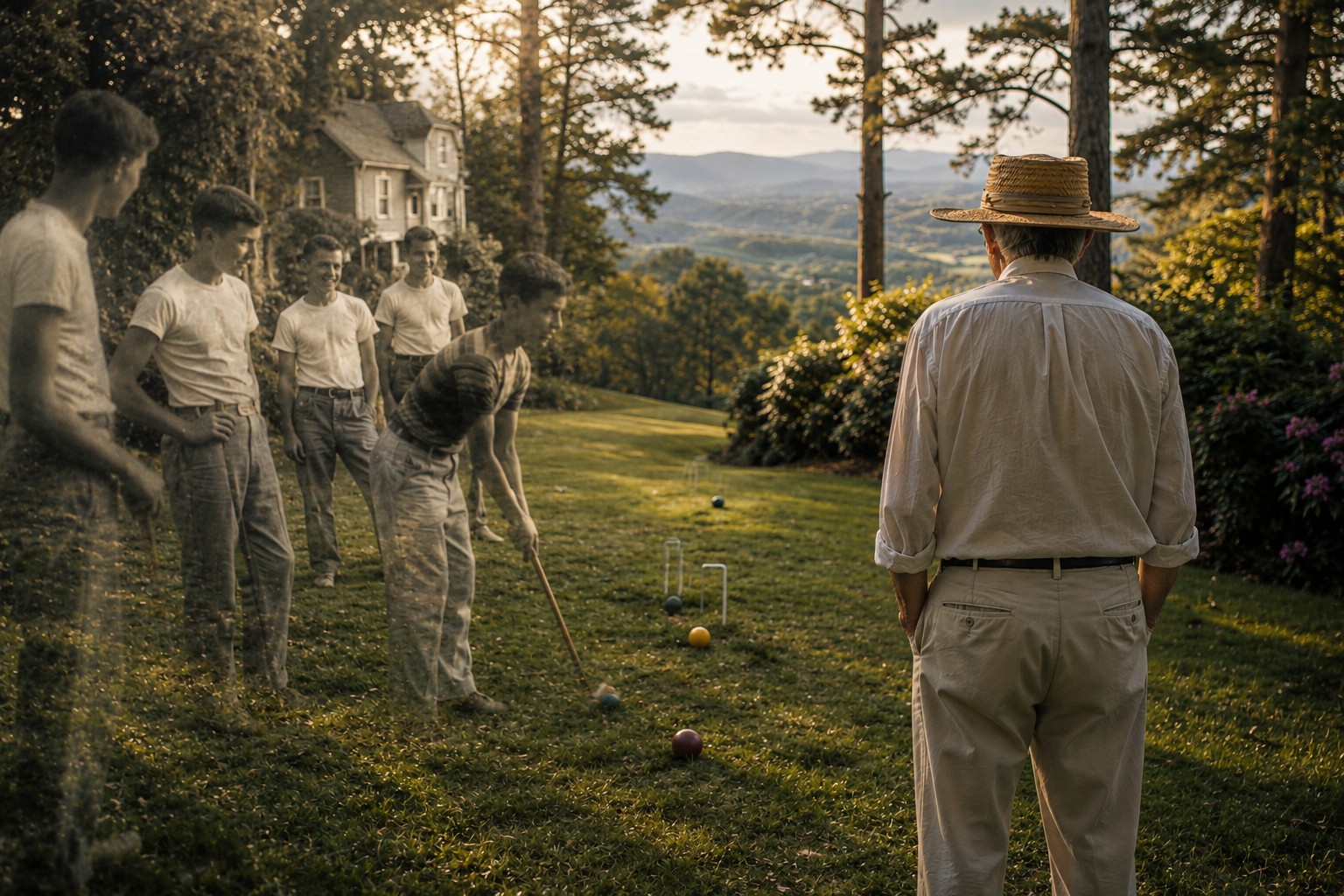
Mallet. Ball. Wicket.


“There is always one more shot worth believing in.”
—Brent L. Kendrick (b. 1947)


My feet were planted firmly and deliberately on the ground, slightly wider than shoulder width. My body, relaxed and balanced. One hand rested at waist level atop the mallet handle while the other settled lower, wherever comfort and habit had taught it to belong. The mallet hung naturally between my legs, its head poised just behind the ball. I lowered my eyes and followed an invisible line from the center of the ball toward my target. Everything aligned—the ball, the mallet, the distant wicket.

I knew exactly what would come next. With a smooth pendulum swing, I would send the mallet forward, hopefully striking the exact middle of the ball with the center of the mallet head. Just a clean, controlled stroke followed by an easy, unforced follow-through.

Before the mallet could complete its journey, my eyes wandered across the court. It sloped. It dipped. It rose unexpectedly. Grass gave way to patches of dirt. Dirt surrendered to weeds. A ball aimed carefully at a wicket might obey the player—or it might obey the slope. Every shot demanded adjustment. Every turn required patience. Success depended as much on adaptation as skill.

The course occupied a small clearing below the house, tucked among towering trees and surrounded by gardens that had spent decades settling into the mountain. From some spots, the Shenandoah Valley peeked through the foliage below. From others, the trees enclosed the court in a world of their own. Sunlight filtered through the leaves overhead, scattering patches of light and shadow across the grass. No two shots looked quite the same.

A croquet purist would likely find fault with nearly everything about it. The ground wasn’t level. The grass wasn’t uniform. Roots lurked beneath the surface. Gravity inserted itself into nearly every decision. Yet the court possessed a certain stubborn charm. It was not the court one might design from scratch. It was the court the mountain allowed. It was the court that Gary designed, determined to play here on the mountain.

My body remembered this. It had known this posture longer than the mountain had known this court.

To reach that court, I had to climb up a steep flight of concrete steps and walk through a loosely hinged metal gate that opened onto a long expanse of turf, cut close and tight. The starting point was a little way ahead, not far from the double clothesline stretched tight between two iron T’s. It was a narrow yard behind a white, clapboard colonial house across the road where I lived. Looking uphill beyond the fence, I could just barely see the roofline of a small cottage midway up the mountain. Looking to the end of the yard, the grass seemed to end where a fence had once been and where a grove of white pines towered over their needled floor, shading the two-story brick house in their midst.

The court began at the start of the clothesline, continued across the grass, and double-diamonded its way through an expansive and steep pine-needled slope behind the neighboring brick house, where the air turned cool and sharp with the smell of pine. On that court, too, a ball aimed carefully at a wicket might obey the player—or it might obey the slope. Every shot demanded adjustment. Every turn invited improvisation. Success depended as much on imagination as skill.

“You’re taking too long,” Gary called.

The mallet met the ball with a satisfying crack. My burgundy ball started confidently toward the waiting white wicket before surrendering, inch by inch, to the quiet persuasion of gravity.

Gary, shaded beneath his floppy blue sun hat, watched it drift off course and laughed. Beneath the broad brim of my straw hat, I laughed too. There we stood, two old men peering from beneath oversized brims, smelling of sunscreen and freshly cut grass, both convinced that the next shot would surely behave itself.

It didn’t.

Our next shots were even worse. Both balls gathered speed, raced gleefully downhill, crossed the boundary, and disappeared into the weeds. We looked at one another for a moment, then burst into laughter—the kind born of disbelief, optimism, and the certainty that we’d simply climb the hill and try again.

We retrieved our balls, walked back uphill, and tried again.

The older boys—home from college for the summer—were already waiting, mallets in hand. Impossibly slim in their side-tabbed trousers and white T-shirts, bronzed and unworried by the sun, they stood with the easy confidence of boys who belonged to the game. The air around them carried the faint, exotic drift of Jade East. Word traveled fast in a small town. They knew. Before I had even reached the gate, the squabbling began—whose team I would join, whose side would have me. I stepped into my place among them, planted my feet, lowered my eyes to the ball, and looked toward the waiting wicket.

That summer lived inside those arguments over me. I was one of them—not the youngest tag-along, not the kid from across the road, but a player worth having. Damned good, if the squabbling meant anything. The laughter came easily there, too. Cheers rose when a ball slipped cleanly through a wicket. Groans turned into laughter when it didn’t. Before the echoes faded, someone was already settling over the next shot, convinced this one would be different.

The wicket waited.

So did the slope.

So did the laughter.

Hands settled comfortably on well-worn mallets.

Feet found familiar ground.

Eyes followed an invisible line toward a distant wicket.

Everything aligned.

The mallet. The ball. The wicket.

And for one suspended moment, before the swing began, there was only belief that the ball would find its line.