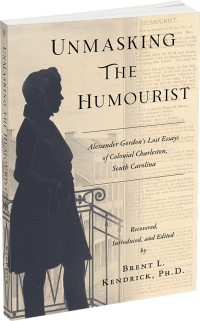
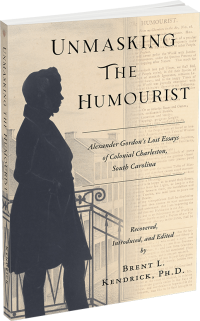
“The pieces of the puzzle come together seamlessly; better still, Kendrick’s investigation informs and enriches the Humourist essays, illuminating their historical and literary contexts.” —Publishers Weekly
Publisher’s Weekly Cover, December 15-22, 2025
I knew the review was scheduled to appear. I’d marked the date. I’d even ordered copies in advance.
Still, nothing quite prepares you for the moment when the work arrives by weight.
Nineteen pounds, to be exact.
The box from Fry Communications sat innocently enough at the door, but when I lifted it, I laughed—an unguarded, surprised laugh. This wasn’t an email notification or a discreet PDF link. This was paper. Ink. Volume. Evidence that something quiet and patient had crossed a threshold into the world of objects.
Inside were stacks of Publishers Weekly—the December 15-22 issue, fresh from the press. And there it was: the review of Unmasking The Humourist, resting calmly among other books, other arguments, other claims on a reader’s attention. No fanfare. No special lighting. Just…there. As if it had always belonged.
The review in context.
That may sound small. It isn’t.
For writers—especially those of us who work in literary recovery, archival research, and historical attribution—most of the labor happens far from spectacle. It happens in libraries and databases, in footnotes and marginalia, in moments when you are unsure whether the trail you’re following will narrow into clarity or vanish altogether. There are no crowds for this kind of work. No applause when you discover one more corroborating detail, one more pattern that holds.
Unmasking The Humourist grew out of precisely that kind of sustained attention. The essays at its center—satirical, incisive, mischievous pieces published pseudonymously in the South-Carolina Gazette in the early 1750s—had long been admired but never convincingly attributed. Their author hid in plain sight. The work demanded patience: weighing tone against context, tracing bureaucratic fingerprints, listening carefully to what language reveals when you stop rushing it.
And patience is not fashionable. We live in a moment that rewards speed, certainty, and hot takes. Literary recovery is none of those things. It is slow, provisional, and often lonely. You work without knowing whether recognition will ever arrive—or whether it even should. You work because the work matters.
That’s why seeing the review in Publishers Weekly mattered to me—not as a trophy, but as confirmation that the argument held. That it made sense beyond my own desk. That it earned its place in the broader conversation about early American literature and satire.
What struck me most wasn’t pride. It was scale.
The full review.
Here was my book, not elevated or isolated, but contextualized—surrounded by other studies, other voices, other claims. This is where scholarship belongs: not shouted, but situated. Not proclaimed, but tested.
There’s something grounding about that.
I spread the pages out on the table. I read the review again, this time with the odd sensation of distance—as though I were encountering the project for the first time. The reviewer understood what I had tried to do. Better still, they understood why it mattered. That’s the quiet victory every researcher hopes for.
And then there was the sheer physicality of it all. The stacks. The heft. The knowledge that these copies would travel—to libraries, to colleagues, to readers I’ll never meet. Work that had lived for years in notes and drafts now had mass. It could be lifted. Shared. Passed hand to hand.
Research takes time. Recovery takes patience.
But sometimes—blessedly, unexpectedly—the work becomes something you can actually lift.
And when it does, you pause. You hold it. You let it be real.
—Terry Tempest Williams (b. 1955. American writer and environmental activist whose lyrical essays explore the intersections of personal narrative, place, and ecological stewardship.)
Something snuck up on me yesterday.
I was talking on the phone with my 90-year-old sister when I glanced down at my smartphone, saw my WordPress dashboard—and nearly did a spit take.
Over 15,188 views this year already!
That’s already more than all of 2024, and we still have October, November, and December to go. Apparently, my little mountain corner has gone global again—and I couldn’t be more grateful.
To every one of you, My Dear Readers, who reads, comments, shares, or quietly lingers over a sentence or two: thank you. You’ve turned this space into a community of curiosity, compassion, and laughter. Every click, every view, every thoughtful message reminds me that words still matter—and that connection runs deeper than algorithms.
Your Top 10 Favorites of 2025 (So Far)
Every year tells its own story through what readers choose. This year’s list made me smile. It’s a mix of reflection, resilience, and rediscovery—with a dash of irreverence (because, well, it’s me or Poor Brentford Lee or maybe both).
● “I Am Afraid” — A wake-up call for our country—and a reminder of who we still can be.
●“The Place: Charleston” — The launch of my Unmasking The Humourist: Alexander Gordon’s Lost Essays of Colonial Charleston, South Carolina.
There’s still more to come before year’s end—new essays, reflections, maybe even a few surprises that have been sitting in my drafts waiting for the right moment. Perhaps even one or two guest posts by our famed and acclaimed Poor Brentford Lee.
I can’t promise I’ll always be profound, but I can promise I’ll keep showing up with authenticity, honesty, humor, and heart.
Thank you, My Dear Readers, for being here, for reading, and for reminding me—every day—that a single voice can still find an echo.
This week’s post is arriving early, because in just a few days I will step into a room filled with history and voices that refuse to fade. On October 1, the Charleston Library Society—the oldest cultural institution in the South and the second-oldest circulating library in the nation—will host the launch of my Unmasking The Humourist: Alexander Gordon’s Lost Essays of Colonial Charleston, South Carolina.
Why Charleston? Because the city itself is part of the story. It was here, in November 1753, that Alexander Gordon began publishing his Humourist essays in The South-Carolina Gazette. Through wit and irony, Gordon held up a mirror to colonial society, skewering hypocrisy, praising learning, and questioning authority. His essays pulsed with the contradictions of a city that was both refined and raw, elegant and quarrelsome. Charleston was his stage, and for nearly three centuries his voice remained hidden in the fragile pages of a newspaper few had cause to revisit.
That is, until now.
The Charleston Library Society is not just the venue for this launch—it is the very repository that safeguarded the Gazette itself, preserving the faint ink on brittle pages that carried Gordon’s words into the future. Founded in 1748, just five years before The Humourist first appeared, the Library has weathered fires, wars, earthquakes, and centuries of change. Its shelves and archives testify to the endurance of ideas—and to the truth that words matter. To stand in this place and reintroduce Gordon’s voice is both an author’s honor and a literary historian’s homecoming.
This launch also falls on a milestone: 272 years since the first Humourist essay appeared in Charleston. That span of time is almost unimaginable. Empires have risen and fallen, nations have been born, wars have been fought, and yet these essays—sharp, funny, insightful—still breathe. They remind us that human folly, ambition, vanity, and hope are constants. Gordon was not writing only for 1753. He was writing for us.
For me, this book represents years of research and a kind of detective work: following a trail of clues, comparing voices, weighing evidence, and finally piecing together the case for Gordon’s authorship. It is scholarship, yes—but it is also a story of recovery. Of bringing back a writer who deserved to be remembered, who deserves a place in our understanding of American letters.
And so, on October 1, Unmasking The Humourist will take its first public bow in the very city that first gave it life.
If you are in or near Charleston, I would be delighted to see you at the Charleston Library Society. If you are far away, I hope you will celebrate with me from wherever you are.
Because this launch is not just mine—it belongs to every reader who believes in the power of words to survive, to provoke, to amuse, and to endure.
About the Book
This edition definitively establishes Alexander Gordon (c. 1692–1754)—antiquarian, Egyptologist, scholar, singer, and later Clerk of His Majesty’s Council of South Carolina—as the author of The Humourist essays, restoring his rightful place in literary history.
The Introduction confirms Gordon’s authorship and provides the necessary historical context surrounding the essays and their publication in The South-Carolina Gazette.
The Humourist Essays section presents the complete authoritative text. Each essay is introduced with a detailed headnote offering historical context, exploring key themes, and situating the essay within broader literary and cultural traditions. These headnotes also clarify references, highlight rhetorical and satirical techniques, and connect The Humourist to its periodical essay tradition. Following each essay, explanatory notes supply annotations that illuminate historical allusions, linguistic nuances, and biographical details, making the essays more accessible to modern readers while preserving their original wit and bite.
The Afterword suggests areas for future scholarship—richer literary analysis of Gordon’s techniques, his engagement with Charleston’s intellectual and political life, his later years in South Carolina, and his place in transatlantic literary traditions. This volume thus serves both as a definitive authorship study and as a definitive text, laying a foundation for future research.
Finally, the Appendix corrects a 277-year-old historical error that mistakenly attributed to Gordon a natural history of South Carolina. This archival correction not only restores the record but also underscores the importance of rigorous scholarship—whether in reclaiming a forgotten author’s voice or in ensuring that legacy is preserved with accuracy.
Unmasking The Humourist: Alexander Gordon’s Lost Essays of Colonial Charleston, South Carolina is available now:
“Teachers are those who use themselves as bridges, over which they invite their students to cross; then, having facilitated their crossing, joyfully collapse, encouraging them to create bridges of their own.”
—Nikos Kazantzakis (1883–1957), Greek novelist and philosopher, best known for ZorbatheGreek.
Whenever I think of Labor Day—not just today, the official day of celebration, but at any time of the year—I hear Walt Whitman’s poem, “I Hear America Singing.”
In spirit, it remains one of the most comprehensive and inclusive celebrations of labor I know. Whitman exalts the varied carols of America: mechanics, carpenters, boatmen, masons, shoemakers, wood-cutters, mothers, wives, girls, fellows—
“Each singing what belongs to him or her and to none else.”
Even though Whitman’s intent was to celebrate all labor, I’ve often wished he had stretched his litany further: to nurses and caregivers, to social workers and librarians, to the quiet hands who stock shelves at dawn or clean buildings long after everyone else has gone home. So many vital songs go unsung. And yet, by inference, perhaps he did include them—since he was singing America itself, and since his deepest wish was to be the poet of Democracy, the poet of the people, all people.
I especially wish–maybe with a touch of occupational selfishness–that he had included educators—those whose labor shapes every other voice in the chorus. Educators labor not with saw or chisel, but with patience, persistence, and vision—tools just as demanding as Whitman’s mechanics and masons. Their labor is not confined to the classroom or the clock. For many—certainly for me—it was twenty-four hours a day, seven days a week. I went to bed thinking about my students and woke up thinking about them again. Lessons, endless papers, worries, hopes—and encouragement, too—followed me everywhere. Teaching was never a job; it was a calling that claimed my whole self. Like countless other educators, I gave my students my all—and then more.
Educators also give second chances, ignite new beginnings, and shape futures that might otherwise have been lost.
A day never passes that I don’t think about one or more of the bridge builders who taught me—my third-grade teacher who handed me Robert Frost’s poems and lit a lifelong love of language, or my high school biology teacher who welcomed us to his desk day after day, giving us not just knowledge but his time, his presence, himself. My college and university professors, too, showed me that education was not a finish line but a lifelong pursuit. Their labor was quiet, personal, and lasting.
I know this firsthand. I walked the bridge that educators built for me, and in time I became a builder myself—pouring my own labor into students, carrying them forward just as others once carried me.
And when I needed a bridge of my own, the Virginia Community College System gave me not just one opportunity, but two. In 1998 after I left the Library of Congress, it opened the door for me to finally live my childhood dream of teaching English. And years later, through the Chancellor’s Commonwealth Professorship Program, it offered me something even rarer—a second chance to complete research I had set aside nearly forty years earlier. That truth has reshaped how I see education itself. It’s not only about beginnings. It’s also about returnings. Sometimes, opportunity does knock twice. The Virginia Community College System gave me mine.
It gave me that second chance with Unmasking The Humourist: Alexander Gordon’s Lost Essays of Colonial Charleston, South Carolina. What began as a graduate paper in 1973—sparked by the encouragement of mentors like Calhoun Winton and J. A. Leo Lemay—has at last found its full voice. The forgotten essays of colonial Charleston have their rightful place in American literary tradition, and I have had the rare privilege of finishing the work I once left behind.
That’s why I dedicated Unmasking The Humourist to the Virginia Community College System and its educators:
―For the Virginia Community College System― ─────────────── Dedicated to transforming lives and expanding possibilities throughout its 23 colleges, proving that education is not just about learning, but about unlocking potential, shaping futures, and ensuring that no great idea goes unfinished.
And because words alone weren’t enough, I decided to act on that dedication. I have never forgotten the benefactors—sometimes unseen, sometimes unknown—who helped carry me across my own bridge: from a coal camp childhood to a college classroom, to a professor’s life I once only dreamed of. Their quiet generosity made my journey possible.
All proceeds from the sale of this book will be donated to The Virginia Foundation for Community College Education
On this Labor Day, I hear Whitman’s chorus again. It grows stronger, more complete, when we hear the steady song of educators—singing what belongs to them, and to none else. Their song is the bridge that carries not just students, but all of us, forward.
“Nothing is more powerful than an idea whose time has come.”
—Victor Hugo (1802–1885). French novelist, poet, and statesman (adapted from his Histoire d’un crime, 1877.)
Victor Hugo’s insight feels especially fitting today. After nearly three centuries in obscurity, Alexander Gordon’s essays have finally found their moment—and their audience.
My book, Unmasking The Humourist: Alexander Gordon’s Lost Essays of Colonial Charleston, South Carolina, has just been named a Top New Release in U.S. Literary Criticism on Amazon.
From colonial Charleston to Amazon’s Top New Release banner — Alexander Gordon finally takes his bow.
That bright orange banner may be a digital flourish, but for me, it symbolizes something much deeper: the recovery of a voice that nearly slipped into oblivion.
A Journey Nearly Three Centuries in the Making
Alexander Gordon’s satirical essays, published pseudonymously in colonial Charleston in 1753-54, were witty, sharp, and—until now—lost to time. For nearly three centuries, they lay hidden in crumbling newspapers, unnoticed by scholars, unread by modern audiences.
When I started my work on the Humourist essays, I could not have imagined how far the search would take me—through archives, biographies, and dusty trails. It became a mystery worth solving, a conversation across centuries.
Why It Matters
Bringing Gordon back into the light isn’t just about literary recovery—it’s about restoring a missing piece of cultural history and literary history—America’s and Charleston’s. His voice adds texture to our understanding of early America: its humor, its politics, its people.
Seeing readers discover him today—on a platform as modern and massive as Amazon—is a reminder that scholarship doesn’t live only in libraries. It can leap across time and space, reshaping how we see the past and present alike.
A Note of Gratitude
This milestone belongs not just to me, but to everyone who has encouraged me, asked the hard questions, and believed in the value of preserving what was almost lost.
Here’s to Alexander Gordon, finally taking his bow on the 21st-century stage. And here’s to the readers who will now join him there.
If you know someone who loves history, literature, or Charleston’s rich past, I invite you to share this book with them. The Humourist has waited nearly three hundred years for his audience—perhaps now is the moment he finds it.
“The pursuit of historical truth requires rigorous attention to evidence, but also imagination—an ability to see beyond the silences.”
—Eric Foner (b. 1943), Columbia University historian and Pulitzer Prize–winning author of The Fiery Trial.
It began with a clue. A slip of language. A name tucked too neatly into silence.
For years, The Humourist was one of colonial America’s most compelling mysteries: a sharp, satirical voice that burst onto the front page of The South-Carolina Gazette in 1753 and 1754—then disappeared without a trace.
No signature. No farewell. Just a trail of dazzling essays and a question no one could quite answer: Who was he?
What followed, for me, was part scholarship, part sleuthing. I tracked language patterns, pored over wills, newspapers, shipping records, and marginalia. I followed leads from Charleston to Edinburgh and back again. And finally, I solved the puzzle, and the answer emerged:
Alexander Gordon—a Scottish-born antiquarian and early Egyptologist, who would eventually serve as Clerk of His Majesty’s Council in South Carolina. A man educated in Enlightenment thought, fluent in satire, and bold enough to take aim at power in a bustling port city where reputation was currency.
The mystery is solved. But Unmasking The Humourist doesn’t just name the man—it restores his voice.
This authoritative and definitive edition brings Gordon’s essays back into circulation for the first time in nearly 270 years, fully annotated and critically framed, with a scholarly introduction that explores Gordon’s identity, influences, and the forces that led to his disappearance from literary memory.
Why These Essays Matter
The Humourist columns are more than colonial curiosities. They are early American satire at its finest—witty, incisive, and rich with transatlantic influence. Gordon’s essays place Charleston on the literary map, not as a provincial outpost, but as a vibrant participant in the Enlightenment-era conversation about politics, identity, and the press.
This book marks a breakthrough in how we understand the American essay tradition. It challenges the idea that colonial literature was all sermons and pamphlets. Here, we meet a writer who was sharp, worldly, and unafraid to poke fun at hypocrisy—whose pen was as powerful as any pulpit or platform of his day.
A Milestone Moment
Today, I submitted the final corrections to the publisher, along with keywords, pricing, and metadata. The next step is the printed proof—then, in due time, the book itself.
It’s a strange and beautiful feeling. Emily Dickinson said it best:
“After great pain, a formal feeling comes.”
This project has spanned decades. It has taken me deep into archival records, across centuries of silence, and finally into the steady light of historical clarity.
And Now?
I’m proud to share the cover—front and back. Because The Humourist, like all great stories, deserves both.
Launch Details?
Not quite yet. But soon. The typeset is locked. The voice is ready.
This fall, a long-lost satirist steps out of the colonial shadows—and into the modern light.
“A man should never be ashamed to own he has been in the wrong, which is but saying, in other words, that he is wiser today than he was yesterday.”
–Alexander Pope (1688–1744; English poet and satirist, one of the most influential poets of the 18th century, whose wit and keen moral reflections in works like “The Rape of the Lock” and “An Essay on Man” secured his literary legacy.)
Eating crow is never easy. In fact, it’s downright tough, so much so that it takes a lot of willpower and gumption.
Oh, I’m not talking about eating crow as in the genus Corvus, those glossy black birds found in most parts of the world. I’ve never eaten one of them.
I’m talking about eating the kind of crow that we sometimes have to eat when we discover that we’re wrong. That’s a hard discovery to make. Let’s face it: it’s hard to fess up when we’re wrong. But let’s own up to it—sometimes the best thing to do is just eat crow and be done with it.
Take the stubborn husband who swore up and down he could fix the plumbing himself, despite his wife’s warnings. A few YouTube tutorials, a flooded bathroom, and an emergency call to the plumber later, he’s standing there, soaking wet, eating a big plate of crow.
Or the manager who brushed off an employee’s suggestion, only to watch the competition roll out the same idea—successfully. There’s no easy way to walk that one back, but let’s hope the manager at least had the sense to admit, “I should’ve listened.”
Then there’s the friend who mocked TikTok, Wordle, or Air Fryers, scoffing at the hype—until they tried it. And now? They’re sending out their Wordle scores every morning, scrolling TikTok before bed, and raving about how crispy their Brussels sprouts get. Yep. Crow. Served hot and fresh.
People have been “eating crow” since the dawn of human interaction so the list could go on and on, ranging from professional to personal and from funny to frustrating, but I don’t need to continue. Every item in the list captures the same universal realization: Oops … I was wrong. Ididn’tunderstand.
Even though we’ve been eating crow for a long, long time, the phrase itself is surprisingly modern. It first appeared in 1885 in the MagazineofAmericanHistory:
“‘To eat crow’ means to recant, or to humiliate oneself.”
By 1930, the phrase had taken on a more serious tone:
“I should merely be making an ass of myself if I accused someone and then had to eat crow” (E. Queen, French Powder Mystery).
By 1970, “eating crow” was used in a way that is close to what we all hope for when we use the phrase today:
“I was going to apologize, eat crow, offer to kiss and make up” (New Yorker)
Yep! Sometimes, eating crow comes with extra benefits.
These days, eating crow is firmly on the menu for anyone caught in the wrong. Actually, it was on my menu last week. Two servings of crow. That’s right. Two servings. Mind you, I haven’t been caught in the wrong because I haven’t done anything wrong other than having had some lingering thoughts down through the years about two Mary E. Wilkins Freeman scholars. I’ve now come to realize that I was wrong, or, more accurately, I’ve come to realize that I didn’t understand.
And since I’ve always believed that eating crow is most beneficial if done in public, let me lift the cloche and reveal my double portion.
My first portion is because of thoughts that I’ve had about Thomas Shuler Shaw, a librarian at the Library of Congress, who embarked on an ambitious project to write what would have been the first biography of Mary E. Wilkins Freeman. His goal was to illuminate the life and literary contributions of this remarkable author who had died in 1930.
However, fate had other plans. Shaw’s 1931 biography, A Nineteenth Century Puritan, faced rejection from prominent publishers such as Harper & Brothers, Ladies’ Home Journal, and The Saturday Evening Post. I’ve always credited Shaw for persevering, at least enough to find a home for his meticulously curated scrapbooks and the typescript of his unpublished biography in the Rare Book & Special Collections Division at the Library of Congress. Those artifacts provide a rich tapestry of insights into Freeman’s life and work, and they certainly helped me with my edition of The Infant Sphinx: Collected Letters of Mary E. Wilkins Freeman (Scarecrow, 1985).
Nonetheless, I wondered then as I do now: why didn’t Shaw continue his efforts to find a publisher? His book would have distinguished itself as the first Freeman biography. What impact might it have had on her literary reputation if the details of her life had been accessible to readers of the 1930s and 1940s?
My second portion of crow relates to another scholar working on a Freeman biography around the same time. Edward Foster wrote his Mary E. Wilkins Freeman: A Biographical and Critical Study in 1934 as his thesis when he was a candidate for the Doctor of Philosophy degree at Harvard University. The university accepted his thesis, but Foster didn’t complete his Harvard degree. He put aside his Freeman work until 1956 when he revised and published it as Mary E. Wilkins Freeman (Hendricks House).
Foster was direct when he explained the delay:
My thesis was accepted […] also for subsidized publication by Harvard Press. Lacking funds for subsidy and failing to get trade publication, I forgot the thing for nearly twenty years. MWF is only a small part of my career. (Foster to Brent L. Kendrick, ALS, October 24, 1973)
Nonetheless, I wondered then as I do now: why didn’t Foster try to find a publisher sooner than he did? What impact might it have had on her literary reputation if Foster’s details of her life had been accessible to readers of the 1930s and 1940s.
There. I’ve done it. I’ve eaten my two portions of crow. However, I have to do one more thing to help you understand the art of eating crow. To turn eating crow into an art requires divulging what prompted, in my case, not just one portion of crow but two in a single serving. That’s the source of the catharsis. That’s the confession, without which eating crow can never be an art.
Here’s mine.
Yesterday, I uploaded the manuscript of my forthcoming book Unmasking The Humourist: Alexander Gordon’s Lost Essays of Colonial Charleston, South Carolina. My book definitively establishes Gordon (c. 1692–1754)—antiquarian, Egyptologist, scholar, singer, and later Clerk of His Majesty’s Council of South Carolina—as the author of The Humourist essays, restoring his rightful place in literary history.
I hesitate to say this, but the book is a significant scholarly work. It’s meticulously researched, not only unearthing a forgotten literary voice but also redefining our understanding of colonial American literature. While it’s structured with rigor, it remains highly engaging, making complex historical and literary analysis accessible without oversimplification. It’s not just a literary recovery; it’s a reframing of Charleston’s intellectual life, the role of satire in the colonies, and the transatlantic literary tradition. That’s no small feat.
To say that I am ecstatic is an understatement. I am.
But get this. I’ve been working on this book since 1973, when Professor Calhoun Winton of the University of South Carolina suggested that I try to solve this literary mystery. Published in the South-Carolina Gazette, the essays had been largely forgotten, and the identity of their author remained unknown.
At the time, I recognized their brilliance and used them as the foundation for a graduate paper. Then I put the project aside where it remained in my mental storehouse of “one-day, some-day” ideas, waiting for the right time.
Decades later, the Virginia Community College System (VCCS) gave me an extraordinary opportunity to return to that project, to bring these essays into the light, and to finally answer the question that had remained unanswered for centuries: Who wrote them?
As a VCCS Chancellor’s Professor (2012-2014), I answered that question and shared the essays and my ongoing findings with my blog readers right here. Actually, that’s when TheWiredResearcher had its beginning.
Ironically, I delayed publishing my watershed UnmaskingTheHumourist until now.
You may be wondering about my delays, just as I wondered about Foster’s delays and Shaw’s delays.
I’ve been wondering about my delays, too, and that’s why I’m eating crow.
I could toss out many reasons:
● TheHumourist essays seemed too short for a book and too long for a scholarly article.
● I wanted to make certain that my evidence for claiming Alexander Gordon as the author was as compelling as my discussion.
● I wanted to do further research so that my headnotes and endnotes for the essays were comprehensive.
All of those reasons are true.
I won’t toss into that mix other scholarly pursuits that came my way.
I won’t toss into that mix my early career advances as a federal employee or my second career advances as an educator.
I won’t toss into that mix caring for aging parents.
Actually, I won’t toss into that mix anything else because what became obvious to me when I uploaded Unmasking The Humourist: Alexander Gordon’s Lost Essays of Colonial Charleston, South Carolina was something seriously simple. We all lead complex, complicated, and convoluted lives.
● I know that truth firsthand.
● You likely do as well.
● So, too, did Edward Foster.
● So, too, did Thomas Shuler Shaw.
Wondering about their delays caused no harm, but I now see there was no need to wonder at all. I might simply have acknowledged what I’ve come to recognize in my own self-talk about The Humourist:
Life is rich, robust, and mysterious, and it rarely marches forward on a straight path.
As I move forward on my path, I’ll keep that truth in mind as I interact with others—and with myself. And with that heightened awareness, perhaps I really will have mastered the art of eating crow.