Dead as a Doornail


“The unexamined word is not worth using.”
—Brent L. Kendrick (b. 1947). Essayist, educator, and literary scholar, whose work explores the unexpected weight of ordinary life.


“Have you ever heard that expression before?”

I thought it might be a Southern idiom, and since Gary grew up in the Midwest, I wasn’t sure he knew it.

“What expression?”

“The one I just used. Dead as a doornail.”

“I have.”

Fine. It was settled. We both knew what it meant. Finished. Used up. Worthless.

“Well, it strikes me as one of the silliest things I’ve ever heard of. What on earth is a dead doornail?”

“No idea.”

I didn’t either.

How’s them apples? There we sat, two men who appreciate language and use it with careful precision, agreeing that we knew an expression while at the same time confessing that we didn’t understand the phrase that was central to its meaning.

I don’t like feeling as dumb as a stick, so after morning coffee, I made my way to the Oxford English Dictionary (OED) like a bat out of hell so that I could learn about dead doornails.

Oh, boy. I was right. I knew in a flash that I was going to have a Red Letter Day. Lands sake alive. Dead as a doornail goes all the way back to 1350:

“For but ich haue bote of mi bale … I am ded as dore-nail.” (William of Palerne, l. 628)

Don’t worry. I’ll dress it up in some modern rags so that it makes sense:

“For unless I have remedy for my sorrow, I am dead as a doornail.”

Well, that was fine and dandy, but I still didn’t know what a dead doornail was. I had to dig more. And more, I found. Did you know that in ye olden days doornails were hand-forged, heavy-duty nails, driven through wood and then clenched—the protruding end hammered flat—making them impossible to remove or reuse. Permanently fixed, permanently purposeless, they were, in every practical sense, dead.
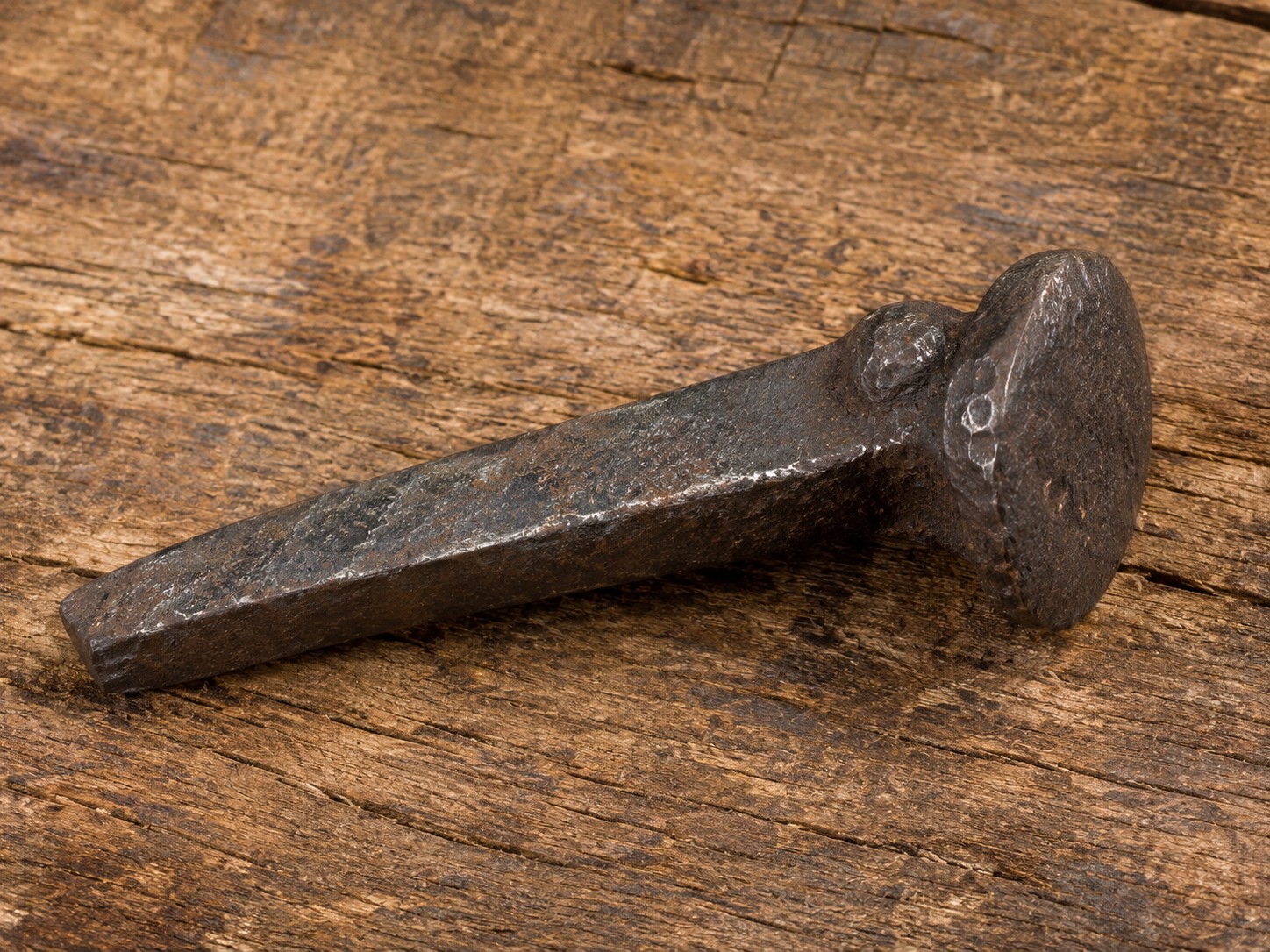
And right after unearthing the meaning of dead doornail, I hit paydirt. I came across an entire navigation of other things I could strut around saying. If a doornail can be dead, apparently so can a lot of other things I’d never thought about:

Dead as a stone

Dead as clay

Dead as a herring

Dead as a hammer

English, it seems, has never lacked for dead things.

And then, there’s my favorite one of all. It’s music to my untrained ear:

Dead as the diplodocus

It’s hard to laugh when you’ve got one hand stuck fast to a dead doornail and the other hand being pulled even further back in time by a giant herbivorous sauropod.

I had to laugh. One dead doornail had opened the door to dozens of expressions I use every day without ever stopping to examine what they really ask of me.

The first expression that popped into my head? “Let me know if I can do anything.” I’ve said it more times than I can count.

But what exactly are we saying? At first glance, the meaning seems obvious. Yet the more I think about it, the more I realize that the phrase carries a greater obligation than we usually acknowledge.

After all, those aren’t words of sympathy. They’re words of commitment.

The moment I tell someone to let me know if I can do anything, I’ve volunteered to do something. Maybe it’s as simple as a phone call. Maybe it’s a card. Maybe it’s a casserole. Maybe it’s sitting quietly beside a friend who has just buried a spouse and doesn’t particularly want to talk.

The point is that I’ve offered. Whether the request is large or small, I’ve just volunteered a piece of myself. My words have placed me on the hook.

How often we say those words because they sound appropriate without stopping to consider what we’ve actually promised, without fully examining the obligation hidden inside the offer?

The words are easy enough to say. The casserole takes a little more effort.

Next up was the expression, “I’m so sorry.”

At first glance, it seems simple enough. We say it when someone loses a spouse, receives a frightening diagnosis, buries a parent, or watches a cherished dream collapse.

But what exactly are we saying?

Most of the time, we aren’t apologizing. We didn’t cause the death, the disease, or the disappointment.

Yet the expression carries an obligation all the same.

When I tell someone I’m sorry, I’m not merely acknowledging a fact. I’m entering, however briefly, into another person’s sorrow. I’m saying that your loss matters enough for me to stop, notice, and share a small measure of the burden.

In other words, I’m not simply expressing sympathy.

I’m promising compassion.

That’s a weightier promise than I suspect many of us realize when the words tumble so easily from our lips.

Then came two expressions that sit at opposite ends of the emotional spectrum.

“I hate you.”

Three words.

“I love you.”

Three words.

Yet each carries enough power to alter the course of a relationship, a family, perhaps even a life.

We often treat them as expressions of feeling. But they are more than that. They are declarations. Commitments. Judgments.

To tell someone “I hate you” is not merely to report an emotion. It is to wound, to distance, to diminish, to push another person away.

To tell someone “I love you” is not merely to report an emotion either. It is to assume an obligation—to care, to sacrifice, to forgive, to remain present when remaining present is difficult.

Perhaps that is why both expressions deserve more examination than they usually receive.

They are among the easiest words in the English language to say. And among the hardest to live.

Finally, I came to a phrase that millions of people have spoken for centuries:

“Forgive us our trespasses, as we forgive those who trespass against us.”

I’ve heard it all my life. I’ve spoken it hundreds, perhaps thousands, of times.

But have I examined it? Have I truly considered what I’m asking?

The first part is easy enough. Most of us welcome forgiveness for our failures, shortcomings, and mistakes.

It’s the second part that gives me pause. As we forgive. Not as we intend to forgive. Not as we hope to forgive. Not as we might someday forgive.

As we forgive.

Those words transform a prayer into a promise, a request into an obligation.

And they leave me wondering how many other expressions I use with confidence, familiarity, and conviction without fully considering what they mean—or what they ask of me.

As I reflected on all of these expressions—seemingly light yet laden with responsibility and commitment—I came to a simple conclusion. Going forward, I intend to pay a little more attention to my Ps and Qs.

Not because I suddenly care more about manners. But because I have been reminded that words matter.

They always have.

Whether I am offering help, expressing sorrow, seeking forgiveness, declaring love, or reciting a prayer, I owe those words more than familiarity. I owe them thought.

After all, the unexamined life is not worth living.

Perhaps the same can be said of the unexamined word.

Keeping Up with the Evidence


“Language is fossil poetry.”
— Ralph Waldo Emerson (1803–1882). American essayist and philosopher, leading voice of the Transcendentalist movement.


Savannahians have long dubbed their city the Hostess of the South. Many also claim that Jones Street is the most beautiful street in the city. Maybe so. Brick by brick, it unfurls like a quiet benediction: a ribbon of warm red paving stones softened by time, shaded by live oaks whose arms stretch overhead, heavy with Spanish moss filtering the light into a perpetual late-afternoon glow. Federal and Greek Revival townhouses stand shoulder to shoulder, dignified but never aloof, their brick façades punctuated by deep green shutters, wrought-iron balconies, and stoops that rise just enough to suggest ceremony without pretension. Lantern-lit doors—some painted a daring lacquered red—open onto iron urns spilling over with ferns and flowering vines, blurring the line between garden and street. Even the street’s history seems layered into the view, so that walking Jones Street feels less like moving through space than through time, where elegance lingers and beauty is not announced but assumed.

Some Savannahians even maintain that the expression “keeping up with the Joneses” began because of the luxurious homes built along Jones Street. I had never heard that claim until friends visited Savannah and later shared it—along with a stream of photographs—on Facebook. I knew the expression, of course, but I had never heard it tethered to a specific place, much less to a famous street down South.

The claim fueled the researcher in me, leading me to the Oxford English Dictionary (OED). If the phrase is anchored to Jones Street in Savannah, the OED editors are unaware of it. They credit the expression instead to Arthur Ragland “Pop” Momand, who in 1913 launched his New York Globe comic strip, Keeping Up with the Joneses. The strip drew on Momand’s experiences in Nassau County, New York, rather than on any known connection to Savannah’s storied street.

I could have let the matter rest there. OED consulted. Myth gently dispelled. Case closed. But curiosity and further digging—beyond the OED and into archival material, historical accounts, and even the occasionally useful corridors of YouTube—clarified the matter. Since Momand’s comic strip emerged from New York, the Joneses in question were almost certainly New York Joneses. And in the late nineteenth century, that name carried weight. The Livingstons, the Schermerhorns, the Masons, and the Jones family were counted among New York’s old-money elite. Mason and Jones controlled what was then the third-largest bank in the country—Chemical Bank—and their combined wealth ranked among the most formidable in New York’s financial world.

Within that circle, Elizabeth Schermerhorn Jones stood at the center of social gravity. She did not merely inhabit high society; she defined it. Her standards of dress, decorum, and domestic display shaped the expectations of an entire class. Others did not simply admire—they imitated. To be fashionable was to approximate her taste. To be modern was to anticipate it. Her Newport summer residence, constructed in 1853, became a symbol of that authority—an architectural declaration of wealth and refinement that drew attention and, inevitably, comparison.

After her death in 1886, the house passed through multiple owners, declined, and was eventually sold at foreclosure in 1934. Today only the reinforced shell remains, its walls braced in a quiet act of preservation—as if even the structure itself were still attempting, in some small way, to keep up the Joneses.

English is full of such borrowed names, reminders that language often preserves the reputations—and sometimes the accidents—of the people who once carried them.

A few examples may surprise you. Others will feel as familiar as the words themselves.

Did you know that the Earl of Sandwich, pressed by appetite and convenience at the gaming table, is said to have solved his dilemma by placing meat between slices of bread, allowing him to eat without interrupting play. Whether the story is embroidered or not, the word sandwich endured. What began as a practical solution became a culinary staple, and the man himself receded into the background, leaving behind a word now spoken far more often than his title ever was.

Then we have Captain Charles Boycott, an English land agent in nineteenth-century Ireland, who found himself the target of organized social and economic resistance from protesting tenants. Rather than confront him directly, the community withdrew—refusing to work his land, speak his name, or acknowledge his presence. The strategy proved so effective that his surname—boycott—entered the language as a verb, now used globally to describe collective refusal. The man was resisted; the name persisted.

Or what about Étienne de Silhouette? An eighteenth-century French finance minister known for his austerity measures lent his name—somewhat unfairly—to a form of portraiture defined by its simplicity. The inexpensive shadow profiles that became fashionable during his tenure were mockingly associated with his economic policies. Over time, the satire softened, and the word silhouette came to describe not frugality but form itself: an outline, a presence reduced to its essential shape.

The word dunce offers an even stranger reversal. It derives from the medieval philosopher John Duns Scotus, whose followers were once regarded as careful and rigorous thinkers. They wore distinctive pointed caps as a mark of their intellectual tradition. Yet in time, critics of scholasticism turned the name into an insult. The scholar became a fool, and the cap a symbol of ignorance—a reminder that language does not always preserve reputation so much as it repurposes it.

Then we have Amelia Bloomer. She did not invent the garment that bears her name, but she did something perhaps more enduring: she advocated for its adoption. A nineteenth-century reformer, she promoted a style of dress that allowed women greater freedom of movement—looser trousers gathered at the ankle, worn beneath a shortened skirt. The look was practical, even liberating, but it was also controversial. Her name became attached to the style, and with it, to the broader idea that clothing could signal change. What was once a subject of ridicule now reads as an early gesture toward autonomy.

And let’s not forget James Brudenell, the 7th Earl of Cardigan, who is remembered for leading the ill-fated Charge of the Light Brigade during the Crimean War. Less dramatically, though perhaps more enduringly, his name came to be associated with the knitted wool jacket worn by British officers under their uniforms. The cardigan, as it is now known, has long since shed its military associations. It remains, instead, as a quiet example of how even the most turbulent histories can soften into something familiar, worn close, and almost entirely detached from their origins.

So the more I explore borrowed names that have crept into our language, perhaps Savannah can keep its story. Jones Street may not have given us the phrase “keeping up with the Joneses,” but it hardly needs the credit to justify the legend.

Language often works this way. A person’s name slips quietly into common speech, the individual gradually fading while the word remains, carrying only the echo of its origin. And when a story is told often enough—beautifully enough, and in just the right light—its beginning can begin to matter less than its appeal. In the end, what we are really keeping up with may not be the Joneses at all, but the enduring human habit of turning beauty, memory, and rumor into something that feels like truth—and is repeated as if it were true.