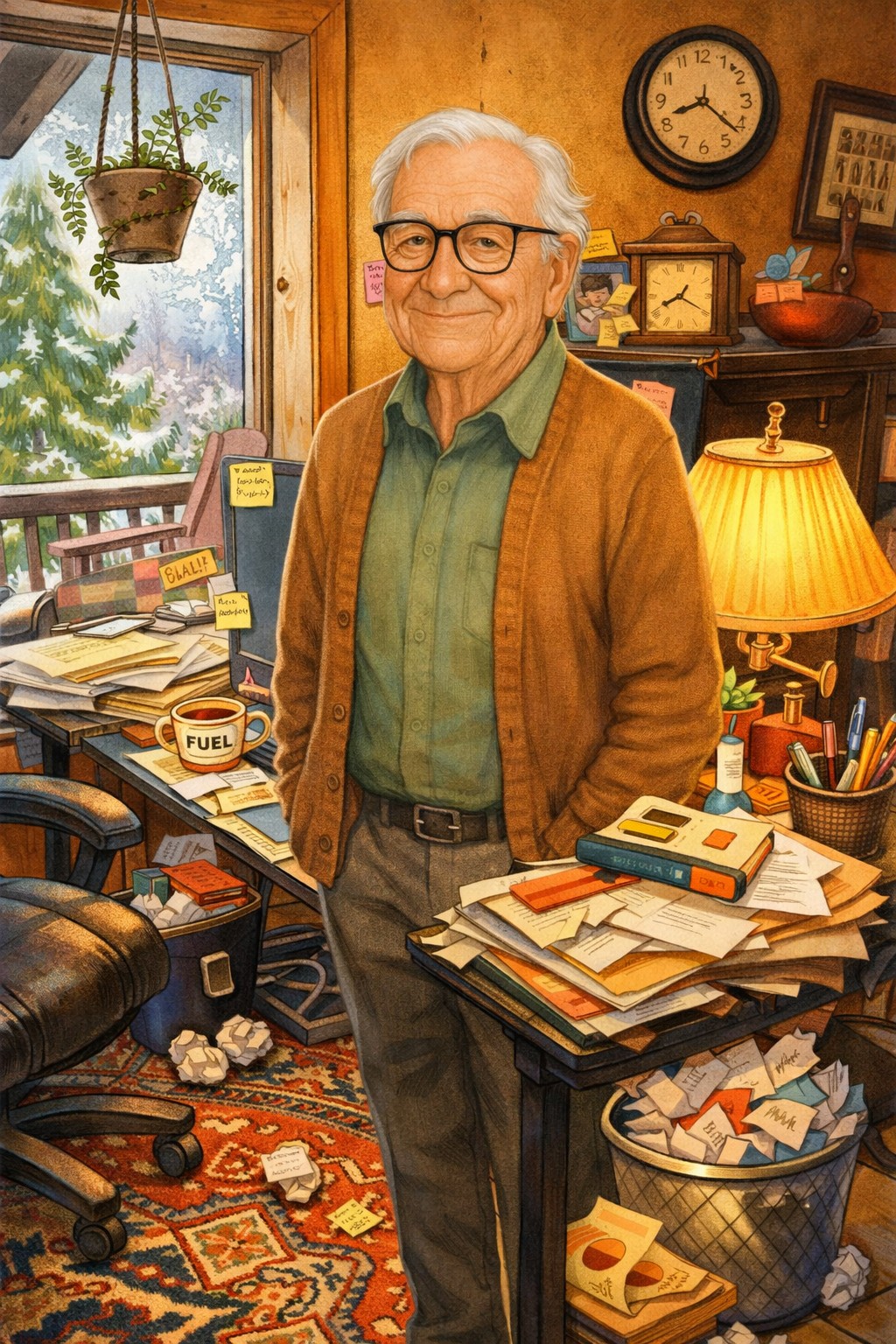
A Banner Year, Gently Told

As this year draws to a close, I want to thank you for visiting my blog 32,727 times.

That didn’t happen overnight. And it didn’t happen by accident.

This year, more people found their way here than ever before—slowly, steadily, and often by returning. Compared with last year, readership grew significantly, not because anything went viral, but because the writing kept meeting the right readers at the right moment.

Growth, the quiet way,

These pages have held many things:

● 18th-century satire and present-day kitchens.
● Scholarship and softness.
● Books, biscuits, dogs, devotion, memory, love.

Some posts traveled far. Others found only a handful of readers. But every one was written with care—and read with attention.

I don’t think of these as clicks.

I think of them as moments of shared presence in a distracted world.

You made this a banner year.

If you were one of the 32,725:

● thank you for reading,
● thank you for lingering,
● thank you for making this a place worth returning to.

Here’s to a year shaped by patience, curiosity, and generosity of spirit—and to whatever quiet magic comes next.

Wired with wonder,
Brent

Poor Brentford Cleans the Wax Out of His Ears and Finds Meaning in the Noise and Music of Mistakes


As 2025 comes to its close, Poor Brentford makes his last appearance of the year, offering a final benedictus and inviting us all to lean in, mishear boldly,
and sing in broken harmony “One Lane Zion.”


This is a true story. A confession, if you will. It’s the kind my mother used to make before coffee, after coffee, or frankly whenever the mood struck her to entertain herself and whoever else happened to be within earshot.

She’d sit at the Formica-topped, chrome-legged kitchen table, coffee cup in hand, her pinky raised just so, and say, perfectly straight-faced:

“When the Primitive Baptists sang ‘On Him I Can Depend,’ I was absolutely certain they were singing ‘On Him I candy pin.’”

Then she’d pause—just long enough to make you look up—and add:

“I always pictured the Lord wearing a peppermint-striped robe, a nice big bow, and candy pinned all over Him. It was a sweet, sweet comfort to my soul.”

That was my mother. She could turn blasphemy into blessing before breakfast.

I guess mishearing runs in the family. Maybe it all started with her. As I grew older and older, I swear on a stack of leather britches that everyone all over our little coal camp was mishearing things but making sense of them anyhow. Somehow.

When I was little, I guess I always thought everyone heard what I heard. I mean when our little congregation would launch into that grand old harvest hymn, I was sure as heck they were “Bringing in the sheep.” What else could they be bringing in? Say what? Sheaves? No way. We had sheep in the hollers of West Virginia. I had seen one or two, and I was certain that someone needed to do something with them especially when the cold Sheep’s Rain started to fall. It made perfect theological sense to me that the faithful would gather their flocks and present them to the Almighty before supper, or some hungry days, maybe even for supper.

But Lord have mercy. Wait ’til I tell you what my oldest sister swore she heard when the church sang “Oh, How I Love that Man of Galilee.” To this very day, she swears she thought they were praising Galileo. That works, too. Love is love, after all. I just hope she didn’t think that Jesus had a telescope and a strong interest in planetary motion. He didn’t, did He?

So there we were—a family of devout mishearers, certain our Creator managed sheep and celestial calculations all before breakfast.

Our unpainted cinderblock church sat in a dirt field without a sign or even a sign of grass right at the bottom of Pool Room Hill and by the time a hymn rhapsodied its way out the solitary window that someone painted-shut, it was anybody’s guess what the congregation was singing. The hymnals were worn thin, the pianist kept on keeping on with that clickety-clackety thing she did on the ivories, and half the folks sang from memory or eyesight blurred by coal dust and exhaustion.

Here’s an example as good as plenty. “I’ll Fly Away.” Poor Brentford’s dad who didn’t darken a church door in those days, swore what he heard it come up from below was loud and clear:

“I’ll Find a Way.”

Wouldn’t that make perfect sense for a coal miner like him to hear lyrics like that, especially in a coal camp where folks never expected wings anywhere except outside in the chicken coop or inside on a dinner plate. All they hoped for was a break in the company line, a way to keep supper on the table, and the roof patched till payday. Finding a way was its own kind of flight. And Lord knows he found a way.

But then came “In the Sweet By and By,” which Poor Brentford swore was “In the Sweet Buy and Buy.” He figured Heaven must have a company store too, just like the one in Ashland, only this one sold mercy by the pound and grace on credit. Maybe the angels might even mark the bill “Paid in Full,” but till then, you’d better keep your script handy.

One Sunday, right after his daddy got a payday and got back home from playing cards, he heard the choir swell into “Where Could I Go but to the Lord?” But land’s sake. What do you think reached that poor child’s ears? “Where Could I Go but to the Store?” It landed with hard conviction. In a camp where the store kept both your debts and your dinner, the line between salvation and supplies was never quite clear. He pictured the Lord behind the counter, apron dusted in flour, handing out hope with provisions and trusting somebody somewhere to settle up.

In places like that, meaning bent itself toward survival. Hymns, promises, even Heaven had to pass through the same filter as supper and credit—what will keep us going.

And then came the hymn that nearly undid him: “Holy, Holy, Holy.” No doubt Poor Brentford heard “Holey, holey, holey.” He saw it all: Heaven’s laundry line stretched across eternity, robes and socks waving in a golden breeze, each one worn clean through at the knees.

“Makes sense,” he thought. “If you’ve spent your life kneeling, you’ll come through the Pearly Gates with a few holes to show for it.”

Another time, the choir raised its voices for “There Is a Balm in Gilead.” The Cold War was heating up in his early ears and the green window shades were being pulled down every night to keep the Commies from seeing the riches inside all the rickety little houses in the coal camp, and Poor Brentford nearly dove under the pew, sure they were shouting a warning:

“There Is a Bomb in Gilead.”

He scanned the room for a coal mine to run to for safety and muttered, “Lord, if this is the rapture, it’s poorly timed.”

One song though, hit him so hard it nearly made him shut up. It was when he heard one of the church sisters in Christ singing a cappella as best she could but way off key, “Farther Along.” He heard it as “Father Alone.” For once, the mistake didn’t make him laugh. He saw in his mind a weary God sitting by Himself on a cloud, wondering why His children kept wandering off—singing the wrong words but meaning every one of them.

That was the first time mishearing didn’t feel like play. It felt like recognition.

Years later, long after the hymnal pages had crumbled and the ivories had browned, Poor Brentford decided that maybe he should go away, somewhere far away, and get the wax out of his ears and maybe get some schoolhouse so that he could understand things better. Sure enough. He did. You’d never guess what he discovered?

One day, without even looking for it, he stumbled onto a word for what they’d been doing all along. A real word.

Mondegreen.

Turns out it came from a Scottish ballad, where a poor lady was said to have “laid him on the green,” but someone heard it as “Lady Mondegreen.” Poof! Just like that, the misheard lady was granted immortality. Proof! Just like that, a wrong word, held long enough, can become its own kind of truth.

When Poor Brentford learned about that word he laughed out loud. He had been inventing Lady Mondegreens since the cradle and had gone on to fill his whole durn life with saints and shepherds who existed only in the wax between his ears.

And isn’t that just like all of us? The whole world hums along out of tune. You want more proof? Just take a gander at some pop songs:

Jimi Hendrix cried, “’Scuse me while I kiss the sky,” but half of America swore he said, “’Scuse me while I kiss this guy.”

Elton John pleaded, “Hold me closer, tiny dancer,” but we still see him clutching Tony Danza.

Creedence Clearwater Revival warned, “There’s a bad moon on the rise,” though to many of us it will forever be, “There’s a bathroom on the right.”

Poor Brentford’s verdict on ’em all?

“These all work fine. Kissin’, bathrooms, Tony Danza—whatever gets you through the verse.”

But here’s what caught him off guard. He realized the same muscle that bends words into comfort bends meaning too. We don’t just mishear lyrics; we reinterpret life until it sings in our key.

A miner hears “I’ll Find a Way.”

A child hears “In the Sweet Buy and Buy.”

A lonely church sister hears “Father Alone.”

Maybe that’s not error at all. Maybe it’s hope doing what hope does best—repairing what’s broken. Maybe that’s the thing about mishearing: sometimes, by pure accident, you stumble into truth. Because really, what’s faith if not a lifelong attempt to make sense of what we can’t quite hear?

We catch snatches. We fill in the blanks. We call it belief.

Of one thing, though, Poor Brentford is certain. The holey Holy doesn’t wholly mind. Maybe Heaven even keeps a special choir—the Mishearing Saints—singing merrily off-script but in tune with the heart.

Even now, I reckon meaning still passes through the same old filter—what helps us hold on, what helps us make it through the night.

So listen up. As 2026 trollops its way in, go on and clean the wax out of your own durn ears.

When you do, Lord knows what you’ll hear. Maybe you’ll find out why folks have been laughin’.

Happy New Ear.

Home Alone, Together


“We’re all just walking each other home.”
Ram Dass (1931–2019). American spiritual teacher and author of Be Here Now. His work emphasizes compassion, presence, and our shared human journey.


Early morning. Early breakfast. Just the two of us—three, counting Ruby, who has claimed her customary spot under the kitchen table, waiting for the last crumbs of food or wisdom, whichever falls first. Gary and I are sitting across from one another, easing into our day as we always do.

He’s looking out through the French doors toward the deck, where the lighted reindeer we put up together stand frozen in their stately poses of the first snow. I’m facing the working end of the kitchen: stainless steel appliances catching the last of yesterday’s shine, boxwood wreaths hanging in the window, the whole room trimmed and tucked as though company is coming.

Between us is the long view into the living room—garlands draped over the loft railing, trees (plural—cheerfully, unapologetically plural) gleaming in their corners, lamps warming the walls, decorations perched on every surface that would hold still long enough. It looks, frankly, as though Christmas got carried away and stayed for dessert.

Out of nowhere, I say, “She’ll be alone this weekend.”

Gary turns. “Who?”

“My sister. Arlene.” I take a sip of coffee. “I’ve gotten this ridiculous notion in my head that she’s going to round up all the nearby senior citizens and stage their own version of Home Alone.

We both chuckle, but the idea has already taken hold of me, and the cameras start rolling.

I can see it clearly. The walkers revved up like getaway cars, hearing aids squealing like high-tech booby traps, and the whole troop plotting slapstick with the seriousness of jewel thieves. It’s claptrap nonsense, of course. They’d never really do it. Would they? I doubt it. But how would I know? I don’t know any of them except my sister.

But in my mind, the first scene is already framed and from there the full movie unfolds.

The massive wooden door closes with that soft, familiar thump, and for a moment I can hear the whole house settling around it, almost the way a person exhales after company leaves. Snow blankets the yard like a quilt pulled up by a generous hand. In reality, there is no snow there in North Carolina, except in the photograph from last winter that I’m looking at, the one insisting that I let the house and yard wear a snowfall, too.

It’s a small town, one state away. But it could just as easily be your town or mine or anyone’s. Places like this multiply across the country, each one familiar enough that you can walk through the front door in your imagination without fumbling for the light switch.

Inside stands my sister. She’s eighty-five and determined, leaning into the walker that has become her steady companion. Mind you, she wasn’t left home alone accidentally to fend for herself like Kevin McCallister in Home Alone. She’s simply stepping into a quiet weekend while her daughter and son-in-law are away. She has love, support, and everything she needs.

It’s a beautiful house to behold and to be alone inside. Christmas trees are scattered through the rooms like warm invitations. The largest stands in the front room, glowing with the kind of soft light that makes winter feel kinder. Miss Kitty, the household’s silent monarch, purrs beneath it as if she has been appointed guardian of the glittering tree skirt. If mischief were to break out, she would be responsible, not my sister. My sister is more likely navigating the kitchen with caution, pouring coffee, warming dinner, and keeping an eye on keeping steady.

Still, my mind keeps drifting toward the movie. The parallels surface whether invited or not. A child unexpectedly alone. A golden-ager temporarily on her own. Two people at opposite ends of life who have to face the same truth: they’re the only human heartbeat in the house. His version of that truth was noisy and slapstick. Hers, quiet and measured. Yet both had to answer the same unnerving question:

What now?

And that’s where I started to realize that the nonsense of the movie points toward an important truth, one buried deep down inside each of us. The boy did not simply defend his house. He defended himself against the old, universal fear of being alone. He did it in the only way an eight-year-old could: with a heap of claptrap and a wild imagination. He tied paint cans to bannisters. He smeared tar on the steps. He turned cardboard cutouts into party guests. He rigged a toy train so it looked like Michael Jordan was circling the living room. The entire operation was absurd, but it worked. It gave him something to do with his fear, and in doing so, it transformed the fear itself.

I think we all do something similar, no matter our age. We gather what we have at hand and fashion a small defense against the fear of being alone. Children build their courage with noise and make-believe. Adults use busyness, familiar routines, and the jokes that soften the dark edges of a room. Elders rely on rituals, morning light through the same window, and the quiet companionship of animals who seem to understand more than they let on. Whatever the tools, the intention is the same. We are all trying to steady ourselves against the quiet and find a little joy in the process.

This wasn’t theoretical for my sister. She is capable, yet I imagine she felt afraid. She’d never say so, of course. She’s too strong. But, really, who wouldn’t be? When the door closed, when the house settled, when she realized she was the only heartbeat inside, fear must have visited her the way it visits all of us. Human. Ancient. Asking its familiar question:

Can I do this? Alone?

Yet even in her fear, I can imagine her shaping the hours with the practical, stubborn spark that has carried her through a lifetime. If she had been the star of her own senior-citizen remake of Home Alone, she wouldn’t have rigged paint cans or tarred the steps, but I can picture her angling her walker like a modest barricade, checking the locks with practiced determination, setting her ears and senses to “alert mode,” and deputizing Miss Kitty as Head of Household Security. She would have done nothing reckless. She would have done nothing theatrical. She would have done the small, knowing gestures that help an old fear settle down and behave.

It’s right here at this quiet, ordinary threshold that I started to be stirred by an even deeper truth. What my sister faced in that moment isn’t unique to someone alone for a weekend. It is the condition every human being inherits the moment we arrive in this world. Being “home alone” is human. I don’t mean in the cute, holiday-movie sense, but in the older, deeper, existential one. From the beginning, every one of us has lived within the small boundaries of our own minds, our private fears, private hopes, and our private rooms. Aloneness is the quiet fact beneath every era, every culture, every age. An eight-year-old with a slingshot in a Chicago suburb. An eighty-five-year-old with a walker in North Carolina. A shepherd in ancient Israel. A monk in a Himalayan monastery. A woman weaving baskets in West Africa. A man tapping away on his smartphone in the Shenandoah Valley. Put them on the same long timeline and the same truth surfaces: each one faces the same inner room, the same echoing questions, and the same silence that asks to be met.

This is meaning-making, and it begins the moment we face our aloneness, not when we avoid it, not when we panic in it. It begins when we turn toward it and say:

“Well, here I am. Now what? What can I shape from this?”

Philosophers have been wrestling with that same question since the dawn of thought. From the Buddha to Kierkegaard, from Lao Tzu to Camus, from the psalmists to the Stoics, every tradition has circled the same enduring question:

● How does a human being rise inside the solitude of their own existence?

● How do we take the raw material of being alone and coax something illuminated out of it?

World religions, in all their variety and beauty, have offered the same response in their own accents. They do not deny the dark. They answer it with light. Literally, symbolically, ritually. Light as remembrance. Light as resistance. Light as meaning. Light as shared humanity. Advent candles. Hanukkah flames. Diwali lamps. Temple lanterns. The kinara burning through the seven days of Kwanzaa. All of them whisper the same ancient encouragement: keep something bright near you. Keep something burning for the ones who come after. If you must face the dark—and everyone must—then face it with a flame.

As I kept circling back to look at the whole scene, I realized that, at some point, each one of us is “home alone.” But it isn’t a tragedy. And it isn’t a failure. It is simply the place where the human spirit begins to show its strength. When we face the aloneness—not outrun it, not dramatize it, but turn toward it—we start gathering whatever light we can find. A lamp switched on at dusk. A familiar chair pulled close to the tree. A loving voice warming the room. A cat curling into our lap with quiet reassurance. These gestures are anything but small. They are how we turn fear into presence, and presence into possibility.

What astonishes me is not that we are afraid, but that we keep meeting our fear with resourcefulness, humor, memory, and hope. We keep rising. We keep lighting dark corners. We keep finding ways to move through our aloneness with a surprising and stubborn grace.

We don’t pretend aloneness away—we meet it together. That is the miracle.

Day by day, weekend by weekend, life by life, we find enough light to find one another and to walk one another home—alone, together.

When the Book Review Becomes Real


“The pieces of the puzzle come together seamlessly; better still, Kendrick’s investigation informs and enriches the Humourist essays, illuminating their historical and literary contexts.” —Publishers Weekly


Publisher’s Weekly Cover, December 15-22, 2025

I knew the review was scheduled to appear. I’d marked the date. I’d even ordered copies in advance.

Still, nothing quite prepares you for the moment when the work arrives by weight.

Nineteen pounds, to be exact.

The box from Fry Communications sat innocently enough at the door, but when I lifted it, I laughed—an unguarded, surprised laugh. This wasn’t an email notification or a discreet PDF link. This was paper. Ink. Volume. Evidence that something quiet and patient had crossed a threshold into the world of objects.

Inside were stacks of Publishers Weekly—the December 15-22 issue, fresh from the press. And there it was: the review of Unmasking The Humourist, resting calmly among other books, other arguments, other claims on a reader’s attention. No fanfare. No special lighting. Just…there. As if it had always belonged.

The review in context.

That may sound small. It isn’t.

For writers—especially those of us who work in literary recovery, archival research, and historical attribution—most of the labor happens far from spectacle. It happens in libraries and databases, in footnotes and marginalia, in moments when you are unsure whether the trail you’re following will narrow into clarity or vanish altogether. There are no crowds for this kind of work. No applause when you discover one more corroborating detail, one more pattern that holds.

Unmasking The Humourist grew out of precisely that kind of sustained attention. The essays at its center—satirical, incisive, mischievous pieces published pseudonymously in the South-Carolina Gazette in the early 1750s—had long been admired but never convincingly attributed. Their author hid in plain sight. The work demanded patience: weighing tone against context, tracing bureaucratic fingerprints, listening carefully to what language reveals when you stop rushing it.

And patience is not fashionable. We live in a moment that rewards speed, certainty, and hot takes. Literary recovery is none of those things. It is slow, provisional, and often lonely. You work without knowing whether recognition will ever arrive—or whether it even should. You work because the work matters.

That’s why seeing the review in Publishers Weekly mattered to me—not as a trophy, but as confirmation that the argument held. That it made sense beyond my own desk. That it earned its place in the broader conversation about early American literature and satire.

What struck me most wasn’t pride. It was scale.

The full review.

Here was my book, not elevated or isolated, but contextualized—surrounded by other studies, other voices, other claims. This is where scholarship belongs: not shouted, but situated. Not proclaimed, but tested.

There’s something grounding about that.

I spread the pages out on the table. I read the review again, this time with the odd sensation of distance—as though I were encountering the project for the first time. The reviewer understood what I had tried to do. Better still, they understood why it mattered. That’s the quiet victory every researcher hopes for.

And then there was the sheer physicality of it all. The stacks. The heft. The knowledge that these copies would travel—to libraries, to colleagues, to readers I’ll never meet. Work that had lived for years in notes and drafts now had mass. It could be lifted. Shared. Passed hand to hand.

Research takes time. Recovery takes patience.

But sometimes—blessedly, unexpectedly—the work becomes something you can actually lift.

And when it does, you pause.
You hold it.
You let it be real.

Never in My Lifetime. Why This Moment in the American Presidency Is Different.


“If you see something that is not right, you have a moral obligation to say something.”
—John Lewis (1940–2020). Civil Rights leader and U.S. Congressman.


Ebenezer Scrooge I am not.

Ask anyone. Ask everyone. I’ll wager you won’t find a soul who has ever called me stingy, sour, or mean-spirited.

Yet, this holiday season, I’ve felt a bit of a Bah, Humbug mood creeping in, not about Christmas or the lights or the joy around me, but about something else entirely. It’s something heavier. It’s something I didn’t expect to feel at seventy-eight.

So make yourself a cup of coffee, tea, or hot chocolate, and pull up a chair beside me. Let me tell you what’s stirring.

It begins, I suppose, with the one clear advantage that comes with age: hindsight.

Last month, I turned seventy-eight. Candidly, I’ve been looking back at the past decades a lot this year, not from a personal angle, but a political one.

I’ve lived through a lot, and I have a vantage point that people younger than I simply don’t.

I grew up in the shadow of McCarthyism (the early 1950s), when suspicion was a national pastime.

I remember the shock of four assassinations—JFK in ’63, Malcolm X in ’65, and both Martin Luther King Jr. and Robert Kennedy in ’68.

I watched the Civil Rights movement reshape the country through the 1950s and 60s.

I lived through the long, grinding years of Vietnam (1955–1975) and the protests that defined a generation.

I witnessed the unraveling of trust during Watergate (1972–74).

I saw Reagan confront the final act of the Cold War in the 1980s.

I watched America enter Iraq and Afghanistan after 9/11, wars that stretched from 2001 to 2021.

I’ve felt the impact of multiple economic crashes—1973, 1987, 2000, 2008.

And I lived through the Obama years (2009–2016), a hopeful presidency during a time when the country’s political divides were hardening in ways none of us fully saw coming.

Looking back across all the turmoil, the marches, the reckonings, the wars, and the scandals, I’ve realized something I didn’t expect. Our protests have always had a focus: an issue, a cause, a policy, a war. They rose up around ideas that divided us or injustices that demanded attention. Even the most explosive chapters of my lifetime had a center of gravity that wasn’t a single person but the larger forces shaping the country.

But what we’re witnessing now feels different. In fact, it is different. In nearly eight decades of watching this nation rise, fracture, heal, and reinvent itself, I’ve never seen sustained nationwide protests aimed not at a policy or a war, but at a president himself. The center of gravity has shifted. The outrage isn’t about an issue—it’s about the individual. It’s about the president.

Don’t get me wrong: we’re still seeing the familiar issue-driven protests that have always been part of American life. People are marching about immigration policy, climate change, book bans, economic strains, reproductive rights, and a dozen other concerns that flare and fade as the political winds shift. That part hasn’t changed.

What has changed—what stands apart from every era I’ve lived through—is the scale and persistence of the protests aimed not at a policy but at the president himself. The “No Kings” movement isn’t fighting over legislation; it’s rejecting the idea of one man placing himself above the laws that govern the rest of us. And in my lifetime, that is unprecedented.

The protests I’m talking about aren’t the usual disagreements over taxes, foreign policy, or legislation. They’re about the president’s conduct, his rhetoric, his legal troubles, and the fear—spoken openly now—that democratic norms cannot hold under his influence. People are marching about character, about fitness, about the very idea of what the presidency should represent. That’s new. In my lifetime, no president has drawn this kind of personal, sustained, multi-city repudiation simply by virtue of who he is.

It matters because when protests shift from policies to personalities, the stakes change. Policies can be debated, amended, reversed; they live in the realm of argument. But when millions of people focus their alarm on a single leader—on temperament, on truthfulness, on respect for institutions—that signals a deeper fracture. It means the country is no longer arguing about what we should do, but about who we are willing to trust with power. I’ve never seen that question asked so loudly, or by so many, in the streets.

I’ve seen my share of turbulence. I’ve watched this country reinvent itself more than once. But this moment feels distinct, and I find myself wanting to name it before history reframes it for us. Not to alarm, but to observe. Not to predict, but to remember. For all my years watching this country rise and falter, I’ve never seen a presidency provoke this kind of personal outcry. Saying so feels like the least a witness can do.

Maybe that’s the real value of hindsight. It’s the quiet ability to say, “This is new,” without shouting and without shrinking from it. I don’t claim special wisdom, but I do claim a long view. From that view, this moment stands out.

If this moment truly is different—and it is—then it cannot be met with habits borrowed from easier times. Recognizing what is new is not enough. Witness alone does not stabilize a democracy. A moment like this places demands on those who live through it, not as spectators, but as citizens. It asks more than opinion and more than outrage. It asks for conduct.

This moment requires attention that is disciplined rather than entertained. It requires tracking what actually changes—laws altered, norms broken, power consolidated—instead of reacting to spectacle. It requires noticing patterns rather than isolated scandals and refusing to look away simply because we are tired. Exhaustion is not neutral; it benefits whoever gains from our distraction. Paying attention is labor, and right now that labor is necessary.

This moment requires honesty that refuses euphemism. It requires naming corruption as corruption, authoritarian behavior as authoritarian, and cruelty as cruelty, even when doing so makes conversations uncomfortable or costly. It requires resisting the urge to soften language so others can remain disengaged. It also requires self-examination, asking whether silence, politeness, or a desire to avoid conflict has quietly become moral retreat. Democracies do not fail only because of liars; they fail when too many people choose comfort over truth.

This moment requires steadiness that is grounded in self-command rather than denial. It requires rejecting panic, resisting despair, and refusing the addictive churn of outrage that leaves nothing behind but fatigue. It requires consistency—staying informed when the news is grim, voting every time, and continuing to show up after the drama fades and only responsibility remains. Strongmen thrive on chaos. Steady citizens deprive them of that advantage.

This moment requires participation that goes beyond holding opinions. It requires voting in every election and helping others do the same. It requires supporting institutions under pressure—courts, schools, libraries, journalists, and election workers—because they slow the abuse of power and protect the rule of law. It requires showing up locally, where power is quieter but more reachable, and where absence carries consequences. Democracy is not sustained by commentary alone; it is sustained by persistent, ordinary involvement.

This moment requires refusal to normalize what would once have shocked us. It requires refusal to excuse behavior simply because it has become familiar and refusal to accept that “this is just how things are now.” It requires refusing to let fatigue become permission. Refusal is not negativity; it is boundary-setting. Democracies collapse when citizens gradually accept what they should never have agreed to tolerate, and refusal is how those lines are held.

Whatever comes next, I’ll keep trusting the clarity that age has sharpened rather than dulled. Though the season might tempt me to climb the nearest chimney and holler Bah, Humbug into the cold mountain air, I won’t. Scrooge may have needed three ghosts to find his hope again, but I’ve lived long enough to know where mine comes from. It comes from the stubborn resilience of ordinary people. Like you. Like me.

Even now—especially now—I choose to believe in our power to bend this country toward something better. We’ve done it before. Whether we do it again will depend on what we’re willing to notice, to protect, and to refuse.

An Open Letter to a Sudden Surge

The MtnHouse
December 11, 2025

Dear Sudden Surge,

You took me by surprise again this morning. As always, when I awakened, I checked my Fitbit to see how my heart did overnight. Then I checked WordPress to see how my readers were doing.

And there you were. Another thousand views. A quiet jolt to the chart. Numbers climbing when I wasn’t looking.

You’ve been dancing higher and higher since October, when I passed 15,000 and figured I’d reached my high-water mark. I even wrote a piece of thanks back then, thinking I’d said all there was to say. But now here we are—December 11th—and this little corner of the internet has gathered 25,053 views.

I’ve done nothing different. I have no flashy headlines. I have no trending hashtags. I just keep following the same rhythm: writing essays born from memory in a home filled with love. I just keep foolin’ around with words and ideas.

So why now, after all these years?

That question hangs gently in the room with me. It’s not demanding an answer. It’s simply inviting a reflection. Maybe something shifted in the writing. Maybe it’s more expansive. Maybe it’s more lived-in. Maybe it’s a voice carrying a steadier warmth now. Maybe it’s grief that’s softened into grace. Maybe it’s love that arrived not with fanfare, but with a quiet hand stretched out in invitation. Maybe it’s all of those things. Maybe. And add to all those maybes one more. Maybe it’s readers sharing with readers.

Gary, of course, doesn’t ask to be written about. But his presence is here, between the lines, in the patience of a paragraph, the steadiness of tone, the way I’ve learned to let silence do some of the talking.

Ruby, on the other hand, insists on being written about, whether she’s nosing me away from my smartphone or curling up in solidarity as I revise for the twenty-fifth time. She is, as always, the keeper of the tempo, the mistress of the move.

So this isn’t an open letter to public stats. It’s a letter to something deeper. It’s a letter to what it means to keep writing when no one’s watching, and then to wake up and find that someone was.

My essays aren’t meant to dazzle. And I know: they don’t. They’re just small acts of holding up the light, one weekly reflection at a time. The fact that they’re being read, now more than ever, tells me something I didn’t expect: quiet honesty still finds its way.

Thank you, Sudden Surge, for reminding me that patience has its own reward, that consistency is a kind of faith, and that somewhere out there, readers are still pausing to linger with a slow essay from the mountain.

I don’t know what this upturn means, or where it leads. But I do know I’ll keep showing up with my smartphone in hand and love at my side.

Wired with wonder and gratitude,
Brent

The Shape of a Surge

I Call Them Ebony

“Life is a becoming, not a being.”

—Carl Jung (1875-1961). Swiss psychiatrist and founder of analytical psychology.

My dream life has always been rich, layered, tapestried, and almost theatrical in its staging. I rarely dream about daily life. My dreams take place in cities I’ve never visited, landscapes that I’ve never seen, and eras long before or long after my own. And yet I always feel at home in them.

Usually, everything arrives in extravagant, saturated Technicolor.

But not this one.

Two nights after my seventy-eighth birthday, in the soft slumber between 6:06 and 6:30 a.m., I slipped into a dream unlike any I’ve ever had. It came in intense gradients of black, white, and gray. It was as if my subconscious had switched from paint to charcoal. When I woke, the dream woke with me, fully intact, waiting patiently for me to reflect.

I stood in an indoor space. It was a hall, a room, or perhaps a gathering place, and I was part of a crowd. I couldn’t tell you who the people were. Their faces were blurred, unreal, more like presences than individuals. Witnesses. Shapes. A chorus.

And then—

I saw them.

At first, they appeared as an elderly Black woman who was petite but arresting in presence. Their deeply ebony skin was creased and chiseled, textured like something carved rather than aged. Their hair fell in short, curved bangs and soft, tucked-under curls. Their eyes were dark, bottomless, and profoundly alive. They seemed not so much eyes as portals.

Then they began to twirl.

Slowly. Fluidly. Without strain or wobble. They descended toward the floor as if melting into themselves, spinning in a movement so smooth it seemed beyond anatomy. No catching of balance, no hesitation. It was just a gentle spiraling downward until they were nearly seated on the ground. Then, just as seamlessly, they spiraled upward again, rising on a single leg with the poise of something birdlike. Ancient. Balanced. Perched.

And in that rising, the transformation began.

Their skin tautened, and their features sharpened. The nose took on a beak-like elegance. The cheekbones drew higher. The eyes moved deeper into shadowed hollows. Their face tightened into something more elemental than human. They executed a slow, miraculous somersault. While still balanced on a single leg, they landed perfectly, continuing the twirl without effort, without breathlessness, without age.

By the time they came to stillness, they were statuesque, unshakable, and alive. Their gender had fallen away. What had begun as an old woman had become something older, an archetype, a presence, a force.

Through all of it, they moved with an ease that felt destined. No strain. No doubt. No pause to gather balance. The certainty with which they descended, ascended, transformed, and landed was astonishing. It was more than grace. It was alignment. It was a being doing exactly what they were meant to be doing, as naturally as breathing.

I felt awe. I felt love. A quiet message rose inside me:

Look at what is possible.
Look at what we can become.

I call them Ebony.

Dreams this vivid don’t arrive as entertainment. They arrive as instruction. And this one, with its charcoal palette and its slow, impossible choreography, came carrying meaning that was mythic, psychological, and deeply human. Ebony wasn’t a character. Ebony was a message.

Their spiraling descent wasn’t collapse. It wasn’t weakness or age or decline. It was surrender. It was a deliberate returning to earth, to origin, to root.

And their rising wasn’t effort. It wasn’t strain. It wasn’t defiance of gravity. It was emergence. It was a lifting from truth. It was that ancient pattern of down-into-shadow and up-into-light. It was the true rhythm of transformation. It was also the rhythm of aging, if we let it be: not diminishing, but distillation into essence.

As Ebony’s form shifted, the nose sharpened, the cheekbones rose, the eyes deepened. They took on the geometry of a bird. Not literally, but symbolically. Birds see from above. They traverse realms. They carry messages. They balance effortlessly. Ebony became less human and more like an elder spirit, a watcher, a presence that stands at the crossroads between the earthly and the ascendant. Their final perch-like stance didn’t simply look like balance; it looked like perspective.

I wasn’t alone in that dream. I was part of a crowd. Their faces meant nothing, but their presence meant everything. I wasn’t receiving a private telegram. I was witnessing a universal message delivered in a room full of humanity, even if I couldn’t name a single person in it.

What surprised me most wasn’t the transformation. It was the love. I didn’t admire Ebony. I loved them. And that love wasn’t directed outward. It was recognition. I wasn’t watching someone else become extraordinary. I was watching a truth within myself step into view.

And perhaps most striking of all was their certainty. Every motion—the descent, the ascent, the impossible somersault—unfolded with the calm conviction of a being fulfilling its purpose. They weren’t performing. They were revealing. They didn’t try to succeed. They embodied success. Watching Ebony was like watching destiny moving through muscle and bone.

I’ve lived long enough to know that dreams like this don’t arrive to flatter us. They arrive to remind us. To unearth something we’ve forgotten. To widen the frame. To flip the narrative about aging, limitation, and impossibility.

Ebony didn’t come to tell me I’m special. Ebony came to tell me I’m not alone.

Because what unfolded in that charcoal dream happens in quieter ways in every life. We all descend. We all rise. We all tighten into a truer shape than the one we started with. The story of our lives is a long spiral into becoming.

What Ebony modeled with every fluid turn was the power of moving in alignment with our deepest truth, with the certainty of someone fulfilling their purpose. Not arrogance. Not bravado. But a quiet internal knowing:

This is who I am.
This is what I’m here for.
This is the shape my becoming must take.

Ebony wasn’t hoping to land the somersault. They had already landed it in intention before the body ever followed.

And that, I believe, is the invitation for all of us:

To move toward the life that feels destined.
To step into the self that feels true.
To let doubt loosen and purpose clarify.
To embrace the possibility that becoming doesn’t stop—not with age, not with loss, not with time.

Life doesn’t narrow as we grow older. It deepens.

Sometimes, in the quiet hours before dawn, a presence appears, not to frighten us, but to awaken us. A reminder. A revelation. A truth we’ve grown old enough to finally understand.

I call them Ebony.

They came to show me what’s possible.

They came to show us all.

You, When Others Wouldn’t

“If you light a lamp for someone, it will also brighten your own path.”

— Buddha (Siddhārtha Gautama, c. 563–483 BCE). One of history’s most influential spiritual teachers.

Lost once again. The map was blurred, the faces were turned away, and even my voice felt foreign in my own mouth. I asked for help—and the world, polite but indifferent, kept walking past me.

Then, from the corner of the dream, they came: a quiet order of nuns, habits brushing against the air like whispered prayers. They didn’t question, didn’t doubt, didn’t ask why I’d lost my way. They simply pointed, walked beside me, and led me back—not home, but to shelter.

The next day, in a hall filled with strangers, I stood and wept. A litany rose unbidden from somewhere deep inside my soul:

“You, when others wouldn’t.
You who stopped.
You who listened.
You who saw.
You who guided.”

Even in dreams, grace has its own coordinates. It finds the weary traveler and teaches him again how to say thank you.

If we can rise to that level of grace in our dreams, surely, we can do the same in our waking worlds, not only as we approach tomorrow’s Giving Tuesday but also for the days and dreams following.

I’m always moved by Giving Tuesday, but here’s what touches me most about all giving on any day. It’s rarely the grand gesture that changes a life. It’s the small one. The held door. The unexpected kindness. The “you, when others wouldn’t.”

History is full of moments when the world pivoted because someone chose to act quietly.

A schoolteacher once told a shy seamstress she had worth. Rosa Parks carried that worth onto a bus—and stayed seated. One small affirmation. One historic refusal to rise.

A girl in a noisy cafeteria slid her tray beside the classmate no one chose. Temple Grandin steadied. And the world gained a scientist who would reshape our understanding of animal behavior with a mind sharpened by that single act of belonging.

A janitor, keys jangling at his side, unlocked a door he technically wasn’t supposed to open. Katherine Johnson stepped through that doorway and, years later, calculated trajectories that sent astronauts safely around the earth and back again. A quiet gesture. A giant leap.

A grieving orphan found milk bottles on her doorstep each morning—paid for by a neighbor who refused to let her go without. Eleanor Roosevelt drank that kindness into her bones and later poured it back into a nation hungry for courage and compassion.

A librarian in rural Arkansas bent one small rule and whispered, “Take as many as you can carry.” Maya Angelou carried the world home in her arms. One book. One voice saved.

A neighbor left warm pies on the porch of a lonely, sick boy. Fred Rogers tasted gentleness—and spent his life serving that same gentleness back to millions.

And once, in a coal camp tucked into the hills of West Virginia, there was a boy with more dreams than dollars. Family scraped together what they could. Hometown folks established a scholarship for books. And a benefactor he never met—a woman with a soft spot for sons of coal miners—left a scholarship in her will. A small legacy. A single key. It opened the doors of Alderson–Broaddus, and he walked through. One quiet kindness at a time, my whole life unfolded.

Giving Tuesday began the same way—a small act against a noisy world.

In 2012, while Black Friday and Cyber Monday shouted for our wallets, one community center in New York whispered a different idea: What if we set aside a day to give instead of grab? No marching band. No corporate roar. Just a fragile invitation to generosity.

From that whisper came a wave.

By 2013, national organizations amplified the call, and tiny local charities set $1,000 goals for school supplies—and met them.

By 2017, corporations began matching donations in the millions, while families sent $10 to local food pantries so children could eat over the weekend.

In 2020, during the hardest months of the pandemic, Giving Tuesday saw its greatest surge—global giving and neighborhood kindness flowing side by side, from billion-dollar pledges to collected change for an elderly couple’s grocery delivery.

By 2023, U.S. donors gave over $3.1 billion, even as small wildlife refuges and shelters used single matching gifts to exceed their modest goals.

And 2024 reached new heights: an estimated $3.6 billion donated nationwide. But alongside those vast totals was a tiny nonprofit raising just over $5,000 from 37 supporters—enough to keep its doors open one more year.

Big gestures.
Small gestures.
All pointing the way.

The nuns in my dream offered direction, compassion, a hand on my elbow saying, “This way.” They changed everything by simply choosing to care. The nuns in my dream led me to shelter.

This Giving Tuesday, maybe we can do the same—for someone still searching for the way back.

20,062 Reasons to Be Grateful

“I would maintain that thanks are the highest form of thought.”

—G. K. Chesterton (1874–1936,). influential English essayist whose sharp wit, moral clarity, and human warmth made him one of the most quoted thinkers of his time.

My blog surprised me again this week. Back in October, I crossed 15,000 views and thought I’d reached my high-water mark for the year. Now, barely a month later, I’m staring at an even bigger number:

20,062 views—with a full month still to go.

That’s more than last year, more than the year before, and more than I ever expected from this little mountain corner of mine. Apparently, these memoir stories I write from a quiet oasis in the wilderness of Virginia keep finding their way into far-off places—and into the hands and hearts of readers I’ll never meet yet somehow feel connected to all the same.

Reasons to Be Grateful

But 20,062 isn’t really a number. Not to me.

It’s the sum of moments someone chose to spend with my words. It’s a cup of coffee that went cold on a stranger’s table because they lingered. It’s a pause in someone’s busy day. It’s a late-night scroll where someone said, without ever typing the words, “I’ll stay a little longer.” Twenty thousand tiny gestures of yes in a world full of noise.

And the deeper truth behind that math—the part I keep circling back to—is that this milestone isn’t about reach or visibility or bragging rights. It’s about what it represents in the long arc of a life. I’ve lived enough years, and carried enough stories, to know that readers don’t show up unless something in the writing rings true. They don’t return unless the voice feels familiar, honest, worth sitting with. They certainly don’t keep climbing toward 20,000 unless the stories hold something real.

So this isn’t a celebration of views.

It’s a quiet acknowledgment that I’ve kept faith with my own voice—through reinvention, through loss, through love found unexpectedly, through the strange and luminous chapters that have made up this year. And somehow, astonishingly, readers have kept faith with me.

And yes, threaded into the margins—without ever mentioning Gary by name—is the quiet steadiness that has shaped this year in ways I’m still learning to articulate. Love doesn’t call attention to itself; it simply widens the edges of your life. It softens how you move through the world, deepens the tone of your voice, and reminds you that being read is wonderful, but being seen—fully, gently, without hurry—is something else entirely.

This year, more than any before, has reminded me that showing up with a story is an act of hope. And reading one is, too. Somewhere in that exchange—when the writing meets the reading—something human and steady is created. Something that matters.

So here I sit, on a chilly Thanksgiving week, taking in this milestone not as a trumpet blast but as a simple moment of gratitude. Gratitude for the readers who knock on my digital door day after day. Gratitude for the chance to tell the stories I’ve carried for decades. Gratitude for the ways this year has widened, softened, and surprised me—and for the quiet presence that keeps teaching me that the best stories are the ones we live, not just write.

I didn’t expect this climb to 20,062. But I’m grateful for every step, every reader, every quiet yes.

And with a month still to go, I’ll just say it now—

Thank you.

Thanksgiving Shenanigans with Poor Brentford Lee

Benjamin Franklin had Poor Richard.
TheWiredResearcher has Poor Brentford Lee

and welcomes him back as a guest contributor—
louder than a sardine timer and twice as slippery
to sanctify
our Thanksgiving tables
with a bold mix of satire and sass.

Discerning readers like you, My Dear Friends, have no doubt noticed that from time to time, I write my posts under what I would call my nom de plume, Poor Brentford Lee. I like it, especially since it always makes me feel that I’m right up there in American letters right beside Ben Franklin and his famed Poor Richard.

I suspect it is with me as it was with Franklin. Using a nom de plume allows me to say things that I might have better sense than to say under my real name.

Anyway, I like Poor Brentford Lee enough that I let him grab hold of my smartphone and tap his heart away to share whatever it is he insists on sharing about Thanksgiving!

And this, My Dear Friends, is precisely where I step aside and let Poor Brentford take over. He’s already clearing his throat, poised to pontificate about Thanksgiving and give you a mouthful about all the other holidays we might celebrate. Or not.

Take it away, Poor Brentford…

Law me, Child, you would think folks would leave well enough alone and let Thanksgiving shine on its own once a year. But no. One day’s not enough for some people. They’ve gone and populated the whole turkey week with holidays!

Where shall I begin and how shall I spit out all the celebrations making every day on my calendar look like parchment with measles.

I’ll tell you here and now. Lace your girdle. Tighten your suspenders. Better still. Do both.

“Who? Me?”

“Yes. You. You tin-bellied Buzzard.”

And no. It is not true, the rumor that you may have heard that Ben Franklin wanted the buzzard to be declared America’s national bird. (And even if he had, he would not have endorsed eating it for Thanksgiving instead of turkey. So don’t let my nonsense bother your pretty little mind nary a whit when you sit down and take a gander at the golden bird on your table. It’s a turkey. And, besides, a turkey by any other name tastes the same.) But he did prefer the turkey over the Bald Eagle–which was, is, and forever shall be America’s national bird. He thought the eagle had “bad moral character” whereas the turkey was a bird “of courage.” But I assure you, Franklin never advocated that the turkey–or buzzard–be elevated to a national symbol.

But let’s get back to this bird of courage, with my genuine assurance that you’ll be stuffed by the time yours is done. (And it may be already.)

Do you realize that just a few days ago–Monday, November 24–folks celebrated:

Celebrate Your Unique Talent Day. (Law me, Child, half of us still haven’t identified a talent, and the other half are busy showing theirs off on Facebook. Settle down and smooth your feathers. We’re all special just as we are.)

D. B. Cooper Day. (Lord help us! Who in their stuffed mind celebrates a masked, unidentified airplane hijacker? Pass the gravy, please—and make it strong.)

International Au Pair Day. (Bless their ambitious little hearts. Raising other people’s children while living in their basements. That’s not a holiday—that’s a calling.)

National Brand Day. (Because nothing says Thanksgiving spirit like corporate logos. Law me twice and hand me a napkin.)

National Fairy Bread Day. (Child, that’s just white bread with butter and sprinkles. The Australians have some nerve calling it a delicacy. Bless their festive little hearts.)

National Sardines Day. (Well, thank you! I think I will. Pass the saltines, please. Those fishies may be little, but they sure pack the omegas. Goodness, no. No need to open the windows. Light a candle? Have you lost your mind? Eat some sardines and chill.)

Land’s sake. That’s just Monday’s shenanigans.

I won’t dare trot my way through Tuesday and Wednesday, and when we get to Thanksgiving Day (the granddaddy of all American feasts), we’ve got at least five other celebrations dotting up my measled calendar—including Turkey-Free Thanksgiving. (I’m about to faint. Run fetch the smelling salts, please.) And Pins and Needles Day. (No doubt all the turkeys in the land are on theirs. My stars, even the Macy’s balloons look nervous.)

And don’t get me started on what follows on Friday. It’s none other than Black Friday, but Poor Brentford calls it National Lose Your Religion Day.

Thank your lucky un-plucked feathers that brings us to December, filled with an entire navigation of celebratory days that won’t get stuck in anybody’s craw.

The month barely opens before we’re knee-deep in Advent (which starts on November 30 this year—law me, Sweetheart, some of us are still digesting stuffing and the rest of us are remembering that we meant to buy candles).

Then comes December 8, the Feast of the Immaculate Conception (a reminder that December still knows how to be holy before the cookies take over).

December 10 brings Human Rights Day (which, given the state of the world, ought to be celebrated daily, loudly, and with snacks).

December 12 offers the Feast of Our Lady of Guadalupe (a celebration so radiant it could light a path clear across the Shenandoah), and December 13 arrives with Saint Lucy’s Day (bless their bright little candles; it’s the one holiday where setting fire to your hair is considered festive).

And then, Sugar, December 21 rolls in with the Winter Solstice (the shortest day of the year—when the sun says “I’m tired” and slips behind the hills before Poor Brentford has found his reading glasses).

December 24 is Christmas Eve (the day we all lie and say “just one more cookie”), December 25 is Christmas Day (the grandmammy of gift wrap and gravy boats), and December 26 brings the first day of Kwanzaa and Boxing Day (a pair of celebrations that stretch the season just a little sweeter and a little longer).

Finally, December 31 lurches toward us as New Year’s Eve (when half the country watches the ball drop and the other half drops before the ball does).

And before you start thinking December has nothing left to get stuck in your craw, Dear One, let Poor Brentford assure you otherwise. We haven’t even touched the other December shenanigans—those bafflin’, bedazzlin’, bubble-blowin’ celebrations that make a body wonder who’s in charge of this calendar.

Take Package Protection Day (Law me, Sweetheart, if your packages need protection, it’s already too late).

Then there’s Bathtub Party Day (Heavens no. These bubbles are reserved for… well, that’s none of your business).

Put On Your Own Shoes Day arrives next (bless their slow little hearts—and who, pray tell, was puttin’ ’em on before today?).

National Letter Writing Day finally appears (fetch me a quill and ink pot pen before the feeling passes), followed closely by Weary Willie Day (and aren’t we all, after this calendar?).

Then up pops Dewey Decimal System Day (now kiss my librarian grits—this is a holiday worthy of humanity), and International Mountain Day (Child, here in the Shenandoah, every day is Mountain Day, even Tuesday).

Fast-forward a bit and December tosses out National Whiners’ Day (celebrated mostly by folks returning gifts they don’t deserve), followed by Still Need To Do Day (my to-do list fainted dead away—fetch the smelling salts), and finally Make Up Your Mind Day (if only—Poor Brentford’s been undecided since the first time he picked up a pen).

As for me, I’ve made up my mind that I’ve stuffed you with enough celebrations already, and I’m not about to puff up my feathers and strut around with more. Land’s sake alive! If I got going on all the celebrations we won’t be celebrating in 2026, I’d be here forever and you’d be reading even longer. (One reader told me just a feather or two ago that I was getting pretty windy.)

Now, before you fan yourself and declare that Poor Brentford has lost the last marble he was ever loaned, let me tell you something plain and true. All this fussin’ and frettin’ over holidays—big ones, little ones, ridiculous ones—might seem like the carryings-on of a nation that’s plum run out of sense. But Sugar, I don’t think that’s it at all. Not deep down.

I think we keep inventing these goldurned celebrations because we’re hungry for each other. Hungry for community, for belonging, for a reason—any reason—to stop the world long enough to say, “I’m here, you’re here, thank heavens we made it another day.”

We are a scattered people trying to stitch ourselves back together with whatever thread we can find—peppermint bark, bathtub bubbles, mountain days, turkey days, even days devoted to weary Willies and packages that need protecting. It’s laughable, yes. But it’s also a kind of hope. A kind of reaching.

And if you ask me—and you didn’t, but here I go anyway—I think we ought to take these foolish little observances and set them right on the Thanksgiving table alongside the mashed potatoes and cranberry sauce. Call them what they are:

Laughable Blessings.

Because heaven knows we need reasons to laugh. We need excuses to gather. We need bright spots—silly or sacred—that remind us we belong to one another, even on the days we feel most alone.

So Child, if some little holiday comes along and tickles your wishbone or nudges your heart, pull up a chair at your Thanksgiving table and let it sit a spell. Celebrate it. Laugh at it. Give thanks for it.

Light a candle. Bake a pie. Wear the dress or don’t (but mercy, cover the essentials). Put on your own shoes—today or tomorrow.

Because in the end, Thanksgiving isn’t only about turkeys and table linens. It’s about noticing the small things—absurd, tender, holy—that remind us how lucky we are to be here at all.

And that, My Dear Readers, is a blessing worth celebrating on Thanksgiving and every day of the year.


Poor Brentford Says

Eat well. Laugh loudly.
And Sweetheart, if life insists on giving you
a celebration for every day on the calendar…
count them as blessings — even the laughable ones
.