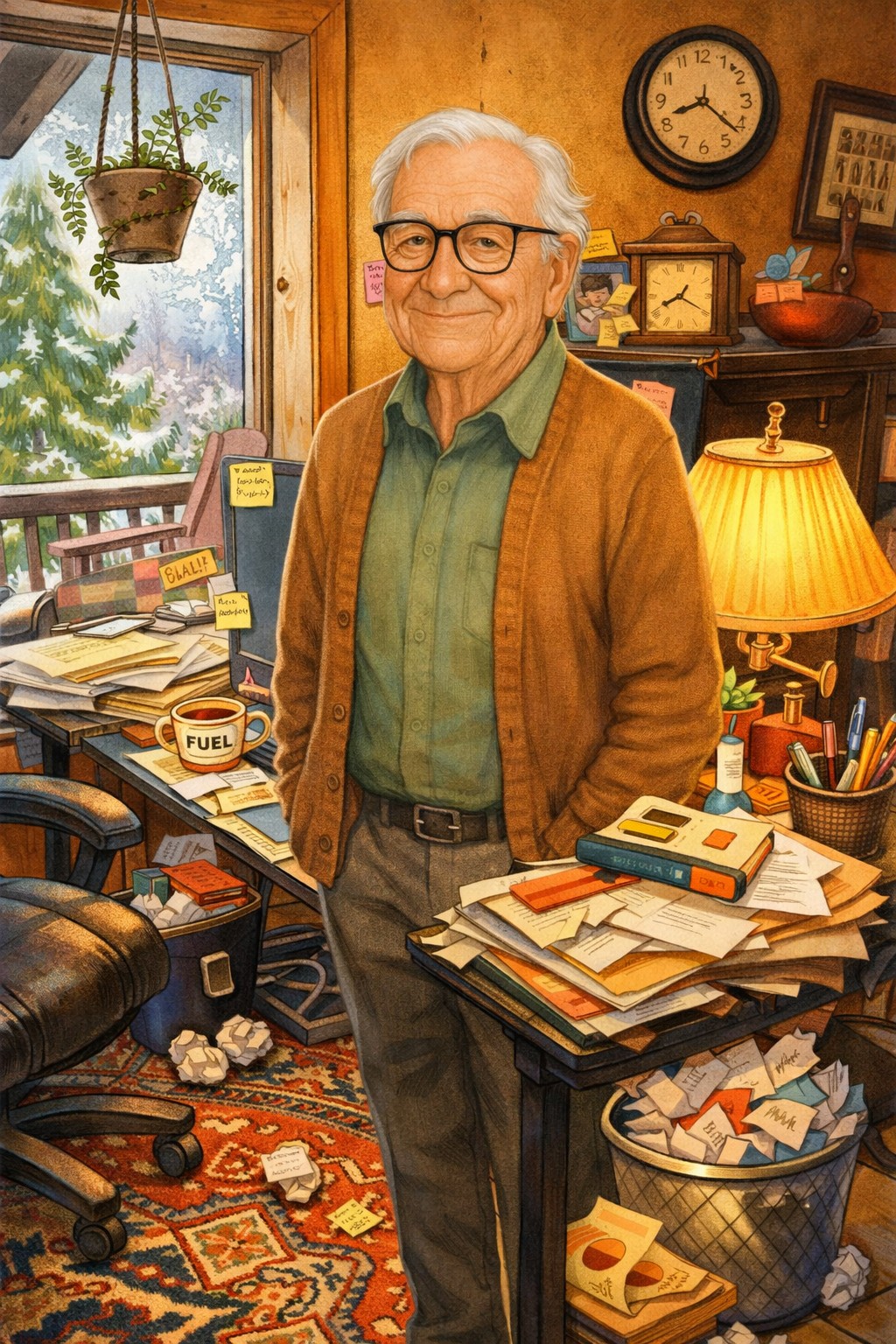
Thanksgiving Shenanigans with Poor Brentford Lee

Benjamin Franklin had Poor Richard.
TheWiredResearcher has Poor Brentford Lee

and welcomes him back as a guest contributor—
louder than a sardine timer and twice as slippery
to sanctify
our Thanksgiving tables
with a bold mix of satire and sass.

Discerning readers like you, My Dear Friends, have no doubt noticed that from time to time, I write my posts under what I would call my nom de plume, Poor Brentford Lee. I like it, especially since it always makes me feel that I’m right up there in American letters right beside Ben Franklin and his famed Poor Richard.

I suspect it is with me as it was with Franklin. Using a nom de plume allows me to say things that I might have better sense than to say under my real name.

Anyway, I like Poor Brentford Lee enough that I let him grab hold of my smartphone and tap his heart away to share whatever it is he insists on sharing about Thanksgiving!

And this, My Dear Friends, is precisely where I step aside and let Poor Brentford take over. He’s already clearing his throat, poised to pontificate about Thanksgiving and give you a mouthful about all the other holidays we might celebrate. Or not.

Take it away, Poor Brentford…

Law me, Child, you would think folks would leave well enough alone and let Thanksgiving shine on its own once a year. But no. One day’s not enough for some people. They’ve gone and populated the whole turkey week with holidays!

Where shall I begin and how shall I spit out all the celebrations making every day on my calendar look like parchment with measles.

I’ll tell you here and now. Lace your girdle. Tighten your suspenders. Better still. Do both.

“Who? Me?”

“Yes. You. You tin-bellied Buzzard.”

And no. It is not true, the rumor that you may have heard that Ben Franklin wanted the buzzard to be declared America’s national bird. (And even if he had, he would not have endorsed eating it for Thanksgiving instead of turkey. So don’t let my nonsense bother your pretty little mind nary a whit when you sit down and take a gander at the golden bird on your table. It’s a turkey. And, besides, a turkey by any other name tastes the same.) But he did prefer the turkey over the Bald Eagle–which was, is, and forever shall be America’s national bird. He thought the eagle had “bad moral character” whereas the turkey was a bird “of courage.” But I assure you, Franklin never advocated that the turkey–or buzzard–be elevated to a national symbol.

But let’s get back to this bird of courage, with my genuine assurance that you’ll be stuffed by the time yours is done. (And it may be already.)

Do you realize that just a few days ago–Monday, November 24–folks celebrated:

Celebrate Your Unique Talent Day. (Law me, Child, half of us still haven’t identified a talent, and the other half are busy showing theirs off on Facebook. Settle down and smooth your feathers. We’re all special just as we are.)

D. B. Cooper Day. (Lord help us! Who in their stuffed mind celebrates a masked, unidentified airplane hijacker? Pass the gravy, please—and make it strong.)

International Au Pair Day. (Bless their ambitious little hearts. Raising other people’s children while living in their basements. That’s not a holiday—that’s a calling.)

National Brand Day. (Because nothing says Thanksgiving spirit like corporate logos. Law me twice and hand me a napkin.)

National Fairy Bread Day. (Child, that’s just white bread with butter and sprinkles. The Australians have some nerve calling it a delicacy. Bless their festive little hearts.)

National Sardines Day. (Well, thank you! I think I will. Pass the saltines, please. Those fishies may be little, but they sure pack the omegas. Goodness, no. No need to open the windows. Light a candle? Have you lost your mind? Eat some sardines and chill.)

Land’s sake. That’s just Monday’s shenanigans.

I won’t dare trot my way through Tuesday and Wednesday, and when we get to Thanksgiving Day (the granddaddy of all American feasts), we’ve got at least five other celebrations dotting up my measled calendar—including Turkey-Free Thanksgiving. (I’m about to faint. Run fetch the smelling salts, please.) And Pins and Needles Day. (No doubt all the turkeys in the land are on theirs. My stars, even the Macy’s balloons look nervous.)

And don’t get me started on what follows on Friday. It’s none other than Black Friday, but Poor Brentford calls it National Lose Your Religion Day.

Thank your lucky un-plucked feathers that brings us to December, filled with an entire navigation of celebratory days that won’t get stuck in anybody’s craw.

The month barely opens before we’re knee-deep in Advent (which starts on November 30 this year—law me, Sweetheart, some of us are still digesting stuffing and the rest of us are remembering that we meant to buy candles).

Then comes December 8, the Feast of the Immaculate Conception (a reminder that December still knows how to be holy before the cookies take over).

December 10 brings Human Rights Day (which, given the state of the world, ought to be celebrated daily, loudly, and with snacks).

December 12 offers the Feast of Our Lady of Guadalupe (a celebration so radiant it could light a path clear across the Shenandoah), and December 13 arrives with Saint Lucy’s Day (bless their bright little candles; it’s the one holiday where setting fire to your hair is considered festive).

And then, Sugar, December 21 rolls in with the Winter Solstice (the shortest day of the year—when the sun says “I’m tired” and slips behind the hills before Poor Brentford has found his reading glasses).

December 24 is Christmas Eve (the day we all lie and say “just one more cookie”), December 25 is Christmas Day (the grandmammy of gift wrap and gravy boats), and December 26 brings the first day of Kwanzaa and Boxing Day (a pair of celebrations that stretch the season just a little sweeter and a little longer).

Finally, December 31 lurches toward us as New Year’s Eve (when half the country watches the ball drop and the other half drops before the ball does).

And before you start thinking December has nothing left to get stuck in your craw, Dear One, let Poor Brentford assure you otherwise. We haven’t even touched the other December shenanigans—those bafflin’, bedazzlin’, bubble-blowin’ celebrations that make a body wonder who’s in charge of this calendar.

Take Package Protection Day (Law me, Sweetheart, if your packages need protection, it’s already too late).

Then there’s Bathtub Party Day (Heavens no. These bubbles are reserved for… well, that’s none of your business).

Put On Your Own Shoes Day arrives next (bless their slow little hearts—and who, pray tell, was puttin’ ’em on before today?).

National Letter Writing Day finally appears (fetch me a quill and ink pot pen before the feeling passes), followed closely by Weary Willie Day (and aren’t we all, after this calendar?).

Then up pops Dewey Decimal System Day (now kiss my librarian grits—this is a holiday worthy of humanity), and International Mountain Day (Child, here in the Shenandoah, every day is Mountain Day, even Tuesday).

Fast-forward a bit and December tosses out National Whiners’ Day (celebrated mostly by folks returning gifts they don’t deserve), followed by Still Need To Do Day (my to-do list fainted dead away—fetch the smelling salts), and finally Make Up Your Mind Day (if only—Poor Brentford’s been undecided since the first time he picked up a pen).

As for me, I’ve made up my mind that I’ve stuffed you with enough celebrations already, and I’m not about to puff up my feathers and strut around with more. Land’s sake alive! If I got going on all the celebrations we won’t be celebrating in 2026, I’d be here forever and you’d be reading even longer. (One reader told me just a feather or two ago that I was getting pretty windy.)

Now, before you fan yourself and declare that Poor Brentford has lost the last marble he was ever loaned, let me tell you something plain and true. All this fussin’ and frettin’ over holidays—big ones, little ones, ridiculous ones—might seem like the carryings-on of a nation that’s plum run out of sense. But Sugar, I don’t think that’s it at all. Not deep down.

I think we keep inventing these goldurned celebrations because we’re hungry for each other. Hungry for community, for belonging, for a reason—any reason—to stop the world long enough to say, “I’m here, you’re here, thank heavens we made it another day.”

We are a scattered people trying to stitch ourselves back together with whatever thread we can find—peppermint bark, bathtub bubbles, mountain days, turkey days, even days devoted to weary Willies and packages that need protecting. It’s laughable, yes. But it’s also a kind of hope. A kind of reaching.

And if you ask me—and you didn’t, but here I go anyway—I think we ought to take these foolish little observances and set them right on the Thanksgiving table alongside the mashed potatoes and cranberry sauce. Call them what they are:

Laughable Blessings.

Because heaven knows we need reasons to laugh. We need excuses to gather. We need bright spots—silly or sacred—that remind us we belong to one another, even on the days we feel most alone.

So Child, if some little holiday comes along and tickles your wishbone or nudges your heart, pull up a chair at your Thanksgiving table and let it sit a spell. Celebrate it. Laugh at it. Give thanks for it.

Light a candle. Bake a pie. Wear the dress or don’t (but mercy, cover the essentials). Put on your own shoes—today or tomorrow.

Because in the end, Thanksgiving isn’t only about turkeys and table linens. It’s about noticing the small things—absurd, tender, holy—that remind us how lucky we are to be here at all.

And that, My Dear Readers, is a blessing worth celebrating on Thanksgiving and every day of the year.


Poor Brentford Says

Eat well. Laugh loudly.
And Sweetheart, if life insists on giving you
a celebration for every day on the calendar…
count them as blessings — even the laughable ones
.

Looking Back on the Outer Edge of Forever

“The real voyage of discovery consists not in seeking new landscapes, but in having new eyes.”

Marcel Proust (1871–1922). from his The Captive (1923), the fifth volume of his seven-part masterpiece In Search of Lost Time. Proust’s exploration of memory and perception reshaped modern literature.

Somewhere I saw it. Everywhere, maybe. Nowhere? Wherever—it grabbed hold of me and wouldn’t let go.

It was the gripping question:

“What would you tell your 18-year-old self?”

It lingered—since forever. Or yesterday? Either way, one morning not long ago, I tried to get rid of it by tossing it out to others—as if the orphaned question might leave me alone once it found a new home.

The replies were as varied as I expected, and as humorous and matter-of-fact, too:

“Buy stock in Apple and Amazon.”

“Be good at life; cultivate a well-rounded lifestyle.”

“Be patient; trust in God.”

“Serve God better.”

“Stay young; don’t age.”

“Be friends with your mom. Spend more time with family. Don’t let important things slide.”

“Don’t worry about impressing anyone other than yourself.”

Almost always, their offerings included a request to hear what I would have told my 18-year-old self. As a result, the question dug itself more deeply into my being, as I stalled by answering:

“I’m still thinking.”

It was true. But I knew I had to answer the question, too, not for them, but for me.

Several possibilities surfaced.

The first was rather light-hearted:

“You don’t have to have it all figured out. Just stay curious, kind, and honest. Don’t waste your energy chasing approval. Learn to cook, listen more than you talk, and remember: dogs and good people can tell when your heart’s true. Oh, and wear sunscreen.”

I dissed it immediately (though it carried some truths). Then I came up with:

“Don’t rush. The world will still be there when you’re ready to meet it. Pay attention to seemingingly insignificant things. They’re where meaning hides. Keep your humor close and your integrity closer. Fall in love, but don’t lose yourself in the process. And when life hands you a fork in the road, check which one smells like supper.”

I didn’t like that any better, though it, too, spoke truth. I was certain I could nail it with a third attempt:

“You think you know who you are right now, but you’re only meeting the opening act. Be kind. Be curious. And don’t confuse noise for meaning. The world rewards loudness, but grace whispers. Listen to that whisper. It’s you, becoming.”

Then six words sauntered past, not so much tinged with regret as with remembrance. Six words. Six.

“Be a citizen of the world.”

Those words had crossed my path before. In fact, I remember exactly when—not the actual date but instead the general timeframe and the location.

It would have been in the early 1980s, when I was working at the Library of Congress. I was standing in the Main Reading Room of the Jefferson Building, as captivated by its grandeur as I had been when I first started working there in 1969.

Above me, light spilled through the dome like revelation. Gold, marble, and fresco conspired to make the air itself feel sacred, as if thought had taken on architecture. Beyond those arches, knowledge waited in silence, breathing through pages and time.

Even now, I can close my eyes and see it: the way the dome seemed to rise into forever—an invitation, a reminder—that the world was larger than any one life, and I was already standing in the heart of it.

As an editor of the National Union Catalog, Pre-1956 Imprints—the “bibliographic wonder of the world”—I knew every alcove, every corridor, every one of its 532 miles of bookshelves, holding more than 110 million items in nearly every language and format. I had walked those miles over and over again doing my editorial research. I had come to learn that knowledge knows no barrier. I had come to learn that it transcends time and place.

At the same time, I decided that I could transcend place, too. With my experience and credentials, I began to imagine working in the world’s great libraries—first the Library of Congress, then The British Library, then the Bibliothèque Nationale de France, then the Biblioteca Nazionale Centrale di Roma.

I didn’t know where the journey would end, but it gave me a dream, a dream of being a citizen of the world of learning.

More than that, it was a dream untainted by pretense—never by the notion of being uppity. Instead, it was a simple dream. I figured that if I had made it from the coal camps of West Virginia to the hallowed halls of our nation’s library, I could pack up whatever it was that had brought me that far and go throughout the world, savoring knowledge and learning—and perhaps, over time, gaining a smidgen of wisdom.

But here’s the catch. If transcending geography is the measure of my dream’s fulfillment—the wanderlust, the scholar’s yearning for marble floors, old paper, and the hum of languages not my own—then, at first glance, I failed. I never made it to any of the world’s great libraries except the Library of Congress.

However, as I look back through my life-lens of 78 years come November 20, I realize that maybe I went beyond the geographic destinations that I set for myself.

I went from the mountains of West Virginia to the monuments of D.C., from there to the marshlands of South Carolina where I earned my Ph.D., from there back home to the monuments, and, from there, at last, to the Shenandoah Valley and college teaching that took me internationally via Zoom and tapped into Open Educational Resources that did away with the restrictive border of printed books.

In a sense, then, although I didn’t cross country borders, I crossed the borders of ideas, with my voice carrying me farther than my feet ever needed to.

I’ve managed to live generously, teach across generations, write with empathy, research with joy, garden with gratitude, cook with curiosity, and love with intentionality. In all of that, I have been that citizen of the world—not by passport stamps, but by curiosity. By compassion. By connection.

Maybe that’s the truth I’d offer my 18-year-old self:

“You don’t have to travel the world to belong to it.
You only have to live with your eyes open.”

Redbuds of Remembrance

To be remembered, to have one’s name spoken—these are the most powerful things anyone can hope for.

–Paul Monette (1945–1995; award-winning gay author, poet, and activist. His 1988 Borrowed Time: An AIDS Memoir was one of the first memoirs to document the AIDS crisis from a personal, unflinching perspective.)

Cercis canadensisor Redbud, as we call it here in the Shenandoah Valley of Virginia—is blooming now, as April unfurls, splashing the forest with an unmistakable purple that defies subtlety. Not pink. Not lavender. But a wild, jubilant purple that dares the bare trees around it to remember what life feels like. Its blossoms don’t wait for leaves, and they don’t hide behind foliage. They burst straight from the bark, bold and tender all at once—like a memory that insists on being remembered.

They seem more magnificent this year, tugging at my heart more fiercely than ever before, making David’s words ring out above his gentle whisper:

“When the Redbuds bloom, remember me.”

David and I knew one another decades ago at the Library of Congress where we both worked in the United States Copyright Office. When we first met, David was a Cataloger, and I was a Technical Support Specialist and then Copyright Training Coordinator. We were hello-in-passing colleagues.

Later, a close and unexpected bond developed between us. I became the Library of Congress Intern Director, coordinating a 9-month program that brought together a dozen or so highly talented librarians from within the Library and across the nation, providing them with an in-depth understanding of the library’s collections, its services, and its management infrastructure.

Sitting in my office about two weeks before the program’s start, I looked up and saw David standing there. After I congratulated him on being selected for that year’s Intern class, he gave me a troubled look:

“Thanks. Can we talk?”

“Of course. Come on in.”

He closed the door as he entered. He sat down, sighed, and shot me another look that to this day remains in my memory as one of existential angst:

“I have AIDS.”

My reply hung in the air, like eternity:

“I’m so sorry.”

What else could I have said? It was 1985. Even though AIDS (Acquired ImmunoDeficiency Syndrome) was generally known to most Americans, as it spread within the gay community, it started making its way to sensational articles in national newspapers, leaving all of us–especially in the gay community–terror stricken.

● 37% in Poll Say AIDS Altered Their Attitude to Homosexuals

● Saliva Discounted as an AIDS Threat

● More and More AIDS Cases Found Among Drug Users

● Panel Disagrees Over AIDS Risk for Public

● Grim New Ravage of AIDS: Brain Damage

● Rock Hudson, Screen Idol, Dies at 59

I had read those articles and more, but they had not prepared me for this moment.

Sitting across the desk from me was not Rock Hudson. Not a brain-ravaged AIDS person. Not a drug user. Not any of the things that I had read about.

Sitting across the desk from me was my friend David. David, poised at a high point in his career. David, diagnosed with AIDS. David. Death.

Before my three words had reached David’s ears, I walked around to where he sat. As I stretched out my arms, David stood to receive my embrace. Each knowing that friends stand for friends. Each knowing that friends stand with friends.

“I don’t know what to do?”

“About what?”

“About starting the Intern program.”

I knew the answer that I was about to give David was true. It had nothing to do with being gay. Nothing to do with AIDS. It had everything to do with being. Everything to do with living.

“I don’t have a magic ball, David, but it seems to me that as you face unknown health issues, a structured program like this might just be the anchor that you need.”

“But what about my fellow interns?”

David was well aware that for the next nine months, we would all share a small classroom–with top library officials appearing and making presentations throughout the day. It was close quarters. It was rigorous. It was intense.

He was also well aware of the public reaction to AIDS. Fear was thick in the air—fear of infection, fear of proximity, even fear within the gay community itself. At one point, some wondered whether poppers had caused the epidemic.

“I don’t know how your fellow Interns will react, but I’d urge you to stick with the program. I’ll be with you every day, and I’ll have your back.”

David left my office, leaving each of us with lots to think about.

For David, thinking about whether to continue with the program or let a disease with an unknown trajectory–other than eventual death–take charge of his life and spirit.

For me, thinking about navigating the months ahead while remembering that I was directing the most prestigious Library Intern program in the nation.

Two weeks passed. No word from David. Hopeful, I went ahead and made his name tent, stacking it with the others. As I stood at the door, greeting each of the Interns, I saw David walking my way:

“Let’s do it!”

And do it, we did, for a succession of days strung together like a strand of survival pearls. Then, one day, just before we were breaking for lunch, David asked whether he could share something with his classmates.

I knew what was coming. I knew, too, that anyone with something to share knows better than anyone else not only when to share but also how to share.

David shared his news with them as bluntly as he had shared it with me, but his existential angst had softened, perhaps in the hope that a burden shared would become a burden lessened.

I watched each face in the room. I listened to every word. To every breath between the words. One by one, each Intern summoned courage to offer consolation, support, hope, and help. When the last among them had offered all they had to give, one spoke again, laying one thing more upon love’s altar:

“Let’s have lunch brought in so we can all stay here together. Today. With David.”

We did.

The spirit that shone around the room that day continued to shine upon us day after day, month after month, all the way through a triumphant Intern graduation with David as one of our speakers.

David and his fellow Interns proved themselves to be a class beyond measure.

Where many people spoke of separation, the Interns spoke of inclusion.

Where many people chose to remain socially ignorant, the Interns chose to embrace information as power.

Where many people practiced discrimination, the Interns practiced acceptance.

I like to think that all of us rose to the occasion. We did. At the same time, I know that it was David who helped us rise higher than we ever imagined simply because we were not trying to rise. We were just trying to be … ourselves. We were just trying to let him be … himself.

In David, we did not see the face of AIDS.

In David, we saw the face of humanity.

In David, we saw the face of ourselves.

In David, we saw the depth of our empathy.

In David, we saw the things that each of us valued most.

In David, we saw opportunities to be more present, to say “I love you” more, and to recalibrate the course of our own lives.

In David, we saw the face of our own mortality, our fears of not having lived fully, of leaving things unsaid, and of being forgotten.

Through David and with David, we grappled with all of those grave issues–spoken and unspoken–confident of being fellow travelers on a shared journey.

Through David, with the arrival of every new spring since–now numbering forty–I am wrapt by redbuds of remembrance.

Too Big to Handle

“Life is not about waiting for the storm to pass but about learning to dance in the rain.”

Vivian Greene (American author and motivational speaker who focuses on themes of personal growth, resilience, and embracing life’s challenges.)

Winter settled in early here in the Shenandoah Valley of Virginia. Its chill, chillier. Its still, stiller. With night temps below zero and day temps hovering in the teens and twenties, my mountain road became ice layer upon ice layer. Snow still blankets the Great North Mountain Range across the valley, ridgelines shadowed, deep furrows of gray wrinkles defining sharp and rugged terrain lulled into surrender.

As I bring my glance closer to home, I see my wrap-around, snow-covered deck, and in the midst of the floating whiteness is a fire-engine-red hand cart.

I smile as it transports me to last year when my deck, always my above-ground oasis, became a special summer escape. I spent weeks getting down and dirty, scraping off years of deck paint and putting on new primer and new paint. It looked so beautiful that I decided to make it even more special than usual. I married lush greens and artful design, allowing nature and human craftsmanship to merge mid-air. The solid presence of four Adirondack chairs and matching lounger–rich burgundy slats with jet black frames–offered a ready invitation to sit, glide, recline, and be. The rugs defining the sitting areas–bursts of Oriental color and abstract design with blues, pinks, and golds–grounded the whole deck.

I won’t even blush by telling you that my plants last summer stole the show. My tall, stately night-blooming Cereus stretched upward as if trying to touch the sky, while elephant ears fanned outward, their broad, green leaves catching the light just so. The royal purple Musa banana plants, their wide leaves giving off a tropical vibe, reminded me daily that tropical life can flourish for a season, right here on my mountaintop deck. Tucked betwixt and between, smaller pots cradled succulents and geraniums and ferns, almost spilling into the space, their feathery fronds adding softness to the more structured, towering greens. For me, it all felt perfectly placed yet organic, as if my deck had become one with the natural world that surrounds it.

It’s my summer space to unwind, reflect, and listen to the rustle of the breeze, framed by the valley and mountains beyond. It always seems perpetually forever.

Yet, I always know that when fall arrives, my deck morphs into a transition space, caught between seasons. I always move the houseplants indoors, leaving behind scattered soil, stray leaves, and colorful rugs peppered with dirt—a stark contrast to the vibrant life that flourished there just a few days before the march indoors began.

I’ve always loved this parade of plants. I loved it more when I was younger, and my muscles could handle the massive ceramic pots and even larger plants that were a gardener’s eye candy. This past year, the plants seemed lusher, the pots seemed larger, and everything seemed heavier.

I realized that in order to keep the parade moving, I needed a hand cart to help with what had become too big to handle. The cart worked beautifully. Together, we moved the pots so that I could roll up the rugs and ready the deck for its long winter sleep.

When I finished, I left the fire-engine-red hand cart on the deck, right where it made its final lift. I wanted it to stand out, bold and purposeful, a conscious and constant reminder of the options I had when I discovered that the pots and plants on my deck were too big for me to handle.

In that moment, I could have decided that too big to handle was fate’s way of telling me to give up–to stop doing what I’ve spent decades doing; to stop enjoying what I’ve spent decades enjoying. I do not believe the season will ever come when I’ll sigh:

“Enough. I’m done.”

But if that season should arrive, I like to think that I will celebrate it triumphantly with all the notes my feeble gardener’s voice can warble.

Then again, I could have decided that too big to handle was a subtle nudge to scale back, to embrace smaller pots and smaller plants. I know that season may come when I’ll answer the call of the bonsai.

Standing there, however, I realized that too big to handle was not a defeat, but instead, it was an opportunity for me to get the job done differently.

You might be wondering why I didn’t decide to hire someone to move the pots and plants for me. If they’d been in the yard, I might have. To me, the deck is personal, even sacred. It’s me, myself, reaching out to touch the forest beyond and the sky above. The sky and forest reach back, their touch completing the connection. Somehow, the deck is me–one with the universe.

For now–and now is all that matters–I have my fire-engine-red hand cart, my ready ally, poised to see me into a new season and all that might seem too big to handle.

The Ghost of Palmyra Church Road

“Memory is the diary that we all carry about with us.”

Oscar Wilde (1854–1900; Irish playwright, poet, and author known for his wit, flamboyant style, and sharp social criticism as well as for his role in the aesthetic movement, which emphasized beauty and art for art’s sake.)

Sometimes, I wonder when a routine in our lives becomes a ritual. They are different, of course. Routines are often performed out of necessity or habit. Rituals carry a sense of purpose, mindfulness, or emotional significance. I suppose a routine can turn into a ritual when its meaning grows beyond its original purpose—when the participants become more conscious of the act itself, savoring it, reflecting on its importance, or incorporating personal values into it.

I’m thinking, for example, of an afternoon drive that my late partner and I used to take daily down a nearby country road meandering along the banks of the Shenandoah River. It started as little more than a way to while away the time between Allen’s arrival home from his 7a.m. to 3p.m. shift at our local hospital until the start of our 5 o’clock cocktail hour and dinner prep.

We always took my Jeep. Allen didn’t like its bumpy ride, but since I was willing to drive, he put up with it. It didn’t take long before we both realized the routine had shifted from its original intent. It became a time when Allen could share the highlights of his day as a surgical technologist, and I could share highlights of mine as an English professor. Then, we savored being with one another, moving along, cocooned in quiet.

Now, heading out for that same drive feels different. I’m alone, but the road is still filled with echoes of those drives with Allen. The gravel crunches beneath the tires, a reminder that I’m traveling at a slower pace—though I still catch myself thinking in we. As I drive down our rutted road, the bumps and jolts are as familiar as ever, almost comforting, as if the past rides along with me into the present. I’m never in too much of a hurry. After all, I know that venturing down means that I’ll have to come back up eventually.

Fall has arrived. The goldenrod along the roadside catches my eye because it often made its way back home into floral arrangements. The landscape changes as I transition from the gravel onto the hard surface of the county road. It meanders along steep banks, the guardrails dented woefully from cars that couldn’t quite manage the turns. The sound of the tires shifts too, now whirring on the pavement as the engine hums along at a modest speed—never more than thirty-five, even though the road stretches out ahead.

Leaving behind the George Washington National Forest, I see the Shenandoah Valley open up into a vast, sweeping view of mountains—beyond them, West Virginia. Mailboxes line the road, clinging to its edge like sentinels. The curves of the road feel like a roller coaster, and I slow down as I near the North Fork of the Shenandoah River. It’s instinct now, my pause to check the depth of the water below, watching as it glides under the bridge.

I pass through Edinburg, a town where unoccupied buildings look as cared for as the rest. I find myself wondering what brought people here in the first place and what keeps them here now. Stony Creek runs by Edinburg Mill, built a decade or so before the Civil War. Just beyond is the cemetery, always a reminder, as if I ever needed one, that a little ways further is where we always used to turn left onto Palmyra Church Road.

I turn there today. This stretch is all too familiar. It’s paved but without markings to show the center of the road, the travel lanes, or the road’s edges. Massanutten Mountain looms straight ahead. I slow down even slower, savoring the ride, stretching out the trip as long as I can. I realize that I have no compelling destination. This trip is about the road itself, the memories, the connection to this place, and the quiet reflection it brings.

The speed limit drops to 25, and the road stretches out ahead. For now, it’s just me and the country road. There’s nothing behind me that I can see and nothing ahead of me but that same winding road.

Soon, I approach a grassy field stretching along the banks of the Shenandoah River. The grass, tall and dry, ready to bow down for a twin-engine plane’s landing. Small cones dot the nearly invisible runway, glowing at night like distant stars, guiding the landing, and then leading to a small, weathered hangar. In times past, we would sometimes glimpse a small plane resting at the far end of the field, its presence quiet and still. We never saw the pilot, if one ever existed. These days, the plane is gone, as if it never was. The field lies empty, waiting.

A little further along, I do a double take to my left as I see Palmyra Church of the Brethren. I’m not sure that Allen and I ever saw it on any of our drives. If we did, neither of us commented. I’m not surprised. It’s a modest church with white wooden siding, a metal roof, and a small steeple that adds a traditional touch. A brick chimney on one side adds to the rural charm. The front entrance is simple, with a door accessed by steps and a metal railing, alongside a wooden ramp. No one is there. The absence of people turns quiet into stark, making the church feel even more secluded if not abandoned.

I pause and cannot help but wonder why a road meandering along the mighty Shenandoah River would bear the name of a church so plain and inconspicuous that it’s easily unseen. Yet, even as I wonder, I know. For the dwindled few, it’s still a house of worship. And then I pause again. Seeing no cemetery. I wonder: where do they bury their dead?

I leave those wonderings behind me as I start looking ahead, hoping to see the small, thin woman that Allen and I used to see as she walked the road, her steps so soft they seemed to barely touch the ground. She was always beneath a large, open black umbrella, shielding her, sometimes from sun or rain or snow, but more often than not, from nothing more than open sky and passersby. Her pace seemed slower than the passage of time itself, as if she were floating rather than walking. Her face leaned down toward a cell phone held delicately in one hand, her eyes locked on its screen. She appeared ethereal, her presence more like a drifting shadow, but there was an undeniable humanity about her—fragile and real.

Allen and I worried about her. We broke our quiet to talk about her. Where was she going? Where had she been? Where was her home? How far away from home was she? Who was waiting there for her return? She seemed so other-worldly that I started calling her The Ghost of Palmyra Church Road. We always wondered whether we would see her on our next drive. We always did, every time, though in a different spot every time, always somewhere further back or somewhere further ahead. Over time, we warmed to her, and we waved softly. It took her longer, but the time came when she warmed back, shyly and slowly, as if to freeze time itself with the lift of her mittened hand.

Something about her presence always felt timeless. Today, she’s not here.

The rumble of tires against the pavement breaks the quiet as I approach a small bridge to my right, spanning this narrow section of the Shenandoah River, connecting to Old Valley Pike. Sometimes, if we were pressed for time, Allen and I would turn here and head back home.

Usually, though, we weren’t in a hurry, and we’d continue down the road where, from this point, it became Red Bank Road. Expansive farmlands open to my right, framed by wooden fences holding on to the Civil War. These fields, too, are dry and dusty.

To my right, I catch glimpses of the Shenandoah River through the sycamore. Rounding the last turn, I’m aware that the speed limit rises to 45 as I approach Mount Jackson. I could easily turn around and retrace the drive as Allen and I used to do as part of our ritual. But I don’t. I know that The Ghost of Palmyra Church Road is no more likely to appear than the plane that’s disappeared from the field. They coexist with the church that has no people and no cemetery–echoes in my memory.

As the landscape shifts and as the signs of the times creep back in, the quiet truth shatters my silence.

This time, I’m driving alone, my right hand resting on the Jeep’s console, no longer holding Allen’s hand in mine.

This time, I realize. Allen is gone.

This time, I realize. The ritual is gone.

This time, I realize. I’m driving home.

This is just another country road.