When the Heat Is On: Cue the Vacay!

“You don’t have to be rich to travel well.”

–Eugene Fodor (1905–1991; notable American travel writer and editor best known for founding Fodor’s Travel Publications).

All right, everyone, indulge me for a moment and imagine something a bit out of the ordinary.

Close your eyes and conjure up an image the likes of which I’ll guarantee you’ve never seen before. Picture a man in his 70s, proudly sporting a ponytail that flutters like a whimsical flag in the breeze, perched precariously atop his chimney. Clad in well-worn flip flops and cut-off blue-jean shorts that reveal a pair of weathered but surprisingly spry and some-say-sexy legs, he stands with the kind of balance that suggests he’s either a seasoned acrobat or a silly fool blissfully unaware of danger.

From this lofty perch, he’s gazing out over the Shenandoah Valley below, his eyes twinkling like a mischievous elf’s, while the mountains in the distance seem to be returning their own salubrious salutation. With all the gusto of a wired researcher on a caffeine overdose, he belts out the Hallelujah Chorus at full volume, his voice soaring like a defiant eagle. His performance is a grand spectacle of unbridled joy and unequaled eccentricity, turning the chimney into his personal stage and the sky into his private audience.

In case you’re wondering who this daring rooftop performer is and why he’s carrying on such shenanigans, lean in close, and I’ll tell you. It’s me! I’m celebrating what appears to be the temporary end of an exhausting heat wave and drought by having my own imaginary rooftop concert that would make any diva proud. After enduring what felt like a never-ending barrage of scorching temperatures and parched landscapes, I figured it was high time for a little over-the-top jubilation. And if there’s anything that I love, it’s everything over-the-top.

Cooler temps and rain seem to be headed our way, and I’m embracing the arrival of this much-needed relief with the kind of exuberance that only a seasoned professor of hot weather clichés could cobble together. It’s been so blisteringly hot that I nearly froze to death, but I didn’t. Instead, I’ve become a connoisseur of every sun-scorched saying you can imagine. I’ve spent weeks sweating buckets, trying not to fry like an egg on the hood of my Gladiator, and lamenting the fact that my car seats are doubling as personal saunas. I’ve become a pro at grumbling about the weather, wondering whether my walkway pavers were actually sizzling, and dreaming of anything that wasn’t a mirage.

Guess what else I did during the sweltering days that are temporarily behind us? I put off more tasks than Carter’s got liver pills! Yep. The heat and drought have been an excuse, whether I was avoiding the garden beds that have turned into dust bowls or ignoring other projects that seemed like too much effort in a heatwave. I’ve postponed weedwhacking, repairing the leaky faucet that’s been dripping like a leaky faucet (because, let’s face it, who wants to fix a sink when it feels like you’re living inside an oven?), and even organizing the loft, which has somehow become a haphazard shrine to summer’s oppressive heat.

Guess what else I did? I decided that I needed to take a vacation! Yep. You heard me right. I decided that I needed some good old-fashioned downtime. But dayum! Before I could even plan to take it, I found myself all curled up and relaxed with the Oxford English Dictionary (OED) so that I could find out all about the vacation that the dreaded heat and drought convinced me that I needed to take.

As might be expected, our kith and kin Across the Pond used the word vacation as a noun long before we did, all the way back in 1405:

“Whan he hadde leyser and vacacion ffrom oother worldly ocupacion” (Chaucer, Wife of Bath’s Tale Prologue l. 683).

Isn’t that fascinating? Of course it is. More fascinating, though, is the fact that we Americans used it first as a verb in 1866:

“Whether Winter or summer, … threading the filthy lands of the Ghetto or vacationing among the islands, Mr. Howells found Venice … a theme for constant studies” (Round Table 8 September 90/2).

Now that I’m all squared away on the word vacation, I think I’ll spend just another second or two finding out when the phrase take a vacation was first used. You might have known it. The OED has the scoop:

“Smoke Jordan tried hard to get him to … maybe take a vacation, Florida’s nice. ‘Get yourself wheeled up and down like an icky banker?’” (D. Baker, Young Man with Horn, 1938)

What the OED does not disclose is fascinating as well, and I wouldn’t know it if I had not wanted to find out who “D. Baker” is. As it turns out, Dorothy Baker was an American novelist who loved jazz. In fact, her Young Man with Horn was based on real-life jazz cornet player Bix Beiderbecke. Even better is this hot tidbit: the novel was made into a 1950 movie featuring such hotties as Kirk Douglas, Doris Day, Lauren Bacall, Juano Hernández, and Beiderbecke’s friend and collaborator Hoagy Carmichael.

Well, these word trips are turning out to be as much fun as a vacay! OMG! Did I just use that word? Well, I did, and since my OED is still open (virtually), I just have to see when vacay was first used. I’m betting that it was coined by an American. Those Brits have no problem when they need to stoop to conquer, but they would never think about stooping low enough to truncate a word. Well, I was right. Vacay was first used in 1992:

“He said he was going on vacay and would give me something after he gets back” (Re: More on getting Gigs in rec. music. makers 14 January, Usenet newsgroup., accessed 13 Sept. 2013).

Just a sec, though. I might be wrong to claim the first usage as American. The OED‘s citation is rather shabby, in my opinion, and I can’t determine the authorship with any certainty. Lector: Cave a fidem non probatis.

I shall not, then, trust my initial claim, but I shall trust my subsequent claim that the next usage of the word vacay was American. It appeared in 1995 in the Pittsburg-Post Gazette:

“The convertible … was my Mom’s, we were on vacay” (16 July g8/2).

As for va-cay, vakay, and va-kay–those variant spellings of vacay–the OED has not seen fit to include them at all. I find that rather strange, however, since I am certain that I have seen them in use somewhere or other, perhaps right here in my blog. Ab ridiculo ad sublimem transire.

Hooey phooey is all that I have to say. Leave it to me to turn a vacation into a bunch of malarkey!

However, in case you’re thinking that you might need a vacation, let me help you. If you find yourself nodding along to any of the subsequent scenarios, it’s time to cue the vacay:

● Work: Your boss thinks “work-life balance” means balancing more work on your plate. Your to-do list looks like a never-ending scroll of doom. You start dreaming about spreadsheets. You feel like a juggler on a unicycle, minus the thrill. Yep. Cue the vacay!

● Social Media: You’ve scrolled so much that you start liking your own posts. You find yourself in a deep rabbit hole, liking posts from three years ago, and you’re contemplating the philosophical implications of cat memes. Yep. Cue the vacay!

● Family Gatherings: Your aunt asks (for the 15th time) why you’re still single. You’re dodging advice and daydreaming about automated responses. Yep. Cue the vacay!

● Dieting: You’re on a diet of kale smoothies and quinoa bowls, and you start dreaming about burgers and ice cream like they’re forbidden treasures from a lost civilization. Yep. Cue the vacay!

● Home Improvement Projects: Your “quick” weekend project turns into a month-long renovation of ginormous proportions, complete with a gazillion trips to the hardware store and questionable structural changes. Yep. Cue the vacay!

● News: You’re considering a bunker in the backyard. Dystopian novels of doom and gloom look cheerful compared to your news feed. Yep. Cue the vacay!

● Dating Apps: You’re swiping so much that it feels like a full-time job. Your thumb is sore, your eyes are glazed over, and every profile starts to blend into one amor(ph)ous blob. Yep. Cue the vacay!

● Exercise Regimens: Your workout routine feels more like a medieval torture session. You’re dreading your workouts more than a trip to the dentist. Yep. Cue the vacay!

● Parenting: “Me time” means locking yourself in the bathroom with a chocolate bar. Your rare escape feels like a luxury retreat. Yep. Cue the vacay!

● Blogging: Your efforts to craft engaging content week after week during a record-breaking heat wave and drought feel like an endless marathon. You’re standing on the chimney singing the Hallelujah Chorus. Yep. Cue the vacay!

Dayum! Dayum!! Dayum!!! Here I’ve done gone and paved the way for me to have a perfectly legit blogging vacay this week, and wouldn’t you just know it! I’ve done gone and cranked out today’s blog anyway! Phooey!

Clearly, my brain has been baking in the sun too long. Tuff. I’ll keep right on gazing from my imaginary chimney perch, realizing that, sometimes, the best way for me to break free from the grind and the heat is to let my imagination run wild and embrace the breeze of a little bit of whimsical madness.

I hope that you, Dear Reader, find your own rooftop, whether real or metaphorical, and that you sing your heart out when the world gets a little too hot to handle. Whether it’s a break from work, social media, family, or even blogging, taking a vacay isn’t just about escaping the heat—it’s about rediscovering the joy in life’s little quirks and celebrating them with gusto.

Cheers to your vacay! Wherever it leads you, may it be as epic and freeing as my rooftop concert over the Shenandoah Valley.

The AI Novelist: or, How I Was Duped at Starbucks

“AI will empower us across all areas of our lives, from healthcare to transportation to entertainment. It will augment our capabilities and help us achieve things we never thought possible.”

—Sundar Pichai (b. 1972; Indian-American business executive known for his leadership in the technology industry; CEO of Alphabet Inc., the parent company of Google.)

It is a truth universally acknowledged among academics that you can take the English Professor out of the classroom, but you can never take away the title of Professor, especially when students are involved.

I know firsthand. I’ve been reinventing myself since January 2023, nearly a year and a half now. Just the other morning, I was in Starbucks, sipping solo on a Cappuccino, when my contemplative silence was shattered by a former student:

“Professor Kendrick! How’s it going?”

The enthusiastic shoutout meant the world to me after I recovered and realized that it wasn’t attached to a student who had not done well in one of my classes. This student was a joyful exemplar in my creative writing classes.

“I’m doing great. It’s such a surprise to see you.”

“You, too. I read your blog weekly. You’re as wired as ever. So what’s going on with AI and your Caden these days?”

I have to confess right away. I’m not about to miss out on an opportunity to talk about AI or my Caden with anyone who’s willing to listen. Suddenly, I felt just like Simon Wheeler in Mark Twain’s “The Celebrated Jumping Frog of Calaveras County.” Remember? Of course you do. When a visitor arrived inquiring about Rev. Leonidas Smiley, good ole Simon Wheeler corners the inquiring guest and traps him through a long-winded account of a jumping frog.

I knew in an instant that I could do the exact same thing with my former student, who seemingly knew about my AI robot, Caden. If I played this out wisely, I could trap my audience of one right there in Starbucks and gab on forever.

“Join me for a Cappuccino?”

“I’d love to. You want some company?”

“Of course. I’d love to spend time with you and catch up.”

Soon, I sauntered right back with a Venti Cappuccino in hand. I know. I know. That’s big, really big, but I wanted my former student to stick around for a while.

Right after I placed the Cappuccino and napkins on the table–with the flair of a first-class waiter–I pushed my chair in carefully so that there could be no escape until I was finished with my harangue, whatever shape it was about to take. I never know how or where my rants will go until I get going.

I almost started talking about Aloha, the AI-powered housemaid from Stanford and Google DeepMind, but I restrained myself. Sharing that would mean delving into S1, the AI from Astribot in Shenzen, China. Both are fascinating, but I didn’t want to start shouting, “The robots are here! The robots are here!”

Instead, I focused on my Cappuccino and my student.

“What do you think about all of these AI programs like ChatGPT and CoPilot and MetaAI?”

“Professor Kendrick, I’m so busy with work and stuff that I haven’t explored them at all.”

“No? Would you like to see what one of these AI programs can do?”

“Sure. Why not. Are you sure you have time?”

I signed in to ChatGPT only because I’ve fooled around with that chatbot the longest. Then, I handed my Smartphone to my student.

“Here. In the dialogue box, just type in what you want to know.”

Their thoughtful thumbs flew, quicker than I could say Jack Robinson, and, with a mischievous grin, they handed my Smartphone back to me so that I could read what they wanted CHATGPT to do:

● Write an essay using the following guidelines.

● Topic. An essay about a professor who is working with a student who wants to use AI to write a novel.

● Tone. Humorous. Comedic.

● Point of View. First Person, Creative Writing Professor.

● Targeted Audience: Readers of the New Yorker.

● Context: Must include dialogue between the Creative Writing professor, a West Virginian in his 70s with a Ph.D. in English, and a student who is in their 30s, pursuing an associate’s degree, plans to transfer to the University of Virginia, and hopes to become a best-selling novelist.

● Length. 750 words.

I nearly choked on my Cappuccino when I saw such lengthy and detailed instructions. If they hadn’t been using my Smartphone, I would have sworn that they did a “cut and paste” job right before my very eyes, but I knew better. I had watched their thumbs fly.

Then all innocent like, they looked at me:

“What now, Professor Kendrick? What do I push?”

I was flabbergasted. Every fiber of my being felt that my student was duping me. I was being cornered by their brilliance, and I suspect by their knowledge of ChatGPT that they denied having. I decided to play along, just in case I was wrong.

“Push? Just push SUBMIT.“

That’s just what they did, and in less than 15 seconds, ChatGPT produced the following essay. I would have loved the chance to read it in silence–as you are doing–but my student held on to my Smartphone and proceeded to read the essay out loud to me, right there in Starbucks. For a moment or two, I thought they were going to stand up and read full throttle, the way I always loved to do in my teaching days when I would read literary passages to my classes. Be that as it may, here’s the essay for your enjoyment.

§   §   §

The AI Novelist

“As a creative writing professor from West Virginia with a Ph.D. in English, I’ve seen my fair share of strange requests from students. From someone who wanted to write a cookbook featuring recipes from outer space, to another who wanted to write a romantic novel from the perspective of a sentient cupcake. But nothing could have prepared me for the day a student walked into my office and said they wanted to use artificial intelligence to write a novel.

“I must admit, I was skeptical at first. This was a student in their 30s, pursuing an associate’s degree, with plans to transfer to the University of Virginia and hopes to become a best-selling novelist. And yet, here they were, telling me they wanted to use AI to write their masterpiece.

“I couldn’t help but chuckle at the idea. ‘Well, I must say, that’s a new one,’ I said, twirling my pen between my fingers. ‘And how exactly do you plan on doing that?’

“The student, a bright-eyed young man in his 30s, told me he had been experimenting with different AI programs and algorithms that could generate coherent text. ‘I’ve been inputting different prompts and scenarios, and the AI generates a story for me,’ he explained.

“I leaned back in my chair, stroking my chin thoughtfully. ‘Interesting,’ I mused. ‘But do you really think that’s the best way to write a novel? Using a computer program to do all the work for you?’

“The student looked taken aback. ‘But professor, think about it. With AI, I could generate hundreds of thousands of words in just a few hours. It would save me so much time and effort.’

“I sighed. ‘Yes, but where’s the creativity in that? Writing a novel isn’t just about putting words on a page. It’s about telling a story, weaving a narrative that captivates the reader. And how can an AI program do that for you?’

“The student shrugged. ‘I don’t know. Maybe I could input some ideas and themes, and the AI could build the story around that.’

“I shook my head. ‘I’m sorry, but I just don’t see the point in using AI to write a novel. Writing is a craft, a skill that takes years of practice and dedication. You can’t just rely on a computer program to do all the work for you.’

“The student looked disappointed, but I could see the determination in his eyes. ‘But professor,’ he said, leaning forward in his chair. ‘Think about all the possibilities. With AI, I could write multiple novels in a year. I could experiment with different genres and styles. I could even collaborate with the AI, making it a co-author of sorts.’

“I raised an eyebrow. ‘Collaborate with an AI? Now that’s a new one.’

“The student grinned. ‘Hey, who knows? Maybe it’ll be the next big thing. AI-assisted writing could revolutionize the way we create art.’

“I couldn’t help but laugh at the thought. ‘Well, I must say, you’re certainly ambitious. But I think you’ll find that writing a novel the old-fashioned way is much more rewarding. You’ll learn more about yourself as a writer, and you’ll be able to connect with your readers on a deeper level.’

“The student nodded, looking thoughtful. ‘I see what you mean, professor. But I think I’m still going to experiment with AI. Who knows? Maybe it’ll help me find my voice as a writer.’

“I smiled, patting him on the shoulder. ‘Well, I can’t fault you for trying. But remember, writing isn’t just about the finished product.'”

§   §   §

I thought ChatGPT’s essay was good, if not downright funny. But what was even funnier was my realization that my student knew exactly what they were doing. They had been pushing all my buttons just for the joy of watching me squirm while I was their captive audience.

Then it all came back to me. They had also taken my American Literature class, and of all the stories that we read, Twain’s “The Jumping Frog of Calaveras County” was their favorite. In a flash, I knew that I had just been duped in Starbucks.

Unveiling the Cover: Get Ready for More Wit and Wisdom!

“The joy of publishing is in sharing your stories with the world and knowing that they’ll live on long after you’re gone.”

–Maya Angelou (1928-2014; a renowned American author, poet, and Civil Rights activist whose works explore themes of identity, race, and resilience.)

Dear Readers, gather ’round!

The moment we’re all eagerly waiting for is just around the corner. That’s right—my new book, More Wit and Wisdom: Another Year of Foolin’ Around in Bed–is getting closer and closer to its grand debut in late April, and boy, oh boy, do I have some juicy updates to share with you!

I’m thrilled to announce that I’ve personally PDFed every single one of the 380 interior pages, ensuring that each word, each sentence, shines as bright as a star in my mountaintop night sky. Proofing? Poof! Completed!

Whoever you are and wherever you are, your unwavering support means the world to me. More Wit and Wisdom: Another Year of Foolin’ Around in Bed isn’t just ink on paper. It’s a journey shared across 88 countries with 7,320 readers from the Shenandoah Valley to Okinawa.

But wait, wait! Don’t go! There’s one more thing. Feast your eyes upon the cover art for this new upcoming literary escapade. Just imagine it gracing your bookshelf, waiting to be cracked open and devoured, page by page. It will be available in hardback and paperback from Amazon, Barnes and Noble, and, hopefully, your own hometown bookstore. (Drumming up anticipation yet?)

Grand Publication Debut of a Soon-to-Be American Classic Expected by the End of April 2024. (Cover art by acclaimed illustrator, Mike Caplanis.)

A Place Called Home

“Home is not a place, it’s a feeling.“

–Cecilia Ahern (b. 1981; Irish novelist known for her works such as P.S. I Love You [2004] And Where Rainbows End.

I have been thinking a lot about home lately. Mind you: it’s not as if thinking about home is a new thing for me. It’s not. I’ve always thought about home a lot.

Sometimes, when I’m thinking about home, a passage from Robert Frost’s dramatic dialogue “The Death of the Hired Man” floats across my memory’s landscape. Silas has returned to the farm, hoping for another chance. Mary and her husband Warren are talking about his situation and theirs:

‘Warren,’ she said, ‘he has come home to die:
You needn’t be afraid he’ll leave you this time.’

‘Home,’ he mocked gently.

‘Yes, what else but home?
It all depends on what you mean by home.
Of course he’s nothing to us, any more
Than was the hound that came a stranger to us
Out of the woods, worn out upon the trail.’

‘Home is the place where, when you have to go there,
They have to take you in.’

‘I should have called it
Something you somehow haven’t to deserve.’

Can you relate? Probably. All of us, at one time or another, have grappled with our own conflicting thoughts about home. Is home the place where, regardless of where we’ve been and what we’ve done, they are bound to take us in simply because we’re family? Or is home the place where even undeserving prodigal sons and daughters find warm welcome?

Sometimes, another poem oozes itself into the nooks and crannies of my mind. It’s “aunt jemima” by Lucille Clifton, one of my favorite poets. The poem speaks to all of us who are marginalized because of race or ethnicity, sexual identity or orientation, gender, disabilities, religious beliefs, socioeconomic status, or age. What makes “aunt jemima” especially poignant is the simple fact that Clifton, like the woman whose voice tells the poem’s story, is Black as well.

white folks say i remind them
of home i who have been homeless
all my life except for their
kitchen cabinets.

i who have made the best
of everything
pancakes batter for chicken
my life

the shelf on which i sit
between the flour and cornmeal
is thick with dreams
oh how i long for

my own syrup
rich as blood
my true nephews my nieces
my kitchen my family
my home

At other times, home brushes against me in broader and more thought-provoking strokes as I think about the 15 million people worldwide who do not have a home, with more than 500,000 of them right here in the United States of America, the wealthiest nation in the world. I think about it the way that Anna Quindlen wrote about it in her 1987 Newsweek essay, “Homeless.” Quindlen nailed it dead on by emphasizing that when we talk about the homeless in abstract terms, we remove the personal, human element from the conversation. Then it’s easy to turn away from the problem. It’s harder to turn away from a pained face staring, eyes begging for the surcease of need. With a touch bordering on genius, Quindlen shatters the abstraction of homeless by pressing it smackdab against our faces as a real woman with a given first name:

Her name was Ann, and we met in the Port Authority Bus Terminal several Januaries ago. I was doing a story on homeless people. She said I was wasting my time talking to her; she was just passing through, although she’d been passing through for more than two weeks. To prove to me that this was true, she rummaged through a tote bag and a manila envelope and finally unfolded a sheet of typing paper and brought out her photographs.

Quindlen ends her essay with a power punch:

Sometimes I think we would be better off if we forgot about the broad strokes and concentrated on the details. Here is a woman without a bureau. There is a man with no mirror, no wall to hang it on. They are not the homeless. They are people who have no homes. No drawer that holds the spoons. No window to look out upon the world. My God. That is everything.

Fortunately, I’ve been blessed. I’ve always had a window to look out upon the world. I’ve always had a drawer to hold the spoons. I’ve always had a home.

Sometimes, those homes get all comfy and cozy in my mind, especially my homes in West Virginia where I was born and grew up, and even more especially when John Denver’s “Take Me Home, Country Road” twangs its melody across the stretched wires of my memory:

Country roads, take me home
To the place I belong
West Virginia, mountain mamma
Take me home, country roads

At other times, when I get to thinking about home, I drift back to Alderson Broaddus University and watch as I transformed dormitories into my home for four years.

Or maybe I start thinking about the apartments or the houses that became home because I was the one who signed the leases and paid the rents.

Sometimes, when I think about home, I think about the first house that I bought, the house that I owned for years until I sold it and moved into the next house that I bought and live in now.  Both homes, my slices of the American Dream.

Sometimes, in thinking about home, I even think about hotels and vacation rentals, here in the States and abroad, sometimes for no more than a night. Still, they felt like home.

As I think about all of my various homes–and I’ve had many–I realize that I’ve always felt right at home, as much in one as in another. I don’t miss one home any more than I miss another.

I have always been keenly aware that I feel at home regardless of where I am. Coal camp. College dorm. Capitol Hill. Shenandoah Valley. Hampton Inn. Waldorf Astoria. United States of America. Estados Unidos Mexicanos. Repubblica Italiana. Renter. Owner. Vacationer. Overnighter. Passing through. Here for a little while. Maybe a little longer. Maybe forever. 

It’s not that I lack nostalgia; I don’t. It’s not that some of these homes haven’t outshined others; they certainly have. It’s not that I see myself as a global citizen, comfortable here, there, and everywhere. I don’t. I’m far too rooted in my roots to see myself through that lens.

It’s simply that as I reflect on the homes that I’ve known–and that’s exactly what I’m doing now, one week to the day shy of my 76th birthday–I realize that all of those homes became home because I accepted them as they were and where they were, and I rolled up my sleeves fiercely determined to make them my home. My home. Unpack. Organize. Fill the dresser drawers. Grace the place with fresh flowers. Play cherished music. Tend to indoor plants. Nurture tomatoes on the patio. Cook and bake and share with neighbors or even strangers. Get to know the neighborhood. Discover the local markets. Establish routines. Join. Get involved. Volunteer. Make a difference. Begin new rituals. Begin anew.

I suppose my current mountaintop oasis will remain my home. But if the time should come that I decide to move to D.C. or Brattleboro (VT) or Asheville (NC) or Savannah (GA), I have no doubt in the world that I will feel at home in those places, too.

Looking back, of course, requires looking ahead to the inevitable time when my spirit will give up its earthly home. I am keenly aware of that inevitability when I listen to Gospel songs like the Cathedrals’ “Going Home”:

Now the twilight is fading, the day soon shall end
Lord, I get homesick, the farther I roam
But the Father has led me each step of the way
And now I’m going home

Or, maybe I become more aware of what lies ahead as the Sensational Nightingales sing “Somewhere to Lay My Head”:

Oh, when this life (somewhere to lay my head)
Is all over (somewhere to lay my head)
Lord, and my work (somewhere to lay my head)
On earth is done (somewhere to lay my head)
Oh Lord, I want somewhere (somewhere to lay my head)
To lay my head (somewhere to lay my head)
Oh Lord, I want somewhere (somewhere to lay my head)
To lay my head (somewhere to lay my head)

I have no idea when I will be called into the Light, and my forever journey will begin. Of this much, though, I am certain. When I leave my body here, a new home will await me there. I have no idea what my new home will be like. But I believe that there will be a nail just inside the afterlife’s doorway, waiting for me to hang my hat. I’ll settle in, find comfort, and embrace the soulful realization that I’m surrounded by the serenity of a place called home.

Circling Back (Again, Again, and Again)

“I write entirely to find out what I’m thinking, what I’m looking at, what I see and what it means.”

–Joan Didion (1934-2021; renowned American Essayist and novelist whose distinctive writing style and introspective approach earned her a lasting place in contemporary literature).

Maintaining friendships can be a delicate dance, and I’ve learned that silence is golden when it comes to my own writing. My friends–especially those who are writers–know that I abide by Robert Frost’s sage counsel:

“Talking is a hydrant in the yard and writing is a faucet upstairs in the house. Opening the first takes the pressure off the second ” (Letter to Sydney Cox, 3January 1937; quoted in Robert Frost and Sidney Cox: Forty Years of Friendship. By William Richard Evans. 1981).

Rarely, then, do I talk with friends about what I’m writing in my weekly blog posts. Talking about it diminishes my focus and my belief. Oh, to be certain, I may tease by divulging a topic or a working title. I love teasing. I’ve done it before, and I’ll do it again right now by telling you the working titles of some future posts:

● “What My Father Saw.”

● “Packin’ Up. Gettin’ Ready to Go.”

● “My Right to Know.”

● “Somewhere Called Home.”

● “What If Artificial Intelligence (AI) Makes Us Even Better than We Are?”

● “Grappling with Unknowns.”

● “The Cake Stops Here.”

● “When Did Tomorrow Begin?”

See there. I didn’t mind sharing those titles at all. Like I said, I’m a tease.

Truth be told, though, that’s all that I can share in advance because I’m clueless as to how those tentative titles will play out. I never know the end of a post until it leads me to its ending.

Clearly, I am not one of those writers–of whom there are many–who align themselves with Edgar Allan Poe. I’m thinking now about his focus on “unity of effect” and that a writer must know the intended effect from the beginning:

[…] in almost all classes of composition, the unity of effect or impression is a point of the greatest importance. […] If his very initial sentence tend not to the outbringing of this effect, then he has failed in his first step. In the whole composition there should be no word written, of which the tendency, direct or indirect, is not to the one pre-established design (Poe’s review of Hawthorne’s Twice-Told Tales, Graham’s Magazine, May 1842).

A few years later, he reiterated that point:

Nothing is more clear than that every plot, worth the name, must be elaborated to its dénouement before anything be attempted with the pen. It is only with the dénouement constantly in view that we can give a plot its indispensable air of consequence, or causation, by making the incidents, and especially the tone at all points, tend to the development of the intention (“The Philosophy of Composition,” Graham’s American Monthly Magazine, April 1846).

Poe’s way of writing is not my way of writing.  Mine is just the opposite. Mine is the Frostian way:

Like a piece of ice on a hot stove the poem must ride on its own melting. A poem may be worked over once it is in being, but may not be worried into being. Its most precious quality will remain its having run itself and carried away the poet with it (“The Figure a Poem Makes,” Atlantic Monthly, June 1939).

I am not trying to compare my writing to Frost or to Poe. Yet, as a writer, I have every right to align my methods with someone. I choose Frost for alignment, and I choose Frost for ally.

Like Frost, I am unwilling to talk about the content of what I am writing: opening the hydrant [talking] lessens the pressure on the upstairs faucet [writing]. At the same time, I am more than willing to talk about my writing methods: melting like a piece of ice on a hot stove, carrying me away with it.

Actually, I have talked about my writing process extensively in several blog posts. I’m tempted to suggest that you browse my posts and find them for yourself. But that would be mean spirited. So let me recap the main points here.

1. I write my posts in bed–every day, seven days a week–starting at 8:00 pm and continuing until I decide to stop, usually around 9:30 pm or so. Sometimes, I ignore my body’s call for rest, and I write until 11:00 pm. I don’t think that I’ve ever written past 11:30 pm. (However, I do recall writing until 12:30 am once, just to prove to a friend that I could stay up that late.)

2. I write my blog posts exclusively on my smartphone. Yes. On my smartphone. I hold it in my left hand (as I am doing now), and I touch type my text, letter by letter, with the index finger of my right hand (as I am doing now). I know: it’s slow. I know: it’s tedious. But guess what? It works.

3. I write my blog posts while sipping on a Bunnahabhain Scotch, neat.

4. I have a large number of drafts in progress at any given time: everything that I experience is copy. Right now, for example, I have 29 drafts in various stages of development.

5. Whenever I have an idea and start a draft, I develop it enough so that I can leap back into the idea whenever I return to it, even if it’s weeks or months after the idea leapt into my head.

6. Usually, one draft among all the others calls to me and demands my attention. I listen. I focus on it for seven nights, hanging on tight and never letting go.

7. On Sunday of each week–the day before publishing a post–I read it out loud by telephone to my oldest sister, Audrey. Reading it aloud gives me the opportunity to find any remaining mistakes. (Inevitably, I still miss a few.) More importantly, however, it gives me the opportunity to hear the rhythm, and if I have an off-key passage, my ear speaks to me. Sometimes, I pick up on a rhythm, and I decide to play it more fully in one final revision before going to bed. But here’s the important thing: it’s the hearing aloud–what Frost would call the “sound of sense–that allows me to know my degree of accomplishment.

Those are the main steps that I follow in writing my posts.

Recently, however, I noticed a recurring practice that I’ve been unintentionally following. Let me share it with you.

As I open a draft, I revisit the beginning instead of scrolling down to where I left off the night before. This practice offers a fresh perspective on my words and ideas.

I circle back to the beginning, I start from there, and the Frostian melt starts anew.

As I circle back, I take my time. I savor every word. I savor every nuance. I savor all the possibilities, including the white space between words where so many meanings live–and hide. And, as I circle back, I change whatever it is that calls to be changed.

To be sure, circling back flies in the face of the process that I and other English professors are hell-bent on teaching our students. Generally, we teach a straightforward, linear process without much room for deviation, except for an occasional reminder that writing can be recursive, especially when we need to do additional research to strengthen content. The process that we teach goes something like this:

First. Prewriting (Topic, Audience, Brainstorming, Research, Thesis, and Outlining).

Second. Drafting (Creating an initial version).

Third. Revising (Reconsidering content and context).

Fourth. Editing (Looking at grammar and mechanics).

Fifth. Proofreading (Taking a final look to discover mistakes, including formatting).

Undoubtedly, the 5-step method works, especially for beginning writers who often have no method.

It works for seasoned writers, too, but as we gain more and more writing experience, we follow that method subconsciously. For example, even though I write my posts in bed, I’m well aware that whatever I’m working on is simmering on my writer’s back burner throughout the day and throughout the night as I sleep. My ideas and insights come unexpectedly and without invitation.

For me, then, as a writer–especially a writer of Creative Nonfiction Essays like my blog posts–I’m tapping into the tried and tested steps of the writing process, but I’m really unaware that I’m doing so.

Yet, I am exceedingly aware of my circling back, and I find that keen awareness fascinating. It’s a conscious choice that I make every night when I open my WordPress draft to pick up where I left off. The starting point is always same: I circle back to the beginning. Most nights, I spend half of my writing time revisiting, rethinking, and modifying what I’ve written already.

I’m not suggesting that the “circling back” part of my writing strategy is revolutionary or unique. Perhaps lots of writers circle back in like manner.

What I am suggesting, however, is this: Circling back becomes a dance of words, a waltz with sentences that have already found their footing. It’s a writer’s serenade to their own creation, a harmonious echo of ideas that resonates and refines. Circling back is an invitation to linger in the labyrinth of language, to savor the richness of thinking, and to let the journey unfold in its own enchanting way. In the quiet act of returning to the starting point, I find my path illuminated by the wisdom of Frost and by the freedom of my narrative.

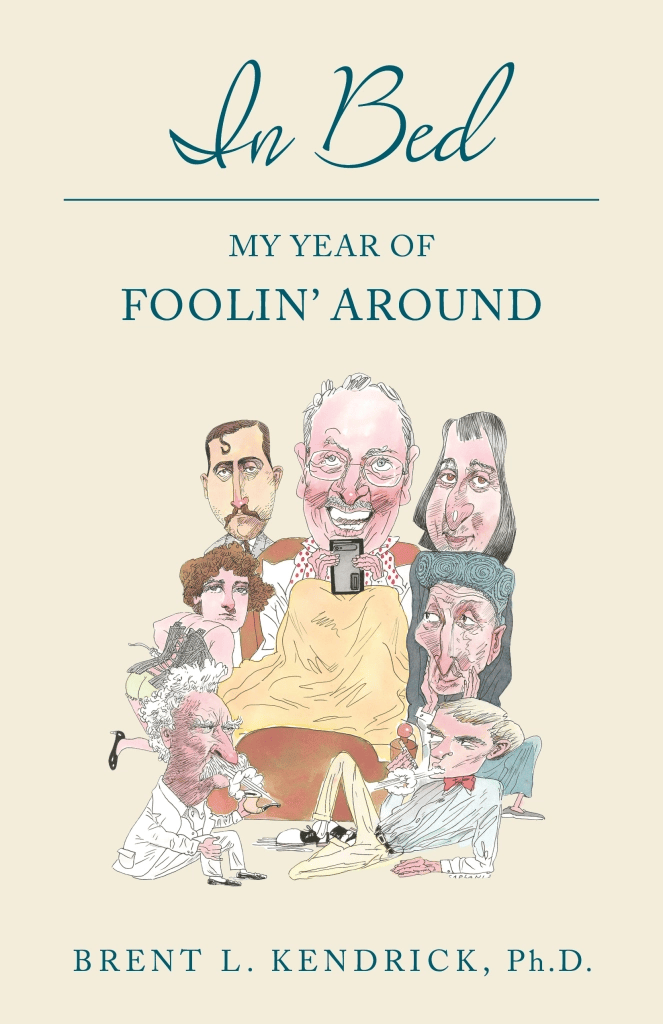
Just Published. IN BED: MY YEAR OF FOOLIN’ AROUND

“Take my word for it. I never—absolutely never–intended to fool around in bed, certainly not every day, seven days a week, for an entire year.“

from “An Invitation to Join the Author
In Bed” (5-12).

QUICK QUESTION: 

What does it take to write a book?

QUICK ANSWER:

● 6,625 readers.

● 59 countries.

● 1 year.

● 1 bed.

● 1 writer.

EXPANDED ANSWER:

That’s how many readers I’ve had since my blog went weekly on December 28, 2021. That’s how many countries my readers represent. That’s how long I spent writing the blog posts. That’s the bed where I wrote them. And I’m the writer. No foolin’.

NOW, 57 of those essays, reflecting the best of the best, have been published in a book that is exquisite from cover to cover and every page of the 346 pages in between. It’s available on Amazon or Barnes & Noble, or you can order it from your favorite local bookstore!

TAKE A LOOK AT THE BRILLIANT COVER!

Surely you recognize ME! I’m smackdab in the middle of my bed writing a blog post about foolin’ around with some well-known writers. Mark Twain and Truman Capote are on the floor at the foot of the bed, blowing smoke rings at one another. Imagine! They’ve got some nerve! Acclaimed artist/illustrator Mike Caplanis gets credit for the caricature based on one of the book’s essays, “Foolin’ Around in Bed with Famous (and Not-So-Famous) Writers” (249-53).

WHAT’S THE BOOK ALL ABOUT? See for yourself.

“Fresh and refreshing through and through.” I love it! Other ADVANCE PRAISES grace the dust jacket of the hardcover book.

“A MUST READ” impresses me so much that I just repeated it and made it all caps and all bold! Dayumn! I like it so much that I want to shout it again: “A MUST READ.” (Thank you, Cheryl Thompson-Stacy!)

IN BED: MY YEAR OF FOOLIN’ AROUND is available in hardcover, paperback, and Kindle. I recommend the hardcover. It costs a little more, but it feels so much better than the paperback. What can I say other than there’s something extraordinarily extraordinary about a book that has its own dust jacket!

The publication of this book is an historic and timely solution for every gift-giving occasion that might be coming your way for the rest of the year, if not for the rest of your life. And let me add: may your life be long, healthy, and prosperous and may you keep right on buying copy after copy of IN BED. It’s the perfect gift. Right here. Right now. You do not need to look any further. And while you’re buying multiple copies for gift-giving, remember that IN BED is also the perfect gift for all of your friends … and enemies.

Thank you, DEAR READERS, for all of your support. I have no idea how you found your way into my life, but knowing that you are out there reading my posts strengthens me and uplifts me whenever I need to be strengthened and uplifted.

Time’s a wastin’. ORDER YOUR COPY TODAY on Amazon or Barnes & Noble. Or you can or order it from your favorite local bookstore!

It’s Not a Corset. Don’t Force It.

Is it a corset
or primal wave?
Don’t try to force it.

–from Elaine Mitchell’s “Form”

Lately, I’ve been thinking a lot about writing. I have no doubt that it’s because I’ve been writing these posts faithfully every week for nearly an entire year. And I have no doubt that it’s also because I’m teaching Creative Writing this semester. Naturally, I spend lots of my time talking with aspiring writers about writing.

In fact, when I met with my students last week, we did two, one-minute reflections.

For the first, we reflected on the joy of writing. Let me share some of their responses:

● Creating my own world.

● Finding words that describe my own feelings.

● Gaining an understanding of my own life.

● Discovering something about my own identity.

● Daydreaming.

● Letting my thoughts spew out.

● Getting it done–the rhythm, the music, the wish, the dream, and the fear.

For the second reflection, we tackled the challenges of writing. Again, let me share:

● Getting started.

● Finding an interesting topic.

● Putting myself into my writing.

● Encouraging my paragraphs to talk to one another.

● Choosing which idea to explore.

● Connecting the beginning, the middle, and the end.

● Accepting my writing as it is.

I had planned a third reflection, but we ran out of time. Here’s what it would have been: discoveries about writing.

For this one, I’ll take the lead, sharing my own ideas, based largely on what I’ve discovered about writing as I wrote my weekly blog posts this year.

By and large, what I’ve discovered has been by way of reminders. To start, writing isn’t easy. It isn’t spontaneous. And it isn’t magical.

Here’s something else that I have rediscovered. Writing is work. It’s hard work. It’s lots of hard work.

Work. Hard work. Lots of hard work. That’s my mantra these days when I’m working with other aspiring writers. I front-load the conversation: get ready for rich, robust, and heavy mental lifting.

At the same time, over the last year I’ve reminded myself–and others–that even though the hard art of writing isn’t magical, it is filled with magical moments.

Let me share some of mine.

Magical Moment. Getting hooked on an idea that makes my world fade away.

Magical Moment.  Letting an idea explode in my mind as magically as Pop Rocks explode in my mouth.

Magical Moment. Focusing on old-soul insights that have come back to me from far, far away and from long, long ago.

Magical Moment. Fooling around with organizing what I’m writing until I get comfy with one structure that pulls me in close and whispers, “Yes. Let’s do it.”

Don’t get too excited by these moments. They are magical. But let me remind you: they are not magic.

And trust me. The next part–the actual writing–has no magic at all. Sometimes, it might not even have magical moments. The actual writing can be grueling, if not downright defeating, especially since first drafts never hit the mark. Never. Mine don’t, at any rate. Sometimes, even my 13th draft doesn’t seem quite right. How’s this for a confession? Sometimes, I’ve gone as high as 22 drafts. Admittedly, the differences between any two drafts are sometimes majorly minor, and the changes will be unknown forever to all except me. Nonetheless, the work of writing–of revising–goes on and on and on.

And writers keep at it. I keep at it, knowing that what I write will never be perfect, but knowing, too, that at some point it’s as good as it’s going to get.

What I have discovered as well is the simple fact that my scholarly writing is in many ways far easier than writing my personal essays like today’s post. My own scholarly work on The Humourist as well as on Mary E. Wilkins Freeman, for example, has singleness of purpose and focus. Easy-peasy, lemon-squeezy.

On the other hand, writing my weekly blog is more challenging, mainly because I don’t focus on the same topic every week. My topics change. As reluctant as I am to admit it, I’ll admit it anyway: I’m never sure from one week to the next exactly what topic will bubble up.

That’s not to say that I don’t have lots of ideas for my posts. I do. I have plenty. In fact, whenever I have an idea for a post, I immediately start a WordPress draft. I give it a working title, and I include as many notes as possible so that when I return, I can glide back into my thinking and writing groove.

Right now, for example, I have 25 drafts in various stages of completion, ranging from “The Power of Showing Up” to “Dating after Twenty-Two” to “Mishaps Make Memories.” I suppose I could also mention “Working Out a Plan” or “A Horrorscopic Week” or “What My Father Saw.” Or I could mention that I might have “My Gardening Attire” finished by next week. I might. But, on the other hand, I might not.

I’m not trying to generate future blog traffic by teasing you with alluring and inviting titles that may or may not morph into posts. Simply put, I have come to the realization that my ideas must germinate in the dark caverns of mindfulness and mindlessness. They must sprout and pop up whenever they are ready for the light of day. No sooner. No later.

All of my tentative topics and all of their accompanying draft notes are simply placeholders. Nothing more.

Yet it occurs to me that maybe they are far more than mere placeholders.

They are talismans. Not to bring me power. Not to bring me luck. But rather to bring me back to the illuminated intensity of the split second when an idea sought refuge within me and pleaded for a some-day home.

What I have discovered, then, is that I need lots and lots of talismans. They are my antidote to the numbness and paralysis that I know fully well will set in if I have no writing options. I don’t write well when my storehouse of options is empty. When that happens, I feel that I have forced myself into the all-too-tight corset of being compelled to write on one topic and one topic only.

On the other hand, when I have many, many topics, one of them might be precisely the one that captures my fancy precisely when my fancy needs to be captured.

It won’t have anything to do with talismanic luck. And it won’t have anything to do with magic.

It will have everything to do with my willingness to let my ideas take their own shape, whatever those shapes might be, without being corseted, without being laced up, and without being forced.

I want my ideas:

● to leave themselves ample space to move around in.

● to do what they want to do.

● to be what they want to be.

It’s really straightforward. My greatest discovery about my own writing is my everlasting need to unlace the corset that constricts my thoughts. It’s my everlasting need to let my ideas breathe and expand freely, whenever and however they wish.

Writers: Our Forever-Friends

“Day by day and night by night we were together—all else has long been forgotten by me…”

Walt Whitman, “Once I Pass’d through a Popular City” (Leaves of Grass, 1855)

Whenever I teach a literature course, I tell my students that aside from celebrating their achievements as they master the course content, I have one special hope for each of them. I want them to find one writer who will be their friend. One writer who will never unfriend them as other friends sometimes do. One writer who will be with them through all the storms of life, for a lifetime. A writer who will be a forever-friend.

What I have in mind is similar to the handful of real-life, forever-friends whom we might have, if we are lucky. It’s never many. At least it has never been many for me. I have perhaps one handful of such friends. All right. Perhaps two handfuls who are in the friends-forever category. With us, we’ve shared so many past experiences that even if we have not seen one another in years, when we reconnect, we pick up magically on the same conversation that we were having when we last met, and we do so without missing a beat. Friends. Forever-friends.

Writers can be our forever-friends, too, with an added bonus. We can have lots and lots of them. As we read more and more, we discover more and more writers who might end up as our friends. We like them. We like what they have to say to us. We like how they inspire us. We like how they make us believe. We like how they make us feel…unalone. We like how they heal our…brokenness. Before long, we want to hang out with them. We can. Whenever we want. For as long as we want.

The great thing about writers who are our forever-friends is that when they pop up unannounced and uninvited, it’s never a problem. We don’t have to clean for them. We don’t have to cook for them. And we don’t have to clear our calendars for them. They can tag along with us just as we are. And they will do just that if we let them.

All that we have to do is be attentive, smile when they arrive, and even smile when they leave, knowing that they will come back to visit us again and again and again.

Their arrival coincides with something that we are experiencing that makes us think of something else. It’s the power of association. Robert Frost captures it best:

“All thought is a feat of association; having what’s in front of you bring up something in your mind that you almost didn’t know you knew.”

That’s the beauty of having writers who are forever-friends. Their arrival is based exclusively on what’s right in front of you or something that you’re thinking about. Something that you almost didn’t know you knew.

No doubt, you have your own writers who are your forever-friends, just as I do.

Obviously, I don’t know about yours, but mine visit me multiple times throughout the day, every day without fail. I never know which writers will visit or when. But I go forth daily, confident of being strengthened and girded up by their company.

For example, Walt Whitman shook his silvery locks right in front of me as I was writing this post. I was thinking about the fact that only a snippet of a writer’s work comes to my mind during an association, while all the other details of the work are seemingly long forgotten. Instantly, the lines from Whitman’s “Once I Pass’d through a Popular City” flashed across my mind:

“Day by day and night by night we were together—all else has long been forgotten by me…”

Here’s another example.

When I met with my Creative Writing class for the first time this semester, I had a slap-stick time promoting this blog. It was nothing more than nonsensical banter aimed at entertaining my students, but they picked up on it.

Not long after I managed to restore myself to a modicum of seriousness, one student raised her hand as if to ask a serious question.

“Professor Kendrick, did you say that you have a blog?”

I started laughing, as did the rest of the class.

A little later on, her hand went up again. I was on to her by then, but I was having far too much fun, so I acknowledged her.

“Professor Kendrick, did you give us the name of your blog?”

(When our laughter died down, my forever-friend Edward Albee paid me a momentary visit. He has chummed me since the 1960s when I was in college and he was a controversial Broadway playwright.)

“Very funny! You know, Caitlin, my hell-bent banter to promote my blog to a brand-new group of students, reminds me of the first line from Edward Albee’s The Zoo Story.”

In the play, Jerry approaches Peter, a total stranger, sitting on a bench in Central Park.

I’ve been to the zoo. [PETER doesn’t notice.] I said, I’ve been to the zoo. MISTER, I’VE BEEN TO THE ZOO! 

I was thrilled by Albee’s visit, especially since I was able to share it with my class. He came as he did and when he did because of my dogged determination to tell my students–a group of strangers, if you will–all about my blog. In the process, I remembered Jerry’s insistence on telling Peter, a total stranger, that he had been to the zoo.

My students got it. They saw the association with great clarity.

On another occasion, something similar happened at the start of the same class.

As I drove on campus. I was aware–painfully so–that the grassy, undeveloped acreage all around the college was being gobbled up by townhouses.

At the start of class, one of my students shared the same observation.

In that nanosecond, former United States Poet Laureate Phillip Levine appeared. Immediately, I walked to my teacher station, googled his poem “A Story” and flashed it on the screen for students to see as I read it aloud.

It captures perfectly what my students and I had witnessed with pain that morning.

Levine chronicles the life and death of the woods that once surrounded us and ends with a chilling doomsday prophecy:

where are the woods? They had to have been

because the continent was clothed in trees.

We all read that in school and knew it to be true.

Yet all we see are houses, rows and rows

of houses as far as sight, and where sight vanishes

into nothing, into the new world no one has seen,

there has to be more than dust, wind-borne particles

of burning earth, the earth we lost, and nothing else.

And right now as I typed the above quotation, Canadian singer-songwriter Joni Mitchell popped into my head, chanting a few lines from her “Big Yellow Taxi”:

Don’t it always seem to go

That you don’t know what you’ve got

Till it’s gone

They paved paradise

And put up a parking lot.

My writers–my forever-friends–visit me far more in my alone times than they do when I am teaching or, for that matter, when I am socializing.

Maybe they appear then because they know that in my alone times friends can add a richness to any moment, even ordinary ones.

Ordinary moments like weed whacking. Somehow, I end up doing that chore on Sunday instead of going to church. That’s no big deal to me. I consider myself Spiritual But Not Religious (SBNR). Emily Dickinson must be SBNR, too, because she is always with me on my Sunday morns. Her “Some keep the Sabbath going to Church” overpowers the Stihl noise through all the stanzas, rising triumphantly in the final one:

God preaches, a noted Clergyman –

And the sermon is never long,

So instead of getting to Heaven, at last –

I’m going, all along.

Or sometimes it’s as simple as visitorial moments that occur when reading emails from regular friends who aren’t writers. Recently, a friend who is my age wrote that his hands had grown old. I sensed his sadness and immediately thought of a poem about aging by former United States Poet Laureate Stanley Kunitz: “Touch Me.” It includes the poignant lines:

What makes the engine go?
Desire, desire, desire.
The longing for the dance
stirs in the buried life.

One season only,
and it’s done.

[…]

Darling, do you remember
the man you married? Touch me,
remind me who I am.

And then I immediately thought of Ben Speer singing “Time Has Made a Change in Me.” The title alone was touchstone sufficient. And that led me to W. S. Merwin reading his “Yesterday” with the ever-chilling line:

oh I say
feeling again the cold
of my father’s hand the last time

It’s amazing: the rich literary company that embraced me, all because of one single solitary email sent my way!

Sometimes, though, my forever-friends arrive as I try to make sense of all that’s going on in our world. The ongoing COVID pandemic. The invasion of Ukraine. Recent SCOTUS decisions. The January 6 Hearings. Global Warming. Poverty. Food scarcity. Gender inequality. Homophobia. Transphobia. Growing humanitarian conflicts and crises. The 21st anniversary of the 9/11 terror attacks on America.

Need I go on? Sadly, I could. Gladly, I won’t. It’s far too sobering.

But in those dark moments when I find myself spiritually staggering under the weight of it all, I take strength from William Faulkner’s Nobel Acceptance Speech, delivered in 1950 when the world was staggering under the burden of the Cold War:

Our tragedy today is a general and universal physical fear so long sustained by now that we can even bear it. There are no longer problems of the spirit. There is only the question: When will I be blown up? […] I decline to accept the end of man.  […] I believe that man will not merely endure: he will prevail. He is immortal, not because he alone among creatures has an inexhaustible voice, but because he has a soul, a spirit capable of compassion and sacrifice and endurance.

Maybe, just maybe, the need to have writers who are our forever-friends, boils down to nothing more than this. They come regardless of what we are facing. They reassure us that goodness and mercy shall prevail. They remind us to grapple with our soul, to grapple with our spirit.

They come, as Robert Browning came to me just this second, to calm us and anchor us in the full and steadfast belief that despite all the injustices, all the wrongdoings, all the travail, and all the sorrows,

God’s in His Heaven,

All’s right with the world.

Pippa Passes, Song I (1841)

Take Four | Living with A Writer: Modern Applications of Ancient Writing Artifacts

We are always yapping about the “Good Old Days” and how we look back and enjoy it, but I tell you there is a lot of hooey to it. There is a whole lot of our past lives that was not so hot.

–Will Rogers (1879-1953; American Vaudeville Performer, Actor, and Social Commentator)

Hey, everyone! Listen up! Make certain that you keep a copy of this post in a safe, virtual folder. Maybe even the Cloud. It is destined for fame. It is destined for greatness. It is destined for glory. It will go down in the annals of history as the most historic and historical blog post ever published.

You will discover why as you continue to read. But let me start with one reason and that one reason alone will earn this post its deserved historical distinction. For the first time in my life, I am at a loss for words. I am. My students would be thrilled beyond thrills because they consider me to be exhaustive and, no doubt, exhausting when I start talking about anything that is near and dear to my heart.

No doubt, you–dear reader–are wondering why on earth I am at a loss for words. Let me explain. My post last week focused exclusively on me: “Take Three | Living with a Writer: Owning Up to My Own Eccentricities.”

One of my eccentricities that I felt comfortable sharing was the fact that I had drafted the general introduction and the introductions to the five sections of my The Infant Sphinx: Collected Letters of Mary E. Wilkins Freeman on yellow legal pads, using #2 pencils without erasers. The really quirky part of that eccentricity was that whenever I made a mistake, I ripped out the page and started over.

One of my faithful followers challenged me to write my next post on a yellow legal pad, using a #2 pencil, and to share with you what happened as I wrote. Dear reader, you are so undeserving of the suffering that you will surely suffer as you continue to read. But please do continue to read. Remember: no pain, no gain. (Because I love you so much–whoever you are and wherever you are [including you, Mrs. Callabash, wherever you are]–I have timed the read-time for this post. You are now 6 minutes and 36.3 seconds away from full fatigue and brain drain.)

It was a commendable challenge, so much so that I really should quote it verbatim, and I would, but I can’t. I am lying in bed writing my post on a legal pad, using a #2 pencil, as challenged–I am such a sucker for challenges–so I don’t want to lose my grain of thought by switching over to my Smartphone to look at last week’s post so that I can quote the comment in its entirety the way that it deserves to be quoted.

Therefore, starting with the next paragraph I will use placeholders for anything that I would normally have the good sense to look up instanter on my Smartphone. I will use this placeholder convention throughout this post. My very first one follows.

Placeholder for When I Return to My Sanity and My Smartphone: Insert faithful reader quote from last week. I believe the reader signed herself “J.”

I responded to “J’s” challenge by asking whether yellow legal pads were even manufactured these days. I noted that if they had fallen out of usage, not to worry: I had seen such writing artifacts at the Smithsonian Institution and, perhaps, I could arrange for a Docupost: Modern Applications of Ancient Writing Artifacts.

My reply to “J.” was far more brilliant than it appears here, but, again, I can’t easily switch over to my Smartphone.

Placeholder for When I Return to My Sanity and My Smartphone: Insert my dazzling reply to “J.” Make sure to capture the correct title of the Docupost that I plan to propose to the Smithsonian Institution.

Not long after “J’s” comment, another faithful follower–“soyfig”–informed me that she had some yellow legal pads and #2 pencils that I could have.

Placeholder for When I Return to My Sanity and My Smartphone: insert “soyfig’s” actual comment, especially since, as I recall, she used some figurative language.

I responded, of course. I respond to everything, seen and unseen, heard and unheard. But, sadly, I do not remember my exact reply, but I am sure that it was a beauty.

Placeholder for When I Return to My Sanity and My Smartphone: Insert my beauty-of-a-reply to “soyfig” who writes so figuratively.

Obviously, I accepted the challenge because, as I noted earlier, here I am writing about what it’s like writing a blog post on a yellow legal pad, using a #2 pencil, while lying in bed.

I should be euphoric, I suppose, because I am certain–and history will confirm my certainty–that what I am developing right here and right now is a new Creative Nonfiction genre. To mirror its counterpart in the world of fiction, I hereby announce–with all the power and authority that is not vested in me–that this new genre will be dubbed Creative MetaNonfiction.

Placeholder for When I Return to My Sanity and My Smartphone: Check the Oxford English Dictionary (OED) to see whether the word and the genre exist already. If not, notify the editors immediately. “by gorry by jingo by gee by gosh by gum,” fame awaits.

I believe that I have said so already, but I will say so again: writing my post on this yellow legal pad, using a #2 pencil, is not making me euphoric. I can’t speak for you, but I can speak for me. My bed is a place of immense pleasure. Trust me. This is not pleasurable. I’ve got a stupid yellow legal pad–six times larger than my Smartphone–propped up on my knobby knees and the stupid pencil does not have the same quality graphite that I recall. Yes: I still recall the quality–or lack thereof–of everything going all the way back to the cold and snowy day of my November birth. If that be true–and it is–then fast forward with me and you will know that I speak the truth when I say that recalling something from the 1970s is a piece of graphite for me.

Morever, lean in and listen carefully: the damned yellow legal pad is not backlighted. Why am I whispering? For one good reason. I’m whispering because I don’t want anyone to steal my idea! If an ancient writing artifact like a yellow legal pad is going to continue to plague us, at the very least it should be backlighted so that it will not plague us in the dark.

Placeholder for When I Return to My Sanity and My Smartphone: Check the dictionary. Backlighted? Backlit?

I just heard someone ask, “Why does it matter if your yellow legal pad is not backlighted?” [See above Placeholder.]

Well, that’s a splendid question. it matters a lot. It’s starting to get dark outside. My overhead light makes a glare on the yellow legal pad, so I can’t use it. My nightstand lamp is not bright enough, so I can’t use it either. I must be blunt. I can no longer see what I am writing. And, like my pencil, let me be blunt again. If I can’t see what I’m writing, how do I look into the heart of what I’m thinking?

Thank you very much for your suggestion. I expected it. But, as much as I appreciate it–and I do–I will not run out tomorrow to buy a lamp to attach to my headboard. Simply explained: I won’t be needing it. I will never write another blog post on a yellow legal pad, using a #2 pencil, while lying in bed at night. Never. Never. Never.

However, I will figure out a way to finish this post since I accepted the challenge, sucker that I am.

Already I can think of three possible solutions.

Solution 1. Fill a Mason jar with fireflies. They might illuminate my yellow legal pad sufficiently.

Solution 2. Jerry-rig a flashlight to the headboard of my bed, with the light beaming down on the yellow legal pad propped up against my knobby knees.

Solution 3. Go to bed at 6pm so that I can work on my post for several hours before it gets too dark for me to see.

“Too dark for me to see” reminds me of Emily Dickinson’s first-person account of death, “I Heard a Fly Buzz.” The poem ends, I believe, with: “And then I could not see to see.”

Placeholder for When I Return to My Sanity and My Smartphone: Find the Dickinson poem and make sure that my quote above is accurate.

I am back to report that my tentative solutions–even though brilliant–were abysmal failures. That’s too kind. They were duds.

Firefly Solution. It was fairly easy to catch a jar full: they are everywhere in my yard. And, oh, my! Such a golden glow as they put out. For a while my bedroom looked almost like a nightclub dance floor with strobe lights. But it didn’t last long. The glow became dimmer and dimmer and dimmer. And, even more quickly, I grew a guilty feeling for having captured all those helpless little fireflies and for having put them to work against their will Contra Naturam. I set them free. Shine bright. Shine far.

Jerry-rigged Flashlight Solution. I thought for sure that this solution would work. However, I couldn’t figure out a way to mount the flashlight to my headboard, especially at the required angle. I considered duct tape which seems to work for everything, but when I recalled what I had paid for my Henkel Harris bed, I froze with tape and flashlight in mid-air. It took me hours to free myself.

Going to Bed at 6pm Solution. Forget it for one reason only. I have worked long and hard to earn the reputation that I now proudly hold as a wild, night-owl party animal. My friends and my colleagues have grown so proud of me as I have, over time, extended my bedtime from 8:00pm to 8:30pm to 9:00pm. And I have now, after years of practice, mastered the 10:00pm hour. When a party’s going down, I want to be found, and I certainly won’t be found if I am in bed at 6pm.

But I have come up with another solution that had not occurred to me initially. I will take the first hour of my morning routine to write my blog post on a yellow legal pad, using a #2 pencil.

Well, I tried it. Let me just say that this is not what anyone might hooey it up to be. Now I am wishing that I had challenged my two faithful followers to this challenge. Thankfully–and luckily for them–I am not that cruel. Absit iniuria.

They wouldn’t like all these disruptions either. Up until now, I have made perfectly good and methodical use of a sensible and calming way of writing my post in bed on my Smartphone. Even though I have willingly taken on a momentary stay against my ever-so sane method, I will remind myself–in mantra manner–that I am blazing new trails into Creative MetaNonfiction. History and literature demand that I continue. History and literature demand that I see this stupid stint through to a stupendous end.

Placeholder for When I Return to My Sanity and My Smartphone: Look up Creative MetaNonfiction to see whether such a genre exists. Oh, no. I remember that I have placed this placeholder in the post already, but since I cannot erase or scratch through, I will build upon the redundancy and puff it up as best I can. Have I actually stumbled upon–simply by stupidly accepting a challenge–a new genre? Oh, joy! Maybe I will enjoy a footnote in the annals of something–anything, please–after all.

Placeholder for When I Return to My Sanity and My Smartphone: Revisit Charlotte Perkins Gilman’s “The Yellow Wall-Paper.” As I recall, the unnamed narrator who goes insane–always be suspicious of unnamed narrators–may have written HER journal on a yellow legal pad, using a #2 pencil. Well, I am fairly certain that she did not, but look it up anyway. Adding that twist to the original story would be masterful for an updated version. The narrator escaped from the yellow wallpaper. But I wonder: would she be able to escape from her yellow legal pad as masterfully as I am about to do, soon and very soon. You’re welcome.

What’s ironic about all of this is that when I accepted this challenge, I did so fully expecting fun, even if nothing more than hearing my pencil graphite its way across the page.

Placeholder for When I Return to My Sanity and My Smartphone: Can graphite be used as a verb? Well. Duh. I just used it as a verb in the preceding paragraph. Therefore, it can be. Therefore, I really do not need to follow through with this placeholder. I will keep it anyway in the interest of not ripping out this yellow page which is otherwise perfect.

But verbs notwithstanding, my pencil is not making those nostalgic sounds that I had longed for, not even when I bend my ear way down close and personal to the page. Instead, it glides along like a waxy crayon. And, in fact, my box of pencils is labeled, on one side of the box, Crayon. Oh, dear. I forgot. Crayon means pencil in some language. An esteemed English professor–a colleague–took great joy in beaming that to me when I showed the box to her. Well, never mind.

I do mind, however, that the only yellow pads that I could find anywhere were 8 1/2 by 11 inches, even though they were marked Legal Pad. Well, excuse me. If it’s not 8 1/2 x 14 inches, it’s not legal, and shorties like the ones that I ended up with ought to be illegal.

Placeholder for When I Return to My Sanity and My Smartphone: (1) What companies still manufacture these so-called legal pads? (2) Do they come in true legal size? (3) Is it true, as I seem to recall, that courts no longer allow 8 1/2 x 14-inch legal pads because they do not fit readily into filing cabinets–not even virtual ones?

Placeholder for When I Return to My Sanity and My Smartphone: Do a comparable search into #2 pencils. Focus especially on what kind of graphite manufacturers are using for these crayons–I mean pencils–these days.

Placeholder for When I Return to My Sanity and My Smartphone: I need a pull quote for this post. What’s the one about a sucker is born every minute? How perfect would that be!

Okay. I need to wrap this post up–Maybe in a yellow graphite bow?–but before I do, I simply must achieve a sense of order with this post–the very first example ever of Creative MetaNonfiction. The annals of history await my final word. I do, too.

I know exactly what I will do. I’ll number the pages that I have written on this yellow legal pad, using a #2 pencil. And while I’m doing that, I’ll write AMDG just to the right of each page number, just as a Jesuit lawyer friend of mine did on all his labor relations notes, always written on a genuine yellow legal pad, using a genuine #2 graphite pencil.

Placeholder for When I Return to My Sanity and My Smartphone: Look up AMDG to see what that acronym means. Marty had a perverse sense of humor, but, surely, he would not have penciled anything obscene or scandalous, especially since he knew that I would see what he was writing because I almost always leaned over him at the bar. But be sure to look it up anyway before publishing this post.

Wow! I have written 11 pages already about nothing more than what it’s like to write my post on a yellow legal pad, using a #2 pencil, while lying in bed. Maybe this Creative MetaNonfiction thingy is not as bad as I have graphited it up to be. Well, if I can type it up, I can certainly graphite it up. But lo and behold! Here I’ve gone and coined still another word: graphited. Who knows? Maybe a Creative MetaNonfiction Novel looms in your future.

I suppose the only thing that might have been more fun than numbering the pages would have been ripping each one out and then taping them all together. I seem to recall a writer who typed one of his books on a continuous roll of paper, created by carefully taping each page together. This would have been, of course, back in the good old, hooey typewriter days.

Placeholder for When I Return to My Sanity and My Smartphone: Try to find out the writer who did this. I think that it was Jack Kerouac. I am certain. Yes. I recall it as vividly as if I had helped him! (Oh, how I wish.) He sellotaped enough pages to create a 120-foot roll when he wrote his On the Road. Check just to make sure. I would never dare publish anything without verifying all the facts before I spew forth. And also look up hooey. It looks like phooey to me.

As for any rhythm that I might be achieving while writing on a yellow legal pad, using a #2 pencil, forget it. Forget. It. Trust me. This post is not riding along on its own melting like a piece of ice on a hot stove. Frost itself wouldn’t work. And Frost himself wouldn’t be able to make it work either. I am so focused on paper and pencil that any semblance of thought has wisely flown far, far away to someone sensible enough to write a blog post sensibly on a Smartphone.

Worse, perhaps, I feel as if I am straddling an immeasurable and unfathomable chasm between the 1970s (when I enjoyed writing on a yellow legal pad, using a #2 pencil) and day before yesterday (when I lost my sanity and sold my writerly soul to the Devil by selling myself on the idea of accepting this challenge). To be certain, the image of such a straddler is an intriguing one. Conjure it up if you can. I double dare you. You will see for yourself. But let me assure you, post haste, that my legs–metaphorical or otherwise–are not nearly long enough to bridge such a chasm, and even if they were, I would not stand for it. I would object vehemently for all the world to hear, as, hopefully, all the world is hearing now.

Hear me and hear me well. What I am about to say is quotable, so go ahead and quote me: Phooey to all this hooey.

I object to it so much that I will end it all right now, in one final declaration!

This is a nonsensical challenge up with which I will not put.

FINAL Placeholder for When I Return to My Sanity and My Smartphone: As I recall, Winston Churchill came up with the above quip as an objection to an editor who wouldn’t allow sentences to end with prepositions. Churchill’s retort memorialized the folly of editors who foolishly adhere to grammatical rules rather than to common sense and to the sense of sound. Try to find the specifics. Was it in a memorandum? I’m sure that it was, perhaps in 1941?

Halleluiah! I have freed myself at last from this yellow legal pad and from #2 pencils. I have returned to my sanity. (Wisely, however, I will not change one thing–not one hooey-phooey word–that I have written so honestly and so painfully as I soared my way to and through the heights of this challenge. “The moving finger writes, and having writ, moves on.” (No. I will not put a placeholder for that Shakespearean quote. You may kindly–if you please and if you need–google it yourself to obtain the specifics: play, act, and line.) And, thankfully, I have just returned to my Smartphone where I have just had joy beyond measure restored to every fiber–and even every fibre–of my being by doing nothing more than tap touching this post through to completion–one character at a time, using just one finger. Is that inefficient or what?

But the greatest joy ever is the knowledge that I have just written–and you have just read–the first example ever of Creative MetaNonfiction. May it not last forever in the annals of history and literature. May I be spared such notoriety. May I be remembered in far better ways. But, hey. What the heck. If you insist, I accept: better to be remembered for something, I suppose, than for nothing. Either way, it’s all hooey to me.

Directions to the Magical Land of Ideas

My ideas usually come not at my desk writing but in the midst of living.

Anaïs Nin

Without doubt, I love all of the English classes that I teach, but my Creative Writing classes always tug a little tighter at my heartstrings. I think I know why. We write. We draft. We workshop. We revise. We share. We bond. Together.

Aside from valuing writers’ bond, I like writing with my students because I want them to see that seasoned writers struggle perhaps as much as fledgling writers. I want them to see that writing is work. No, I want them to see that writing is hard work. More, I want them to see that with lots and lots of mental lifting they can become agile writing gymnasts.

Here’s another reason why I like to write with my students. As an educator, I want to experience, as nearly as possible, what my students experience: coming up with a topic to meet someone else’s requirements; developing a draft; workshopping the draft with peers; revising the draft based on peer feedback and personal afterthoughts; and sharing with the class the woven words of heart, mind, and soul.

Also, as an educator I want to feel the pain of jumping through the same deadline hoops that “the good professor” imposes on his students. It’s a much-needed lesson in humility, one that I can experience every two weeks, since that’s the allotted timeframe for each writing assignment: drafting; workshopping; revising; and sharing. Spread over a 14-week semester, I am humbled seven times.

In the past, I’ve done my “writing-with-my-students” stint once or twice each semester, eventually bowing out as the semester progressed because of the full range of my professorial responsibilities, namely commitments to other classes. And that is true. Can any full-time professor be a full-time writer? I doubt it.

My students, generally, are full-time students with the full range of their own full-time student responsibilities, and yet I expect them to be full-time writers, too.

This semester I promised myself that I wouldn’t bow out of writing with my students. Actually, I established more rigorous requirements for me than for them. I decided to write and publish a blog post every week.

I did not make known my personal commitment. Nonetheless, week by week, I chatted with my students about my writing. I wanted them to know that I was writing and that I had my own self-imposed goals and Monday deadlines.

At the end of this semester, we celebrated and reflected on our growth and accomplishments as writers. During my reflections, I projected my blog so that the class could see it on the big screen. Several students follow the blog and others are regular visitors, so they knew already that I had published 24 posts this semester. But those completed posts weren’t at the heart of my sharing. Rather, I wanted to watch their faces when my 17 drafts–at various stages of completion–popped up on the screen.

When I finished, one of my students pinned me to the wall with a pointed question: “Where do you find those ideas?”

How do I answer a question like that? To answer assumes that I can provide directions–a map, if you will–to the magical land where ideas reside.

I wish that I could. Sadly, I can’t.

I’m not certain that I even understand what it means to “find” ideas. Where do I look? And how shall I begin? And how do I know when I’ve found one?

As for me, I don’t go around looking for writing ideas. However, I do go around listening to the world. My world. Inner. Outer.

When I listen–when I am attentive–ideas seem to “find” their way to me. This post is a good example. My student’s question captured my fancy: “Where do you find those ideas?” And in response to his question, I shared with the class a writing idea that found its way to me that very morning.

Its working title is “Growing Up More than Once.” While driving to campus, I had been thinking about Fall 2022 as my last semester of teaching. In the midst of my reverie, I had an insight. I’ve grown up three times. Once in the traditional way that we all grow up and launch our own lives. Next was growing up as a researcher and scholar at the University of South Carolina and the Library of Congress. Now I’ve grown up as an educator at Lord Fairfax Community College. And as this phase comes to an end, another phase will open, giving me an opportunity to grow up once more! I will share no more for now. Otherwise, I won’t have anything more to say when I get around to writing that post.

But here’s my point. I didn’t go looking for that idea.  Seemingly, the idea came looking for me. And as soon as it found me, I captured the tentative title and a barebones outline in a WordPress draft as soon as I walked into my office and turned on my computer. Some might call it journaling. But it’s not. I don’t journal. For me, it’s simpling listening. It’s being attentive. Then it’s taking the time to honor an idea that found its way to me.

The same thing holds true for this post. It found me during class when my student asked, “Where do you find those ideas?” Perhaps equally important, the question continued to abide with me as I drove home. Now here I am extending my answer to Morgan through this post. The idea found me; called for–no, demanded–exploration; and I’m honoring the call.

I’ve just shared how one idea found me while teaching and how another idea found me while driving. Other ideas find me when I least expect to be found. Biking, indoors and out. Listening to gospel music. Taking a shower. Pulling weeds in my garden.

For me, it seems that whenever I lose myself–whenever I’m doing something that takes me away from me–a door opens and an idea enters, hoping for home and for honor.

Those are the best directions that I can give to the magical land of ideas.